Small Business Accountant: 2026 CRA Filing Guide

What if the next CRA (Canada Revenue Agency) notification in your inbox wasn't a source of dread, but a confirmation of your business's perfect standing? For many entrepreneurs, the arrival of tax season brings a persistent anxiety regarding missed savings or accidental errors. You likely started your company to innovate and serve, not to get buried under GST/HST (Goods and Services Tax / Harmonized Sales Tax) filings and complex payroll calculations.
Partnering with a dedicated small business accountant, like the experts at Tax Partners, ensures that your records are precise and your tax liabilities are minimized. This clarity is the foundation of growth. We understand that balancing daily operations with strict federal requirements is a constant challenge, even for the most seasoned business owners.
This article provides a clear roadmap for the 2026 filing year under CRA rules. We'll help you master compliance and optimize your financial health using essential deadlines and updated tax brackets. By the end of this guide, you'll have the expert Canadian tax strategies needed to drive better business decisions and secure your long-term success.
Key Takeaways
- Master the federal Income Tax Act under CRA rules to ensure total compliance and eliminate the anxiety often associated with government audits.
- Learn how a dedicated small business accountant GTA can help you navigate complex GST/HST requirements and optimize your corporate tax position.
- Discover how to integrate corporate financial statement preparation with personal wealth management to secure your long-term financial stability.
- Explore specialized tax strategies for emerging sectors like ecommerce and blockchain to stay ahead of evolving Canadian regulatory standards.
- Understand the value of proactive guardianship and 40 years of expertise in protecting your business from unforeseen financial challenges.
Navigating the Canadian Tax Landscape for CRA Filers
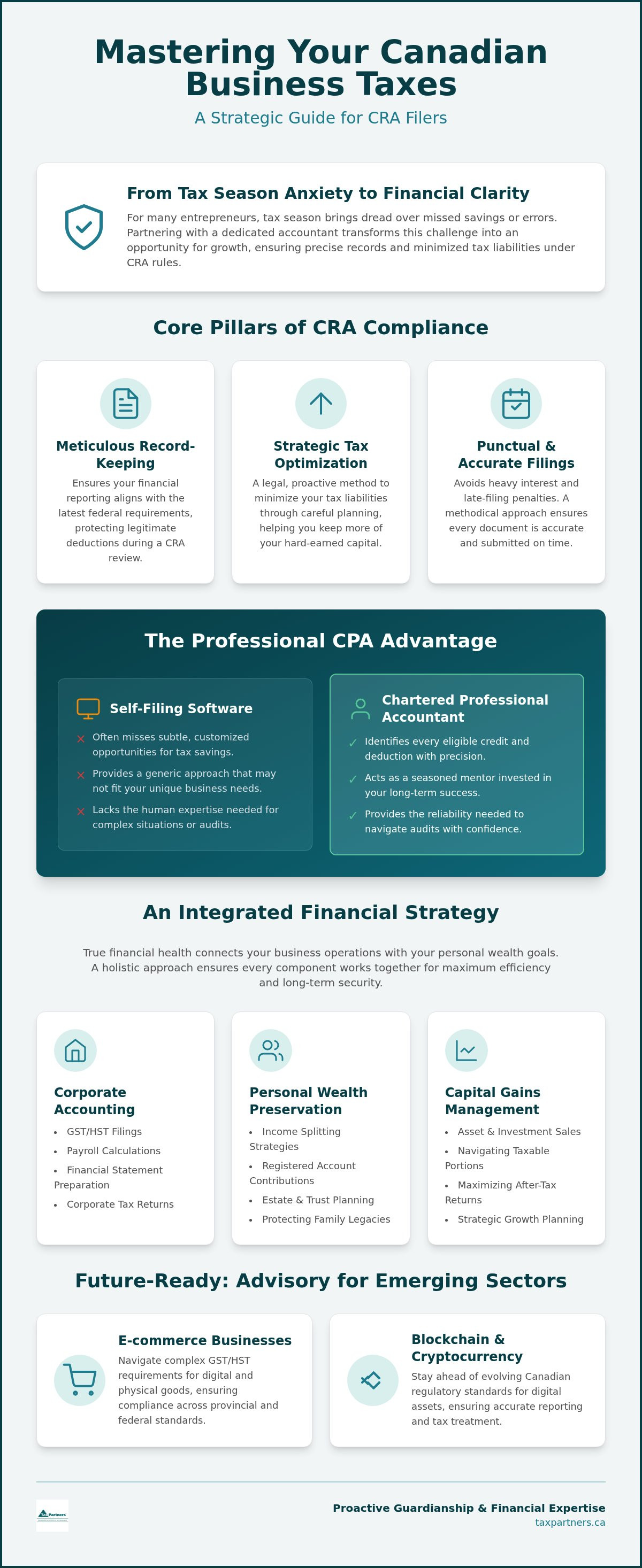
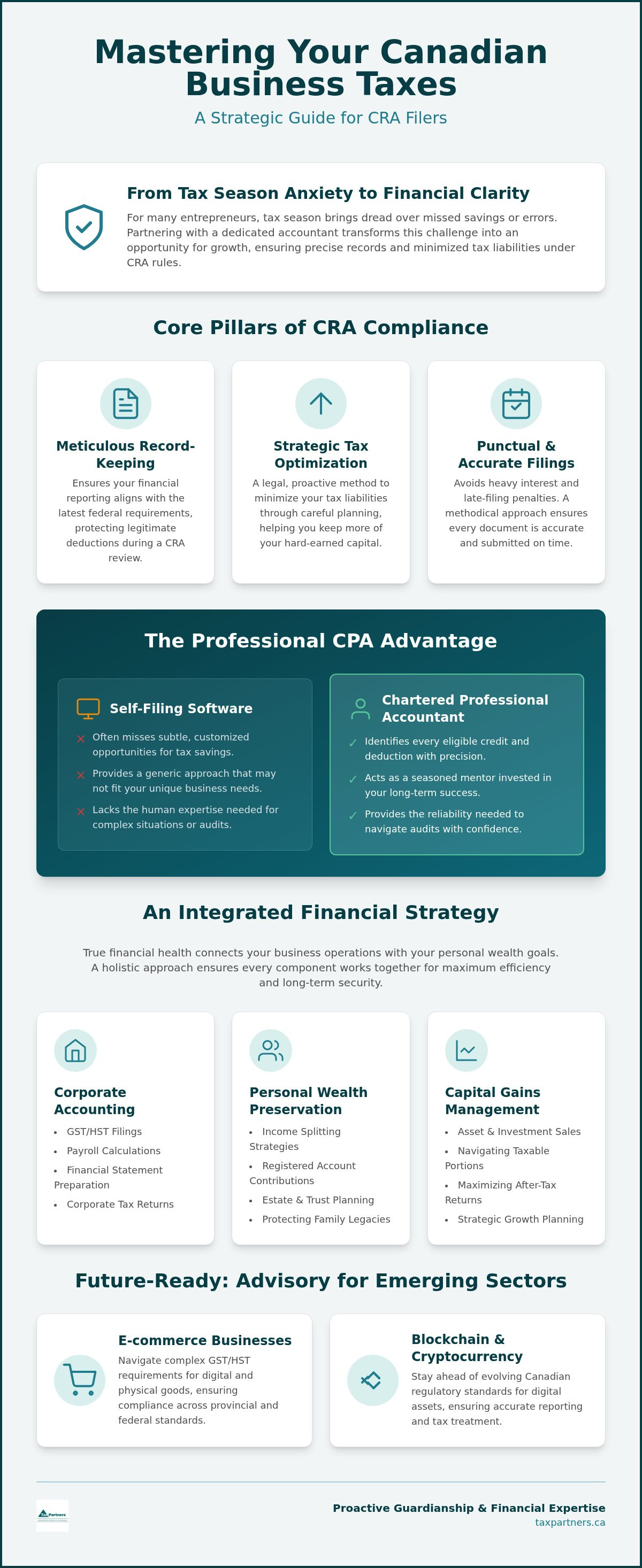
The Canada Revenue Agency (CRA) acts as the federal authority for tax administration. It's the body responsible for collecting revenue and delivering essential social and economic benefit programs. Every professional Canadian accounting service must adhere strictly to the federal Income Tax Act. This legislation is complex and frequently updated, making professional guidance indispensable for business owners. Success starts with Navigating the Canadian Tax Landscape through meticulous record-keeping. Partnering with a small business accountant GTA ensures your financial reporting aligns with the latest federal requirements. Without accurate documentation, you risk losing legitimate deductions during a review. Tax optimization is a legal, strategic method used to minimize your tax liabilities through careful planning. It differs from evasion by following the law to keep more of your hard-earned capital.
The Role of a Professional CPA in Canada
The Chartered Professional Accountant (CPA) designation is a mark of excellence and ethical steadfastness. Candidates undergo years of rigorous training to master the nuances of Canadian finance and tax law. A small business accountant GTA serves as a seasoned mentor who is deeply invested in your success. They don't just react to past numbers; they look ahead to secure better financial outcomes. While self-filing software is widely available, it often misses the subtle opportunities for customization that a human expert identifies. A CPA provides the reliability and precision needed to move your business from uncertainty to total control. Their expertise helps you navigate audits and complex filings with confidence.
Understanding CRA Compliance Standards
Compliance is the act of following all federal tax laws and ensuring every document is filed on time. It's not just a suggestion. It's a legal requirement that protects your business's reputation. Once the agency processes your return, you'll receive a Notice of Assessment (NOA). This document is a critical record that summarizes your income, credits, and any taxes owed or refunded. Proactive planning is essential to avoid the heavy interest and late-filing penalties that the CRA applies under Canadian rules. By working with an expert, you ensure that every filing is accurate and submitted well before the deadline. This methodical approach transforms tax season from a period of stress into a seamless part of your business cycle.
Optimizing Personal Tax and Wealth Preservation
Personal wealth isn't just about the revenue your company generates; it's about the portion you retain after the CRA takes its share. For Canadian residents, implementing robust personal income tax strategies is the first step toward long-term security.
A small business accountant GTA acts as a proactive guardian, identifying every eligible credit and deduction to shield your income. Effective tax planning integrates seamlessly with your broader wealth management goals to ensure your assets grow steadily over time.
Estate planning also plays a vital role in this process by protecting family legacies from excessive taxation upon transfer. By looking ahead, you can secure a stable future for the next generation without sacrificing your current liquidity. This holistic approach transforms tax season from a hurdle into a strategic advantage for your family.
Strategic Tax Planning for Canadian Families
Tax planning is the methodical analysis of your financial situation from a tax perspective. It ensures that every element of your financial life works together to achieve maximum efficiency. Families can utilize diverse strategies, such as income splitting or contributing to registered accounts, to reduce their overall tax burden under CRA rules.
It's essential to review significant life changes, like marriage, the birth of a child, or the sale of a property, with your accountant to centre your strategy. This ongoing dialogue allows for the high degree of customization that generic software simply cannot provide. For more detailed instructions on reporting requirements, you can consult the official CRA Filing Guide.
Capital Gains and Wealth Management
Capital Gains refer to the profit you realize when you sell an asset or investment for more than its original purchase price. Under Canadian tax laws, only a portion of these gains is typically taxable, which offers a unique opportunity for strategic growth. Your small business accountant GTA will help you navigate these thresholds with precision to maximize your returns.
Engaging in tax-efficient wealth management helps preserve your hard-earned assets against inflation and market volatility. The CRA treatment of investment income varies depending on whether it's interest, dividends, or capital gains. Understanding these distinctions ensures total clarity in your financial reporting and prevents unexpected tax bills.
If you're ready to secure your financial legacy, you can speak with our team today to begin your personalized planning journey. We're here to provide the steady hand you need to navigate these complex regulations.
Corporate Accounting Solutions for Canadian SMEs
Small and midsize enterprises (SMEs) face a distinct set of challenges that demand more than just basic filing. Accurate corporate income tax preparation requires a deep dive into your financial statements to ensure every figure reflects the true state of your business. A small business accountant GTA provides the oversight needed to maintain these records with surgical precision and ethical steadfastness.
Organized bookkeeping isn't just about recording history. It's about freeing you to focus on scaling your operations and pursuing new market opportunities without the weight of administrative stress. When your books are in order, you gain the clarity needed to drive better business decisions and respond quickly to changing market conditions.
A Notice to Reader (NTR) report offers a standardized way to present your financial data to external parties. These reports provide the transparency that lenders and investors look for when assessing your company's financial health. This professional compilation builds the credibility you need to secure financing for future growth or equipment purchases.
Streamlining GST/HST and Payroll Compliance
For business owners in specialized industries such as property development or construction, you can check out Okie Accounting Group LLC to discover how their fractional controller services can help you manage these complexities and maintain a strong financial foundation.
The Goods and Services Tax (GST) and Harmonized Sales Tax (HST) are consumption taxes that businesses must collect and remit to the CRA. Accurate payroll management is equally vital to ensure both employee satisfaction and regulatory compliance. Professional oversight prevents common errors in sales tax remittances that often lead to costly audits and interest charges.
- GST: A 5% federal tax applied to most goods and services in Canada under federal rules.
- HST: A blended tax used in several provinces to combine federal and provincial sales taxes.
- Payroll: Involves the precise calculation of source deductions, including Canada Pension Plan (CPP) and Employment Insurance (EI).
Tax Optimization for Business Owners
Business incorporation offers a powerful way to defer or reduce taxes legally for CRA filers. By utilizing corporate structures, you can keep more capital within the business to fund expansion and innovation. Strategic planning is also essential for Optimizing Personal Tax and Wealth Preservation through the use of dividends and salary mixes.
Succession planning is a critical step that many family business owners overlook until it's too late. It involves creating a detailed roadmap for the eventual transfer of leadership and ownership to the next generation. A proactive guardian ensures that this transition happens smoothly while minimizing the tax impact on your family legacy. We help you look ahead to secure the best possible outcome for your company's long-term future.
Specialized Tax Advisory for Emerging Sectors
Modern industries require more than standard balance sheets. A small business accountant GTA provides the industry-specific knowledge needed to navigate a CRA audit or review with confidence. We act as a proactive guardian for those operating in biotech, pharmaceutical innovation, and digital finance. Our firm understands that non-traditional digital assets require a bespoke approach. We help you move from uncertainty to total control by applying 40 years of institutional wisdom to emerging technologies.
Industry-specific knowledge is your best defence during a CRA review. For biotech and pharmaceutical firms, this includes understanding the nuances of laboratory expenses and intellectual property valuation. We provide the reliability and precision needed to justify your claims and protect your research investments. This methodical approach ensures that your focus remains on innovation while we secure your regulatory standing.
Cryptocurrency Accounting under CRA Guidelines
Cryptocurrency is a digital representation of value that isn't legal tender. Under current rules, the CRA generally treats crypto as a commodity rather than a currency. This means that transactions may trigger capital gains or business income depending on the nature of the activity. Identifying these distinctions is critical for accurate reporting and avoiding unforeseen tax liabilities.
Managing cryptocurrency taxes requires meticulous records of every trade, transfer, and mining activity. Partnering with a small business accountant GTA ensures that your digital portfolio remains compliant with all federal standards. Without a steady hand at the helm, the volatility of these assets can lead to significant reporting errors. We provide the clarity needed to manage your digital wealth with ethical steadfastness.
Accounting for Ecommerce and Tech Startups
Digital sellers often struggle with unique sales tax challenges when shipping across different provinces. Each jurisdiction has its own rates and thresholds for GST and HST that you must track accurately to avoid penalties. Outsourced bookkeeping allows your tech company to scale effectively while we handle the regulatory heavy lifting. This transparency is vital for building trust with investors and maintaining a healthy cash flow.
For tech startups, the ability to scale is paramount. Our bookkeeping services grow with you, transitioning from basic entry to complex financial statement preparation as your revenue increases. This foresight ensures that your financial foundation is always strong enough to support your next round of funding or market expansion. We position your firm as an accessible expert in its own right by maintaining impeccable financial records.
Canadian innovation is also driven by R&D tax credits, which provide essential funding for growth. These incentives reward companies that invest in technological advancement and scientific research. If you're building the future of biotech or ecommerce, contact our specialized tax advisors to secure your eligible credits and drive your business forward.
Selecting Professional Canadian Accounting Services
Selecting the right partner for your financial journey is a pivotal decision for any entrepreneur. While large institutions offer scale, a boutique CPA firm provides the personalized responsiveness that leads to superior financial outcomes. You need a small business accountant GTA who views your success as their primary metric. Look for a firm that combines modern technical expertise with deep-seated reliability and ethical steadfastness.
Institutional wisdom isn't built overnight; it's forged through decades of managing complex regulatory shifts. Our firm brings over 40 years of experience to every client file, providing a level of precision that only comes from long-term practice. Since 1981, we've filed over 495,000 returns and helped our clients save more than $87M in taxes. This proven track record demonstrates our commitment to being a proactive guardian of your wealth.
The Value of a Proactive Tax Partnership
A proactive partnership is a relationship where your accountant anticipates future needs rather than just reacting to past events. Regular consultations throughout the year prevent the stress of year-end tax surprises and the anxiety of missing legitimate savings. This steady hand at the helm ensures you're always prepared for upcoming CRA deadlines and evolving federal rules. Our mission and vision centre on long-term client success through transparent communication and personalized care. We believe in building a partnership that evolves alongside your business aspirations.
Getting Started with Professional Tax Support
The path to total financial control begins with a comprehensive initial consultation. This session is designed to realize your specific financial goals and identify immediate opportunities for tax optimization under Canadian laws. We provide a professional checklist to help you organize your financial documents and ensure no detail is overlooked. This structured approach moves you quickly from uncertainty toward a feeling of complete understanding.
Securing your financial future requires a seasoned, authoritative mentor who remains deeply invested in your progress. Don't leave your compliance to chance or generic software that lacks human insight. Partner with a small business accountant GTA who offers the bespoke service and foresight your company deserves. We're ready to provide the seamless, end-to-end support you need to lead your business with confidence.
Lead Your Business with Financial Confidence
Mastering the complexities of the 2026 tax year requires more than just meeting deadlines; it demands a proactive approach to your entire financial landscape. We've explored how precise record-keeping under CRA rules and integrated wealth management strategies protect your hard-earned assets. By addressing the specific needs of SMEs and emerging sectors like cryptocurrency, you can transform tax compliance from a burden into a strategic advantage.
Partnering with a small business accountant GTA provides the reliability and ethical steadfastness needed to navigate these regulatory shifts. Our firm brings over 40 years of Canadian tax expertise and a proven track record of reliability to every client file. With 1,390+ five-star Google reviews from satisfied entrepreneurs, we continue to serve as a proactive guardian for businesses across the country. We're dedicated to ensuring your financial reporting drives better decisions and long-term stability.
Your journey toward total financial clarity starts with a single step. Secure your financial future with Tax Partners today. We're ready to provide the seasoned mentorship and personalized care your business deserves to thrive in the years ahead.
Frequently Asked Questions
What is the difference between a bookkeeper and a CPA in Canada?
A bookkeeper focuses on recording day-to-day transactions and maintaining organized ledgers for your company. In contrast, a Chartered Professional Accountant (CPA) provides high-level strategic oversight and complex tax planning. A small business accountant GTA with a CPA designation ensures your filings adhere strictly to the federal Income Tax Act. While bookkeepers keep your data current, CPAs act as proactive guardians who analyze financial statements to drive better business decisions.
When is the deadline for filing corporate tax returns for CRA filers?
For CRA filers, the corporate (T2) income tax return is due six months after your corporation's fiscal year-end. It's important to note that any taxes owing are typically due much earlier, generally two or three months after the year-end. Missing these specific federal deadlines results in automatic late-filing penalties and compounding interest. Always confirm your exact dates with the CRA or a professional to maintain your company's perfect standing.
How does the CRA define a small business for tax purposes?
The CRA defines a small business primarily through the Canadian-Controlled Private Corporation (CCPC) status. This classification allows eligible businesses to access the small business deduction on their first $500,000 of active business income. To qualify, your company must be a private corporation resident in Canada that is not controlled by non-residents or public corporations. Accurate classification is essential for accessing lower tax rates and optimizing your corporate financial health.
What are the benefits of hiring a professional for GST/HST filing?
Professional oversight ensures your GST/HST remittances are precise and compliant with federal sales tax laws. An expert identifies all eligible input tax credits (ITCs) to ensure you aren't overpaying the CRA. This precision improves your business's cash flow and prevents the common filing errors that frequently trigger audits. A small business accountant GTA provides the transparency and reliability needed to manage these complex requirements while you focus on scaling operations.
Can an accounting firm help me if I am facing a CRA audit?
An authoritative accounting firm provides essential support by acting as your representative during a CRA audit or review. They manage all technical correspondence and ensure your financial documentation is presented with ethical steadfastness. This proactive guardian approach alleviates the stress of regulatory scrutiny and ensures your business remains compliant with the federal Income Tax Act. Their expertise helps justify your deductions and protects your rights throughout the entire investigative process.
What documents do I need to prepare for my annual tax meeting?
You need to gather your year-end financial statements, including your balance sheet and profit and loss reports. Ensure you have all receipts, invoices, bank statements, and payroll records organized for review. Using a professional checklist helps ensure no critical document is missed before your meeting. Proper organization allows your accountant to focus on sophisticated tax strategies and wealth preservation goals rather than basic data entry or administrative cleanup.
How are capital gains taxed for individuals under Canadian rules?
Capital gains for individuals are taxed by including 50% of the profit realized from an asset sale in your taxable income. This rule applies to investments like stocks, bonds, and secondary real estate properties under Canadian law. Certain exemptions, such as those for a principal residence, may reduce or eliminate this liability entirely. Navigating these thresholds requires a steady hand at the helm to ensure your personal wealth remains protected from excessive taxation.
Is cryptocurrency income taxable for Canadian residents?
Cryptocurrency income is absolutely taxable for Canadian residents as the CRA treats digital assets as a commodity. Depending on your activity, your crypto transactions may be classified as either capital gains or business income. You must maintain meticulous records of all trades, mining, and staking to ensure total compliance with federal standards. A specialized accountant provides the foresight needed to manage these non-traditional assets and avoid the severe penalties associated with non-disclosure.

Article by
Mahad Mohamed
Mahad Mohamed is an accountant and the CEO of Tax Partners, with over 26+ years of Canadian and international tax and accounting experience. His expertise includes corporate reorganization, cross-border tax structuring (Canada & US), tax disputes, CRA audits, and tax planning for small owner-managed private corporations. Most recently, Mahad is a pioneer in Canadian crypto taxation and founded Block3 Finance.
Previously, Mahad worked for the Canada Revenue Agency (CRA), Big4 accounting firms, and served as a Rulings Officer for the Federal Tax Authority of the UAE before acquiring Tax Partners in 2014.
Tax Partners has 44 full-time accountants and over 18,400+ clients.
Disclaimer
This article provides general information only and is current as of its publication date. It has not been updated and may be out of date. It does not constitute legal advice and should not be relied upon as such. Every tax situation is unique and may differ from the examples discussed in this article. If you have specific questions, you should seek the advice of our accountants for your unique circumstances. Book a FREE Initial Consultation Today!
Frequently Asked Questions
What is the difference between a bookkeeper and a CPA in Canada?
A bookkeeper focuses on recording day-to-day transactions and maintaining organized ledgers for your company. In contrast, a Chartered Professional Accountant (CPA) provides high-level strategic oversight and complex tax planning. A small business accountant GTA with a CPA designation ensures your filings adhere strictly to the federal Income Tax Act. While bookkeepers keep your data current, CPAs act as proactive guardians who analyze financial statements to drive better business decisions.
When is the deadline for filing corporate tax returns for CRA filers?
For CRA filers, the corporate (T2) income tax return is due six months after your corporation's fiscal year-end. It's important to note that any taxes owing are typically due much earlier, generally two or three months after the year-end. Missing these specific federal deadlines results in automatic late-filing penalties and compounding interest. Always confirm your exact dates with the CRA or a professional to maintain your company's perfect standing.
How does the CRA define a small business for tax purposes?
The CRA defines a small business primarily through the Canadian-Controlled Private Corporation (CCPC) status. This classification allows eligible businesses to access the small business deduction on their first $500,000 of active business income. To qualify, your company must be a private corporation resident in Canada that is not controlled by non-residents or public corporations. Accurate classification is essential for accessing lower tax rates and optimizing your corporate financial health.
What are the benefits of hiring a professional for GST/HST filing?
Professional oversight ensures your GST/HST remittances are precise and compliant with federal sales tax laws. An expert identifies all eligible input tax credits (ITCs) to ensure you aren't overpaying the CRA. This precision improves your business's cash flow and prevents the common filing errors that frequently trigger audits. A small business accountant GTA provides the transparency and reliability needed to manage these complex requirements while you focus on scaling operations.
Can an accounting firm help me if I am facing a CRA audit?
An authoritative accounting firm provides essential support by acting as your representative during a CRA audit or review. They manage all technical correspondence and ensure your financial documentation is presented with ethical steadfastness. This proactive guardian approach alleviates the stress of regulatory scrutiny and ensures your business remains compliant with the federal Income Tax Act. Their expertise helps justify your deductions and protects your rights throughout the entire investigative process.
What documents do I need to prepare for my annual tax meeting?
You need to gather your year-end financial statements, including your balance sheet and profit and loss reports. Ensure you have all receipts, invoices, bank statements, and payroll records organized for review. Using a professional checklist helps ensure no critical document is missed before your meeting. Proper organization allows your accountant to focus on sophisticated tax strategies and wealth preservation goals rather than basic data entry or administrative cleanup.
How are capital gains taxed for individuals under Canadian rules?
Capital gains for individuals are taxed by including 50% of the profit realized from an asset sale in your taxable income. This rule applies to investments like stocks, bonds, and secondary real estate properties under Canadian law. Certain exemptions, such as those for a principal residence, may reduce or eliminate this liability entirely. Navigating these thresholds requires a steady hand at the helm to ensure your personal wealth remains protected from excessive taxation.
Is cryptocurrency income taxable for Canadian residents?
Cryptocurrency income is absolutely taxable for Canadian residents as the CRA treats digital assets as a commodity. Depending on your activity, your crypto transactions may be classified as either capital gains or business income. You must maintain meticulous records of all trades, mining, and staking to ensure total compliance with federal standards. A specialized accountant provides the foresight needed to manage these non-traditional assets and avoid the severe penalties associated with non-disclosure.