ITIN Application for Canadians: A Guide to IRS Compliance in 2026

What if you could secure your US tax identification without ever letting your passport leave your sight? For many, the ITIN application Canada process feels like a high-stakes gamble with your most sensitive identity documents. It's natural to feel uneasy about mailing an original passport to an IRS processing centre in Texas, especially when your cross-border financial interests are on the line. You recognize that staying compliant under IRS rules is vital for claiming treaty benefits, yet the fear of document loss or a ten-week processing delay often creates unnecessary stress.
You can navigate this regulatory requirement with absolute certainty and zero risk to your physical paperwork. This guide explains how to obtain your number securely by utilizing authorized Certifying Acceptance Agents right here in Canada. We'll walk you through the essential steps to ensure your application is accurate, professional, and fully aligned with current IRS standards for 2026, allowing you to focus on your financial goals instead of administrative hurdles.
Key Takeaways
- Understand the specific IRS rules that require an ITIN for Canadians who earn US-sourced income but are ineligible for a Social Security Number.
- Master the ITIN application Canada process by correctly filing Form W-7 to establish your identity and foreign status without administrative delays.
- Discover how to keep your original passport safe by using an authorized Certifying Acceptance Agent instead of mailing documents to the IRS in Texas.
- Learn how to claim essential benefits under the US-Canada Tax Treaty to protect your earnings from double taxation and reduce withholding.
- Partner with cross-border tax specialists who provide the foresight and precision needed to maintain long-term compliance with the IRS.
What is an ITIN Under IRS Rules and Why Do Canadians Need One?
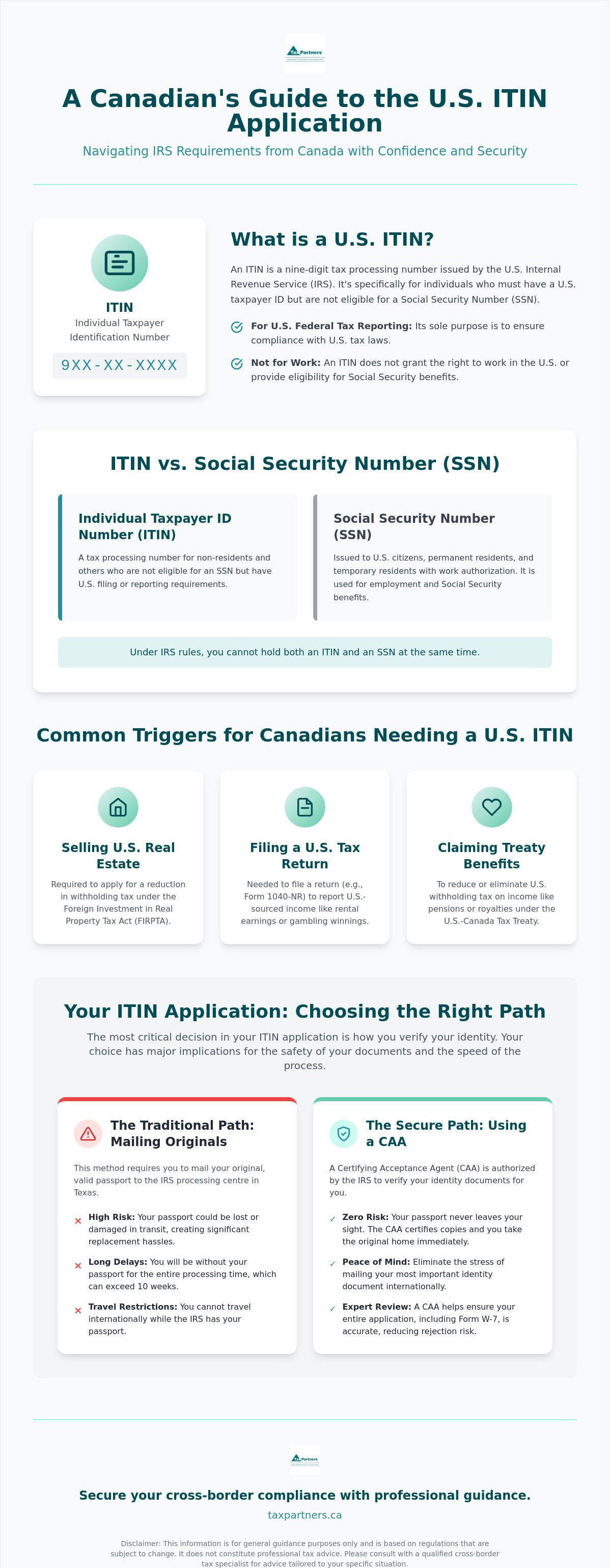
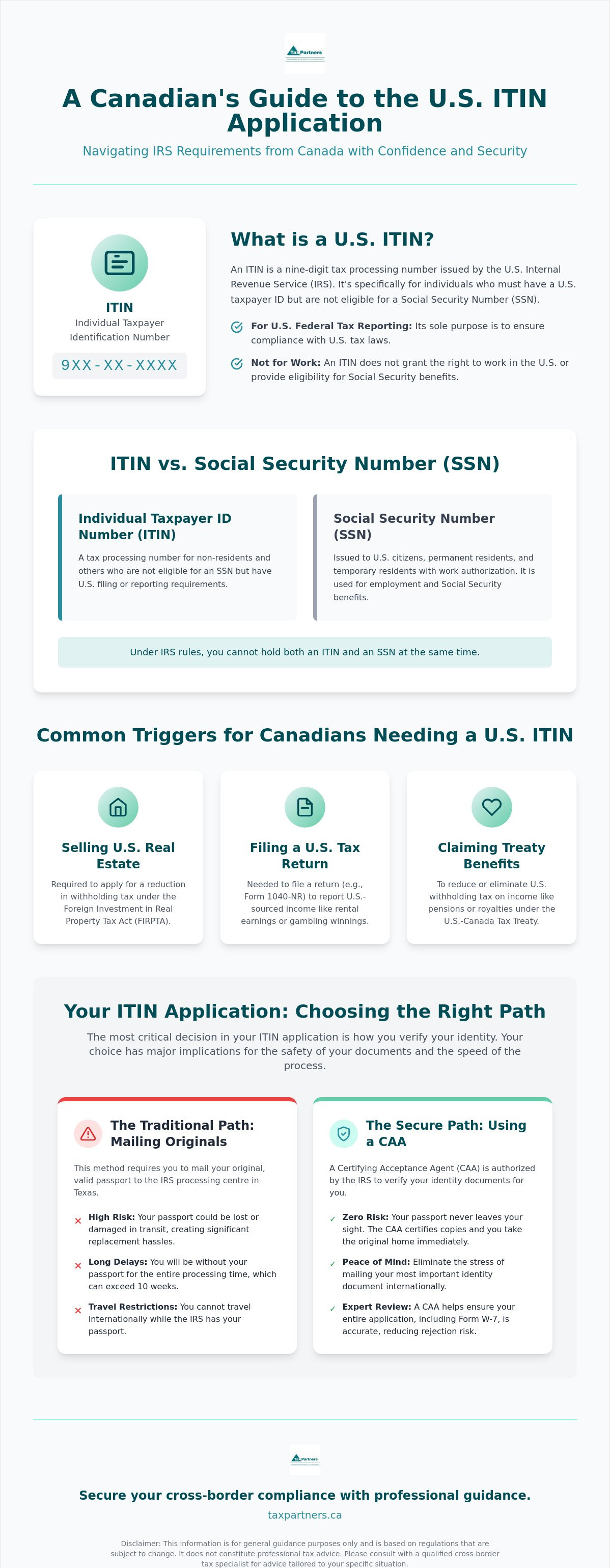
An Individual Taxpayer Identification Number, or ITIN, is a nine-digit tax processing number issued by the Internal Revenue Service (IRS). It's designed specifically for individuals who are required to have a US taxpayer identification number but aren't eligible for a Social Security Number (SSN). For many, starting an ITIN application Canada is the first step in managing cross-border financial interests with precision. You must understand that an ITIN is purely for federal tax reporting; it doesn't grant you the right to work in the United States, nor does it provide eligibility for Social Security benefits.
One of the most important boundaries to recognize is that this requirement exists strictly under IRS rules. Your obligations to the Canada Revenue Agency (CRA) are separate and distinct. While the two agencies share information under international agreements, obtaining an ITIN is about satisfying your US tax identity, not your Canadian one. It's a tool for compliance that ensures you're recognized correctly by US authorities when you have financial activity south of the border.
The Distinction Between SSNs and ITINs
Most Canadians only qualify for an SSN if they have specific US work authorization or a green card. For everyone else, the ITIN serves as a compliance bridge. If you're a Canadian resident with US financial ties, this number allows you to file returns and claim treaty benefits. Under IRS regulations, you can't hold both an SSN and an ITIN at the same time. If you later become eligible for an SSN, your ITIN must be rescinded. Understanding What is an ITIN Under IRS Rules helps clarify why this number is so specific to non-resident tax compliance and why the IRS maintains such a strict separation between these two types of identifiers.
Common Triggers for a Canadian ITIN Application
When does a Canadian actually need to initiate an ITIN application Canada? The most common trigger is the requirement to file a US federal tax return, such as Form 1040-NR, to report income like rental earnings or gambling winnings. You might also need one in these specific scenarios:
- Selling US Real Estate: An ITIN is often required to apply for a reduction in the standard withholding tax mandated by the Foreign Investment in Real Property Tax Act (FIRPTA).
- Claiming Treaty Benefits: To reduce or eliminate US backup withholding on royalties, pensions, or annuities under the US-Canada Tax Treaty, you must provide an ITIN to the payer.
- Banking and Investment: Many US-based financial institutions require this number before you can open an interest-bearing account or organize a US-based investment portfolio.
By securing an ITIN, you move from a state of potential uncertainty toward a feeling of total control over your US tax obligations. It's about foresight; by obtaining the number before you need to file, you ensure a smoother experience with the IRS when deadlines approach.
The ITIN Application Process: Navigating Form W-7 from Canada
The core of your ITIN application Canada journey is Form W-7, officially titled the "Application for IRS Individual Taxpayer Identification Number." This document serves as the formal request to the IRS to establish your tax identity. While the form itself appears brief, it requires absolute precision. You must simultaneously prove your identity and your status as a foreign national. Any inconsistency between your supporting documents and the data entered on the form can lead to an immediate rejection. Errors are the leading cause of the ten-week delays many Canadians experience during peak seasons.
Understanding the underlying logic of the IRS is essential. Generally, the IRS does not issue these numbers in a vacuum. You must either attach a valid US federal income tax return to your application or meet a specific "exception" criteria. These exceptions often apply if you're claiming treaty benefits on passive income, such as royalties or gambling winnings, before a return is even due. Following The ITIN Application Process correctly ensures you don't fall into the common trap of submitting a "naked" application without the required tax return or substantiating exception documentation.
Step 1: Establishing Your Filing Category
Your first task is to identify the correct "reason for applying" among the checkboxes at the top of Form W-7. These range from "non-resident alien required to get an ITIN to claim tax treaty benefit" to "non-resident alien filing a US federal tax return." Your choice here is dictated by the specific type of US-sourced income you're reporting or protecting. Selecting the wrong category is a frequent mistake that results in the IRS returning the entire package. It's often helpful to seek a professional review of your documentation before submission to ensure your category aligns with your financial reality.
Step 2: Documentation Requirements for Canadians
For most applicants, the Canadian passport is the gold standard. It's the only "stand-alone" document the IRS accepts to prove both identity and foreign status at once. If you don't have a valid passport, you must provide at least two other documents, such as a Canadian birth certificate and a driver's licence. These must include a photograph and be current at the time of your ITIN application Canada. The IRS will not accept expired identification, nor will they accept simple photocopies. Documentation must be either the original or a certified copy from the issuing agency. Using the most current December 2024 revision of Form W-7 is mandatory to avoid processing errors.
Mailing Originals vs. Using a Certifying Acceptance Agent (CAA)
Mailing your passport to the IRS service centre in Austin, Texas, is often the most stressful part of the entire process. For many, the thought of their primary identity document being out of their hands for months is a significant deterrent. Deciding how to handle your identity documents is the most critical choice you'll make during your ITIN application Canada. While the "DIY" method of mailing originals is an option, it introduces risks that you can easily avoid with a more strategic approach.
The Risks of the Mail-In Method
When you mail your original Canadian passport to the IRS, you're entering a period of "document purgatory." The IRS may hold your original documents for 60 to 90 days, and this timeframe can extend even longer during peak tax seasons. This creates a practical problem; you cannot travel internationally or use your passport for local identification while it sits in a processing queue in Texas. There's also the rare but real risk of document loss or damage during international transit.
Another common point of confusion involves local certification. Many applicants try to use a local Canadian notary to certify their passport copies. However, the IRS generally doesn't accept these standard notarized copies for ITIN purposes. They require either the original document or a copy certified by the original issuing agency, such as Passport Canada. This often leads to rejected applications and wasted months of waiting for a response that only asks for more proof.
How a CAA Streamlines Your Application
The alternative is to work with an IRS-authorized Certifying Acceptance Agent (CAA). A CAA is a professional who has undergone specific training and authorization from the IRS to verify your identity documents in person. Instead of mailing your passport to the United States, you present it to the agent, who verifies its authenticity and returns it to you immediately. This is the gold standard for any ITIN application Canada, as it eliminates the need to part with your physical documents.
The CAA then prepares and submits a "Certificate of Accuracy" along with your application. This certificate tells the IRS that a trusted agent has personally inspected the original documents, which allows you to keep your passport in your possession throughout the entire processing period. This method not only provides peace of mind but also reduces the likelihood of rejection due to documentation errors. Tax Partners provides this specialized ITIN application service Canada to ensure your documents remain safe while your application moves through the system with professional precision. It's about maintaining control of your identity while meeting your US tax obligations.
Claiming Treaty Benefits: How an ITIN Protects Your Income
The US-Canada Tax Treaty exists to ensure that your hard-earned income isn't depleted by double taxation. For Canadians, this treaty is a powerful shield; however, it remains inactive without a valid tax identifier. By completing an ITIN application Canada, you establish a formal "tax identity" with the IRS. This identity allows you to declare your residency status and claim specific reduced withholding rates or exemptions at the source. Without this number, US payers are often legally required under IRS rules to withhold a significant flat percentage of your gross income, regardless of your actual tax liability or the expenses you incurred to earn it.
Securing an ITIN ensures you only pay the "fair share" required by law. It transforms you from an anonymous foreign payee into a recognized taxpayer eligible for treaty protections. This proactive step prevents the frustration of seeing a large portion of your income withheld by a US institution, which can often take a full year or more to recover through a refund claim. It's about precision and foresight; having your number ready before a transaction occurs keeps your cash flow stable and your cross-border activities transparent.
Common Income Types Covered by the Treaty
Canadian residents frequently receive US-sourced income that falls under treaty protection. This includes pensions, annuities, and certain US-sourced social security benefits. For those in creative or technical fields, royalties from intellectual property and income from independent personal services, such as consulting or public speaking, are also covered. Even gambling winnings from US casinos are subject to these rules. In many cases, having an ITIN allows you to file Form 1040-NR, the US Nonresident Alien Income Tax Return, to report your income accurately and recover any tax that was over-withheld by the payer. This process ensures that your tax obligations to the IRS are settled correctly without impacting your standing with the CRA.
ITINs for US Real Estate Transactions
If you're selling real property in the United States, you'll likely encounter the Foreign Investment in Real Property Tax Act (FIRPTA). Under these IRS rules, the buyer is typically required to withhold a portion of the gross sales price and remit it to the IRS. To reduce this withholding at the time of closing, you must apply for a "Withholding Certificate," a process that requires a valid ITIN. This ensures your capital isn't tied up in IRS accounts for months after the sale is finalized. Additionally, Canadians with US financial interests should stay mindful of their fbar filing requirements if they maintain financial accounts south of the border that meet certain reporting thresholds.
Understanding which treaty articles apply to your unique situation is vital for long-term financial health. If you're ready to secure your treaty benefits and protect your US-sourced earnings, contact our cross-border tax team today to begin your application with professional guidance.
Securing Your Cross-Border Compliance with Tax Partners
Tax Partners serves as a seasoned mentor for Canadians navigating the intricate landscape of IRS regulations. With over 40 years of specialized experience in US and cross-border tax compliance, our firm provides a level of reliability and ethical steadfastness that only comes from decades of practice. We recognize that an ITIN application Canada is rarely a standalone task. Instead, it's a vital piece of a larger financial puzzle. Our team acts as a proactive guardian, ensuring you aren't just meeting current requirements but are actively looking ahead to secure the best possible outcome for your cross-border interests.
We believe in a highly organized, integrated approach. This means we don't just process your number; we simultaneously manage the ITIN application, the required US tax returns, and the subsequent impact on your Canadian tax obligations. By handling these components together, we eliminate the risk of conflicting filings between the IRS and the CRA. This methodical flow of communication moves you quickly from a state of potential uncertainty toward a feeling of total control. You'll find a steady hand at the helm, combining institutional wisdom with a modern, responsive outlook on emerging tax sectors.
Beyond the Number: A Holistic Compliance Strategy
An ITIN is a powerful tool, but its value is maximized when it's part of a broader 1040 tax filing for Canadians strategy. Staying compliant under IRS rules requires precision, especially when coordinating those filings with your responsibilities as a CRA filer. Errors in one jurisdiction can lead to penalties or the loss of foreign tax credits in the other. Our role is to provide the foresight needed to avoid these pitfalls. We focus on transparency and customization, ensuring your specific US-sourced income is protected by treaty benefits while maintaining absolute integrity in your Canadian reporting.
Getting Started with Your Application
The complexity of international tax doesn't have to be a source of stress. You can realize significant peace of mind by choosing professional assistance that saves you months of administrative frustration. We invite you to contact us for a consultation that addresses your unique cross-border needs. Whether you're selling US real estate, managing a US-based investment portfolio, or claiming treaty exemptions on royalties, our team provides the expert guidance you deserve. Working with an established Canadian firm offers a sense of stability and long-term partnership, ensuring your ITIN application Canada is the first step toward seamless, end-to-end tax support.
Master Your US Tax Compliance
Securing an ITIN is about more than just fulfilling a requirement; it's about establishing a secure tax identity under IRS rules. By choosing the right path for your ITIN application Canada, you protect your original identity documents and ensure you're positioned to claim every treaty benefit you deserve. You now understand how a Certifying Acceptance Agent eliminates the stress of mailing your passport and how a holistic compliance strategy prevents the frustration of double taxation.
With over 40 years of cross-border tax expertise and 1,390+ five-star Google reviews, Tax Partners offers the deep-seated reliability you need. As an authorized IRS Certifying Acceptance Agent (CAA), we provide the precision and foresight required to navigate these complex regulations with total confidence. We're ready to act as your proactive guardian, moving you from uncertainty to total control over your financial interests.
Secure your ITIN and protect your original documents with Tax Partners. Your cross-border success is our priority, and we're here to support you every step of the way.
Frequently Asked Questions
Can I apply for an ITIN if I do not live in the United States?
Yes, you can apply for an ITIN while living in Canada. The number is specifically designed for non-resident aliens who have a tax filing requirement under IRS rules but aren't eligible for a US Social Security Number. It's the primary way the IRS tracks tax obligations for individuals residing outside the United States, allowing you to remain compliant without being a US resident.
How long does it take for the IRS to issue an ITIN to a Canadian resident?
Standard processing time for an ITIN application Canada is approximately seven weeks. However, this can extend to nine or eleven weeks during the peak tax season or when applying from abroad. As of February 2026, the IRS reported processing times of about ten weeks for applications submitted at the end of the previous year. It's best to apply well before your tax deadline to account for these potential delays.
Does my Canadian ITIN expire if I do not use it for several years?
Your ITIN will expire if you don't use it on a US federal tax return for three consecutive tax years. For instance, if a number wasn't used for tax years 2022, 2023, or 2024, it would have expired on December 31, 2025. You'll need to submit a new application to renew it if your US financial activities resume and you have a new filing requirement under IRS rules.
Is a Canadian passport sufficient to obtain an ITIN without other documents?
A valid Canadian passport is the only stand-alone document the IRS accepts to prove both identity and foreign status simultaneously. If you have a current passport, you don't need to provide additional identification like a birth certificate or driver's licence. This makes the process significantly simpler for most Canadian applicants, provided the document hasn't reached its expiry date at the time of your ITIN application Canada.
Can I use an ITIN to file a Canadian tax return with the CRA?
You cannot use an ITIN to file a Canadian tax return with the CRA. The IRS issues the ITIN strictly for US federal tax purposes. For your Canadian filings, the CRA requires either a Social Insurance Number (SIN) or a Temporary Tax Number (TTN). It's vital to keep these two jurisdictions separate in your financial records to ensure you're using the correct identifier for each country's tax authority.
What happens if the IRS rejects my ITIN application due to an error?
If the IRS rejects your application, they'll issue a notice explaining the specific error. This often leads to delays of several months as you'll have to restart the process from the beginning. Common errors include using an outdated version of Form W-7 or failing to provide a valid reason for the application. Working with a Certifying Acceptance Agent helps ensure your application is accurate the first time, avoiding these lengthy setbacks.
Do I need an ITIN if I am only visiting the US as a tourist?
You don't need an ITIN if you're only visiting the United States as a tourist. The requirement only applies if you have US-sourced income, such as rental earnings or gambling winnings, or if you need to claim benefits under the US-Canada Tax Treaty. Tourism alone doesn't trigger an IRS filing obligation, so you don't need to worry about this number for standard cross-border travel or vacations.
Can an ITIN be used to claim the Earned Income Tax Credit (EITC) under IRS rules?
Individuals filing with an ITIN are not eligible for the federal Earned Income Tax Credit (EITC) under IRS rules. While some US states may offer their own credits to ITIN holders, the federal government requires at least one parent to have a valid Social Security Number to claim the full Child Tax Credit or any portion of the EITC. This is a strict federal limitation that remains in place for the 2026 tax year.

Article by
Mahad Mohamed
Mahad Mohamed is an accountant and the CEO of Tax Partners, with over 26+ years of Canadian and international tax and accounting experience. His expertise includes corporate reorganization, cross-border tax structuring (Canada & US), tax disputes, CRA audits, and tax planning for small owner-managed private corporations. Most recently, Mahad is a pioneer in Canadian crypto taxation and founded Block3 Finance. Previously, Mahad worked for the Canada Revenue Agency (CRA), Big4 accounting firms, and served as a Rulings Officer for the Federal Tax Authority of the UAE before acquiring Tax Partners in 2014. Tax Partners has 44 full-time accountants and over 18,400+ clients.
Disclaimer
This article provides general information only and is current as of its publication date. It has not been updated and may be out of date. It does not constitute legal advice and should not be relied upon as such. Every tax situation is unique and may differ from the examples discussed in this article. If you have specific questions, you should seek the advice of our accountants for your unique circumstances. Book a FREE Initial Consultation Today!
Frequently Asked Questions
The Distinction Between SSNs and ITINs
Most Canadians only qualify for an SSN if they have specific US work authorization or a green card. For everyone else, the ITIN serves as a compliance bridge. If you're a Canadian resident with US financial ties, this number allows you to file returns and claim treaty benefits. Under IRS regulations, you can't hold both an SSN and an ITIN at the same time. If you later become eligible for an SSN, your ITIN must be rescinded. Understanding What is an ITIN Under IRS Rules helps clarify why this number is so specific to non-resident tax compliance and why the IRS maintains such a strict separation between these two types of identifiers.
Common Triggers for a Canadian ITIN Application
When does a Canadian actually need to initiate an ITIN application Canada? The most common trigger is the requirement to file a US federal tax return, such as Form 1040-NR, to report income like rental earnings or gambling winnings. You might also need one in these specific scenarios: By securing an ITIN, you move from a state of potential uncertainty toward a feeling of total control over your US tax obligations. It's about foresight; by obtaining the number before you need to file, you ensure a smoother experience with the IRS when deadlines approach. The core of your ITIN application Canada journey is Form W-7, officially titled the "Application for IRS Individual Taxpayer Identification Number." This document serves as the formal request to the IRS to establish your tax identity. While the form itself appears brief, it requires absolute precision. You must simultaneously prove your identity and your status as a foreign national. Any inconsistency between your supporting documents and the data entered on the form can lead to an immediate rejection. Errors are the leading cause of the ten-week delays many Canadians experience during peak seasons. Understanding the underlying logic of the IRS is essential. Generally, the IRS does not issue these numbers in a vacuum. You must either attach a valid US federal income tax return to your application or meet a specific "exception" criteria. These exceptions often apply if you're claiming treaty benefits on passive income, such as royalties or gambling winnings, before a return is even due. Following The ITIN Application Process correctly ensures you don't fall into the common trap of submitting a "naked" application without the required tax return or substantiating exception documentation.
Step 1: Establishing Your Filing Category
Your first task is to identify the correct "reason for applying" among the checkboxes at the top of Form W-7. These range from "non-resident alien required to get an ITIN to claim tax treaty benefit" to "non-resident alien filing a US federal tax return." Your choice here is dictated by the specific type of US-sourced income you're reporting or protecting. Selecting the wrong category is a frequent mistake that results in the IRS returning the entire package. It's often helpful to seek a professional review of your documentation before submission to ensure your category aligns with your financial reality.
Step 2: Documentation Requirements for Canadians
For most applicants, the Canadian passport is the gold standard. It's the only "stand-alone" document the IRS accepts to prove both identity and foreign status at once. If you don't have a valid passport, you must provide at least two other documents, such as a Canadian birth certificate and a driver's licence. These must include a photograph and be current at the time of your ITIN application Canada. The IRS will not accept expired identification, nor will they accept simple photocopies. Documentation must be either the original or a certified copy from the issuing agency. Using the most current December 2024 revision of Form W-7 is mandatory to avoid processing errors. Mailing your passport to the IRS service centre in Austin, Texas, is often the most stressful part of the entire process. For many, the thought of their primary identity document being out of their hands for months is a significant deterrent. Deciding how to handle your identity documents is the most critical choice you'll make during your ITIN application Canada. While the "DIY" method of mailing originals is an option, it introduces risks that you can easily avoid with a more strategic approach.
The Risks of the Mail-In Method
When you mail your original Canadian passport to the IRS, you're entering a period of "document purgatory." The IRS may hold your original documents for 60 to 90 days, and this timeframe can extend even longer during peak tax seasons. This creates a practical problem; you cannot travel internationally or use your passport for local identification while it sits in a processing queue in Texas. There's also the rare but real risk of document loss or damage during international transit. Another common point of confusion involves local certification. Many applicants try to use a local Canadian notary to certify their passport copies. However, the IRS generally doesn't accept these standard notarized copies for ITIN purposes. They require either the original document or a copy certified by the original issuing agency, such as Passport Canada. This often leads to rejected applications and wasted months of waiting for a response that only asks for more proof.
How a CAA Streamlines Your Application
The alternative is to work with an IRS-authorized Certifying Acceptance Agent (CAA). A CAA is a professional who has undergone specific training and authorization from the IRS to verify your identity documents in person. Instead of mailing your passport to the United States, you present it to the agent, who verifies its authenticity and returns it to you immediately. This is the gold standard for any ITIN application Canada, as it eliminates the need to part with your physical documents. The CAA then prepares and submits a "Certificate of Accuracy" along with your application. This certificate tells the IRS that a trusted agent has personally inspected the original documents, which allows you to keep your passport in your possession throughout the entire processing period. This method not only provides peace of mind but also reduces the likelihood of rejection due to documentation errors. Tax Partners provides this specialized ITIN application service Canada to ensure your documents remain safe while your application moves through the system with professional precision. It's about maintaining control of your identity while meeting your US tax obligations. The US-Canada Tax Treaty exists to ensure that your hard-earned income isn't depleted by double taxation. For Canadians, this treaty is a powerful shield; however, it remains inactive without a valid tax identifier. By completing an ITIN application Canada, you establish a formal "tax identity" with the IRS. This identity allows you to declare your residency status and claim specific reduced withholding rates or exemptions at the source. Without this number, US payers are often legally required under IRS rules to withhold a significant flat percentage of your gross income, regardless of your actual tax liability or the expenses you incurred to earn it. Securing an ITIN ensures you only pay the "fair share" required by law. It transforms you from an anonymous foreign payee into a recognized taxpayer eligible for treaty protections. This proactive step prevents the frustration of seeing a large portion of your income withheld by a US institution, which can often take a full year or more to recover through a refund claim. It's about precision and foresight; having your number ready before a transaction occurs keeps your cash flow stable and your cross-border activities transparent.
Common Income Types Covered by the Treaty
Canadian residents frequently receive US-sourced income that falls under treaty protection. This includes pensions, annuities, and certain US-sourced social security benefits. For those in creative or technical fields, royalties from intellectual property and income from independent personal services, such as consulting or public speaking, are also covered. Even gambling winnings from US casinos are subject to these rules. In many cases, having an ITIN allows you to file Form 1040-NR, the US Nonresident Alien Income Tax Return, to report your income accurately and recover any tax that was over-withheld by the payer. This process ensures that your tax obligations to the IRS are settled correctly without impacting your standing with the CRA.
ITINs for US Real Estate Transactions
If you're selling real property in the United States, you'll likely encounter the Foreign Investment in Real Property Tax Act (FIRPTA). Under these IRS rules, the buyer is typically required to withhold a portion of the gross sales price and remit it to the IRS. To reduce this withholding at the time of closing, you must apply for a "Withholding Certificate," a process that requires a valid ITIN. This ensures your capital isn't tied up in IRS accounts for months after the sale is finalized. Additionally, Canadians with US financial interests should stay mindful of their fbar filing requirements if they maintain financial accounts south of the border that meet certain reporting thresholds. Understanding which treaty articles apply to your unique situation is vital for long-term financial health. If you're ready to secure your treaty benefits and protect your US-sourced earnings, contact our cross-border tax team today to begin your application with professional guidance. Tax Partners serves as a seasoned mentor for Canadians navigating the intricate landscape of IRS regulations. With over 40 years of specialized experience in US and cross-border tax compliance, our firm provides a level of reliability and ethical steadfastness that only comes from decades of practice. We recognize that an ITIN application Canada is rarely a standalone task. Instead, it's a vital piece of a larger financial puzzle. Our team acts as a proactive guardian, ensuring you aren't just meeting current requirements but are actively looking ahead to secure the best possible outcome for your cross-border interests. We believe in a highly organized, integrated approach. This means we don't just process your number; we simultaneously manage the ITIN application, the required US tax returns, and the subsequent impact on your Canadian tax obligations. By handling these components together, we eliminate the risk of conflicting filings between the IRS and the CRA. This methodical flow of communication moves you quickly from a state of potential uncertainty toward a feeling of total control. You'll find a steady hand at the helm, combining institutional wisdom with a modern, responsive outlook on emerging tax sectors.
Beyond the Number: A Holistic Compliance Strategy
An ITIN is a powerful tool, but its value is maximized when it's part of a broader 1040 tax filing for Canadians strategy. Staying compliant under IRS rules requires precision, especially when coordinating those filings with your responsibilities as a CRA filer. Errors in one jurisdiction can lead to penalties or the loss of foreign tax credits in the other. Our role is to provide the foresight needed to avoid these pitfalls. We focus on transparency and customization, ensuring your specific US-sourced income is protected by treaty benefits while maintaining absolute integrity in your Canadian reporting.
Getting Started with Your Application
The complexity of international tax doesn't have to be a source of stress. You can realize significant peace of mind by choosing professional assistance that saves you months of administrative frustration. We invite you to contact us for a consultation that addresses your unique cross-border needs. Whether you're selling US real estate, managing a US-based investment portfolio, or claiming treaty exemptions on royalties, our team provides the expert guidance you deserve. Working with an established Canadian firm offers a sense of stability and long-term partnership, ensuring your ITIN application Canada is the first step toward seamless, end-to-end tax support. Securing an ITIN is about more than just fulfilling a requirement; it's about establishing a secure tax identity under IRS rules. By choosing the right path for your ITIN application Canada, you protect your original identity documents and ensure you're positioned to claim every treaty benefit you deserve. You now understand how a Certifying Acceptance Agent eliminates the stress of mailing your passport and how a holistic compliance strategy prevents the frustration of double taxation. With over 40 years of cross-border tax expertise and 1,390+ five-star Google reviews, Tax Partners offers the deep-seated reliability you need. As an authorized IRS Certifying Acceptance Agent (CAA), we provide the precision and foresight required to navigate these complex regulations with total confidence. We're ready to act as your proactive guardian, moving you from uncertainty to total control over your financial interests. Secure your ITIN and protect your original documents with Tax Partners. Your cross-border success is our priority, and we're here to support you every step of the way.
Can I apply for an ITIN if I do not live in the United States?
Yes, you can apply for an ITIN while living in Canada. The number is specifically designed for non-resident aliens who have a tax filing requirement under IRS rules but aren't eligible for a US Social Security Number. It's the primary way the IRS tracks tax obligations for individuals residing outside the United States, allowing you to remain compliant without being a US resident.
How long does it take for the IRS to issue an ITIN to a Canadian resident?
Standard processing time for an ITIN application Canada is approximately seven weeks. However, this can extend to nine or eleven weeks during the peak tax season or when applying from abroad. As of February 2026, the IRS reported processing times of about ten weeks for applications submitted at the end of the previous year. It's best to apply well before your tax deadline to account for these potential delays.
Does my Canadian ITIN expire if I do not use it for several years?
Your ITIN will expire if you don't use it on a US federal tax return for three consecutive tax years. For instance, if a number wasn't used for tax years 2022, 2023, or 2024, it would have expired on December 31, 2025. You'll need to submit a new application to renew it if your US financial activities resume and you have a new filing requirement under IRS rules.
Is a Canadian passport sufficient to obtain an ITIN without other documents?
A valid Canadian passport is the only stand-alone document the IRS accepts to prove both identity and foreign status simultaneously. If you have a current passport, you don't need to provide additional identification like a birth certificate or driver's licence. This makes the process significantly simpler for most Canadian applicants, provided the document hasn't reached its expiry date at the time of your ITIN application Canada.
Can I use an ITIN to file a Canadian tax return with the CRA?
You cannot use an ITIN to file a Canadian tax return with the CRA. The IRS issues the ITIN strictly for US federal tax purposes. For your Canadian filings, the CRA requires either a Social Insurance Number (SIN) or a Temporary Tax Number (TTN). It's vital to keep these two jurisdictions separate in your financial records to ensure you're using the correct identifier for each country's tax authority.
What happens if the IRS rejects my ITIN application due to an error?
If the IRS rejects your application, they'll issue a notice explaining the specific error. This often leads to delays of several months as you'll have to restart the process from the beginning. Common errors include using an outdated version of Form W-7 or failing to provide a valid reason for the application. Working with a Certifying Acceptance Agent helps ensure your application is accurate the first time, avoiding these lengthy setbacks.
Do I need an ITIN if I am only visiting the US as a tourist?
You don't need an ITIN if you're only visiting the United States as a tourist. The requirement only applies if you have US-sourced income, such as rental earnings or gambling winnings, or if you need to claim benefits under the US-Canada Tax Treaty. Tourism alone doesn't trigger an IRS filing obligation, so you don't need to worry about this number for standard cross-border travel or vacations.
Can an ITIN be used to claim the Earned Income Tax Credit (EITC) under IRS rules?
Individuals filing with an ITIN are not eligible for the federal Earned Income Tax Credit (EITC) under IRS rules. While some US states may offer their own credits to ITIN holders, the federal government requires at least one parent to have a valid Social Security Number to claim the full Child Tax Credit or any portion of the EITC. This is a strict federal limitation that remains in place for the 2026 tax year.