Estate Planning for Business Owners: A Strategic Guide for Canadian Entrepreneurs

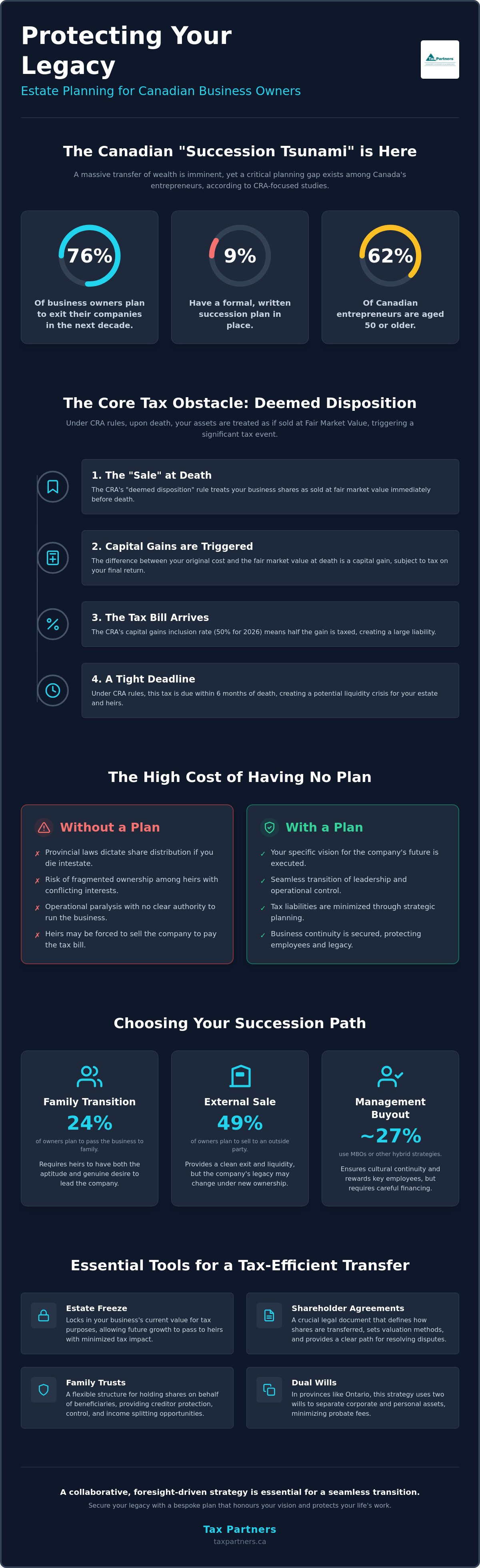
Did you know that 76% of Canadian business owners plan to exit their companies within the next decade, yet only 9% have a formal succession plan in place? This "succession tsunami" represents a massive transfer of wealth, yet many entrepreneurs remain frozen by the complexity of estate planning for business owners. It's natural to feel a sense of unease when considering the future of your legacy. You want to ensure your life's work survives you, but the anxiety over high capital gains taxes can feel overwhelming. We believe that your hard work deserves a proactive guardian to honour your vision and secure its future.
We've designed this strategic guide to help you protect your business legacy, minimize tax exposure, and ensure a seamless transition for your heirs. You'll learn how to manage the "deemed disposition" rule; this is the mechanism where the CRA treats your assets as if they were sold at fair market value immediately before death. We'll also cover how to utilize the $1.25 million Lifetime Capital Gains Exemption to your advantage. This journey will move you from a state of potential uncertainty toward a feeling of total control over your financial destiny.
Key Takeaways
- Navigate the "deemed disposition" rules under the CRA to prevent significant tax liabilities from compromising your company's future.
- Evaluate the three primary succession paths, including family transition, management buyout, or external sale, to ensure a smooth operational handover.
- Learn how estate planning for business owners uses an "Estate Freeze" to lock in tax values while passing growth to heirs.
- Protect your legacy with Shareholder Agreements and Family Trusts designed to safeguard assets and resolve potential disputes.
- Understand why a collaborative, foresight-driven strategy between tax and legal advisors is essential for a seamless transition.
Why Estate Planning for Business Owners Requires a Bespoke Approach
For a Canadian entrepreneur, your business is likely your most significant asset. It's also your most complex. Unlike personal assets like a family home or a vehicle, corporate shares represent control, income, and a legacy that supports employees and family members alike. This is why estate planning for business owners cannot be a one-size-fits-all solution. It requires a bespoke strategy that accounts for the unique structure of your corporation and the specific tax environment managed by the Canada Revenue Agency (CRA).
The risks of failing to plan are high. If a business owner dies intestate, meaning without a valid will, provincial laws in Canada determine how shares are distributed. This often leads to fragmented ownership among family members who may have conflicting interests. Without clear direction, a corporation can face operational paralysis where no one has the legal authority to sign contracts, manage payroll, or make critical board decisions. A tailored plan ensures that your business remains a functional entity rather than a source of family conflict.
The Deemed Disposition Rule for CRA Filers
In Canada, we don't have a traditional estate tax like the one managed by the IRS in the United States. Instead, the CRA applies the "deemed disposition" rule. At the time of death, you're treated as having sold all your capital property at fair market value. This includes your business shares. If your company has grown significantly, this can trigger a massive capital gains tax bill. For 2026, the capital gains inclusion rate for CRA filers is a flat 50% for individuals and corporations. This creates a potential liquidity crisis; under CRA rules, the tax owing on a final return is due within 6 months of the date of death. Without a plan to fund this liability, your heirs might be forced to sell the company just to pay the tax.
Beyond the Basic Will
A standard personal will is often insufficient to govern a complex business. You need to ensure your executor has the specific authority to vote corporate shares and manage business operations during the probate process. This is a core part of Succession planning. Without these specific powers, the transition of leadership can stall in the court system. A bespoke approach often involves the use of dual wills in provinces like Ontario to minimize probate fees on corporate assets. This strategy allows you to organize your affairs so that the business can continue to run smoothly while the rest of your estate moves through legal channels.
Succession Planning: Ensuring Operational Continuity
While the previous section focused on the technicalities of CRA tax rules and the "deemed disposition," we must now address the "human" side of the equation. Succession planning is the process of identifying and preparing the next generation of leadership. It's the bridge between a business that exists today and a legacy that continues tomorrow. Comprehensive estate planning for business owners requires this dual focus: one eye on the tax man and the other on your talent pool. Stability isn't something that happens overnight; it requires years of intentional training and mentorship to ensure the business doesn't collapse when the founder steps away.
The timing of this planning is becoming critical for the Canadian economy. According to research from Doane Grant Thornton LLP (June 2026), 62% of Canadian entrepreneurs are now 50 years of age or older. This demographic shift means a significant volume of companies will change hands very soon. Without a clear roadmap for who will take the helm, these businesses risk operational paralysis during the probate process or upon the unexpected incapacity of the founder.
Internal vs. External Transitions
Passing the torch to a child or relative is often the most rewarding choice, but it's also the most complex. You must honestly evaluate if your heirs have both the professional aptitude and the genuine desire to lead. Data from Doane Grant Thornton LLP (June 2026) indicates that approximately 24% of Canadian entrepreneurs plan to sell to a family member. Forcing a child into a role they don't want is a recipe for corporate decline. Using a succession planning for family business strategy helps maintain harmony by setting clear expectations and professional boundaries. If an internal candidate isn't viable, the same study shows that 49% of owners will sell to a buyer with no personal connection, which may be the best way to secure your financial future.
The Management Buyout (MBO) Option
Sometimes the best successors are already on your payroll. A management buyout allows your key employees to take the reins, which often preserves the company culture better than an external sale. This often involves vendor take-back (VTB) financing. In a VTB arrangement, you essentially act as the bank by allowing the buyers to pay the purchase price over time from the company's future profits. It ensures you receive fair value for your life's work while providing a manageable entry point for your team. This structure can be particularly effective for Canadian owners who want to reward long-term staff while exiting the daily operations.
Don't wait for a milestone birthday or a health scare to start this process. You also need a "break glass in case of emergency" contingency plan for unexpected incapacity to protect your employees and partners under Canadian law. If you're ready to begin drafting your roadmap, you can speak with our advisory team to explore which transition model fits your goals.
Tax-Efficient Wealth Transfer and Growth Strategies
While identifying your successor secures the operations, neutralizing the growing tax burden secures the capital. Effective estate planning for business owners involves a proactive shift from simple wealth accumulation to strategic wealth preservation. Without a clear plan, your company’s success inadvertently builds a massive future liability for your heirs. To combat this, we often implement an "Estate Freeze," a powerful mechanism designed to cap your tax exposure at its current level while allowing future appreciation to bypass your personal estate.
An Estate Freeze works by locking in the value of your business at today's fair market value. By converting your common shares into preferred shares with a fixed value, you create a ceiling for the capital gains tax that will eventually be due upon death under Canadian tax law. This foresight allows you to accurately calculate your future tax bill today, rather than leaving your family with an unpredictable financial burden years down the road. It turns a potential crisis into a manageable, predictable line item in your long-term strategy.
The Mechanics of an Estate Freeze
The process begins by exchanging your existing common shares for preferred shares. These preferred shares have a fixed redemption value equal to the company’s current worth. Simultaneously, the corporation issues new common shares to your children or a family trust at a nominal price. Since these new shares start with zero value, any future growth in the company’s value is attributed to the new shareholders rather than your personal estate. You can also choose to "crystallize" your gains during this reorganization. This involves triggering a deemed sale to utilize your current tax exemptions, effectively increasing the cost base of your shares and reducing the terminal tax hit for CRA filers.
Utilizing the Lifetime Capital Gains Exemption (LCGE)
The LCGE is a cornerstone of Canadian tax planning that every entrepreneur should understand. For 2026, the Lifetime Capital Gains Exemption for qualifying small business corporation (QSBC) shares is approximately $1.25 million under CRA rules in Canada. To qualify as a QSBC, your business must meet specific CRA criteria, including the "asset test" where at least 90% of assets must be used in active business in Canada at the time of the transfer. By holding shares through a family trust, you can potentially multiply this $1.25 million exemption across several beneficiaries, shielding millions of dollars from the capital gains tax. This strategy keeps significantly more capital within your family, providing a stable foundation for the next generation's success.
Planning for this liability is not just about reduction; it's about liquidity. Even with a perfect freeze, the CRA requires payment shortly after death. Life insurance remains a primary tool to provide the necessary cash, acting as a proactive guardian for your business assets. It ensures that your legacy is preserved intact, without the need to liquidate the very company you spent a lifetime building. By combining these tax tools with a robust funding plan, you move from a state of uncertainty to one of total control over your financial destiny.
Essential Legal and Financial Structures for Protection
While tax strategies like the Estate Freeze provide the financial blueprint, legal structures act as the foundation that holds your legacy together. Without these protections, even the most tax-efficient plan can crumble under the weight of a shareholder dispute or a prolonged probate process. Comprehensive estate planning for business owners must include a robust Shareholder Agreement and a clear definition of authority through Powers of Attorney. These documents ensure that your business remains operational and your family remains protected during a transition.
One of the most overlooked risks is the period of incapacity. Many entrepreneurs focus entirely on what happens after they pass away, but what happens if you're alive but unable to make decisions? You need a Power of Attorney (POA) for personal care to handle medical choices, but more importantly, a POA for property and business. The individual making your health decisions might not be the right person to vote your corporate shares, manage payroll, or sign legal contracts. Assigning a specific business POA ensures a proactive guardian is at the helm of your company if you cannot be.
The Power of the Shareholder Agreement
Think of a Shareholder Agreement as a "corporate pre-nuptial." It's essential for any business with more than one owner. The most critical component is the "buy-sell" clause, which dictates exactly what happens if a shareholder dies or becomes disabled. It prevents a grieving spouse or an inexperienced heir from becoming an accidental business partner by forcing the sale of shares back to the company or the surviving partners. To make this work, you must agree on a valuation method while everyone is healthy and rational. Most successful owners fund these buyouts with corporate-owned life insurance, ensuring the cash is available the moment it's required.
Family Trusts as a Multi-Purpose Tool
Family trusts offer a sophisticated way to manage asset distribution while bypassing the provincial probate process. Because the trust owns the assets rather than the individual, those assets don't form part of your estate and aren't subject to the delays of court validation. This is particularly valuable in provinces like Ontario or British Columbia where probate fees are higher. However, you must plan for the CRA's "21-year rule." Under this rule, a trust is deemed to have sold its assets at fair market value every 21 years, which triggers capital gains taxes. Expert oversight helps you distribute assets to beneficiaries before this deadline to defer that tax hit.
In certain jurisdictions, we also recommend "Dual Wills" to further shield your business from unnecessary costs. This allows you to separate corporate shares into a secondary will that doesn't require probate, potentially saving your heirs thousands in Estate Administration Tax. If you want to ensure your legal structures are as strong as your business, you should book a consultation with our estate specialists to review your current agreements.
Partnering with a CPA to Secure Your Legacy
Effective estate planning for business owners is rarely a solo performance. It's a collaborative effort that requires a seamless dialogue between your legal counsel and your tax advisors. While a lawyer drafts the legal "shell" of your will or trust, a CPA ensures the financial "engine" inside those structures is tuned for maximum tax efficiency. We provide the technical data and strategic foresight needed to ensure that your legal documents actually achieve their intended financial outcomes under complex CRA regulations.
Our role is to act as a proactive guardian for your wealth. We don't just react to the requirements of the past year; we look ahead to identify potential tax traps before they become liabilities. By aligning your corporate structure with your personal goals, we help you realize a customized plan that protects your family's future and honours your life's work. This partnership provides the stability you need to focus on running your business while we manage the intricate details of wealth preservation and CRA compliance.
Our Proactive Guardian Approach
We believe in moving beyond reactive tax filing toward long-term strategic wealth management. With over 40 years of experience, our firm offers the institutional wisdom necessary to handle the unique challenges faced by Canadian SMEs. Tax laws are not static. The CRA frequently updates its positions on matters like trust reporting and capital gains inclusion rates. We provide regular reviews of your estate roadmap to ensure your strategy remains relevant and robust in the face of changing legislation.
Next Steps: Building Your Estate Roadmap
The journey toward a secure legacy begins with a clear understanding of your current position. This often starts with a comprehensive business valuation to establish a baseline for your "deemed disposition" planning. From there, we work to align your personal retirement needs with your eventual exit strategy. Whether you're looking to transition to the next generation or prepare for a third-party sale, we help you organize your affairs to minimize friction and maximize value.
Securing your legacy doesn't have to be a source of stress. With the right team by your side, you can move from uncertainty to total control. If you're ready to protect what you've built, you should contact Tax Partners for a strategic estate planning consultation. We'll help you draft a roadmap that provides peace of mind for you and a clear path forward for your heirs.
Secure Your Vision for the Next Generation
Your business is the result of years of dedication, sacrifice, and strategic growth. Protecting that legacy requires more than just a standard will; it demands a comprehensive approach to estate planning for business owners that addresses both CRA tax liabilities and operational continuity. By implementing the structures we've discussed, such as an Estate Freeze or utilizing the Lifetime Capital Gains Exemption, you can ensure your hard work benefits your heirs rather than being consumed by deemed disposition taxes. You've built something remarkable. Now it's time to ensure it stands the test of time.
With over 40 years of Canadian tax expertise and specialized wealth management strategies, we've helped countless entrepreneurs move from uncertainty to total clarity. Our 1,390+ five-star Google reviews reflect our commitment to being a proactive guardian for our clients' success. Don't leave your life's work to chance. Secure your business legacy with Tax Partners—book your consultation today. We're here to provide the steady hand and institutional wisdom you need to protect your family and your future. Your legacy is our priority.
Frequently Asked Questions
What is the difference between a will and an estate plan for a business owner?
A will is just one piece of the puzzle. Comprehensive estate planning for business owners involves multiple legal and financial tools like shareholder agreements, family trusts, and tax-deferred transfer strategies. While a will dictates asset distribution, an estate plan ensures your business remains operational and tax-efficient during the transition. It's about securing your legacy rather than just dividing your assets.
How does the CRA tax a business when the owner passes away?
Under CRA rules, a deceased individual is "deemed" to have sold all capital property at fair market value immediately before death. This triggers capital gains tax on the appreciation of your business shares. For 2026, the capital gains inclusion rate is 50%. The resulting tax bill is generally due within six months of the date of death, which can create a sudden liquidity crisis for the company.
Can I use the Lifetime Capital Gains Exemption (LCGE) in my estate plan?
You can use the LCGE to shield your estate from significant taxes. In 2026, this exemption is approximately $1.25 million for qualifying small business corporation (QSBC) shares. To qualify for this CRA tax benefit, your corporation must meet specific asset tests. This includes the requirement that at least 90% of assets are used in active business in Canada at the time of death.
What is an estate freeze and when should a Canadian business owner consider one?
An estate freeze is a transaction that fixes the value of your business shares at their current fair market value. By exchanging common shares for preferred shares, you "freeze" your future tax liability while passing all subsequent growth to your heirs. Canadian business owners should consider this when their company's value begins to exceed the amount they need for a comfortable retirement.
How can life insurance help with estate planning for my corporation?
Life insurance provides the immediate liquidity needed to pay the CRA tax bill without forcing a sale of business assets. It's also a critical tool for funding buy-sell agreements within a shareholder agreement. This ensures that surviving partners have the cash to buy out a deceased owner's shares. This provides stability for the company and a fair, timely payout for the heirs.
What happens to my business if I become incapacitated without a Power of Attorney?
If you become incapacitated without a Power of Attorney (POA), your business may face operational paralysis. No one will have the legal authority to sign contracts, pay employees, or vote your shares. In such cases, the court must appoint a guardian to manage your affairs. This process is often slow, expensive, and public. It can significantly damage the company's value and reputation.
Why should I consider having dual wills for my Canadian business?
Dual wills are a strategic tool used to minimize provincial probate fees, specifically in provinces like Ontario. By creating a primary will for public assets and a secondary will for private corporate shares, you can bypass the court validation process for your business. This keeps your corporate details private. It also saves your estate approximately 1.5% in Estate Administration Tax on the value of those shares.
How often should I update my business estate plan?
You should review your plan every three to five years or whenever a major life event occurs. Significant changes like a marriage, divorce, or a substantial increase in business value should trigger an immediate update. Regular reviews ensure your plan remains compliant with evolving CRA regulations. They also ensure your strategy continues to reflect your current personal and professional goals.

Article by
Mahad Mohamed
Mahad Mohamed is an accountant and the CEO of Tax Partners, with over 26+ years of Canadian and international tax and accounting experience. His expertise includes corporate reorganization, cross-border tax structuring (Canada & US), tax disputes, CRA audits, and tax planning for small owner-managed private corporations. Most recently, Mahad is a pioneer in Canadian crypto taxation and founded Block3 Finance. Previously, Mahad worked for the Canada Revenue Agency (CRA), Big4 accounting firms, and served as a Rulings Officer for the Federal Tax Authority of the UAE before acquiring Tax Partners in 2014. Tax Partners has 44 full-time accountants and over 18,400+ clients.
Disclaimer
This article provides general information only and is current as of its publication date. It has not been updated and may be out of date. It does not constitute legal advice and should not be relied upon as such. Every tax situation is unique and may differ from the examples discussed in this article. If you have specific questions, you should seek the advice of our accountants for your unique circumstances. Book a FREE Initial Consultation Today!
Frequently Asked Questions
The Deemed Disposition Rule for CRA Filers
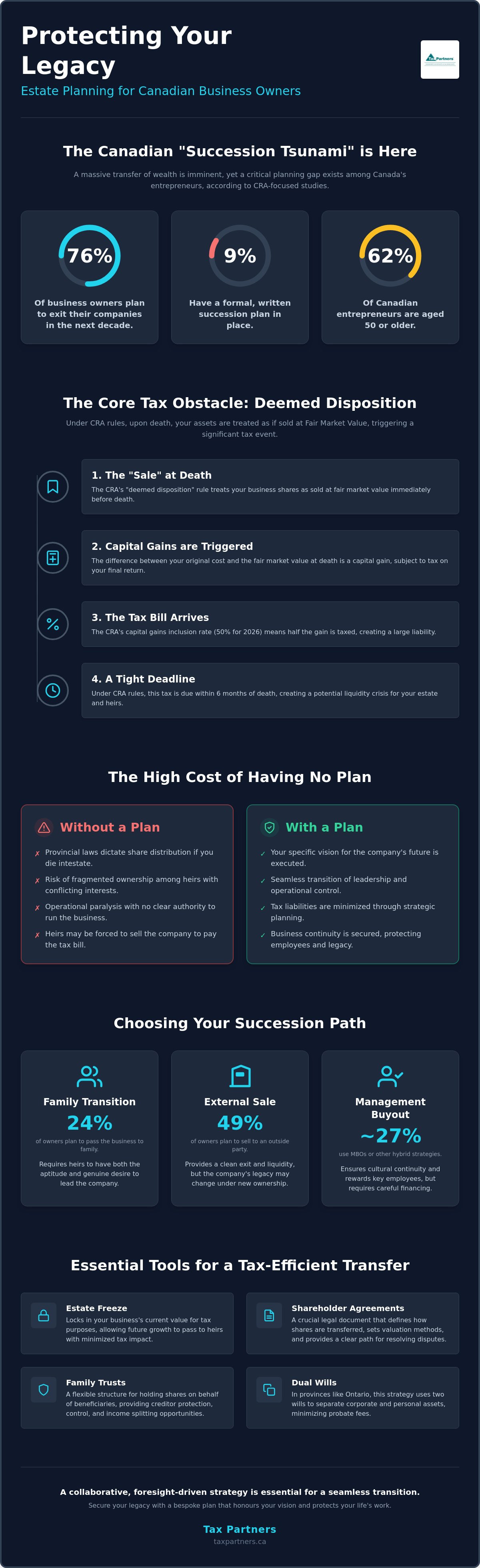
In Canada, we don't have a traditional estate tax like the one managed by the IRS in the United States. Instead, the CRA applies the "deemed disposition" rule. At the time of death, you're treated as having sold all your capital property at fair market value. This includes your business shares. If your company has grown significantly, this can trigger a massive capital gains tax bill. For 2026, the capital gains inclusion rate for CRA filers is a flat 50% for individuals and corporations. This creates a potential liquidity crisis; under CRA rules, the tax owing on a final return is due within 6 months of the date of death. Without a plan to fund this liability, your heirs might be forced to sell the company just to pay the tax.
Beyond the Basic Will
A standard personal will is often insufficient to govern a complex business. You need to ensure your executor has the specific authority to vote corporate shares and manage business operations during the probate process. This is a core part of Succession planning. Without these specific powers, the transition of leadership can stall in the court system. A bespoke approach often involves the use of dual wills in provinces like Ontario to minimize probate fees on corporate assets. This strategy allows you to organize your affairs so that the business can continue to run smoothly while the rest of your estate moves through legal channels. While the previous section focused on the technicalities of CRA tax rules and the "deemed disposition," we must now address the "human" side of the equation. Succession planning is the process of identifying and preparing the next generation of leadership. It's the bridge between a business that exists today and a legacy that continues tomorrow. Comprehensive estate planning for business owners requires this dual focus: one eye on the tax man and the other on your talent pool. Stability isn't something that happens overnight; it requires years of intentional training and mentorship to ensure the business doesn't collapse when the founder steps away. The timing of this planning is becoming critical for the Canadian economy. According to research from Doane Grant Thornton LLP (June 2026), 62% of Canadian entrepreneurs are now 50 years of age or older. This demographic shift means a significant volume of companies will change hands very soon. Without a clear roadmap for who will take the helm, these businesses risk operational paralysis during the probate process or upon the unexpected incapacity of the founder.
Internal vs. External Transitions
Passing the torch to a child or relative is often the most rewarding choice, but it's also the most complex. You must honestly evaluate if your heirs have both the professional aptitude and the genuine desire to lead. Data from Doane Grant Thornton LLP (June 2026) indicates that approximately 24% of Canadian entrepreneurs plan to sell to a family member. Forcing a child into a role they don't want is a recipe for corporate decline. Using a succession planning for family business strategy helps maintain harmony by setting clear expectations and professional boundaries. If an internal candidate isn't viable, the same study shows that 49% of owners will sell to a buyer with no personal connection, which may be the best way to secure your financial future.
The Management Buyout (MBO) Option
Sometimes the best successors are already on your payroll. A management buyout allows your key employees to take the reins, which often preserves the company culture better than an external sale. This often involves vendor take-back (VTB) financing. In a VTB arrangement, you essentially act as the bank by allowing the buyers to pay the purchase price over time from the company's future profits. It ensures you receive fair value for your life's work while providing a manageable entry point for your team. This structure can be particularly effective for Canadian owners who want to reward long-term staff while exiting the daily operations. Don't wait for a milestone birthday or a health scare to start this process. You also need a "break glass in case of emergency" contingency plan for unexpected incapacity to protect your employees and partners under Canadian law. If you're ready to begin drafting your roadmap, you can speak with our advisory team to explore which transition model fits your goals. While identifying your successor secures the operations, neutralizing the growing tax burden secures the capital. Effective estate planning for business owners involves a proactive shift from simple wealth accumulation to strategic wealth preservation. Without a clear plan, your company’s success inadvertently builds a massive future liability for your heirs. To combat this, we often implement an "Estate Freeze," a powerful mechanism designed to cap your tax exposure at its current level while allowing future appreciation to bypass your personal estate. An Estate Freeze works by locking in the value of your business at today's fair market value. By converting your common shares into preferred shares with a fixed value, you create a ceiling for the capital gains tax that will eventually be due upon death under Canadian tax law. This foresight allows you to accurately calculate your future tax bill today, rather than leaving your family with an unpredictable financial burden years down the road. It turns a potential crisis into a manageable, predictable line item in your long-term strategy.
The Mechanics of an Estate Freeze
The process begins by exchanging your existing common shares for preferred shares. These preferred shares have a fixed redemption value equal to the company’s current worth. Simultaneously, the corporation issues new common shares to your children or a family trust at a nominal price. Since these new shares start with zero value, any future growth in the company’s value is attributed to the new shareholders rather than your personal estate. You can also choose to "crystallize" your gains during this reorganization. This involves triggering a deemed sale to utilize your current tax exemptions, effectively increasing the cost base of your shares and reducing the terminal tax hit for CRA filers.
Utilizing the Lifetime Capital Gains Exemption (LCGE)
The LCGE is a cornerstone of Canadian tax planning that every entrepreneur should understand. For 2026, the Lifetime Capital Gains Exemption for qualifying small business corporation (QSBC) shares is approximately $1.25 million under CRA rules in Canada. To qualify as a QSBC, your business must meet specific CRA criteria, including the "asset test" where at least 90% of assets must be used in active business in Canada at the time of the transfer. By holding shares through a family trust, you can potentially multiply this $1.25 million exemption across several beneficiaries, shielding millions of dollars from the capital gains tax. This strategy keeps significantly more capital within your family, providing a stable foundation for the next generation's success. Planning for this liability is not just about reduction; it's about liquidity. Even with a perfect freeze, the CRA requires payment shortly after death. Life insurance remains a primary tool to provide the necessary cash, acting as a proactive guardian for your business assets. It ensures that your legacy is preserved intact, without the need to liquidate the very company you spent a lifetime building. By combining these tax tools with a robust funding plan, you move from a state of uncertainty to one of total control over your financial destiny. While tax strategies like the Estate Freeze provide the financial blueprint, legal structures act as the foundation that holds your legacy together. Without these protections, even the most tax-efficient plan can crumble under the weight of a shareholder dispute or a prolonged probate process. Comprehensive estate planning for business owners must include a robust Shareholder Agreement and a clear definition of authority through Powers of Attorney. These documents ensure that your business remains operational and your family remains protected during a transition. One of the most overlooked risks is the period of incapacity. Many entrepreneurs focus entirely on what happens after they pass away, but what happens if you're alive but unable to make decisions? You need a Power of Attorney (POA) for personal care to handle medical choices, but more importantly, a POA for property and business. The individual making your health decisions might not be the right person to vote your corporate shares, manage payroll, or sign legal contracts. Assigning a specific business POA ensures a proactive guardian is at the helm of your company if you cannot be.
The Power of the Shareholder Agreement
Think of a Shareholder Agreement as a "corporate pre-nuptial." It's essential for any business with more than one owner. The most critical component is the "buy-sell" clause, which dictates exactly what happens if a shareholder dies or becomes disabled. It prevents a grieving spouse or an inexperienced heir from becoming an accidental business partner by forcing the sale of shares back to the company or the surviving partners. To make this work, you must agree on a valuation method while everyone is healthy and rational. Most successful owners fund these buyouts with corporate-owned life insurance, ensuring the cash is available the moment it's required.
Family Trusts as a Multi-Purpose Tool
Family trusts offer a sophisticated way to manage asset distribution while bypassing the provincial probate process. Because the trust owns the assets rather than the individual, those assets don't form part of your estate and aren't subject to the delays of court validation. This is particularly valuable in provinces like Ontario or British Columbia where probate fees are higher. However, you must plan for the CRA's "21-year rule." Under this rule, a trust is deemed to have sold its assets at fair market value every 21 years, which triggers capital gains taxes. Expert oversight helps you distribute assets to beneficiaries before this deadline to defer that tax hit. In certain jurisdictions, we also recommend "Dual Wills" to further shield your business from unnecessary costs. This allows you to separate corporate shares into a secondary will that doesn't require probate, potentially saving your heirs thousands in Estate Administration Tax. If you want to ensure your legal structures are as strong as your business, you should book a consultation with our estate specialists to review your current agreements. Effective estate planning for business owners is rarely a solo performance. It's a collaborative effort that requires a seamless dialogue between your legal counsel and your tax advisors. While a lawyer drafts the legal "shell" of your will or trust, a CPA ensures the financial "engine" inside those structures is tuned for maximum tax efficiency. We provide the technical data and strategic foresight needed to ensure that your legal documents actually achieve their intended financial outcomes under complex CRA regulations. Our role is to act as a proactive guardian for your wealth. We don't just react to the requirements of the past year; we look ahead to identify potential tax traps before they become liabilities. By aligning your corporate structure with your personal goals, we help you realize a customized plan that protects your family's future and honours your life's work. This partnership provides the stability you need to focus on running your business while we manage the intricate details of wealth preservation and CRA compliance.
Our Proactive Guardian Approach
We believe in moving beyond reactive tax filing toward long-term strategic wealth management. With over 40 years of experience, our firm offers the institutional wisdom necessary to handle the unique challenges faced by Canadian SMEs. Tax laws are not static. The CRA frequently updates its positions on matters like trust reporting and capital gains inclusion rates. We provide regular reviews of your estate roadmap to ensure your strategy remains relevant and robust in the face of changing legislation.
Next Steps: Building Your Estate Roadmap
The journey toward a secure legacy begins with a clear understanding of your current position. This often starts with a comprehensive business valuation to establish a baseline for your "deemed disposition" planning. From there, we work to align your personal retirement needs with your eventual exit strategy. Whether you're looking to transition to the next generation or prepare for a third-party sale, we help you organize your affairs to minimize friction and maximize value. Securing your legacy doesn't have to be a source of stress. With the right team by your side, you can move from uncertainty to total control. If you're ready to protect what you've built, you should contact Tax Partners for a strategic estate planning consultation. We'll help you draft a roadmap that provides peace of mind for you and a clear path forward for your heirs. Your business is the result of years of dedication, sacrifice, and strategic growth. Protecting that legacy requires more than just a standard will; it demands a comprehensive approach to estate planning for business owners that addresses both CRA tax liabilities and operational continuity. By implementing the structures we've discussed, such as an Estate Freeze or utilizing the Lifetime Capital Gains Exemption, you can ensure your hard work benefits your heirs rather than being consumed by deemed disposition taxes. You've built something remarkable. Now it's time to ensure it stands the test of time. With over 40 years of Canadian tax expertise and specialized wealth management strategies, we've helped countless entrepreneurs move from uncertainty to total clarity. Our 1,390+ five-star Google reviews reflect our commitment to being a proactive guardian for our clients' success. Don't leave your life's work to chance. Secure your business legacy with Tax Partners—book your consultation today. We're here to provide the steady hand and institutional wisdom you need to protect your family and your future. Your legacy is our priority.
What is the difference between a will and an estate plan for a business owner?
A will is just one piece of the puzzle. Comprehensive estate planning for business owners involves multiple legal and financial tools like shareholder agreements, family trusts, and tax-deferred transfer strategies. While a will dictates asset distribution, an estate plan ensures your business remains operational and tax-efficient during the transition. It's about securing your legacy rather than just dividing your assets.
How does the CRA tax a business when the owner passes away?
Under CRA rules, a deceased individual is "deemed" to have sold all capital property at fair market value immediately before death. This triggers capital gains tax on the appreciation of your business shares. For 2026, the capital gains inclusion rate is 50%. The resulting tax bill is generally due within six months of the date of death, which can create a sudden liquidity crisis for the company.
Can I use the Lifetime Capital Gains Exemption (LCGE) in my estate plan?
You can use the LCGE to shield your estate from significant taxes. In 2026, this exemption is approximately $1.25 million for qualifying small business corporation (QSBC) shares. To qualify for this CRA tax benefit, your corporation must meet specific asset tests. This includes the requirement that at least 90% of assets are used in active business in Canada at the time of death.
What is an estate freeze and when should a Canadian business owner consider one?
An estate freeze is a transaction that fixes the value of your business shares at their current fair market value. By exchanging common shares for preferred shares, you "freeze" your future tax liability while passing all subsequent growth to your heirs. Canadian business owners should consider this when their company's value begins to exceed the amount they need for a comfortable retirement.
How can life insurance help with estate planning for my corporation?
Life insurance provides the immediate liquidity needed to pay the CRA tax bill without forcing a sale of business assets. It's also a critical tool for funding buy-sell agreements within a shareholder agreement. This ensures that surviving partners have the cash to buy out a deceased owner's shares. This provides stability for the company and a fair, timely payout for the heirs.
What happens to my business if I become incapacitated without a Power of Attorney?
If you become incapacitated without a Power of Attorney (POA), your business may face operational paralysis. No one will have the legal authority to sign contracts, pay employees, or vote your shares. In such cases, the court must appoint a guardian to manage your affairs. This process is often slow, expensive, and public. It can significantly damage the company's value and reputation.
Why should I consider having dual wills for my Canadian business?
Dual wills are a strategic tool used to minimize provincial probate fees, specifically in provinces like Ontario. By creating a primary will for public assets and a secondary will for private corporate shares, you can bypass the court validation process for your business. This keeps your corporate details private. It also saves your estate approximately 1.5% in Estate Administration Tax on the value of those shares.
How often should I update my business estate plan?
You should review your plan every three to five years or whenever a major life event occurs. Significant changes like a marriage, divorce, or a substantial increase in business value should trigger an immediate update. Regular reviews ensure your plan remains compliant with evolving CRA regulations. They also ensure your strategy continues to reflect your current personal and professional goals.