Year-End Accounting for Business: A Comprehensive Canadian Checklist for 2026

Could you be handing over thousands of dollars to the Canada Revenue Agency simply because your records aren't ready for your accountant? For many Canadian entrepreneurs, year end accounting for business feels less like a routine task and more like a high-stakes race against the clock. It's natural to feel overwhelmed by the pressure of reconciling complex transactions or the fear of a CRA audit due to missing documentation. You aren't alone in your confusion over the gap between T2 filing deadlines and tax payment windows.
This article promises a clear way forward through the noise. We've built a structured, CRA-compliant checklist to help you master your fiscal year-end while maximizing your eligible deductions. You'll gain a clean set of books and the peace of mind that comes with total regulatory compliance. We will preview the essential steps for 2026, including navigating the 5.95 percent CPP contribution rates and understanding provincial tax shifts in Ontario and Newfoundland and Labrador. By the end of this guide, you'll have the foresight needed to minimize your corporate tax liability and secure your business's financial future.
Key Takeaways
- Establish a clear reporting timeline by confirming your unique fiscal year-end date through official incorporation documents or previous T2 returns.
- Master your year end accounting for business by systematically reconciling internal ledgers against bank statements to ensure absolute financial integrity.
- Safeguard your operations against CRA scrutiny by verifying payroll source deductions and preparing essential T4 and T5 information returns before the spring deadlines.
- Enhance your tax position by accurately identifying capital assets and conducting physical inventory counts to reflect the true value of your business.
- Reduce professional fees and eliminate tax-season stress by organizing a complete year-end package that transitions your data from simple bookkeeping into a strategic tax resource.
Establishing Your Foundation: Confirming the Fiscal Year-End
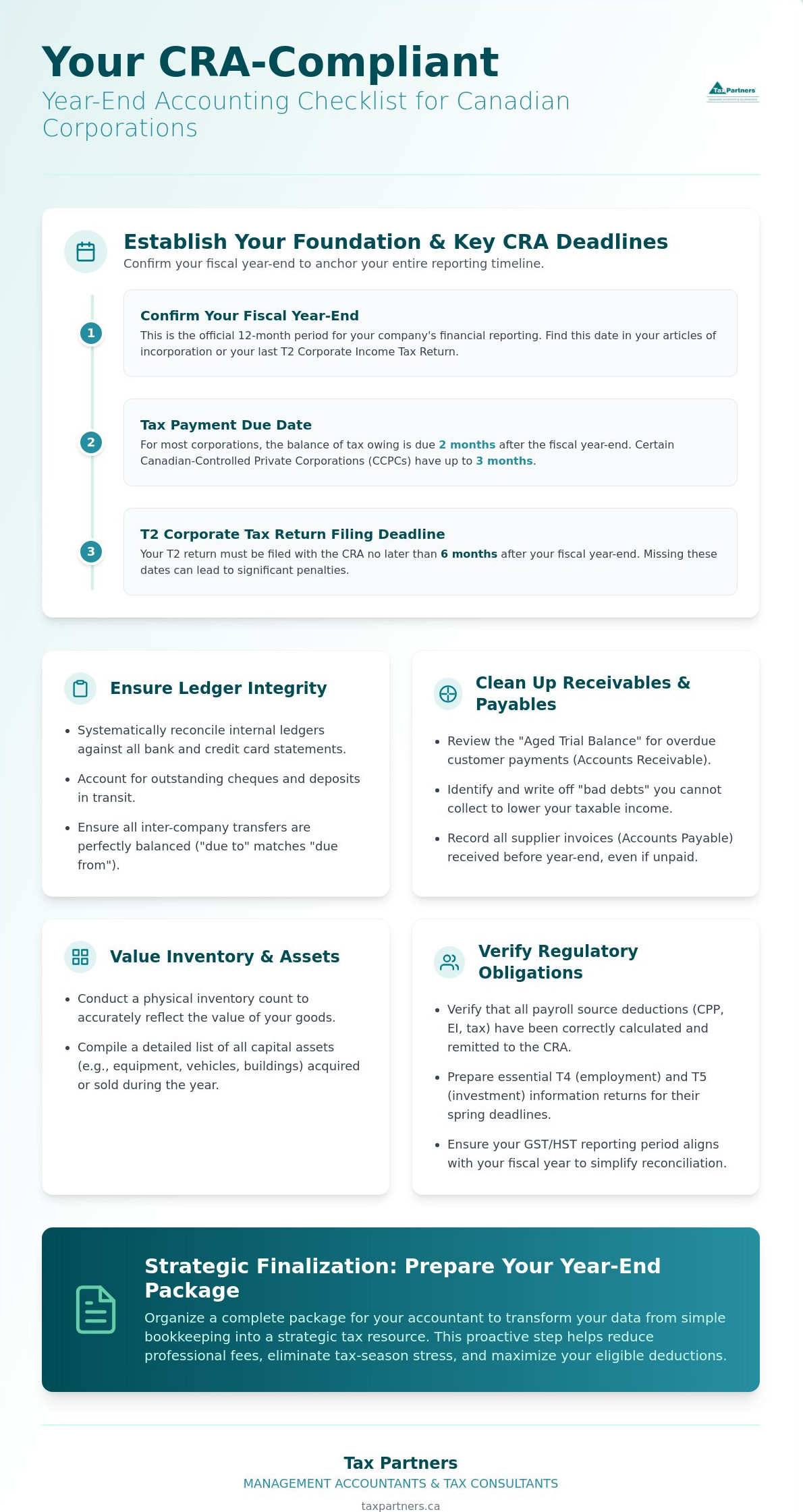
A fiscal year serves as the 12-month pulse of your company's financial health. It's the designated period you use to calculate annual financial statements and determine your tax obligations to the Canada Revenue Agency (CRA). While many new owners assume they must follow the calendar year ending December 31, corporations in Canada often have the flexibility to choose a custom date. Successfully managing financial close management begins with knowing exactly when this window shuts. You can verify your specific date by reviewing your articles of incorporation or your most recent T2 Corporate Income Tax Return.
Choosing a custom fiscal year allows you to align your reporting with your business's natural cycle. For example, a retail business might prefer a January 31 year-end to capture the full holiday season and post-holiday returns before closing the books. Effective year end accounting for business requires this initial clarity; otherwise, you risk missing critical windows for tax planning and inventory valuation. If you're unsure of your current standing, your accountant can help you realize the benefits of a date that reflects your actual cash flow patterns rather than an arbitrary calendar deadline.
Understanding CRA Deadlines for Corporations
Under CRA rules, there's a vital distinction between when you must file your return and when you must pay your taxes. For Canadian corporations, the T2 filing deadline is exactly six months after the fiscal year-end. However, the balance of tax owing is typically due much sooner; usually two months after year-end for most corporations, or three months for certain Canadian-Controlled Private Corporations (CCPCs). If your business is part of a group of associated corporations, these timelines and your access to the small business tax rate may change. Missing these dates is costly. The CRA applies significant penalties for non-compliance, which can reach up to $25,000 in specific cases, making a proactive approach essential for your peace of mind.
Aligning GST/HST Reporting Periods
You must also ensure your Goods and Services Tax (GST) or Harmonized Sales Tax (HST) reporting frequency aligns with your fiscal year. Mismatched periods often lead to confusing cash flow modelling and unnecessary administrative hurdles. If your corporate year ends in June but your GST/HST is filed on a calendar quarter, reconciling your numbers becomes a complex puzzle. You can verify your current filing status and frequency by logging into the "My Business Account" portal on the CRA website. Keeping these cycles synchronized ensures that your year end accounting for business remains a streamlined process rather than a fragmented struggle against conflicting deadlines.
The Reconciliation Phase: Ensuring Ledger Integrity
Integrity in your financial records is the bedrock of a successful filing. Effective year end accounting for business relies on a systematic comparison of your internal ledgers against external realities. You must verify that every transaction on your bank and credit card statements appears accurately in your accounting software. Pay close attention to "deposits in transit" or outstanding cheques that haven't yet cleared the bank. These discrepancies often hide simple errors that could skew your profit margins or trigger unwanted inquiries from the Canada Revenue Agency (CRA).
Transparency is your best defence during a tax review. If you operate multiple business entities, you must ensure all inter-company transfers are perfectly balanced. Every "due to" entry in one company's ledger must have a corresponding "due from" entry in the other. Documenting these movements clearly demonstrates that your businesses aren't shifting funds arbitrarily. Taking the time to investigate these details now prevents a frantic scramble when your accountant begins the T2 preparation.
Cleaning Up Accounts Receivable and Payable
For those new to the terminology, Accounts Receivable (AR) represents the money your customers owe you, while Accounts Payable (AP) represents the money you owe to vendors. To ensure accuracy, you should review your "Aged Trial Balance." This report categorizes outstanding invoices by how long they've been unpaid. Identifying "bad debts" (money you likely won't recover) before your year-end allows you to write them off as an expense. This adjustment helps lower your taxable income. Simultaneously, verify that all vendor invoices received before your year-end date are recorded, even if you haven't paid them yet. This ensures your expenses are captured in the correct fiscal year under the accrual method of accounting.
Reconciling Shareholder Loan Accounts
A shareholder loan account tracks the flow of funds between the business owner and the corporation. It's a high-scrutiny area for CRA filers. Under CRA rules, if you draw money from the company, you generally must repay it within one year after the end of the corporation’s fiscal year. If you don't, the CRA may consider the amount as personal income, leading to an unexpected tax hit. Documenting these transactions with formal corporate resolutions provides a clear paper trail. If these reconciliations feel daunting, you can speak with a professional advisor to ensure your entries meet all regulatory standards.
Inventory, Assets, and the Digital Ledger
Accurately valuing what your business owns is just as vital as tracking what it spends. Performing a physical inventory count is a cornerstone of year end accounting for business. You should conduct this count as close to your fiscal year-end as possible to ensure your financial statements reflect the actual goods on hand. Discrepancies between your digital records and physical stock can lead to errors in your Cost of Goods Sold (COGS) calculation, which directly impacts your reported profit. If you discover obsolete or damaged items, you may be able to write them down to their net realizable value, providing a more precise picture of your company's health.
Beyond your stock, you must review your capital assets. These are significant purchases, such as machinery, vehicles, or specialized equipment, that provide value to your company over several years. Under CRA rules, you cannot deduct the full cost of these items in the year you buy them. Instead, you use the Capital Cost Allowance (CCA) to claim depreciation over time. Each asset falls into a specific CRA class with a designated percentage rate. Reviewing your CCA claims ensures you maximize your legal deductions while staying compliant. If you sold or scrapped any equipment during the year, you must document these disposals to adjust your asset classes and account for any potential recaptured depreciation or terminal losses.
Reporting Cryptocurrency and Digital Assets
For CRA filers, it's essential to realize that the CRA views cryptocurrency as a commodity rather than a traditional currency. This means your digital transactions are subject to the same rules as barter transactions. You must reconcile every wallet trade and transfer using professional accounting software that tracks your adjusted cost base (ACB). Depending on the frequency and nature of your trading, the CRA may classify your crypto activity as either business income or capital gains. Business income is fully taxable, while only 50 percent of a capital gain is typically included in your income. Proper documentation now prevents significant headaches during a future audit.
Reviewing Prepaid Expenses and Accruals
Precision in your year end accounting for business also requires adjusting for timing differences. You likely have prepaid expenses, such as annual insurance premiums or rent paid in advance, that cover months in the next fiscal year. You should only record the portion used in the current year as an expense; the rest remains an asset on your balance sheet. Conversely, you must account for accrued liabilities. These are expenses you've incurred but haven't yet received an invoice for, such as utilities or professional fees. Recording these accruals ensures your financial statements reflect your true obligations at the moment the year closes. This foresight ensures your records remain transparent and audit-ready.
Compliance Checkpoints: Payroll and Regulatory Obligations
Managing your payroll obligations is a significant part of year end accounting for business. You must ensure that the total source deductions taken from employee paycheques match exactly what you remitted to the CRA throughout the year. For 2026, keep in mind the CPP contribution rate is 5.95 percent for both employees and employers. Any discrepancy here can lead to a Pensionable and Insurable Earnings Review (PIER) report from the CRA, which often results in unwanted penalties and interest charges. Taking the time to verify these totals now ensures your filings remain beyond reproach.
Once your numbers are reconciled, you need to prepare T4 slips for your employees and T5 slips for any dividends paid to shareholders. Precision is paramount during this stage. You must include all "Taxable Benefits," such as automobile allowances or employer-paid life insurance premiums, as these are considered part of an individual's total compensation under CRA rules. It's also a critical time to verify worker classifications. The CRA continues to apply high scrutiny to whether workers are truly independent contractors or if they should be classified as employees. Incorrectly classifying a worker can lead to a significant bill for unpaid employer contributions and taxes.
Finalizing GST/HST and Other Tax Remittances
Perform a "reasonableness test" on your sales tax filings before closing the books. Your total GST collected should generally equal 5 percent of your taxable Canadian sales. This is also your final opportunity to capture any Input Tax Credits (ITCs) you might have missed during your monthly bookkeeping. These credits represent the GST/HST you paid on business expenses and directly reduce the amount you owe to the government. If you operate in provinces like British Columbia or Saskatchewan, ensure you have also met your specific provincial sales tax obligations, as these requirements remain separate from the federal harmonized system.
For instance, routine maintenance and cleaning for your commercial vehicles at Nanak Car Wash are taxable business expenses that qualify for these valuable credits.
Similarly, for business travel requirements in the UK, choosing a dependable provider like A Taxi 24/7 provides the consistent invoicing needed to support your expense claims and simplify your year-end reconciliation.
Preparing for Electronic Filing Standards
The CRA is moving decisively away from paper-based systems. Most corporations are now required to file their returns and make payments through digital channels. You must verify that your accounting software is updated to handle the 2026 electronic filing protocols to avoid processing delays or technical errors. This transition is often easier when you have received professional business incorporation tax advice, as setting up these digital pathways early creates a more resilient reporting structure. If you need assistance navigating these portals or reconciling your payroll, you can contact our team for expert guidance.
Strategic Finalization: Moving from Bookkeeping to Tax Optimization
The final phase of your fiscal cycle marks a critical transition from administrative record-keeping to high-level financial strategy. While bookkeeping ensures your daily transactions are captured accurately, year end accounting for business involves interpreting that data to secure your company's future. This is the moment where you move beyond simply "balancing the books" and start looking for ways to enhance your bottom line. By organizing a comprehensive year-end package for your professional advisor, you reduce billable hours and ensure your files are ready for an efficient T2 preparation. This package should include your final trial balance, bank reconciliations, and the physical inventory records discussed in earlier chapters.
Strategic finalization also opens the door to significant tax-saving opportunities. For Canadian-Controlled Private Corporations (CCPCs), the federal small business tax rate remains at a competitive 9 percent for 2026. You should also evaluate your eligibility for the Scientific Research and Experimental Development (SR&ED) tax incentive if your business invested in innovation this year. These credits can often offset a substantial portion of your tax liability. Once the filing is complete, you must set a firm date for a post-year-end review. This meeting allows you to analyze why certain targets were missed and how you can refine your processes for the upcoming fiscal cycle.
The Role of Professional Tax Preparation
Engaging an expert for your corporate filings provides a layer of "Audit Defense" that software alone cannot offer. Professional oversight ensures you remain compliant with evolving CRA regulations while identifying deductions that often pay for the service itself. For complex SMEs, seeking professional tax preparation in Toronto provides access to specialized knowledge regarding provincial tax shifts, such as the Ontario small business rate decrease to 2.2 percent effective July 1, 2026. A seasoned mentor doesn't just react to the numbers; they proactively shield your business from regulatory risks and find hidden efficiencies in your corporate structure.
Setting Financial Goals for the New Year
Use the insights gained from your 2026 data to build a resilient budget and cash flow forecast for 2027. Identifying specific Key Performance Indicators (KPIs), such as your current ratio or gross profit margin, allows you to track your progress with precision throughout the next four quarters. You've worked hard to build your enterprise, and you deserve a partner who is as invested in your success as you are. At Tax Partners, we act as your proactive guardian, providing the steady hand and institutional wisdom needed to navigate the complexities of Canadian tax law. Together, we can transform your year end accounting for business from a seasonal stressor into a powerful catalyst for long-term growth.
Securing Your Financial Future for 2027
Mastering year end accounting for business isn't just a regulatory requirement; it's a strategic advantage that protects your company's growth. By confirming your fiscal deadlines, reconciling every ledger entry, and accurately valuing your assets, you move from simple data entry to powerful financial foresight. This process ensures you remain compliant with the Canada Revenue Agency while uncovering the deductions you've earned through your hard work. You don't have to face the complexities of the 2026 tax season alone.
With over 40 years of Canadian tax expertise and more than 495,000 returns filed since 1981, we understand the nuances of the CRA's evolving rules. Our 1,390+ five-star Google reviews reflect our commitment to providing the steady hand and reliable partnership your business deserves. Let Tax Partners manage your year-end accounting for total peace of mind. We're ready to help you close this year with confidence and step into the next one with total clarity. Your success is our mission, and we're here to guide you every step of the way.
Frequently Asked Questions
What is the difference between a fiscal year and a calendar year for Canadian businesses?
A calendar year always ends on December 31, while a fiscal year is any 12-month period chosen by a corporation for its reporting cycle. Under CRA rules, new corporations can select their year-end date during their first year of operation. This flexibility allows you to align your year end accounting for business with your industry's natural seasonal peaks or specific cash flow patterns.
When is the actual deadline to pay my corporate taxes to the CRA?
Most Canadian corporations must pay their taxes within two months of their fiscal year-end. However, certain Canadian-Controlled Private Corporations (CCPCs) may qualify for a three-month payment deadline if they meet specific income and asset thresholds. It's important to realize that this payment deadline is much earlier than the six-month T2 filing deadline given by the CRA.
Can I change my fiscal year-end date once it has been established?
Yes, you can request a change to your fiscal year-end, but you generally need to obtain written permission from the CRA first. You must provide a sound business reason for the change, such as a shift in your company's ownership or a change in your primary business activity. The CRA typically won't approve changes made solely to minimize taxes or for personal convenience.
What documents do I need to provide to my accountant for year-end?
You should provide your accountant with a complete trial balance, bank and credit card statements, and a detailed list of accounts receivable and payable. Additionally, include records of any capital asset purchases, physical inventory counts, and shareholder loan transactions. Organizing these documents into a clean package helps ensure your year end accounting for business remains efficient and avoids unnecessary billable hours.
How does the CRA treat cryptocurrency transactions at year-end?
The CRA treats cryptocurrency transactions as barter transactions, meaning the value of the digital asset is viewed as a commodity rather than legal tender. Depending on the nature of your activity, gains or losses are reported as either business income or capital gains. You must maintain detailed records of every trade, including the date and the Canadian dollar value at the time of the transaction.
What happens if I miss the T2 filing deadline for my corporation?
Missing the T2 filing deadline results in an immediate late-filing penalty from the CRA. This penalty is 5 percent of the unpaid tax that was due on the filing date, plus an additional 1 percent for each complete month the return is late, up to a maximum of 12 months. Repeat offenders may face even higher penalties, making timely compliance essential for your financial stability.
Are shareholder draws considered taxable income at the business year-end?
Shareholder draws are not immediately taxable as personal income if they are repaid within one year after the end of the corporation's fiscal year. However, if the draw remains unpaid beyond this window, the CRA may include the amount in your personal income for the year it was withdrawn. Properly documenting these draws as loans with corporate resolutions is a key part of your regulatory obligations.
How long should I keep my year-end accounting records and receipts?
You must keep your year-end accounting records and supporting documents for at least six years from the end of the last tax year they relate to. This includes receipts, invoices, bank statements, and payroll records. In certain cases, such as when a return is filed late or an objection is pending, the CRA may require you to retain these records for an even longer period.

Article by
Mahad Mohamed
Mahad Mohamed is an accountant and the CEO of Tax Partners, with over 26 years of Canadian and international tax and accounting experience. His expertise includes corporate reorganization, cross-border tax structuring (Canada & US), tax disputes, CRA audits, and tax planning for small owner-managed private corporations. Most recently, Mahad is a pioneer in Canadian crypto taxation and founded Block3 Finance. Previously, Mahad worked for the Canada Revenue Agency (CRA), Big4 accounting firms, and served as a Rulings Officer for the Federal Tax Authority of the UAE before acquiring Tax Partners in 2014. Tax Partners has 44 full-time accountants and over 18,400 clients.
Disclaimer
This article provides general information only and is current as of its publication date. It has not been updated and may be out of date. It does not constitute legal advice and should not be relied upon as such. Every tax situation is unique and may differ from the examples discussed in this article. If you have specific questions, you should seek the advice of our accountants for your unique circumstances. Book a FREE Initial Consultation Today!
Frequently Asked Questions
Understanding CRA Deadlines for Corporations
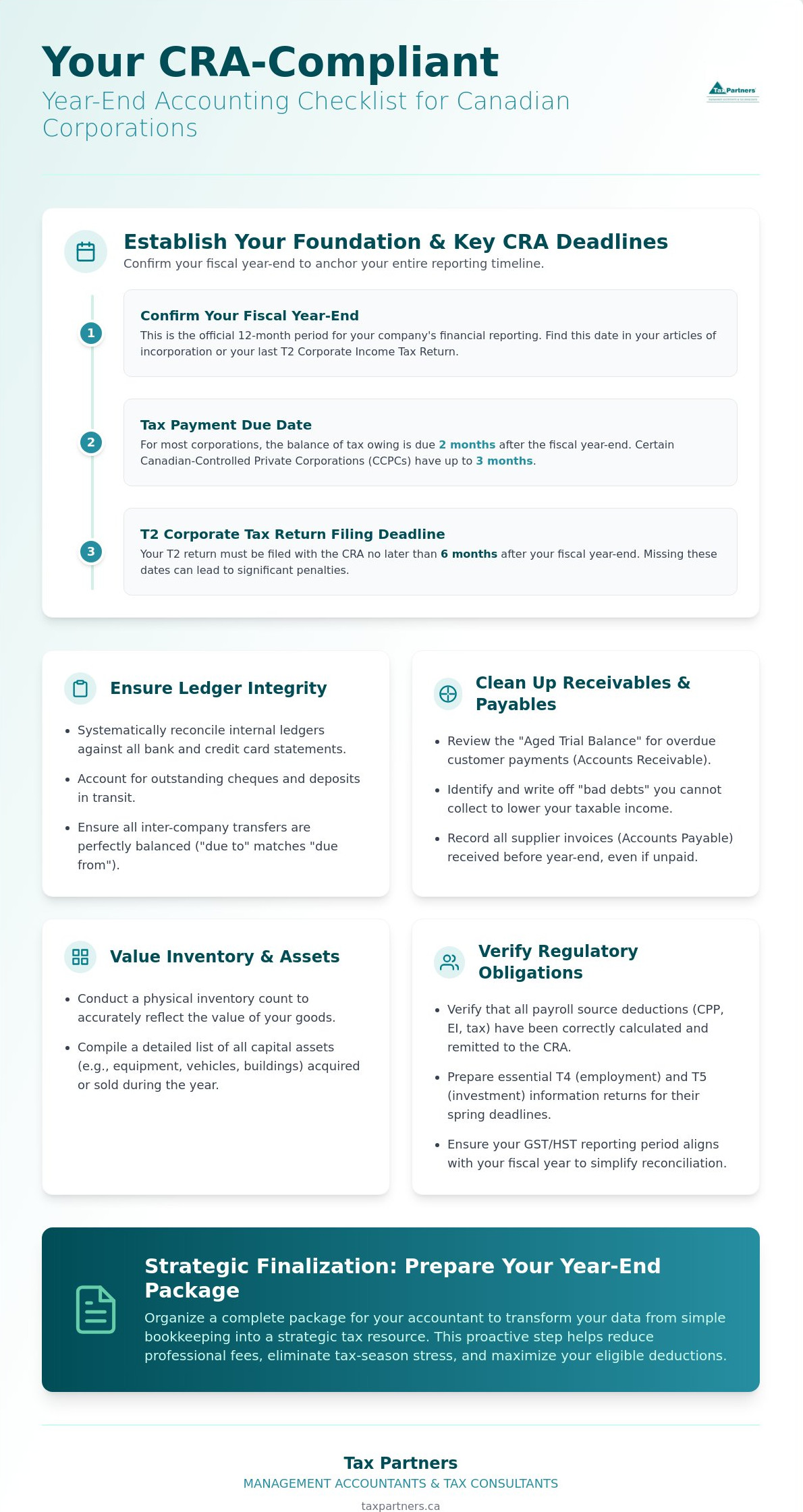
Under CRA rules, there's a vital distinction between when you must file your return and when you must pay your taxes. For Canadian corporations, the T2 filing deadline is exactly six months after the fiscal year-end. However, the balance of tax owing is typically due much sooner; usually two months after year-end for most corporations, or three months for certain Canadian-Controlled Private Corporations (CCPCs). If your business is part of a group of associated corporations, these timelines and your access to the small business tax rate may change. Missing these dates is costly. The CRA applies significant penalties for non-compliance, which can reach up to $25,000 in specific cases, making a proactive approach essential for your peace of mind.
Aligning GST/HST Reporting Periods
You must also ensure your Goods and Services Tax (GST) or Harmonized Sales Tax (HST) reporting frequency aligns with your fiscal year. Mismatched periods often lead to confusing cash flow modelling and unnecessary administrative hurdles. If your corporate year ends in June but your GST/HST is filed on a calendar quarter, reconciling your numbers becomes a complex puzzle. You can verify your current filing status and frequency by logging into the "My Business Account" portal on the CRA website. Keeping these cycles synchronized ensures that your year end accounting for business remains a streamlined process rather than a fragmented struggle against conflicting deadlines. Integrity in your financial records is the bedrock of a successful filing. Effective year end accounting for business relies on a systematic comparison of your internal ledgers against external realities. You must verify that every transaction on your bank and credit card statements appears accurately in your accounting software. Pay close attention to "deposits in transit" or outstanding cheques that haven't yet cleared the bank. These discrepancies often hide simple errors that could skew your profit margins or trigger unwanted inquiries from the Canada Revenue Agency (CRA). Transparency is your best defence during a tax review. If you operate multiple business entities, you must ensure all inter-company transfers are perfectly balanced. Every "due to" entry in one company's ledger must have a corresponding "due from" entry in the other. Documenting these movements clearly demonstrates that your businesses aren't shifting funds arbitrarily. Taking the time to investigate these details now prevents a frantic scramble when your accountant begins the T2 preparation.
Cleaning Up Accounts Receivable and Payable
For those new to the terminology, Accounts Receivable (AR) represents the money your customers owe you, while Accounts Payable (AP) represents the money you owe to vendors. To ensure accuracy, you should review your "Aged Trial Balance." This report categorizes outstanding invoices by how long they've been unpaid. Identifying "bad debts" (money you likely won't recover) before your year-end allows you to write them off as an expense. This adjustment helps lower your taxable income. Simultaneously, verify that all vendor invoices received before your year-end date are recorded, even if you haven't paid them yet. This ensures your expenses are captured in the correct fiscal year under the accrual method of accounting.
Reconciling Shareholder Loan Accounts
A shareholder loan account tracks the flow of funds between the business owner and the corporation. It's a high-scrutiny area for CRA filers. Under CRA rules, if you draw money from the company, you generally must repay it within one year after the end of the corporation’s fiscal year. If you don't, the CRA may consider the amount as personal income, leading to an unexpected tax hit. Documenting these transactions with formal corporate resolutions provides a clear paper trail. If these reconciliations feel daunting, you can speak with a professional advisor to ensure your entries meet all regulatory standards. Accurately valuing what your business owns is just as vital as tracking what it spends. Performing a physical inventory count is a cornerstone of year end accounting for business. You should conduct this count as close to your fiscal year-end as possible to ensure your financial statements reflect the actual goods on hand. Discrepancies between your digital records and physical stock can lead to errors in your Cost of Goods Sold (COGS) calculation, which directly impacts your reported profit. If you discover obsolete or damaged items, you may be able to write them down to their net realizable value, providing a more precise picture of your company's health. Beyond your stock, you must review your capital assets. These are significant purchases, such as machinery, vehicles, or specialized equipment, that provide value to your company over several years. Under CRA rules, you cannot deduct the full cost of these items in the year you buy them. Instead, you use the Capital Cost Allowance (CCA) to claim depreciation over time. Each asset falls into a specific CRA class with a designated percentage rate. Reviewing your CCA claims ensures you maximize your legal deductions while staying compliant. If you sold or scrapped any equipment during the year, you must document these disposals to adjust your asset classes and account for any potential recaptured depreciation or terminal losses.
Reporting Cryptocurrency and Digital Assets
For CRA filers, it's essential to realize that the CRA views cryptocurrency as a commodity rather than a traditional currency. This means your digital transactions are subject to the same rules as barter transactions. You must reconcile every wallet trade and transfer using professional accounting software that tracks your adjusted cost base (ACB). Depending on the frequency and nature of your trading, the CRA may classify your crypto activity as either business income or capital gains. Business income is fully taxable, while only 50 percent of a capital gain is typically included in your income. Proper documentation now prevents significant headaches during a future audit.
Reviewing Prepaid Expenses and Accruals
Precision in your year end accounting for business also requires adjusting for timing differences. You likely have prepaid expenses, such as annual insurance premiums or rent paid in advance, that cover months in the next fiscal year. You should only record the portion used in the current year as an expense; the rest remains an asset on your balance sheet. Conversely, you must account for accrued liabilities. These are expenses you've incurred but haven't yet received an invoice for, such as utilities or professional fees. Recording these accruals ensures your financial statements reflect your true obligations at the moment the year closes. This foresight ensures your records remain transparent and audit-ready. Managing your payroll obligations is a significant part of year end accounting for business. You must ensure that the total source deductions taken from employee paycheques match exactly what you remitted to the CRA throughout the year. For 2026, keep in mind the CPP contribution rate is 5.95 percent for both employees and employers. Any discrepancy here can lead to a Pensionable and Insurable Earnings Review (PIER) report from the CRA, which often results in unwanted penalties and interest charges. Taking the time to verify these totals now ensures your filings remain beyond reproach. Once your numbers are reconciled, you need to prepare T4 slips for your employees and T5 slips for any dividends paid to shareholders. Precision is paramount during this stage. You must include all "Taxable Benefits," such as automobile allowances or employer-paid life insurance premiums, as these are considered part of an individual's total compensation under CRA rules. It's also a critical time to verify worker classifications. The CRA continues to apply high scrutiny to whether workers are truly independent contractors or if they should be classified as employees. Incorrectly classifying a worker can lead to a significant bill for unpaid employer contributions and taxes.
Finalizing GST/HST and Other Tax Remittances
Perform a "reasonableness test" on your sales tax filings before closing the books. Your total GST collected should generally equal 5 percent of your taxable Canadian sales. This is also your final opportunity to capture any Input Tax Credits (ITCs) you might have missed during your monthly bookkeeping. These credits represent the GST/HST you paid on business expenses and directly reduce the amount you owe to the government. If you operate in provinces like British Columbia or Saskatchewan, ensure you have also met your specific provincial sales tax obligations, as these requirements remain separate from the federal harmonized system.
Preparing for Electronic Filing Standards
The CRA is moving decisively away from paper-based systems. Most corporations are now required to file their returns and make payments through digital channels. You must verify that your accounting software is updated to handle the 2026 electronic filing protocols to avoid processing delays or technical errors. This transition is often easier when you have received professional business incorporation tax advice, as setting up these digital pathways early creates a more resilient reporting structure. If you need assistance navigating these portals or reconciling your payroll, you can contact our team for expert guidance. The final phase of your fiscal cycle marks a critical transition from administrative record-keeping to high-level financial strategy. While bookkeeping ensures your daily transactions are captured accurately, year end accounting for business involves interpreting that data to secure your company's future. This is the moment where you move beyond simply "balancing the books" and start looking for ways to enhance your bottom line. By organizing a comprehensive year-end package for your professional advisor, you reduce billable hours and ensure your files are ready for an efficient T2 preparation. This package should include your final trial balance, bank reconciliations, and the physical inventory records discussed in earlier chapters. Strategic finalization also opens the door to significant tax-saving opportunities. For Canadian-Controlled Private Corporations (CCPCs), the federal small business tax rate remains at a competitive 9 percent for 2026. You should also evaluate your eligibility for the Scientific Research and Experimental Development (SR&ED) tax incentive if your business invested in innovation this year. These credits can often offset a substantial portion of your tax liability. Once the filing is complete, you must set a firm date for a post-year-end review. This meeting allows you to analyze why certain targets were missed and how you can refine your processes for the upcoming fiscal cycle.
The Role of Professional Tax Preparation
Engaging an expert for your corporate filings provides a layer of "Audit Defense" that software alone cannot offer. Professional oversight ensures you remain compliant with evolving CRA regulations while identifying deductions that often pay for the service itself. For complex SMEs, seeking professional tax preparation in Toronto provides access to specialized knowledge regarding provincial tax shifts, such as the Ontario small business rate decrease to 2.2 percent effective July 1, 2026. A seasoned mentor doesn't just react to the numbers; they proactively shield your business from regulatory risks and find hidden efficiencies in your corporate structure.
Setting Financial Goals for the New Year
Use the insights gained from your 2026 data to build a resilient budget and cash flow forecast for 2027. Identifying specific Key Performance Indicators (KPIs), such as your current ratio or gross profit margin, allows you to track your progress with precision throughout the next four quarters. You've worked hard to build your enterprise, and you deserve a partner who is as invested in your success as you are. At Tax Partners, we act as your proactive guardian, providing the steady hand and institutional wisdom needed to navigate the complexities of Canadian tax law. Together, we can transform your year end accounting for business from a seasonal stressor into a powerful catalyst for long-term growth. Mastering year end accounting for business isn't just a regulatory requirement; it's a strategic advantage that protects your company's growth. By confirming your fiscal deadlines, reconciling every ledger entry, and accurately valuing your assets, you move from simple data entry to powerful financial foresight. This process ensures you remain compliant with the Canada Revenue Agency while uncovering the deductions you've earned through your hard work. You don't have to face the complexities of the 2026 tax season alone. With over 40 years of Canadian tax expertise and more than 495,000 returns filed since 1981, we understand the nuances of the CRA's evolving rules. Our 1,390+ five-star Google reviews reflect our commitment to providing the steady hand and reliable partnership your business deserves. Let Tax Partners manage your year-end accounting for total peace of mind. We're ready to help you close this year with confidence and step into the next one with total clarity. Your success is our mission, and we're here to guide you every step of the way.
What is the difference between a fiscal year and a calendar year for Canadian businesses?
A calendar year always ends on December 31, while a fiscal year is any 12-month period chosen by a corporation for its reporting cycle. Under CRA rules, new corporations can select their year-end date during their first year of operation. This flexibility allows you to align your year end accounting for business with your industry's natural seasonal peaks or specific cash flow patterns.
When is the actual deadline to pay my corporate taxes to the CRA?
Most Canadian corporations must pay their taxes within two months of their fiscal year-end. However, certain Canadian-Controlled Private Corporations (CCPCs) may qualify for a three-month payment deadline if they meet specific income and asset thresholds. It's important to realize that this payment deadline is much earlier than the six-month T2 filing deadline given by the CRA.
Can I change my fiscal year-end date once it has been established?
Yes, you can request a change to your fiscal year-end, but you generally need to obtain written permission from the CRA first. You must provide a sound business reason for the change, such as a shift in your company's ownership or a change in your primary business activity. The CRA typically won't approve changes made solely to minimize taxes or for personal convenience.
What documents do I need to provide to my accountant for year-end?
You should provide your accountant with a complete trial balance, bank and credit card statements, and a detailed list of accounts receivable and payable. Additionally, include records of any capital asset purchases, physical inventory counts, and shareholder loan transactions. Organizing these documents into a clean package helps ensure your year end accounting for business remains efficient and avoids unnecessary billable hours.
How does the CRA treat cryptocurrency transactions at year-end?
The CRA treats cryptocurrency transactions as barter transactions, meaning the value of the digital asset is viewed as a commodity rather than legal tender. Depending on the nature of your activity, gains or losses are reported as either business income or capital gains. You must maintain detailed records of every trade, including the date and the Canadian dollar value at the time of the transaction.
What happens if I miss the T2 filing deadline for my corporation?
Missing the T2 filing deadline results in an immediate late-filing penalty from the CRA. This penalty is 5 percent of the unpaid tax that was due on the filing date, plus an additional 1 percent for each complete month the return is late, up to a maximum of 12 months. Repeat offenders may face even higher penalties, making timely compliance essential for your financial stability.
Are shareholder draws considered taxable income at the business year-end?
Shareholder draws are not immediately taxable as personal income if they are repaid within one year after the end of the corporation's fiscal year. However, if the draw remains unpaid beyond this window, the CRA may include the amount in your personal income for the year it was withdrawn. Properly documenting these draws as loans with corporate resolutions is a key part of your regulatory obligations.
How long should I keep my year-end accounting records and receipts?
You must keep your year-end accounting records and supporting documents for at least six years from the end of the last tax year they relate to. This includes receipts, invoices, bank statements, and payroll records. In certain cases, such as when a return is filed late or an objection is pending, the CRA may require you to retain these records for an even longer period.