IRS Streamlined Procedure for Canadians: 2026 Guide

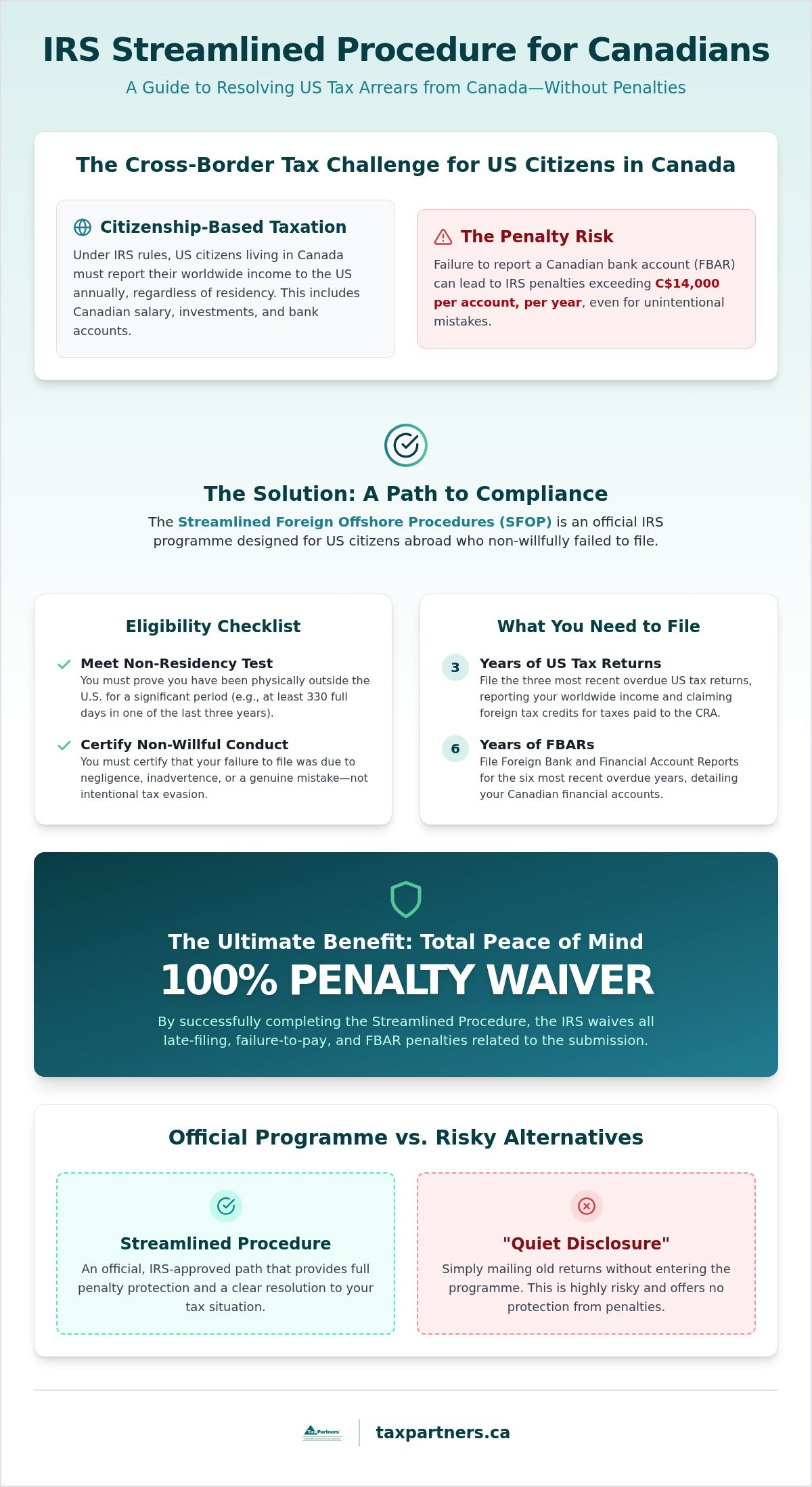
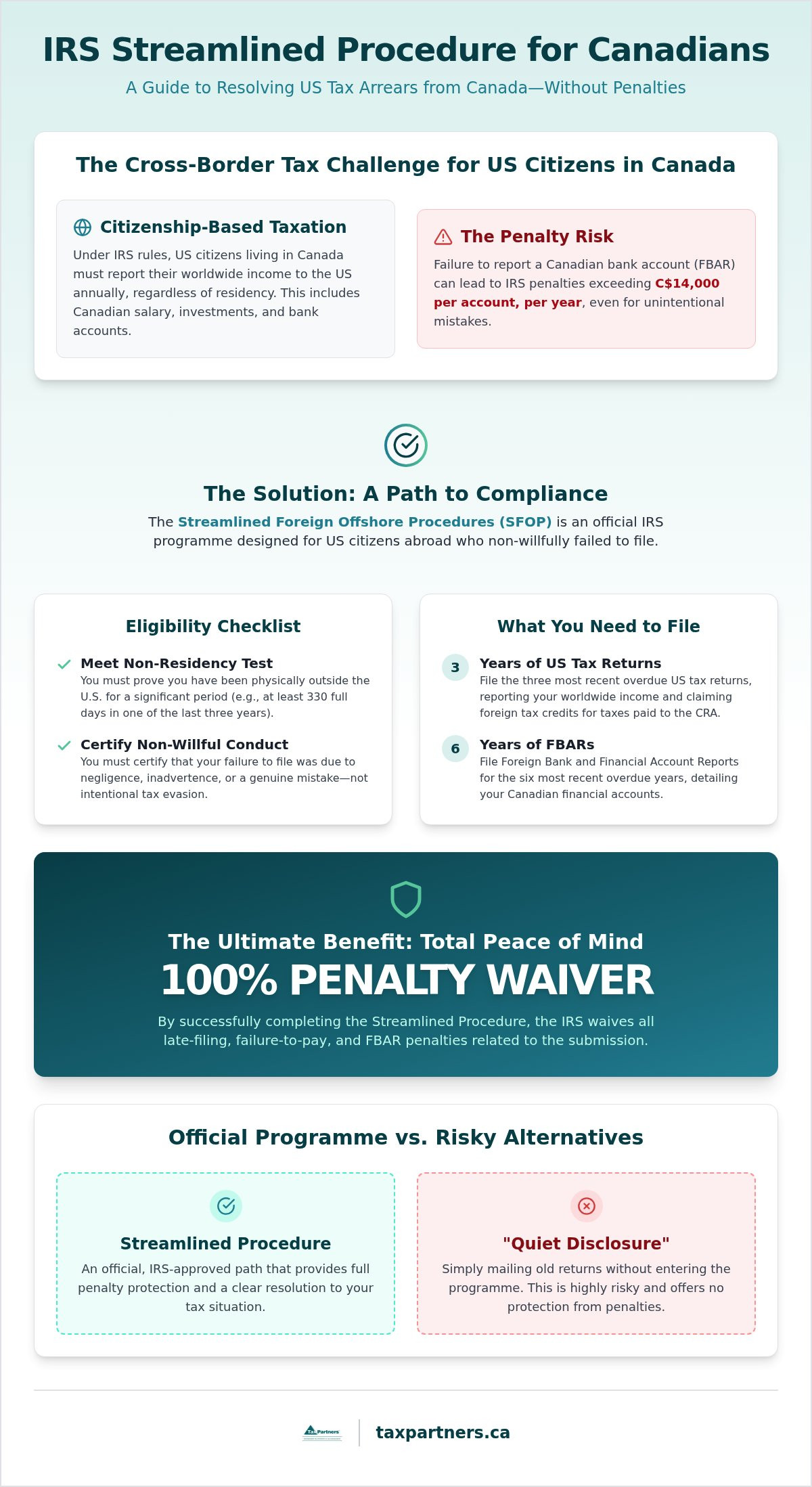
Most Canadians with US citizenship don't realize that the IRS can assess penalties exceeding C$14,000 per year simply for holding a local bank account they haven't reported. It's a staggering figure that often leads to immediate stress regarding your standing under IRS rules. However, the IRS streamlined procedure for Canadians offers a reliable way to fix these past mistakes without facing financial ruin.
It's completely normal to feel overwhelmed by the complex web of cross-border obligations and the fear of double taxation. You've worked hard to build your life in Canada, and the last thing you want is for a technical filing error to jeopardize your financial stability. This program was designed specifically for people who acted with non-willful conduct, meaning they made honest mistakes without any intent to evade the law.
By following this 2026 guide, you'll discover how to resolve your US tax arrears from Canada without facing a single penalty. We'll explore the current eligibility rules for the Streamlined Foreign Offshore Procedures, the critical role of Form 14653, and how to file your Foreign Bank Account Report (FBAR) correctly. This path provides a clear, methodical journey toward total compliance and the lasting peace of mind you deserve.
Key Takeaways
- Understand how citizenship-based taxation under IRS rules applies to your life in Canada and why annual filings remain mandatory regardless of residency.
- Discover how the IRS streamlined procedure for Canadians provides a legitimate path to resolve tax arrears while waiving costly FBAR and late-filing penalties.
- Identify the specific non-residency and non-willful conduct criteria you must meet to qualify for this protective disclosure programme.
- Learn the exact documentation needed to complete the required three years of US tax returns and six years of foreign account reports.
- Gain insights into navigating the US-Canada tax treaty to eliminate the risk of double taxation and secure your cross-border financial status.
Understanding US Tax Obligations for Canadian Residents
Most countries tax individuals based on where they live. The Canada Revenue Agency (CRA), for example, focuses on residency. The United States operates differently. Under IRS rules, US citizens and Green Card holders living in Canada are subject to citizenship-based taxation. This means your tax obligations follow you across the border, regardless of how long you've lived in a Canadian province.
Many Canadians are surprised to learn that their local financial life must be transparent to the IRS. Two specific requirements often cause the most confusion for those living abroad:
- FBAR: The Foreign Bank and Financial Accounts report is a mandatory filing for those with accounts in Canada that exceed specific aggregate thresholds at any point during the year.
- FATCA: The Foreign Account Tax Compliance Act requires you to report your foreign financial assets and interests directly to the IRS on an annual basis.
The Reality of Worldwide Income Reporting
Your annual US return must reflect your global financial activity. This includes your Canadian salary, investment interest, and dividends. While the US-Canada Tax Treaty serves as a shield to prevent double taxation, it isn't an automatic waiver. You must still file a return under IRS rules to claim foreign tax credits for the money you've already paid to the CRA. Even if you owe zero dollars to the US government, the failure to file these forms can trigger heavy financial penalties. For instance, a non-willful FBAR violation can result in a penalty of roughly C$13,500 per account per year, according to industry standards.
Why Canadians Often Fall Behind
It's common for dual citizens to be "accidental Americans." These are individuals who were born in the US or have a US parent but have spent their entire adult lives in Canada. They often remain unaware of their filing duties until they attempt to renew a passport or open a new bank account. Increased transparency and data sharing between the CRA and the IRS mean that these omissions are now easily identified by authorities.
If you've fallen behind, don't panic. The Streamlined Filing Compliance Procedures were created for this exact scenario. By using the IRS streamlined procedure for Canadians, you can catch up on your US tax returns and FBARs without the fear of punitive fines. Acknowledging the requirement is the first step toward a resolution that protects your assets and your peace of mind. The IRS streamlined procedure for Canadians provides a clear path back to compliance for those who acted without any intent to evade their obligations.
The IRS Streamlined Procedure: A Path to Compliance
For Canadians who have unknowingly missed their US filing deadlines, the IRS Streamlined Filing Compliance Procedures offer a powerful reset button. This programme, specifically the Streamlined Foreign Offshore Procedures (SFOP), allows you to come forward voluntarily. It's designed to bring you back into the fold without the crushing weight of accumulated fines.
The IRS streamlined procedure for Canadians requires you to certify that your previous failure to comply was "non-willful." Under IRS rules, this means your conduct resulted from negligence, inadvertence, or a simple mistake. If you truly didn't know you had to file while living in Canada, you likely fit this definition perfectly.
Penalty Abatement and Financial Relief
The most significant advantage of this path is the 100% waiver of late-filing and FBAR penalties. Without this protection, the IRS could technically assess penalties for every year you missed. By using this procedure, you essentially draw a line in the sand and move forward with a clean slate.
This relief is particularly vital for Canadian residents with local retirement accounts or savings. These accounts often trigger complex reporting requirements that are easily missed by those unfamiliar with US law. Achieving full compliance through this official channel provides a definitive finish line for your past tax worries.
Streamlined vs. Traditional Quiet Disclosure
Some taxpayers consider a "quiet disclosure," which involves simply mailing in old returns without entering an official programme. This approach is incredibly risky. It often flags your account for an audit because the IRS sees multiple years of delinquent data arriving at once without explanation.
In contrast, the IRS streamlined procedure for Canadians is an IRS-sanctioned method that provides a clear framework for your submission. It requires a detailed narrative on Form 14653 explaining your non-willfulness. Because this statement is signed under penalty of perjury, professional guidance is essential to ensure your story is told accurately and honestly.
If you're feeling uncertain about how to phrase your certification or organize your records, it may be time to speak with a cross-border specialist who understands both sides of the border. Taking a proactive step now can prevent much larger complications in the future.
Eligibility Criteria for the Streamlined Foreign Offshore Procedures
Qualifying for the IRS streamlined procedure for Canadians requires meeting a specific set of criteria designed to filter out intentional tax evaders. First, you must possess a valid Taxpayer Identification Number (TIN) or Social Security Number (SSN). If you don't have one, you must apply for it concurrently with your submission. Additionally, you cannot be under any form of civil or criminal examination by the IRS. If the authorities have already opened an audit into your accounts, this path is generally closed to you.
The core of the submission is the signed certification on IRS Form 14653. This document is a formal statement where you confirm your eligibility and explain the reasons for your previous non-compliance. It's a high-stakes form that requires precision and total honesty. Mistakes here can lead to the very penalties you're trying to avoid.
Defining the Non-Willful Standard
The IRS defines non-willfulness as conduct that is not intentional or a deliberate evasion of tax. When reviewing your case, the IRS evaluates the "totality of circumstances" to determine if you qualify. They look at your background, your education, and your specific reasons for not filing. For many people in Canada, the reason is simple: they didn't know that US citizenship required filing returns while living abroad. This is particularly common for dual citizens who have spent their entire lives north of the border. The IRS Streamlined Filing Compliance Procedures FAQ provides deeper context on how these rules apply to specific situations, such as holding Canadian retirement accounts.
The Importance of the Residency Test
The rules for the IRS streamlined procedure for Canadians are distinct from those for US residents. To qualify for the foreign version of the programme, you must meet a strict non-residency test. This generally means you must have been outside the US for at least 330 full days in at least one of the three most recent tax years for which the US tax return due date has passed. You also must not have maintained an "abode" (a primary home or centre of domestic life) within the United States during that time.
Because the residency rules can be technical, it's wise to consult a cross-border tax accountant to verify your status before submitting your paperwork. They'll help you determine if you meet the day-count requirements and ensure you're filing under the correct stream. Getting this right from the start is the best way to secure your financial future and avoid unnecessary scrutiny.
The Step-by-Step Filing Process for Canadians
Starting the IRS streamlined procedure for Canadians requires a methodical approach to your financial history. You'll need to gather your Canadian financial records for the specific look-back periods required by the IRS. This includes collecting T4 slips for employment income, T5 slips for investment returns, and monthly bank statements for every account you hold in Canada.
Under IRS rules, you must prepare and submit the last three years of US Individual Income Tax Returns (Form 1040). You're also required to file the last six years of FBAR filings, also known as FinCEN Form 114, for all foreign accounts. The final component is your signed certification of non-willfulness, which explains the specific circumstances that led to your previous non-compliance.
Handling Canadian Registered Accounts
Canadian registered accounts require careful handling under IRS rules to avoid unexpected tax hits. Tax-Free Savings Accounts (TFSAs), for instance, are often viewed as foreign trusts by the IRS, which can trigger additional reporting requirements. While these accounts are tax-free for CRA filers, the IRS does not recognize that status without specific treaty elections.
Registered Retirement Savings Plans (RRSPs) generally fare better. They typically maintain their tax-deferral benefits under the US-Canada Tax Treaty, meaning you won't owe US tax on the growth until you make a withdrawal. However, you must still report the existence and value of these accounts on your FBAR and other required forms to remain fully compliant.
Submitting the Documentation
The submission process for the Streamlined programme is strictly manual. You must file all returns on paper and mail them to a specific IRS facility in the United States. To ensure your file is processed under the correct programme, you should write "Streamlined Foreign Offshore" in red ink at the top of the first page of each tax return.
If your returns show that you owe tax, you must include the full payment with your submission. This includes any tax due for the three-year look-back period plus interest, though the programme waives all late-filing and FBAR penalties. If you're ready to begin organizing your records, contact our cross-border team for a detailed checklist tailored to your specific accounts.
Securing Your Financial Future with Cross-Border Expertise
Achieving full compliance under IRS rules is more than a regulatory hurdle. It's the foundational step toward long-term wealth preservation for any dual citizen or Green Card holder living in Canada. By resolving past omissions, you protect your Canadian assets from potential seizure or extreme levies. Working with a professional firm allows you to realize significant tax efficiencies while ensuring you never pay more than required under the US-Canada Tax Treaty. This financial peace of mind allows you to focus on family wellness; for those exploring elderly care options, you can check out Peace In-Home Health Care Services.
The IRS streamlined procedure for Canadians represents a unique window of opportunity. It allows you to move from a state of uncertainty to one of total control over your financial status. Proactive disclosure is always the safer and more cost-effective route compared to waiting for an IRS notice to arrive in your mailbox. Once the IRS initiates an inquiry or examination, the chance to use these voluntary procedures often vanishes instantly.
The Value of Professional Certification
A CPA-led submission ensures that your certification of non-willfulness is robust and factually sound. This narrative is the most scrutinized part of your filing, and a professional steady hand is vital for its success. Experts can also identify specific credits, such as the Foreign Tax Credit, which often reduces or entirely eliminates US tax owing for those already paying income tax to the CRA. This ensures your cross-border status doesn't lead to unnecessary double taxation.
Beyond the immediate relief, professional guidance helps you organize your financial records for the years ahead. This foresight makes future annual filings simple and stress-free. You'll gain a clear understanding of how your Canadian investments, such as mutual funds or private corporate holdings, interact with US tax law. Tax Partners provides the reliability and ethical steadfastness needed to manage these complex requirements with precision.
For Canadians looking to expand their commercial interests south of the border, Massingill Attorneys & Counselors at Law offers specialized legal support for navigating US business formation and incorporation in Texas.
Start Your Compliance Journey Today
The IRS streamlined procedure for Canadians is an incredible opportunity to wipe the slate clean and secure your cross-border financial standing. Our team possesses decades of institutional wisdom to guide you through every step of this landscape. We handle the technical complexity so you can focus on your life and career in Canada without the weight of tax-related stress.
Don't let the fear of unreported accounts linger any longer. Contact us at Tax Partners to begin your confidential assessment. We're here to act as your proactive guardian, ensuring your financial legacy remains protected on both sides of the border through expert US and cross-border accounting services.
Take Command of Your Cross-Border Compliance
Navigating the complexities of citizenship-based taxation requires a proactive mindset and a clear strategy. By utilizing the IRS streamlined procedure for Canadians, you can resolve years of missing returns while protecting your hard-earned Canadian savings from punitive fines. This programme remains a vital lifeline for those who acted without intent to evade their obligations, providing a methodical path back to total standing under IRS rules. It's about moving from a state of uncertainty to one of complete financial clarity.
Tax Partners offers a steady hand at the helm, combining over 40 years of cross-border tax experience with a commitment to personalized care. Our team has earned over 1,390 five-star Google reviews by delivering bespoke guidance to dual citizens and US expats. We understand the nuances of the US-Canada tax treaty and how it applies to your specific life in Canada. Book a consultation with our cross-border tax experts today to secure your financial legacy. You don't have to carry the weight of regulatory stress alone; we are here to ensure your journey toward compliance is both seamless and successful.
Frequently Asked Questions
Is the IRS Streamlined Procedure still available for Canadians in 2026?
Yes, the IRS streamlined procedure for Canadians remains fully available in 2026 with no announced expiration date. While the IRS reserves the right to modify or terminate this programme at any time, it continues to serve as the primary route for non-willful taxpayers to catch up. You should consider filing as soon as you realize an oversight exists to lock in your eligibility under current IRS rules and avoid future scrutiny.
How much does it cost to file under the IRS Streamlined Procedure?
The total cost depends on your specific financial history and any tax actually owed for the three-year look-back period. While the programme waives all late-filing and FBAR penalties, you must pay any outstanding tax plus interest. Under IRS rules for 2026, the interest rate on underpayments reached 7% for the first and third quarters. Professional fees for cross-border accounting will vary based on the complexity of your Canadian assets and registered accounts.
What happens if the IRS rejects my non-willful certification?
If the IRS rejects your non-willful certification, your case may be referred for a standard civil or criminal examination. This could lead to the assessment of the very penalties the programme was designed to waive, such as the heavy FBAR fines for unreported Canadian accounts. Ensuring your narrative on Form 14653 is robust and accurately reflects your circumstances is the best way to prevent a rejection and secure your financial standing.
Can I use the Streamlined Procedure if I don't have a Social Security Number?
You can still use this procedure even if you don't currently have a Social Security Number. Under IRS rules, you must possess a valid Taxpayer Identification Number (TIN) or apply for one as part of your streamlined submission. For many dual citizens in Canada, this involves applying for an SSN at a US consulate or through the Social Security Administration before or during the filing process to ensure the submission is processed correctly.
Do I have to pay taxes to both the IRS and the CRA on the same income?
You generally won't pay tax to both the IRS and the CRA on the same dollar of income. The US-Canada Tax Treaty provides mechanisms like the Foreign Tax Credit to prevent double taxation. Because Canadian income tax rates are often higher than US federal rates, the credits you receive for taxes paid to the CRA frequently reduce your US tax liability to zero. However, you must still file a return to claim these credits.
What Canadian accounts do I need to report on my FBAR?
Under IRS rules, you must report all foreign financial accounts where the total value exceeded $10,000 USD (approximately C$13,700) at any point during the year. This includes Canadian chequing and savings accounts, investment portfolios, RRSPs, and TFSAs. Even if you are only a joint owner or have signature authority over an account, such as a business account, it must be included in your annual FBAR filing to remain compliant.
How long does it take for the IRS to process a Streamlined filing?
The IRS doesn't provide a specific timeline, but processing usually takes several months to over a year. Because these are paper-filed returns mailed to a specialized facility, the timeline depends on the current backlog. You won't typically receive a formal acceptance letter; instead, the IRS will process your returns and cash any included payment cheques. No further correspondence generally indicates that your IRS streamlined procedure for Canadians submission was successfully accepted.
What is the difference between FBAR and FATCA for Canadians?
The primary difference lies in the reporting thresholds and the specific forms used. FBAR (FinCEN Form 114) focuses on bank and financial accounts and is filed with the Treasury Department. FATCA (Form 8938) is filed with your tax return and covers a broader range of foreign financial assets, such as private company shares. Both requirements apply to US citizens in Canada, though the thresholds for FATCA reporting are significantly higher than those for FBAR.

Article by
Mahad Mohamed
Mahad Mohamed is an accountant and the CEO of Tax Partners, with over 26+ years of Canadian and international tax and accounting experience. His expertise includes corporate reorganization, cross-border tax structuring (Canada & US), tax disputes, CRA audits, and tax planning for small owner-managed private corporations. Most recently, Mahad is a pioneer in Canadian crypto taxation and founded Block3 Finance.
Previously, Mahad worked for the Canada Revenue Agency (CRA), Big4 accounting firms, and served as a Rulings Officer for the Federal Tax Authority of the UAE before acquiring Tax Partners in 2014.
Tax Partners has 44 full-time accountants and over 18,400+ clients.
Disclaimer
This article provides general information only and is current as of its publication date. It has not been updated and may be out of date. It does not constitute legal advice and should not be relied upon as such. Every tax situation is unique and may differ from the examples discussed in this article. If you have specific questions, you should seek the advice of our accountants for your unique circumstances. Book a FREE Initial Consultation Today!
Frequently Asked Questions
Is the IRS Streamlined Procedure still available for Canadians in 2026?
Yes, the IRS streamlined procedure for Canadians remains fully available in 2026 with no announced expiration date. While the IRS reserves the right to modify or terminate this programme at any time, it continues to serve as the primary route for non-willful taxpayers to catch up. You should consider filing as soon as you realize an oversight exists to lock in your eligibility under current IRS rules and avoid future scrutiny.
How much does it cost to file under the IRS Streamlined Procedure?
The total cost depends on your specific financial history and any tax actually owed for the three-year look-back period. While the programme waives all late-filing and FBAR penalties, you must pay any outstanding tax plus interest. Under IRS rules for 2026, the interest rate on underpayments reached 7% for the first and third quarters. Professional fees for cross-border accounting will vary based on the complexity of your Canadian assets and registered accounts.
What happens if the IRS rejects my non-willful certification?
If the IRS rejects your non-willful certification, your case may be referred for a standard civil or criminal examination. This could lead to the assessment of the very penalties the programme was designed to waive, such as the heavy FBAR fines for unreported Canadian accounts. Ensuring your narrative on Form 14653 is robust and accurately reflects your circumstances is the best way to prevent a rejection and secure your financial standing.
Can I use the Streamlined Procedure if I don't have a Social Security Number?
You can still use this procedure even if you don't currently have a Social Security Number. Under IRS rules, you must possess a valid Taxpayer Identification Number (TIN) or apply for one as part of your streamlined submission. For many dual citizens in Canada, this involves applying for an SSN at a US consulate or through the Social Security Administration before or during the filing process to ensure the submission is processed correctly.
Do I have to pay taxes to both the IRS and the CRA on the same income?
You generally won't pay tax to both the IRS and the CRA on the same dollar of income. The US-Canada Tax Treaty provides mechanisms like the Foreign Tax Credit to prevent double taxation. Because Canadian income tax rates are often higher than US federal rates, the credits you receive for taxes paid to the CRA frequently reduce your US tax liability to zero. However, you must still file a return to claim these credits.
What Canadian accounts do I need to report on my FBAR?
Under IRS rules, you must report all foreign financial accounts where the total value exceeded $10,000 USD (approximately C$13,700) at any point during the year. This includes Canadian chequing and savings accounts, investment portfolios, RRSPs, and TFSAs. Even if you are only a joint owner or have signature authority over an account, such as a business account, it must be included in your annual FBAR filing to remain compliant.
How long does it take for the IRS to process a Streamlined filing?
The IRS doesn't provide a specific timeline, but processing usually takes several months to over a year. Because these are paper-filed returns mailed to a specialized facility, the timeline depends on the current backlog. You won't typically receive a formal acceptance letter; instead, the IRS will process your returns and cash any included payment cheques. No further correspondence generally indicates that your IRS streamlined procedure for Canadians submission was successfully accepted.
What is the difference between FBAR and FATCA for Canadians?
The primary difference lies in the reporting thresholds and the specific forms used. FBAR (FinCEN Form 114) focuses on bank and financial accounts and is filed with the Treasury Department. FATCA (Form 8938) is filed with your tax return and covers a broader range of foreign financial assets, such as private company shares. Both requirements apply to US citizens in Canada, though the thresholds for FATCA reporting are significantly higher than those for FBAR.