Understanding the US-Canada Tax Treaty in 2026

Most cross-border taxpayers believe the us canada tax treaty acts as an automatic safety net, but in 2026, it remains a proactive shield that you must actively claim to secure its protections. Relying on the tax authorities to apply these benefits on your behalf is a gamble that often results in double taxation or unexpected penalties. It's natural to feel overwhelmed by the requirement to file both a T1 and a 1040, especially when you're trying to determine which country has the primary right to tax your income.
You deserve a sense of total control over your financial obligations. This guide provides the expert foresight you need to leverage the treaty to eliminate redundant taxes and maintain steadfast compliance with both the CRA and the IRS. We'll walk you through the essential tie-breaker rules for residency, the latest withholding rates on dividends, and the 183-day rule for employment income. By the end, you'll have the clarity and confidence to manage your cross-border affairs with precision and peace of mind.
Key Takeaways
- Shield your wealth. Understand how this bilateral agreement protects your assets by preventing the CRA and the IRS from taxing the same income twice.
- Establish your status. Master the tie-breaker rules within the us canada tax treaty to accurately determine your residency and realize significant tax savings.
- Reduce your tax burden. Identify the specific conditions under which withholding taxes on dividends, interest, and royalties can be reduced or eliminated.
- Ensure steadfast compliance. Learn the essential procedural steps for disclosing treaty-based positions to avoid costly penalties and maintain your standing with both tax authorities.
- Secure your future. Gain insight into how proactive professional guidance helps you manage the intersection of IRS and CRA regulations with total confidence.
The Purpose of the US-Canada Income Tax Convention
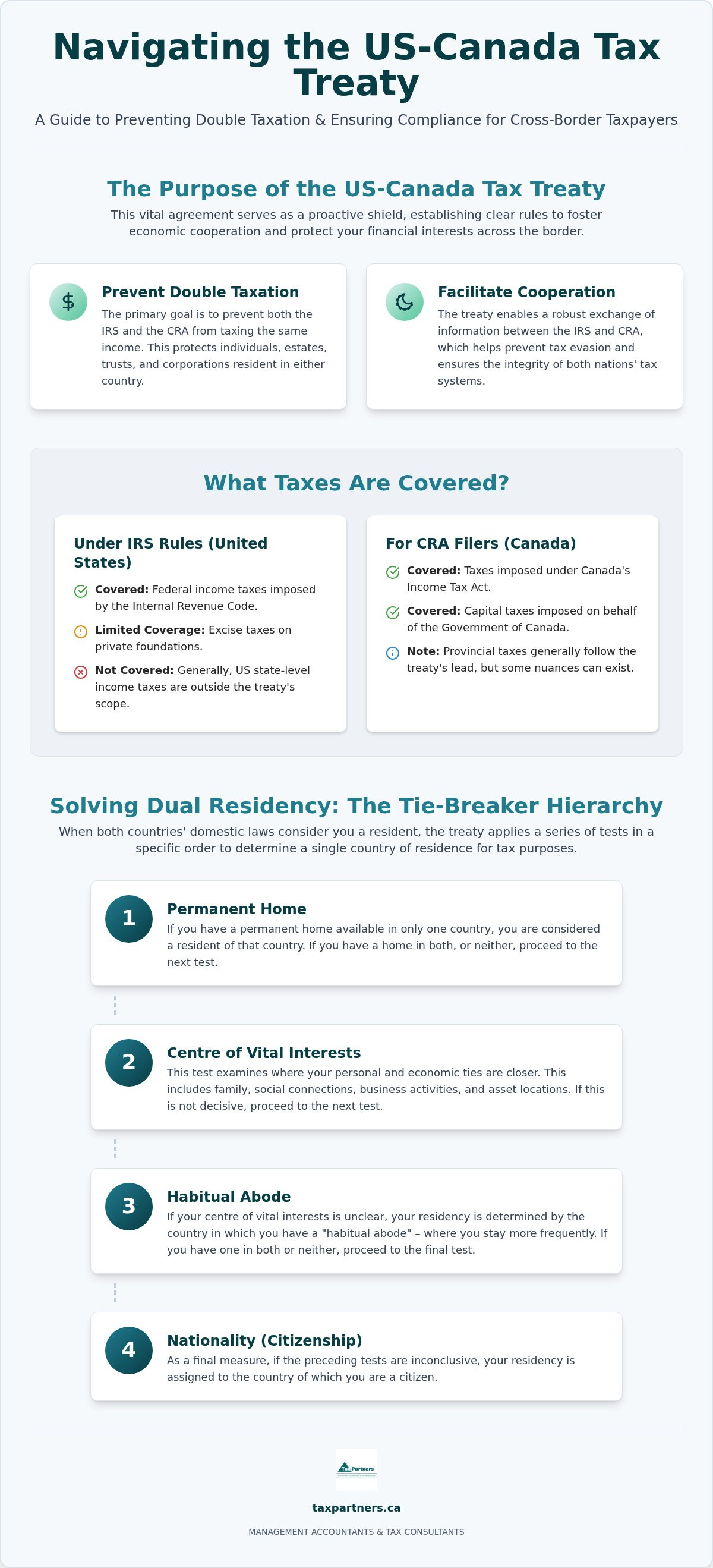
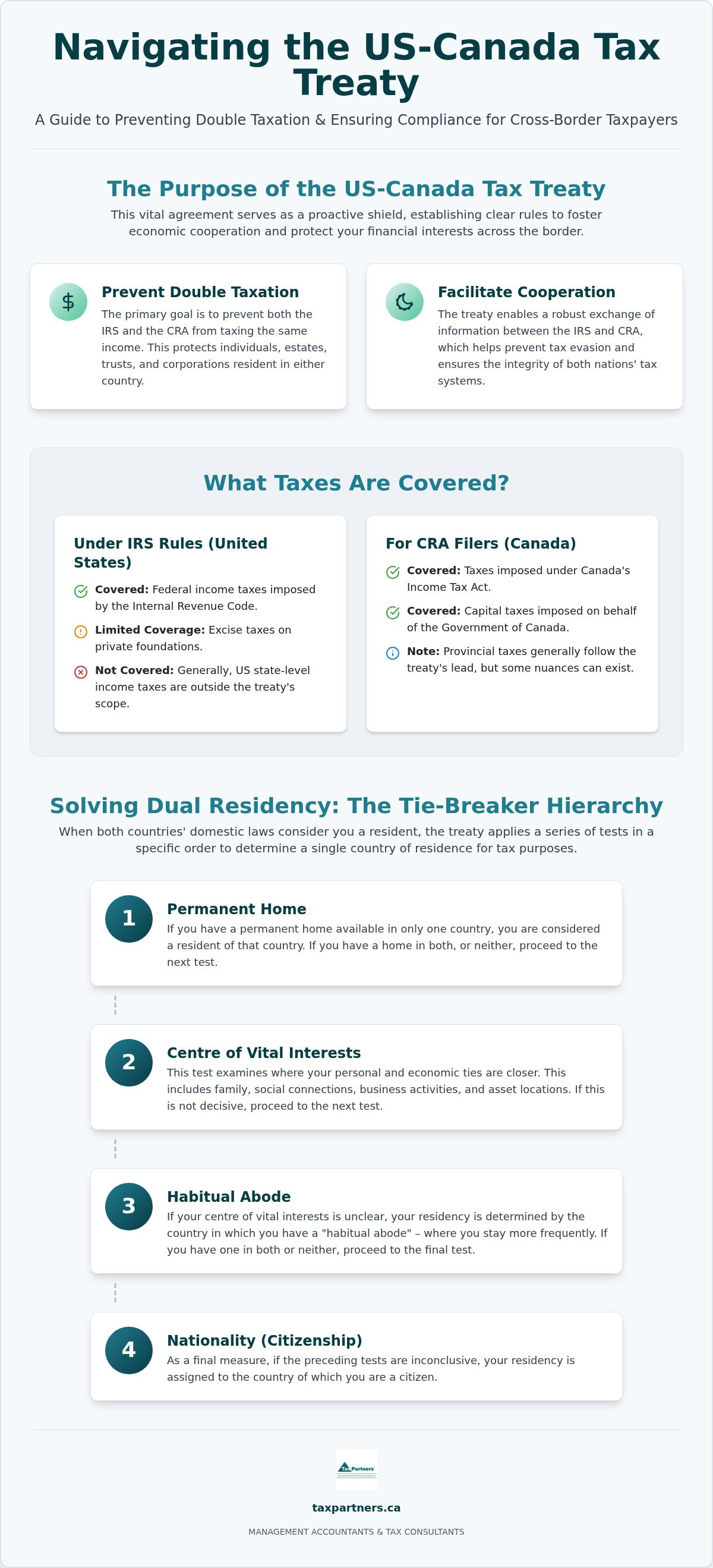
The us canada tax treaty isn't just a collection of legal clauses; it's a vital framework for economic cooperation between two of the world's largest trading partners. At its heart, this bilateral agreement exists to prevent double taxation on the same income. Without it, a resident of Toronto earning dividends from a New York firm might find both the CRA and the IRS claiming a significant portion of that single dollar. This protection extends to a broad spectrum of taxpayers, including individuals, estates, trusts, and corporations resident in either nation. Beyond simple relief, the convention facilitates a robust exchange of information between the IRS and the CRA. This cooperation is essential for maintaining the integrity of the Canadian tax system and preventing fiscal evasion. The core objective of the treaty is the elimination of tax barriers for cross-border trade and labour.
For those managing complex financial lives, the treaty serves as a proactive shield. It provides the predictability needed to invest, work, and grow across the border without the constant fear of redundant tax burdens. By establishing clear rules on which country holds the primary taxing rights, the convention allows for a more seamless flow of capital and expertise. It's a steady hand at the helm for anyone navigating the waters of international finance.
Taxes Covered Under IRS Rules
The treaty primarily addresses Federal income taxes imposed by the Internal Revenue Code of 1986. It's a common misconception that the treaty is a universal pass. It doesn't cover everything. Specifically, US state-level taxes usually fall outside the treaty's scope. If you're earning income in states like California or New York, you may still face local tax obligations regardless of the treaty's federal protections. Additionally, excise taxes on private foundations are included to a limited extent, but the focus remains squarely on federal income. Professional oversight is often required to determine how these US & Cross-Border Accounting & Tax Services apply to your specific situation.
Taxes Covered for CRA Filers
For Canadian residents, the treaty specifically covers taxes imposed under the Income Tax Act. While provincial taxes generally follow the treaty's lead, some nuances and exceptions can exist depending on the province in question. Our role is to act as your proactive guardian, ensuring that all filings align with these complex regulations. The convention also encompasses capital taxes imposed on behalf of the Government of Canada. This comprehensive coverage ensures that your domestic and international obligations are balanced, providing you with total control over your tax position while remaining fully compliant with the latest 2026 protocols.
Determining Residency and the Tie-Breaker Rules
Residency serves as the fundamental anchor for all cross-border tax obligations. It determines which country has the primary right to tax your income and which must provide a credit for taxes paid elsewhere. Under IRS rules, US citizens face a unique challenge; they're taxed on their worldwide income regardless of where they reside. Conversely, the CRA determines residency based on residential ties, such as having a home, a spouse, or dependants in Canada. When both nations claim you as a resident under their domestic laws, the us canada tax treaty provides a vital mechanism to resolve these conflicts. You can find the specific legal definitions in the full text of the US-Canada Income Tax Convention, which outlines how these competing claims are settled to protect you from being taxed twice on the same dollar.
The Tie-Breaker Hierarchy for Dual Residents
The treaty employs a structured "tie-breaker" test to assign a single country of residency for tax purposes. This hierarchy is designed to move you from uncertainty to a clear resolution. The first test is the permanent home. If you have a dwelling available to you in only one country, that country is your residence. However, if you maintain a home in both, the focus shifts to your centre of vital interests. This involves an analysis of where your personal and economic ties are closest, including your place of business and social affiliations. If your centre of vital interests cannot be determined, the secondary tests look at your habitual abode and, finally, your nationality. This methodical approach ensures that your tax status is based on the reality of your life, not just a set of rigid checkboxes.
Claiming Non-Resident Status under the Treaty
Once your residency is determined via the tie-breaker rules, you must properly disclose this position to the authorities. For those filing with the IRS, this often involves using Form 8833 to claim treaty benefits as a resident of Canada. On the Canadian side, you might be considered a "deemed non-resident" if the treaty assigns your residency to the United States. Failing to document these positions correctly can lead to significant administrative hurdles and potential audits. To realize the full benefits of these rules and ensure your filings are beyond reproach, it's wise to consult an international tax advisory Canada. If you're unsure how these rules apply to your current living situation, feel free to reach out for a consultation with our cross-border specialists.
Treatment of Common Cross-Border Income Streams
While residency sets the stage, the actual impact of the us canada tax treaty is felt most directly in how your specific income streams are taxed. The treaty serves as a sophisticated mechanism to reduce or even eliminate withholding taxes that would otherwise erode your earnings. Whether you are an investor, a remote worker, or a retiree, these provisions ensure that your cross-border activities remain financially viable. It is crucial to remember that treaty benefits must be proactively claimed on your tax returns to be valid; they are never applied by default by the tax authorities.
Managing these income streams requires foresight and a deep understanding of how two different tax systems interact. By leveraging the treaty correctly, you can ensure that your tax obligations are minimized and your cash flow is protected. This proactive approach is the hallmark of a secure financial strategy in a cross-border context.
Dividends and Interest under IRS and CRA Rules
Standard withholding rates on passive income can be as high as 30% without treaty intervention. However, under the treaty, these rates are typically reduced to 15% for dividends paid to residents of the other country. For many investors, interest income is frequently exempt from withholding tax entirely, provided the parties are dealing at arm's length. To realize these reduced rates, you must provide specific documentation to the payer, such as a W-8BEN for US payers. Detailed guidance on these procedural requirements can be found in IRS Publication 597, which offers a comprehensive look at how the treaty modifies standard US tax law for Canadian residents. Failing to provide the correct forms often results in the maximum withholding rate being applied, requiring a lengthy process to recover the overpaid tax.
Social Security and Pension Benefits
Retirement planning across the border requires a steady hand to avoid double taxation on your hard-earned savings. Under the treaty, US Social Security benefits paid to a Canadian resident are taxable only in Canada. In practice, 85% of these benefits are subject to Canadian income tax at your marginal rate, offering a clear framework for retirees living north of the border. Conversely, Canadian Pension Plan (CPP) and Old Age Security (OAS) payments made to a US resident are generally taxable only in the United States.
Protecting the tax-deferred status of your retirement accounts is equally important. The treaty includes specific provisions for RRSPs and Roth IRAs, allowing these vehicles to maintain their tax-advantaged status even when the holder moves across the border. Without these protections, you might face annual taxation on internal growth. Navigating these rules with precision ensures that your global Wealth Management & Financial Planning strategy remains intact and fully compliant with the protocols for the 2026 tax year.
Procedural Requirements for Claiming Treaty Benefits
Claiming the protections of the us canada tax treaty requires more than just a conceptual understanding of the law. It demands a meticulous approach to documentation and filing. Both the IRS and the CRA are increasingly vigilant about cross-border transparency, meaning that any benefit you claim must be backed by the correct forms and a clear paper trail. This procedural rigour acts as your best defence against unexpected audits and ensures that your financial life remains stable and predictable. Relying on an automatic application of these benefits is a mistake that can lead to costly delays and unnecessary stress.
A proactive approach to your filings ensures that you remain in total control of your tax position. By identifying the specific requirements for your situation early, you can avoid the reactive scramble that often leads to errors. This level of foresight is what separates a compliant taxpayer from one who faces constant regulatory friction.
IRS Form 8833: Treaty-Based Return Position Disclosure
When you take a position that the treaty overrules domestic IRS law, you must generally disclose this via Form 8833. This is a critical step for anyone claiming to be a resident of Canada while still having US-source income. While there are specific exceptions for certain types of passive income, disclosure remains the safest path to avoid scrutiny. Failing to file Form 8833 when required can result in a $1,000 penalty for individuals. It's a steep price to pay for a simple administrative oversight, which is why precision in your initial filing is paramount. We help you navigate these requirements to ensure every disclosure is accurate and timely.
Filing with the CRA as a Treaty Resident
For those living in Canada, the CRA requires you to report your worldwide income on your T1 return. However, the treaty allows you to claim a deduction or a foreign tax credit for taxes already paid to the IRS on US-source income. This mechanism ensures you aren't paying tax twice on the same dollar. You must also remain mindful of foreign property disclosures; Form T1135 is mandatory if you hold specified foreign property with a total cost of more than C$100,000 at any time in the year. Accurate record-keeping is the foundation of a successful cross-border strategy and provides the evidence needed to survive any potential audit with confidence.
Ensuring that all 1040-NR filing for Canadians requirements are met is a complex task that benefits from professional oversight. We act as your proactive guardian, looking ahead to identify potential filing gaps before they become problems. If you're concerned about your current cross-border compliance or want to ensure your 2026 returns are beyond reproach, contact our expert team today for a comprehensive review of your tax position.
Why Expert Oversight is Essential for Cross-Border Tax
The us canada tax treaty offers a robust framework for protection, but its benefits are only as effective as the strategy used to claim them. Regulatory scrutiny is currently at an all-time high. Navigating the intersection of IRS and CRA regulations requires more than just technical knowledge; it demands a proactive guardian who can anticipate shifts before they impact your wealth. Tax Partners provides this level of precision, acting as a seasoned mentor for individuals and businesses dealing with the complexities of cross-border obligations. By partnering with experts who understand the nuances on both sides of the border, you eliminate the anxiety of potential penalties and the heavy burden of paying tax twice on the same income.
Our approach is rooted in stability and long-term partnership. We don't just react to requirements; we look ahead to secure a better outcome for your financial future. This level of responsiveness and lack of pretension positions our firm as an accessible expert rather than a distant institution. You gain the confidence that comes from having a steady hand at the helm of your financial affairs.
The Value of a Comprehensive Tax Strategy
True compliance is not a once-a-year event but a continuous process of refinement. We go beyond simple filing to offer integrated wealth management and financial planning that considers your long-term legacy. With over 40 years of experience and more than 495,000 returns successfully filed, our firm has saved clients more than C$87 million by identifying efficiencies that others often overlook. This deep-seated reliability ensures your estate, business interests, and personal assets are protected against the friction of international borders. We provide the steady hand you need to organize your global financial affairs with total clarity, ensuring that every dollar is accounted for and every protection is utilized.
Take Control of Your Cross-Border Compliance
Leaving your treaty benefits to chance or the limitations of DIY software is a risk that few can afford in 2026. The us canada tax treaty contains intricate clauses that require professional interpretation to maximize their utility. Our team focuses on creating a bespoke plan that fits your unique situation, whether you are a dual citizen, an expat, or a business owner expanding into new markets. We take the stress out of the process, moving you from a state of uncertainty to one of complete control. This methodical approach ensures that your journey across the border is seamless and secure. Reach out today to speak with a cross-border tax expert and secure the future of your financial health with a partner who is genuinely invested in your success.
Secure Your Cross-Border Financial Future
Managing a life that spans two countries is a significant achievement, but it shouldn't be overshadowed by the weight of regulatory uncertainty. You've learned that the us canada tax treaty is your most powerful tool for eliminating double taxation, provided you navigate its residency tie-breaker rules and disclosure requirements with absolute precision. Success in 2026 depends on moving from a reactive stance to one of informed control. By organizing your affairs around these treaty protections, you safeguard your wealth and ensure your long-term compliance with both the CRA and the IRS.
Our team brings over 40 years of institutional wisdom and the expertise gained from filing hundreds of thousands of returns to every client partnership. With more than 1,390 five-star Google reviews, we've proven our commitment to being the steady hand at the helm for taxpayers like you. Don't leave your financial security to chance. Contact Tax Partners for expert cross-border tax advice and take the first step toward total peace of mind. Your cross-border journey deserves a partner who is as invested in your success as you are.
Frequently Asked Questions
Does the US-Canada tax treaty apply to state taxes?
The us canada tax treaty generally does not apply to US state-level income taxes. While the federal government provides robust protections, individual states like California or New York maintain their own taxing authority and are not bound by the treaty's provisions. This means you might still owe state taxes even if your federal liability is reduced. It's essential to check the specific rules for each state where you earn income to ensure full compliance.
How do I avoid double taxation on my US pension while living in Canada?
You avoid double taxation on a US pension by claiming a foreign tax credit on your Canadian T1 return. While the IRS may withhold tax at the source, the CRA allows you to deduct that amount from your Canadian tax payable. This mechanism ensures you aren't paying twice on the same retirement income. We help you organize these credits to maximize your wealth preservation while adhering to the 2026 protocols.
What is IRS Form 8833 and when do I need to file it?
IRS Form 8833 is a disclosure form required when you take a position that the us canada tax treaty overrules domestic US tax law. You generally need to file it if you are claiming a residency tie-breaker or certain exemptions on your 1040-NR. Failing to include this form can lead to a $1,000 penalty for individuals. It's a critical procedural step that provides transparency to the IRS and protects your treaty-based claims.
Can the US-Canada tax treaty help me if I am a dual citizen?
The treaty offers significant protections for dual citizens, though the "Saving Clause" allows the US to tax its citizens as if the treaty didn't exist in many cases. However, specific exceptions allow dual residents to use tie-breaker rules to determine their tax home. This can help you avoid double taxation on passive income and pensions. Professional oversight is vital here to navigate the intersection of citizenship-based and residency-based taxation systems.
What happens if I forget to claim a treaty benefit on my tax return?
If you forget to claim a treaty benefit, you can typically file an amended tax return to rectify the oversight. For the IRS, this involves Form 1040-X; for the CRA, you would use Form T1-ADJ. There are time limits for these adjustments, usually three years from the original filing date. Acting quickly helps you recover overpaid taxes and ensures your records accurately reflect your intended treaty-based positions.
How does the treaty affect social security payments between the two countries?
Social security payments are generally taxable only in the country where the recipient resides. If you live in Canada and receive US Social Security, the treaty dictates that only the CRA can tax that income. Specifically, 85% of the benefit is included in your Canadian taxable income. This rule prevents the IRS from withholding tax on these payments, providing a clear and simplified tax experience for cross-border retirees.
Are there specific treaty rules for Canadian business owners operating in the US?
Canadian business owners are generally only taxed in the US if they have a "permanent establishment" south of the border. This typically refers to a fixed place of business, like an office or factory. If your US activities don't meet this threshold, the treaty may exempt your business profits from US federal tax. It's a complex area where precise documentation is needed to prove you don't have a taxable presence in the US.
To manage these complexities effectively, many entrepreneurs utilize outsourced financial leadership. A firm like Wright CPAs, LLC can provide the strategic oversight needed to maintain clarity and compliance while scaling operations across the border in Buffalo and beyond.
Does the treaty cover capital gains tax on real estate sales?
The treaty generally allows the country where the real estate is physically located to have the primary right to tax capital gains. If you sell a property in Florida while living in Toronto, the US will tax the gain first. You would then report the sale in Canada and claim a foreign tax credit for the US taxes paid. This prevents double taxation while ensuring the country where the property is located receives its fair share of the revenue.

Article by
Mahad Mohamed
Mahad Mohamed is an accountant and the CEO of Tax Partners, with over 26+ years of Canadian and international tax and accounting experience. His expertise includes corporate reorganization, cross-border tax structuring (Canada & US), tax disputes, CRA audits, and tax planning for small owner-managed private corporations. Most recently, Mahad is a pioneer in Canadian crypto taxation and founded Block3 Finance.
Previously, Mahad worked for the Canada Revenue Agency (CRA), Big4 accounting firms, and served as a Rulings Officer for the Federal Tax Authority of the UAE before acquiring Tax Partners in 2014.
Tax Partners has 44 full-time accountants and over 18,400+ clients.
Disclaimer
This article provides general information only and is current as of its publication date. It has not been updated and may be out of date. It does not constitute legal advice and should not be relied upon as such. Every tax situation is unique and may differ from the examples discussed in this article. If you have specific questions, you should seek the advice of our accountants for your unique circumstances. Book a FREE Initial Consultation Today!
Frequently Asked Questions
Does the US-Canada tax treaty apply to state taxes?
No, the us canada tax treaty generally only applies to federal income taxes. Under IRS rules, individual states such as California or New York are not legally bound by the treaty's provisions. This means you might still owe state-level taxes even if you are exempt at the federal level. For CRA filers, most Canadian provinces align their tax laws with the treaty, but you should always confirm specific local rules to avoid surprises.
How do I avoid double taxation on my US pension while living in Canada?
You avoid double taxation by claiming a foreign tax credit on your Canadian T1 return for taxes paid under IRS rules. The us canada tax treaty also allows for a reduced withholding rate at the source for certain distributions. It's essential for CRA filers to report the gross pension amount and then apply the appropriate credit. This proactive approach ensures that your retirement income remains protected from redundant tax hits across the border.
What is IRS Form 8833 and when do I need to file it?
IRS Form 8833 is a mandatory disclosure form used when a taxpayer takes a position that the us canada tax treaty modifies or overrules a provision of the Internal Revenue Code. Under IRS rules, you must file this form to explain why you are claiming specific benefits, such as residency tie-breakers. Failing to provide this disclosure can result in a $1,000 penalty for individuals. It's a critical document for maintaining transparency and avoiding unnecessary scrutiny.
Can the US-Canada tax treaty help me if I am a dual citizen?
Yes, the treaty is highly beneficial for dual citizens who are subject to taxation under IRS rules on their worldwide income. It provides specific tie-breaker rules to determine a single country of residence for tax purposes, which helps organize your global filings. This status allows you to utilize foreign tax credits effectively on your CRA filings to offset US tax liabilities. Dual citizens can navigate their complex obligations with much greater confidence and clarity.
What happens if I forget to claim a treaty benefit on my tax return?
If you forget to claim a treaty benefit, you must file an amended tax return with the IRS or the CRA to correct the error. Under IRS rules, this usually involves filing Form 1040-X along with the required treaty disclosure forms. For CRA filers, you can request an adjustment to a previous year's return through the My Account portal. However, waiting too long can lead to the loss of credits or the imposition of interest on unpaid balances.
How does the treaty affect social security payments between the two countries?
Social security payments are generally taxable only in the country where the recipient resides, regardless of which government issues the cheque. For example, US Social Security paid to a resident of Canada is taxable only for CRA filers. This specific provision of the us canada tax treaty simplifies the financial lives of retirees by ensuring they only deal with one tax authority for these benefits. It provides much-needed stability for those managing their retirement across the border.
Are there specific treaty rules for Canadian business owners operating in the US?
Yes, the treaty includes "Permanent Establishment" rules that determine when a Canadian business has a sufficient presence to be taxed under IRS rules. Generally, you aren't taxed on business profits in the US unless you have a fixed place of business or a dependent agent there. This protection allows Canadian entrepreneurs to explore the US market without immediately triggering complex federal tax obligations. It's a vital shield for businesses looking to expand their cross-border operations safely.
Does the treaty cover capital gains tax on real estate sales?
The treaty generally allows the country where the real estate is located to have the primary right to tax any capital gains from a sale. For CRA filers selling US property, the gain is first taxed under IRS rules, which often involves FIRPTA withholding requirements. You then report the sale on your Canadian return and claim a foreign tax credit to prevent double taxation. This ensures that you only pay the higher of the two tax rates on your profit.