How to Navigate 1040 Tax Filing for Canadians in 2026

Did you know that 1040 tax filing for Canadians is often less about paying the IRS and more about proving exactly why you don't owe them a cent? For the over one million Americans residing in Canada, these annual forms are a vital shield. They serve as a strategic exercise in treaty protection that prevents financial leakage and double taxation. We recognize the deep-seated stress of managing conflicting tax years while fearing that a single mistake could lead to significant penalties. It's a complex weight to carry, but you don't have to manage it alone.
Our guide offers a clear roadmap to help you master U.S. tax compliance under IRS rules for the 2026 tax season. We'll provide the clarity you need to handle your obligations with confidence, from utilizing the $16,100 standard deduction for single filers to meeting the June 15 automatic extension deadline for those living abroad. You'll gain a thorough understanding of your filing requirements and the peace of mind that comes with total regulatory control. We'll begin by examining the specific thresholds and treaty benefits that protect your income and simplify your cross-border journey.
Key Takeaways
- Identify your status as a "U.S. Person" under IRS rules to understand why your Canadian salary and investment income are subject to worldwide reporting requirements.
- Master the essentials of 1040 tax filing for Canadians by identifying the specific forms and schedules, such as Schedule 1, required for cross-border income reporting.
- Leverage the Canada-U.S. Tax Treaty to resolve residency tie-breaker situations and protect your earnings from double taxation.
- Streamline your 2026 preparation by organizing your CRA tax slips and converting all Canadian dollar amounts using IRS-approved annual exchange rates.
- Understand why standard tax software often fails cross-border filers and how professional advisory ensures your filing remains precise and compliant.
Who Must Complete a 1040 Tax Filing in Canada?
Determining your obligation to the Internal Revenue Service (IRS) begins with a clear understanding of the "U.S. Person" designation. Unlike most nations that tax based on physical residency, the United States employs a citizenship-based taxation model. This means your tax home follows you across the border. For a broader perspective on how these rules fit into the federal framework, you can explore this U.S. Taxation System Overview. Under IRS rules, if you're a citizen or a green card holder, your location in Toronto or Vancouver doesn't exempt you from annual reporting.
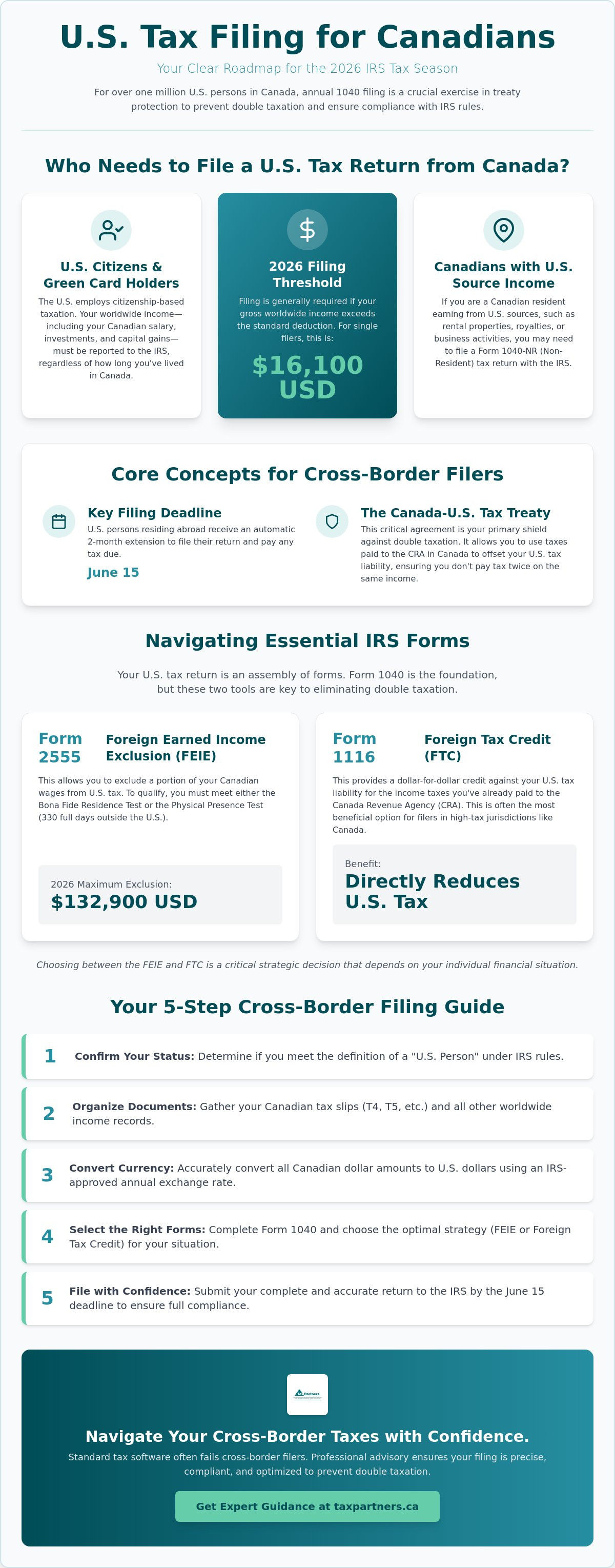
The IRS requires "U.S. Persons" to report their worldwide income. This includes your Canadian salary, interest from a local bank, and even capital gains from selling property in Canada. For the 2026 tax year, the filing requirement is generally triggered when your gross income exceeds the standard deduction. For single filers under IRS rules, this threshold is $16,100. If you meet this level of income from any global source, 1040 tax filing for Canadians becomes a mandatory annual task to maintain your compliance status.
U.S. Citizens and Green Card Holders
Living in Canada for 30 years doesn't dissolve your link to the IRS. Many people who haven't stepped foot in the States for decades are still legally required to file. Maintaining these records is vital if you plan to travel south, sponsor a family member, or eventually renounce your citizenship. The IRS typically requires five years of tax transparency before you can formally exit the system, making proactive filing a wise strategy for your long-term flexibility.
Canadian Residents with U.S. Source Income
You don't need to be a citizen to have a relationship with the IRS. If you're a Canadian resident earning income from U.S. sources, you might need to file Form 1040-NR, the non-resident version of the standard return. This applies to those who own U.S. rental properties, receive royalties from American companies, or earn gambling winnings at a U.S. casino. You'll likely need an Individual Taxpayer Identification Number (ITIN) to process these returns if you don't have a Social Security Number.
To manage these specific requirements, you can learn more about Tax and Accounting Services from a U.S.-based professional who specializes in valuation and cross-border compliance.
Beyond citizenship, other common triggers for a U.S. filing obligation include:
- Meeting the Substantial Presence Test by spending more than 183 days in the U.S. over a three-year weighted period.
- Performing professional services on U.S. soil, even for a short-term contract.
- Receiving dividends from U.S.-based corporations that haven't been fully handled by treaty withholdings.
Identifying these triggers early helps you avoid the stress of surprise penalties. Whether you're a dual citizen or a Canadian investor, understanding these boundaries is the first step toward total control over your cross-border tax health.
Essential IRS Forms and Schedules for Cross-Border Filers
Successful 1040 tax filing for Canadians is rarely about a single document. It's a methodical assembly of various schedules designed to capture a complete picture of your international financial life. While Form 1040 serves as the anchor for your individual return, most residents in Canada will need supplemental forms to satisfy IRS rules and avoid costly oversights. Mastering these documents is the first step toward transforming a complex obligation into a manageable routine.
Schedule 1 is a frequent requirement for reporting additional income that doesn't fit on the main return, such as Canadian business profits or rental gains. To prevent the IRS from taxing income you've already reported to the CRA, you'll rely heavily on two primary mechanisms: the Foreign Earned Income Exclusion (Form 2555) and the Foreign Tax Credit (Form 1116). For those navigating these choices for the first time, IRS Publication 519: U.S. Tax Guide for Aliens provides essential context for determining your specific filing status and eligible benefits.
The Role of the Foreign Earned Income Exclusion
The Foreign Earned Income Exclusion (FEIE) allows you to exclude a significant portion of your Canadian wages from U.S. taxation. For the 2026 tax year, the IRS has set the maximum exclusion at $132,900. To qualify, you must pass either the Physical Presence Test, which requires being outside the U.S. for 330 full days, or the Bona Fide Residence Test. It's a powerful tool, but it's not always the most tax-efficient path. Using the FEIE can sometimes prevent you from claiming certain credits, such as the Additional Child Tax Credit, which is why a calculated approach is necessary.
Reporting Foreign Assets (FATCA vs. FBAR)
Transparency remains a cornerstone of IRS compliance. You must distinguish between Form 8938, required under the Foreign Account Tax Compliance Act (FATCA), and the FBAR (FinCEN Form 114). The FBAR is a separate filing mandated if the aggregate value of your Canadian bank accounts, RRSPs, or TFSAs exceeds $10,000 at any point during the calendar year. Form 8938 generally carries higher reporting thresholds but requires detailed disclosure of specified foreign financial assets directly on your tax return.
Failing to disclose these assets can lead to severe penalties that far outweigh the original tax liability. Proactive reporting is your best defence against these risks. If you're looking for precision in your cross-border strategy, our team offers specialized US & Cross-Border Accounting & Tax Services to ensure your 1040 tax filing for Canadians is both accurate and optimized for your unique situation.
Eliminating Double Taxation via the Canada-U.S. Tax Treaty
The primary concern for anyone managing 1040 tax filing for Canadians is the risk of paying tax twice on the same income. While the U.S. taxes based on citizenship, the Canada-U.S. Tax Treaty serves as a vital safeguard to ensure your financial health isn't compromised by cross-border obligations. This bilateral agreement provides the legal framework to determine which country has the primary taxing right over specific types of income. However, these benefits aren't applied by default. You must actively claim them through your annual return to the IRS.
One critical concept to understand is the "Savings Clause." Under IRS rules, this clause allows the United States to tax its citizens as if the treaty didn't exist. It sounds daunting, but the treaty includes specific exceptions to this clause that protect social security benefits and certain pension distributions. Additionally, if both the IRS and CRA claim you as a resident, the treaty provides "tie-breaker" rules. These rules look at your permanent home, your centre of vital interests, and your habitual abode to resolve the conflict. When you take a position that relies on the treaty to override standard U.S. tax law, you'll typically need to file Form 8833 to disclose this to the IRS.
How the Foreign Tax Credit Works
The Foreign Tax Credit (FTC) is your most effective defence against double taxation. It allows you to use the taxes you've already paid to the CRA to offset what you owe on your U.S. 1040. The IRS organizes this into a "basket" system. For example, taxes paid on your Canadian wages fall into the general category basket, while taxes on interest or dividends go into the passive income basket. If your Canadian tax rate is higher than your U.S. rate, you might end up with unused credits. For the 2026 tax year, you can generally carry these excess credits back one year or forward up to ten years to offset future U.S. tax debt.
Special Considerations for RRSPs and TFSAs
The treaty offers excellent protection for Registered Retirement Savings Plans (RRSPs), allowing for tax-deferred growth under IRS rules without the need for annual elections. This ensures your retirement savings aren't eroded by U.S. taxes while you're still working in Canada. Unfortunately, the same courtesy isn't extended to Tax-Free Savings Accounts (TFSAs). The IRS does not recognize the tax-free status of Canadian TFSAs, treating them as regular taxable investment accounts. This "TFSA Trap" means any income earned within the account must be reported on your 1040. Proactive planning is the only way to minimize this exposure and keep your long-term wealth strategy on track.
Step-by-Step Guide: How to File Your 1040 from Canada
Precision is the hallmark of a successful cross-border filing. You're moving from Canadian source documents to an American regulatory framework, which requires a methodical workflow to ensure nothing is lost in translation. Managing 1040 tax filing for Canadians involves more than just filling out boxes; it's about aligning two different tax systems into a single, compliant narrative for the IRS.
Your first task is to assemble a complete file of your Canadian income records. This includes T4 slips for employment, T5 slips for interest, and T3 slips for trust income. You'll also need your final CRA Notice of Assessment. This document is vital because it proves the exact amount of tax you've already paid to Canada, which is the figure you'll use to claim the Foreign Tax Credit. Without this verification, the IRS may challenge your credit claims, leading to potential double taxation.
Selecting your filing status is the next critical junction. Under IRS rules for 2026, your status determines your standard deduction. A single filer or those married filing separately receive a $16,100 deduction, while married couples filing jointly see that amount double to $32,200. If you have dependents and meet specific residency requirements, you might qualify as a Head of Household, which carries a $24,150 deduction. These figures directly impact your final tax liability, so choosing the correct status is a foundational step in your 1040 tax filing for Canadians.
Currency Conversion and Record Keeping
The IRS requires all income and expenses to be reported in U.S. dollars. You don't necessarily have to use a specific daily rate for every transaction; the IRS typically accepts an average annual exchange rate if your income was received evenly throughout the year. You can find these rates through the U.S. Treasury or the Bank of Canada. Consistency is key here. If you choose a source, use it for all conversions on your return. Keep your records, including the specific exchange rates used, for at least seven years to protect yourself during a cross-border audit.
Deadlines and Extensions for Canadians
While the IRS general filing deadline is April 15, 2026, U.S. citizens and residents living in Canada receive an automatic two-month extension to June 15, 2026. This extra time is helpful, but it comes with a catch: any tax you owe must still be paid by April 15 to avoid interest charges. If your financial situation is particularly complex, you can file Form 4868 to request a further extension to October 15, 2026. This provides ample time to ensure every schedule is perfectly aligned. If you want to ensure your strategy is audit-ready, our team provides expert US & Cross-Border Accounting & Tax Services to guide you through every deadline.
Why Professional Cross-Border Advisory is Essential
While off-the-shelf software promises simplicity, it's rarely designed for the intricate nuances of 1040 tax filing for Canadians. Most U.S. retail tax programs cater to domestic residents with straightforward domestic income. They often fail to recognize the complex interplay between Canadian tax slips and IRS requirements. This technical gap can lead to missed treaty elections or improperly calculated foreign tax credits, which often results in double taxation or unwanted IRS scrutiny. Relying on a generic algorithm to manage your cross-border compliance is a risk that few can afford to take.
Our team brings over 40 years of institutional wisdom to your financial strategy. We've navigated thousands of complex interactions with both the IRS and the CRA, acting as a proactive guardian for our clients' wealth. By applying the Canada-U.S. Tax Treaty with absolute precision, our firm has successfully saved clients over $87 million in taxes that might have otherwise been paid unnecessarily. This level of savings isn't achieved through simple data entry. It requires a deep understanding of how to leverage every available legal protection to your advantage.
The Complexity of Dual Compliance
Managing dual compliance requires perfect synchronization between two distinct regulatory bodies. While both nations utilize a December 31 year-end, the reporting deadlines and extension rules operate under different frameworks. A professional advisor identifies hidden pitfalls like Passive Foreign Investment Companies (PFICs). Under IRS rules, many common Canadian mutual funds and ETFs are classified as PFICs. These assets can trigger complex reporting requirements and punitive tax rates if they aren't disclosed correctly on your 1040. We ensure that your Canadian return for CRA filers and your U.S. obligations are reconciled to prevent any discrepancies that could trigger an audit.
Taking the Next Step with Tax Partners
Every cross-border situation is unique, requiring a bespoke approach to 1040 tax filing for Canadians. We don't just process forms; we build a personalized roadmap that secures your financial future. You gain direct access to our national network of experts who understand the local nuances of both jurisdictions. We take the weight of regulatory complexity off your shoulders, providing the stability and long-term partnership you need to thrive in a global economy. Don't leave your compliance to chance when you can have a steady hand at the helm. Secure your financial future with a professional 1040 review today and experience the peace of mind that comes from total control.
Secure Your Cross-Border Financial Future
Managing your status as a "U.S. Person" doesn't have to be a source of annual anxiety. By mastering the assembly of required schedules and leveraging the Canada-U.S. Tax Treaty, you transform a complex legal obligation into a strategic advantage. You now have the roadmap to handle currency conversions and IRS deadlines with total confidence. Expertly navigating 1040 tax filing for Canadians ensures your wealth remains protected from double taxation while keeping you in good standing under IRS rules.
Since 1981, our firm has filed over 495,000 returns, earning 1,390+ five-star Google reviews from clients who value our deep-seated reliability. We offer specialized expertise in IRS Streamlined Filing to help those who need to catch up on past obligations without fear. Our team acts as your proactive guardian, looking ahead to secure a better outcome for your long-term partnership. Book a Cross-Border Tax Consultation with Tax Partners to ensure your strategy is both precise and audit-ready. Take the first step toward a stress-free tax season and let us provide the steady hand you need at the helm.
Frequently Asked Questions
Do I have to pay tax to both the IRS and the CRA on the same income?
You generally don't pay tax to both countries on the same dollar of income. Under IRS rules, you can use the Foreign Tax Credit to offset your U.S. tax liability with the taxes you've already paid for CRA filers. The Canada-U.S. Tax Treaty provides specific mechanisms to ensure that income earned in Canada is primarily taxed there, while the U.S. only taxes the difference if their rate is higher.
What happens if I have not filed a U.S. tax return in several years while living in Canada?
Failing to file for several years can lead to significant IRS penalties and interest charges. However, the IRS offers compliance programs for those who haven't filed due to non-willful conduct. It's vital to address these gaps before the IRS initiates an audit. Proactive disclosure through specific amnesty routes can often waive late-filing and late-payment penalties, helping you regain your status as a compliant taxpayer.
Is a TFSA taxable in the United States for a Canadian resident?
Yes, a TFSA is considered a taxable investment account under IRS rules. While these accounts are tax-free for CRA filers, the IRS does not recognize this status under the current treaty. You must report all interest, dividends, and capital gains earned within your TFSA on your U.S. return. This is a common pitfall in 1040 tax filing for Canadians that requires careful reporting to avoid non-compliance.
Do I need to report my Canadian primary residence to the IRS?
You don't need to report the ownership of your primary residence to the IRS on an annual basis. However, if you sell the property, you must report the capital gain on your 1040. Under IRS rules, there's an exclusion for a portion of the gain on a primary residence, but any profit exceeding that threshold is taxable. If you rent out a portion of the home, that income must be reported on Schedule E.
What is the Streamlined Foreign Offshore Procedure for late filers?
The Streamlined Foreign Offshore Procedure is an IRS amnesty program designed for taxpayers who failed to report foreign assets or file returns non-willfully. It allows you to catch up by filing three years of back taxes and six years of FBARs. If you qualify, the IRS waives all penalties that would normally apply to late filings. This is a primary route for many to resolve their 1040 tax filing for Canadians without financial hardship.
Can I file my U.S. taxes electronically from Canada?
Yes, you can file your U.S. taxes electronically from Canada using IRS-approved software or through a cross-border tax professional. E-filing is generally faster and provides a confirmation of receipt that paper filing lacks. However, some complex forms or treaty positions may still require a paper return. You should confirm with the IRS or a qualified advisor if your specific situation allows for a digital submission in 2026.
How does the Canada-U.S. Tax Treaty protect my pension?
The Canada-U.S. Tax Treaty protects your pension by ensuring that your RRSP or RRIF grows tax-deferred under IRS rules. It also prevents double taxation on pension distributions. Generally, the country where you reside has the primary right to tax the pension income, while the other country provides a credit for those taxes. This ensures your retirement savings aren't unfairly depleted by two different tax jurisdictions.
What is the deadline for Canadians to file a 1040 in 2026?
The general deadline for 1040 tax filing for Canadians in 2026 is June 15, which is an automatic two-month extension for those living abroad. However, any tax you owe to the IRS must be paid by April 15, 2026, to avoid interest charges. If you require more time to organize your documents, you can file for an extension until October 15, 2026, though this only extends the filing time, not the payment deadline.

Article by
Mahad Mohamed
Mahad Mohamed is an accountant and the CEO of Tax Partners, with over 26+ years of Canadian and international tax and accounting experience. His expertise includes corporate reorganization, cross-border tax structuring (Canada & US), tax disputes, CRA audits, and tax planning for small owner-managed private corporations. Most recently, Mahad is a pioneer in Canadian crypto taxation and founded Block3 Finance.
Previously, Mahad worked for the Canada Revenue Agency (CRA), Big4 accounting firms, and served as a Rulings Officer for the Federal Tax Authority of the UAE before acquiring Tax Partners in 2014.
Tax Partners has 44 full-time accountants and over 18,400+ clients.
Disclaimer
This article provides general information only and is current as of its publication date. It has not been updated and may be out of date. It does not constitute legal advice and should not be relied upon as such. Every tax situation is unique and may differ from the examples discussed in this article. If you have specific questions, you should seek the advice of our accountants for your unique circumstances. Book a FREE Initial Consultation Today!
Frequently Asked Questions
U.S. Citizens and Green Card Holders
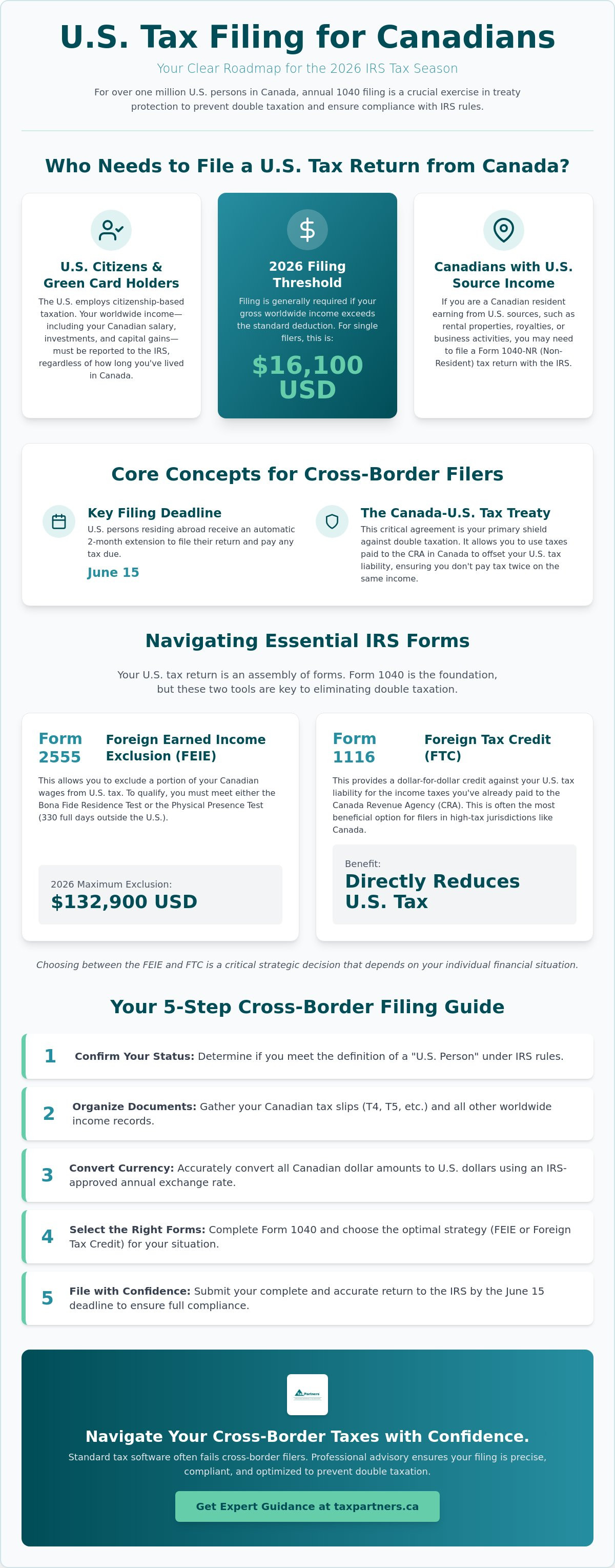
Living in Canada for 30 years doesn't dissolve your link to the IRS. Many people who haven't stepped foot in the States for decades are still legally required to file. Maintaining these records is vital if you plan to travel south, sponsor a family member, or eventually renounce your citizenship. The IRS typically requires five years of tax transparency before you can formally exit the system, making proactive filing a wise strategy for your long-term flexibility.
Canadian Residents with U.S. Source Income
You don't need to be a citizen to have a relationship with the IRS. If you're a Canadian resident earning income from U.S. sources, you might need to file Form 1040-NR, the non-resident version of the standard return. This applies to those who own U.S. rental properties, receive royalties from American companies, or earn gambling winnings at a U.S. casino. You'll likely need an Individual Taxpayer Identification Number (ITIN) to process these returns if you don't have a Social Security Number. Beyond citizenship, other common triggers for a U.S. filing obligation include: Identifying these triggers early helps you avoid the stress of surprise penalties. Whether you're a dual citizen or a Canadian investor, understanding these boundaries is the first step toward total control over your cross-border tax health. Successful 1040 tax filing for Canadians is rarely about a single document. It's a methodical assembly of various schedules designed to capture a complete picture of your international financial life. While Form 1040 serves as the anchor for your individual return, most residents in Canada will need supplemental forms to satisfy IRS rules and avoid costly oversights. Mastering these documents is the first step toward transforming a complex obligation into a manageable routine. Schedule 1 is a frequent requirement for reporting additional income that doesn't fit on the main return, such as Canadian business profits or rental gains. To prevent the IRS from taxing income you've already reported to the CRA, you'll rely heavily on two primary mechanisms: the Foreign Earned Income Exclusion (Form 2555) and the Foreign Tax Credit (Form 1116). For those navigating these choices for the first time, IRS Publication 519: U.S. Tax Guide for Aliens provides essential context for determining your specific filing status and eligible benefits.
The Role of the Foreign Earned Income Exclusion
The Foreign Earned Income Exclusion (FEIE) allows you to exclude a significant portion of your Canadian wages from U.S. taxation. For the 2026 tax year, the IRS has set the maximum exclusion at $132,900. To qualify, you must pass either the Physical Presence Test, which requires being outside the U.S. for 330 full days, or the Bona Fide Residence Test. It's a powerful tool, but it's not always the most tax-efficient path. Using the FEIE can sometimes prevent you from claiming certain credits, such as the Additional Child Tax Credit, which is why a calculated approach is necessary.
Reporting Foreign Assets (FATCA vs. FBAR)
Transparency remains a cornerstone of IRS compliance. You must distinguish between Form 8938, required under the Foreign Account Tax Compliance Act (FATCA), and the FBAR (FinCEN Form 114). The FBAR is a separate filing mandated if the aggregate value of your Canadian bank accounts, RRSPs, or TFSAs exceeds $10,000 at any point during the calendar year. Form 8938 generally carries higher reporting thresholds but requires detailed disclosure of specified foreign financial assets directly on your tax return. Failing to disclose these assets can lead to severe penalties that far outweigh the original tax liability. Proactive reporting is your best defence against these risks. If you're looking for precision in your cross-border strategy, our team offers specialized US & Cross-Border Accounting & Tax Services to ensure your 1040 tax filing for Canadians is both accurate and optimized for your unique situation. The primary concern for anyone managing 1040 tax filing for Canadians is the risk of paying tax twice on the same income. While the U.S. taxes based on citizenship, the Canada-U.S. Tax Treaty serves as a vital safeguard to ensure your financial health isn't compromised by cross-border obligations. This bilateral agreement provides the legal framework to determine which country has the primary taxing right over specific types of income. However, these benefits aren't applied by default. You must actively claim them through your annual return to the IRS. One critical concept to understand is the "Savings Clause." Under IRS rules, this clause allows the United States to tax its citizens as if the treaty didn't exist. It sounds daunting, but the treaty includes specific exceptions to this clause that protect social security benefits and certain pension distributions. Additionally, if both the IRS and CRA claim you as a resident, the treaty provides "tie-breaker" rules. These rules look at your permanent home, your centre of vital interests, and your habitual abode to resolve the conflict. When you take a position that relies on the treaty to override standard U.S. tax law, you'll typically need to file Form 8833 to disclose this to the IRS.
How the Foreign Tax Credit Works
The Foreign Tax Credit (FTC) is your most effective defence against double taxation. It allows you to use the taxes you've already paid to the CRA to offset what you owe on your U.S. 1040. The IRS organizes this into a "basket" system. For example, taxes paid on your Canadian wages fall into the general category basket, while taxes on interest or dividends go into the passive income basket. If your Canadian tax rate is higher than your U.S. rate, you might end up with unused credits. For the 2026 tax year, you can generally carry these excess credits back one year or forward up to ten years to offset future U.S. tax debt.
Special Considerations for RRSPs and TFSAs
The treaty offers excellent protection for Registered Retirement Savings Plans (RRSPs), allowing for tax-deferred growth under IRS rules without the need for annual elections. This ensures your retirement savings aren't eroded by U.S. taxes while you're still working in Canada. Unfortunately, the same courtesy isn't extended to Tax-Free Savings Accounts (TFSAs). The IRS does not recognize the tax-free status of Canadian TFSAs, treating them as regular taxable investment accounts. This "TFSA Trap" means any income earned within the account must be reported on your 1040. Proactive planning is the only way to minimize this exposure and keep your long-term wealth strategy on track. Precision is the hallmark of a successful cross-border filing. You're moving from Canadian source documents to an American regulatory framework, which requires a methodical workflow to ensure nothing is lost in translation. Managing 1040 tax filing for Canadians involves more than just filling out boxes; it's about aligning two different tax systems into a single, compliant narrative for the IRS. Your first task is to assemble a complete file of your Canadian income records. This includes T4 slips for employment, T5 slips for interest, and T3 slips for trust income. You'll also need your final CRA Notice of Assessment. This document is vital because it proves the exact amount of tax you've already paid to Canada, which is the figure you'll use to claim the Foreign Tax Credit. Without this verification, the IRS may challenge your credit claims, leading to potential double taxation. Selecting your filing status is the next critical junction. Under IRS rules for 2026, your status determines your standard deduction. A single filer or those married filing separately receive a $16,100 deduction, while married couples filing jointly see that amount double to $32,200. If you have dependents and meet specific residency requirements, you might qualify as a Head of Household, which carries a $24,150 deduction. These figures directly impact your final tax liability, so choosing the correct status is a foundational step in your 1040 tax filing for Canadians.
Currency Conversion and Record Keeping
The IRS requires all income and expenses to be reported in U.S. dollars. You don't necessarily have to use a specific daily rate for every transaction; the IRS typically accepts an average annual exchange rate if your income was received evenly throughout the year. You can find these rates through the U.S. Treasury or the Bank of Canada. Consistency is key here. If you choose a source, use it for all conversions on your return. Keep your records, including the specific exchange rates used, for at least seven years to protect yourself during a cross-border audit.
Deadlines and Extensions for Canadians
While the IRS general filing deadline is April 15, 2026, U.S. citizens and residents living in Canada receive an automatic two-month extension to June 15, 2026. This extra time is helpful, but it comes with a catch: any tax you owe must still be paid by April 15 to avoid interest charges. If your financial situation is particularly complex, you can file Form 4868 to request a further extension to October 15, 2026. This provides ample time to ensure every schedule is perfectly aligned. If you want to ensure your strategy is audit-ready, our team provides expert US & Cross-Border Accounting & Tax Services to guide you through every deadline. While off-the-shelf software promises simplicity, it's rarely designed for the intricate nuances of 1040 tax filing for Canadians. Most U.S. retail tax programs cater to domestic residents with straightforward domestic income. They often fail to recognize the complex interplay between Canadian tax slips and IRS requirements. This technical gap can lead to missed treaty elections or improperly calculated foreign tax credits, which often results in double taxation or unwanted IRS scrutiny. Relying on a generic algorithm to manage your cross-border compliance is a risk that few can afford to take. Our team brings over 40 years of institutional wisdom to your financial strategy. We've navigated thousands of complex interactions with both the IRS and the CRA, acting as a proactive guardian for our clients' wealth. By applying the Canada-U.S. Tax Treaty with absolute precision, our firm has successfully saved clients over $87 million in taxes that might have otherwise been paid unnecessarily. This level of savings isn't achieved through simple data entry. It requires a deep understanding of how to leverage every available legal protection to your advantage.
The Complexity of Dual Compliance
Managing dual compliance requires perfect synchronization between two distinct regulatory bodies. While both nations utilize a December 31 year-end, the reporting deadlines and extension rules operate under different frameworks. A professional advisor identifies hidden pitfalls like Passive Foreign Investment Companies (PFICs). Under IRS rules, many common Canadian mutual funds and ETFs are classified as PFICs. These assets can trigger complex reporting requirements and punitive tax rates if they aren't disclosed correctly on your 1040. We ensure that your Canadian return for CRA filers and your U.S. obligations are reconciled to prevent any discrepancies that could trigger an audit.
Taking the Next Step with Tax Partners
Every cross-border situation is unique, requiring a bespoke approach to 1040 tax filing for Canadians. We don't just process forms; we build a personalized roadmap that secures your financial future. You gain direct access to our national network of experts who understand the local nuances of both jurisdictions. We take the weight of regulatory complexity off your shoulders, providing the stability and long-term partnership you need to thrive in a global economy. Don't leave your compliance to chance when you can have a steady hand at the helm. Secure your financial future with a professional 1040 review today and experience the peace of mind that comes from total control. Managing your status as a "U.S. Person" doesn't have to be a source of annual anxiety. By mastering the assembly of required schedules and leveraging the Canada-U.S. Tax Treaty, you transform a complex legal obligation into a strategic advantage. You now have the roadmap to handle currency conversions and IRS deadlines with total confidence. Expertly navigating 1040 tax filing for Canadians ensures your wealth remains protected from double taxation while keeping you in good standing under IRS rules. Since 1981, our firm has filed over 495,000 returns, earning 1,390+ five-star Google reviews from clients who value our deep-seated reliability. We offer specialized expertise in IRS Streamlined Filing to help those who need to catch up on past obligations without fear. Our team acts as your proactive guardian, looking ahead to secure a better outcome for your long-term partnership. Book a Cross-Border Tax Consultation with Tax Partners to ensure your strategy is both precise and audit-ready. Take the first step toward a stress-free tax season and let us provide the steady hand you need at the helm.
Do I have to pay tax to both the IRS and the CRA on the same income?
You generally don't pay tax to both countries on the same dollar of income. Under IRS rules, you can use the Foreign Tax Credit to offset your U.S. tax liability with the taxes you've already paid for CRA filers. The Canada-U.S. Tax Treaty provides specific mechanisms to ensure that income earned in Canada is primarily taxed there, while the U.S. only taxes the difference if their rate is higher.
What happens if I have not filed a U.S. tax return in several years while living in Canada?
Failing to file for several years can lead to significant IRS penalties and interest charges. However, the IRS offers compliance programs for those who haven't filed due to non-willful conduct. It's vital to address these gaps before the IRS initiates an audit. Proactive disclosure through specific amnesty routes can often waive late-filing and late-payment penalties, helping you regain your status as a compliant taxpayer.
Is a TFSA taxable in the United States for a Canadian resident?
Yes, a TFSA is considered a taxable investment account under IRS rules. While these accounts are tax-free for CRA filers, the IRS does not recognize this status under the current treaty. You must report all interest, dividends, and capital gains earned within your TFSA on your U.S. return. This is a common pitfall in 1040 tax filing for Canadians that requires careful reporting to avoid non-compliance.
Do I need to report my Canadian primary residence to the IRS?
You don't need to report the ownership of your primary residence to the IRS on an annual basis. However, if you sell the property, you must report the capital gain on your 1040. Under IRS rules, there's an exclusion for a portion of the gain on a primary residence, but any profit exceeding that threshold is taxable. If you rent out a portion of the home, that income must be reported on Schedule E.
What is the Streamlined Foreign Offshore Procedure for late filers?
The Streamlined Foreign Offshore Procedure is an IRS amnesty program designed for taxpayers who failed to report foreign assets or file returns non-willfully. It allows you to catch up by filing three years of back taxes and six years of FBARs. If you qualify, the IRS waives all penalties that would normally apply to late filings. This is a primary route for many to resolve their 1040 tax filing for Canadians without financial hardship.
Can I file my U.S. taxes electronically from Canada?
Yes, you can file your U.S. taxes electronically from Canada using IRS-approved software or through a cross-border tax professional. E-filing is generally faster and provides a confirmation of receipt that paper filing lacks. However, some complex forms or treaty positions may still require a paper return. You should confirm with the IRS or a qualified advisor if your specific situation allows for a digital submission in 2026.
How does the Canada-U.S. Tax Treaty protect my pension?
The Canada-U.S. Tax Treaty protects your pension by ensuring that your RRSP or RRIF grows tax-deferred under IRS rules. It also prevents double taxation on pension distributions. Generally, the country where you reside has the primary right to tax the pension income, while the other country provides a credit for those taxes. This ensures your retirement savings aren't unfairly depleted by two different tax jurisdictions.
What is the deadline for Canadians to file a 1040 in 2026?
The general deadline for 1040 tax filing for Canadians in 2026 is June 15, which is an automatic two-month extension for those living abroad. However, any tax you owe to the IRS must be paid by April 15, 2026, to avoid interest charges. If you require more time to organize your documents, you can file for an extension until October 15, 2026, though this only extends the filing time, not the payment deadline.