Reporting Crypto Gains to the CRA: A 2026 Guide

What if the CRA already knows more about your digital wallet than you do? Many Canadian investors feel a growing sense of unease as the April 30, 2026, filing deadline approaches, particularly when trying to determine how to report crypto gains CRA. You aren't alone if you find it difficult to track your adjusted cost base across various platforms or if you're worried about the distinction between capital gains and business income.
We understand that the evolving regulatory environment can feel like a moving target. This guide provides the precise steps you need to calculate your transactions accurately and ensure full compliance with current CRA requirements. We'll walk you through the specific forms required, explain the new capital gains inclusion rates for amounts over C$250,000, and show you how to build a robust reporting strategy that protects your financial future.
By the end of this article, you'll have the clarity and confidence to manage your 2026 tax obligations with ease. Our goal is to move you from a state of uncertainty to one of total control over your digital asset portfolio.
Key Takeaways
- Understand why the CRA classifies digital assets as commodities rather than legal tender and how this affects your overall tax liability.
- Learn exactly how to report crypto gains CRA filers must disclose to correctly distinguish between capital gains and business income.
- Master the Adjusted Cost Base (ACB) calculation to track your costs in Canadian Dollars and ensure you only pay what you truly owe.
- Identify the specific forms required for your 2026 filing, including Schedule 3 and Form T2125, based on your unique trading activity.
- Discover the essential record-keeping habits that protect your portfolio and serve as a robust defence during a CRA audit.
Understanding How the CRA Views Cryptocurrency
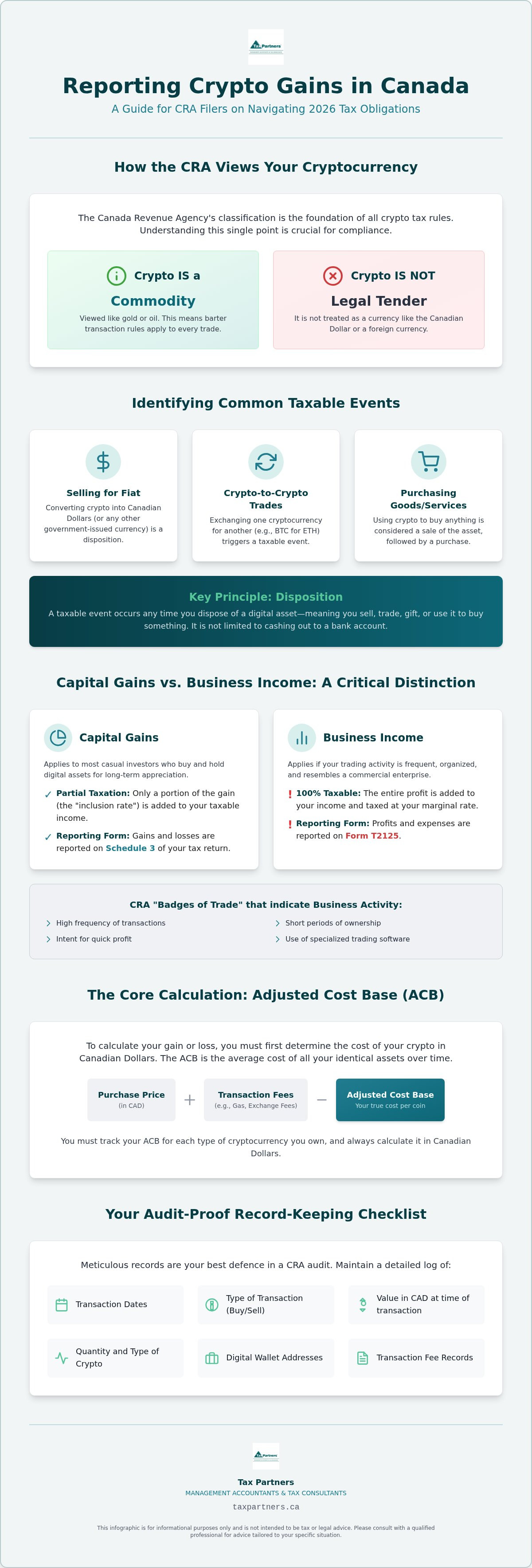
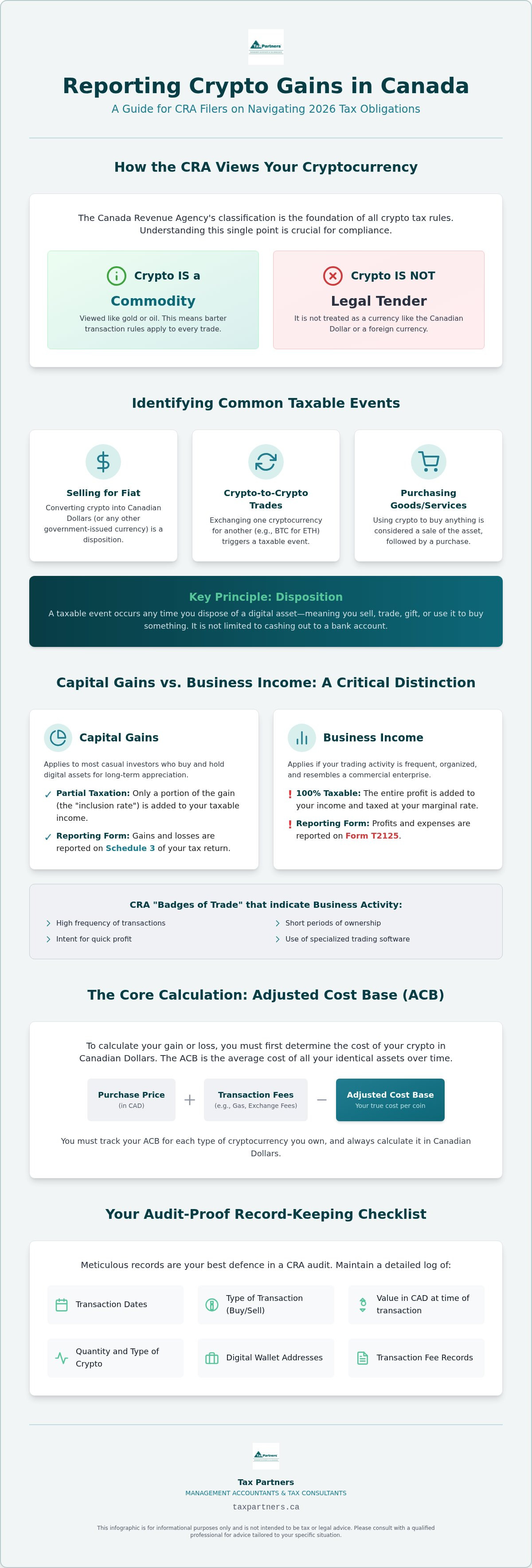
The Canada Revenue Agency (CRA) provides a clear framework for digital assets, though it differs significantly from how many investors perceive their portfolios. You might view your Bitcoin or Ethereum as a digital currency, but the CRA does not recognize cryptocurrency as legal tender or a foreign currency. Instead, for tax purposes in Canada, digital assets are treated as commodities. This distinction is the foundation for understanding how to report crypto gains CRA filers must manage each tax season. When you understand that your tokens are viewed similarly to gold or oil, the reporting requirements become much more logical.
Commodity Classification for CRA Filers
Treating cryptocurrency as a commodity means that the rules for barter transactions apply. When you use a digital asset to pay for a service or a new piece of hardware, the CRA views this as a two-part event. You sold a commodity and then used the value of that sale to make a purchase. This approach remains consistent across the entire digital landscape, including non-fungible tokens (NFTs) and stablecoins. Even if a stablecoin is pegged to the value of a fiat currency, it is still a commodity in the eyes of the regulator. This classification aligns with a broader trend in global cryptocurrency regulation where authorities seek to bring digital markets into existing tax frameworks. It ensures that every trade is accounted for, regardless of the asset's specific utility or perceived stability.
Identifying Taxable Events in Digital Assets
Many taxpayers mistakenly believe that taxes are only due when they "cash out" to a Canadian bank account. In reality, every disposition of cryptocurrency is a taxable event under CRA rules. A disposition occurs whenever you give up ownership, transfer, or exchange your digital property. It's the moment the value is realized, and the CRA expects to see it reflected on your return. Common taxable events include:
- Selling for Fiat: Converting your tokens into Canadian Dollars or any other traditional currency.
- Crypto-to-Crypto Trades: Exchanging one cryptocurrency for another is a taxable event, even if no fiat currency ever touches your account.
- Purchasing Goods: Using digital assets to buy a service or product triggers a gain or loss based on the fair market value at the time of the transaction.
Tracking these moments is essential for anyone learning how to report crypto gains CRA effectively. If you are unsure about a specific transaction type, consulting with specialized cryptocurrency accountants can provide the clarity needed to avoid future disputes. Reporting requirements apply to every single trade, making meticulous record-keeping a necessity for every Canadian investor.
Determining Capital Gains versus Business Income
Determining if your activity is a capital investment or a business operation is a critical step in understanding how to report crypto gains CRA filers encounter. Most casual investors who buy and hold digital assets for long-term growth will report their profits as capital gains. However, if your activity mirrors a commercial enterprise, the CRA may classify your profits as business income instead.
The tax consequences of this distinction are significant. Business income is 100% taxable at your marginal rate, which can lead to a much higher tax bill. Conversely, capital gains benefit from an inclusion rate, meaning only a portion of the gain is added to your taxable income for the year.
Factors Indicating Business Activity
The CRA examines several criteria to decide if you're running a business. They look for signs of "badges of trade," which include high transaction frequency and a short period of ownership. If you spend several hours a day trading or use professional-grade software, you're likely operating a business in their eyes. The intention to turn a quick profit is often the most decisive factor during an audit.
Key indicators of business activity include:
- An obvious intention to generate profit through short-term turnover rather than long-term appreciation.
- Extensive knowledge of the digital asset markets or professional experience in securities trading.
- High frequency of transactions that suggests a repetitive and organized system.
- Using specialized trading platforms, technical analysis tools, or bots to execute orders.
If you're unsure where your trading volume lands, it's often helpful to speak with a tax professional to review your specific situation before you file.
The Capital Gains Inclusion Rate for 2026
A capital gain occurs when you sell a digital asset for more than its original purchase price plus any acquisition costs. For the 2026 tax year, the general inclusion rate for individuals remains at 50% for the first C$250,000 of net capital gains. This means you only pay tax on half of your profits within this threshold.
A significant change applies to high-value transactions for the 2026 tax year. For net capital gains exceeding C$250,000 in a single year, the inclusion rate increases to 66.67% for the portion above that threshold. You should consult the CRA's official guide or a qualified accountant to confirm how to report crypto gains CRA requirements apply to your specific tax bracket and total gain amount.
Calculating Your Adjusted Cost Base (ACB)
The core of accurate tax reporting lies in the Adjusted Cost Base (ACB). This figure represents the total cost of your cryptocurrency acquisitions, but it's more than just the sticker price of the tokens. For CRA filers, the ACB includes the purchase price plus any commissions or transaction fees paid to acquire the asset. Mastering this calculation is the most effective way to understand how to report crypto gains CRA requirements demand without overpaying your taxes.
Calculating your ACB requires you to determine the fair market value of the digital asset in Canadian Dollars (C$) at the exact moment of the transaction. If you purchased Bitcoin on a foreign exchange using USD, you must convert that value to CAD using the Bank of Canada exchange rate for that day. Failing to track these values accurately often leads to CRA reassessments; the tax authority has little patience for estimated figures when precise data is available.
Tracking Purchase Prices and Transaction Fees
Record-keeping is your primary defence against reporting errors. You must document the date, the quantity, and the total value for every acquisition. Don't forget to include gas fees or network costs in your cost base. These expenses reduce your eventual capital gain, so excluding them means you're effectively volunteering to pay more tax than necessary. Simple exchange export files often lack the depth required for a full audit trail. They might show the trade but fail to capture the relevant CAD conversion or the fee structure needed for a perfect ACB calculation.
Managing Multiple Wallets and Exchanges
The CRA treats all units of a specific cryptocurrency as "identical property." This means you must maintain a unified ACB for all your holdings of that coin, even if they're spread across multiple hardware wallets and different exchanges. Moving tokens between your own wallets isn't a taxable event, but it does complicate the tracking of your average cost. If you buy Ethereum on one platform and more on another, you must average those costs together into a single pool.
Managing this complexity manually becomes nearly impossible for active traders. High volume and cross-chain transfers create a web of data that is difficult to untangle come tax season. This is where professional blockchain accountants become essential partners. They use specialized tools to reconcile transactions across all platforms, ensuring your reporting remains steadfast and ethically sound. Taking a proactive approach to your ACB today prevents the stress of a disorganized filing tomorrow.
Completing Your CRA Tax Return Forms
Accurate form completion represents the final, vital step in your tax journey. The documents you choose depend entirely on whether your activity is classified as a personal investment or a business operation. Every figure you enter must be converted to Canadian dollars based on the fair market value at the time of the transaction. It's not enough to simply use the numbers provided by your exchange in USD; you must use the Bank of Canada exchange rate for the specific date of each trade. You should also maintain a rigorous filing system, as the CRA requires you to keep all supporting documentation for at least six years. This includes wallet addresses, transaction IDs, and records of any software used to track your portfolio.
Reporting Capital Gains on Schedule 3
Most Canadian investors will use Schedule 3 to disclose their profits. On this form, you'll list your "proceeds of disposition," which is the total value you received when you sold or traded your tokens. You then subtract your Calculated Adjusted Cost Base (ACB) and any outlays or expenses, such as exchange fees, incurred during the sale. This process determines your net capital gain or loss. Under current CRA guidelines, you'll only be taxed on the taxable portion of these gains, typically 50% for the first C$250,000. If you've experienced a market downturn, reporting your losses is equally important. These capital losses can be used to offset other capital gains from the current year, or they can be carried back three years or forward indefinitely to reduce future tax bills. Mastering these forms is the ultimate goal when learning how to report crypto gains CRA requirements specify.
Filing Business Income on Form T2125
If your high-frequency trading is considered a business, you must use Form T2125, the Statement of Business or Professional Activities. While this means 100% of your profits are taxable as ordinary income, it also allows you to subtract legitimate business expenses. You can deduct costs that were incurred specifically to earn that income. This might include a portion of your home office expenses, internet bills, or the cost of technical analysis tools. For those who have scaled their operations into a full-time enterprise, investigating Canadian corporate tax strategies can offer additional ways to manage your liabilities and protect your assets. Properly navigating these forms ensures you remain in full compliance while optimizing your financial outcome. To ensure every detail of your 2026 filing is correct, you can contact our team for a personalized review of your documentation.
Ensuring Compliance and Minimizing Audit Risk
The CRA is no longer operating in the dark. They've obtained court orders to compel major exchanges to share user data, effectively ending the era of perceived anonymity. If you're wondering how to report crypto gains CRA filers must disclose, realize that transparency is your best ally. The agency actively matches exchange data with individual returns to identify discrepancies and unreported activity.
Detailed record-keeping is your best defence in a CRA audit. If you realize you've missed reporting gains in previous years, don't wait for a letter to arrive. The Voluntary Disclosures Program (VDP) may offer a way to correct your tax affairs without facing the full weight of penalties. It's a proactive step that demonstrates your commitment to ethical steadfastness and long-term compliance.
Maintaining Detailed Transaction Records
You need to keep more than just a simple summary of your trades. The CRA expects to see the dates of every transaction, the specific coin types involved, the quantity, and the wallet addresses used. Saving screenshots of your transaction history on exchanges is a wise precaution. Exchanges can go offline, change their data retention policies, or lose historical records during platform migrations. Specialized software can help organize this data, but it still requires human oversight to ensure the logic matches Canadian tax law correctly. Organized records move you from a state of potential uncertainty toward a feeling of total control.
Professional Support for Complex Portfolios
Modern portfolios often involve more than simple buying and selling on a single platform. Staking, airdrops, and decentralized finance (DeFi) introduce layers of complexity that standard software might misinterpret. A professional accountant can help you navigate these nuances, identifying tax-saving opportunities while ensuring every trade is accounted for correctly. Our firm acts as a proactive guardian for your wealth, combining decades of institutional wisdom with a modern outlook on emerging sectors. We look ahead to secure better outcomes for our clients by anticipating regulatory shifts. If you have a high volume of trades or complex assets, you can book a consultation for your 2026 return to ensure total peace of mind.
Secure Your Financial Future
Mastering the intricacies of how to report crypto gains CRA requirements demand is the only way to protect your digital portfolio from unnecessary scrutiny. By accurately distinguishing between capital gains and business income, and maintaining a unified Adjusted Cost Base across all your wallets, you transform potential tax liabilities into a well-managed financial strategy. Precision in your record-keeping today ensures that you remain in total control of your 2026 filing.
With over 40 years of Canadian tax experience and a specialized cryptocurrency accounting department, we provide the steady hand you need to navigate these complex regulations. Our firm is proud of our over 1,390 five-star Google reviews, reflecting our commitment to reliability and personalized care for every client. We act as your proactive guardian, looking ahead to secure the best possible outcome for your investments.
Ready to file with total confidence? Book a consultation with our crypto tax experts to ensure your reporting is accurate and optimized. Your peace of mind is our priority.
Frequently Asked Questions
Do I have to pay tax if I haven't cashed out my crypto to a bank account?
Yes, you must pay tax even if you haven't moved funds to a Canadian bank account. Under CRA rules, swapping one cryptocurrency for another or using digital assets to purchase goods are both considered taxable dispositions. These events trigger a gain or loss based on the fair market value in Canadian dollars at the time of the transaction. Simply holding your assets in a wallet isn't taxable, but any exchange of ownership is.
How does the CRA know if I own cryptocurrency?
The CRA uses several methods to track digital asset ownership, including court orders that compel Canadian exchanges to share user data. Starting in 2027 for the 2026 tax year, the Crypto Asset Reporting Framework (CARF) will further enhance this transparency. Additionally, any financial transaction involving virtual currency over C$10,000 is reported to FINTRAC. It's safer to assume the agency has access to your trading history through these automated data-sharing agreements.
Can I use capital losses from crypto to reduce my employment income tax?
No, you cannot use capital losses from cryptocurrency to reduce your employment income. For CRA filers, capital losses are only applicable against capital gains. If your losses exceed your gains in a given year, you can carry the remaining balance back three years or forward indefinitely to offset future gains. This rule applies unless your activity is classified as business income, where losses might be treated differently against other income sources.
What happens if I lost my private keys or my crypto was stolen?
If you lose your private keys or your assets are stolen, the CRA may consider this a capital loss. However, you must provide significant evidence to support your claim, such as the wallet address and proof of the theft or loss. The agency scrutinizes these claims closely to prevent fraud. We recommend keeping a detailed log of the circumstances and any police reports to ensure your reporting remains compliant during a potential review.
Is mining cryptocurrency considered business income or a capital gain?
Mining is typically classified as business income for CRA filers when the activity is performed in a highly organized or commercial manner. If you've invested in specialized hardware and operate with a clear profit motive, 100% of your earnings are taxable as income. Conversely, a hobbyist mining very small amounts might occasionally qualify for capital gains treatment, but the CRA's threshold for business activity in mining is generally quite low.
Are airdrops and hard forks taxable under CRA rules?
The CRA generally treats airdrops as taxable income at the time they are received. The fair market value in Canadian dollars on the date of receipt becomes your cost base for future transactions. Hard forks are treated differently, as they often result in a new asset with a zero dollar cost base. Understanding how to report crypto gains CRA requirements for these specific events is essential to avoid accidental misreporting on your 2026 return.
How do I report crypto gains if I am a dual citizen of the US and Canada?
Dual citizens must report their global cryptocurrency activities to both the CRA and the IRS. While you are taxed on your worldwide income in both jurisdictions, the Canada-US tax treaty usually prevents double taxation through foreign tax credits. You'll report your gains under CRA rules in Canada first, then claim a credit on your US return. This situation is complex and typically requires professional oversight from experts in cross-border accounting to ensure full compliance.
What are the penalties for not reporting cryptocurrency gains to the CRA?
Failing to report your gains can lead to substantial financial penalties and interest charges. If the CRA determines that you have omitted income due to gross negligence, they can apply a penalty equal to 50% of the tax avoided. Interest on the unpaid balance compounds daily, which can quickly erode your investment returns. Proactive disclosure is always the best path to maintain ethical steadfastness and avoid the stress of an aggressive audit.

Article by
Mahad Mohamed
Mahad Mohamed is an accountant and the CEO of Tax Partners, with over 26+ years of Canadian and international tax and accounting experience. His expertise includes corporate reorganization, cross-border tax structuring (Canada & US), tax disputes, CRA audits, and tax planning for small owner-managed private corporations. Most recently, Mahad is a pioneer in Canadian crypto taxation and founded Block3 Finance.
Previously, Mahad worked for the Canada Revenue Agency (CRA), Big4 accounting firms, and served as a Rulings Officer for the Federal Tax Authority of the UAE before acquiring Tax Partners in 2014.
Tax Partners has 44 full-time accountants and over 18,400+ clients.
Disclaimer
This article provides general information only and is current as of its publication date. It has not been updated and may be out of date. It does not constitute legal advice and should not be relied upon as such. Every tax situation is unique and may differ from the examples discussed in this article. If you have specific questions, you should seek the advice of our accountants for your unique circumstances. Book a FREE Initial Consultation Today!
Frequently Asked Questions
Do I have to pay tax if I haven't cashed out my crypto to a bank account?
Yes, you must pay tax even if you haven't moved funds to a Canadian bank account. Under CRA rules, swapping one cryptocurrency for another or using digital assets to purchase goods are both considered taxable dispositions. These events trigger a gain or loss based on the fair market value in Canadian dollars at the time of the transaction. Simply holding your assets in a wallet isn't taxable, but any exchange of ownership is.
How does the CRA know if I own cryptocurrency?
The CRA uses several methods to track digital asset ownership, including court orders that compel Canadian exchanges to share user data. Starting in 2027 for the 2026 tax year, the Crypto Asset Reporting Framework (CARF) will further enhance this transparency. Additionally, any financial transaction involving virtual currency over C$10,000 is reported to FINTRAC. It's safer to assume the agency has access to your trading history through these automated data-sharing agreements.
Can I use capital losses from crypto to reduce my employment income tax?
No, you cannot use capital losses from cryptocurrency to reduce your employment income. For CRA filers, capital losses are only applicable against capital gains. If your losses exceed your gains in a given year, you can carry the remaining balance back three years or forward indefinitely to offset future gains. This rule applies unless your activity is classified as business income, where losses might be treated differently against other income sources.
What happens if I lost my private keys or my crypto was stolen?
If you lose your private keys or your assets are stolen, the CRA may consider this a capital loss. However, you must provide significant evidence to support your claim, such as the wallet address and proof of the theft or loss. The agency scrutinizes these claims closely to prevent fraud. We recommend keeping a detailed log of the circumstances and any police reports to ensure your reporting remains compliant during a potential review.
Is mining cryptocurrency considered business income or a capital gain?
Mining is typically classified as business income for CRA filers when the activity is performed in a highly organized or commercial manner. If you've invested in specialized hardware and operate with a clear profit motive, 100% of your earnings are taxable as income. Conversely, a hobbyist mining very small amounts might occasionally qualify for capital gains treatment, but the CRA's threshold for business activity in mining is generally quite low.
Are airdrops and hard forks taxable under CRA rules?
The CRA generally treats airdrops as taxable income at the time they are received. The fair market value in Canadian dollars on the date of receipt becomes your cost base for future transactions. Hard forks are treated differently, as they often result in a new asset with a zero dollar cost base. Understanding how to report crypto gains CRA requirements for these specific events is essential to avoid accidental misreporting on your 2026 return.
How do I report crypto gains if I am a dual citizen of the US and Canada?
Dual citizens must report their global cryptocurrency activities to both the CRA and the IRS. While you are taxed on your worldwide income in both jurisdictions, the Canada-US tax treaty usually prevents double taxation through foreign tax credits. You'll report your gains under CRA rules in Canada first, then claim a credit on your US return. This situation is complex and typically requires professional oversight from experts in cross-border accounting to ensure full compliance.
What are the penalties for not reporting cryptocurrency gains to the CRA?
Failing to report your gains can lead to substantial financial penalties and interest charges. If the CRA determines that you have omitted income due to gross negligence, they can apply a penalty equal to 50% of the tax avoided. Interest on the unpaid balance compounds daily, which can quickly erode your investment returns. Proactive disclosure is always the best path to maintain ethical steadfastness and avoid the stress of an aggressive audit.