Tax Strategies for Incorporated Professionals in Canada: 2026

What if the corporate structure you designed to protect your wealth is actually the primary obstacle to your retirement? For many doctors, engineers, and consultants, the reality of 2026 is that traditional methods are no longer enough to stay ahead of inflation and shifting CRA thresholds. Implementing proactive tax strategies for incorporated professionals Canada is the only way to ensure your hard-earned capital remains in your hands rather than being eroded by high personal and corporate rates.
It's understandable to feel a sense of unease when faced with the complexity of passive income rules or the potential loss of the Small Business Deduction. You want to focus on your professional practice, not spend your evenings deciphering the latest YMPE limits or TOSI exemptions. We're here to help you move from uncertainty to total control. In this article, you'll learn how to optimize your remuneration, leverage the C$1,275,000 Lifetime Capital Gains Exemption, and build a robust exit strategy that secures your legacy. We'll provide a clear roadmap to maximize your after-tax wealth while maintaining full compliance with current regulations.
Key Takeaways
- Understand the critical distinction between reactive tax filing and proactive planning to minimize your long-term CRA liability and maximize after-tax wealth.
- Identify the most effective tax strategies for incorporated professionals Canada to preserve your Small Business Deduction and navigate passive income thresholds.
- Master the balance between salary and dividends to optimize your immediate cash flow while maximizing RRSP contribution room and CPP credits.
- Explore advanced wealth preservation tools, from specialized crypto-asset accounting to leveraging the C$1,275,000 Lifetime Capital Gains Exemption for a tax-efficient exit.
- Shift from seasonal compliance to a holistic strategy that aligns your corporate structure with your personal retirement and succession goals.
Strategic Tax Planning vs. Preparation for CRA Filers
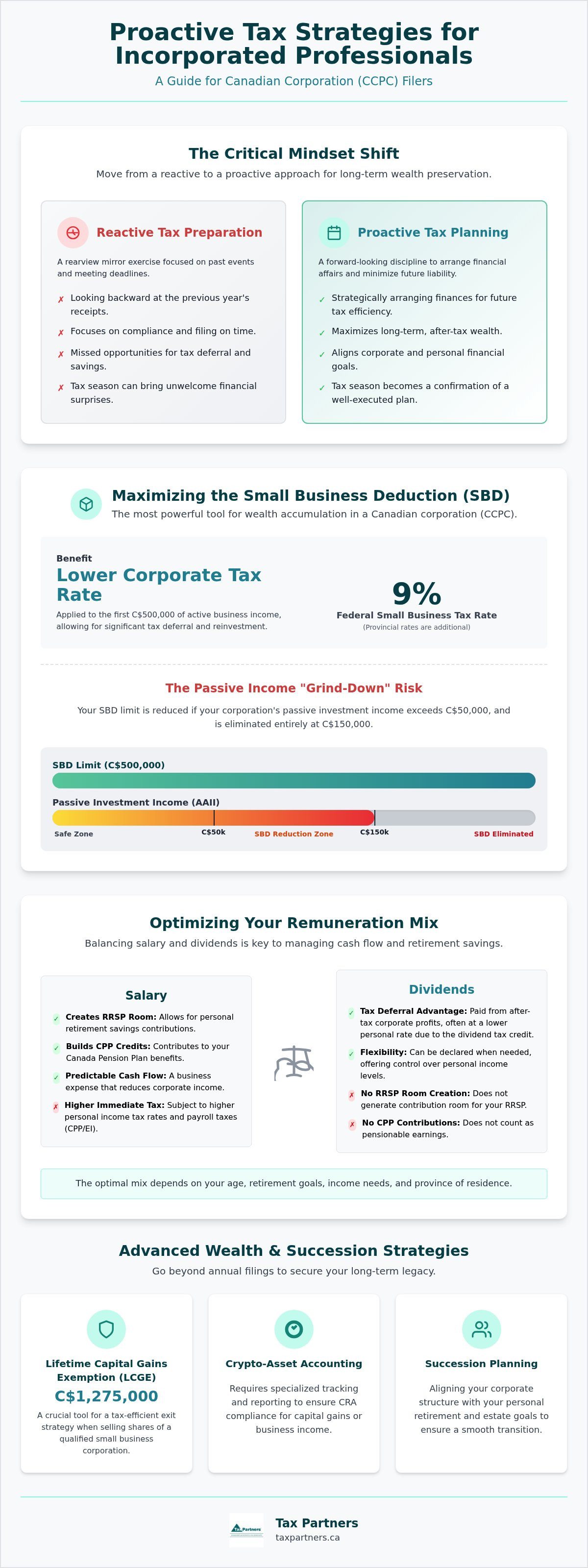
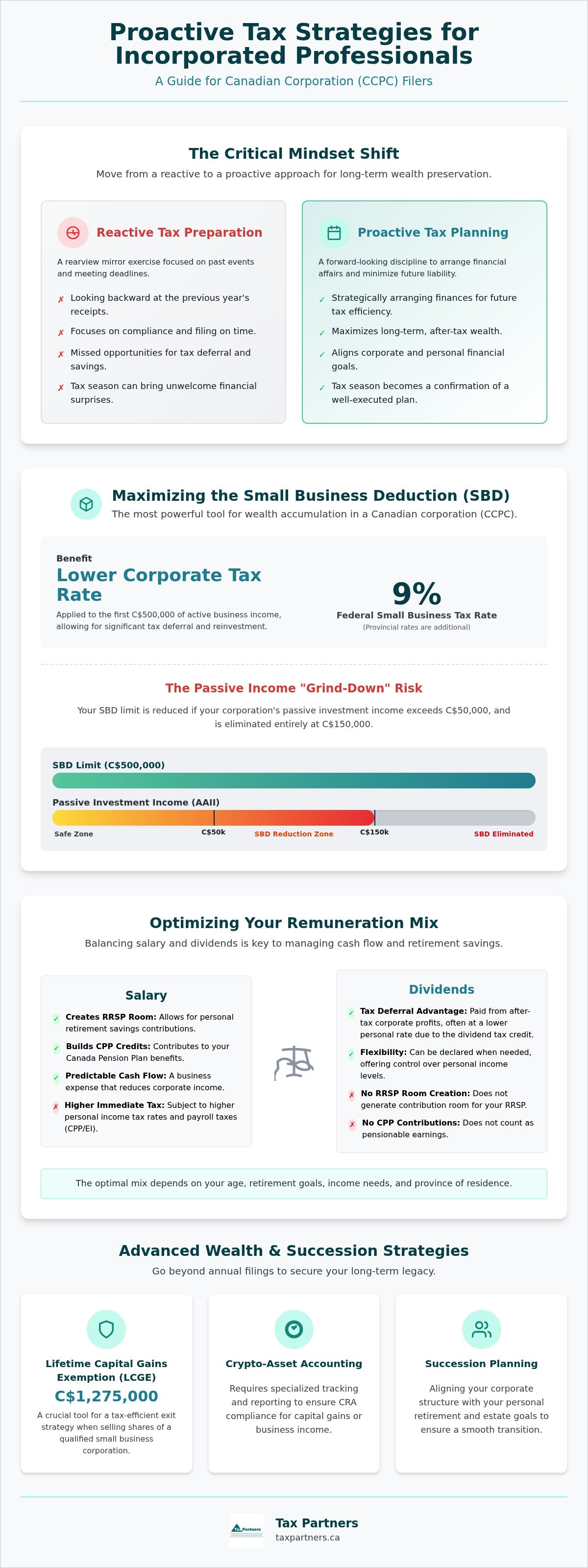
Many professionals view tax season as a rearview mirror exercise. It is often the process of looking back at the previous year's receipts and filing a return to meet a deadline. This is tax preparation, and while necessary, it is inherently reactive. True tax planning is a forward-looking discipline. It involves the proactive arrangement of your financial affairs to minimize your future liability to the CRA. For those seeking effective tax strategies for incorporated professionals Canada, the shift from a reactive to a proactive mindset is the single most important step toward long-term wealth preservation. Tax season shouldn't be a surprise. It should be a confirmation of a plan already executed.
The foundation of the Canadian tax system is the principle of "Integration." The CRA aims for a neutral outcome where the total tax paid is roughly the same whether you earn income personally or through a corporation. However, without a precise strategy, professionals often face double taxation or missed deferral opportunities. Understanding Corporate tax in Canada is essential because your corporate decisions dictate your personal tax bracket. When you realize that every dollar left in your corporation is a tool for future growth, the value of a coordinated strategy becomes clear.
Why Proactive Planning is Essential in 2026
In 2026, the margin for error has narrowed significantly. The CRA has increased its digital monitoring and audit selection precision, making accurate record-keeping a non-negotiable requirement. Proactive planning allows you to manage corporate cash flow effectively, ensuring you have the liquidity for quarterly tax instalments. It also helps you navigate the 2026 CPP changes, including the second additional contribution (CPP2) on earnings between $74,600 and $85,000. Planning ensures you are prepared for:
- Managing corporate cash flow for timely tax instalments.
- Optimizing the mix of salary and dividends before the calendar year ends.
- Staying ahead of evolving passive income thresholds that could impact your tax rate.
The Role of a Specialized CPA in Strategy
Navigating the complexities of the Income Tax Act requires a steady hand at the helm. While DIY software might suffice for simple returns, it often fails to account for the intricate needs of high-earning incorporated individuals. A specialized CPA acts as a proactive guardian, looking ahead to identify risks before they become liabilities. The most successful professionals realize that tax doesn't exist in a vacuum. By combining tax services with integrated wealth management, you create a seamless strategy that protects your assets today while securing your retirement for tomorrow. This partnership provides a level of foresight that seasonal filing simply cannot match.
Maximizing the Small Business Deduction and Corporate Structure
The Small Business Deduction (SBD) remains the most powerful tool for wealth accumulation within a Canadian corporation. It allows Canadian-controlled private corporations (CCPCs) to pay a significantly lower tax rate on their first C$500,000 of active business income. In 2026, the federal small business tax rate is 9%, which, when combined with provincial rates, creates a massive opportunity for tax deferral. This deferral is the engine behind many successful tax strategies for incorporated professionals Canada. By keeping more capital inside the business, you can reinvest in growth or build a robust investment portfolio that compounds over time. Understanding the specific rules outlined in the CRA T2 Corporation Income Tax Guide is vital to ensuring your business remains eligible for these preferred rates.
However, the SBD is not an absolute right; it is a limit that requires careful management. The "Small Business Limit" can be reduced if your corporation, along with any associated companies, earns significant passive investment income. This is known as the Adjusted Aggregate Investment Income (AAII) rule. If your passive income exceeds C$50,000, the CRA begins to "grind down" your access to the small business tax rate. For every C$1 of investment income over this threshold, your SBD limit decreases by C$5. Once your passive income reaches C$150,000, the SBD is eliminated entirely, and your active business income is taxed at the higher general corporate rate.
Navigating Passive Income Thresholds
Managing your investment portfolio is just as important as managing your professional practice. To preserve your SBD, you must be strategic about the types of income your corporate investments generate. Strategies often include focusing on capital gains rather than interest or foreign dividends, as only 50% of capital gains are included in the AAII calculation. Some professionals choose to pay out higher dividends to shareholders to trigger a refund of "Refundable Dividend Tax on Hand" (RDTOH), which can offset the impact of high passive income. Others may look toward individual pension plans or corporate-owned life insurance to shelter growth from the AAII calculation. If you find these rules overwhelming, discussing your corporate structure with a specialist can provide the clarity you need to protect your tax status.
Effective Use of Holding Companies
A well-organized corporate structure often involves the use of a holding company (HoldCo). By separating your professional operations from your accumulated wealth, you gain a layer of asset protection. You can move excess cash from your operating company (OpCo) to your HoldCo via inter-corporate dividends, which are typically tax-free. This allows you to secure profits away from the risks of the active business while maintaining the tax-deferred status of the funds. Our corporate income tax services focus on ensuring these movements are documented correctly to avoid unintended tax consequences. A HoldCo also provides a centralized vehicle for long-term investments, making it easier to manage the passive income thresholds discussed earlier and preparing the ground for a future business exit or succession plan.
Salary vs. Dividends: Optimizing Your Remuneration Mix
Decisions regarding remuneration are among the most frequent and impactful choices an incorporated professional makes. It's not a one-size-fits-all calculation. The right answer depends on your age, your lifestyle needs, and your long-term retirement goals. By balancing salary and dividends, you can fine-tune your personal tax bracket while ensuring your corporation remains a lean vehicle for investment. This is a cornerstone of effective tax strategies for incorporated professionals Canada. You should view your income not as a static figure, but as a lever that can be adjusted to meet changing financial demands and regulatory shifts.
The Strategic Advantage of a Salary
Taking a salary provides a steady, predictable T4 income that lenders value. If you plan to apply for a mortgage or a personal line of credit in 2026, having documented employment income is often a prerequisite for approval. Beyond lending, salary is a fully deductible corporate expense. This reduces the corporation's taxable income dollar-for-dollar. Perhaps most importantly, salary creates RRSP contribution room. For 2026, the maximum RRSP contribution limit is C$33,810. It also builds Canada Pension Plan (CPP) credits. For 2026, the Year's Maximum Pensionable Earnings (YMPE) is C$74,600. You'll also need to account for the second additional CPP contribution (CPP2) on earnings between C$74,600 and the Year’s Additional Maximum Pensionable Earnings (YAMPE) of C$85,000. These contributions provide a guaranteed, inflation-indexed floor for your retirement income, offering a layer of security that personal investments alone may not match.
The Role of Dividends in Tax Integration
Dividends offer a simpler way to extract profits without the administrative weight of payroll. Because they are paid out of after-tax corporate income, they don't require the corporation to remit CPP or other payroll taxes. This can significantly improve corporate cash flow. To prevent double taxation, the CRA uses the Dividend Tax Credit. This ensures the total tax you pay on a dividend, combined with the tax the corporation already paid, is roughly equal to what you would have paid on a salary. You'll receive either eligible or non-eligible dividends. Eligible dividends are taxed at a lower personal rate because the corporation already paid the higher general tax rate. Non-eligible dividends are paid from income taxed at the small business rate. Dividends allow you to manage your personal tax brackets with precision. If you've had a high-income year personally, you might choose to leave more money in the corporation. If you need extra cash for a one-time purchase, a dividend can be declared quickly. Realize that your optimal mix isn't static; it will shift as your practice grows and your family needs change.
Advanced Strategies: Crypto-Assets and Succession Planning
As your professional corporation matures, your focus naturally shifts from immediate tax deferral to long-term wealth preservation and eventual transition. Modern tax strategies for incorporated professionals Canada must now account for non-traditional assets and sophisticated exit plans that were once considered niche. Whether you are diversifying into digital currencies or preparing for a multi-generational transfer of your practice, the decisions you make today will determine the tax efficiency of your legacy. Moving beyond simple compliance requires a proactive approach to assets that carry unique regulatory weight.
Precise record-keeping is the foundation of these advanced strategies. The CRA has significantly increased its scrutiny of blockchain transactions, and professionals must realize that digital assets are not invisible to the tax man. Managing these complex elements requires a steady hand at the helm to ensure that your corporate investments don't inadvertently jeopardize your Small Business Deduction or your eligibility for future exemptions. Centring your long-term plans on a clear succession strategy is the only way to protect the value you have spent decades building.
Corporate Cryptocurrency and the CRA
The CRA treats cryptocurrency as a commodity rather than a currency for tax purposes. If your corporation holds digital assets, the tax implications depend heavily on the nature of your activity. Long-term holding typically results in capital gains, where only 50% of the gain is taxable. However, frequent trading or "mining" can be classified as business income, which is 100% taxable. This distinction is critical for your corporate tax return. Using specialized cryptocurrency accounting ensures that every buy, sell, and swap is documented with the correct fair market value in Canadian Dollars. If your corporation is active in this space, partnering with blockchain accountants is essential to navigate the technical reporting requirements and avoid costly penalties during an audit.
The Lifetime Capital Gains Exemption (LCGE)
The Lifetime Capital Gains Exemption is perhaps the most significant tax benefit available to Canadian business owners. For 2026, the LCGE limit has been indexed to approximately C$1,275,000, allowing you to realize a substantial portion of your business's sale price tax-free. To qualify, your corporation must meet the criteria for a Qualified Small Business Corporation (QSBC). This includes a "holding period" test and an "asset test," where at least 90% of the corporation's assets must be used in active business at the time of sale. Professionals often use an "estate freeze" to lock in the current value of the corporation, allowing future growth to accrue to family members. This strategy not only manages future tax liabilities but also provides a clear path for succession. To ensure your corporation meets these strict QSBC requirements well before a sale, consult with our succession planning specialists to review your current corporate structure.
Implementing a Holistic Wealth and Tax Strategy
The transition from basic tax compliance to sophisticated wealth preservation is a defining moment for any incorporated professional. It marks the point where you stop simply reacting to CRA deadlines and start actively shaping your financial future. As we have explored, the most effective tax strategies for incorporated professionals Canada are not isolated tactics. They are interconnected decisions that balance immediate cash flow with long-term security. Success in 2026 requires more than a seasonal filing; it demands a steady hand at the helm to ensure your corporate structure remains agile as regulations shift and your personal goals evolve.
A long-term partnership with a specialized CPA firm provides value that far exceeds the cost of preparation. While software can check boxes, it cannot offer the foresight needed to navigate the "grind down" of the Small Business Deduction or the complexities of an estate freeze. Regular strategy check-ins, combined with a clear understanding of Financial Advisory and Management Fees, allow you to pivot when the CRA introduces new digital monitoring tools or when your practice enters a new phase of growth. This proactive guardianship is what separates those who merely earn a high income from those who build lasting, multi-generational wealth.
Integrating Tax with Wealth Management
Tax planning should never exist in a silo. It is a critical component of a broader wealth management strategy that considers your entire financial ecosystem. When you look at insurance, investments, and taxes as a single unit, you unlock synergies that aren't visible in isolation. For example, corporate-owned life insurance can provide a tax-efficient way to transfer wealth to the next generation, while strategic investment choices can help you stay below the C$50,000 passive income threshold. The ultimate goal is simple: to keep more of what you earn for your family's future. By aligning your corporate tax outcomes with your personal financial planning, you create a robust shield against the erosion of your capital.
Your Next Steps for 2026
As you evaluate your current approach to tax and wealth, consider whether your advisor provides the transparency and industry-specific expertise your practice deserves. A truly effective tax partner should offer more than just numbers; they should provide a guided journey toward total control. Use this checklist to evaluate your next steps:
- Does your CPA have 40+ years of experience specifically with Canadian professional corporations?
- Are they proactive in identifying tax-saving opportunities before year-end, such as optimizing your C$33,810 RRSP limit?
- Do they offer integrated services that cover both corporate accounting and long-term financial planning?
- Is there a clear commitment to ethical steadfastness and transparent communication?
The landscape of 2026 is complex, but you don't have to navigate it alone. Secure your legacy and protect your hard-earned wealth with a bespoke strategy tailored to your unique concerns. Contact Tax Partners today for a consultation and discover how a proactive approach to tax can transform your professional corporation into a powerful engine for wealth preservation.
Secure Your Legacy with Proactive Planning
Mastering the balance between immediate remuneration and long-term asset protection is essential for every Canadian professional. Whether you're navigating the nuances of the C$1,275,000 Lifetime Capital Gains Exemption or managing corporate crypto-assets, your focus must remain on the seamless integration of your business and personal goals. Implementing the right tax strategies for incorporated professionals Canada ensures that your hard-earned capital stays where it belongs: in your hands. You've worked hard to build your practice; your tax structure should work just as hard to protect it.
At Tax Partners, we act as your proactive guardian in an increasingly complex regulatory environment. With over 495,000 returns filed and more than C$87 million saved for our clients, our team brings specialized expertise in corporate, cross-border, and cryptocurrency taxation. We don't just file forms; we build long-term partnerships rooted in stability and ethical steadfastness. We provide the steady hand at the helm that allows you to focus on your professional excellence with total peace of mind.
Take control of your financial journey today. Book a strategic tax planning session with Tax Partners today to customize a roadmap that protects your wealth and secures your family's future. It's time to move toward a future of total clarity and financial confidence.
Frequently Asked Questions
Is tax planning for incorporated professionals different from simple tax preparation?
Yes, tax planning is a proactive strategy while tax preparation is a reactive compliance task. Planning involves the forward-looking arrangement of your financial affairs to minimize future CRA liability. This is a core part of effective tax strategies for incorporated professionals Canada. Preparation merely records what has already happened. By planning ahead, you can implement structural changes that simple preparation cannot achieve after the year has ended.
What is the Small Business Deduction limit for Canadian corporations in 2026?
The federal Small Business Deduction (SBD) limit for 2026 is C$500,000 of active business income. This allows eligible Canadian-controlled private corporations to access a preferential 9% federal tax rate. Some provinces offer variations on this limit; for instance, Nova Scotia's limit is C$700,000. It's important to monitor this limit closely, as it's shared among associated corporations and can be reduced by high levels of passive investment income.
Can I pay myself exclusively in dividends to save on taxes?
You can choose to be paid exclusively in dividends, but this isn't always the most tax-efficient path. While dividends avoid CPP contributions and simplify payroll administration, they don't create RRSP contribution room. For 2026, the RRSP limit is C$33,810, which represents a significant tax-deferred growth opportunity. A balanced mix of salary and dividends is often better for long-term wealth preservation and access to personal lending.
How does the CRA treat cryptocurrency held within a professional corporation?
The CRA treats cryptocurrency as a commodity, meaning transactions generally result in capital gains or business income. If your corporation holds digital assets as long-term investments, only 50% of the capital gain is taxable. However, frequent trading or mining activity may be classified as business income, which is 100% taxable. Meticulous record-keeping of every blockchain transaction's fair market value in Canadian Dollars is essential to remain compliant with evolving digital asset rules.
What is the Lifetime Capital Gains Exemption and how do I qualify?
The Lifetime Capital Gains Exemption (LCGE) allows you to shelter up to approximately C$1,275,000 in gains from the sale of Qualified Small Business Corporation shares in 2026. To qualify, your corporation must meet specific asset tests, including the requirement that 90% of assets be used in active business at the time of sale. You must also have held the shares for at least 24 months prior to the disposition to claim this exemption.
How much passive income can my corporation earn before my tax rate increases?
Your corporation can earn up to C$50,000 in adjusted aggregate investment income before the Small Business Deduction begins to decrease. For every C$1 earned over this C$50,000 threshold, your SBD limit is reduced by C$5. Once your passive income reaches C$150,000, the SBD is eliminated entirely. Managing your corporate portfolio is a vital component of tax strategies for incorporated professionals Canada to avoid being pushed into higher tax brackets.
Should I use a holding company for my professional corporation's investments?
Using a holding company is an effective way to protect accumulated wealth and facilitate tax-deferred reinvestment. You can move excess cash from your operating company to a holding company through tax-free inter-corporate dividends. This structure secures profits from the risks of your active practice while allowing you to manage passive income thresholds more effectively. It also simplifies future succession planning or the eventual sale of your professional practice.
What are the risks of a CRA audit for incorporated professionals?
The primary risks in a CRA audit include the misclassification of a Personal Services Business (PSB) and undocumented corporate expenses. The CRA has increased its digital monitoring and oversight in 2026, specifically targeting professionals who work primarily for one client. If classified as a PSB, you lose access to the Small Business Deduction and many deductible expenses. Maintaining meticulous records and a clear corporate structure is your best defence against these assessments.

Article by
Mahad Mohamed
Mahad Mohamed is an accountant and the CEO of Tax Partners, with over 26+ years of Canadian and international tax and accounting experience. His expertise includes corporate reorganization, cross-border tax structuring (Canada & US), tax disputes, CRA audits, and tax planning for small owner-managed private corporations. Most recently, Mahad is a pioneer in Canadian crypto taxation and founded Block3 Finance.
Previously, Mahad worked for the Canada Revenue Agency (CRA), Big4 accounting firms, and served as a Rulings Officer for the Federal Tax Authority of the UAE before acquiring Tax Partners in 2014.
Tax Partners has 44 full-time accountants and over 18,400+ clients.
Disclaimer
This article provides general information only and is current as of its publication date. It has not been updated and may be out of date. It does not constitute legal advice and should not be relied upon as such. Every tax situation is unique and may differ from the examples discussed in this article. If you have specific questions, you should seek the advice of our accountants for your unique circumstances. Book a FREE Initial Consultation Today!
Frequently Asked Questions
Is tax planning for incorporated professionals different from simple tax preparation?
Yes, tax planning is a proactive, year-round strategy while tax preparation is a reactive reporting of past events. Simple preparation ensures you meet CRA filing deadlines accurately. Strategic planning involves arranging your financial affairs in advance to minimize future liability. It's the difference between merely recording your tax bill and actively working to reduce it through foresight and structural optimization.
What is the Small Business Deduction limit for Canadian corporations in 2026?
The federal small business limit remains at $500,000 for Canadian-Controlled Private Corporations (CCPCs) in 2026. This limit applies to active business income, allowing for a reduced federal tax rate of 9%. You should also account for provincial thresholds, which generally align with the federal limit. However, this limit is reduced if your corporation's taxable capital exceeds $10 million or if passive income thresholds are met.
Can I pay myself exclusively in dividends to save on taxes?
You can choose an all-dividend remuneration model, but it may not be the most effective choice for your long-term wealth. While dividends avoid mandatory CPP contributions and payroll taxes, they don't create RRSP contribution room. A balanced mix is often the core of effective tax strategies for incorporated professionals Canada. This approach allows you to build personal retirement room while maintaining corporate tax efficiency.
How does the CRA treat cryptocurrency held within a professional corporation?
The CRA treats cryptocurrency as a commodity rather than a currency for tax purposes. Any gains or losses from trading digital assets within your corporation are typically taxed as capital gains or business income. You must maintain meticulous records of the adjusted cost base for every transaction in Canadian dollars. Failure to track these values precisely can lead to significant complications during a CRA audit or review.
What is the Lifetime Capital Gains Exemption and how do I qualify?
The Lifetime Capital Gains Exemption (LCGE) allows you to realize tax-free gains on the sale of Qualified Small Business Corporation (QSBC) shares. For 2026, the exemption limit has increased to $1,275,000. To qualify, your corporation must meet the "asset use" test, where at least 90% of your assets are used in active business at the time of sale. You must also meet specific holding period requirements for the shares.
How much passive income can my corporation earn before my tax rate increases?
Your access to the small business tax rate begins to decrease once your passive income exceeds $50,000 in a taxation year. For every $1 of investment income earned above this threshold, your $500,000 small business limit is reduced by $5. If your corporation earns $150,000 or more in passive income, the Small Business Deduction is completely eliminated. This results in your active income being taxed at the higher general corporate rate.
Should I use a holding company for my professional corporation's investments?
A holding company is a powerful tool for asset protection and tax-efficient wealth accumulation. It allows you to move surplus profits from your operating company via tax-free inter-corporate dividends, shielding those funds from operational risks. This structure facilitates long-term tax deferral by keeping capital within the corporate environment. It's an ideal way to separate your professional practice from your growing investment portfolio and personal wealth.
What are the risks of a CRA audit for incorporated professionals?
The primary risks include the misclassification of personal expenses as business deductions and the incorrect reporting of passive income. The CRA often scrutinizes professional corporations to ensure they aren't operating as Personal Services Businesses (PSBs), which carry higher tax rates. Meticulous record-keeping and a proactive relationship with a specialized CPA firm are your best defences. Having a steady hand at the helm ensures your filings remain compliant and defensible.