Tax Implications of Selling a Business in Canada (2026 Guide)

Did you know that one in five Canadian companies will likely change ownership within the next five years, representing nearly C$300 billion in business value? For many owners, the excitement of an exit is often dampened by the complex tax implications of selling a business in Canada. It's a high-stakes transition where a single structural oversight can lead to unnecessary double taxation or a lost exemption.
You've spent decades building your legacy, and you likely feel that the CRA shouldn't be your largest beneficiary. We understand the stress that comes with deciphering regulatory rules, especially when trying to determine if your shares qualify for the Lifetime Capital Gains Exemption. Our goal is to replace that uncertainty with a sense of total control and clarity.
In this 2026 guide, you'll discover how to navigate current rules to protect your equity and maximize your after-tax proceeds. We'll examine the benefits of share versus asset sales, verify the latest LCGE thresholds, and outline a clear roadmap for your professional consultation. By the end, you'll have the foresight needed to secure a prosperous future for yourself and your family.
Key Takeaways
- Compare asset and share sales to understand the tax implications of selling a business in Canada and prevent the trap of double taxation.
- Identify if you qualify for the 2026 Lifetime Capital Gains Exemption (LCGE) to shelter up to C$1,275,000 of your proceeds under CRA rules.
- Learn how to use earn-outs and vendor take-back mortgages as effective tools for tax deferral and price negotiation.
- Discover the "purification" steps needed to meet Qualified Small Business Corporation (QSBC) status at least 24 months before your exit.
- Establish a clear plan for integrating your post-sale wealth into a comprehensive estate strategy to minimize future deemed disposition taxes.
Asset Sale vs. Share Sale under CRA Rules
The decision of how to structure your exit is rarely a simple one. It often feels like a strategic tug-of-war between you and your buyer. While you aim to keep more of your hard-earned equity, the buyer usually seeks to maximize their future tax deductions. This fundamental choice significantly shapes the tax implications of selling a business in Canada, as the CRA treats these two paths with distinct sets of rules. Understanding the Canadian tax system is vital here, as it dictates how your proceeds are categorized and taxed at both the corporate and personal levels.
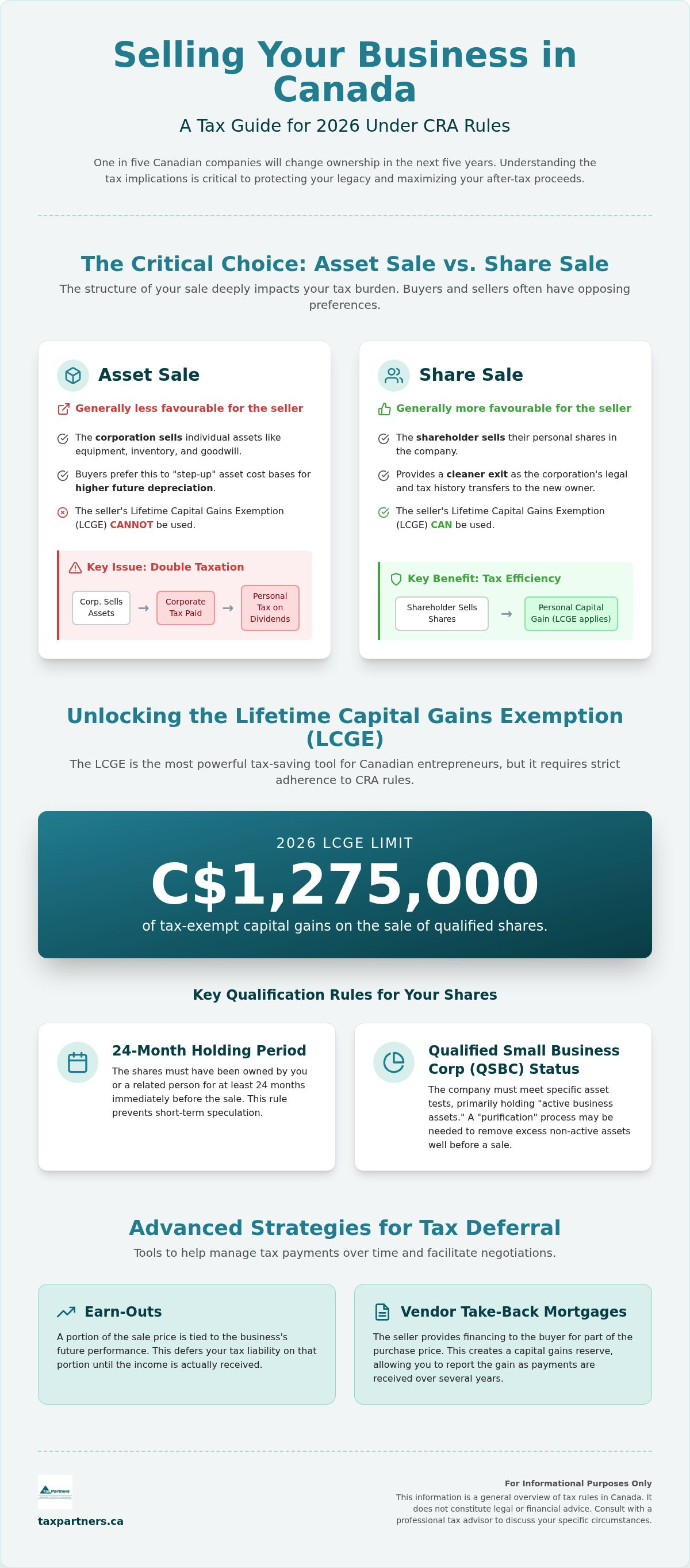
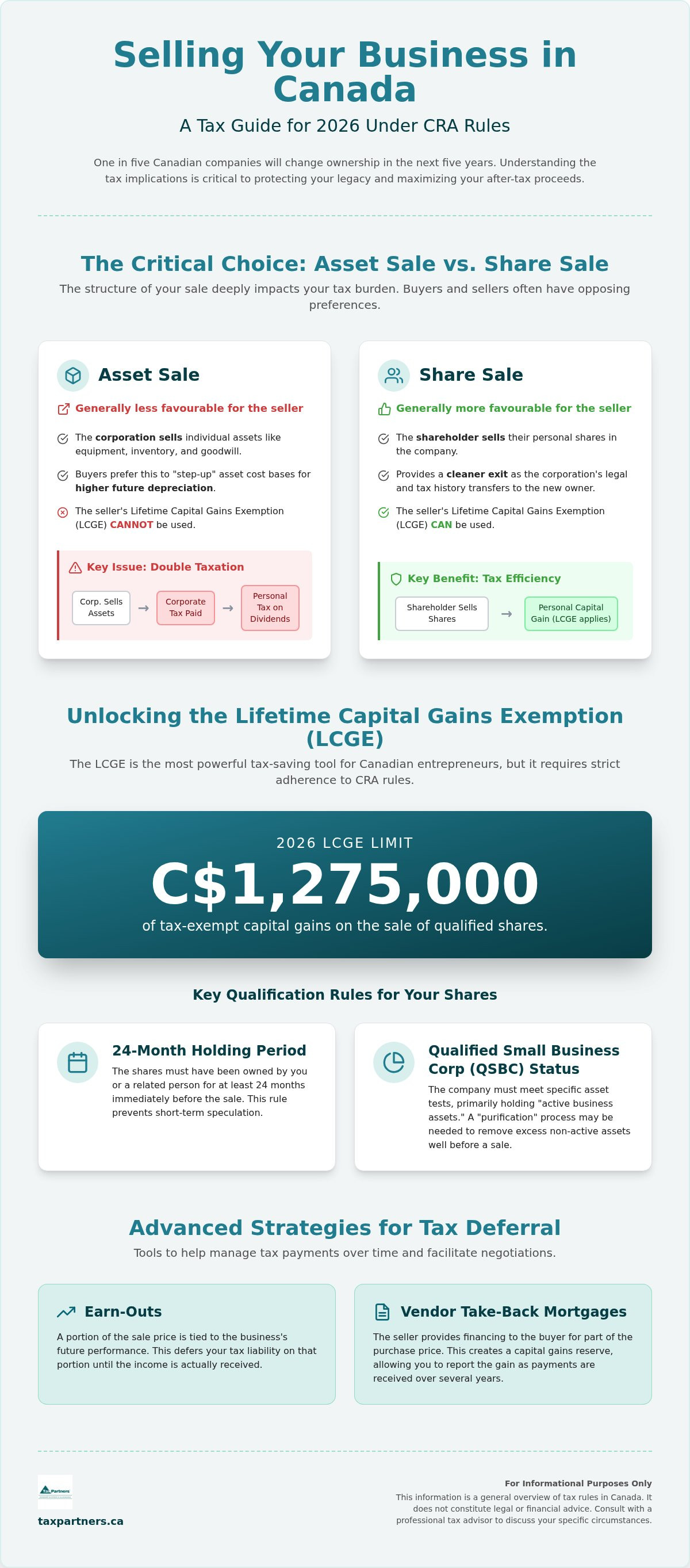
Buyers typically favour asset sales because they can "step up" the cost base of the assets they acquire. This allows them to claim higher depreciation in the future. Sellers, however, often find themselves at a disadvantage in this scenario. You'll need to weigh the immediate tax burden against the purchase price offered to ensure the deal truly serves your long-term goals.
The Tax Impact of an Asset Sale
In an asset sale, your corporation sells its individual components, such as equipment, inventory, or goodwill. The CRA views the proceeds as corporate income first. This structure often triggers a "recapture" of previously claimed Capital Cost Allowance (CCA). Recapture occurs when an asset sells for more than its undepreciated capital cost, and the CRA taxes this amount as ordinary income at your corporate income tax rate.
You'll then face a second layer of taxation when you withdraw the remaining cash from the corporation. This "double taxation" happens because you must pay personal income tax on the dividends distributed to you. Because the corporation is the seller, not you as an individual, you cannot apply the Lifetime Capital Gains Exemption to the proceeds. This often results in a significantly lower after-tax amount compared to other structures.
The Benefits of a Share Sale
Most Canadian business owners prefer a share sale because it treats the transaction as a personal capital gain for the shareholder. This is where the tax implications of selling a business in Canada become much more favourable for the individual seller. By selling your shares, you may qualify for the LCGE, which can shelter up to C$1,275,000 of capital gains from tax in 2026. This single exemption can save you hundreds of thousands of dollars in a single transaction.
This method avoids corporate-level taxes entirely, allowing you to move the proceeds directly into your personal wealth management plan. Additionally, a share sale provides a cleaner break for the founder. The corporation's tax history, contracts, and payroll accounts remain intact under the new owner. This continuity can make the business more attractive to buyers who want a turn-key operation without the complexity of setting up new legal entities.
Navigating the Lifetime Capital Gains Exemption (LCGE)
The Lifetime Capital Gains Exemption (LCGE) represents the pinnacle of tax planning for Canadian entrepreneurs. It offers a rare opportunity to exit your company while keeping a substantial portion of your equity away from the tax collector. For 2026, the CRA has set the exemption limit at C$1,275,000. Realizing the value of this exemption requires more than just a successful sale; it requires precise adherence to the Qualified Small Business Corporation (QSBC) rules. Understanding these tax implications of selling a business in Canada early in your journey is the difference between a tax-free windfall and a heavy bill from the CRA.
You shouldn't wait until a letter of intent is on your desk to review your eligibility. The criteria are rigid, and the CRA frequently audits these claims to ensure every requirement is met. Proactive planning allows you to identify potential hurdles while you still have time to correct them.
The 24-Month Holding Period Rule
The CRA mandates a strict 24-month holding period to qualify for the exemption. You, or a person related to you, must have held the shares for at least two years prior to the disposition. This rule prevents short-term speculators from accessing a benefit intended for long-term builders. The CRA monitors share ownership history closely through corporate minute books and tax filings.
A common pitfall occurs when shares are transferred or issued shortly before a sale. If you've recently restructured your business or brought on new partners, you must carefully track these dates. If you're unsure if your current share structure meets these requirements, it's wise to consult with a tax specialist to verify your timeline.
The Asset Test: Active Business Assets
Meeting the "Asset Test" is often the most complex hurdle for business owners. Your corporation must satisfy two specific thresholds regarding its assets to maintain QSBC status:
- The 90% Test: At the exact moment of sale, at least 90% of the fair market value of the corporation's assets must be used in active business carried on primarily in Canada.
- The 50% Test: Throughout the entire 24-month holding period, more than 50% of the assets must have been used in an active business.
Many successful businesses inadvertently fail these tests by accumulating too much "passive" wealth. This includes excess cash, stock portfolios, or real estate not used in daily operations. To protect your eligibility, you may need to "purify" the corporation. This process involves stripping out non-active assets, often through dividends or a holding company, to ensure your balance sheet remains compliant with CRA standards. Addressing these tax implications of selling a business in Canada well in advance ensures your hard work translates into maximum after-tax wealth.
Strategic Timing and Transaction Structuring
Timing isn't just about market conditions; it's a vital component of tax efficiency. A sudden influx of capital in a single calendar year can push you into the highest marginal tax bracket, significantly increasing the tax implications of selling a business in Canada. By strategically choosing your closing date, you can better manage your income levels and potentially defer liabilities into future years.
Transaction structures like earn-outs and vendor take-back (VTB) mortgages often serve as effective bridges between buyer and seller expectations. In a VTB mortgage, you essentially act as the lender for the buyer, allowing them to pay a portion of the purchase price over time. This not only facilitates the sale but also enables you to utilize specific deferral mechanisms recognized by the CRA.
Structuring the deal requires a proactive approach to ensure the legal framework supports your financial goals. Our corporate income tax services provide the technical oversight needed to organize these complex arrangements without falling into common regulatory traps.
Utilizing the Capital Gains Reserve
If you don't receive the full purchase price in the year of the sale, the CRA may allow you to claim a capital gains reserve. This mechanism lets you spread the tax hit over a maximum of five years, provided you receive the proceeds over that same period. You must bring at least 20% of the gain into your income each year on a cumulative basis.
This strategy is particularly helpful for maintaining a lower marginal tax rate. Instead of paying tax on the entire gain at once, you recognize it gradually as the cash actually arrives in your bank account. It provides a steady stream of income while keeping your annual tax obligations manageable and predictable.
The Role of Holding Companies
Using a holding company can offer a layer of flexibility that personal ownership lacks. When a holding company sells the shares of an operating company, the proceeds can often be transferred as tax-efficient inter-corporate dividends. This allows you to keep the capital within a corporate structure for future reinvestment or diversification without triggering an immediate personal tax bill.
- Reinvestment: You can deploy the full pre-tax amount into new ventures or securities.
- Income Splitting: A holding company can help facilitate structured distributions to family members over time.
- Asset Protection: It separates your sale proceeds from the risks associated with the previous operating entity.
Professional advice is essential here to navigate the CRA's anti-avoidance rules, such as those found in Section 84.1 of the Income Tax Act. These rules are designed to prevent the conversion of taxable dividends into capital gains, so every step must be documented with precision. Taking these precautions ensures the tax implications of selling a business in Canada remain a manageable part of your successful exit.
Managing Post-Sale Wealth and Estate Integration
The moment the deal closes, your role shifts from a business builder to a steward of capital. This transition is one of the most overlooked tax implications of selling a business in Canada, as liquid wealth requires a different defensive strategy than operational equity. You've successfully navigated the sale; now, you must ensure that your proceeds aren't eroded by annual tax leakage or structural inefficiencies.
Large transactions often trigger the Alternative Minimum Tax (AMT) under CRA rules. This parallel tax calculation ensures that individuals who utilize significant deductions or exemptions, such as the LCGE, still pay a minimum threshold of tax. While AMT can often be recovered as a credit in subsequent years, it represents a significant immediate cash flow consideration that requires the steady hand of our wealth management and financial planning team.
Wealth Preservation Strategies
Preserving your capital involves moving beyond basic savings accounts to more sophisticated, tax-sheltered environments. Individual Pension Plans (IPPs) or Retirement Compensation Arrangements (RCAs) can serve as powerful tools for former owners. These structures allow for significant tax-deductible contributions from a holding company, effectively deferring personal tax while providing a predictable retirement income stream.
The goal is to achieve long-term growth while minimizing the "drag" of annual taxes on investment income. By utilizing corporate structures and specific insurance-based products, you can protect your capital from high marginal rates. For a deeper look at these methods, we recommend reviewing our guide on tax-efficient wealth management to see how these pieces fit together.
Estate Planning and Succession
A business sale fundamentally changes your will and estate requirements. Your assets have likely shifted from private corporation shares to a mix of cash, securities, or holding company interests. This change necessitates a comprehensive review of your estate plan to ensure your legacy remains intact and your heirs aren't burdened by a massive tax bill upon a "deemed disposition" at death.
- Update Your Will: Ensure your documents reflect your new liquidity and any new holding company structures.
- Inter-generational Transfers: Use family trusts or prescribed rate loans to move future growth to the next generation tax-efficiently.
- The Centre of Excellence: Coordinate your CPA, legal counsel, and wealth advisor to ensure all parts of your plan move in unison.
Managing this new chapter requires a proactive guardian who looks beyond the transaction to your long-term security. If you're ready to integrate your sale proceeds into a lasting legacy, connect with our team today for a personalized consultation.
Securing Your Legacy with Professional Tax Planning
Attempting to manage the tax implications of selling a business in Canada with off-the-shelf software is a risk that few successful entrepreneurs can afford to take. While these digital tools are efficient for standard income scenarios, they lack the sophisticated logic required for multi-year corporate divestitures. A business exit involves overlapping CRA rules that require human judgment, historical context, and a deep understanding of evolving tax law.
Having a seasoned CPA by your side provides more than just technical accuracy; it offers a robust defense during potential CRA inquiries. The CRA often scrutinizes large capital gains claims, and having a professional representative who understands your entire transaction history ensures that your interests are protected. We act as your proactive guardian, ensuring that every filing is backed by the ethical steadfastness and precision your legacy deserves.
The Proactive Guardian Approach
At Tax Partners, we don't just react to tax requirements; we look ahead to identify potential audit triggers before they become obstacles. Our team brings the collective wisdom of over 40 years of experience in Canadian tax law to your specific situation. This deep-seated reliability is rooted in a history of over 495,000 filed returns, providing us with the institutional knowledge to navigate even the most complex corporate structures.
- Audit Readiness: We ensure your corporate minute books and financial records are beyond reproach.
- Strategic Foresight: Our planners anticipate how current CRA trends might affect your future liabilities.
- Ethical Integrity: We prioritize transparent, compliant strategies that stand up to the highest levels of scrutiny.
Next Steps for Business Owners
Your journey toward a successful, tax-efficient exit begins with organization and foresight. We recommend that you gather your corporate financial statements for the last three years to provide a clear picture of your company's trajectory. This documentation is essential for conducting a preliminary assessment of your LCGE eligibility and identifying any necessary purification steps.
The transition from owner to retiree or serial entrepreneur is a significant life event that merits a steady hand at the helm. We invite you to contact Tax Partners today to begin your exit journey with a team that is genuinely invested in your success. You can book a consultation to receive a personalized roadmap designed to protect your hard-earned equity and secure your family's future.
Secure Your Financial Legacy Today
Exiting your business is the culmination of years of dedication and sacrifice. You've seen how choosing a share sale over an asset sale is often the most effective way to manage the tax implications of selling a business in Canada, especially when leveraging the C$1,275,000 LCGE limit for 2026. Strategic timing and the proactive "purification" of your assets are not just suggestions; they're essential steps to ensuring your hard-earned equity stays where it belongs. Transitioning from a business owner to a wealth manager requires a shift in perspective that starts long before the final papers are signed.
You don't have to navigate these complex CRA regulations alone. With over 40 years of Canadian tax expertise and more than 1,390 five-star Google reviews, our team has saved clients more than C$87M through meticulous, personalized planning. We're ready to act as your proactive guardian throughout this entire transition, providing the steady hand you need to move forward with total confidence.
Secure your business exit strategy with Tax Partners today to gain the clarity and control you deserve. Your legacy is far too valuable to leave to chance, and we're here to ensure your next chapter is your most prosperous one yet.
Frequently Asked Questions
What is the Lifetime Capital Gains Exemption for 2026?
The Lifetime Capital Gains Exemption (LCGE) for qualified small business corporation shares in 2026 is C$1,275,000. This indexed amount allows eligible individuals to shelter a significant portion of their capital gains from taxation. To utilize this benefit, your shares must meet specific Qualified Small Business Corporation (QSBC) criteria at the time of the sale. It remains a cornerstone for minimizing the tax implications of selling a business in Canada.
How does an asset sale differ from a share sale for CRA filers?
In a share sale, you sell your ownership interest in the corporation, which typically triggers a personal capital gain and potential LCGE eligibility. Conversely, an asset sale involves the corporation selling individual items like equipment or goodwill. This structure often results in corporate-level tax and the recapture of depreciation. For CRA filers, share sales are generally preferred because they avoid the double taxation often associated with distributing asset sale proceeds.
Can I use the LCGE if I sell my business to a family member?
You can generally use the LCGE when selling to a family member, provided the shares meet all QSBC requirements. However, the CRA applies strict "anti-avoidance" rules to non-arm's length transactions to ensure the business isn't undervalued. The sale must occur at fair market value to avoid punitive tax consequences. Professional guidance is essential to structure these family transfers correctly and preserve your hard-earned exemption eligibility.
What is the 24-month holding period rule for Canadian businesses?
To qualify for the LCGE, the CRA requires that you, or a person related to you, must have owned the shares for at least 24 months before the disposition. Additionally, more than 50% of the fair market value of the corporation's assets must have been used in an active business throughout that entire period. This rule ensures the tax benefit supports long-term builders rather than those seeking short-term speculative gains.
How does a vendor take-back mortgage affect my taxes under CRA rules?
A vendor take-back (VTB) mortgage allows you to receive the purchase price over several years rather than in one lump sum. Under CRA rules, this may enable you to claim a capital gains reserve, spreading your tax liability over a maximum of five years. You must report at least 20% of the gain annually on a cumulative basis. This strategy helps manage your marginal tax bracket and improves your overall cash flow.
What is the Alternative Minimum Tax and how does it affect business sales?
The Alternative Minimum Tax (AMT) is a parallel tax system designed to ensure that individuals who use significant deductions or exemptions still pay a minimum threshold of tax. When you claim the LCGE, it may trigger an AMT liability on your personal return for that year. While you can often carry this tax forward as a credit to offset future taxes, it requires proactive planning to manage the immediate impact on your proceeds.
Do I need to notify the CRA before I sell my business?
You don't need to notify the CRA before the sale, but the transaction must be reported on your tax return for the year it closes. If your business has employees or GST/HST accounts, you'll need to file final returns or close those accounts appropriately. In an asset sale, you and the buyer may also need to file Form GST44 to exempt the transaction from GST/HST, provided specific conditions are met.
How can a holding company help me save taxes when I sell?
A holding company can receive sale proceeds as tax-efficient inter-corporate dividends, allowing you to retain capital within a corporate structure for future reinvestment. This deferral prevents an immediate personal tax hit at the highest marginal rates. It also provides a flexible framework for long-term wealth management and estate planning. Successfully navigating the tax implications of selling a business in Canada often involves using these corporate layers to protect and grow your wealth.

Article by
Mahad Mohamed
Mahad Mohamed is an accountant and the CEO of Tax Partners, with over 26+ years of Canadian and international tax and accounting experience. His expertise includes corporate reorganization, cross-border tax structuring (Canada & US), tax disputes, CRA audits, and tax planning for small owner-managed private corporations. Most recently, Mahad is a pioneer in Canadian crypto taxation and founded Block3 Finance.
Previously, Mahad worked for the Canada Revenue Agency (CRA), Big4 accounting firms, and served as a Rulings Officer for the Federal Tax Authority of the UAE before acquiring Tax Partners in 2014.
Tax Partners has 44 full-time accountants and over 18,400+ clients.
Disclaimer
This article provides general information only and is current as of its publication date. It has not been updated and may be out of date. It does not constitute legal advice and should not be relied upon as such. Every tax situation is unique and may differ from the examples discussed in this article. If you have specific questions, you should seek the advice of our accountants for your unique circumstances. Book a FREE Initial Consultation Today!
Frequently Asked Questions
What is the Lifetime Capital Gains Exemption for 2026?
The Lifetime Capital Gains Exemption (LCGE) for qualified small business corporation shares in 2026 is C$1,275,000. This indexed amount allows eligible individuals to shelter a significant portion of their capital gains from taxation. To utilize this benefit, your shares must meet specific Qualified Small Business Corporation (QSBC) criteria at the time of the sale. It remains a cornerstone for minimizing the tax implications of selling a business in Canada.
How does an asset sale differ from a share sale for CRA filers?
In a share sale, you sell your ownership interest in the corporation, which typically triggers a personal capital gain and potential LCGE eligibility. Conversely, an asset sale involves the corporation selling individual items like equipment or goodwill. This structure often results in corporate-level tax and the recapture of depreciation. For CRA filers, share sales are generally preferred because they avoid the double taxation often associated with distributing asset sale proceeds.
Can I use the LCGE if I sell my business to a family member?
You can generally use the LCGE when selling to a family member, provided the shares meet all QSBC requirements. However, the CRA applies strict "anti-avoidance" rules to non-arm's length transactions to ensure the business isn't undervalued. The sale must occur at fair market value to avoid punitive tax consequences. Professional guidance is essential to structure these family transfers correctly and preserve your hard-earned exemption eligibility.
What is the 24-month holding period rule for Canadian businesses?
To qualify for the LCGE, the CRA requires that you, or a person related to you, must have owned the shares for at least 24 months before the disposition. Additionally, more than 50% of the fair market value of the corporation's assets must have been used in an active business throughout that entire period. This rule ensures the tax benefit supports long-term builders rather than those seeking short-term speculative gains.
How does a vendor take-back mortgage affect my taxes under CRA rules?
A vendor take-back (VTB) mortgage allows you to receive the purchase price over several years rather than in one lump sum. Under CRA rules, this may enable you to claim a capital gains reserve, spreading your tax liability over a maximum of five years. You must report at least 20% of the gain annually on a cumulative basis. This strategy helps manage your marginal tax bracket and improves your overall cash flow.
What is the Alternative Minimum Tax and how does it affect business sales?
The Alternative Minimum Tax (AMT) is a parallel tax system designed to ensure that individuals who use significant deductions or exemptions still pay a minimum threshold of tax. When you claim the LCGE, it may trigger an AMT liability on your personal return for that year. While you can often carry this tax forward as a credit to offset future taxes, it requires proactive planning to manage the immediate impact on your proceeds.
Do I need to notify the CRA before I sell my business?
You don't need to notify the CRA before the sale, but the transaction must be reported on your tax return for the year it closes. If your business has employees or GST/HST accounts, you'll need to file final returns or close those accounts appropriately. In an asset sale, you and the buyer may also need to file Form GST44 to exempt the transaction from GST/HST, provided specific conditions are met.
How can a holding company help me save taxes when I sell?
A holding company can receive sale proceeds as tax-efficient inter-corporate dividends, allowing you to retain capital within a corporate structure for future reinvestment. This deferral prevents an immediate personal tax hit at the highest marginal rates. It also provides a flexible framework for long-term wealth management and estate planning. Successfully navigating the tax implications of selling a business in Canada often involves using these corporate layers to protect and grow your wealth.