International Assignment Tax Services in Canada (2026 Guide)

Is your global mobility strategy built on a foundation of tax compliance, or are you one CRA audit away from a major financial setback? Moving talent across borders is a bold move for any organization, but the administrative weight of international assignment tax services Canada can quickly feel like an anchor. You likely understand that the difference between a successful relocation and a costly mistake often hinges on a single residency determination.
We recognize the stress that comes with deciphering the Canada Revenue Agency (CRA) rules on factual versus deemed residency. It's difficult to maintain focus on your business goals when you're caught in the weeds of dual-jurisdiction payroll. You deserve a clear path forward that protects both your company's bottom line and your employees' net pay.
This 2026 guide provides the expert CPA framework you need to master cross-border compliance with confidence. We'll examine how to navigate CRA residency obligations and implement tax equalization strategies that ensure seamless compliance. By the end of this article, you'll have a proactive roadmap to secure your global mobility strategy for the long term.
Key Takeaways
- Learn to distinguish between factual and deemed residency under CRA rules to prevent unexpected tax liabilities and protect your global mobility strategy.
- Discover how international assignment tax services Canada simplify shadow payroll management and ensure precise source deductions for your cross-border team.
- Understand the strategic differences between outbound and inbound assignments to stay ahead of evolving CRA reporting requirements and filing deadlines.
- Implement a tax equalization policy that protects your employee's take-home pay while shielding your organization from regulatory penalties.
- Use a structured compliance checklist to track primary residential ties and maintain the meticulous records needed for a successful CRA filing.
Defining Residency for CRA Filers on International Assignment
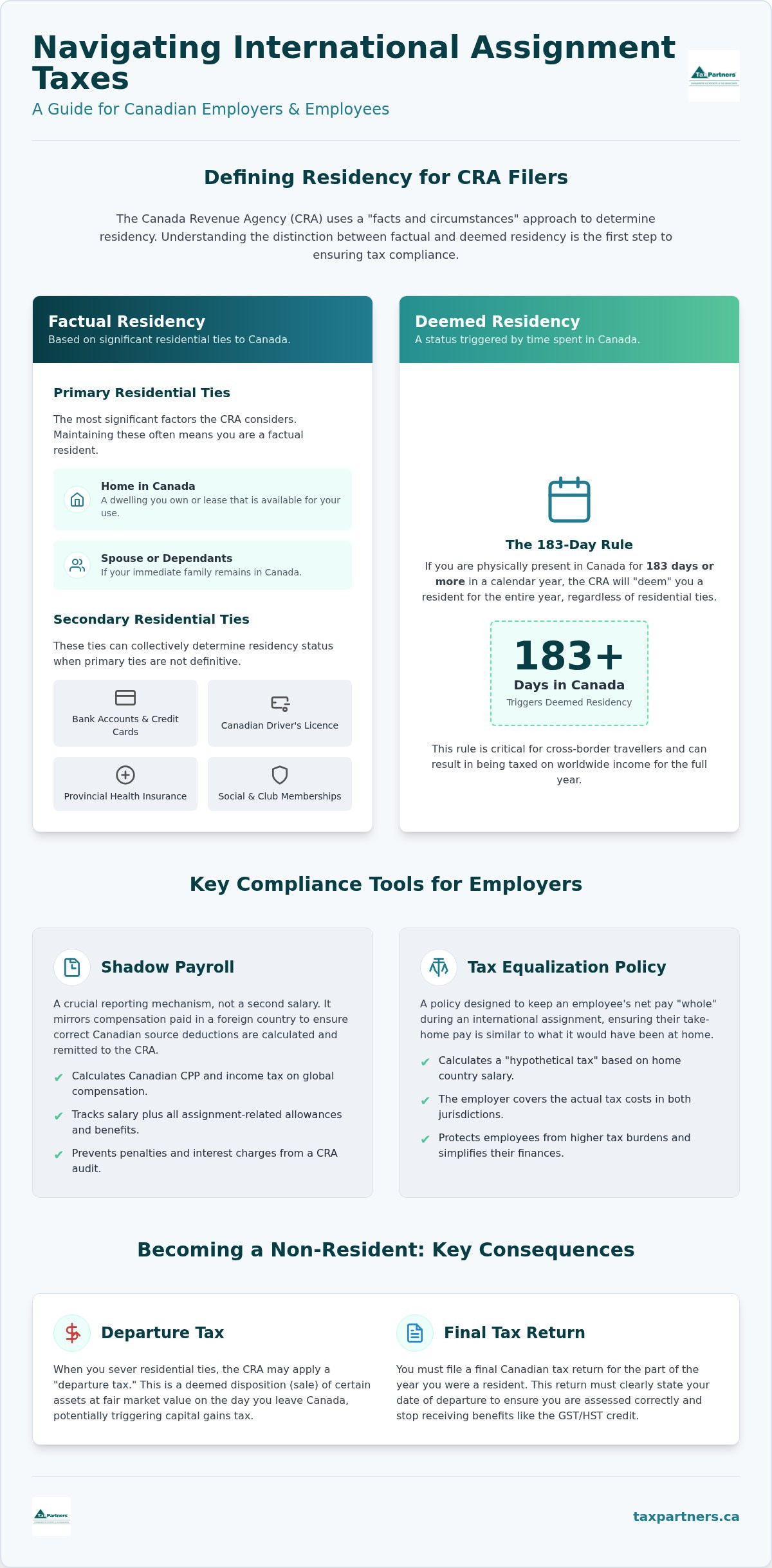
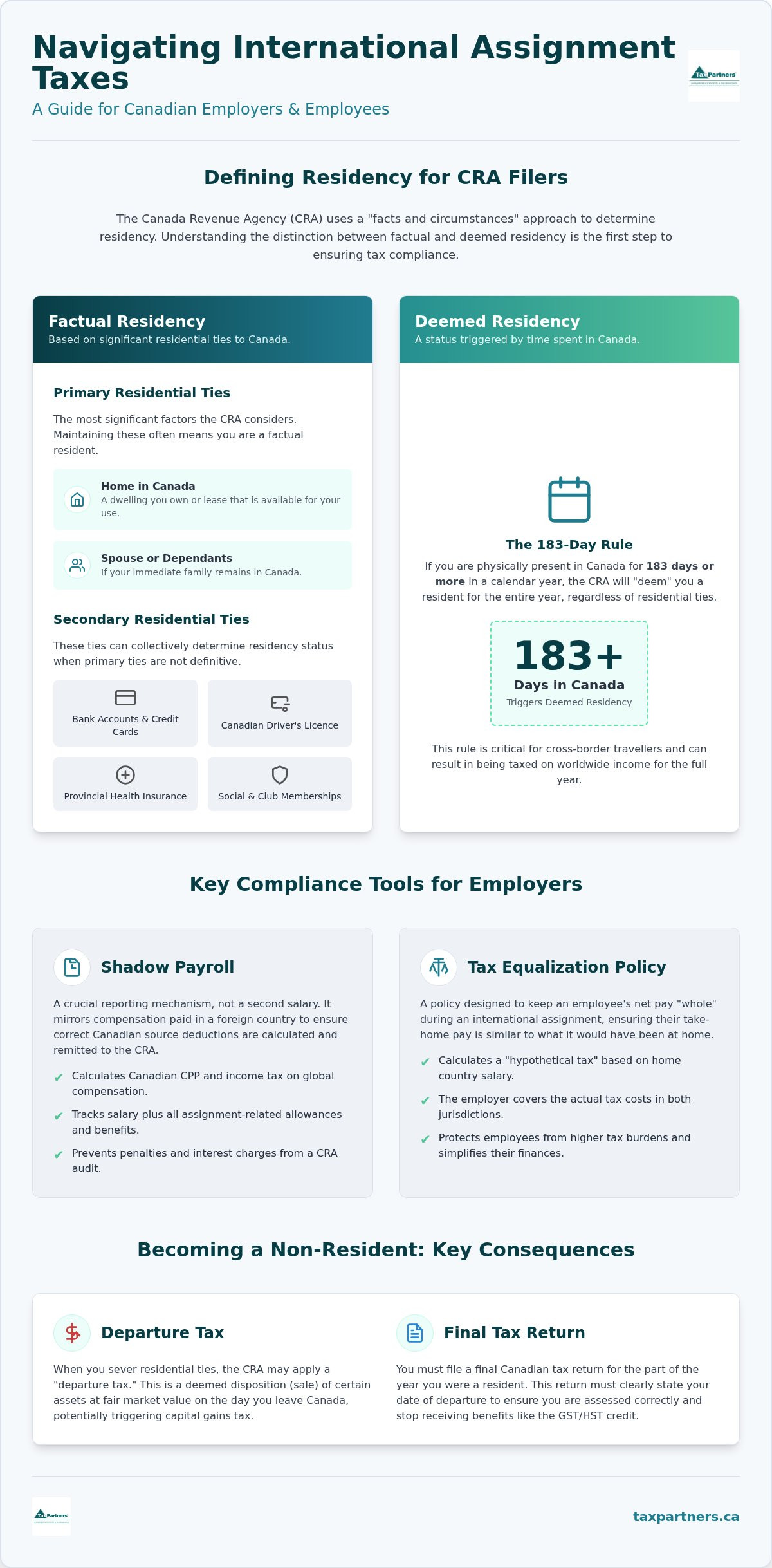
Residency serves as the foundation of your Canadian tax obligations. For organizations seeking international assignment tax services Canada, the distinction between factual and deemed residency is often the most complex hurdle. The Canada Revenue Agency (CRA) uses a "facts and circumstances" approach, meaning every situation is unique.
Factual residency depends on the residential ties you maintain within Canada while working abroad. If you leave for a foreign post but keep a home available for your use, or if your spouse and dependants remain in the country, the CRA will likely view you as a factual resident. This status means you remain subject to Canadian tax on your worldwide income.
Secondary ties also carry weight in the CRA's assessment. These include:
- Canadian bank accounts and credit cards
- A Canadian driver's licence
- A provincial health insurance card
- Social ties, such as memberships in Canadian recreational or religious organizations
Deemed residency is a separate category, often triggered by the 183-day rule. If you stay in Canada for 183 days or more in a calendar year, the CRA may "deem" you a resident for the entire year. This rule applies even if you don't have significant residential ties, making it a critical trap for frequent cross-border travellers.
Determining Your Status Under the Tax Treaty
When you work in a country that has a tax treaty with Canada, you might be considered a resident of both nations. Tax treaties contain tie-breaker rules to resolve these conflicts. These rules look at where you have a permanent home and where your personal and economic interests are closer.
Correctly applying these treaty rules is essential for avoiding double taxation. It ensures that only one country has the primary right to tax your global earnings. You can explore more about these specific frameworks on our tax in Canada resource page.
The Consequences of Becoming a Non-Resident
Severing ties with Canada isn't a silent process. If you successfully establish non-residency, you may face the departure tax, which is a deemed disposition of certain assets at fair market value. Essentially, the CRA treats it as if you sold your assets on the day you left, which can trigger capital gains taxes.
You must file a final Canadian tax return for the portion of the year you were a resident. This return must clearly state your date of departure. Notifying the CRA correctly ensures you aren't improperly assessed for taxes or benefits, such as the GST/HST credit, after you've left.
Shadow Payroll and Tax Equalization for Canadian Employers
Shadow payroll is a vital compliance tool for Canadian companies managing global talent. It's not a second salary payment. Instead, it's a reporting mechanism that ensures compensation paid in a foreign jurisdiction is correctly documented for the CRA. When utilizing international assignment tax services Canada, you'll find that shadow payroll acts as a mirror record. It calculates the necessary Canadian source deductions, such as CPP and income tax, even if the actual funds are delivered via a foreign bank account.
Employers must calculate and remit these deductions with precision. You're required to account for the employee's base salary plus all assignment-related incentives. This includes housing allowances, cost-of-living adjustments, and various benefits-in-kind. Neglecting to track these amounts accurately can lead to substantial interest charges and penalties during a CRA audit. It's often helpful to speak with a cross-border advisor to ensure your reporting captures every taxable component.
Beyond payroll, sending staff abroad introduces the risk of "permanent establishment." If an employee's activities create a fixed place of business in the host country, your company could face unexpected corporate tax obligations there. This risk makes proactive planning essential for every global mobility strategy; for instance, companies expanding into the Netherlands often partner with ICSPayroll to manage local employment compliance securely.
Implementing a Tax Equalization Policy
The core philosophy of tax equalization is to keep the employee "whole" during their time abroad. This means their net pay should be roughly the same as if they had remained in their home province. To achieve this, you calculate a "hypothetical tax," which represents the Canadian tax they would have paid on their stay-at-home salary. The company then assumes responsibility for paying the actual taxes in both jurisdictions. A final reconciliation at the end of the tax year ensures that all payments align with the equalization agreement.
Reporting Requirements Under IRS Rules for US Assignments
Assignments to the United States require a high level of coordination between the CRA and the IRS. You must manage payroll reporting carefully to prevent duplicate withholdings that can negatively impact an employee's cash flow. Under IRS rules, specific forms and disclosures are necessary to claim treaty benefits and avoid double taxation. For a deeper look at American compliance, see our guide on 1040-NR filing for Canadians, which outlines the current requirements for 2026.
Outbound vs. Inbound Assignments: Strategic Differences
Direction matters. Every cross-border move requires a bespoke approach to international assignment tax services Canada. Whether you're sending a Canadian executive to London or bringing a specialist from Tokyo into Canada, the CRA compliance requirements follow different tracks. While the goal is always to minimize double taxation, the forms and reporting timelines vary based on the assignee's path.
Strategic tax planning depends on identifying the flow of talent early. Outbound moves focus on managing the departure from the Canadian tax net. Inbound moves focus on integrating into the Canadian system while respecting foreign obligations. Both directions rely on the effective use of foreign tax credits to ensure the assignee isn't taxed twice on the same dollar of income.
Outbound: Protecting Your Canadian Tax Status
When a Canadian resident moves abroad, the primary objective is often managing residency status. You must decide if you'll remain a factual resident, keeping your global income subject to CRA rules, or become a non-resident. Filing Form NR73, Determination of Residency Status (Leaving Canada), allows you to obtain a formal opinion from the CRA. This provides a clear baseline for your tax obligations during your time away.
If you decide to rent out your Canadian home while abroad, you must manage specific withholding requirements. Under CRA rules, agents or tenants usually withhold 25 percent of the gross rent. However, by filing Form NR6 and an annual Section 216 return, you can often choose to be taxed on your net rental income instead. This strategy frequently results in a lower tax burden and better cash flow for the assignee.
Inbound: Navigating the Canadian Tax Landscape
Foreign nationals arriving in Canada enter a system focused on source-based taxation. Under Regulation 102 of the Income Tax Act, employers must withhold tax from any salary paid for work performed on Canadian soil. This applies regardless of where the employer's head office is located. For contractors, Regulation 105 mandates a 15 percent withholding on fees paid for services rendered in Canada. These rules are non-negotiable without a formal waiver from the CRA.
To comply with these rules, inbound assignees need a Social Insurance Number or an Individual Tax Number (ITN). Once registered, foreign tax credits become the primary tool for preventing double taxation. These credits allow the assignee to deduct taxes paid to their home country from their Canadian liability. Utilizing expert international assignment tax services Canada ensures that these inbound transitions are smooth and that all available treaty benefits are claimed correctly.
International Assignment Tax Compliance Checklist
Compliance is a marathon, not a sprint. Managing international assignment tax services Canada requires a chronological strategy that begins months before the first flight. By breaking the process into distinct phases, you can transform a chaotic move into a controlled transition. A proactive approach is your best defence against CRA scrutiny.
The pre-departure phase is your most critical window. This is the time to conduct a formal residency assessment and review your employer's tax equalization policy. Understanding how your net pay is protected before you sign an assignment agreement prevents financial friction later. Once you're abroad, your focus shifts to meticulous record-keeping. You must track every day spent in Canada versus the host country to support your residency status and tax treaty claims.
Reporting and repatriation round out the cycle. You must disclose all foreign-source income to the CRA if you maintain factual residency during your time away. When the assignment ends, planning for your return is essential. Re-establishing Canadian ties, such as provincial health coverage and driver's licences, requires the same level of care as severing them. Proper foresight ensures you don't inadvertently trigger double residency issues during the transition year.
Essential Documentation for CRA Filers
The CRA requires filers to retain supporting documents for at least six years. This isn't just a suggestion; it's a safeguard against future audits. Your file should include:
- Employment contracts and assignment letters
- Housing and lease agreements in both jurisdictions
- Travel logs and boarding passes to verify physical presence
- Official receipts for foreign taxes paid to substantiate foreign tax credit claims
Avoiding Common Compliance Pitfalls
Many assignees fall into the trap of assuming a tax treaty automatically eliminates all Canadian obligations. While treaties provide relief from double taxation, they don't exempt you from the requirement to file a Canadian tax return. Missing a filing deadline can result in significant penalties, even if your tax balance is zero. The CRA prioritizes transparency, and late disclosures often trigger unwanted scrutiny of your global income.
Every global move has unique variables that a generic checklist cannot cover. You can reach out to our team for expert tax advisory services to review your specific situation and ensure no detail is overlooked during your transition.
Why Tax Partners is Your Strategic Guardian for Global Moves
Moving talent across borders is one of the most complex tasks a business can undertake. With over 40 years of experience in cross-border tax, we serve as a steady hand at the helm for your global transitions. We provide international assignment tax services Canada that combine technical precision with a boutique, personalized touch.
Our seasoned CPAs realize that global mobility is about people, not just paperwork. We work closely with your HR team to manage the heavy lifting of compliance, from residency determinations to shadow payroll. By outsourcing these technical burdens, your internal team can stay focused on employee engagement and project success.
Integrated Wealth Management and Tax Planning
An international assignment shouldn't just be a career milestone; it should be a catalyst for your long-term financial success. We look beyond the immediate tax year to ensure your global move aligns with your broader goals. Our team provides strategic advice on estate planning and wealth preservation, helping global citizens manage the complexities of owning assets in multiple jurisdictions. If your business interests extend to the Middle East, you can visit Israel Cross Border Law Firm for specialized assistance with investment and legal matters between Israel and the United States.
We specialize in protecting your net worth while you focus on your international role. Whether you're dealing with foreign investments or managing a Canadian property portfolio, we provide the clarity you need. Explore our wealth management and financial planning services to see how we can secure your future.
Additionally, for professionals managing wealth across the Pacific, you can learn more about True North Lifestyle to discover how their financial planning and retirement strategies support individuals and businesses in Australia.
Furthermore, if your relocation involves the United States and you require legal guidance on matters such as debt relief or family law in Massachusetts, you can visit Law Offices of Matthew T. Desrochers, P.C. for dedicated support.
A Steady Hand for Complex Cross-Border Challenges
We take a proactive approach to your tax affairs, identifying potential savings and compliance risks long before they become problems. This foresight is what distinguishes a proactive guardian from a reactive service provider. We ensure that every foreign tax credit is claimed and every treaty benefit is utilized to its full potential.
The peace of mind that comes from having a dedicated advisor cannot be overstated. You'll have a single point of contact who understands your history, your goals, and the nuances of your specific assignment. Take the first step toward a seamless transition and contact us today to discuss your global mobility needs.
Secure Your Global Mobility Strategy for 2026
Deciphering the intersection of CRA residency rules and global payroll doesn't have to be a source of constant stress for your organization. By establishing clear residency determinations early and implementing precise shadow payroll mechanisms, you protect both your company and your assignees from unexpected liabilities. Mastering international assignment tax services Canada is ultimately about foresight, transforming complex regulatory requirements into a competitive advantage for your global mobility program.
At Tax Partners, we've provided bespoke cross-border tax solutions to individuals and SMEs since 1981. With over 495,000 tax returns filed and more than 1,390 five-star Google reviews, our seasoned CPAs offer the reliability you need to manage talent across borders with total confidence. We act as your proactive guardian, ensuring every treaty benefit is claimed and every compliance hurdle is cleared before it impacts your bottom line.
Secure your global mobility strategy and contact Tax Partners today to discuss your specific needs. Your international success is within reach, and we're here to guide you every step of the way.
Frequently Asked Questions
Do I still have to pay Canadian tax if I work in another country?
You generally must pay Canadian tax on your worldwide income if the CRA considers you a factual resident. This status depends on whether you maintain significant residential ties, such as a home, spouse, or dependants in Canada. If you successfully establish non-residency, you typically only pay Canadian tax on income earned from Canadian sources, such as rental income or specific investments.
What is the 183-day rule for Canadian tax residency?
The 183-day rule applies to individuals who don't have significant residential ties but stay in Canada for 183 days or more in a calendar year. Under CRA guidelines, you are "deemed" a resident for the entire year for tax purposes. This rule is a critical factor for international assignment tax services Canada when managing short-term inbound transfers and avoiding unexpected tax liabilities.
How can I avoid being taxed twice on my international income?
You can avoid double taxation by claiming Foreign Tax Credits on your Canadian tax return for taxes paid to a foreign government. Canada also maintains tax treaties with many nations that include tie-breaker rules to determine which country has the primary taxing right. These agreements are essential for ensuring that your global mobility strategy doesn't result in a double tax burden.
What is tax equalization and how does it work for employees?
Tax equalization is an employer-led policy designed to ensure your net take-home pay remains the same as if you had stayed in Canada. Your employer deducts a "hypothetical tax" from your pay, which represents your estimated Canadian liability. The company then assumes the responsibility of paying the actual taxes owed in both Canada and the host country on your behalf.
Do I need to sell my house in Canada to become a non-resident for tax purposes?
You don't necessarily have to sell your Canadian home to become a non-resident, but you must demonstrate that you've severed primary residential ties. If you keep the property, it should ideally be rented to an arm's-length tenant under a long-term lease. The CRA evaluates this alongside other factors, such as where your family resides and where you hold a driver's licence.
What are the tax implications for a company sending employees to Canada?
Companies sending employees to Canada must manage Regulation 102 withholdings for employment income earned on Canadian soil. You'll likely need to set up a shadow payroll to report these earnings and remit the required source deductions to the CRA. There is also a risk of creating a "permanent establishment," which could trigger Canadian corporate tax obligations for your business.
Can I still contribute to my RRSP while on an international assignment?
You can continue to contribute to your Registered Retirement Savings Plan (RRSP) as long as you have available contribution room from previous years. However, if you become a non-resident for tax purposes, you won't generate new contribution room from your foreign earnings. It's best to review your room on your latest CRA Notice of Assessment before making a contribution.
How do I report my foreign income to the CRA correctly?
Factual residents must report their worldwide income in Canadian dollars on their annual T1 return. You should use the Bank of Canada exchange rate for the date the income was received or the average annual rate for the tax year. Utilizing professional international assignment tax services Canada ensures you apply for the appropriate credits to offset these foreign earnings and maintain compliance.

Article by
Mahad Mohamed
Mahad Mohamed is an accountant and the CEO of Tax Partners, with over 26+ years of Canadian and international tax and accounting experience. His expertise includes corporate reorganization, cross-border tax structuring (Canada & US), tax disputes, CRA audits, and tax planning for small owner-managed private corporations. Most recently, Mahad is a pioneer in Canadian crypto taxation and founded Block3 Finance.
Previously, Mahad worked for the Canada Revenue Agency (CRA), Big4 accounting firms, and served as a Rulings Officer for the Federal Tax Authority of the UAE before acquiring Tax Partners in 2014.
Tax Partners has 44 full-time accountants and over 18,400+ clients.
Disclaimer
This article provides general information only and is current as of its publication date. It has not been updated and may be out of date. It does not constitute legal advice and should not be relied upon as such. Every tax situation is unique and may differ from the examples discussed in this article. If you have specific questions, you should seek the advice of our accountants for your unique circumstances. Book a FREE Initial Consultation Today!
Frequently Asked Questions
Do I still have to pay Canadian tax if I work in another country?
You generally must pay Canadian tax on your worldwide income if the CRA considers you a factual resident. This status depends on whether you maintain significant residential ties, such as a home, spouse, or dependants in Canada. If you successfully establish non-residency, you typically only pay Canadian tax on income earned from Canadian sources, such as rental income or specific investments.
What is the 183-day rule for Canadian tax residency?
The 183-day rule applies to individuals who don't have significant residential ties but stay in Canada for 183 days or more in a calendar year. Under CRA guidelines, you are "deemed" a resident for the entire year for tax purposes. This rule is a critical factor for international assignment tax services Canada when managing short-term inbound transfers and avoiding unexpected tax liabilities.
How can I avoid being taxed twice on my international income?
You can avoid double taxation by claiming Foreign Tax Credits on your Canadian tax return for taxes paid to a foreign government. Canada also maintains tax treaties with many nations that include tie-breaker rules to determine which country has the primary taxing right. These agreements are essential for ensuring that your global mobility strategy doesn't result in a double tax burden.
What is tax equalization and how does it work for employees?
Tax equalization is an employer-led policy designed to ensure your net take-home pay remains the same as if you had stayed in Canada. Your employer deducts a "hypothetical tax" from your pay, which represents your estimated Canadian liability. The company then assumes the responsibility of paying the actual taxes owed in both Canada and the host country on your behalf.
Do I need to sell my house in Canada to become a non-resident for tax purposes?
You don't necessarily have to sell your Canadian home to become a non-resident, but you must demonstrate that you've severed primary residential ties. If you keep the property, it should ideally be rented to an arm's-length tenant under a long-term lease. The CRA evaluates this alongside other factors, such as where your family resides and where you hold a driver's licence.
What are the tax implications for a company sending employees to Canada?
Companies sending employees to Canada must manage Regulation 102 withholdings for employment income earned on Canadian soil. You'll likely need to set up a shadow payroll to report these earnings and remit the required source deductions to the CRA. There is also a risk of creating a "permanent establishment," which could trigger Canadian corporate tax obligations for your business.
Can I still contribute to my RRSP while on an international assignment?
You can continue to contribute to your Registered Retirement Savings Plan (RRSP) as long as you have available contribution room from previous years. However, if you become a non-resident for tax purposes, you won't generate new contribution room from your foreign earnings. It's best to review your room on your latest CRA Notice of Assessment before making a contribution.
How do I report my foreign income to the CRA correctly?
Factual residents must report their worldwide income in Canadian dollars on their annual T1 return. You should use the Bank of Canada exchange rate for the date the income was received or the average annual rate for the tax year. Utilizing professional international assignment tax services Canada ensures you apply for the appropriate credits to offset these foreign earnings and maintain compliance.