Tax on US Rental Income for Canadian Residents

Did you know that enhanced data-sharing protocols between the CRA and IRS recently flagged over 15,000 previously unreported vacation properties? Owning a slice of the American dream shouldn't lead to a cross-border nightmare, yet many owners feel overwhelmed by the complex rules regarding tax on US rental income for Canadian residents. It's perfectly natural to feel a sense of unease when faced with the prospect of IRS penalties or the confusion of filing in two different jurisdictions.
We understand that your primary goal is to protect your investment returns while remaining ethically steadfast in your obligations to both the IRS and the CRA. This article provides a clear roadmap to help you master these complexities, from choosing the right withholding options to claiming essential tax credits. You'll gain a precise understanding of how to navigate your filings under IRS rules and ensure your CRA reporting is handled with foresight and accuracy.
Key Takeaways
- Understand why owning property south of the border creates an immediate tax nexus under IRS rules, regardless of your primary residency in Canada.
- Discover how to manage the tax on US rental income for Canadian residents by choosing between the default 30% gross withholding or electing to pay based on net income.
- Master the process of translating your earnings into Canadian dollars and identifying deductible expenses specifically permitted for CRA filers.
- Utilize the US-Canada Tax Treaty to claim foreign tax credits on your Canadian return, effectively preventing double taxation on your rental profits.
- Establish a proactive compliance roadmap that protects your investment returns and ensures you remain prepared for inquiries from both the IRS and the CRA.
Dual Jurisdiction Tax Obligations for Canadian Owners
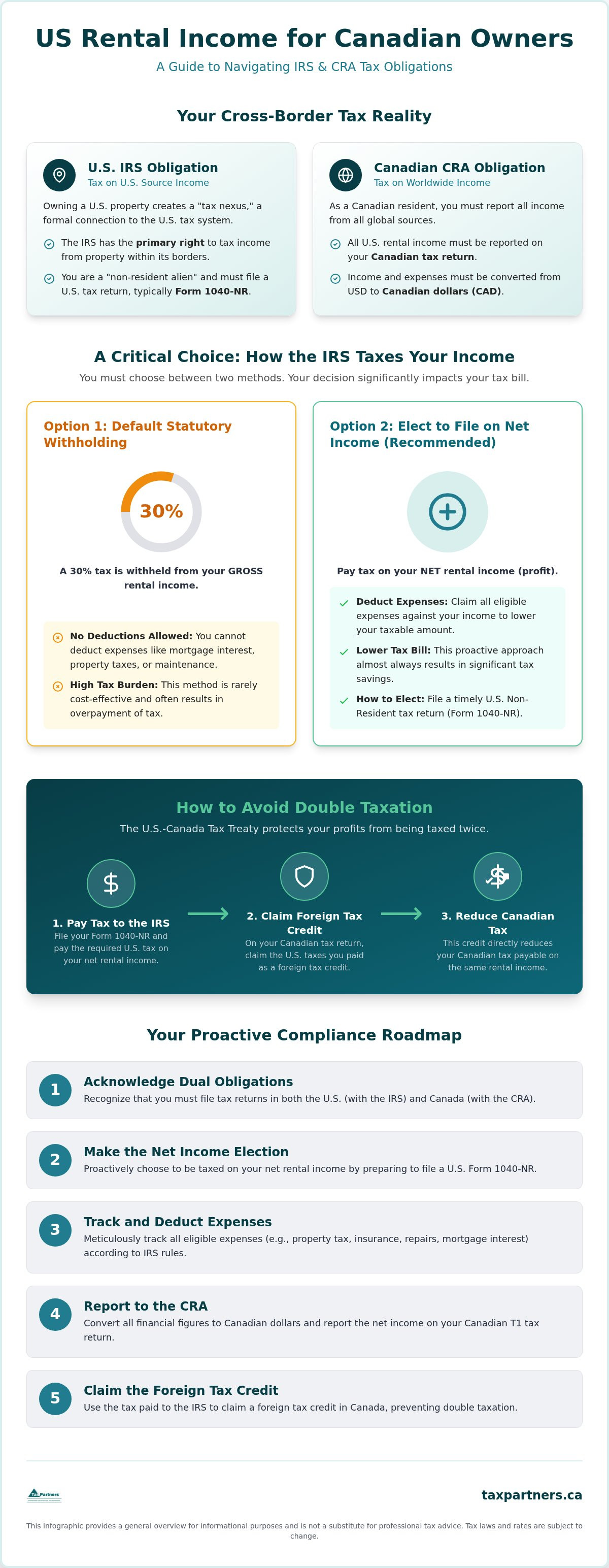
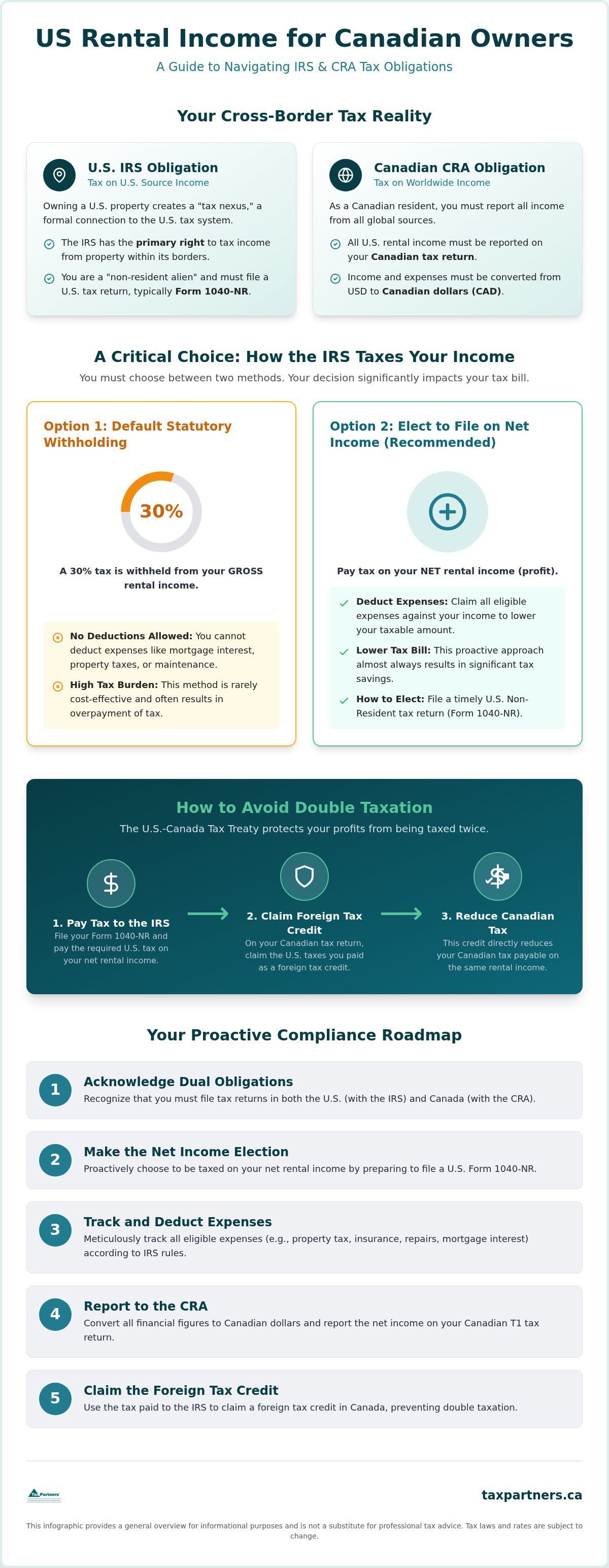
Owning property in the US is a significant achievement, but it brings immediate regulatory responsibilities. Even if you only rent out your US rental property for a few weeks a year, you've established a physical presence that the Internal Revenue Service (IRS) recognizes. This creates a "nexus," which means you now have a formal connection to the U.S. tax system. You can't simply wait until the end of the year to think about these obligations; they begin the moment you collect your first rent cheque.
Under IRS rules, the US maintains the primary right to tax income generated by land or buildings located within its borders. At the same time, for CRA filers, residency in Canada triggers an obligation to report all global earnings. Successfully managing the tax on US rental income for Canadian residents requires a disciplined, dual-track approach to satisfy both sets of authorities. This isn't just about filing paperwork; it's about understanding how two different legal systems interact with your personal wealth. Failing to recognize these distinct obligations can lead to significant penalties and interest charges in both nations, which can quickly erode your profit margins.
Understanding IRS vs CRA Reporting Requirements
The IRS views you as a "non-resident alien" for tax purposes. This specific status requires you to file a US tax return, typically Form 1040-NR, to report your US-sourced income. You'll need to track your income and expenses based on the US tax year, which follows the calendar year from January to December. This can be tricky since the CRA and IRS often have different criteria for what qualifies as a deductible expense. Defining your status correctly is the essential first step in ensuring you don't overpay or trigger an unnecessary audit. Missing these requirements often leads to specific complications under IRS rules:
- Automatic Withholding: A default 30% withholding tax on gross rent receipts if proper elections aren't made.
- Expense Forfeiture: The potential loss of the ability to claim valid business expenses against your rental income.
- Compliance Costs: Substantial interest charges on unpaid balances that accumulate over time.
The Concept of Worldwide Income for CRA Filers
Under CRA rules, Canadian residents are taxed on income from all global sources. This means the CRA expects you to report every dollar of gross rental receipts earned in the US, regardless of where the money is physically held. Even if the funds remain in a US bank account to cover local property taxes or maintenance, they are still considered income in the year they were received. Reporting this income is mandatory to maintain compliance and avoid the stress of a potential audit. You'll need to convert these US figures into Canadian dollars, using the specific exchange rate requirements set out by the CRA for that tax year.
Our team at Tax Partners acts as a proactive guardian for your investments. We provide the foresight needed to manage the tax on US rental income for Canadian residents, ensuring you remain in full compliance while protecting your hard-earned returns from dual-jurisdiction risks.
Navigating IRS Requirements for US Rental Income
The Internal Revenue Service (IRS) maintains a default position that often surprises Canadian investors. Unless you take proactive steps, the IRS treats your rental activities as passive income, which triggers a significant and immediate tax obligation. Understanding the tax on US rental income for Canadian residents requires a strategic choice between two very different methods of compliance.
This decision is a critical one that significantly impacts the annual cash flow of your investment. You must provide proper documentation to your US property manager or tenant to ensure they apply the correct withholding method from the start. Making the right choice early prevents the stress of trying to reclaim overpaid funds later in the year.
The Statutory Withholding Rule Under IRS Regulations
Under IRS rules, a statutory withholding rate of 30% is generally applied to your gross rental income. Gross income refers to the total rent collected before you account for any expenses, mortgage interest, or property management fees. This withholding is often treated as a final tax if you choose not to file a US return, though it's rarely the most cost-effective path for owners.
You should consult with a professional to confirm the current statutory withholding rates for the 2026 tax year. For more detailed guidance on these obligations, you can review the IRS requirements for foreign owners. Your property manager is legally responsible for remitting these funds, so clear communication is essential to avoid compliance errors.
Electing to File a 1040-NR Return for Net Income Reporting
Most Canadian owners realize that paying 30% of their gross revenue isn't financially sustainable. You have the option to make a "Section 871(d)" election, which allows you to treat your rental income as "effectively connected" with a US trade or business. This vital election enables you to report your net income on IRS Form 1040-NR rather than being taxed on every dollar of gross rent.
By filing this return, you can deduct legitimate operating expenses to lower your taxable balance. Common deductions include:
- Property taxes and insurance premiums
- Repairs, maintenance, and utility costs
- Mortgage interest and professional management fees
- Depreciation of the building and furniture
To move forward with this election and file your return, you'll need an Individual Taxpayer Identification Number (ITIN). You can learn more about ITIN applications to ensure your paperwork is in order before the next filing deadline. If you're ready to optimize your cross-border strategy, our team is here to help you evaluate your specific situation and protect your investment returns.
Reporting US Rental Earnings to the CRA
Once you've satisfied the IRS rules for foreign owners of US real property, your focus must shift back home. The CRA expects a full accounting of your American earnings on your Canadian tax return. This stage is where many investors feel the most pressure, as the rules for deductible expenses and income reporting often differ between the two countries. Handling the tax on US rental income for Canadian residents isn't just about duplication; it's about translation and precise alignment.
Accuracy in these calculations is vital to ensure you aren't overpaying or under-reporting your true earnings. The CRA and IRS don't always agree on what constitutes a valid deduction, so you'll need to maintain separate records for each jurisdiction. Professional guidance helps in aligning these two disparate tax systems on your annual T1 return, protecting you from the stress of future audits. Our team at Tax Partners acts as a steady hand, ensuring your Canadian filings are as robust as your US ones.
Converting US Dollars to Canadian Funds for CRA Compliance
The CRA requires every figure on your return to be expressed in Canadian dollars (C$). You can't simply report US figures and hope for the best. You have two main choices for conversion: using the exchange rate on the specific day each rent payment was received, or applying the Bank of Canada average annual exchange rate. Once you select a method, the CRA requires you to use it consistently across all years of property ownership.
Consistency is the hallmark of a reliable tax strategy. The Bank of Canada provides daily and annual average rates that are essential for this process. If you received rent monthly, using the annual average is often simpler, but you must verify the specific rate for the current year before you file. This precision ensures your reported income matches the reality of the Canadian economy at the time of receipt.
Deductible Expenses and Capital Cost Allowance (CCA) Rules
While the IRS allows for certain deductions, the CRA has its own list of eligible expenses for CRA filers. You can typically deduct costs like property management fees, advertising, and interest on the financing used to purchase the property. However, one of the most significant differences lies in Capital Cost Allowance (CCA). CCA is the Canadian version of depreciation, allowing for a systematic write-off of the property's cost over several years.
Unlike the mandatory depreciation often found in the US, CCA is optional for Canadian residents. You must be strategic here. Under CRA rules, you aren't allowed to use CCA to create or increase a rental loss. This means if your expenses already exceed your income, you can't claim CCA to further reduce your taxes. Understanding the tax on US rental income for Canadian residents involves knowing when to claim these deductions to maximize your long-term position.
Avoiding Double Taxation with Foreign Tax Credits
The prospect of paying tax on the same dollar to both the IRS and the CRA is a primary concern for property owners. It feels inherently unfair to see your investment returns diminished by dual taxation. Fortunately, the tax on US rental income for Canadian residents is managed through a formal agreement designed to prevent this exact scenario.
The US-Canada Tax Treaty serves as a vital shield for your cross-border assets. It ensures the total tax you pay doesn't exceed the higher of the two countries' individual rates. By providing clear rules on which nation has the primary taxing rights, the treaty brings stability to your financial planning.
Utilizing the US-Canada Tax Treaty for Relief
Invoking these treaty benefits isn't automatic; it requires specific disclosures on your returns. Tax Partners specializes in navigating the US-Canada tax treaty to protect your hard-earned wealth. We ensure every available treaty provision is applied correctly to minimize your global tax burden.
The treaty provides the legal framework necessary to ensure you aren't penalized for investing across borders. It defines how income is sourced and which jurisdiction gets the "first bite" of the tax apple. This clarity is essential for anyone looking to maintain a long-term real estate portfolio in the United States.
Calculating the Foreign Tax Credit on Your T1 Return
For CRA filers, the Foreign Tax Credit (FTC) is the primary tool for offsetting US taxes paid. When you file your Canadian T1 return, you can generally claim a credit for the income tax paid to the IRS. This credit effectively reduces your Canadian tax bill dollar-for-dollar, up to a specific limit.
The credit is generally the lesser of the US tax paid or the Canadian tax applicable to that income. If your US tax rate is higher than your Canadian rate, you might not receive a full credit for the excess. This limitation makes accurate long-term wealth management essential for maintaining your investment's profitability.
Precision in these calculations is essential because incorrect FTC claims frequently trigger CRA reviews. You must keep detailed records of all IRS payments to support your claim. This includes documents like IRS Form 1042-S or your processed 1040-NR return.
State taxes paid in the US may also be eligible for certain types of relief or deductions in Canada. Our team can help you calculate your foreign tax credits accurately to ensure you aren't leaving money on the table. We act as a proactive guardian, looking ahead to secure the best possible outcome for your cross-border investment.
Strategic Compliance and Professional Cross-Border Planning
Managing the tax on US rental income for Canadian residents isn't a one-time task you can finish each April. It's an ongoing strategic process that requires constant attention to shifting regulations in both countries. Proactive planning reveals optimization opportunities that DIY software often misses, ensuring you don't leave money on the table.
As regulations evolve, having a seasoned mentor to guide your financial journey is invaluable. We believe that professional oversight is the best way to alleviate the stress often associated with complex cross-border matters. This proactive approach ensures you're not just reacting to requirements but are actively securing a better outcome for your portfolio.
Essential Record-Keeping for Multi-Jurisdictional Audits
Maintaining organized records is your best defence against future inquiries from either the IRS or CRA. For CRA filers, you should retain all leases, repair invoices, and mortgage statements for at least seven years. This long-term storage ensures you're fully prepared if the agency requests documentation for previous tax years.
You also need to maintain a detailed log of all days spent in the US. This log supports your residency status under IRS rules and prevents accidental classification as a US resident for tax purposes. Store digital copies of all filed US returns and IRS correspondence in a secure, encrypted location.
Organizing your records by jurisdiction simplifies the work of your cross-border accountant and reduces the risk of data entry errors. Clear separation between US expenses and Canadian reporting requirements provides a sense of total control over your financial narrative. It transforms a potentially chaotic audit into a manageable, transparent process.
How Tax Partners Secures Your Cross-Border Position
We provide integrated US and Canadian tax services to ensure no detail is overlooked in your filings. Our team manages everything from ITIN applications to the complex foreign tax credit calculations we discussed earlier. We act as a proactive guardian, looking ahead to identify risks before they become costly penalties.
Our firm focuses on transparency and foresight to help you keep more of your hard-earned rental income. We combine decades of institutional wisdom with a modern, forward-thinking outlook on cross-border investment. This personalized care creates a seamless, end-to-end support system for your international real estate holdings.
Your investment deserves the protection of a steady hand at the helm. Reach out today to contact Tax Partners for cross-border expertise and secure your financial future. We're ready to help you move from a state of uncertainty to a feeling of total understanding and control.
Secure Your Cross-Border Prosperity
Mastering the tax on US rental income for Canadian residents requires a blend of technical precision and strategic foresight. By choosing to file a 1040-NR return under IRS rules, you can effectively shield your monthly cash flow from the default 30% gross withholding. Simultaneously, properly claiming foreign tax credits for CRA filers ensures that you avoid the unfair burden of double taxation on your global earnings. These proactive steps transform a complex regulatory challenge into a streamlined part of your wealth-building strategy.
With over 40 years of cross-border tax experience and more than 1,390 five-star Google reviews, Tax Partners serves as your proactive guardian in this intricate landscape. We offer specialized expertise in ITIN applications and 1040-NR filings, providing the steady hand you need to manage both jurisdictions with total confidence. Secure your cross-border investment with Tax Partners today to ensure your rental property remains a source of lasting growth. You've worked hard to build your portfolio; let's work together to protect it.
Frequently Asked Questions
Do I need to file a US tax return if my rental property has a net loss?
Yes, you should file a US return even if your property generates a net loss. Doing so allows you to make the Section 871(d) election under IRS rules, which prevents the 30% gross withholding tax from being a final tax. Reporting the loss also allows you to carry it forward to offset future US rental profits.
What happens if I don't report my US rental income to the CRA?
Failing to report this income leads to severe penalties and interest charges from the CRA. Since the IRS and CRA share data automatically, unreported properties are easily identified. You risk a full audit and the loss of the ability to claim foreign tax credits on the tax on US rental income for Canadian residents.
Can I deduct my US mortgage interest on my Canadian tax return?
You can deduct the interest portion of your US mortgage payments on your Canadian return. For CRA filers, this is a valid expense as long as the property is used to generate rental income. You must convert the interest amount from US dollars to Canadian funds using the appropriate exchange rate for that year.
How do I get an ITIN for my US rental property reporting?
You obtain an ITIN by submitting Form W-7 to the IRS along with certified identification documents. This process often requires a federal tax return to be attached unless you meet a specific exception. Working with a Certifying Acceptance Agent can simplify this process and avoid the need to mail your original passport to the US.
Will I be taxed twice on my US rental income as a Canadian resident?
You won't be taxed twice because of the US-Canada Tax Treaty. You can claim a foreign tax credit on your Canadian return for the income taxes paid to the IRS. This mechanism ensures that the tax on US rental income for Canadian residents is only paid at the higher of the two countries' rates.
What is the deadline for filing a 1040-NR with the IRS?
The deadline to file Form 1040-NR with the IRS is June 15 for non-resident aliens who didn't receive wages subject to US withholding. If you did receive US wages, the deadline moves to April 15. It's essential to confirm these dates annually as they can change based on weekends or holidays.
Can I claim US property taxes as a deduction for CRA filers?
Yes, property taxes paid to US local or state authorities are deductible for CRA filers. These are considered a legitimate operating expense for your rental business. Ensure you keep the original tax bills and proof of payment for at least seven years to satisfy Canadian record-keeping requirements.
Do I need to report the sale of my US rental property to both countries?
You must report the sale to both the IRS and the CRA. Under IRS rules, the buyer typically withholds 15% of the gross proceeds under FIRPTA. For your Canadian return, you'll need to calculate the capital gain or loss and report it in Canadian dollars to ensure full compliance.

Article by
Mahad Mohamed
Mahad Mohamed is an accountant and the CEO of Tax Partners, with over 26+ years of Canadian and international tax and accounting experience. His expertise includes corporate reorganization, cross-border tax structuring (Canada & US), tax disputes, CRA audits, and tax planning for small owner-managed private corporations. Most recently, Mahad is a pioneer in Canadian crypto taxation and founded Block3 Finance.
Previously, Mahad worked for the Canada Revenue Agency (CRA), Big4 accounting firms, and served as a Rulings Officer for the Federal Tax Authority of the UAE before acquiring Tax Partners in 2014.
Tax Partners has 44 full-time accountants and over 18,400+ clients.
Disclaimer
This article provides general information only and is current as of its publication date. It has not been updated and may be out of date. It does not constitute legal advice and should not be relied upon as such. Every tax situation is unique and may differ from the examples discussed in this article. If you have specific questions, you should seek the advice of our accountants for your unique circumstances. Book a FREE Initial Consultation Today!
Frequently Asked Questions
Do I need to file a US tax return if my rental property has a net loss?
Yes, you should file a US return even if your property generates a net loss. Doing so allows you to make the Section 871(d) election under IRS rules, which prevents the 30% gross withholding tax from being a final tax. Reporting the loss also allows you to carry it forward to offset future US rental profits.
What happens if I don't report my US rental income to the CRA?
Failing to report this income leads to severe penalties and interest charges from the CRA. Since the IRS and CRA share data automatically, unreported properties are easily identified. You risk a full audit and the loss of the ability to claim foreign tax credits on the tax on US rental income for Canadian residents.
Can I deduct my US mortgage interest on my Canadian tax return?
You can deduct the interest portion of your US mortgage payments on your Canadian return. For CRA filers, this is a valid expense as long as the property is used to generate rental income. You must convert the interest amount from US dollars to Canadian funds using the appropriate exchange rate for that year.
How do I get an ITIN for my US rental property reporting?
You obtain an ITIN by submitting Form W-7 to the IRS along with certified identification documents. This process often requires a federal tax return to be attached unless you meet a specific exception. Working with a Certifying Acceptance Agent can simplify this process and avoid the need to mail your original passport to the US.
Will I be taxed twice on my US rental income as a Canadian resident?
You won't be taxed twice because of the US-Canada Tax Treaty. You can claim a foreign tax credit on your Canadian return for the income taxes paid to the IRS. This mechanism ensures that the tax on US rental income for Canadian residents is only paid at the higher of the two countries' rates.
What is the deadline for filing a 1040-NR with the IRS?
The deadline to file Form 1040-NR with the IRS is June 15 for non-resident aliens who didn't receive wages subject to US withholding. If you did receive US wages, the deadline moves to April 15. It's essential to confirm these dates annually as they can change based on weekends or holidays.
Can I claim US property taxes as a deduction for CRA filers?
Yes, property taxes paid to US local or state authorities are deductible for CRA filers. These are considered a legitimate operating expense for your rental business. Ensure you keep the original tax bills and proof of payment for at least seven years to satisfy Canadian record-keeping requirements.
Do I need to report the sale of my US rental property to both countries?
You must report the sale to both the IRS and the CRA. Under IRS rules, the buyer typically withholds 15% of the gross proceeds under FIRPTA. For your Canadian return, you'll need to calculate the capital gain or loss and report it in Canadian dollars to ensure full compliance.