Ecommerce Accounting Services Canada: A Strategic Guide for Online Sellers

Why does your Shopify or Amazon payout never quite align with the actual deposit in your business bank account? It's a frustrating reality for many online sellers who find themselves buried under a mountain of platform fees and complex "place of supply" rules. You're likely balancing the drive for global growth with the constant worry that a single error in your provincial sales tax (PST) or federal GST/HST reporting could trigger a CRA audit. You deserve a clear view of your bottom line that goes beyond just looking at a digital dashboard.
Partnering with specialized ecommerce accounting services Canada allows you to bridge the gap between messy digital data and tax compliance. This guide will show you how to protect your business from regulatory risks while gaining total visibility into your true profit margins after all platform deductions. We'll explore how to build a scalable accounting system that moves you from a state of financial uncertainty to a position of total strategic control over your brand's future. With the right systems in place, you can focus on scaling your sales while we ensure your standing with the CRA remains beyond reproach.
Key Takeaways
- Learn how to manage the complexities of GST/HST and provincial sales tax requirements for CRA filers to ensure your business remains fully compliant.
- Discover how to reconcile high-volume platform payouts from Shopify or Amazon with your bank deposits to achieve clear visibility into your actual profit margins.
- Understand why specialized ecommerce accounting services Canada are essential for optimizing global sales while protecting your brand from the stress of a potential CRA audit.
- Transition from simple data entry to proactive tax planning that integrates your bookkeeping with long-term wealth management and strategic growth.
- Identify the key criteria for choosing a CPA who understands digital inventory and platform fees rather than relying on generalist accounting software.
Navigating the Complexity of Ecommerce Accounting in Canada
Ecommerce accounting is the specialized management of high-volume digital transactions and inventory across multiple jurisdictions. It goes beyond simple data entry. For a Canadian online seller, it involves tracking every micro-transaction, platform fee, and shipping cost while maintaining strict adherence to CRA requirements. Traditional accounting often stumbles here. A standard bookkeeper might record your Shopify payout as a single lump sum of revenue, but that figure is often net of various costs. Without digging into the raw data, you lose visibility into your true profit margins and risk misreporting your gross income to the CRA. Utilizing professional ecommerce accounting services Canada ensures that your business remains agile while staying fully compliant with federal and provincial tax laws.
The core challenge for online sellers lies in payout reconciliation. When you receive a deposit from Stripe, PayPal, or Amazon, it rarely matches your sales dashboard for that day. This discrepancy occurs because platforms deduct processing fees, refund amounts, and temporary holdbacks before the funds reach your bank account. Managing these nuances requires a steady hand and a deep understanding of Sales taxes in Canada, including the varying rates of GST, HST, and PST across different provinces. High-quality ecommerce accounting services Canada provide the oversight needed to ensure every dollar is accounted for accurately, protecting you from the stress of unexpected discrepancies during an audit.
The Gap Between Generalist Accountants and Ecommerce Specialists
Generalist accountants often lack the technical infrastructure to handle the sheer volume of data generated by modern storefronts. They might misclassify platform holdbacks as expenses or overlook shipping recoveries, leading to a distorted financial picture. Many traditional firms also lean on cash-basis accounting, which is insufficient for the accrual-heavy nature of ecommerce where inventory timing and sales dates are critical. Successful ecommerce sellers require a CPA who understands how to interpret API-driven data to ensure financial integrity.
Understanding the Canadian Digital Sales Ecosystem
The CRA views digital commerce through a specific lens that differs significantly from traditional retail. Recent years have seen the introduction of Marketplace Facilitator rules, where platforms like Amazon or Walmart are responsible for collecting sales taxes on behalf of third-party sellers. However, this doesn't absolve the seller of their reporting duties. You must still track these figures to ensure your total worldwide revenue is reported correctly for GST/HST registration thresholds. Learn more about our ecommerce industry expertise to see how we help brands navigate these specific regulatory hurdles.
Mastering Sales Tax Compliance: GST, HST, and Provincial Requirements
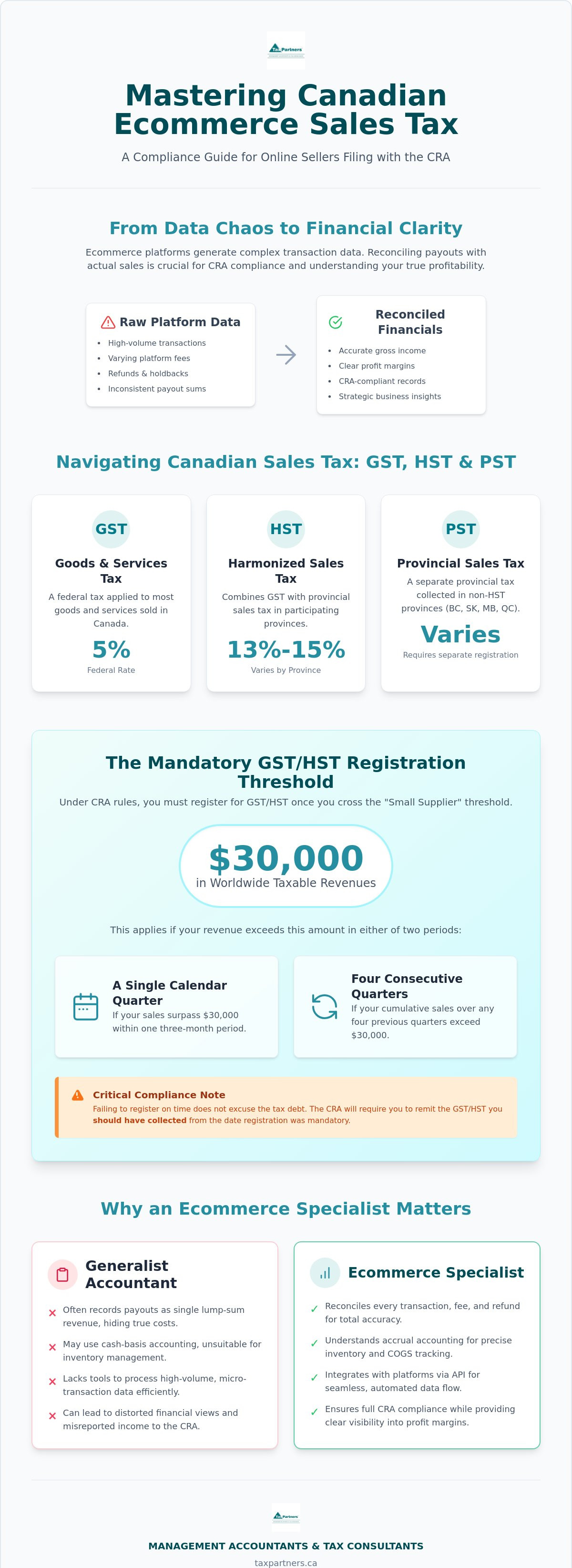
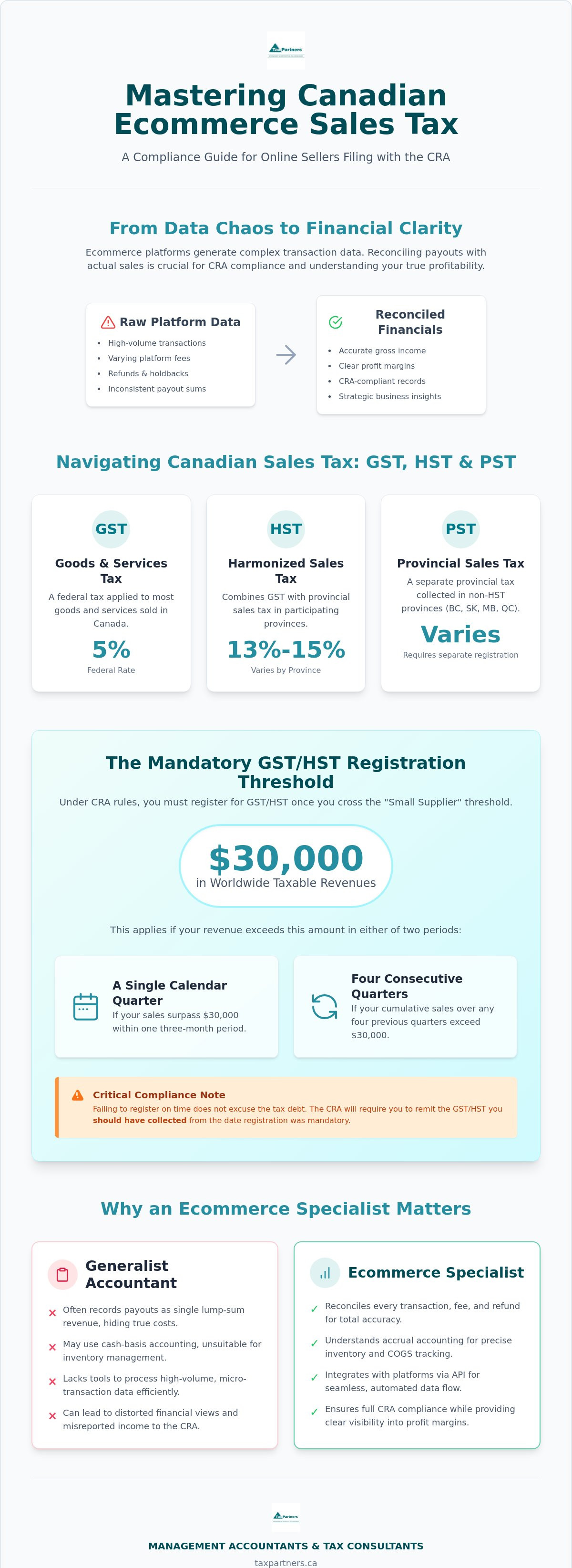
Sales tax compliance in Canada is a multi-layered responsibility that requires precision from the moment you make your first sale. For CRA filers, the foundation of this system is the Goods and Services Tax (GST), a federal tax of 5% applied to most supplies of goods and services. However, several provinces have integrated this with their provincial sales taxes to create the Harmonized Sales Tax (HST). Depending on where your customer is located, you might be collecting 5%, 13%, or even 15% tax. Staying on top of these variations is a core component of professional ecommerce accounting services Canada, as it prevents the costly error of under-collecting from customers or over-remitting to the government.
Under CRA rules, you aren't required to register for GST/HST until you cross the "Small Supplier" threshold. This occurs when your worldwide taxable revenues exceed $30,000 in a single calendar quarter or over four consecutive quarters. Once you surpass this limit, registration becomes mandatory. It's vital to monitor your trailing revenue closely; failing to register at the right time doesn't exempt you from the tax debt. The CRA will expect you to pay the tax you should have collected from the date you were required to register, even if you didn't charge your customers a cent. Since the July 2021 digital economy tax changes, these rules have become even more stringent for platforms and digital service providers, making a "steady hand" at your books more important than ever.
Managing Inter-provincial Sales Rules
The "Place of Supply" rule determines which tax rate applies to a specific transaction. For physical goods, this is generally the province where the product is delivered. For digital products, it often depends on the customer's billing address. Given the Canadian e-commerce market overview showing rapid growth in cross-province shopping, your bookkeeping must be organized to track sales by destination automatically. You should verify current provincial tax rates directly with the CRA or the respective provincial authorities in British Columbia, Saskatchewan, Manitoba, and Quebec, as these provinces maintain separate tax systems (PST or QST) from the federal GST.
Marketplace Facilitator Laws and Your Obligations
If you sell through Amazon, Etsy, or eBay, these platforms may collect and remit sales tax on your behalf under Marketplace Facilitator laws. While this simplifies part of your workflow, it doesn't remove your reporting obligations. You must still report your total gross sales to the CRA and then deduct the tax already collected by the platform to avoid "double-taxing" your revenue. Mismanaging this reconciliation is a common trap that leads to overpaying the tax man. For a deeper look at your corporate responsibilities, see our comprehensive guide to Canadian corporate tax compliance. If you're feeling overwhelmed by these shifting requirements, you might find it helpful to speak with a specialist who can review your current sales tax settings for ecommerce accounting services Canada.
Operational Efficiency Through Specialized Bookkeeping and Inventory
Real-time financial health is no longer a luxury for online sellers; it's an operational necessity. Cloud-based bookkeeping systems allow you to monitor your cash flow and liabilities as they happen. You don't have to wait for a month-end report that is already outdated by the time it reaches your desk. For Canadian businesses, this agility is crucial for managing the constant flow of digital transactions across different time zones. High-quality ecommerce accounting services Canada ensure that your cloud infrastructure serves as a strategic tool rather than just a digital filing cabinet. It provides the clarity needed to make informed decisions about scaling your product lines or adjusting your marketing spend, whether you are testing new designs with Protomolecule or expanding into new territories.
Reconciling payouts from platforms like Shopify, Stripe, or PayPal with your actual bank deposits is where many sellers struggle. A sale recorded on your dashboard rarely matches the amount deposited into your business account. You must account for merchant fees, referral fees, and advertising spend to understand your true net position. Without precise reconciliation, your Cost of Goods Sold (COGS) figures will be skewed. This leads to an inaccurate calculation of your corporate tax liability when filing your return with the CRA. Accurate bookkeeping ensures every penny deducted by a platform is recorded as a legitimate business expense, lowering your taxable income.
Reconciling Multi-currency Payouts and Platform Fees
Multi-currency transactions add a layer of complexity that traditional bookkeeping often misses. Exchange rate fluctuations between the moment a sale occurs and the day the funds are deposited can create significant gains or losses. Automated tools like A2X, when integrated with Xero or QuickBooks, can help bridge this gap by mapping transactions with surgical precision. These tools allow you to track your merchant fees and Return on Ad Spend (ROAS) automatically. This automation reduces human error and gives you a clear picture of your profit margins after all international fees are settled.
Accurate Inventory Valuation for CRA Reporting
Accurate inventory valuation at year-end is a non-negotiable requirement for CRA compliance. Your "inventory on hand" figure directly impacts your balance sheet and determines the COGS you can deduct against your revenue. Under Canadian GAAP (Generally Accepted Accounting Principles), you typically choose between the First-In, First-Out (FIFO) or Weighted Average cost methods. Selecting the right method and maintaining a rigorous count ensures you aren't overpaying corporate tax on unsold stock. For specialized support in managing these records, consider professional bookkeeping services for Canadian SMEs to keep your inventory records audit-ready and your margins healthy.
Evaluating Ecommerce Accounting Services: Key Criteria for Sellers
Choosing the right financial partner is a pivotal decision that impacts your brand's longevity and your personal peace of mind. Many sellers start with DIY software, which is excellent for basic tracking but often fails to account for the complex tax intersections of digital trade. Others hire a generalist accountant who, while competent in traditional retail, may struggle to reconcile Amazon settlement reports or correctly categorize Shopify "holdbacks." Specialized ecommerce accounting services Canada offer a distinct advantage by bridging the gap between high-volume digital data and strict CRA compliance. You need a partner who views your books through the lens of a proactive guardian rather than a reactive data entry clerk.
A significant red flag to avoid is an accounting service that treats every platform payout as simple revenue. This approach ignores the nuanced deductions for merchant fees, shipping recoveries, and advertising costs that occur before the money reaches your bank. If an accountant cannot explain how they handle PST in British Columbia versus HST in Ontario, they aren't equipped to protect your business from a CRA audit. You should seek a firm that integrates bookkeeping with strategic wealth management. This ensures that the profits you work so hard to generate are protected and grow in alignment with your long-term financial goals.
Integration Expertise vs. Strategic Tax Planning
Technical proficiency with accounting software is only half the battle. Knowing how to navigate a Shopify dashboard is helpful, but it's not a substitute for deep knowledge of CRA corporate tax law. For many ecommerce businesses, a "Compilation Engagement" (formerly known as a Notice to Reader) is essential for providing a clear financial snapshot to lenders or potential buyers. This level of professional oversight ensures your digital operations are reflected accurately in your year-end filings. For those looking to scale into foreign markets, our International Tax Advisory in Canada provides the precision needed to manage cross-border complexities without falling into the trap of double taxation.
Proactive CRA Audit Protection
The prospect of a CRA compliance review is a major source of stress for online sellers. However, when your records are built on a foundation of specialized ecommerce expertise, an audit becomes a manageable process rather than a disaster. A seasoned CPA acts as your representative, speaking the language of the tax authorities and ensuring your rights are protected throughout the review. Maintaining audit-ready books is about more than just avoiding penalties; it's about maintaining total control over your business narrative. Our CRA Audit Help and Compliance Guide offers further insights into staying prepared. If you are ready to move beyond basic bookkeeping and secure a proactive guardian for your brand, reach out to our team today for a consultation tailored to your digital sales strategy.
Scaling Your Online Business with Tax Partners’ Strategic Guidance
Tax Partners serves as an authoritative mentor for brands navigating the fast-paced digital economy. With over 40 years of institutional wisdom and more than 495,000 filed returns, we offer a level of reliability that newer generalist firms simply cannot match. We understand that your storefront is more than just a collection of transactions. It is a complex asset that requires a steady hand to manage effectively. By choosing our ecommerce accounting services Canada, you gain access to a proactive guardian who looks beyond the current quarter to secure your long-term success. We bridge the gap between meticulous day-to-day bookkeeping and the high-level strategy required for wealth preservation.
Experience provides a unique perspective. Since 1981, our firm has guided Canadian businesses through every major shift in tax legislation. We apply this decades-long experience to modern digital sectors, ensuring that your brand benefits from both historical insight and forward-thinking strategy. Our ecommerce accounting services Canada are designed to evolve with you as you move from a local startup to a global contender. We help you move from a state of potential uncertainty toward a feeling of total control over your financial narrative.
Bespoke Solutions for High-Growth Digital Brands
As your brand matures, the focus must shift from basic compliance to advanced tax optimization. We provide the personalized care typical of a boutique firm while delivering the technical depth needed for cross-border expansion. If you are scaling into the United States, we ensure your operations remain compliant under both IRS regulations for your American sales and CRA reporting requirements for your Canadian entity. This dual-jurisdiction oversight prevents the costly overlaps that often hinder international growth. We prioritize transparency and precision in every strategy we implement.
A seamless transition into new markets also requires a reliable logistics partner to manage the physical movement of goods across North America. To learn how professional freight forwarding can support your expansion, read more.
Integrating Wealth Management into Your Business Strategy
Your ecommerce business should ultimately serve as a vehicle for your personal long-term wealth. We assist entrepreneurs with succession planning and exit strategies, ensuring that the value you've built is preserved during any future transition. Our approach integrates your corporate structure with strategic wealth management and financial planning. This holistic view ensures that your financial health extends far beyond the digital dashboard. We invite you to schedule a consultation today to realize your business's full financial potential and move toward a future of total clarity.
Secure Your Brand’s Financial Future
Transitioning from manual spreadsheets to a CPA-led strategy ensures you never lose sight of your profit margins or fall behind on CRA sales tax obligations. Accurate inventory valuation and rigorous payout reconciliation are the foundations of a truly scalable online business. By utilizing professional ecommerce accounting services Canada, you gain the foresight needed to navigate inter-provincial tax rules and cross-border expansion with total confidence. You don't have to manage these complexities alone.
With over 495,000 returns filed since 1981 and 1,390+ Five-Star Google Reviews, we bring a steady hand to your financial management. Our specialized expertise across 20+ industries means we understand the unique pressure points of the digital marketplace. We act as your proactive guardian, ensuring every transaction is accounted for and every tax advantage is explored. Secure your ecommerce growth with a Tax Partners consultation today. You’ve built a brand that resonates with your customers; let us build the financial framework that sustains your success for years to come.
Frequently Asked Questions
Do I need to charge GST/HST if I sell to customers in other provinces?
Yes, you must charge the sales tax rate applicable to the province where your customer is located. Under the "place of supply" rules for CRA filers, if you ship a product to Ontario, you apply the 13% HST; if you ship to Alberta, you only apply the 5% federal GST. Keeping your bookkeeping organized by destination is essential for accurate reporting and remittance to the CRA.
What are the CRA requirements for ecommerce record-keeping?
The CRA requires you to maintain thorough records of all transactions for six years from the end of the last tax year they relate to. This includes digital sales invoices, platform settlement reports, bank statements, and receipts for all business expenses. Your digital records must remain accessible and readable in a format that the CRA can verify during a compliance review.
How do I handle US sales as a Canadian-based ecommerce business?
Sales made to customers outside of Canada are typically "zero-rated" for GST/HST purposes. This means you don't charge Canadian sales tax to US customers, but you must still report these transactions as part of your worldwide revenue on your CRA returns. You should also monitor individual US state thresholds to determine if you have a separate obligation to collect US sales tax.
Can I use an automated app instead of hiring an ecommerce accountant?
Automation tools are excellent for data entry, but they don't replace the strategic oversight provided by specialized ecommerce accounting services Canada. Software can sync your Shopify sales to QuickBooks, but it won't identify tax-saving opportunities or ensure your corporate structure is optimized for CRA rules. A professional accountant acts as a proactive guardian for your brand's financial health.
What is the marketplace facilitator rule and how does it affect my Canadian taxes?
Marketplace facilitator rules require platforms like Amazon or Etsy to collect and remit GST/HST on behalf of third-party sellers. For CRA filers, this means you don't physically handle the tax for those specific sales. However, you must still report the gross sales amount on your GST/HST return and then deduct the tax already remitted by the platform to avoid overpaying.
How do I calculate the Cost of Goods Sold (COGS) for my online store?
You calculate COGS by adding the value of your beginning inventory to the cost of new inventory purchased during the year, then subtracting the value of your ending inventory. This final figure represents the direct cost of the products you sold. It's a critical deduction that reduces your taxable income on your Canadian corporate tax return.
When should an ecommerce business in Canada incorporate?
Incorporation is usually a strategic move once your business profit exceeds what you need for personal living expenses. By incorporating, you can often access the small business deduction for CRA filers, which applies a lower tax rate to the first $500,000 of active business income. It also provides a layer of legal separation between your personal assets and your business liabilities.
Are platform fees and advertising costs tax-deductible under CRA rules?
Yes, all legitimate costs incurred to earn business income are deductible. This includes Shopify subscription fees, merchant processing charges from Stripe or PayPal, and digital advertising spend on platforms like Meta or Google. Utilizing ecommerce accounting services Canada ensures these expenses are captured accurately to minimize your total tax liability while remaining fully compliant with the CRA.

Article by
Mahad Mohamed
Mahad Mohamed is an accountant and the CEO of Tax Partners, with over 26+ years of Canadian and international tax and accounting experience. His expertise includes corporate reorganization, cross-border tax structuring (Canada & US), tax disputes, CRA audits, and tax planning for small owner-managed private corporations. Most recently, Mahad is a pioneer in Canadian crypto taxation and founded Block3 Finance. Previously, Mahad worked for the Canada Revenue Agency (CRA), Big4 accounting firms, and served as a Rulings Officer for the Federal Tax Authority of the UAE before acquiring Tax Partners in 2014. Tax Partners has 44 full-time accountants and over 18,400+ clients.
Disclaimer
This article provides general information only and is current as of its publication date. It has not been updated and may be out of date. It does not constitute legal advice and should not be relied upon as such. Every tax situation is unique and may differ from the examples discussed in this article. If you have specific questions, you should seek the advice of our accountants for your unique circumstances. Book a FREE Initial Consultation Today!
Frequently Asked Questions
Do I need to charge GST/HST if I sell to customers in other provinces?
Yes, you must charge the sales tax rate applicable to the province where your customer is located. Under the "place of supply" rules for CRA filers, if you ship a product to Ontario, you apply the 13% HST; if you ship to Alberta, you only apply the 5% federal GST. Keeping your bookkeeping organized by destination is essential for accurate reporting and remittance to the CRA.
What are the CRA requirements for ecommerce record-keeping?
The CRA requires you to maintain thorough records of all transactions for six years from the end of the last tax year they relate to. This includes digital sales invoices, platform settlement reports, bank statements, and receipts for all business expenses. Your digital records must remain accessible and readable in a format that the CRA can verify during a compliance review.
How do I handle US sales as a Canadian-based ecommerce business?
Sales made to customers outside of Canada are typically "zero-rated" for GST/HST purposes. This means you don't charge Canadian sales tax to US customers, but you must still report these transactions as part of your worldwide revenue on your CRA returns. You should also monitor individual US state thresholds to determine if you have a separate obligation to collect US sales tax.
Can I use an automated app instead of hiring an ecommerce accountant?
Automation tools are excellent for data entry, but they don't replace the strategic oversight provided by specialized ecommerce accounting services Canada. Software can sync your Shopify sales to QuickBooks, but it won't identify tax-saving opportunities or ensure your corporate structure is optimized for CRA rules. A professional accountant acts as a proactive guardian for your brand's financial health.
What is the marketplace facilitator rule and how does it affect my Canadian taxes?
Marketplace facilitator rules require platforms like Amazon or Etsy to collect and remit GST/HST on behalf of third-party sellers. For CRA filers, this means you don't physically handle the tax for those specific sales. However, you must still report the gross sales amount on your GST/HST return and then deduct the tax already remitted by the platform to avoid overpaying.
How do I calculate the Cost of Goods Sold (COGS) for my online store?
You calculate COGS by adding the value of your beginning inventory to the cost of new inventory purchased during the year, then subtracting the value of your ending inventory. This final figure represents the direct cost of the products you sold. It's a critical deduction that reduces your taxable income on your Canadian corporate tax return.
When should an ecommerce business in Canada incorporate?
Incorporation is usually a strategic move once your business profit exceeds what you need for personal living expenses. By incorporating, you can often access the small business deduction for CRA filers, which applies a lower tax rate to the first $500,000 of active business income. It also provides a layer of legal separation between your personal assets and your business liabilities.
Are platform fees and advertising costs tax-deductible under CRA rules?
Yes, all legitimate costs incurred to earn business income are deductible. This includes Shopify subscription fees, merchant processing charges from Stripe or PayPal, and digital advertising spend on platforms like Meta or Google. Utilizing ecommerce accounting services Canada ensures these expenses are captured accurately to minimize your total tax liability while remaining fully compliant with the CRA.