Which Tax Firm Should You Choose? A Strategic Evaluation Guide for 2026

What if the most expensive mistake you make this year isn't a bad investment, but choosing a tax firm that only speaks to you in April? Many Canadian business owners live with a constant fear of CRA penalties or the frustration of reactive accountants who only offer silence until the filing deadline. You likely realize that a passive relationship is no longer enough to manage complex U.S. and Canadian tax obligations. Learning the specific questions to ask a tax accountant Canada is the first step toward finding a proactive mentor who identifies tax-saving opportunities before they disappear.
We believe your accounting firm should act as a steady hand at the helm. This guide provides a strategic evaluation framework to ensure you select a partner who aligns with your specific jurisdictional needs and long-term goals. You will discover the essential criteria for 2026, from verifying technical competence to assessing whether a firm can scale with your ambitions nationally. We'll move from identifying common pitfalls to establishing a clear path toward total compliance and financial peace of mind.
Key Takeaways
- Learn why shifting from a reactive tax filer to a proactive strategic partner is essential for your financial growth and wealth preservation in 2026.
- Master the specific questions to ask a tax accountant Canada to ensure they possess the specialized industry knowledge and technical proficiency your business requires.
- Understand the complexities of cross-border compliance to protect your assets and maintain total transparency under both CRA and IRS regulations.
- Identify critical red flags, such as lack of off-season responsiveness or guaranteed refunds, that signal a firm may not be the right fit for a long-term partnership.
- Discover how a firm with national reach and diverse industry expertise can provide a seamless, end-to-end support system for your evolving financial needs.
Navigating the Professional Landscape: Why Your Choice of Tax Firm Matters
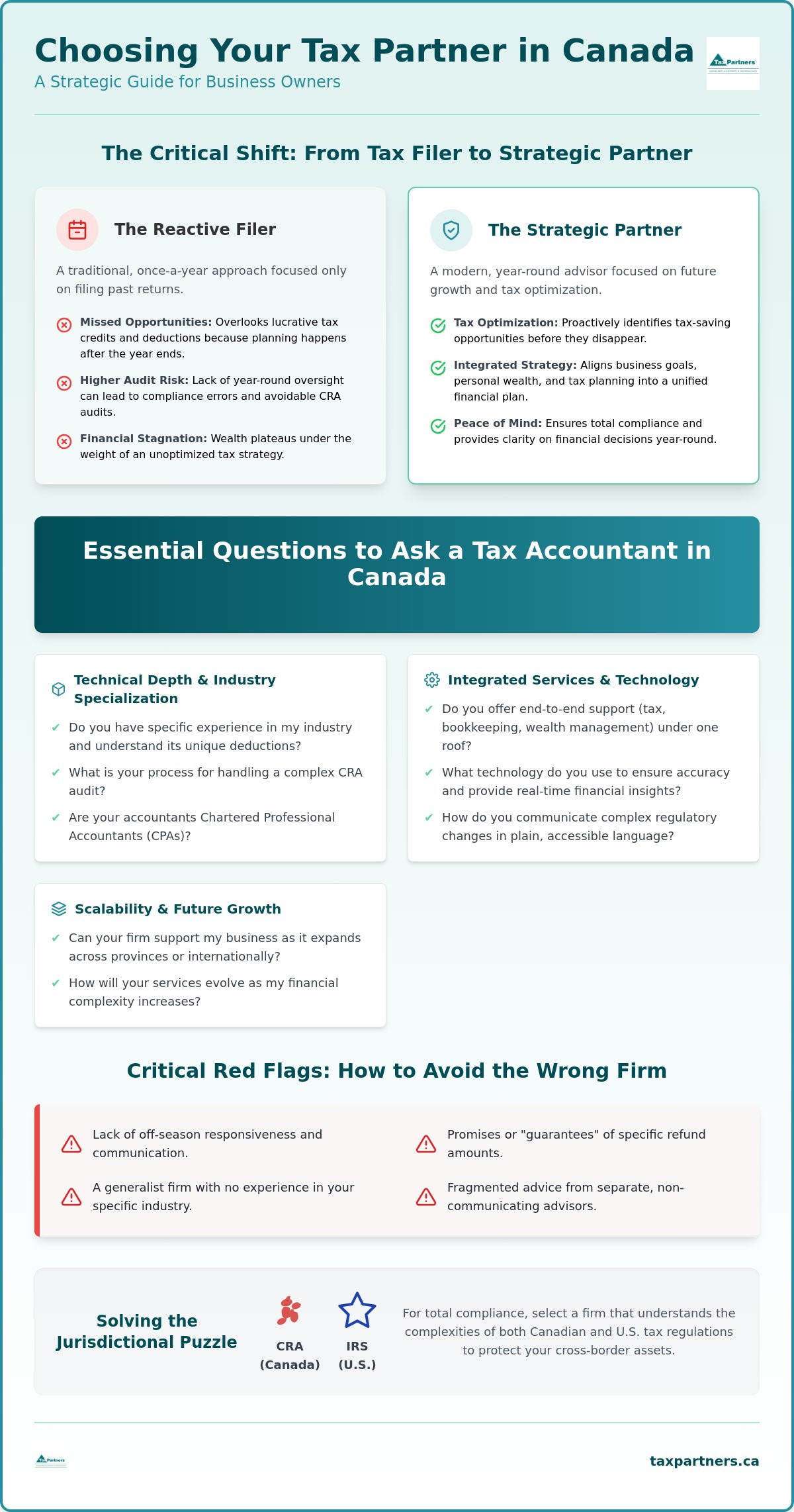
Selecting a tax firm in 2026 is no longer a simple administrative chore. It's a high-stakes decision that determines whether your wealth grows or stagnates under the weight of missed opportunities. The Canadian tax environment has shifted away from traditional, once-a-year filing toward a model of continuous, comprehensive strategy. Your accounting firm should act as a sophisticated financial centre, integrating your business goals with your personal aspirations to create a unified path forward.
Reactive accounting carries a heavy price tag. When an accountant only looks at your books after the year ends, the damage is often already done. You risk missing out on lucrative credits, facing avoidable CRA audits, or watching your wealth plateau. While tax compliance is the floor that keeps you out of trouble, tax optimization is the ceiling that allows your financial potential to soar. Identifying the right questions to ask a tax accountant Canada helps you distinguish between a standard record-keeper and a strategic mentor who understands this distinction.
From Compliance to Strategic Partnership
Modern Canadian businesses operate in a digital, borderless economy that demands more than basic ledger entries. You require a Chartered Professional Accountant (CPA) who possesses a deep-seated understanding of global markets and emerging sectors. This professional acts as a proactive guardian, spotting regulatory shifts and identifying risks before they transform into liabilities. Moving beyond the "once-a-year" conversation is essential. Year-round financial planning ensures that you are never surprised by a tax bill and that every business decision is made with its tax implications in mind. When preparing your list of questions to ask a tax accountant Canada, prioritize their ability to provide this ongoing, high-level guidance.
The Consequences of Mismatched Expertise
Industry-specific knowledge is not a luxury; it is a requirement for financial survival. A firm without experience in your particular sector will inevitably overlook vital deductions and credits tailored to your field. This lack of precision doesn't just cost money; it creates an administrative burden. Managing separate advisors for wealth management and financial planning, bookkeeping, and tax can lead to fragmented advice and conflicting strategies. Tax optimization is the legal process of organizing financial affairs to minimize liability. Achieving this requires an integrated approach where every part of your financial life speaks the same language. A firm that provides end-to-end support ensures that your corporate structure, payroll, and personal investments all work in harmony to protect your bottom line.
Essential Criteria for Evaluating a Canadian Accounting Firm
Evaluating a potential firm requires looking past the certificates on the wall. While a professional designation is the baseline, true value lies in how a firm applies that knowledge to your unique situation. When preparing your list of questions to ask a tax accountant Canada, focus on their ability to handle complexity before it becomes a crisis. A firm that understands your sector can anticipate challenges that a generalist might miss. They should offer a breadth of service that keeps your tax, bookkeeping, and wealth management under one roof to ensure no data is lost in transition.
Modern firms must also leverage technology to drive accuracy. You shouldn't be burdened with manual data entry or chasing paper trails. Instead, your partner should use integrated tools to realize efficiencies and provide real-time insights into your financial health. Communication is equally vital. You need a mentor who can translate dense regulatory changes into plain, accessible language, giving you the clarity needed to make decisive moves. As your business expands, the firm must possess the scalability to support your growth across provinces or even international borders.
Technical Depth and Industry Specialization
A firm with experience across 20 or more industries brings a broader perspective on best practices and niche tax credits. This depth is critical when you require specialized services like CRA audit help. An expert firm doesn't just react to an audit; they build your records to be audit-proof from the start. For corporate needs, ensure they can provide a Notice to Reader or compilation engagement. These reports are often necessary for banking and internal transparency, requiring a high level of precision and ethical steadfastness.
The Proactive Advisory Model
You can identify a proactive firm during your first meeting by observing who asks more questions. A proactive partner won't just ask for your receipts; they'll ask about your five-year plan. This foresight is essential for tax efficient wealth management, where decisions made today impact your retirement and estate. Your questions to ask a tax accountant Canada should also cover their approach to routine but critical tasks like GST/HST filing and payroll management. If you're looking for a partner who prioritizes your long-term stability, you can connect with our advisors to discuss a customized strategy. We focus on identifying every possible saving while maintaining total compliance, ensuring your business remains on a steady course.
Solving the Jurisdictional Puzzle: CRA and IRS Compliance
Cross-border tax compliance is the intricate process of meeting the reporting requirements of both the Canada Revenue Agency (CRA) and the Internal Revenue Service (IRS) simultaneously. This isn't merely a matter of filing two sets of forms; it's about understanding how the tax laws of one nation impact your obligations in the other. For dual citizens, green card holders, or Canadian expats with U.S. based assets, the complexity is immense. One of the most critical questions to ask a tax accountant Canada is how they navigate the nuances of the U.S. Canada tax treaty to prevent double taxation. Most generalist firms struggle with these intricacies, often leaving clients exposed to unnecessary liabilities because they lack specialized cross-border knowledge.
The necessity of explicit attribution cannot be overstated. A professional firm must distinguish between rules for CRA filers and those operating under IRS rules. Without this clarity, you risk applying a Canadian deduction to a U.S. return where it isn't recognized, or failing to disclose foreign assets that the IRS tracks with extreme rigour. This jurisdictional puzzle requires a steady hand and a proactive guardian who understands that a single financial move can trigger reporting requirements on both sides of the border.
Filing for CRA Filers: Canadian Excellence
For those focused purely on domestic growth, managing corporate tax returns and personal income tax within the Canadian regulatory framework remains the top priority. A seasoned firm provides the expertise needed for Canadian corporate tax compliance, ensuring that your business meets every deadline and filing standard set by the CRA. Beyond simple filing, your accountant should act as a mentor, identifying strategies for small business tax reduction and long-term wealth preservation. They ensure that your corporate structure is optimized for the current Canadian tax climate, allowing you to reinvest in your business with confidence.
Navigating the IRS: U.S. and Cross-Border Complexity
Complexity increases significantly when your financial life crosses the border. Under IRS rules, Canadians with U.S. sourced income may need to complete a 1040-NR filing for Canadians. This is just the beginning. The IRS mandates strict reporting of foreign bank accounts and financial assets through FBAR and FATCA requirements. Failing to meet these obligations can lead to heavy penalties that far exceed the tax owed. A specialized firm handles these burdens for you, managing ITIN applications and utilizing streamlined filing procedures for expats who need to catch up on their obligations. They provide the reassurance that your U.S. and Canadian interests are perfectly aligned and fully compliant.
Identifying Red Flags: How to Avoid the Wrong Firm
Choosing the wrong accounting firm is more than a minor inconvenience. It is a significant financial liability. While many professionals claim to offer superior service, certain "red flags" can help you separate a true partner from a simple record-keeper. Your questions to ask a tax accountant Canada should serve as a diagnostic tool to uncover these hidden risks before you sign an engagement letter. A firm that lacks transparency or responsiveness today will likely fail you when a complex regulatory challenge arises tomorrow.
- Guaranteed Refunds: Be extremely wary of any firm that guarantees a specific refund amount before reviewing your documents. Ethical practitioners under CRA rules cannot promise outcomes until they have analyzed your specific data.
- The "Off-Season" Disappearance: Check for responsiveness. If a firm does not return calls or emails during the summer or fall, they are not a year-round partner. You need a proactive guardian, not an April-only acquaintance.
- Verification of Standing: Always verify a firm’s standing with their provincial CPA body. Seek out firms with a documented history of excellence, such as those with over 1,390 five-star Google reviews and recognized industry awards.
- Fee Ambiguity: Assess transparency regarding their fee structure. A reputable firm provides a clear scope of services and avoids hidden costs that surprise you later in the year.
- Audit Abandonment: Question their audit support. You must know if they will stand by you and represent your interests if the CRA or IRS requests a review of your filings.
The Danger of the "Number Cruncher" Mentality
A firm that only looks at the past is a liability to your future growth. This "number cruncher" approach focuses solely on compliance rather than strategy. Some modern firms rely too heavily on automated software without sufficient human oversight. This can lead to missed nuances in complex corporate reorganizations. You need a firm with the bench strength to handle sophisticated structures, ensuring that every automated entry is verified by a seasoned expert who understands your long-term vision.
Due Diligence and Professional Standards
A professional firm is defined by its commitment to client care and ethical steadfastness. This includes a clear mission to protect your wealth through legal tax optimization rather than aggressive, high-risk schemes. While we provide comprehensive guidance, a professional firm must always direct clients to verify specific thresholds or regulatory updates directly with the CRA or IRS to ensure absolute accuracy. If you suspect your current firm is falling short of these standards, speak with a proactive advisor to see how we can secure your financial future through a more dedicated, personalized partnership.
Why Tax Partners is the Definitive Choice for Your Financial Future
Selecting the right firm is the final step in moving from financial anxiety to total understanding. Tax Partners represents the definitive choice for those who value a blend of professional authority and approachable warmth. We merge four decades of institutional wisdom with a forward-thinking approach to global tax matters. While many competitors focus heavily on local city-based services, we provide a national perspective that spans over 20 different industries. This breadth of experience ensures that your specific sector's nuances are never overlooked. As you prepare your final questions to ask a tax accountant Canada, our history of stability and long-term partnership stands as a testament to our reliability.
Our commitment to transparency and precision means we act as more than just accountants. We are your personalized financial guardians. Our cross-border expertise provides a one-stop solution for international filers, removing the stress of managing multiple advisors for CRA and IRS compliance. We handle the technical complexities so you can focus on growing your business and securing your family's future.
Institutional Wisdom Meets Modern Innovation
We leverage the experience of filing over 495,000 returns to solve the unique challenges of every client. This isn't just a statistic; it's a foundation of knowledge that allows us to navigate the most complex regulatory requirements without hesitation. Our specialized teams in blockchain and ecommerce stay ahead of emerging regulations, positioning us as a proactive guardian in the digital economy. We have saved our clients more than $87M through meticulous planning and legal tax optimization. This level of precision is what separates a standard service from a bespoke financial partnership.
Your Journey Toward Total Financial Control
Your journey toward total financial control begins with a firm that prioritizes your success as much as you do. The peace of mind we offer is backed by over 1,390 five-star Google reviews, reflecting a track record of responsiveness and ethical steadfastness. We don't just react to requirements; we actively look ahead to protect your assets and identify growth opportunities. We translate complex tax jargon into actionable strategy, ensuring you always understand your position. To secure your financial legacy and experience the support of a seasoned mentor, you can book a consultation with Tax Partners today. We are ready to help you realize your long-term goals with clarity and confidence.
Securing Your Financial Legacy in 2026 and Beyond
Selecting a tax firm is a commitment to your future stability. You've learned that the right partner acts as a proactive guardian, bridging the gap between basic compliance and genuine wealth optimization. By using the specific questions to ask a tax accountant Canada we've discussed, you can filter for specialized expertise and avoid the pitfalls of reactive record-keeping. Whether you're navigating Canadian corporate requirements or the complexities of U.S. cross-border compliance, clarity remains your greatest asset in a shifting regulatory environment.
At Tax Partners, we bring over 40 years of institutional wisdom and a track record of 1,390+ five-star Google reviews to every client relationship. We don't just file forms; we build strategies that have saved our clients over $87M. It's time to move toward total financial control with a partner who understands your industry's nuances and anticipates risks before they arise. Contact Tax Partners to optimize your tax strategy and preserve your wealth. Your financial peace of mind is within reach, and we're here to guide you every step of the way.
Frequently Asked Questions
How do I switch tax firms if I am unhappy with my current accountant?
Switching firms is a straightforward process that begins with a formal notification to your current accountant. You don't need their permission to move your business. Simply request a copy of your records, including the last seven years of filings and any current working papers. A professional firm will provide a disengagement letter, and your new partner will help you transition your files and update your authorizations with the CRA or IRS.
What is the difference between a bookkeeper and a tax firm?
Bookkeepers manage your day-to-day transaction recording, while a tax firm provides high-level strategy, compliance, and wealth optimization. Think of a bookkeeper as the professional who tracks your financial journey and a tax firm as the navigator. While bookkeeping ensures your data is organized, a tax firm uses that information to minimize liability under CRA rules and plan for long-term growth.
Do I need a specialized firm for U.S. and Canadian cross-border taxes?
Yes, specialized expertise is essential to navigate the intricacies of the U.S. Canada tax treaty and prevent double taxation. Generalist firms often lack the technical depth required to manage both CRA filers and those operating under IRS rules. Specialization ensures you meet reporting requirements like FBAR or 1040-NR filings without facing the heavy penalties associated with cross-border non-compliance.
How much does a professional tax firm typically cost for a small business?
Professional fees vary based on the complexity of your corporate structure and the volume of transactions. Most firms offer either hourly rates or flat-fee packages for corporate year-end filings. While individual returns are generally less complex, business compliance involving payroll and GST/HST filing reflects the specialized expertise required. It's vital to include fee transparency in your initial questions to ask a tax accountant Canada.
Can a tax firm help me if I am currently being audited by the CRA?
Yes, a professional tax firm can act as your authorized representative and manage all communication with the CRA during an audit. They serve as your advocate, ensuring the auditor receives accurate information while protecting your rights as a taxpayer. Having a firm with experience in audit defense can significantly reduce the stress and potential financial impact of a CRA review.
What documents should I have ready before meeting a new tax firm?
You should prepare your most recent Notice of Assessment, past tax returns, and current financial statements. For business owners, having your bookkeeping records and any recent correspondence from the CRA or IRS is also helpful. This preparation allows the firm to conduct a thorough review and identify immediate opportunities for tax optimization or necessary compliance corrections.
How does a firm ensure my data remains secure and confidential?
Reputable firms use bank-grade encryption and secure document portals to protect your sensitive financial data. Security is a pillar of professional accounting standards in Canada. Professional firms implement multi-factor authentication and adhere to strict privacy policies to ensure your records are never compromised or shared without your explicit authorization.
Is it better to choose a boutique firm or a large "Big Four" accounting firm?
The best choice depends on the level of personalized attention and specialized industry expertise you require. While large firms have vast resources, they may lack the bespoke service feel of a mid-sized or boutique firm. For many Canadian businesses, a firm with national reach and deep-seated institutional wisdom offers the ideal balance of high-level capability and genuine, one-on-one mentorship.

Article by
Mahad Mohamed
Mahad Mohamed is an accountant and the CEO of Tax Partners, with over 26+ years of Canadian and international tax and accounting experience. His expertise includes corporate reorganization, cross-border tax structuring (Canada & US), tax disputes, CRA audits, and tax planning for small owner-managed private corporations. Most recently, Mahad is a pioneer in Canadian crypto taxation and founded Block3 Finance.
Previously, Mahad worked for the Canada Revenue Agency (CRA), Big4 accounting firms, and served as a Rulings Officer for the Federal Tax Authority of the UAE before acquiring Tax Partners in 2014.
Tax Partners has 44 full-time accountants and over 18,400+ clients.
Disclaimer
This article provides general information only and is current as of its publication date. It has not been updated and may be out of date. It does not constitute legal advice and should not be relied upon as such. Every tax situation is unique and may differ from the examples discussed in this article. If you have specific questions, you should seek the advice of our accountants for your unique circumstances. Book a FREE Initial Consultation Today!
Frequently Asked Questions
How do I switch tax firms if I am unhappy with my current accountant?
Switching firms is a straightforward process that begins with a formal notification to your current accountant. You don't need their permission to move your business. Simply request a copy of your records, including the last seven years of filings and any current working papers. A professional firm will provide a disengagement letter, and your new partner will help you transition your files and update your authorizations with the CRA or IRS.
What is the difference between a bookkeeper and a tax firm?
Bookkeepers manage your day-to-day transaction recording, while a tax firm provides high-level strategy, compliance, and wealth optimization. Think of a bookkeeper as the professional who tracks your financial journey and a tax firm as the navigator. While bookkeeping ensures your data is organized, a tax firm uses that information to minimize liability under CRA rules and plan for long-term growth.
Do I need a specialized firm for U.S. and Canadian cross-border taxes?
Yes, specialized expertise is essential to navigate the intricacies of the U.S. Canada tax treaty and prevent double taxation. Generalist firms often lack the technical depth required to manage both CRA filers and those operating under IRS rules. Specialization ensures you meet reporting requirements like FBAR or 1040-NR filings without facing the heavy penalties associated with cross-border non-compliance.
How much does a professional tax firm typically cost for a small business?
Professional fees vary based on the complexity of your corporate structure and the volume of transactions. Most firms offer either hourly rates or flat-fee packages for corporate year-end filings. While individual returns are generally less complex, business compliance involving payroll and GST/HST filing reflects the specialized expertise required. It's vital to include fee transparency in your initial questions to ask a tax accountant Canada.
Can a tax firm help me if I am currently being audited by the CRA?
Yes, a professional tax firm can act as your authorized representative and manage all communication with the CRA during an audit. They serve as your advocate, ensuring the auditor receives accurate information while protecting your rights as a taxpayer. Having a firm with experience in audit defense can significantly reduce the stress and potential financial impact of a CRA review.
What documents should I have ready before meeting a new tax firm?
You should prepare your most recent Notice of Assessment, past tax returns, and current financial statements. For business owners, having your bookkeeping records and any recent correspondence from the CRA or IRS is also helpful. This preparation allows the firm to conduct a thorough review and identify immediate opportunities for tax optimization or necessary compliance corrections.
How does a firm ensure my data remains secure and confidential?
Reputable firms use bank-grade encryption and secure document portals to protect your sensitive financial data. Security is a pillar of professional accounting standards in Canada. Professional firms implement multi-factor authentication and adhere to strict privacy policies to ensure your records are never compromised or shared without your explicit authorization.
Is it better to choose a boutique firm or a large "Big Four" accounting firm?
The best choice depends on the level of personalized attention and specialized industry expertise you require. While large firms have vast resources, they may lack the bespoke service feel of a mid-sized or boutique firm. For many Canadian businesses, a firm with national reach and deep-seated institutional wisdom offers the ideal balance of high-level capability and genuine, one-on-one mentorship.