Accountant Toronto: Strategic Financial Guidance and Tax Optimization for 2026

The most expensive tax mistake you can make isn't a simple math error; it's a lack of foresight. Many entrepreneurs and dual citizens feel a persistent weight of anxiety regarding their obligations to the CRA or the IRS. You've likely felt the frustration of a reactive relationship where your professional advisor only speaks to you once a year, leaving you to wonder if you're missing critical opportunities. This silence often leads to confusion over double taxation or the fear that a surprise audit could derail your hard-earned progress.
Securing a dedicated accountant Toronto ensures you move from a state of uncertainty to total control. You deserve a strategic partner who prioritizes wealth preservation and strict compliance across both jurisdictions. We act as your proactive guardian, looking ahead to secure the best possible outcomes for your family and your business. This guide outlines how to optimize your 2026 tax position, minimize liabilities through precise planning, and establish a resilient roadmap for business succession or estate preservation.
Key Takeaways
- Shift your perspective from annual compliance to strategic growth by partnering with an accountant Toronto who serves as a proactive guardian for your wealth.
- Learn how to maintain pristine financial records through professional bookkeeping that streamlines corporate tax preparation and maximizes eligible deductions under CRA rules.
- Navigate the specific reporting requirements for US citizens in Canada, ensuring you meet all IRS filing obligations while minimizing the risk of double taxation.
- Transition from reactive tax filing to long-term wealth management by integrating estate planning and succession strategies into your financial roadmap.
- Discover the value of institutional wisdom when managing complex cross-border interests, providing you with a steady hand at the helm during regulatory shifts.
What to Expect from a Professional Accountant in Canada
The role of a modern Chartered Professional Accountant (CPA) has evolved far beyond the traditional image of a person who merely files paperwork once a year. In a complex financial environment, your accountant Toronto should serve as a strategic mentor and a proactive guardian of your financial legacy. This partnership begins with foundational accuracy but matures into a sophisticated roadmap for wealth preservation. While basic bookkeeping focuses on recording past transactions to satisfy the Canada Revenue Agency (CRA), professional tax planning looks forward. It anticipates regulatory shifts and aligns your business structure with your long-term goals. You should expect a relationship built on transparency and foresight, where your advisor is actively looking for ways to secure a better outcome for your future.
The Distinction Between Compliance and Optimization
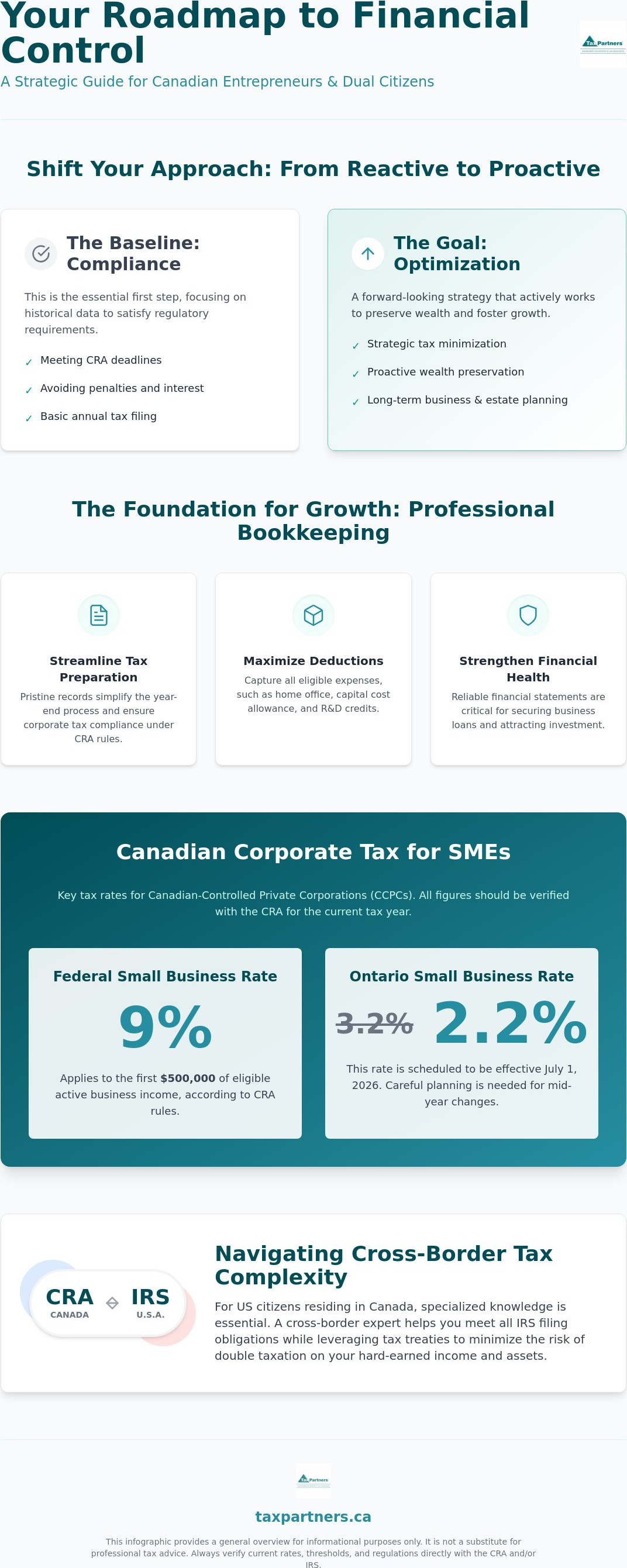
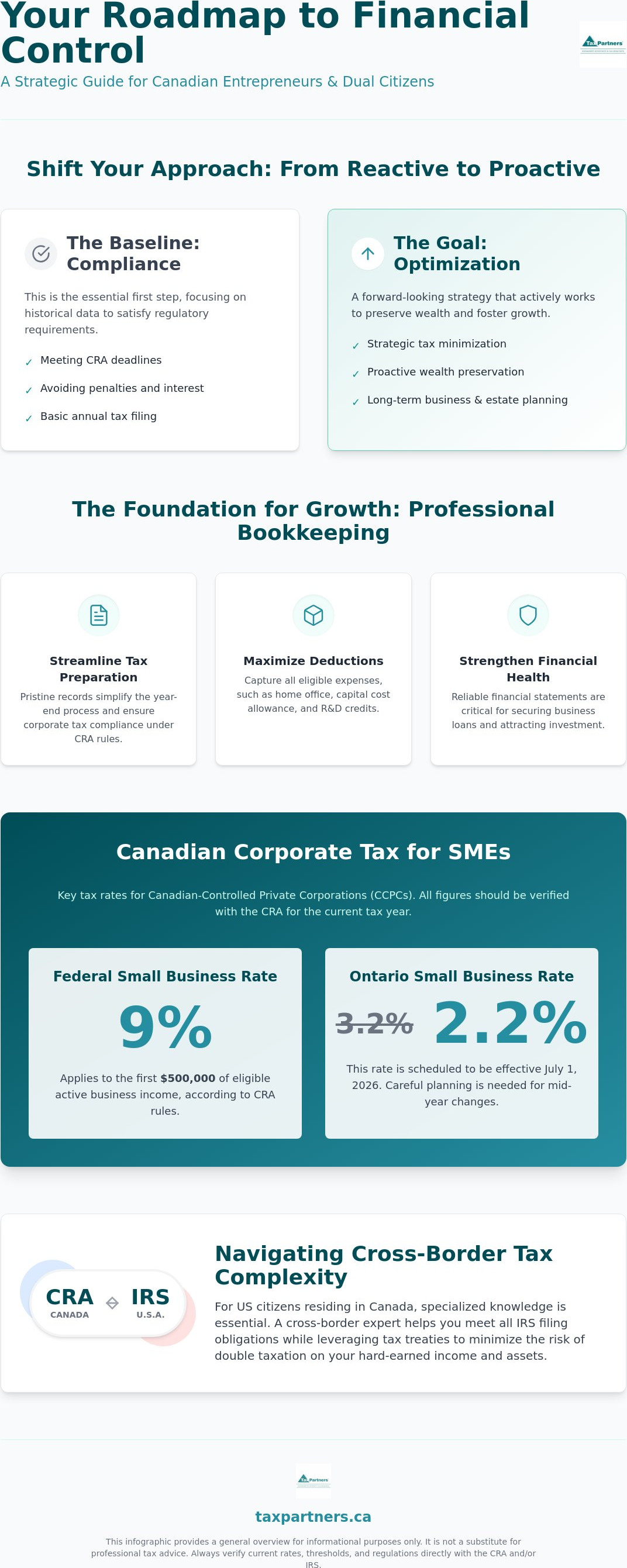
Compliance is the baseline. It ensures you meet CRA deadlines and avoid the immediate sting of penalties or interest charges. Optimization, however, is where true financial empowerment resides. It's the difference between simply paying what you owe and strategically ensuring you keep more of what you earn. Professional oversight from a firm with 40 years of experience reduces the risk of administrative errors that often trigger audits. For those with cross-border interests, an expert advisor interprets complex tax treaties to prevent the erosion of assets through unnecessary taxation. At Tax Partners, we have filed nearly 500,000 returns, which has allowed us to refine a process that prioritizes both total regulatory compliance and aggressive, legal tax minimization.
Criteria for Selecting a Long-Term Financial Partner
Choosing a partner requires looking for deep-seated reliability. You need a firm that combines institutional wisdom with a modern, forward-thinking outlook on emerging sectors like real estate or ecommerce. A high degree of responsiveness is essential; you shouldn't have to wait weeks for an answer to a critical financial question. When evaluating an accountant Toronto, consider the breadth of their accounting services. A firm that can handle everything from weekly payroll to complex wealth management and financial planning provides a seamless, end-to-end support system. This holistic approach ensures that every financial decision you make today is viewed through the lens of your estate preservation and business succession goals for 2026 and beyond.
Corporate Tax Compliance and Bookkeeping for Canadian SMEs
For small and medium-sized enterprises (SMEs) in Ontario, clean books are the difference between scaling and stalling. Maintaining professional bookkeeping services isn't just a matter of organization; it's the primary defence against unnecessary CRA scrutiny. A disciplined financial cycle ensures that every expense is captured and categorized correctly, which simplifies the year-end process and provides a clear picture of your business health. When your records are pristine, you can maximize eligible deductions that would otherwise be overlooked, such as home office expenses, capital cost allowance, or research and development credits. This level of precision is also vital when you seek to secure business loans or attract new investment, as lenders require reliable, verified financial statements to assess risk.
Navigating CRA Corporate Requirements
Maintaining corporate tax compliance requires a deep understanding of the T2 filing process for Canadian-controlled private corporations (CCPCs). For 2026, the federal small business tax rate remains at 9% on the first $500,000 of eligible income. In Ontario, the small business rate is scheduled to decrease from 3.2% to 2.2% effective July 1, 2026. Failing to account for these mid-year shifts can lead to filing errors. Additionally, managing GST/HST obligations is a constant requirement. The CRA frequently conducts post-assessing reviews to verify input tax credits, and missing documentation can result in significant reversals. It's best to verify current thresholds and specific deadlines directly with the CRA to ensure your business remains in good standing.
Bookkeeping as a Foundation for Growth
A seasoned accountant Toronto provides more than just historical records; they offer real-time data for better decision-making. Access to current cash flow figures allows you to pivot when market conditions change or to invest in new opportunities with confidence. For growing companies, outsourcing payroll reduces the administrative burden and ensures that CPP and EI deductions are calculated accurately under Canadian rules. As digital assets become more common, integrating cryptocurrency accounting into your core financial system is no longer optional. Whether your business is in real estate, healthcare, or ecommerce, your financial infrastructure must be robust enough to handle modern complexities. If you're looking to strengthen your firm's financial foundation, you can reach out to our team for a detailed assessment of your current systems.
Specialized Cross-Border and US Tax Requirements
Living in a global hub like Ontario often involves financial interests that stretch across the border. Many individuals mistakenly believe that paying taxes to the CRA automatically satisfies their obligations elsewhere. However, for US citizens or green card holders residing in Canada, the IRS requires annual reporting of worldwide income. Navigating this interface requires an accountant Toronto who understands the specific interplay between two distinct tax systems. Members of the Chartered Professional Accountants of Canada who specialize in cross-border matters provide the necessary oversight to ensure that 1040 or 1040-NR filings are handled with precision. This proactive approach prevents the steep penalties associated with non-compliance and ensures your financial standing remains secure in both jurisdictions.
IRS Compliance for Expats and Dual Citizens
Managing these dual requirements is why many expatriates seek out an accountant Toronto with specific cross-border training. Under IRS rules, the reporting requirements go beyond simple income disclosure. You must also adhere to FBAR (Report of Foreign Bank and Financial Accounts) and FATCA (Foreign Account Tax Compliance Act) regulations if your foreign financial assets exceed certain thresholds. If you've fallen behind on these obligations, the IRS streamlined procedure offers a path to catch up without facing the most severe penalties, provided the failure to file was non-willful. Additionally, individuals who do not qualify for a Social Security Number but have US tax obligations must secure an Individual Taxpayer Identification Number (ITIN). Because these requirements are rigid, you should verify current filing thresholds and form instructions directly with the IRS or a qualified professional.
Strategies to Avoid Double Taxation
The primary tool for protecting your assets from being taxed twice is the US-Canada Income Tax Convention, commonly known as the Tax Treaty. This agreement provides residency tie-breaker rules and allows for the application of foreign tax credits. For example, taxes paid to the CRA on Canadian-sourced income can often be used as a credit to offset your liability on your US return under IRS rules. Applying these treaty benefits correctly is complex and depends heavily on your specific income types and residency status. It's essential to consult with an expert to ensure you are utilizing every available mechanism to minimize your global tax burden while remaining fully compliant with both the IRS and the CRA. This ensures your wealth remains preserved as you move across borders.
Strategic Wealth Management and Succession Planning
True financial security requires moving beyond the cycle of annual tax filings. While meeting your immediate obligations to the CRA is necessary, long-term wealth management and financial planning ensures that your capital continues to grow across generations. An accountant Toronto with a focus on wealth preservation looks at your balance sheet through a multi-year lens rather than a single tax year. This bespoke approach is particularly vital for high-net-worth families who face complex regulatory requirements and higher exposure to shifting tax brackets. By integrating tax planning into your broader financial strategy, you can protect your assets from unnecessary erosion and ensure that your legacy remains intact. Proactive planning isn't just about managing numbers; it's about providing your family with the stability and reassurance they deserve through a partnership built on trust and foresight.
Estate and Succession Planning for Business Owners
For owners of family businesses in Ontario, a clear exit strategy is a fundamental requirement for a smooth transition. Transferring ownership to the next generation involves significant tax implications under CRA rules, particularly regarding the Lifetime Capital Gains Exemption (LCGE). For 2026, the LCGE for qualifying small business corporation shares is approximately $1.25 million. However, accessing this exemption requires careful structural preparation and specific holding periods that must be managed years in advance. Additionally, executors must navigate estate income tax considerations to ensure beneficiaries receive their intended inheritance without administrative delays or surprise liabilities. Establishing a formal succession plan now prevents Canada's "deemed disposition" rule from triggering an unmanageable tax bill upon the death of a shareholder, as all assets are treated as sold at fair market value immediately before death.
Wealth Preservation Strategies
Protecting your capital requires a sophisticated understanding of how to structure investments to minimize capital gains tax exposure over time. For 2026, the capital gains inclusion rate for individuals, corporations, and trusts in Canada is 50%. This means that only half of the realized gain is added to your taxable income for the year. Utilizing holding companies can be an effective way to protect corporate earnings and separate personal assets from business liabilities, providing an extra layer of security. This structure allows for more flexibility in timing dividend payments and reinvesting capital into new ventures. Realizing these benefits requires a steady hand at the helm and a commitment to a multi-year outlook that anticipates future regulatory changes. If you are ready to secure your financial future and protect your family's interests, you can book a consultation with our planning team to begin building your bespoke roadmap.
Selecting the Right Professional Partner for Your Financial Journey
Choosing an accountant Toronto is a decision that impacts your financial trajectory for years to come. You need more than a service provider; you need a partner with the institutional wisdom to navigate shifting regulations with ease. With over 40 years of experience and more than 495,000 returns filed, we have seen every conceivable tax scenario. This depth of knowledge allows our team to act as a steady hand at the helm, ensuring your interests are protected against the complexities of both Canadian and US jurisdictions. Moving from a state of uncertainty to one of total control starts with recognizing that your financial journey deserves a dedicated, proactive guardian who is genuinely invested in your long-term prosperity.
The Tax Partners Advantage
Our commitment to meticulous tax optimization has saved our clients over $87 million to date. This track record is built on a foundation of ethical steadfastness and a drive to secure the best possible outcome for every individual we serve. Our reputation is reflected in over 1,390 five-star Google reviews, which speak to our reliability and the personalized care we provide to each client. While we value our four decades of history, we remain deeply invested in modern sectors. We offer specialized blockchain and cryptocurrency expertise to ensure that digital asset investors remain fully compliant with CRA reporting requirements. Our leadership combines professional authority with an approachable warmth, positioning our firm as an accessible expert rather than a distant institution. We don't just react to the numbers; we anticipate the challenges that lie ahead to secure your wealth.
Next Steps: Securing Your Financial Future
Taking the first step toward a more secure future is simpler than you might expect. We encourage you to gather your current financial documents and prepare for a comprehensive review of your 2026 tax position. Whether you are managing a family business, navigating US expat requirements under IRS rules, or looking to preserve an estate, our end-to-end support system is designed to alleviate your stress. Strategic planning always yields better results than simple compliance. It's time to prioritize your long-term wealth growth over basic filing. You can connect with our Toronto office today to begin a partnership that focuses on your success and stability. We are ready to help you navigate the complexities of the modern financial world with confidence and clarity.
Chart Your Path to Financial Stability
Navigating the intersection of Canadian and US tax laws requires more than just technical skill; it demands a partnership rooted in stability and foresight. We have explored how a dedicated accountant Toronto transforms your financial outlook by moving from reactive filing to proactive wealth optimization. By integrating meticulous bookkeeping with strategic estate planning, you ensure your legacy is protected from the deemed disposition rules of the CRA and the reporting requirements of the IRS. Our firm brings 40 years of professional excellence and expertise in both CRA and IRS jurisdictions to every client relationship.
With over 1,390 five-star Google reviews, our reputation as a proactive guardian is built on decades of delivering results and providing a steady hand at the helm. You don't have to face these regulatory complexities alone. It's time to move from uncertainty toward a feeling of total control and understanding. Secure your financial future with Tax Partners and schedule your consultation today. We look forward to helping you build a resilient roadmap that secures your wealth for 2026 and beyond.
Frequently Asked Questions
What is the difference between a bookkeeper and a CPA in Canada?
A bookkeeper focuses on the daily recording of financial transactions and maintaining organized ledgers, while a Chartered Professional Accountant (CPA) provides high-level analysis and strategic tax planning. While bookkeepers ensure your records are accurate, an accountant Toronto with a CPA designation interprets that data to minimize your liability under CRA guidelines. This distinction is vital for businesses moving beyond basic compliance toward long-term growth and wealth preservation.
Do I need to file a US tax return if I am a dual citizen living in Canada?
Yes, US citizens and green card holders must file an annual US tax return with the IRS regardless of their country of residence. Under IRS rules, you are taxed on your worldwide income, which necessitates filing Form 1040 and potentially reporting foreign accounts through FBAR or FATCA. Failing to meet these requirements can lead to significant penalties, so it is essential to verify current filing thresholds directly with the IRS.
How can a professional accountant help me during a CRA audit?
A professional accountant acts as your authorized representative, managing all communication and documentation requests from the CRA. We ensure that your financial records are presented accurately and that your rights as a taxpayer are protected throughout the process. Having a proactive guardian handle these inquiries reduces your personal stress and helps resolve potential disputes more efficiently through a methodical, organized approach to tax mediation.
What are the common tax deductions for small business owners in Canada?
Small business owners in Canada can often deduct expenses such as home office costs, vehicle expenses for business use, and capital cost allowance (CCA) on equipment. Under CRA rules, these expenses must be incurred for the purpose of earning income and must be supported by receipts or digital records. You should verify current eligibility criteria and specific deduction limits directly with the CRA to ensure your claims are compliant.
How does cryptocurrency taxation work under CRA rules?
The CRA treats cryptocurrency as a commodity, meaning transactions may result in either capital gains or business income depending on the frequency and nature of the trades. It is essential to track the fair market value in Canadian dollars at the time of every trade, swap, or purchase. An accountant Toronto specializing in digital assets can help you navigate these complex reporting requirements to ensure you remain fully compliant with emerging regulations.
What is the deadline for filing corporate tax returns in Canada?
For corporations in Canada, the T2 filing deadline is six months after the end of the fiscal year. However, any taxes owed must generally be paid within two months of the year-end, or three months for eligible Canadian-controlled private corporations (CCPCs). You should confirm your specific fiscal dates and payment requirements with the CRA to avoid interest charges or late-filing penalties that can erode your corporate earnings.
How can I avoid double taxation on my US-sourced income?
You can mitigate double taxation by utilizing the provisions of the US-Canada Income Tax Convention and claiming foreign tax credits on your returns. These credits allow you to offset taxes paid to the CRA against your IRS liability, or vice versa, depending on the source of the income and your residency status. Applying these treaty benefits correctly requires professional oversight to ensure you don't overpay in either jurisdiction under conflicting tax rules.
Why is succession planning important for my family business?
Succession planning is critical for ensuring a tax-efficient transfer of your business while maximizing the Lifetime Capital Gains Exemption (LCGE) available to qualifying shareholders. Without a plan, the "deemed disposition" rule at death can trigger an immediate and substantial tax bill under CRA rules, as assets are treated as sold at fair market value. Early preparation allows you to structure the transition in a way that preserves your family's hard-earned wealth and legacy.

Article by
Mahad Mohamed
Mahad Mohamed is an accountant and the CEO of Tax Partners, with over 26+ years of Canadian and international tax and accounting experience. His expertise includes corporate reorganization, cross-border tax structuring (Canada & US), tax disputes, CRA audits, and tax planning for small owner-managed private corporations. Most recently, Mahad is a pioneer in Canadian crypto taxation and founded Block3 Finance.
Previously, Mahad worked for the Canada Revenue Agency (CRA), Big4 accounting firms, and served as a Rulings Officer for the Federal Tax Authority of the UAE before acquiring Tax Partners in 2014.
Tax Partners has 44 full-time accountants and over 18,400+ clients.
Disclaimer
This article provides general information only and is current as of its publication date. It has not been updated and may be out of date. It does not constitute legal advice and should not be relied upon as such. Every tax situation is unique and may differ from the examples discussed in this article. If you have specific questions, you should seek the advice of our accountants for your unique circumstances. Book a FREE Initial Consultation Today!
Frequently Asked Questions
What is the difference between a bookkeeper and a CPA in Canada?
A bookkeeper focuses on the daily recording of financial transactions and maintaining organized ledgers, while a Chartered Professional Accountant (CPA) provides high-level analysis and strategic tax planning. While bookkeepers ensure your records are accurate, an accountant Toronto with a CPA designation interprets that data to minimize your liability under CRA guidelines. This distinction is vital for businesses moving beyond basic compliance toward long-term growth and wealth preservation.
Do I need to file a US tax return if I am a dual citizen living in Canada?
Yes, US citizens and green card holders must file an annual US tax return with the IRS regardless of their country of residence. Under IRS rules, you are taxed on your worldwide income, which necessitates filing Form 1040 and potentially reporting foreign accounts through FBAR or FATCA. Failing to meet these requirements can lead to significant penalties, so it is essential to verify current filing thresholds directly with the IRS.
How can a professional accountant help me during a CRA audit?
A professional accountant acts as your authorized representative, managing all communication and documentation requests from the CRA. We ensure that your financial records are presented accurately and that your rights as a taxpayer are protected throughout the process. Having a proactive guardian handle these inquiries reduces your personal stress and helps resolve potential disputes more efficiently through a methodical, organized approach to tax mediation.
What are the common tax deductions for small business owners in Canada?
Small business owners in Canada can often deduct expenses such as home office costs, vehicle expenses for business use, and capital cost allowance (CCA) on equipment. Under CRA rules, these expenses must be incurred for the purpose of earning income and must be supported by receipts or digital records. You should verify current eligibility criteria and specific deduction limits directly with the CRA to ensure your claims are compliant.
How does cryptocurrency taxation work under CRA rules?
The CRA treats cryptocurrency as a commodity, meaning transactions may result in either capital gains or business income depending on the frequency and nature of the trades. It is essential to track the fair market value in Canadian dollars at the time of every trade, swap, or purchase. An accountant Toronto specializing in digital assets can help you navigate these complex reporting requirements to ensure you remain fully compliant with emerging regulations.
What is the deadline for filing corporate tax returns in Canada?
For corporations in Canada, the T2 filing deadline is six months after the end of the fiscal year. However, any taxes owed must generally be paid within two months of the year-end, or three months for eligible Canadian-controlled private corporations (CCPCs). You should confirm your specific fiscal dates and payment requirements with the CRA to avoid interest charges or late-filing penalties that can erode your corporate earnings.
How can I avoid double taxation on my US-sourced income?
You can mitigate double taxation by utilizing the provisions of the US-Canada Income Tax Convention and claiming foreign tax credits on your returns. These credits allow you to offset taxes paid to the CRA against your IRS liability, or vice versa, depending on the source of the income and your residency status. Applying these treaty benefits correctly requires professional oversight to ensure you don't overpay in either jurisdiction under conflicting tax rules.
Why is succession planning important for my family business?
Succession planning is critical for ensuring a tax-efficient transfer of your business while maximizing the Lifetime Capital Gains Exemption (LCGE) available to qualifying shareholders. Without a plan, the "deemed disposition" rule at death can trigger an immediate and substantial tax bill under CRA rules, as assets are treated as sold at fair market value. Early preparation allows you to structure the transition in a way that preserves your family's hard-earned wealth and legacy.