TFSA for U.S. Citizens in Canada: IRS and CRA Tax Guide

What if the very account designed to save you money in Canada actually triggered a cascade of IRS penalties and paperwork? For many, the TFSA for US citizens in Canada represents a frustrating paradox where local tax benefits are erased by complex obligations under IRS rules. You likely opened your account to grow your wealth without the CRA taking a cut, yet the IRS does not recognize this tax-free status.
We understand the anxiety that comes with foreign trust reporting and the fear of steep penalties for simple filing errors. It's exhausting to watch your hard-earned savings get consumed by high compliance costs. This guide will help you determine if a TFSA is truly worth the headache or if it's time to pivot your strategy.
You will learn which IRS forms are mandatory for your 2026 filings and how to identify safer investment alternatives for CRA filers. We provide a clear path from regulatory confusion to a sense of total financial control and foresight.
Key Takeaways
- Understand why the CRA treats the TFSA as a tax-free savings tool while the IRS views it as a taxable account with no treaty protection.
- Navigate the mandatory reporting requirements for a TFSA for US citizens in Canada, including FBAR and FATCA thresholds under IRS rules.
- Recognize the dangers of holding Canadian mutual funds or ETFs in a TFSA, as these often trigger complex PFIC reporting for the IRS.
- Compare the TFSA against treaty-protected alternatives like RRSPs to find a more efficient path for your cross-border wealth.
- Learn how to avoid the severe financial penalties that can arise from misclassifying foreign accounts on your US tax returns.
The TFSA Conflict: Why the CRA and IRS Disagree
A Tax-Free Savings Account (TFSA) is a powerful tool for anyone living in Canada. The CRA allows you to contribute after-tax dollars and watch your investments grow without any further tax liability. Managing a TFSA for US citizens in Canada requires a deep understanding of two very different tax codes, as the benefits offered by one country are often ignored by the other.
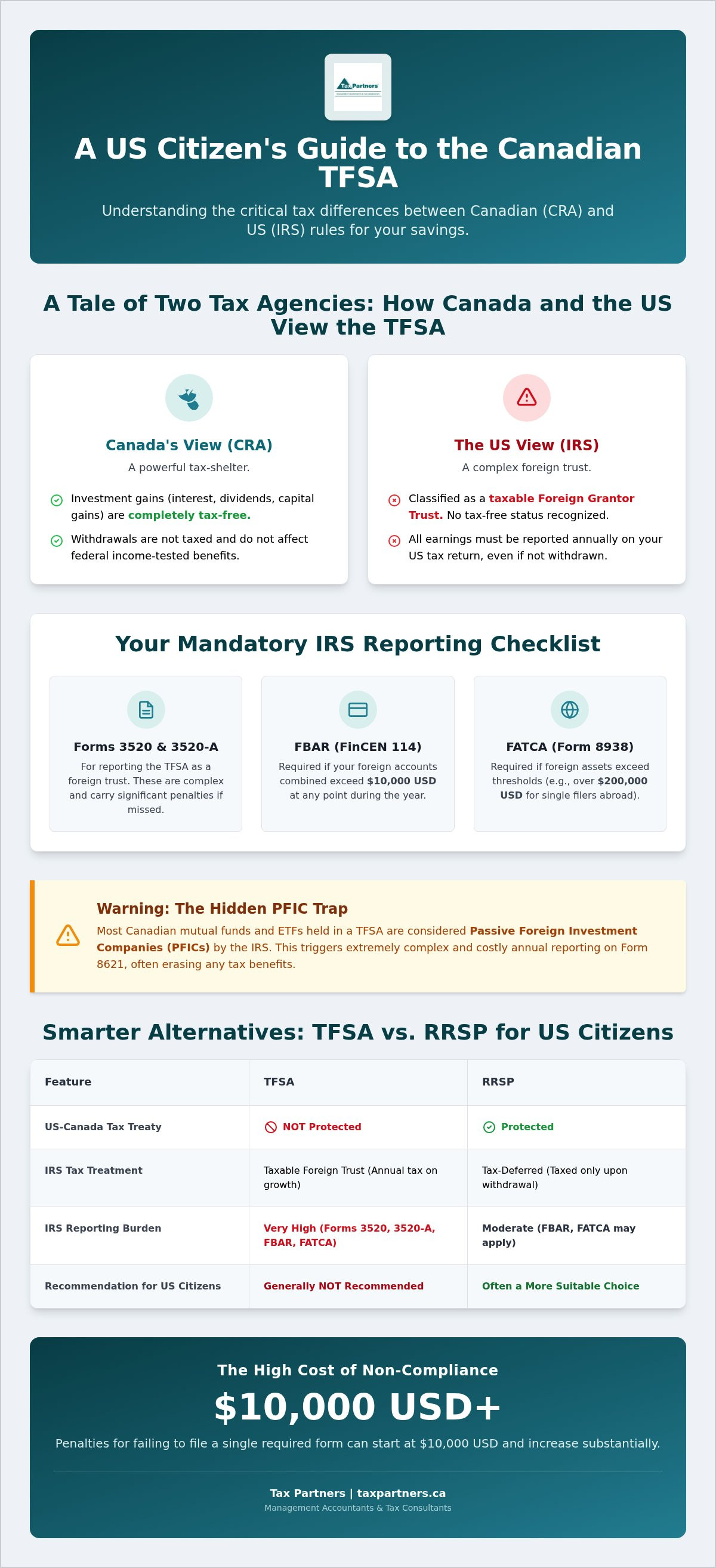
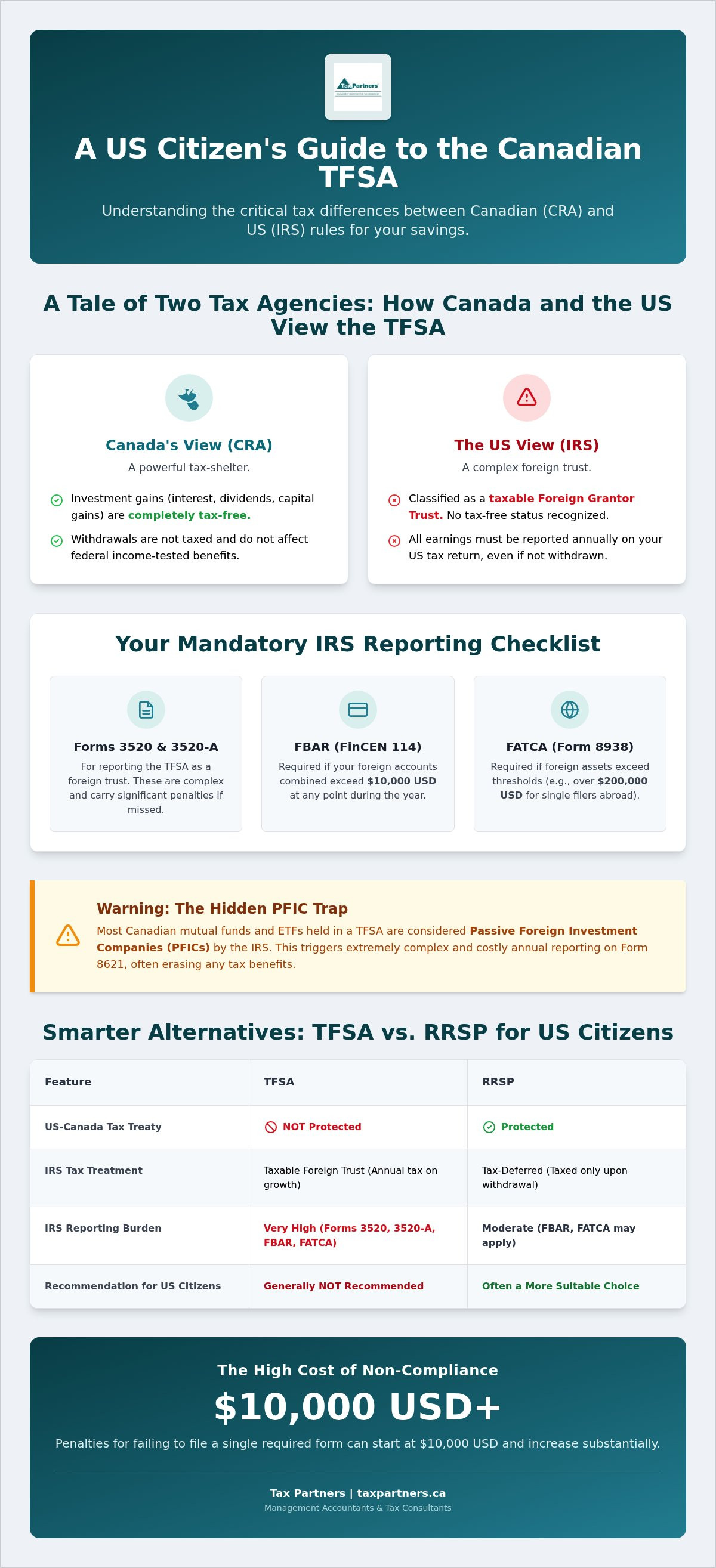
The situation becomes far more complex because the IRS does not share the CRA's view. While Canadian residents enjoy tax-free interest, dividends, and capital gains, the IRS sees the TFSA as a standard, taxable investment account. Under IRS rules, this account has no special status. Every cent earned within the account must be reported on your US individual tax return each year.
This conflict stems from a gap in international agreements. The Canada-U.S. Income Tax Treaty specifically protects certain accounts while ignoring others. Consider these key differences under IRS rules:
- RRSPs: These enjoy treaty protection, allowing for tax-deferred growth until withdrawal for both CRA and IRS filers.
- TFSAs: These have no treaty protection, meaning all annual earnings are taxable in the US even if they remain in the account.
Because the US doesn't recognize the account's registered status, you face a reporting requirement that can quickly become a compliance nightmare. You must disclose all earnings annually to the IRS, even if you never withdraw the funds. This often leads to a situation where the tax savings in Canada are offset by the costs of US tax preparation.
The Foreign Grantor Trust Classification
The IRS frequently classifies a TFSA as a Foreign Grantor Trust under US tax law. This technical designation triggers a heavy reporting burden that most Canadian financial institutions are not equipped to handle. In this context, a grantor is the person who establishes the trust and provides the assets. The beneficiary is the person entitled to receive the income from those assets.
Since you are both the grantor and the beneficiary, the IRS treats the account as yours personally for tax purposes. Failing to understand this classification can lead to missing mandatory forms and facing significant penalties. It is vital to recognize that your Canadian bank's "tax-free" promise does not apply to your US tax standing.
Residency Status and Tax Obligations
US citizens are subject to taxation on their worldwide income, no matter where they reside. This is a unique aspect of the US tax system that many expats find overwhelming. Even if you have lived in Canada for decades, your obligation to the IRS remains unchanged. You must report all income, including that earned in Canadian accounts like the TFSA.
Living in Canada requires you to navigate two different tax systems simultaneously. This dual-filing status means you must coordinate your US tax obligations with your Canadian filings. It's not enough to simply pay your Canadian taxes. You must also ensure that every Canadian-sourced dollar is correctly disclosed to the IRS to maintain your standing as a compliant citizen.
Navigating Mandatory IRS Reporting for Canadian TFSAs
Compliance is the most critical hurdle for anyone managing a TFSA for US citizens in Canada. The IRS prioritizes transparency over tax revenue. This means the burden of proof falls entirely on you. You must disclose the existence of these accounts and their activity, regardless of whether you owe a single dollar in tax.
Failure to meet these strict requirements can lead to severe financial penalties. For instance, failing to file Form 8938 can result in a penalty starting at $10,000 USD. Organizing your records by December 31 each year ensures you have the data ready for the spring filing season. Reporting is mandatory even if your account has not generated a profit during the year.
Essential Forms: 3520 and 3520-A
The IRS often views a TFSA as a foreign trust. This triggers a specific set of obligations that many Canadian banks do not mention. To remain compliant, follow these essential steps:
- Determine if your specific account structure requires Form 3520. This form reports transactions with foreign trusts and receipt of certain foreign gifts.
- Ensure Form 3520-A is filed to report the annual income and assets of the trust. While some banks may provide data, the legal responsibility to file remains with you.
- Coordinate these disclosures with your standard 1040 or your 1040-NR filing for Canadians to ensure your total income is consistent across all forms.
FBAR and FATCA Requirements
Beyond trust reporting, you must navigate two other major disclosure frameworks. FinCEN Form 114, known as the FBAR, is mandatory if the aggregate value of your foreign financial accounts exceeds $10,000 USD at any point during the year. This includes the balance in your TFSA, your chequing accounts, and any other Canadian holdings.
Form 8938, or FATCA, serves a similar purpose but has different thresholds. For US citizens living abroad, the filing requirement generally begins if your assets exceed $200,000 USD on the last day of the year. While these forms may seem redundant, the IRS uses them to cross-reference your reported income and identify potential discrepancies.
The complexity of these requirements often offsets the very tax savings you hoped to achieve. If you feel overwhelmed by these overlapping deadlines, you can speak with a cross-border specialist to streamline your compliance strategy. Proper planning now prevents the stress of an audit later.
Comparing TFSAs with RRSPs and Roth IRAs
Choosing where to park your savings requires a clear understanding of how different accounts bridge the gap between two countries. While a TFSA for US citizens in Canada often leads to reporting fatigue, other registered plans offer a more harmonious experience. The goal is to utilize accounts that both the CRA and the IRS recognize as tax-advantaged vehicles.
The primary conflict arises because the US tax system does not view all Canadian registered plans equally. By selecting accounts with treaty protection, you can avoid the double-taxation traps that catch many unwary expats. This strategic approach ensures your wealth grows steadily without being eroded by unnecessary compliance costs.
Why RRSPs are the Preferred Choice
The Registered Retirement Savings Plan (RRSP) remains the gold standard for cross-border compliance. Unlike the TFSA, the RRSP is explicitly protected under the Canada-U.S. Income Tax Treaty. This protection allows your investments to grow tax-deferred for both the CRA and the IRS without the need for annual earnings reporting in the US.
Compliance is significantly simpler for an RRSP. You don't have to worry about the foreign trust classifications that make a TFSA for US citizens in Canada so burdensome. Many experts in tax efficient wealth management prioritize RRSP contributions to maximize retirement security while minimizing IRS paperwork.
The Roth IRA vs. TFSA Dilemma
The choice between these accounts often comes down to your long-term residency goals and withdrawal needs. A TFSA provides unmatched flexibility for withdrawals in Canada, but it lacks the treaty recognition that a Roth IRA can achieve. However, the CRA considers a Roth IRA a taxable foreign trust unless you proactively file a one-time election to defer taxation under the treaty.
- Withdrawal Rules: TFSAs allow you to take money out at any time for any reason. Roth IRAs generally require you to reach age 59 and a half to avoid US penalties.
- CRA Treatment: Without a proper election, the CRA may tax the annual earnings within your Roth IRA.
- Funding Sequence: Most residents find it beneficial to exhaust RRSP room before considering other cross-border vehicles.
Be wary of the "Contribution Trap" when managing US-based accounts from across the border. If you contribute to a Roth IRA while you are a tax resident of Canada, you risk losing its tax-exempt status for CRA filers. The growth on those new contributions could become taxable in Canada, effectively turning a tax-free vehicle into a reporting liability.
Navigating these choices requires a steady hand and a long-term outlook. By aligning your accounts with the rules of both jurisdictions, you move from a state of uncertainty toward total control over your financial future.
The PFIC Risk: Avoiding Costly Investment Mistakes
A TFSA for US citizens in Canada often holds a hidden danger: the Passive Foreign Investment Company (PFIC). While the reporting forms mentioned earlier are a hurdle, the specific assets you choose can be even more destructive. The IRS views most non-US pooled investments, such as Canadian mutual funds and ETFs, through a very different lens than the CRA.
The CRA encourages these investments as part of a diversified strategy. However, the IRS imposes punitive tax rates and complex interest charges on any income derived from PFICs. This jurisdictional gap means an investment that is tax-free in Canada could be taxed at the highest marginal rate under IRS rules. It effectively erases the benefit of the account.
Identifying PFICs in Your Portfolio
Spotting these assets is relatively straightforward. Any pooled investment vehicle that is not domiciled in the US generally qualifies as a PFIC. This includes the vast majority of funds offered by Canadian financial institutions. Each individual PFIC requires the filing of Form 8621, which is a document that requires a high level of technical precision to complete correctly.
If you hold multiple funds, the compliance burden becomes immense. You must file a separate Form 8621 for every single PFIC held in your account. To simplify your life, consider holding individual stocks or US-listed ETFs instead. These assets do not trigger PFIC rules, allowing you to grow your wealth without the crushing weight of extra paperwork.
The High Cost of Non-Compliance
The financial impact of PFICs extends beyond the tax itself. Because of the complexity involved, accounting fees for filing Form 8621 are significantly higher than standard reporting. In many cases, the cost of compliance actually exceeds the annual growth of the investment. This makes a TFSA for US citizens in Canada a net loss for the taxpayer if not managed with foresight.
There is also a heightened risk of a CRA audit if your cross-border filings appear inconsistent. Since the IRS and CRA exchange data through FATCA, discrepancies in reported income can trigger investigations in both countries. Maintaining a clean record is particularly important for those seeking permanent residency or dual citizenship. If you are unsure if your current portfolio contains these high-risk assets, contact our cross-border team for a comprehensive review.
Strategic Wealth Management for Cross-Border Residents
Managing a TFSA for US citizens in Canada is not a task for off-the-shelf DIY software. While these programs excel at standard filings, they rarely account for the intricate web of foreign trust reporting and PFIC disclosures. Relying on automated tools often leads to missed forms and severe IRS penalties that could have been avoided with foresight.
We believe in a proactive approach that moves you beyond reactive filing. Tax Partners provides a steady hand at the helm, ensuring your cross-border strategy is both legally sound and financially optimized. Our goal is to help you realize your full financial potential without the constant fear of regulatory traps or hidden costs.
Proactive Compliance and Planning
A consultation before opening new Canadian registered accounts can save you thousands in future compliance fees. We specialize in individual tax return preparation that bridges the gap between your Canadian income and US reporting obligations. Our team has filed over 495,000 returns, giving us the institutional wisdom to navigate even the most complex dual-jurisdiction scenarios.
Strategic tax optimization is about more than just checking boxes. It involves looking ahead to ensure that your Canadian savings don't become a liability in the eyes of the IRS. By coordinating your filings across both borders, we help you maintain compliance while maximizing your after-tax wealth.
A Bespoke Approach to Cross-Border Wealth
Our services are not one-size-fits-all. We create tailored strategies for medical professionals, ecommerce sellers, and business owners who face unique challenges under IRS rules. This bespoke care ensures that your wealth management plan respects the nuances of both the CRA and the IRS. It feels like a steady partnership rather than a distant transaction.
You deserve the peace of mind that comes from having a seasoned mentor handle your regulatory burdens. We act as a proactive guardian for your assets, identifying risks before they become costly errors. If you are ready to secure a better outcome for your cross-border assets, contact us for a comprehensive tax review today.
Secure Your Cross-Border Financial Future
Navigating the complexities of a TFSA for US citizens in Canada doesn't have to be a source of constant anxiety. While the CRA offers tax-free growth, your obligations under IRS rules require a proactive strategy to avoid punitive interest and costly reporting errors. By understanding the risks of PFICs and the benefits of treaty-protected accounts like RRSPs, you can organize your wealth with confidence and foresight.
With over 40 years of cross-border tax expertise and more than 1,390 five-star Google reviews, our team specializes in the precise coordination of IRS and CRA filings. We act as a steady hand at the helm, helping you avoid regulatory traps while maximizing your long-term success. You don't have to manage these overlapping requirements alone. Secure your cross-border tax compliance with Tax Partners today to ensure your savings remain an asset rather than a liability. You've worked hard for your financial security, and we're here to help you protect it.
Frequently Asked Questions
Is a TFSA tax-free for US citizens living in Canada?
No, a TFSA is not tax-free for US citizens under IRS rules. While the CRA allows your investments to grow without tax, the IRS does not recognize this status. You must report all interest, dividends, and capital gains earned within the account on your annual US tax return.
What are the IRS reporting requirements for a Canadian TFSA?
You must disclose all earnings from a TFSA for US citizens in Canada on your Form 1040. Additionally, you are often required to file FinCEN Form 114 (FBAR) if your total foreign accounts exceed $10,000 USD. Higher asset levels may also trigger Form 8938 under FATCA regulations.
Can the IRS penalize me for holding a TFSA?
The IRS does not penalize you for simply holding the account, but it imposes steep fines for failing to report it. Penalties for missing FBAR or FATCA filings often start at $10,000 USD. These costs can quickly outweigh any tax benefits you receive from the CRA.
Are Canadian mutual funds inside a TFSA considered PFICs?
Yes, nearly all Canadian mutual funds and ETFs are classified as Passive Foreign Investment Companies (PFICs) by the IRS. This triggers a requirement to file Form 8621 for every single fund held. The tax treatment for PFICs is often punitive, applying the highest marginal rates and interest charges.
Does the Canada-U.S. Tax Treaty protect my TFSA from IRS tax?
No, the Canada-U.S. Income Tax Treaty does not provide any protection for TFSAs. This is a critical distinction because RRSPs are protected under the treaty. Without this coverage, the IRS treats your TFSA as a standard taxable investment account rather than a registered plan.
Should a US citizen close their TFSA before moving to Canada?
Closing the account is often the most practical way to avoid a complex reporting burden. Liquidating the assets before you become a Canadian resident can prevent the need for trust or PFIC disclosures. If you have already moved, you should consult a specialist to evaluate the cost of compliance versus the potential savings.
What is the penalty for failing to file Form 3520 for a TFSA?
The IRS can impose significant penalties if they classify your TFSA as a foreign trust and you fail to file Form 3520 or 3520-A. These penalties are often calculated as a percentage of the account's value or the transactions involved. You should check the current penalty thresholds directly with the IRS to understand your specific risk.
Is an RRSP a better option than a TFSA for US expats?
An RRSP is generally a much more efficient tool for US citizens because it enjoys treaty protection. Under IRS rules, the earnings in an RRSP remain tax-deferred until you make a withdrawal. This makes an RRSP a far simpler and more cost-effective way to save for retirement compared to the reporting burden of a TFSA.

Article by
Mahad Mohamed
Mahad Mohamed is an accountant and the CEO of Tax Partners, with over 26+ years of Canadian and international tax and accounting experience. His expertise includes corporate reorganization, cross-border tax structuring (Canada & US), tax disputes, CRA audits, and tax planning for small owner-managed private corporations. Most recently, Mahad is a pioneer in Canadian crypto taxation and founded Block3 Finance.
Previously, Mahad worked for the Canada Revenue Agency (CRA), Big4 accounting firms, and served as a Rulings Officer for the Federal Tax Authority of the UAE before acquiring Tax Partners in 2014.
Tax Partners has 44 full-time accountants and over 18,400+ clients.
Disclaimer
This article provides general information only and is current as of its publication date. It has not been updated and may be out of date. It does not constitute legal advice and should not be relied upon as such. Every tax situation is unique and may differ from the examples discussed in this article. If you have specific questions, you should seek the advice of our accountants for your unique circumstances. Book a FREE Initial Consultation Today!
Frequently Asked Questions
Is a TFSA tax-free for US citizens living in Canada?
No, a TFSA is not tax-free for US citizens under IRS rules. While the CRA allows your investments to grow without tax, the IRS does not recognize this status. You must report all interest, dividends, and capital gains earned within the account on your annual US tax return.
What are the IRS reporting requirements for a Canadian TFSA?
You must disclose all earnings from a TFSA for US citizens in Canada on your Form 1040. Additionally, you are often required to file FinCEN Form 114 (FBAR) if your total foreign accounts exceed $10,000 USD. Higher asset levels may also trigger Form 8938 under FATCA regulations.
Can the IRS penalize me for holding a TFSA?
The IRS does not penalize you for simply holding the account, but it imposes steep fines for failing to report it. Penalties for missing FBAR or FATCA filings often start at $10,000 USD. These costs can quickly outweigh any tax benefits you receive from the CRA.
Are Canadian mutual funds inside a TFSA considered PFICs?
Yes, nearly all Canadian mutual funds and ETFs are classified as Passive Foreign Investment Companies (PFICs) by the IRS. This triggers a requirement to file Form 8621 for every single fund held. The tax treatment for PFICs is often punitive, applying the highest marginal rates and interest charges.
Does the Canada-U.S. Tax Treaty protect my TFSA from IRS tax?
No, the Canada-U.S. Income Tax Treaty does not provide any protection for TFSAs. This is a critical distinction because RRSPs are protected under the treaty. Without this coverage, the IRS treats your TFSA as a standard taxable investment account rather than a registered plan.
Should a US citizen close their TFSA before moving to Canada?
Closing the account is often the most practical way to avoid a complex reporting burden. Liquidating the assets before you become a Canadian resident can prevent the need for trust or PFIC disclosures. If you have already moved, you should consult a specialist to evaluate the cost of compliance versus the potential savings.
What is the penalty for failing to file Form 3520 for a TFSA?
The IRS can impose significant penalties if they classify your TFSA as a foreign trust and you fail to file Form 3520 or 3520-A. These penalties are often calculated as a percentage of the account's value or the transactions involved. You should check the current penalty thresholds directly with the IRS to understand your specific risk.
Is an RRSP a better option than a TFSA for US expats?
An RRSP is generally a much more efficient tool for US citizens because it enjoys treaty protection. Under IRS rules, the earnings in an RRSP remain tax-deferred until you make a withdrawal. This makes an RRSP a far simpler and more cost-effective way to save for retirement compared to the reporting burden of a TFSA.