Tax Implications: Expanding a Canadian Business Abroad

Did you know that the Canada Revenue Agency (CRA) remains your silent partner even after your operations cross international borders? With Canadian direct investment abroad reaching $2.47 trillion in 2024, scaling your enterprise is an exhilarating milestone that often brings a heavy sense of dread regarding foreign compliance under CRA rules. Understanding the tax implications of expanding a Canadian business abroad is essential to protecting your hard-earned profits and ensuring long-term stability.
You've worked hard to build your brand, and the thought of being taxed twice on the same dollar is enough to stall any global strategy. We're here to help you master complex CRA rules and international obligations, ensuring you organize your global expansion with total clarity. You can move forward with the confidence that your wealth is protected by proactive planning and the steady hand of a seasoned mentor.
This article provides a clear roadmap for choosing between a branch or a subsidiary structure for CRA filers. We'll demystify reporting requirements like the T1134 Information Return, which is a mandatory form for reporting on foreign affiliates to the CRA. You'll also learn how to navigate transfer pricing, which refers to the rules governing transactions between related parties in different countries, to ensure you meet every federal deadline.
Key Takeaways
- Understand the tax implications of expanding a Canadian business abroad to ensure you remain compliant with the CRA's worldwide income rules.
- Evaluate the structural differences between a branch and a subsidiary to determine which legal entity offers the most protection and tax efficiency for your specific goals.
- Learn how to leverage foreign tax credits and tax treaties to avoid the risk of double taxation on your international revenue.
- Identify essential CRA reporting duties and deadlines for information returns like the T1134 to protect your enterprise from significant penalties.
- Develop a proactive roadmap for global growth that balances international opportunities with your Canadian tax obligations.
Navigating Global Growth for Canadian Business Owners
Expanding your reach beyond the border is a monumental achievement for any Canadian entrepreneur. However, this growth fundamentally alters your relationship with the Canada Revenue Agency (CRA). You aren't just managing new customers; you're managing a new set of regulatory expectations.
Under the Canadian tax system, residents are subject to taxation on their worldwide income. This means your corporation may owe taxes to the CRA on profits earned in London, Tokyo, or New York. Success requires a delicate balance between local foreign laws and your domestic obligations.
You must carefully weigh the tax implications of expanding a Canadian business abroad against your local operational needs. Proactive planning ensures that your international success doesn't lead to unexpected domestic liabilities. We act as a proactive guardian to help you maintain this balance while you focus on scaling your vision.
Defining Your Foreign Business Presence
There is a significant difference between simply exporting goods and establishing what is known as a Permanent Establishment (PE). A PE is a technical tax term referring to a fixed place of business, such as an office or a factory, through which your business is conducted. If you hire employees or rent physical space in a foreign country, you likely trigger local tax duties.
A Permanent Establishment doesn't always require a brick-and-mortar storefront. In many jurisdictions, having a "dependent agent"—someone who habitually exercises the authority to conclude contracts in your company's name—is enough to create a taxable presence. Treaty definitions between Canada and the host nation often dictate exactly when your presence becomes taxable in that jurisdiction.
Understanding CRA Jurisdiction on Worldwide Income
For CRA filers, residency is the primary trigger for taxation. If a corporation is incorporated in Canada, it is generally deemed a resident for tax purposes. This residency status gives the CRA the right to tax your income regardless of where it was generated.
The CRA also uses the "Mind and Management" test to determine residency. This test examines where the high-level decision-making and strategic control of the company actually take place. It focuses on where your board of directors resides and where they hold their meetings to make key business choices.
If the central control of your company remains in Canada, your global profits stay within the CRA's reach. Our Global Accounting & Tax Services provide the foresight needed to manage these complex residency rules effectively. Choosing how to structure this presence is your next critical step in protecting your bottom line.
Evaluating Branch vs. Subsidiary Structures Under CRA Rules
Selecting a legal structure is the most consequential decision you'll make when going global. It dictates how the CRA treats every dollar you earn or lose outside our borders. You must weigh the immediate tax benefits against long-term operational risks to ensure your expansion remains sustainable.
There are two primary paths for your international presence: a branch or a subsidiary. Each choice carries unique tax implications of expanding a Canadian business abroad that will affect your bottom line for years to come. Our role is to act as your proactive guardian, helping you choose the structure that aligns with your specific growth goals.
The Tax Impact of Operating as a Foreign Branch
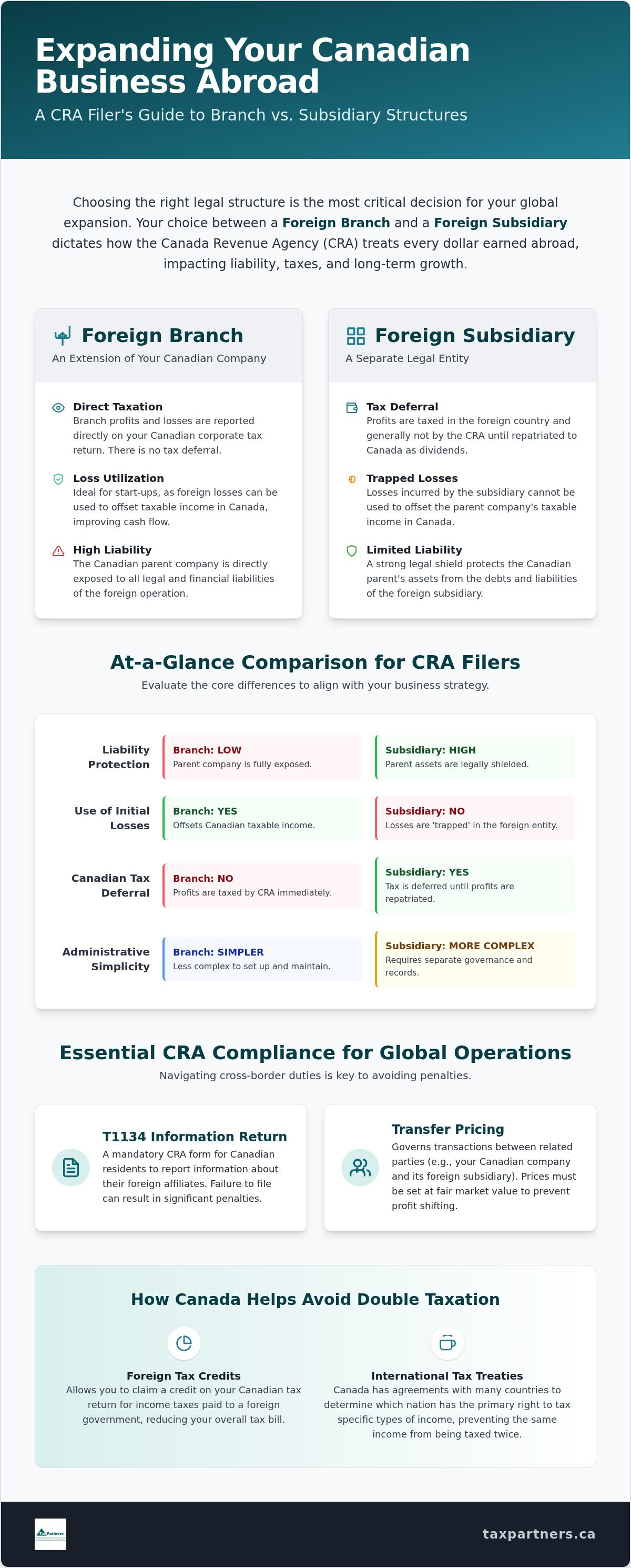
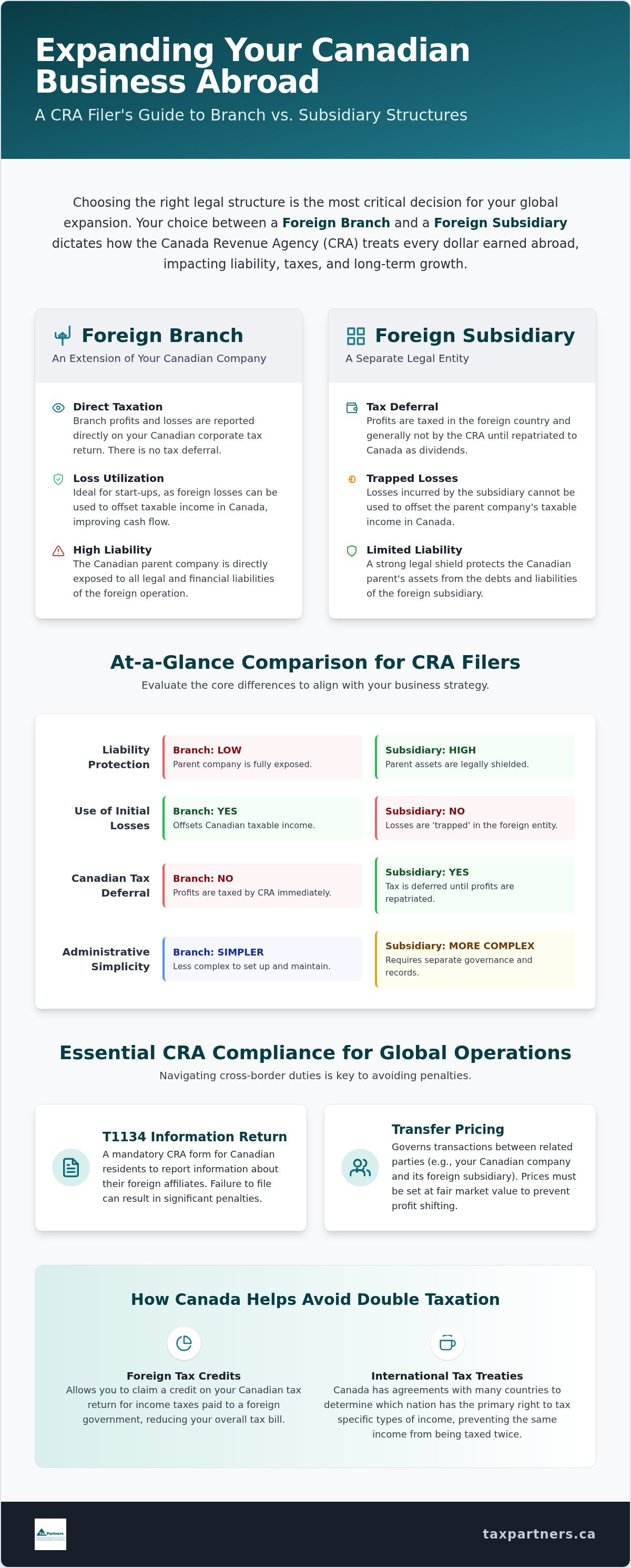
A branch isn't a separate legal person; it's simply an extension of your existing Canadian enterprise. Under CRA International Tax Rules, you report the branch's profits and losses directly on your Canadian corporate tax return. This structure is often preferred during the early stages of expansion because of its simplicity.
Start-up phases often involve significant overhead and initial losses. Operating as a branch allows you to use these foreign start-up losses to offset your taxable income in Canada, providing immediate cash flow relief. However, you must remember that a branch exposes your Canadian parent company to direct foreign legal liabilities and local tax audits.
Utilizing a Foreign Subsidiary for Tax Deferral
A subsidiary is a separate legal entity incorporated under the laws of the host country. This structure offers a layer of protection by siloing liabilities away from your Canadian assets. It also introduces the powerful benefit of tax deferral, which can be a game-changer for your international reinvestment strategy.
For CRA filers, active business income earned by a foreign subsidiary is generally not taxed in Canada until it's paid out as a dividend. To prevent tax avoidance, the CRA applies Foreign Accrual Property Income (FAPI) rules. FAPI is a technical term for passive income, such as interest or rent, earned by a foreign affiliate that the CRA taxes immediately in Canada, even if the money stays abroad.
Moving profits from a subsidiary back to Canada requires careful management of surplus accounts and foreign withholding tax rates. These decisions have a lasting impact on your global cash flow and overall tax efficiency. If you're feeling overwhelmed by these choices, speaking with an international tax specialist can help you find the right fit for your business.
Avoiding Double Taxation with Foreign Tax Credits
Double taxation happens when two nations claim the right to tax the same dollar of profit. This is a common anxiety for owners considering the tax implications of expanding a Canadian business abroad. The CRA provides specific mechanisms to ensure you aren't penalized for your global growth.
Foreign Tax Credits (FTCs) serve as the primary tool for mitigating this financial burden. They allow you to subtract the taxes paid to a foreign government from the amount you owe to the CRA. Properly documenting these payments is essential for a successful claim.
How the CRA Applies Foreign Tax Credits
It's vital to understand that FTCs are generally limited to the amount of Canadian tax that would otherwise be payable on that foreign income. You can't use a high-tax jurisdiction's credit to wipe out your entire Canadian tax bill. The CRA distinguishes between Business Income Tax and Non-Business Income Tax when calculating these credits.
Business Income Tax credits typically relate to profits from an active foreign operation. Non-Business Income Tax credits usually apply to passive revenue like dividends or interest. To secure these credits, you must keep meticulous records of all foreign tax assessments and receipts.
Leveraging Canada’s Global Network of Tax Treaties
Canada maintains one of the world’s most extensive networks of bilateral tax treaties, with approximately 95 agreements currently in force. These treaties provide a structured framework to prevent double taxation and clarify taxing rights between nations. They are a cornerstone of International Tax Advisory Canada.
These agreements often reduce the withholding taxes you pay on dividends, interest, and royalties. For example, treaties can lower the standard 25% withholding rate to significantly smaller percentages. Treaties also provide a formal framework for resolving disputes between the CRA and foreign tax authorities.
Having a steady hand at the helm helps you navigate these complex treaty benefits with precision. We act as your proactive guardian, ensuring you leverage every available treaty provision to protect your bottom line. This strategic alignment turns potential regulatory stress into a clear path for international success.
Managing Cross-Border Compliance and Reporting Duties
Compliance is a conversation with the Canada Revenue Agency (CRA) that goes far beyond simply paying your bills. It involves a rigorous exchange of data regarding your international footprint and financial relationships. Understanding the tax implications of expanding a Canadian business abroad requires you to shift your focus toward these transparency requirements.
The CRA has sharpened its focus on international reporting in recent years to align with global transparency standards. Failing to provide accurate information returns can trigger significant penalties, even if you don't owe a single dollar in tax. Working with a specialist ensures that you meet every deadline under the Income Tax Act with precision and confidence.
Essential CRA Foreign Reporting Forms
CRA filers must navigate a specific set of information returns to document their foreign operations effectively. One of the most critical is the T1134, or the Information Return Relating to Controlled and Non-Controlled Foreign Affiliates. For a corporation with a December 31, 2025, year-end, the filing deadline is generally October 31, 2026, which is 10 months after the fiscal year-end.
Another essential requirement is the T106, which is the Information Return of Non-Arm’s Length Transactions with Non-Residents. This form documents transactions between your Canadian company and related parties abroad, such as a foreign subsidiary. For the same 2025 year-end, the T106 deadline is typically June 30, 2026.
You should also be aware of the T1135 Foreign Income Verification Statement. This form is required for Canadians holding foreign property with a cost exceeding $100,000 at any point during the tax year. Each of these forms represents a vital piece of the compliance puzzle that keeps your business in good standing.
Establishing Defensible Transfer Pricing Strategies
Transfer Pricing is a technical term for the price charged between related parties for goods, services, or intellectual property. The CRA requires these prices to follow the Arm’s Length Principle. This principle dictates that the price must be the same as what two independent, unrelated parties would agree upon in an open market.
To protect yourself during a potential audit, you must maintain contemporaneous documentation. This refers to records prepared at the time of the transaction that justify your pricing choices using verified market data. This proactive approach is a cornerstone of Canadian Corporate Tax Compliance.
Ignoring these documentation requirements can lead to transfer pricing adjustments and harsh financial penalties. We act as your proactive guardian, ensuring your cross-border transactions are defensible, transparent, and fully compliant with the law. If you're concerned about your current reporting status, contact our specialist team today to secure your global operations and gain total peace of mind.
Strategic Global Tax Planning with Tax Partners
Expanding into new territories is a bold move that requires more than just ambition. It demands a steady hand and the type of institutional wisdom that only comes from decades of experience. At Tax Partners, we act as a proactive guardian for your international interests, ensuring your strategy remains sound from day one.
We combine sophisticated tax strategy with an approachable, mentor-like service that prioritizes your peace of mind. Our team has filed over 495,000 returns and saved clients more than $87M. We want to help you keep more of what you earn while staying fully compliant with every CRA requirement.
Customizing Your International Expansion Roadmap
Every industry faces unique challenges when crossing borders. We begin by analyzing your specific target market and industry to identify the most favourable paths forward. This deep dive allows us to uncover the specific tax implications of expanding a Canadian business abroad for your unique situation.
Choosing the right structure is about more than just current profits. We focus on long-term wealth preservation and financial planning to ensure your global success supports your personal and corporate goals. Our Global Accounting & Tax Services provide a bespoke roadmap designed for your specific vision.
Long-Term Compliance for Global Enterprises
Compliance is an ongoing journey that requires constant attention to detail. We provide end-to-end support for bookkeeping, payroll, and complex tax filings across multiple jurisdictions. This comprehensive approach ensures that you never miss a CRA deadline or reporting requirement.
If the CRA initiates an audit or a dispute arises, you don't have to face it alone. We offer specialized expertise in managing CRA audits and mediation to protect your interests. Our steady presence at the helm allows you to focus on growth while we handle the regulatory complexities.
Your global journey deserves a partner who is as invested in your success as you are. We invite you to contact us for a bespoke consultation to discuss your expansion plans. Let us help you navigate the international landscape with confidence and clarity.
Master Your Global Growth Strategy
Expanding your enterprise beyond our borders is a transformative milestone. It requires you to balance international opportunity with the strict reporting requirements of the CRA. By choosing the right legal structure and leveraging Canada's network of tax treaties, you can protect your profits and avoid the heavy burden of double taxation.
Navigating the tax implications of expanding a Canadian business abroad shouldn't be a source of stress. Our GTA-based firm brings over 40 years of Canadian tax expertise and the trust of 1,390+ five-star Google reviews to every client partnership. We act as your proactive guardian, ensuring your global operations remain transparent and fully compliant.
Your ambition deserves a steady hand at the helm to secure your long-term success. Secure your global growth with expert international tax advisory from Tax Partners. We look forward to helping you realize your global potential with confidence and total peace of mind.
Frequently Asked Questions
Do I have to pay Canadian tax on money earned in another country?
Yes, under CRA rules, Canadian corporations are taxed on their worldwide income, meaning you must report profits earned anywhere in the world. However, the system is designed to prevent you from being taxed twice on the same dollar. You can generally claim a foreign tax credit for taxes paid to a foreign government, which reduces your Canadian tax liability. This ensures you aren't unfairly penalized for your global growth.
What is the difference between a foreign branch and a foreign subsidiary for tax purposes?
A branch is considered an extension of your Canadian company, so its profits and losses are reported directly on your Canadian tax return. In contrast, a subsidiary is a separate legal entity incorporated under foreign laws. While a subsidiary offers a layer of legal protection and potential tax deferral on active business income, it also introduces more complex CRA reporting requirements. Choosing between them is a critical part of managing the tax implications of expanding a Canadian business abroad.
What is a tax treaty and how does it help my Canadian business?
A tax treaty is a bilateral agreement between Canada and another nation designed to prevent double taxation and clarify taxing rights. These treaties often reduce the withholding tax rates on payments like dividends, interest, and royalties. For example, a treaty might lower the standard 25% withholding rate to 15% or less for CRA filers. This provides a clear framework for resolving disputes and ensures your international expansion remains cost-effective.
What are the penalties for failing to file CRA foreign reporting forms?
Penalties for failing to file international information returns like the T1134 or T106 can be severe under the Income Tax Act. The CRA may apply daily penalties for late filing, which can quickly accumulate to thousands of dollars per form. In cases of gross negligence or persistent non-compliance, these financial consequences become even more significant. It's essential to meet every federal deadline to protect your business from these avoidable costs.
How does transfer pricing affect my small business expansion?
Transfer pricing refers to the rules governing the prices charged for goods, services, or intellectual property between related parties, such as your Canadian company and its foreign subsidiary. The CRA requires these transactions to follow the Arm’s Length Principle, meaning prices must reflect what independent parties would agree upon. Small businesses must maintain contemporaneous documentation to justify their pricing. This preparation is vital for defending your position during a CRA audit.
Can I use foreign business losses to reduce my Canadian corporate tax?
Yes, you can generally use foreign business losses to reduce your Canadian corporate tax if you operate through a branch structure. Because a branch is an extension of your Canadian corporation, its losses flow directly onto your domestic return to offset other income. If you use a subsidiary, however, those losses are trapped within that separate legal entity and cannot be used to reduce your Canadian tax. This distinction is a major factor in early-stage expansion planning.
What is Foreign Accrual Property Income (FAPI) under CRA rules?
Foreign Accrual Property Income, or FAPI, is a technical term for passive income earned by a foreign affiliate, such as interest, rent, or royalties. Under CRA rules, FAPI is taxed in Canada in the year it's earned, even if the money isn't sent back to Canada. This rule prevents taxpayers from using foreign corporations to defer tax on investment income. Understanding FAPI is essential for accurately assessing the tax implications of expanding a Canadian business abroad.

Article by
Mahad Mohamed
Mahad Mohamed is an accountant and the CEO of Tax Partners, with over 26+ years of Canadian and international tax and accounting experience. His expertise includes corporate reorganization, cross-border tax structuring (Canada & US), tax disputes, CRA audits, and tax planning for small owner-managed private corporations. Most recently, Mahad is a pioneer in Canadian crypto taxation and founded Block3 Finance.
Previously, Mahad worked for the Canada Revenue Agency (CRA), Big4 accounting firms, and served as a Rulings Officer for the Federal Tax Authority of the UAE before acquiring Tax Partners in 2014.
Tax Partners has 44 full-time accountants and over 18,400+ clients.
Disclaimer
This article provides general information only and is current as of its publication date. It has not been updated and may be out of date. It does not constitute legal advice and should not be relied upon as such. Every tax situation is unique and may differ from the examples discussed in this article. If you have specific questions, you should seek the advice of our accountants for your unique circumstances. Book a FREE Initial Consultation Today!
Frequently Asked Questions
Do I have to pay Canadian tax on money earned in another country?
Yes, under CRA rules, Canadian corporations are taxed on their worldwide income, meaning you must report profits earned anywhere in the world. However, the system is designed to prevent you from being taxed twice on the same dollar. You can generally claim a foreign tax credit for taxes paid to a foreign government, which reduces your Canadian tax liability. This ensures you aren't unfairly penalized for your global growth.
What is the difference between a foreign branch and a foreign subsidiary for tax purposes?
A branch is considered an extension of your Canadian company, so its profits and losses are reported directly on your Canadian tax return. In contrast, a subsidiary is a separate legal entity incorporated under foreign laws. While a subsidiary offers a layer of legal protection and potential tax deferral on active business income, it also introduces more complex CRA reporting requirements. Choosing between them is a critical part of managing the tax implications of expanding a Canadian business abroad.
What is a tax treaty and how does it help my Canadian business?
A tax treaty is a bilateral agreement between Canada and another nation designed to prevent double taxation and clarify taxing rights. These treaties often reduce the withholding tax rates on payments like dividends, interest, and royalties. For example, a treaty might lower the standard 25% withholding rate to 15% or less for CRA filers. This provides a clear framework for resolving disputes and ensures your international expansion remains cost-effective.
What are the penalties for failing to file CRA foreign reporting forms?
Penalties for failing to file international information returns like the T1134 or T106 can be severe under the Income Tax Act. The CRA may apply daily penalties for late filing, which can quickly accumulate to thousands of dollars per form. In cases of gross negligence or persistent non-compliance, these financial consequences become even more significant. It's essential to meet every federal deadline to protect your business from these avoidable costs.
How does transfer pricing affect my small business expansion?
Transfer pricing refers to the rules governing the prices charged for goods, services, or intellectual property between related parties, such as your Canadian company and its foreign subsidiary. The CRA requires these transactions to follow the Arm’s Length Principle, meaning prices must reflect what independent parties would agree upon. Small businesses must maintain contemporaneous documentation to justify their pricing. This preparation is vital for defending your position during a CRA audit.
Can I use foreign business losses to reduce my Canadian corporate tax?
Yes, you can generally use foreign business losses to reduce your Canadian corporate tax if you operate through a branch structure. Because a branch is an extension of your Canadian corporation, its losses flow directly onto your domestic return to offset other income. If you use a subsidiary, however, those losses are trapped within that separate legal entity and cannot be used to reduce your Canadian tax. This distinction is a major factor in early-stage expansion planning.
What is Foreign Accrual Property Income (FAPI) under CRA rules?
Foreign Accrual Property Income, or FAPI, is a technical term for passive income earned by a foreign affiliate, such as interest, rent, or royalties. Under CRA rules, FAPI is taxed in Canada in the year it's earned, even if the money isn't sent back to Canada. This rule prevents taxpayers from using foreign corporations to defer tax on investment income. Understanding FAPI is essential for accurately assessing the tax implications of expanding a Canadian business abroad.