T1135 Filing Requirements: A Guide for CRA Filers

You likely recognize that staying on the right side of the CRA is essential for long-term financial stability, yet the definitions and thresholds often remain frustratingly vague. We understand that you want to protect your hard-earned global investments without the constant fear of a costly audit or late-filing fees. Our goal is to provide the steady guidance you need to organize your records and fulfill your obligations with absolute precision.
This guide serves as your roadmap to demystify the reporting process, giving you the clarity needed to handle these regulations with total confidence. You'll learn exactly how the $100,000 cost threshold for CRA filers works, which specific assets you must disclose, and when you can use the simplified reporting method. We provide a practical checklist to ensure your next filing is accurate and your peace of mind is fully restored.
Key Takeaways
- Understand why Form T1135 is a mandatory verification statement for the CRA and how to determine if your specified foreign property meets the $100,000 cost threshold.
- Navigate the T1135 filing requirements Canada by identifying which assets to report, including bank funds, foreign shares, and emerging digital assets like cryptocurrency.
- Learn about critical exclusions such as personal-use vacation homes and assets held within registered accounts like RRSPs or TFSAs to avoid unnecessary reporting.
- Protect your wealth from costly late-filing penalties that can reach $2,500 and understand how the CRA can extend reassessment periods for non-compliance.
- Discover how a methodical approach to valuation and reporting can help you organize your global portfolio while ensuring total compliance with CRA regulations.
Understanding the T1135 Foreign Income Verification Statement
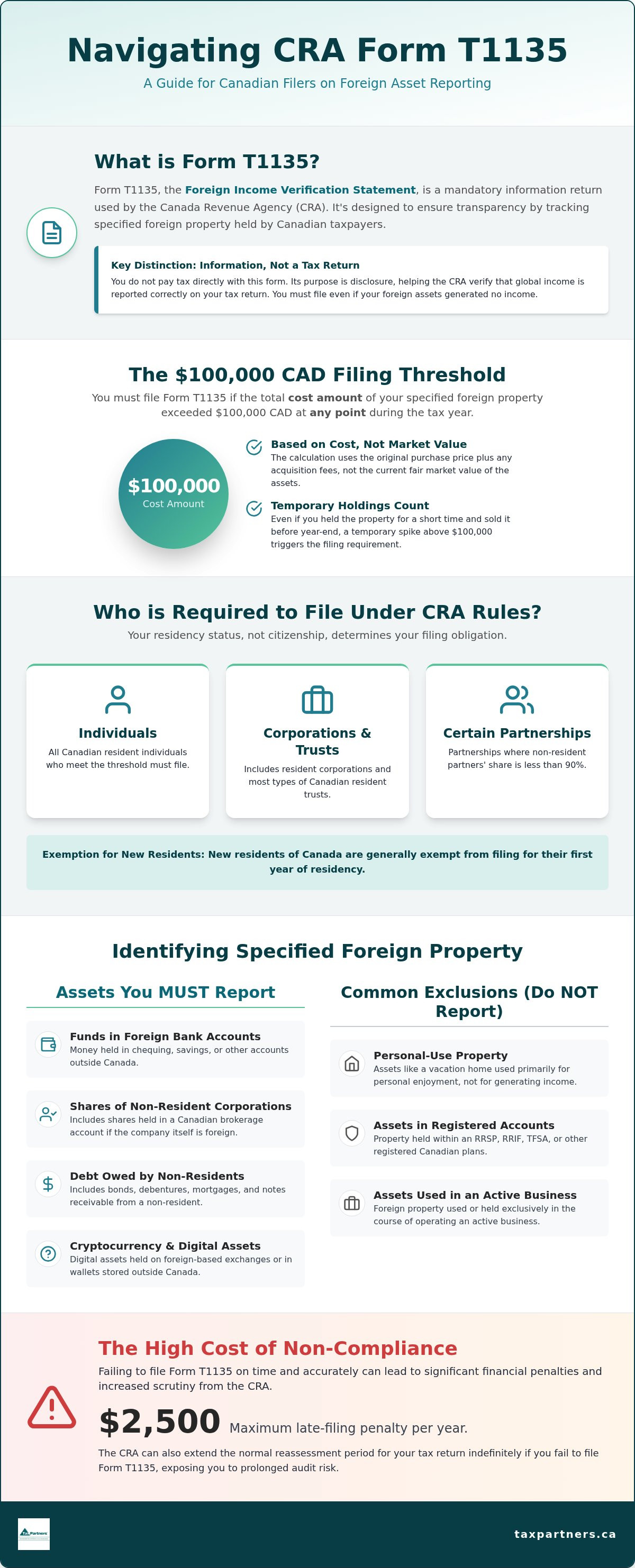
Form T1135, formally known as the Foreign Income Verification Statement, is a critical reporting tool used by the Canada Revenue Agency (CRA). While many filers find the form intimidating, it's essentially a transparency measure designed to provide a clear picture of specified foreign property held by Canadian taxpayers. You should remember that this is an information return, not a tax-owing return; you aren't paying a specific tax on the form itself, but rather disclosing assets to ensure the CRA can verify your global income.
The T1135 filing requirements Canada mandate disclosure even if your assets didn't earn a single cent during the year. If you hold a foreign investment that sits dormant but meets the cost threshold, you're still legally obligated to report it. This proactive disclosure helps prevent misunderstandings and ensures you remain in good standing with federal authorities.
Why the CRA Requires This Disclosure
The CRA uses Form T1135 as a primary weapon against international tax evasion and aggressive tax avoidance. By requiring a detailed account of offshore holdings, the agency can cross-reference reported foreign income with the assets capable of producing that income. This level of oversight is a standard component of Taxation in Canada, reflecting a global shift towards financial transparency. For the taxpayer, maintaining an organized financial trail isn't just about compliance; it's about protecting your wealth and avoiding the stress of an intrusive audit.
Who is Required to File Under CRA Rules?
Determining your obligation starts with your residency status. Under CRA rules, the requirement to file applies to Canadian resident individuals, corporations, and certain trusts. Even certain partnerships must file if the share of the partnership's income belonging to non-resident partners is less than 90 percent. Residency triggers the requirement.
It's a common misconception that citizenship dictates this requirement. In reality, your physical and economic ties to the country, specifically your residency, trigger the need to report. However, the CRA provides a reprieve for those who have just moved here; new residents of Canada generally don't have to file Form T1135 for the first year of their residency. For everyone else, staying informed about global tax obligations is a necessary step in professional wealth management.
The $100,000 Threshold and Specified Foreign Property
The primary trigger for T1135 filing requirements Canada is the total cost amount of your specified foreign property. If this value exceeds $100,000 CAD under CRA rules at any point during the tax year, you must disclose these assets. This requirement in Canada applies even if you sold the property before the year ended, meaning a temporary spike in your foreign holdings can create a filing obligation.
Specified foreign property refers to assets you hold outside Canada that are capable of producing income, such as funds in foreign bank accounts, shares in non-resident corporations, or debt owed by non-residents. Under CRA rules, this term excludes personal-use property, like a vacation home used primarily for enjoyment, or assets used exclusively in an active business. You must be diligent in identifying which of your holdings fall into this category to ensure your reporting is complete.
Under CRA rules, accuracy depends on understanding that the agency looks at the "cost amount" rather than the current fair market value. For most assets in Canada, this is the purchase price you paid, including any commissions or acquisition fees. You can find a detailed breakdown of these definitions in this TurboTax Guide to Foreign Asset Reporting, which helps clarify how the CRA views different asset classes.
Shares of non-resident corporations must be reported under CRA rules even if they're held in a Canadian brokerage account. The CRA determines the location of the property based on the residency of the issuer, not the location of the account holder or the financial institution. This is a common point of confusion for investors who assume Canadian-held accounts are exempt from these disclosure rules.
Cryptocurrency and Digital Assets
The CRA treats cryptocurrency situated outside of Canada as specified foreign property. If your digital assets are held on a foreign-based exchange or in a wallet where the private keys are stored outside the country, they fall under the reporting umbrella in Canada. Seeking cryptocurrency accounting and tax services is often the best way to ensure you don't miss these emerging disclosure requirements under CRA rules.
Calculating the Total Cost Amount
To determine if you've met the threshold under CRA rules, you must aggregate the cost of every foreign property you own. You cannot look at each asset in isolation. If you own $60,000 in foreign stocks and $50,000 in a foreign bank account, your total of $110,000 triggers the filing requirement in Canada.
Currency conversion plays a significant role in this calculation under CRA rules. You must convert the cost of your assets into Canadian dollars using the exchange rate in effect on the date of purchase. Keeping meticulous records of these historical rates is vital for precise reporting in Canada. If you're unsure how to value a complex global portfolio, you can speak with our team to clarify your specific situation.
Exclusions: What You Do Not Need to Report
Understanding what the CRA doesn't require you to disclose is just as vital as knowing what it does. Many filers feel overwhelmed by the thought of listing every global asset, but specific carve-outs exist to simplify your administrative burden. These exceptions prevent over-disclosure and ensure you focus on the assets the agency actually cares about for T1135 filing requirements Canada.
One major exclusion applies to property used exclusively in an active business. If you own inventory, equipment, or real estate that's strictly used to run a business outside the country, it's generally exempt from this form. Similarly, if you hold a significant interest in a foreign corporation, you might need to file Form T1134 for foreign affiliates instead of the T1135.
Personal-Use Property Nuances
The most common exception involves personal-use property, such as a vacation home in Florida or a cottage in Europe. The CRA defines this as property owned by you that's used primarily for personal enjoyment. In most cases, "primarily" means you or your family use the property more than 50% of the time.
You should be careful if you decide to monetize your seasonal getaway. If you rent out your foreign condo for six months of the year and only visit for two weeks, it likely loses its personal-use status. At that point, it transforms into an investment property and must be included in your $100,000 cost calculation to help you realize your full reporting obligations.
Registered Accounts and Pensions
You can find reassurance in the fact that your Canadian registered accounts are protected from this specific disclosure. Assets held within an RRSP, RRIF, or TFSA are exempt from Form T1135 reporting, even if those accounts are full of foreign stocks. The CRA already monitors these tax-sheltered vehicles, so redundant reporting isn't necessary.
Foreign pension plans also generally fall outside the scope of this form. However, the intersection of international retirement funds and Canadian tax law is notoriously complex. To ensure your specific plan qualifies for an exemption and to avoid accidental non-compliance, you should consult a cross-border tax accountant for a professional review of your holdings.
Filing Deadlines and the Cost of Non-Compliance
Under CRA rules, the T1135 filing requirements Canada generally follow your income tax return due date. For most individuals, this means a deadline of April 30, while self-employed filers have until June 15. Corporations must submit their information return within six months of the end of their fiscal period to remain in good standing.
Missing these dates triggers immediate financial consequences under federal regulations. The standard penalty for a late Form T1135 is $25 per day, which accumulates to a maximum of $2,500 per year. If the CRA identifies gross negligence or an intentional failure to report, they may apply even harsher surcharges calculated against the total cost of your foreign assets.
A missed form also leaves your past returns vulnerable to extended scrutiny. The CRA can extend the reassessment period for a specific tax return by an additional three years if you fail to file Form T1135 on time or if the form contains omissions. This means your financial history remains open to audit long after the typical window has closed.
The Voluntary Disclosures Program (VDP)
If you realize you've missed previous years, the VDP offers a path to resolution. This program allows you to fix past filing errors and potentially avoid the full brunt of late-filing penalties. To qualify, your disclosure must be truly voluntary, meaning you must come forward before the CRA contacts you regarding the omission. You can find more details on how to handle these situations in our CRA audit help guide.
Managing Multiple Jurisdictions
Cross-border filers face a unique set of challenges regarding asset disclosure. It's vital to remember that Canadian T1135 rules are entirely separate from US FBAR (Foreign Bank and Financial Accounts) requirements. While both involve disclosing foreign assets, the thresholds, forms, and deadlines operate under different legal frameworks. You must keep your CRA and IRS reporting distinct to ensure total compliance on both sides of the border. For specialized support with these overlapping duties, explore our US and Canada tax information.
If you're concerned about a missed deadline or an incomplete history, contact our compliance specialists today for a confidential review of your global holdings.
How Tax Partners Simplifies Your Foreign Reporting
Tax Partners stands as a steady hand for Canadians managing global wealth. With over 40 years of experience and more than 495,000 returns filed, our firm brings deep-seated reliability to every engagement. We apply a methodical approach to identifying and valuing your specified foreign property, ensuring that your records are beyond reproach.
This precision has helped us save our clients over $87M in potential liabilities and unnecessary penalties. Professional preparation does more than just check a box; it reduces the risk of an intrusive CRA audit and identifies opportunities for greater tax efficiency. We act as proactive guardians of your financial legacy, combining institutional wisdom with a modern outlook on international regulations.
Our commitment to ethical steadfastness means you can realize total compliance without the stress of second-guessing your reporting. We provide a clear path from uncertainty to a state of total control. You deserve a partner who is as invested in your success as you are.
A Proactive Approach to Global Assets
We act as a seasoned mentor, helping you look ahead to secure better outcomes for your long-term financial health. Navigating the T1135 filing requirements Canada is often simpler when your foreign assets are part of an integrated wealth management and tax planning strategy. By looking at your global portfolio as a whole, we help you organize your holdings to minimize administrative friction.
A proactive strategy ensures you aren't just reacting to CRA deadlines but are building a stable financial foundation. Our team provides the foresight needed to manage complex reporting before it becomes a source of anxiety. You can start your journey toward clarity today when you visit our checklist page to prepare for your next filing.
Expert Support for Every Industry
Our team provides specialized support tailored to the unique needs of real estate investors, tech professionals, and cryptocurrency holders. Whether you own a rental property in Europe or hold digital assets on a foreign exchange, we have the expertise to value these holdings accurately. While we're a GTA-based firm, our national reach ensures that filers across Canada receive the same high level of personalized care.
We understand that every client has individual concerns that require a bespoke solution. Our responsiveness and lack of pretension make us an accessible expert you can rely on year after year. If you're ready to move toward total understanding and compliance, contact Tax Partners today to secure your financial future.
Empowering Your Global Financial Future
Mastering the T1135 filing requirements Canada is about more than simply avoiding a $2,500 penalty; it's about establishing a transparent foundation for your international wealth. You now understand that the $100,000 cost threshold applies to the aggregate of your holdings, from foreign bank accounts to emerging digital assets. By identifying key exclusions like personal-use property and registered accounts, you can streamline your reporting while staying fully compliant with the CRA.
Our team brings over 40 years of institutional wisdom to every filing, acting as proactive guardians for your cross-border interests. As GTA-based experts with national reach, we specialize in transforming complex regulatory burdens into clear, manageable strategies. We prioritize the stability of your long-term partnerships and the absolute precision of your financial records.
With 1,390+ five-star Google reviews, we're proud to be the trusted choice for Canadians seeking both professional authority and approachable warmth. Secure your global assets with expert CRA tax planning at Tax Partners. You've worked hard to build your global portfolio, and we're here to help you protect it with total confidence and ease.
Frequently Asked Questions
Is a foreign vacation home considered specified foreign property?
A foreign vacation home is generally not considered specified foreign property under CRA rules if you use it primarily for personal enjoyment. This means you or your family must use the property more than 50 percent of the time. If the property becomes a dedicated income-producing asset, it may then trigger T1135 filing requirements Canada. You should track your usage days carefully to ensure you maintain this personal-use status throughout the tax year.
Do I need to report US stocks held in my Canadian trading account?
Yes, you must report US stocks even if they're held in a Canadian brokerage account because the underlying asset is a non-resident corporation. The CRA looks at the residency of the issuer rather than the location of the financial institution holding the shares. If the total cost of these foreign shares and other specified property exceeds $100,000 CAD, they must be included on your information return to ensure full compliance.
What is the penalty for filing Form T1135 late in Canada?
The standard penalty for filing Form T1135 late under CRA regulations is $25 for each day the return is overdue. This penalty can reach a maximum of $2,500 per year for each missed filing. If the agency determines that you've intentionally failed to file or acted with gross negligence, significantly higher penalties can apply. Staying mindful of deadlines is the best way to protect your financial interests from these avoidable costs.
How does the CRA define the 'cost amount' for foreign investments?
The CRA defines the cost amount as the price you paid for the property, converted into Canadian dollars using the exchange rate on the purchase date. This is often referred to as the adjusted cost base. It includes the original purchase price plus any expenses incurred to acquire the asset, such as brokerage fees or legal costs. It's vital to remember that the cost amount remains static regardless of whether the fair market value increases.
Do I have to file a T1135 if my foreign assets are worth less than $100,000?
No, you're not required to file Form T1135 if the total cost of your specified foreign property remained below $100,000 CAD throughout the entire year. This threshold is based on the cost amount, not the current fair market value. However, if your assets cost $90,000 but you purchased an additional $15,000 worth of foreign stocks in June, you've met the T1135 filing requirements Canada and must disclose your holdings.
Can I file Form T1135 electronically for previous tax years?
Yes, the CRA allows individuals and corporations to file Form T1135 electronically for the current year and several previous tax years. Using EFILE or NETFILE is often the most efficient way to ensure your information is received and processed quickly. If you're catching up on multiple years, electronic submission helps create a clear digital trail of your compliance efforts. You should verify the specific back-year limits directly with the CRA or a professional.
Is cryptocurrency included in the T1135 reporting requirements?
Cryptocurrency is included in your reporting obligations under CRA rules if it's situated outside of Canada and meets the cost threshold. The agency views digital assets held on foreign exchanges or in wallets with offshore private keys as specified foreign property. Because the location of decentralized assets is complex to determine, you should maintain detailed records of where your crypto is stored. This ensures you can accurately calculate your total global cost amount each year.
What should I do if I realized I missed a T1135 filing from a previous year?
You should consider applying through the CRA Voluntary Disclosures Program (VDP) to correct the omission before the agency contacts you. Coming forward voluntarily can often lead to the waiver of late-filing penalties and interest. It's a proactive way to fix past errors and secure your standing with federal authorities. You should consult with a specialist to ensure your disclosure meets all the specific requirements for a successful VDP application.

Article by
Mahad Mohamed
Mahad Mohamed is an accountant and the CEO of Tax Partners, with over 26+ years of Canadian and international tax and accounting experience. His expertise includes corporate reorganization, cross-border tax structuring (Canada & US), tax disputes, CRA audits, and tax planning for small owner-managed private corporations. Most recently, Mahad is a pioneer in Canadian crypto taxation and founded Block3 Finance.
Previously, Mahad worked for the Canada Revenue Agency (CRA), Big4 accounting firms, and served as a Rulings Officer for the Federal Tax Authority of the UAE before acquiring Tax Partners in 2014.
Tax Partners has 44 full-time accountants and over 18,400+ clients.
Disclaimer
This article provides general information only and is current as of its publication date. It has not been updated and may be out of date. It does not constitute legal advice and should not be relied upon as such. Every tax situation is unique and may differ from the examples discussed in this article. If you have specific questions, you should seek the advice of our accountants for your unique circumstances. Book a FREE Initial Consultation Today!
Frequently Asked Questions
Who is Required to File Under CRA Rules?
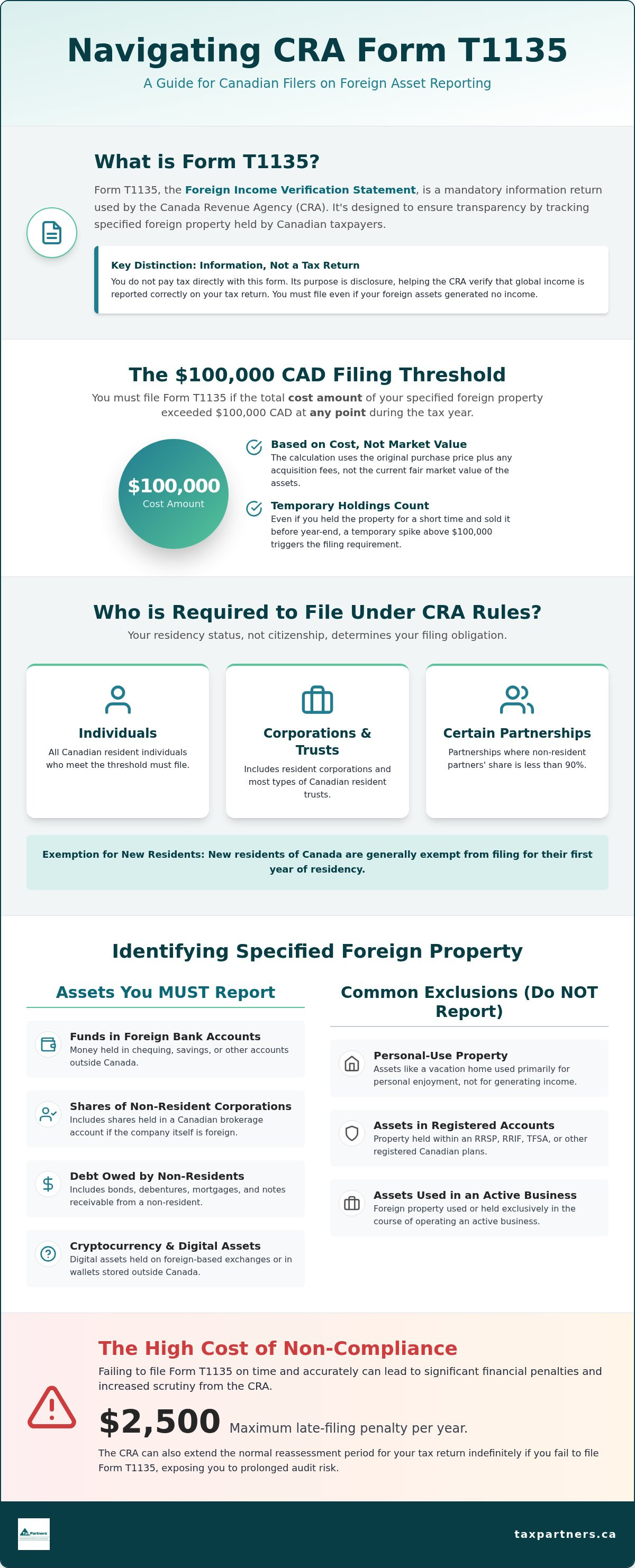
Determining your obligation starts with your residency status. Under CRA rules, the requirement to file applies to Canadian resident individuals, corporations, and certain trusts. Even certain partnerships must file if the share of the partnership's income belonging to non-resident partners is less than 90 percent. Residency triggers the requirement. It's a common misconception that citizenship dictates this requirement. In reality, your physical and economic ties to the country, specifically your residency, trigger the need to report. However, the CRA provides a reprieve for those who have just moved here; new residents of Canada generally don't have to file Form T1135 for the first year of their residency. For everyone else, staying informed about global tax obligations is a necessary step in professional wealth management. The primary trigger for T1135 filing requirements Canada is the total cost amount of your specified foreign property. If this value exceeds $100,000 CAD under CRA rules at any point during the tax year, you must disclose these assets. This requirement in Canada applies even if you sold the property before the year ended, meaning a temporary spike in your foreign holdings can create a filing obligation. Specified foreign property refers to assets you hold outside Canada that are capable of producing income, such as funds in foreign bank accounts, shares in non-resident corporations, or debt owed by non-residents. Under CRA rules, this term excludes personal-use property, like a vacation home used primarily for enjoyment, or assets used exclusively in an active business. You must be diligent in identifying which of your holdings fall into this category to ensure your reporting is complete. Under CRA rules, accuracy depends on understanding that the agency looks at the "cost amount" rather than the current fair market value. For most assets in Canada, this is the purchase price you paid, including any commissions or acquisition fees. You can find a detailed breakdown of these definitions in this TurboTax Guide to Foreign Asset Reporting, which helps clarify how the CRA views different asset classes. Shares of non-resident corporations must be reported under CRA rules even if they're held in a Canadian brokerage account. The CRA determines the location of the property based on the residency of the issuer, not the location of the account holder or the financial institution. This is a common point of confusion for investors who assume Canadian-held accounts are exempt from these disclosure rules.
Is a foreign vacation home considered specified foreign property?
A foreign vacation home is generally not considered specified foreign property under CRA rules if you use it primarily for personal enjoyment. This means you or your family must use the property more than 50 percent of the time. If the property becomes a dedicated income-producing asset, it may then trigger T1135 filing requirements Canada. You should track your usage days carefully to ensure you maintain this personal-use status throughout the tax year.
Do I need to report US stocks held in my Canadian trading account?
Yes, you must report US stocks even if they're held in a Canadian brokerage account because the underlying asset is a non-resident corporation. The CRA looks at the residency of the issuer rather than the location of the financial institution holding the shares. If the total cost of these foreign shares and other specified property exceeds $100,000 CAD, they must be included on your information return to ensure full compliance.
What is the penalty for filing Form T1135 late in Canada?
The standard penalty for filing Form T1135 late under CRA regulations is $25 for each day the return is overdue. This penalty can reach a maximum of $2,500 per year for each missed filing. If the agency determines that you've intentionally failed to file or acted with gross negligence, significantly higher penalties can apply. Staying mindful of deadlines is the best way to protect your financial interests from these avoidable costs.
How does the CRA define the 'cost amount' for foreign investments?
The CRA defines the cost amount as the price you paid for the property, converted into Canadian dollars using the exchange rate on the purchase date. This is often referred to as the adjusted cost base. It includes the original purchase price plus any expenses incurred to acquire the asset, such as brokerage fees or legal costs. It's vital to remember that the cost amount remains static regardless of whether the fair market value increases.
Do I have to file a T1135 if my foreign assets are worth less than $100,000?
No, you're not required to file Form T1135 if the total cost of your specified foreign property remained below $100,000 CAD throughout the entire year. This threshold is based on the cost amount, not the current fair market value. However, if your assets cost $90,000 but you purchased an additional $15,000 worth of foreign stocks in June, you've met the T1135 filing requirements Canada and must disclose your holdings.
Can I file Form T1135 electronically for previous tax years?
Yes, the CRA allows individuals and corporations to file Form T1135 electronically for the current year and several previous tax years. Using EFILE or NETFILE is often the most efficient way to ensure your information is received and processed quickly. If you're catching up on multiple years, electronic submission helps create a clear digital trail of your compliance efforts. You should verify the specific back-year limits directly with the CRA or a professional.
Is cryptocurrency included in the T1135 reporting requirements?
Cryptocurrency is included in your reporting obligations under CRA rules if it's situated outside of Canada and meets the cost threshold. The agency views digital assets held on foreign exchanges or in wallets with offshore private keys as specified foreign property. Because the location of decentralized assets is complex to determine, you should maintain detailed records of where your crypto is stored. This ensures you can accurately calculate your total global cost amount each year.
What should I do if I realized I missed a T1135 filing from a previous year?
You should consider applying through the CRA Voluntary Disclosures Program (VDP) to correct the omission before the agency contacts you. Coming forward voluntarily can often lead to the waiver of late-filing penalties and interest. It's a proactive way to fix past errors and secure your standing with federal authorities. You should consult with a specialist to ensure your disclosure meets all the specific requirements for a successful VDP application.