Roth IRA in Canada: A Cross-Border Guide for CRA Filers

What if the tax-exempt status you spent years building in your US Roth IRA vanished the moment you crossed the border? It's a valid concern for many expats who worry about being taxed twice on the same income. The intersection of IRS rules and CRA requirements often feels like a high-stakes puzzle where one wrong move could cost you your savings.
We understand the stress that comes with managing a roth ira canada while trying to remain fully compliant with the CRA. You've worked hard to secure your financial future, and you deserve to see that wealth grow without unnecessary interference from tax authorities. Our goal is to provide the clarity you need to move forward with confidence.
This guide explains how to protect your assets by filing a one-time Treaty election to defer Canadian tax. You'll learn the vital differences between a Roth IRA and a TFSA, and how to avoid "contaminating" your account under CRA rules. We'll provide a clear roadmap to maintain your tax-free growth and achieve total control over your cross-border retirement plan.
Key Takeaways
- Learn how to file the one-time, irrevocable Treaty election with the CRA to maintain the tax-deferred growth of your US retirement assets while living in Canada.
- Understand the specific risks of "contaminating" your account by making contributions after becoming a Canadian resident, which may lead to annual taxation under CRA rules.
- Compare the 2026 contribution limits and tax treatments for a roth ira canada under IRS rules versus a TFSA for CRA filers.
- Discover how to integrate your US and Canadian tax filings to achieve full cross-border compliance and realize your long-term wealth preservation goals.
Understanding the Roth IRA from a Canadian Perspective
Moving across the border doesn't automatically mean your retirement savings keep their tax-free status. For those managing a roth ira canada, the transition requires a shift in how you view your assets. While the IRS treats these accounts as tax-exempt vehicles, the CRA views them through a different lens. You must understand these distinct jurisdictional rules to protect your wealth from unexpected tax liabilities.
The US tax-exempt status does not automatically apply once you become a resident of Canada for tax purposes. Without a proactive strategy, the growth within your account could become subject to annual Canadian taxation. Success depends on recognizing your account's legal standing under international agreements.
What is a Roth IRA under IRS Rules?
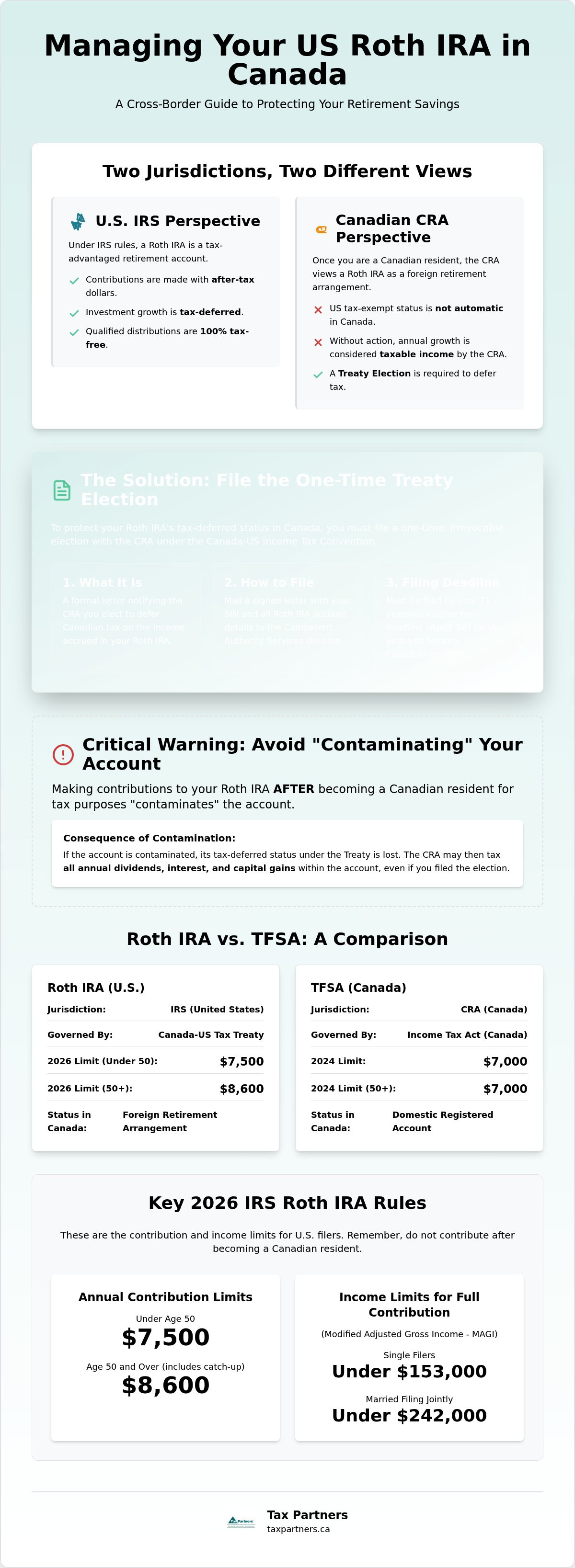
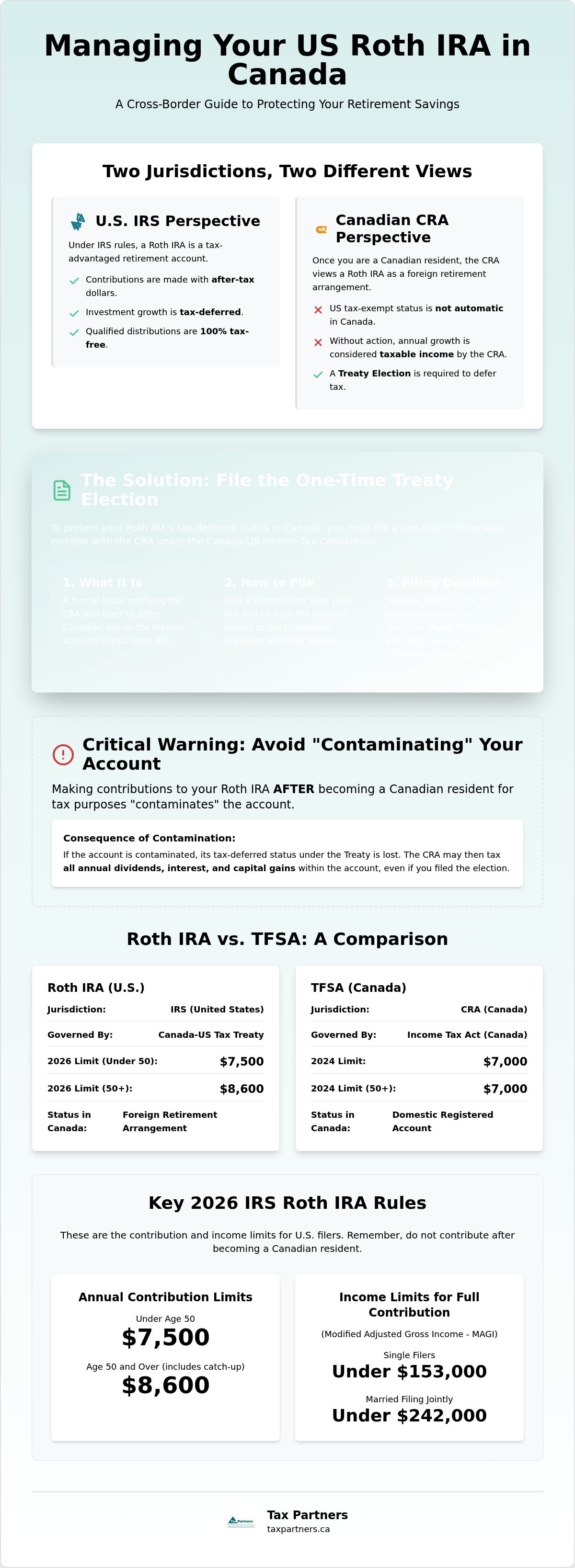
Under IRS rules, a Roth IRA is a retirement savings account where you contribute after-tax dollars. This means you don't receive a tax deduction at the time of contribution. However, your investments grow tax-deferred within the account.
For IRS filers, qualified distributions are entirely tax-free once you meet specific age and holding period requirements. The IRS has established clear parameters for the 2026 tax year regarding who can contribute:
- The annual contribution limit under IRS rules is $7,500 for individuals under age 50.
- Those aged 50 and over may contribute up to $8,600, which includes a catch-up provision.
- Income limits apply; for 2026, single filers must have a Modified Adjusted Gross Income (MAGI) under $153,000 to make a full contribution.
- For married couples filing jointly, the MAGI threshold for a full contribution is $242,000.
How the CRA Views Foreign Retirement Accounts
The CRA generally taxes Canadian residents on their worldwide income from all sources. Unlike a Canadian Registered Retirement Savings Plan (RRSP), which is a domestic product, a Roth IRA is classified as a foreign retirement arrangement. This distinction is critical for your tax filing in Canada.
The Canada-US Income Tax Convention serves as the governing document for cross-border taxation. Under this Treaty, a Roth IRA is recognized as a "pension" rather than a standard savings account. This classification is the key to maintaining your tax-free status, provided you follow specific notification procedures.
Many people mistakenly assume a Roth IRA is identical to a Canadian Tax-Free Savings Account (TFSA). While they share some characteristics, the legal framework for a Roth IRA is rooted in its status as a pension under the Treaty. Failing to treat it as such can lead to the CRA taxing the internal growth of the account every year.
Navigating the Canada-US Tax Treaty Election
For CRA filers, the Treaty Election is a mandatory protective measure that preserves the tax-deferred status of your US retirement assets while living in Canada. This process isn't automatic. You must explicitly notify the CRA's Competent Authority Services Division to ensure your roth ira canada remains recognized as a pension under the Canada-US Income Tax Convention.
Silence is often interpreted as a waiver of your rights under the Treaty. By taking this proactive step, you prevent the CRA from taxing the annual growth within your account. It's a critical move for anyone looking to maintain the long-term benefits of their US savings while residing in Canada.
The One-Time Election for CRA Filers
Drafting the election letter requires precision and attention to detail. You must include your name, Social Insurance Number, and a clear statement electing to defer tax on the income accrued in your Roth IRA. It's also necessary to identify every specific Roth IRA account you hold, including the account number and the fair market value at the time you became a resident of Canada.
Adhering to the CRA's official stance on Roth IRA taxation is the only way to safeguard your future distributions. This election must be filed by your Canadian T1 personal income tax filing due date for the year you become a resident. For most individuals, this deadline is April 30.
Currently, the CRA requires this letter to be mailed to the Competent Authority Services Division. Digital filing options are not yet available for this specific procedure. Physical documentation and proof of mailing are essential for your records.
Consequences of Not Filing the Treaty Election
If you fail to file the election, the CRA may treat all annual dividends, interest, and capital gains within the Roth IRA as taxable income. This oversight can lead to a significant tax bill and the loss of the tax-exempt status for future distributions in Canada. You don't want to turn a tax-free asset into a recurring tax liability.
Late-filed elections are possible but never guaranteed. The CRA's Competent Authority holds discretionary power to accept or reject late requests based on your specific circumstances. Proactive planning is your best defence against these compliance traps.
If you are unsure about the status of your accounts or the timing of your filing, it's wise to speak with a cross-border specialist to ensure your paperwork is in order. We can help you navigate these requirements to protect your wealth.
Roth IRA vs. TFSA: Comparing the Two Jurisdictions
Many expats view the Tax-Free Savings Account (TFSA) as the natural northern counterpart to the US Roth IRA. While they share a common goal of tax-free growth, they operate under entirely different legal frameworks. Understanding these distinctions is vital for managing a roth ira canada without triggering unintended tax consequences from either the IRS or the CRA.
Under IRS rules, the 2026 annual contribution limit for a Roth IRA is $7,500 for individuals under age 50, or $8,600 for those aged 50 and over. Conversely, the 2026 annual contribution limit for a TFSA for CRA filers is $7,000. These limits are set independently by each government and do not overlap or offset one another.
Tax treatment of withdrawals also varies by jurisdiction. For IRS filers, distributions from a Roth IRA are tax-free if they are "qualified," meaning the account holder is at least 59.5 years old and has held the account for five years. For CRA filers, TFSA withdrawals are generally tax-free at any age, but the IRS does not recognize this tax-exempt status for US citizens living in Canada.
Key Similarities in Tax Treatment
Despite their jurisdictional differences, both accounts share a foundational structure that benefits long-term savers. They both require contributions to be made with after-tax dollars, meaning you don't get a tax deduction upfront. However, the subsequent growth remains sheltered within the account.
- Both accounts allow for a wide range of investment options, including stocks, bonds, and mutual funds.
- The primary benefit for both IRS and CRA purposes is the ability to compound wealth without annual taxation on dividends or capital gains.
- Both vehicles offer flexibility, though the rules for accessing those funds differ significantly between the US and Canada.
Why a Roth IRA is Not a TFSA Replacement
It's a common misconception that you can perform a tax-free rollover from a Roth IRA to a TFSA. In reality, no such mechanism exists under the Canada-US Tax Treaty. Moving funds between these accounts would typically be treated as a taxable distribution by the IRS and a new contribution by the CRA.
For US citizens residing in Canada, a TFSA can actually create a reporting burden. The IRS does not recognize the TFSA as a pension, so its earnings are generally taxable on a US return. Additionally, while a Roth IRA held with a US custodian is usually exempt from FBAR reporting, a TFSA is considered a foreign account and must be reported to FinCEN if thresholds are met.
You must also realize that you cannot contribute to a Roth IRA while residing in Canada without risking your Treaty protections. As we will explore in the next section, making a contribution as a Canadian resident can "taint" the account and void its tax-exempt status for the CRA.
Compliance Risks for Canadian Residents with US Accounts
Maintaining a roth ira canada requires strict adherence to contribution rules to avoid severe tax penalties. Even if you have eligible earned income under IRS rules, making a contribution while residing in Canada creates a significant compliance trap with the CRA. You must be vigilant to ensure your actions don't inadvertently void your hard-earned tax protections.
The CRA views any contribution made after you become a Canadian resident as a "prohibited contribution." This action "taints" the account, potentially stripping away the tax-sheltered status you worked hard to build. Once a Roth IRA is tainted, it may lose its Treaty protection forever.
The Prohibited Contribution Rule for CRA Filers
Under the Canada-US Tax Treaty, a prohibited contribution is generally any amount added to the account while you are a tax resident of Canada. This excludes certain rollovers from other US retirement plans, but standard annual contributions are strictly forbidden. You should verify your residency status before making any changes to your US accounts.
When a prohibited contribution occurs, the CRA divides the account into a "Treaty Portion" and a "Non-Treaty Portion." The Treaty Portion consists of the balance before you moved, while the Non-Treaty Portion includes the new contributions and all subsequent earnings. This split creates a permanent accounting burden for the taxpayer.
You will then owe Canadian tax on the income and gains generated by that Non-Treaty Portion every year. To avoid this, you should consider directing US-source income into taxable brokerage accounts or other vehicles that don't jeopardize your existing retirement structures. Precision in your financial planning is the best way to prevent these complications.
Reporting Foreign Assets to the CRA
Beyond contribution rules, you must remain diligent about Understanding Foreign Asset Reporting requirements. CRA filers must submit Form T1135, the Foreign Income Verification Statement, if the total cost of all specified foreign property exceeds $100,000 CAD at any time in the year. This is a common requirement for expats with significant US holdings.
While the Roth IRA itself is often exempt from T1135 reporting if it's considered a pension, other US assets like bank accounts or rental properties are not. For CRA filers, the penalty for failing to file this form is $25 per day, up to a maximum of $2,500 per year. These costs can add up quickly if you overlook your filing obligations.
Coordinating these filings with your US FBAR requirements is essential for total compliance. While the IRS and CRA have different thresholds and deadlines, your reporting must be consistent across both jurisdictions to avoid red flags. Accurate record-keeping is your strongest defence against an audit.
Managing these overlapping requirements can feel overwhelming, but you don't have to do it alone. If you're concerned about your account status, reach out to our cross-border team for a comprehensive compliance review.
Strategic Cross-Border Planning with Tax Partners
Managing a roth ira canada involves more than just filling out forms once a year. It requires a holistic view of your financial life across two distinct tax systems. We act as your proactive guardian, ensuring that your US retirement assets remain protected while you build your life in Canada. Our firm provides the steady hand you need to navigate these overlapping requirements with confidence.
A unified approach to US and Canadian tax filing is the only way to avoid the risk of double taxation. By looking at your total financial picture, we help you realize your long-term wealth preservation goals. Our Cross-Border Tax Services are designed to provide a seamless experience for dual citizens and expats who value precision and ethical steadfastness.
With over 40 years of cross-border tax experience, we understand the nuances of both IRS and CRA regulations. We don't just react to requirements; we look ahead to secure better outcomes for our clients. This proactive stance is essential for maintaining the tax-exempt status of your US assets in a shifting regulatory environment.
Comprehensive US and Canadian Tax Filings
Our methodical process involves preparing both the US 1040 and Canadian T1 returns simultaneously. This coordination ensures that foreign tax credits are applied correctly and that all necessary Treaty elections are filed with the CRA. We prioritize accuracy to protect your assets from unnecessary scrutiny or penalties. If you're a Canadian resident with US source income, you might also benefit from our guide on 1040-NR Filing for Canadians.
Handling both filings under one roof eliminates the risk of conflicting information being sent to the IRS and CRA. We ensure that every rule, from US reporting deadlines to Canadian residency thresholds, is strictly followed. This integrated service provides a sense of total control and understanding for our clients.
Strategic Wealth Management for Dual Residents
Cross-border financial success requires more than just annual filing. We integrate estate planning with specific tax considerations to ensure your legacy remains intact in both jurisdictions. Our team provides customized strategies for dual citizens to protect their global wealth while staying fully compliant. You can find more detail in our resource on Tax-Efficient Wealth Management for CRA Filers.
We proactively monitor legislative changes in both the IRS and CRA jurisdictions to keep your plan current. As we move through the 2026 tax year, staying ahead of new reporting requirements is vital for your peace of mind. Our role is to be your seasoned mentor, providing the institutional wisdom needed to secure your financial future.
Secure Your Cross-Border Legacy
Managing your roth ira canada requires more than just awareness of the rules; it demands active protection through the Canada-US Tax Treaty. By filing your one-time election and avoiding prohibited contributions, you preserve the tax-free growth of your hard-earned assets. You've worked hard for your retirement savings, and maintaining their tax-exempt status in both jurisdictions is essential for your peace of mind.
Our firm acts as a proactive guardian for your wealth, monitoring legislative shifts to keep your strategy current. With over 495,000 returns filed and 1,390+ five-star Google reviews, our team provides the specialized US-Canada tax expertise you need to avoid compliance traps. We invite you to secure your cross-border future with a professional tax consultation from Tax Partners.
You don't have to navigate these complex regulatory waters alone. We are here to provide the steady hand and institutional wisdom required to protect your financial legacy for years to come. Let's work together to ensure your wealth is preserved across every border.
Frequently Asked Questions
Can a Canadian resident open a Roth IRA?
Under IRS rules, you must have US earned income to contribute to a Roth IRA. While a Canadian resident could theoretically open one if they work in the United States, doing so often triggers negative consequences for CRA filers. Making contributions while residing in Canada can "taint" the account, leading to the loss of its tax-exempt status under the Canada-US Tax Treaty.
What happens to my Roth IRA if I move from the US to Canada?
Your account remains a valid US retirement vehicle under IRS rules, but its tax status in Canada changes once you become a resident. To maintain tax-free growth for CRA filers, you must file a one-time, irrevocable election with the CRA's Competent Authority. Without this notification, the CRA may tax the annual earnings within your roth ira canada as they accrue every year.
Is a Roth IRA considered a foreign specified asset for Form T1135?
For CRA filers, a Roth IRA is generally considered a pension and is typically excluded from Form T1135 reporting. However, this exclusion only applies if the account maintains its status as a retirement vehicle under the Canada-US Tax Treaty. If you have other foreign assets exceeding $100,000 CAD, you must still file this form to remain compliant with Canadian reporting regulations.
Do I have to pay Canadian tax on Roth IRA dividends?
You won't pay Canadian tax on dividends if you've filed the required Treaty election and haven't made any "prohibited contributions" since moving. This election allows for the deferral of tax on earnings until you take a distribution. If you fail to file this notification, the CRA may treat dividends and other annual growth as taxable income on your Canadian T1 return.
Can I contribute to my Roth IRA using Canadian employment income?
You shouldn't use Canadian employment income to contribute to your account. Under IRS rules, eligibility is based on having US compensation; furthermore, the CRA views any contribution made while you are a Canadian resident as a prohibited action. This will "taint" the account, causing it to lose its tax-exempt status for CRA purposes and making all future growth taxable in Canada.
How do I file the Roth IRA election with the CRA?
There is no specific form for this process; instead, you must send a physical letter to the CRA's Competent Authority Services Division. This letter must include your Social Insurance Number and specific details about every Roth IRA you hold, including the fair market value. You must file this election by your T1 filing deadline for the year you become a resident of Canada.
Is the TFSA recognized by the IRS as a retirement account?
Under IRS rules, the Tax-Free Savings Account (TFSA) is not recognized as a pension or retirement plan. This means that for US citizens or green card holders in Canada, the income earned within a TFSA is generally taxable on a US tax return. This mismatch often leads to complex tax issues that require careful cross-border planning to resolve effectively and legally.
What is the penalty for not reporting a Roth IRA to the CRA?
The primary penalty for not filing the Treaty election is the annual taxation of the account's internal growth by the CRA. If the account is deemed a specified foreign property and you fail to file Form T1135 when required, the penalty is $25 per day, up to a maximum of $2,500 per year. These costs can be substantial, making proactive compliance essential for all cross-border savers.

Article by
Mahad Mohamed
Mahad Mohamed is an accountant and the CEO of Tax Partners, with over 26+ years of Canadian and international tax and accounting experience. His expertise includes corporate reorganization, cross-border tax structuring (Canada & US), tax disputes, CRA audits, and tax planning for small owner-managed private corporations. Most recently, Mahad is a pioneer in Canadian crypto taxation and founded Block3 Finance.
Previously, Mahad worked for the Canada Revenue Agency (CRA), Big4 accounting firms, and served as a Rulings Officer for the Federal Tax Authority of the UAE before acquiring Tax Partners in 2014.
Tax Partners has 44 full-time accountants and over 18,400+ clients.
Disclaimer
This article provides general information only and is current as of its publication date. It has not been updated and may be out of date. It does not constitute legal advice and should not be relied upon as such. Every tax situation is unique and may differ from the examples discussed in this article. If you have specific questions, you should seek the advice of our accountants for your unique circumstances. Book a FREE Initial Consultation Today!
Frequently Asked Questions
What is a Roth IRA under IRS Rules?
Under IRS rules, a Roth IRA is a retirement savings account where you contribute after-tax dollars. This means you don't receive a tax deduction at the time of contribution. However, your investments grow tax-deferred within the account. For IRS filers, qualified distributions are entirely tax-free once you meet specific age and holding period requirements. The IRS has established clear parameters for the 2026 tax year regarding who can contribute:
Can a Canadian resident open a Roth IRA?
Under IRS rules, you must have US earned income to contribute to a Roth IRA. While a Canadian resident could theoretically open one if they work in the United States, doing so often triggers negative consequences for CRA filers. Making contributions while residing in Canada can "taint" the account, leading to the loss of its tax-exempt status under the Canada-US Tax Treaty.
What happens to my Roth IRA if I move from the US to Canada?
Your account remains a valid US retirement vehicle under IRS rules, but its tax status in Canada changes once you become a resident. To maintain tax-free growth for CRA filers, you must file a one-time, irrevocable election with the CRA's Competent Authority. Without this notification, the CRA may tax the annual earnings within your roth ira canada as they accrue every year.
Is a Roth IRA considered a foreign specified asset for Form T1135?
For CRA filers, a Roth IRA is generally considered a pension and is typically excluded from Form T1135 reporting. However, this exclusion only applies if the account maintains its status as a retirement vehicle under the Canada-US Tax Treaty. If you have other foreign assets exceeding $100,000 CAD, you must still file this form to remain compliant with Canadian reporting regulations.
Do I have to pay Canadian tax on Roth IRA dividends?
You won't pay Canadian tax on dividends if you've filed the required Treaty election and haven't made any "prohibited contributions" since moving. This election allows for the deferral of tax on earnings until you take a distribution. If you fail to file this notification, the CRA may treat dividends and other annual growth as taxable income on your Canadian T1 return.
Can I contribute to my Roth IRA using Canadian employment income?
You shouldn't use Canadian employment income to contribute to your account. Under IRS rules, eligibility is based on having US compensation; furthermore, the CRA views any contribution made while you are a Canadian resident as a prohibited action. This will "taint" the account, causing it to lose its tax-exempt status for CRA purposes and making all future growth taxable in Canada.
How do I file the Roth IRA election with the CRA?
There is no specific form for this process; instead, you must send a physical letter to the CRA's Competent Authority Services Division. This letter must include your Social Insurance Number and specific details about every Roth IRA you hold, including the fair market value. You must file this election by your T1 filing deadline for the year you become a resident of Canada.
Is the TFSA recognized by the IRS as a retirement account?
Under IRS rules, the Tax-Free Savings Account (TFSA) is not recognized as a pension or retirement plan. This means that for US citizens or green card holders in Canada, the income earned within a TFSA is generally taxable on a US tax return. This mismatch often leads to complex tax issues that require careful cross-border planning to resolve effectively and legally.
What is the penalty for not reporting a Roth IRA to the CRA?
The primary penalty for not filing the Treaty election is the annual taxation of the account's internal growth by the CRA. If the account is deemed a specified foreign property and you fail to file Form T1135 when required, the penalty is $25 per day, up to a maximum of $2,500 per year. These costs can be substantial, making proactive compliance essential for all cross-border savers.