ITIN Application in Canada: A 2026 Guide to IRS Compliance

Would you trust the international mail system with your only valid passport for eleven weeks just to satisfy a tax requirement? For many, the ITIN application Canada process feels like a high-stakes gamble with their most essential identification.
We understand the deep-seated anxiety that comes with managing cross-border tax obligations under IRS rules. It's genuinely stressful to worry about minor clerical errors on a Form W-7 while your passport sits in a processing centre in Texas.
This guide provides a reliable path forward. You'll learn how to satisfy every United States regulatory hurdle while keeping your original documents safely in your own hands. Our goal is to replace your uncertainty with a sense of total control and foresight.
We'll examine the specific requirements for 2026 and clarify the differences between the US ITIN and the Canadian ITN. You'll also see how to leverage the US-Canada tax treaty to ensure your filings remain fully compliant and professionally managed for the long term.
Key Takeaways
- Understand the specific IRS criteria that distinguish a US ITIN from a Canadian ITN to ensure you use the correct identification for federal tax reporting.
- Simplify your ITIN application Canada process by learning how to submit Form W-7 without risking the loss of your original passport in the mail.
- Discover how a Certifying Acceptance Agent can verify your identity locally, maintaining your document security while meeting strict IRS standards.
- Master the synchronization of your US federal tax return with your application to avoid common IRS rejection triggers and processing delays.
- Gain peace of mind by aligning your cross-border strategy with seasoned professional guidance that protects your long-term financial health.
Defining the ITIN: IRS Requirements vs. CRA Identification
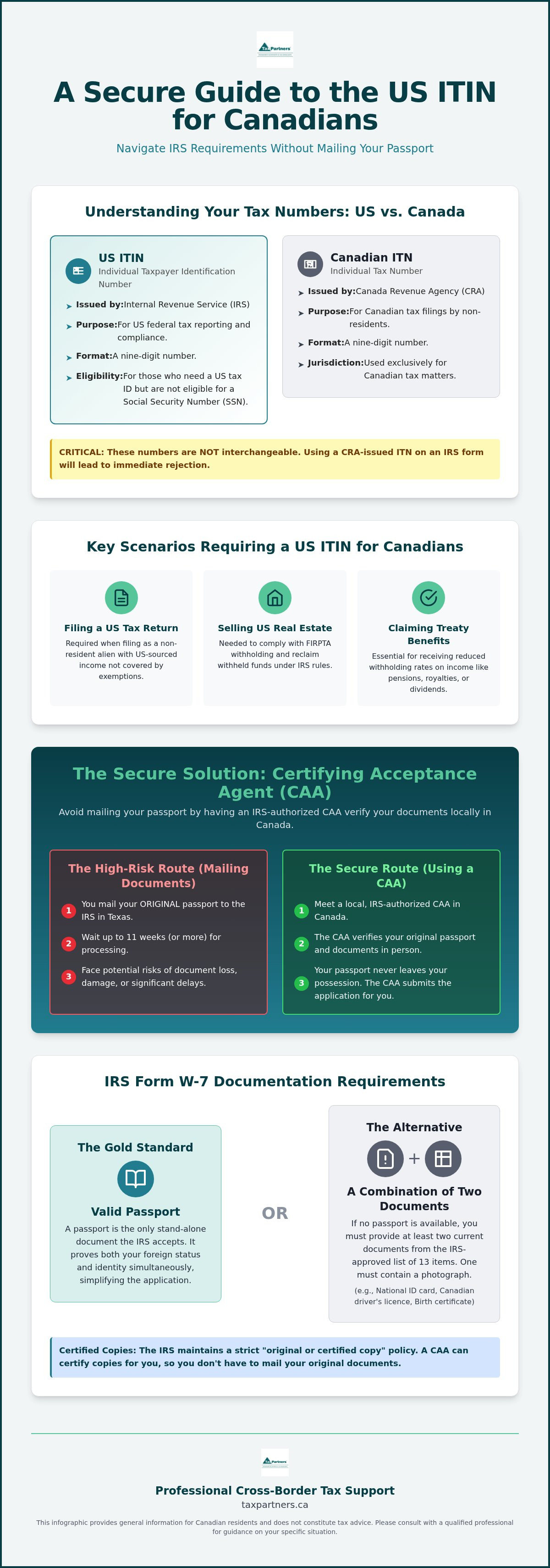
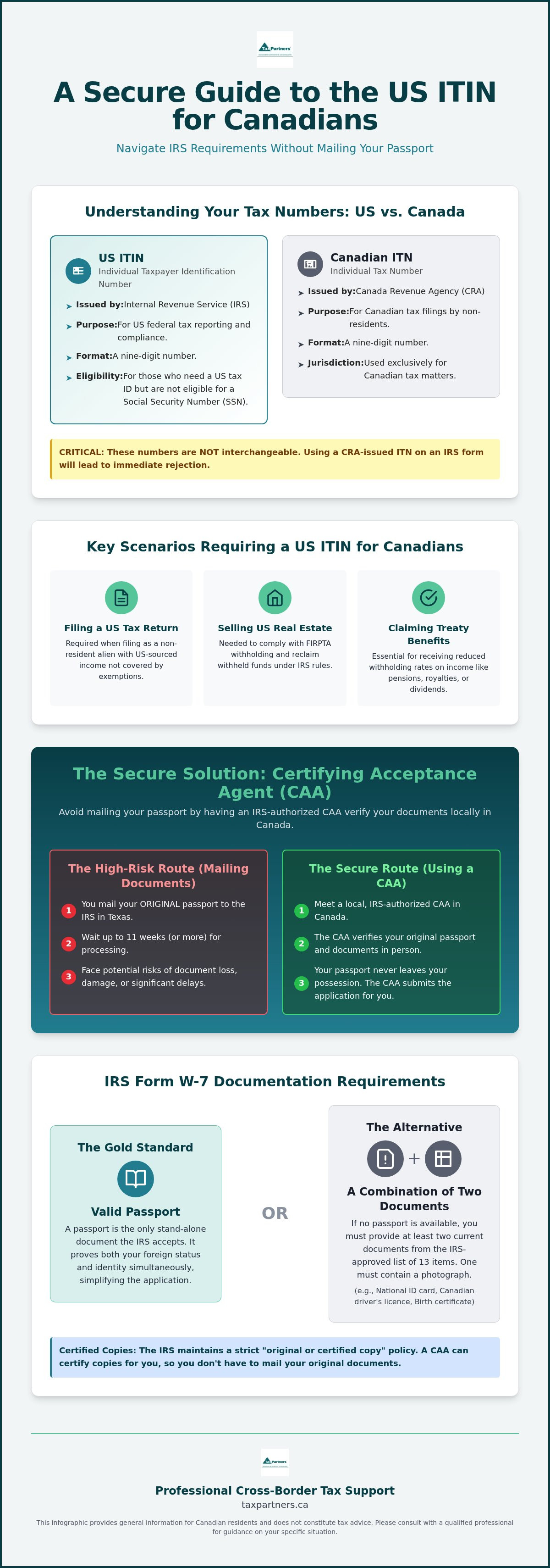
An Individual Taxpayer Identification Number (ITIN) serves as a critical bridge for Canadians engaging with the US tax system. Under IRS rules, the ITIN is a nine-digit tax processing number issued by the Internal Revenue Service (IRS).
It's designed for individuals who must have a US taxpayer identification number but are ineligible for a Social Security Number (SSN). You should realize that this number doesn't grant work authorization or Social Security benefits. It's strictly for federal tax reporting and compliance purposes.
Our team at Tax Partners often sees confusion regarding these requirements. We focus on ensuring your ITIN application Canada process is handled with precision. This prevents the stress of IRS rejections and keeps your cross-border activities on track.
When You Need a US ITIN Under IRS Rules
You'll likely require an ITIN if you're filing a US federal tax return as a non-resident alien. This is common for Canadians with US-sourced income that isn't covered by a standard withholding exemption.
Canadians selling US real estate often need an ITIN to comply with FIRPTA (Foreign Investment in Real Property Tax Act) withholding requirements. Initiating an ITIN application Canada residents can rely on is the first step in reclaiming withheld funds under IRS rules.
Claiming tax treaty benefits on US-sourced income like pensions, royalties, or dividends also requires this number. Without a valid ITIN, you may be subject to higher withholding rates than the treaty allows.
The Distinction Between ITIN and Canadian ITN
The Individual Tax Number (ITN) is a separate identifier issued by the CRA for non-residents who need to file Canadian returns. It's vital for CRA filers to understand that these two numbers serve different jurisdictions.
You must realize that these numbers aren't interchangeable across borders. Using a CRA-issued ITN on an IRS form is a common error that leads to immediate processing delays and potential compliance issues.
Always confirm which jurisdiction is requesting the identification before you start. We provide the foresight needed to distinguish between these requirements, ensuring your filings are accurate from the very start.
Documentation Requirements for the IRS Form W-7
The foundation of any successful ITIN application Canada residents submit is the IRS Form W-7. This document serves as your formal request for a US tax identification number. To satisfy IRS auditors, you must provide evidence that verifies both your identity and your foreign status.
According to official IRS ITIN Information, the agency maintains a very specific list of thirteen acceptable documents for this purpose. Each piece of evidence must be current and show your name and photograph to meet the agency's rigorous standards.
A valid passport stands as the gold standard for your application. Under IRS rules, it's the only stand-alone document that proves both foreign status and identity simultaneously. If you have a current passport, you don't need to provide any other supporting paperwork.
This simplicity is why we strongly recommend using a passport whenever possible to streamline the process. It minimizes the risk of clerical errors and reduces the number of items the IRS needs to track. Providing the wrong type of documentation is the most common reason for application failure.
The IRS doesn't just look for your name; they require proof that you're a legitimate foreign national with a valid reason to interact with the US tax system. We realize that gathering these materials can feel like an overwhelming task, but precision at this stage prevents future headaches.
Acceptable Supporting Documents for US Tax IDs
If a passport isn't available, the IRS requires at least two other certified documents. One of these must contain a photograph to verify your identity. This alternative route requires careful coordination to ensure both categories of proof are covered.
- National identification cards: These must be current and include your photo, name, address, and an expiry date to be valid under IRS rules.
- Canadian driver's licence: This is excellent for proving identity, but the IRS doesn't recognize it as proof of foreign status on its own.
- Birth certificates: These are frequently used for dependents who haven't yet obtained a passport, though they must be original or agency-certified.
The 'Certified Copy' Standard Under IRS Rules
The IRS maintains a strict "original or certified copy" policy. You must submit either the original document or a copy certified by the original issuing agency, such as Service Canada or a provincial vital statistics office. Many applicants mistakenly believe a notarized copy from a local notary public is sufficient.
Under IRS rules, standard notarized copies are typically rejected. This minor distinction often leads to months of delays and frustration. A notary only confirms they saw the original, while the issuing agency confirms the document is a true record of their own files.
Understanding the difference between a notary's stamp and an issuing agency's certification is essential. If you're unsure about your documentation, you can speak with our cross-border team to verify your materials before submission. We help you navigate these nuances so your application moves through the system without unnecessary friction.
The CAA Advantage: Secure ITIN Applications from Canada
A Certifying Acceptance Agent (CAA) represents a specialized tier of professional authorized by the IRS to assist with taxpayer identification. For those managing an ITIN application Canada, this role provides a secure and efficient alternative to standard submission methods. They act as a proactive guardian for your sensitive information throughout the entire process.
Using a professional service allows you to have your identification verified without mailing your original passport to the United States. This significantly reduces the risk of lost documents or identity theft during international transit. You can find more details on how we facilitate this on our ITIN service page.
Accuracy is the final pillar of the CAA advantage. Agents review your Form W-7 to ensure every field aligns with strict IRS standards. According to IRS ITIN Information, even minor errors can lead to immediate rejection and months of unnecessary waiting.
Risks of the DIY Mailing Approach
Mailing original documents to the IRS centre in Austin, Texas, can leave you without a passport for several months. Current estimates for international applications suggest a processing window of 9 to 11 weeks. This delay can be particularly disruptive if you have upcoming travel plans or need your identification for other legal matters.
If the IRS rejects a DIY submission, the applicant must often begin the entire cycle again. This involves re-gathering documents and enduring another lengthy processing period. Clerical errors on Form W-7 are the most frequent cause of these multi-month delays for Canadian residents.
Professional Verification vs. Government Mailing
A CAA can certify your documents through an in-person appointment or a secure video link where permitted under IRS rules. This ensures your original identification stays safely in your possession in Canada. It provides a level of document security that mailing simply cannot replicate.
The agent then submits a formal Certificate of Accuracy along with your completed application to the IRS. This certificate serves as a professional attestation that your identity and foreign status have been verified. If you want to avoid the risks of mailing your passport, you can connect with our team to start your secure application. This professional oversight ensures you maintain total control over your essential identification.
Steps to Complete Your ITIN Application from Canada
Success requires a meticulous synchronization of tax forms and identification documents. Under IRS rules, the process is rarely a standalone submission. You must realize that most requests for a tax ID must be physically attached to a valid US federal income tax return.
This requirement ensures the IRS sees a legitimate tax-related reason for issuing the number. Failing to include the correct 'Exception' documentation or the required return will result in an automatic rejection. We prioritize this alignment to help you avoid the frustration of starting over from scratch.
Managing an ITIN application Canada residents can trust involves following a structured path. This methodical approach moves you from a state of uncertainty toward total compliance and understanding.
Step 1: Determine Your Application Category
First, identify if you're applying based on a standard tax filing requirement or a specific IRS exception. Common exceptions include passive income subjects to US withholding or individuals selling US real estate. These categories have unique evidentiary requirements that must be met before you submit your paperwork.
Review the latest instructions for Form W-7 to confirm your specific category remains valid for the 2026 tax year. Our team helps you identify the correct path if your situation involves complex cross-border investments or property sales. This foresight prevents you from applying under the wrong criteria and wasting valuable time.
Step 2: Prepare Form W-7 and Supporting Returns
Complete Form W-7 with absolute precision. The name on the form must match your identification exactly, down to every middle initial or hyphen. Any discrepancy between your passport and the application is a major trigger for an IRS rejection.
Prepare the 1040-NR (U.S. Nonresident Alien Income Tax Return) or other required returns for the current period as dictated by IRS rules. If you're applying for a spouse or dependent, ensure all required signatures are present and legible. A single missing signature can delay the entire family's application for several months.
Step 3: Certification and Submission
Once your paperwork is ready, meet with a professional to verify your original identification documents. This step is where we certify your identity and foreign status without you ever losing possession of your passport. We package the Form W-7, the tax return, and our formal certification into a single, compliant bundle for submission.
The IRS typically issues a written notice once they've processed the application and assigned your nine-digit number. This notice arrives by mail and serves as your official record for all future US tax filings. If you're ready to secure your tax ID with professional oversight, contact our cross-border specialists today to begin the process.
Professional Cross-Border Support with Tax Partners
Tax Partners offers a steady hand for those managing the complexities of US and cross-border tax compliance. We realize that an ITIN application Canada residents undertake is often just one piece of a larger financial puzzle. Our role is to act as your seasoned mentor, ensuring every filing aligns with your long-term goals.
We prioritize a holistic approach that looks beyond a single form. By considering your total financial health, we help you navigate the intricacies of the US-Canada tax treaty. This strategic foresight ensures you aren't subject to double taxation under IRS rules while remaining fully compliant for CRA filers.
Our firm combines decades of institutional wisdom with a modern, forward-thinking outlook. We move you quickly from a state of potential uncertainty toward a feeling of total control over your tax obligations. This partnership is built on stability and a deep investment in your success.
Integrated Cross-Border Tax Strategies
Our team provides end-to-end support by managing both your Canadian personal tax and your US filing requirements simultaneously. This integration is essential for maintaining accuracy across different jurisdictions. We ensure your ITIN application is perfectly synchronized with the necessary 1040-NR filings required by the IRS.
This comprehensive oversight protects your assets and maintains your standing with both the IRS and the CRA. By handling both sides of the border, we eliminate the communication gaps that often lead to costly errors. You gain the peace of mind that comes from a unified and professionally managed tax strategy.
Why Experience Matters for ITIN Filers
The IRS frequently updates its regulations regarding ITIN renewals and specific application exceptions. Navigating these changes alone can lead to significant financial penalties or rejected applications. With over 40 years of experience and more than 495,000 returns filed, we provide the stability and precision you need.
Our track record of reliability is reflected in over 1,390 five-star Google reviews from clients who value our attentive service. We don't just react to current requirements; we look ahead to secure better outcomes for your cross-border interests. Contact us today to secure your ITIN and simplify your international tax obligations with confidence.
Secure Your Cross-Border Future Today
The path to international tax compliance doesn't have to involve the risk of losing your passport in the mail. By choosing a professional route for your ITIN application Canada, you ensure your identification remains safe while satisfying every requirement under IRS rules. You now understand the vital distinction between US and Canadian identifiers and the necessity of pairing your application with a valid federal tax return.
With over 40 years of cross-border tax experience, Tax Partners acts as a proactive guardian for your financial health. We've filed over 495,000 returns. We maintain 1,390+ five-star Google reviews because we prioritize precision and personalized care. Our specialists bridge the gap between IRS and CRA requirements, providing the stability you need to move forward with total confidence.
Don't let regulatory complexity stall your progress or create unnecessary anxiety. Book a Cross-Border Consultation with Tax Partners to simplify your compliance journey. We're here to provide the steady hand and expert foresight your cross-border interests deserve.
Frequently Asked Questions
What is the difference between a US ITIN and a Canadian ITN?
An ITIN is a nine-digit tax processing number issued by the IRS for US federal tax reporting. In contrast, the Individual Tax Number (ITN) is a separate identifier used specifically for CRA filers in Canada. It's vital to realize these numbers aren't interchangeable. Using a Canadian ITN on a US form will result in immediate rejection by the IRS. The distinction is critical for maintaining compliance on both sides of the border.
Do I have to mail my original passport to the IRS to get an ITIN?
You don't have to mail your original passport if you use a Certifying Acceptance Agent (CAA). A CAA is authorized by the IRS to verify your identity and foreign status in person or via secure video link. This allows you to maintain possession of your documents while still satisfying the IRS "original or certified copy" standard. This is the safest way to handle an ITIN application Canada residents can choose.
How long does it take for the IRS to process an ITIN application from Canada?
The IRS typically takes 9 to 11 weeks to process an ITIN application submitted from outside the United States. During peak tax seasons, which run from January to April, these timelines often extend. You should plan your application well in advance of any US federal tax deadlines to avoid compliance issues. Standard processing within the US is approximately seven weeks, but international filers should expect the longer window for 2026.
Can I apply for an ITIN online without any physical documents?
No, the IRS doesn't offer an online application for ITINs as of 2026. The process remains entirely paper-based and requires physical signatures on Form W-7. You must submit either original documents or certifications from a CAA by mail or in person. Any service claiming to offer a completely digital IRS application without document verification is likely fraudulent or misinformed. Physical verification remains a cornerstone of the IRS identification process.
Does an ITIN expire if I do not use it for several years?
Yes, an ITIN automatically expires on December 31st of the third consecutive year it hasn't been used on a US federal tax return. For example, if you don't use your number for tax years 2023, 2024, and 2025, it would expire at the end of 2025. You'll need to submit a new Form W-7 and supporting identification to the IRS to renew it. This rule of non-use ensures the IRS system remains current.
Can my spouse and children also get an ITIN under IRS rules?
Your spouse and children can obtain ITINs if they're claimed as dependents on your US federal tax return or if you're filing a joint return. They must meet the same identity and foreign status requirements as the primary applicant. Under IRS rules, each family member must submit their own Form W-7 along with the required identification. This often helps Canadians maximize their tax treaty benefits when filing with the IRS as a family unit.
What happens if my ITIN application is rejected by the IRS?
If the IRS rejects your application, you'll receive a written notice explaining the specific reasons for the denial. Common triggers include missing signatures, incorrect document certification, or failing to attach a required US tax return. You must address these errors and resubmit a new Form W-7 to the IRS. Working with a professional helps ensure your ITIN application Canada residents file is accurate the first time, avoiding multi-month delays.
Do I need an ITIN if I am only visiting the US as a tourist?
You don't need an ITIN for standard tourism or casual visits to the United States. This number is strictly for individuals who have a federal tax filing or reporting requirement under IRS rules. Tourists who don't earn US-sourced income or engage in US business activities have no reason to apply. If you're unsure if your travel involves taxable activity, consult with a cross-border professional to verify your status before you travel.

Article by
Mahad Mohamed
Mahad Mohamed is an accountant and the CEO of Tax Partners, with over 26+ years of Canadian and international tax and accounting experience. His expertise includes corporate reorganization, cross-border tax structuring (Canada & US), tax disputes, CRA audits, and tax planning for small owner-managed private corporations. Most recently, Mahad is a pioneer in Canadian crypto taxation and founded Block3 Finance.
Previously, Mahad worked for the Canada Revenue Agency (CRA), Big4 accounting firms, and served as a Rulings Officer for the Federal Tax Authority of the UAE before acquiring Tax Partners in 2014.
Tax Partners has 44 full-time accountants and over 18,400+ clients.
Disclaimer
This article provides general information only and is current as of its publication date. It has not been updated and may be out of date. It does not constitute legal advice and should not be relied upon as such. Every tax situation is unique and may differ from the examples discussed in this article. If you have specific questions, you should seek the advice of our accountants for your unique circumstances. Book a FREE Initial Consultation Today!
Frequently Asked Questions
What is the difference between a US ITIN and a Canadian ITN?
An ITIN is a nine-digit tax processing number issued by the IRS for US federal tax reporting. In contrast, the Individual Tax Number (ITN) is a separate identifier used specifically for CRA filers in Canada. It's vital to realize these numbers aren't interchangeable. Using a Canadian ITN on a US form will result in immediate rejection by the IRS. The distinction is critical for maintaining compliance on both sides of the border.
Do I have to mail my original passport to the IRS to get an ITIN?
You don't have to mail your original passport if you use a Certifying Acceptance Agent (CAA). A CAA is authorized by the IRS to verify your identity and foreign status in person or via secure video link. This allows you to maintain possession of your documents while still satisfying the IRS "original or certified copy" standard. This is the safest way to handle an ITIN application Canada residents can choose.
How long does it take for the IRS to process an ITIN application from Canada?
The IRS typically takes 9 to 11 weeks to process an ITIN application submitted from outside the United States. During peak tax seasons, which run from January to April, these timelines often extend. You should plan your application well in advance of any US federal tax deadlines to avoid compliance issues. Standard processing within the US is approximately seven weeks, but international filers should expect the longer window for 2026.
Can I apply for an ITIN online without any physical documents?
No, the IRS doesn't offer an online application for ITINs as of 2026. The process remains entirely paper-based and requires physical signatures on Form W-7. You must submit either original documents or certifications from a CAA by mail or in person. Any service claiming to offer a completely digital IRS application without document verification is likely fraudulent or misinformed. Physical verification remains a cornerstone of the IRS identification process.
Does an ITIN expire if I do not use it for several years?
Yes, an ITIN automatically expires on December 31st of the third consecutive year it hasn't been used on a US federal tax return. For example, if you don't use your number for tax years 2023, 2024, and 2025, it would expire at the end of 2025. You'll need to submit a new Form W-7 and supporting identification to the IRS to renew it. This rule of non-use ensures the IRS system remains current.
Can my spouse and children also get an ITIN under IRS rules?
Your spouse and children can obtain ITINs if they're claimed as dependents on your US federal tax return or if you're filing a joint return. They must meet the same identity and foreign status requirements as the primary applicant. Under IRS rules, each family member must submit their own Form W-7 along with the required identification. This often helps Canadians maximize their tax treaty benefits when filing with the IRS as a family unit.
What happens if my ITIN application is rejected by the IRS?
If the IRS rejects your application, you'll receive a written notice explaining the specific reasons for the denial. Common triggers include missing signatures, incorrect document certification, or failing to attach a required US tax return. You must address these errors and resubmit a new Form W-7 to the IRS. Working with a professional helps ensure your ITIN application Canada residents file is accurate the first time, avoiding multi-month delays.
Do I need an ITIN if I am only visiting the US as a tourist?
You don't need an ITIN for standard tourism or casual visits to the United States. This number is strictly for individuals who have a federal tax filing or reporting requirement under IRS rules. Tourists who don't earn US-sourced income or engage in US business activities have no reason to apply. If you're unsure if your travel involves taxable activity, consult with a cross-border professional to verify your status before you travel.