How to Apply for an ITIN in Canada: A Professional Guide to Form W-7 and IRS Compliance

What if you could satisfy the Internal Revenue Service (IRS) without ever letting your passport leave Canadian soil? For many Canadians earning U.S. income, the prospect of mailing an original passport to a processing centre in Austin, Texas, is enough to stall any financial plans. You likely recognize that an Individual Taxpayer Identification Number (ITIN) is essential for claiming tax treaty benefits or reporting rental income under IRS rules, but the fear of document loss and the frustration of technical rejections often make the process feel overwhelming. It's a common concern that shouldn't stand in the way of your cross-border goals.
The good news is that securing your tax ID doesn't have to be a high-stakes gamble with your identity. By utilizing a professional ITIN application service Canada, you can navigate the December 2024 revision of Form W-7 with total confidence. This guide will show you the exact steps to secure your number while keeping your original documents safely in your possession. We'll walk through the current IRS compliance requirements, explain the vital role of local verification, and provide a clear roadmap to ensure your application is successful on the first attempt.
Key Takeaways
- Understand why an Individual Taxpayer Identification Number (ITIN) is required under IRS rules for Canadians earning U.S. income who are ineligible for a Social Security Number.
- Explore how a professional ITIN application service Canada allows you to verify your identity locally, keeping your original passport safely in your possession throughout the process.
- Learn to navigate the specific requirements of the December 2024 revision of IRS Form W-7, including the "Exception" categories for those without a tax return.
- Identify the necessary identification documents and "Reason for Applying" codes to prevent application rejections and minimize long IRS processing times.
- Discover the advantages of working with a Certified Acceptance Agent to ensure full compliance with U.S. tax regulations while securing your cross-border financial interests.
What is an ITIN? Understanding IRS Identification for Canadians
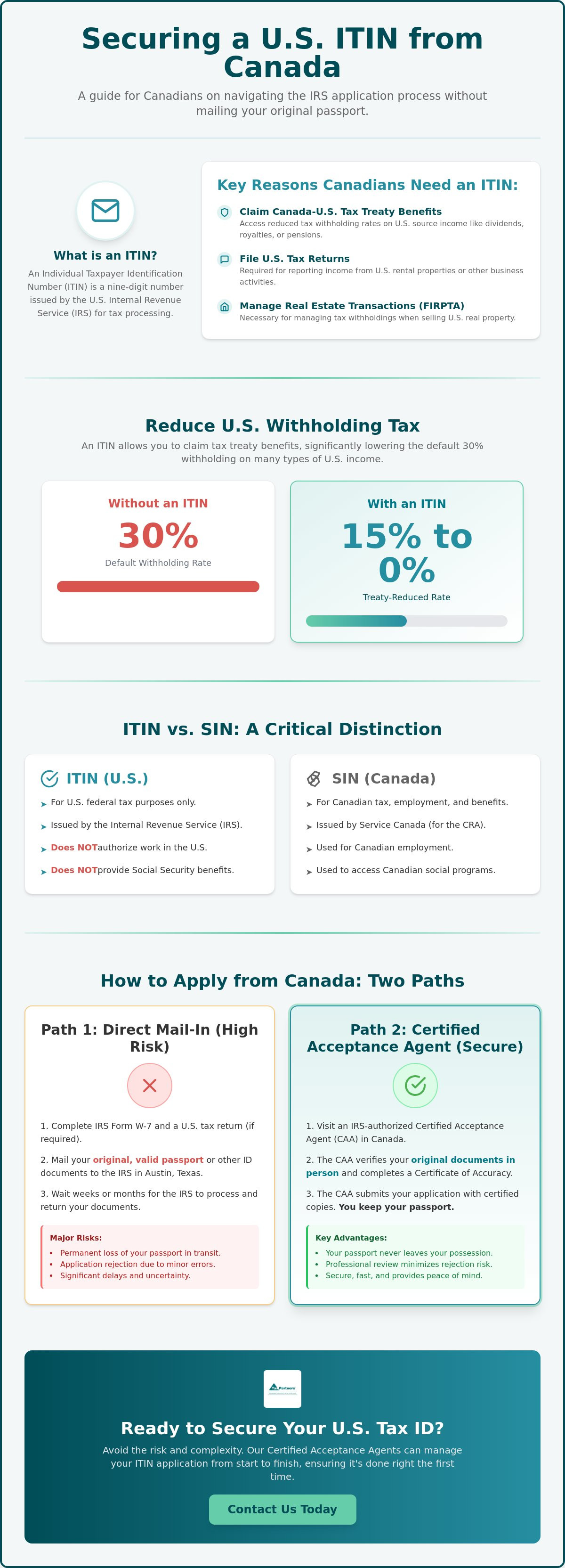
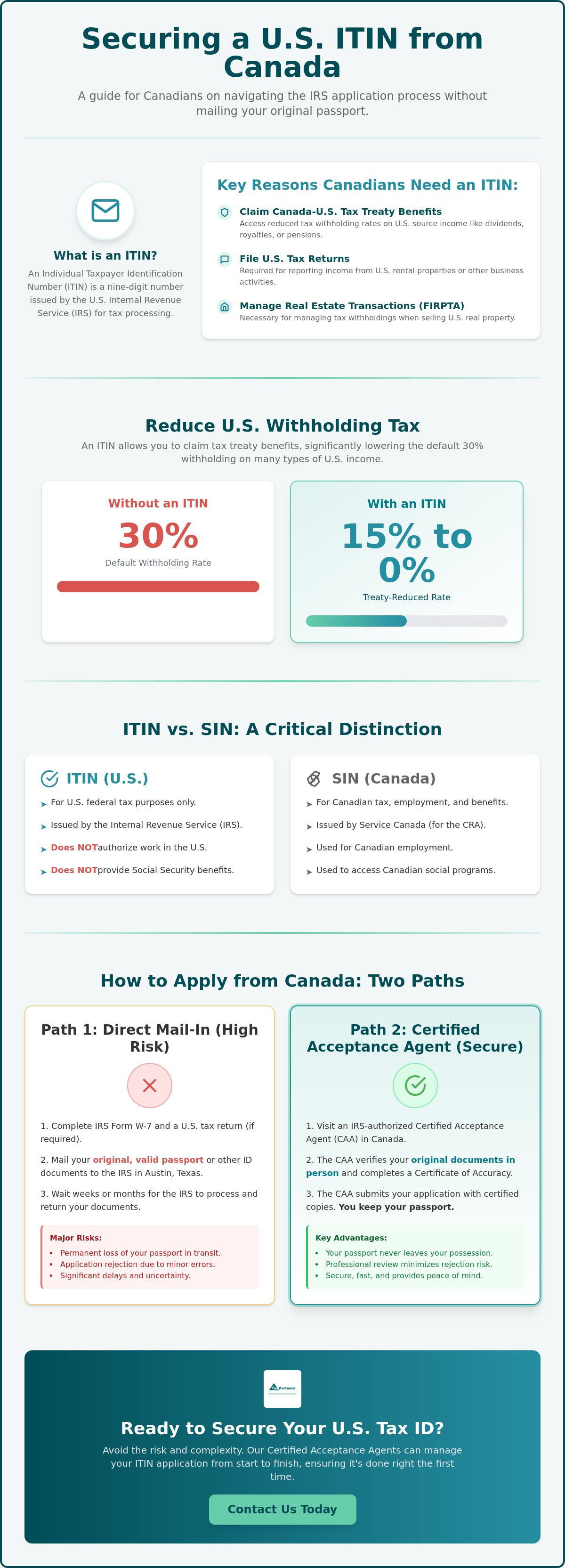
The Individual Taxpayer Identification Number (ITIN) is a nine-digit tax processing number issued by the Internal Revenue Service (IRS). It's designed specifically for individuals who have a federal tax filing or reporting requirement under IRS rules but aren't eligible for a Social Security Number (SSN). For many Canadians, this number serves as the essential link between their financial activities in the United States and their compliance obligations at home. It's vital to realize that while the ITIN looks like an SSN, its purpose is strictly limited to tax administration.
For Canadian residents, the primary value of an ITIN lies in accessing the benefits of the Canada-U.S. Tax Treaty. Without this number, the IRS typically requires payers to withhold 30% of any U.S. source income, such as royalties, dividends, or gambling winnings. By providing a valid ITIN, you can often reduce this withholding rate to 15%, or even 0%, depending on the specific income type. This ensures you aren't overpaying the U.S. government while still meeting your reporting duties. If you're unsure how to begin, an ITIN application service Canada can provide the professional oversight needed to navigate these cross-border complexities with precision.
Who is required to have an ITIN?
You'll likely need an ITIN if you're a non-resident alien with a U.S. tax filing requirement. This includes Canadian residents who earn rental income from U.S. properties or those who have sold U.S. real estate and need to manage withholdings under the Foreign Investment in Real Property Tax Act (FIRPTA). Spouses or dependants of U.S. citizens who are claimed on a U.S. tax return also require their own numbers. Essentially, if the IRS expects a form from you, they expect a valid identification number to accompany it. Using an ITIN application service Canada ensures that your specific reason for applying is correctly documented to avoid processing delays.
ITIN vs. SIN: Clearing the confusion
It's easy to mistake the ITIN for a Canadian Social Insurance Number (SIN), but they operate in entirely different spheres. A SIN is issued for CRA filers to access Canadian social programs, employment, and benefits. Under IRS rules, an ITIN does not grant you the right to work in the United States or provide eligibility for Social Security benefits. It's a tool for tax compliance, not a change in immigration status. Maintaining this distinction is crucial; your Canadian SIN cannot be used for U.S. federal tax purposes. Professional guidance helps maintain this boundary, ensuring you remain compliant with the IRS without compromising your status in either jurisdiction.
The ITIN Application Process: Navigating IRS Form W-7 Requirements
Applying for an ITIN starts with the meticulous completion of IRS Form W-7. The IRS released the most recent revision of this document in December 2024, and it demands absolute precision. Most Canadians believe they must submit a complete U.S. federal tax return alongside their application. While that's the general rule, the IRS provides several "Exception" categories. For example, if you're claiming U.S.-Canada Tax Treaty benefits on passive income like royalties or dividends, you may qualify to apply without an immediate tax filing. Similarly, individuals involved in U.S. real estate sales under FIRPTA rules often fall into these special categories. Choosing the wrong exception code is one of the most frequent reasons for application rejection. This technical hurdle is why many residents rely on an ITIN application service Canada to ensure their paperwork aligns with current IRS standards.
Documentation standards for Canadians
The IRS maintains rigorous standards for verifying your "foreign status" and "identity." A valid, unexpired Canadian passport is the preferred document because it's considered a "stand-alone" proof. It's the only single document that satisfies both IRS requirements at once. If you don't have a passport, you'll need to provide at least two other certified documents, such as a birth certificate and a provincial driver's licence. However, the IRS requires either original documents or certified copies from the issuing agency. The official IRS guidance on Obtaining an ITIN from Abroad highlights the risks of mailing these vital records. Many applicants find that working with a professional who can verify documents in person offers much-needed peace of mind.
IRS processing timelines and expiry rules
Timing is everything when managing cross-border obligations. Standard processing for a W-7 application typically takes about 7 weeks. During the peak tax season, which runs from mid-January through April, or for applications mailed from outside the United States, this wait can extend to 9 or 11 weeks. It's also vital to understand that an ITIN isn't necessarily a lifelong identifier. Under IRS rules, your number will expire if it isn't used on a U.S. federal tax return for three consecutive years. For instance, if you used your number in 2022 but didn't file in 2023, 2024, or 2025, your ITIN would expire on December 31, 2026. Staying current with 1040 tax filing for Canadians is the most effective way to maintain an active status. If you're concerned about the state of your current ID, you can speak with a specialist to review your renewal options.
Comparing Application Methods: Why Canadians Choose Certified Acceptance Agents
Choosing the right path for your application often comes down to a choice between perceived savings and actual security. Under IRS rules, the standard "Do-It-Yourself" method requires you to mail your original, valid Canadian passport directly to the ITIN Operation in Austin, Texas. While this avoids upfront service fees, it introduces a level of risk that many find unacceptable. If you're looking for a more secure route, an ITIN application service Canada offers a professional alternative that prioritizes document safety and technical accuracy.
The alternative to mailing documents is visiting an IRS Taxpayer Assistance Centre in person. However, these offices are located exclusively within the United States. For a resident of Toronto, Vancouver, or Montreal, this would require a cross-border trip, an appointment, and significant travel costs. Even then, not all IRS offices are equipped to process ITIN applications for non-residents. This logistical gap is why most Canadians find that local professional assistance is the most efficient and cost-effective way to manage their U.S. tax identification needs.
The "Passport Problem" for Canadian travellers
Relinquishing your passport for an extended period is a significant hurdle. Standard IRS processing times mean your primary travel document could be held in a foreign processing centre for up to eleven weeks. For Canadians who travel for business or have family across the border, being without a passport is more than an inconvenience; it's a risk to their mobility. There's also the rare but stressful possibility of documents being lost or damaged during international transit. Professional verification through an ITIN application service Canada removes this variable entirely by allowing you to keep your passport in your pocket while the application moves forward.
What is a Certified Acceptance Agent (CAA)?
A Certified Acceptance Agent (CAA) is a professional authorized by the IRS to assist individuals who are ineligible for a Social Security Number. They operate under a formal agreement with the IRS that grants them the power to verify original identity documents and submit certified copies on your behalf. This is a critical distinction from a standard "Acceptance Agent," who cannot certify passports for Canadians. Because a CAA reviews your Form W-7 for technical errors before submission, they often achieve a much higher success rate than DIY applicants. You can find more details in the Official IRS ITIN Application Guidance regarding how these agents facilitate the process from abroad.
The decision to invest in professional assistance often pays for itself through the prevention of costly delays. A rejected application doesn't just mean more paperwork; it means your U.S. tax withholdings remain stuck with the IRS for even longer. By choosing a professional route, you gain the foresight of an expert who understands the nuances of cross-border compliance. It's about moving from a state of uncertainty to a position of total control over your financial identity.
Step-by-Step: How to Prepare Your ITIN Application from Canada
Preparation is the cornerstone of a successful ITIN request. Under IRS rules, every box on Form W-7 must be substantiated by supporting evidence, and even a minor discrepancy can trigger a rejection notice. The process requires a methodical approach that begins long before you put pen to paper. By organizing your documents early, you ensure that your ITIN application service Canada has the necessary materials to build a compliant file. This proactive stance is what separates a smooth issuance from a months-long struggle with IRS correspondence. It's about getting the details right the first time to avoid the frustration of starting over.
Your first task is to identify the specific "Reason for Applying" found in Boxes a through h on the form. For most Canadians, this involves claiming benefits under the U.S.-Canada Tax Treaty to reduce or eliminate U.S. tax withholdings on income earned south of the border. Once the reason is clear, you must gather a valid, unexpired Canadian passport. If your passport has expired, you'll need to renew it before proceeding, as the IRS will not accept outdated identification. Finally, you must determine if your situation requires a full U.S. federal tax return or if you qualify for an exception. This step is critical because the IRS will reject any application that lacks the appropriate tax documentation or a valid exception proof.
Identifying your IRS exception
The IRS provides specific exceptions that allow you to apply for an ITIN without filing a tax return immediately. For Canadians, the most common are:
- Exception 1: This covers passive income like royalties, dividends, or interest. You'll need a formal letter from the U.S. withholding agent or payer to prove your claim.
- Exception 2: This applies to "other" income, such as gambling winnings or prizes. It's often used to reclaim taxes withheld by U.S. casinos when the treaty rate is lower than the standard withholding.
- Exception 3: This is specific to mortgage interest or third-party withholding on the sale of U.S. real property, which is essential for those managing FIRPTA requirements.
Final review checklist
Before submitting, a rigorous final review is essential to prevent technical errors. Ensure that the name on your Form W-7 matches the name on your Canadian passport exactly. If you have a middle name on your ID, it must appear on your application. You must also verify that your "Foreign Status" is clearly established; for Canadians, this means ensuring your country of citizenship is correctly identified as Canada. Finally, check that the application is signed and dated using the month-day-year format preferred by the IRS. If you're ready to begin the process with expert oversight, you can connect with our cross-border specialists today to schedule your verification interview.
Expert ITIN Application Services: How Tax Partners Secures Your US Tax ID
Securing a tax identification number from a foreign government shouldn't feel like a leap of faith. At Tax Partners, we act as a proactive guardian for your cross-border interests, drawing on four decades of institutional wisdom to simplify the complex. As an authorized IRS Certified Acceptance Agent, we provide a specialized ITIN application service Canada that bridges the gap between your Canadian residency and your U.S. tax obligations. We don't just process forms; we ensure your financial identity is handled with the precision and care it deserves. Our long-standing experience allows us to anticipate potential hurdles, significantly reducing the risk of IRS rejection that often plagues DIY applications.
Our approach is rooted in a commitment to ethical steadfastness and personalized support. We understand that every cross-border situation is unique, whether you're a frequent traveller, a property owner, or a digital professional earning U.S. royalties. By positioning ourselves as an accessible expert rather than a distant institution, we offer a steady hand at the helm of your financial affairs. This bespoke service ensures that every detail of your W-7 application is verified under IRS rules, providing you with a seamless path toward compliance and total control over your tax reporting requirements.
The Tax Partners "No-Mail" verification process
We recognize the deep-seated anxiety that comes with the prospect of being without your passport for months. Our "No-Mail" verification process is designed specifically to alleviate this stress. As a Certified Acceptance Agent, we have the authority to verify your Canadian passport in person or via secure video, allowing you to keep your original documents safely in your possession. This eliminates the fear of document loss or identity theft during international transit. Because we maintain a direct communication channel with the IRS ITIN unit, we can resolve technical queries quickly, ensuring your application moves through the system with momentum and clarity.
Comprehensive cross-border support
An ITIN is rarely a standalone requirement; it's usually one piece of a larger financial puzzle. Our team integrates your ITIN application with your broader annual U.S. and Canadian tax returns to ensure a cohesive strategy. For CRA filers, this means carefully coordinating foreign tax credits and treaty claims to avoid the burden of double taxation. We look ahead to secure the best possible outcome for your cross-border wealth, ensuring you realize every available benefit under the U.S.-Canada Tax Treaty. If you're ready to secure your number without the typical administrative headaches, Contact Tax Partners today for expert assistance and take the first step toward a worry-free cross-border experience.
Secure Your Cross-Border Financial Future
Navigating the complexities of IRS compliance doesn't have to be a source of stress. By understanding the rigorous requirements of Form W-7 and the strategic importance of the U.S.-Canada Tax Treaty, you've already taken the first step toward securing your financial interests. The most critical takeaway remains the protection of your identity; utilizing a professional ITIN application service Canada ensures your original passport stays with you while your application moves forward with precision. This methodical approach eliminates the uncertainty of technical rejections and protects you from the risks of document loss.
With over 40 years of cross-border tax expertise and more than 1,390 five-star Google reviews, Tax Partners provides the stability and reliability you need. As an authorized IRS Certified Acceptance Agent, we are ready to act as your proactive guardian in all cross-border matters. Secure your ITIN with Tax Partners—Authorized IRS Certified Acceptance Agents to ensure your application is handled with the highest standard of professional care. You are now equipped to move toward your goals with total confidence and a steady hand at the helm.
Frequently Asked Questions
Do I need an ITIN if I am a Canadian citizen with US rental income?
Yes, you generally require an ITIN under IRS rules if you earn rental income from a U.S. property. This number allows you to file a U.S. federal tax return to report your earnings and, in many cases, helps you claim treaty benefits to reduce the standard 30% withholding tax on your gross rental receipts.
How long does it take for a Canadian to get an ITIN in 2026?
Standard processing for an application submitted from Canada typically takes between 7 and 11 weeks. If you apply during the peak tax season, which runs from mid-January through April, the IRS often requires the full 11 weeks to process your Form W-7 and issue your number.
Can I apply for an ITIN online from Canada?
No, the IRS does not offer an online application portal for the ITIN. You must submit a physical application via mail or through an ITIN application service Canada that employs a Certified Acceptance Agent to verify your documents and submit the paperwork on your behalf.
Will the IRS return my original passport if I mail it to them?
Yes, the IRS will return your original passport to your Canadian address once they finish processing your application. However, many applicants choose professional verification to avoid the risk of their primary travel document being lost or delayed in international transit for several months.
Does an ITIN expire if I do not file a US tax return?
Yes, your ITIN will expire if it is not used on a U.S. federal tax return at least once in three consecutive years. Under current IRS regulations, any number that has remained inactive for this period must be renewed before it can be used for future tax filings or treaty claims.
Can I get an ITIN for my spouse or children in Canada?
Yes, spouses and dependants can obtain an ITIN if they are listed on a U.S. federal tax return. It's important to realize that for the 2025 tax year and beyond, an ITIN is no longer sufficient for claiming the Child Tax Credit, as the IRS now requires a Social Security Number for that specific benefit.
What is the difference between an ITIN and an EIN?
An ITIN is an individual processing number for people who don't have a Social Security Number but have U.S. tax obligations. An Employer Identification Number (EIN) is a separate identifier used by businesses, corporations, or trusts to identify the entity for federal tax purposes under IRS rules.
How much does an ITIN application service in Canada cost?
The IRS itself does not charge a fee to issue an ITIN. Fees associated with an ITIN application service Canada represent the professional costs for document verification, application preparation, and cross-border tax consultation. These costs depend on the complexity of your specific tax situation and the level of support required.

Article by
Mahad Mohamed
Mahad Mohamed is an accountant and the CEO of Tax Partners, with over 26+ years of Canadian and international tax and accounting experience. His expertise includes corporate reorganization, cross-border tax structuring (Canada & US), tax disputes, CRA audits, and tax planning for small owner-managed private corporations. Most recently, Mahad is a pioneer in Canadian crypto taxation and founded Block3 Finance. Previously, Mahad worked for the Canada Revenue Agency (CRA), Big4 accounting firms, and served as a Rulings Officer for the Federal Tax Authority of the UAE before acquiring Tax Partners in 2014. Tax Partners has 44 full-time accountants and over 18,400+ clients.
Disclaimer
This article provides general information only and is current as of its publication date. It has not been updated and may be out of date. It does not constitute legal advice and should not be relied upon as such. Every tax situation is unique and may differ from the examples discussed in this article. If you have specific questions, you should seek the advice of our accountants for your unique circumstances. Book a FREE Initial Consultation Today!
Frequently Asked Questions
Who is required to have an ITIN?
You'll likely need an ITIN if you're a non-resident alien with a U.S. tax filing requirement. This includes Canadian residents who earn rental income from U.S. properties or those who have sold U.S. real estate and need to manage withholdings under the Foreign Investment in Real Property Tax Act (FIRPTA). Spouses or dependants of U.S. citizens who are claimed on a U.S. tax return also require their own numbers. Essentially, if the IRS expects a form from you, they expect a valid identification number to accompany it. Using an ITIN application service Canada ensures that your specific reason for applying is correctly documented to avoid processing delays.
ITIN vs. SIN: Clearing the confusion
It's easy to mistake the ITIN for a Canadian Social Insurance Number (SIN), but they operate in entirely different spheres. A SIN is issued for CRA filers to access Canadian social programs, employment, and benefits. Under IRS rules, an ITIN does not grant you the right to work in the United States or provide eligibility for Social Security benefits. It's a tool for tax compliance, not a change in immigration status. Maintaining this distinction is crucial; your Canadian SIN cannot be used for U.S. federal tax purposes. Professional guidance helps maintain this boundary, ensuring you remain compliant with the IRS without compromising your status in either jurisdiction. Applying for an ITIN starts with the meticulous completion of IRS Form W-7. The IRS released the most recent revision of this document in December 2024, and it demands absolute precision. Most Canadians believe they must submit a complete U.S. federal tax return alongside their application. While that's the general rule, the IRS provides several "Exception" categories. For example, if you're claiming U.S.-Canada Tax Treaty benefits on passive income like royalties or dividends, you may qualify to apply without an immediate tax filing. Similarly, individuals involved in U.S. real estate sales under FIRPTA rules often fall into these special categories. Choosing the wrong exception code is one of the most frequent reasons for application rejection. This technical hurdle is why many residents rely on an ITIN application service Canada to ensure their paperwork aligns with current IRS standards.
Documentation standards for Canadians
The IRS maintains rigorous standards for verifying your "foreign status" and "identity." A valid, unexpired Canadian passport is the preferred document because it's considered a "stand-alone" proof. It's the only single document that satisfies both IRS requirements at once. If you don't have a passport, you'll need to provide at least two other certified documents, such as a birth certificate and a provincial driver's licence. However, the IRS requires either original documents or certified copies from the issuing agency. The official IRS guidance on Obtaining an ITIN from Abroad highlights the risks of mailing these vital records. Many applicants find that working with a professional who can verify documents in person offers much-needed peace of mind.
IRS processing timelines and expiry rules
Timing is everything when managing cross-border obligations. Standard processing for a W-7 application typically takes about 7 weeks. During the peak tax season, which runs from mid-January through April, or for applications mailed from outside the United States, this wait can extend to 9 or 11 weeks. It's also vital to understand that an ITIN isn't necessarily a lifelong identifier. Under IRS rules, your number will expire if it isn't used on a U.S. federal tax return for three consecutive years. For instance, if you used your number in 2022 but didn't file in 2023, 2024, or 2025, your ITIN would expire on December 31, 2026. Staying current with 1040 tax filing for Canadians is the most effective way to maintain an active status. If you're concerned about the state of your current ID, you can speak with a specialist to review your renewal options. Choosing the right path for your application often comes down to a choice between perceived savings and actual security. Under IRS rules, the standard "Do-It-Yourself" method requires you to mail your original, valid Canadian passport directly to the ITIN Operation in Austin, Texas. While this avoids upfront service fees, it introduces a level of risk that many find unacceptable. If you're looking for a more secure route, an ITIN application service Canada offers a professional alternative that prioritizes document safety and technical accuracy. The alternative to mailing documents is visiting an IRS Taxpayer Assistance Centre in person. However, these offices are located exclusively within the United States. For a resident of Toronto, Vancouver, or Montreal, this would require a cross-border trip, an appointment, and significant travel costs. Even then, not all IRS offices are equipped to process ITIN applications for non-residents. This logistical gap is why most Canadians find that local professional assistance is the most efficient and cost-effective way to manage their U.S. tax identification needs.
The "Passport Problem" for Canadian travellers
Relinquishing your passport for an extended period is a significant hurdle. Standard IRS processing times mean your primary travel document could be held in a foreign processing centre for up to eleven weeks. For Canadians who travel for business or have family across the border, being without a passport is more than an inconvenience; it's a risk to their mobility. There's also the rare but stressful possibility of documents being lost or damaged during international transit. Professional verification through an ITIN application service Canada removes this variable entirely by allowing you to keep your passport in your pocket while the application moves forward.
What is a Certified Acceptance Agent (CAA)?
A Certified Acceptance Agent (CAA) is a professional authorized by the IRS to assist individuals who are ineligible for a Social Security Number. They operate under a formal agreement with the IRS that grants them the power to verify original identity documents and submit certified copies on your behalf. This is a critical distinction from a standard "Acceptance Agent," who cannot certify passports for Canadians. Because a CAA reviews your Form W-7 for technical errors before submission, they often achieve a much higher success rate than DIY applicants. You can find more details in the Official IRS ITIN Application Guidance regarding how these agents facilitate the process from abroad. The decision to invest in professional assistance often pays for itself through the prevention of costly delays. A rejected application doesn't just mean more paperwork; it means your U.S. tax withholdings remain stuck with the IRS for even longer. By choosing a professional route, you gain the foresight of an expert who understands the nuances of cross-border compliance. It's about moving from a state of uncertainty to a position of total control over your financial identity. Preparation is the cornerstone of a successful ITIN request. Under IRS rules, every box on Form W-7 must be substantiated by supporting evidence, and even a minor discrepancy can trigger a rejection notice. The process requires a methodical approach that begins long before you put pen to paper. By organizing your documents early, you ensure that your ITIN application service Canada has the necessary materials to build a compliant file. This proactive stance is what separates a smooth issuance from a months-long struggle with IRS correspondence. It's about getting the details right the first time to avoid the frustration of starting over. Your first task is to identify the specific "Reason for Applying" found in Boxes a through h on the form. For most Canadians, this involves claiming benefits under the U.S.-Canada Tax Treaty to reduce or eliminate U.S. tax withholdings on income earned south of the border. Once the reason is clear, you must gather a valid, unexpired Canadian passport. If your passport has expired, you'll need to renew it before proceeding, as the IRS will not accept outdated identification. Finally, you must determine if your situation requires a full U.S. federal tax return or if you qualify for an exception. This step is critical because the IRS will reject any application that lacks the appropriate tax documentation or a valid exception proof.
Identifying your IRS exception
The IRS provides specific exceptions that allow you to apply for an ITIN without filing a tax return immediately. For Canadians, the most common are:
Final review checklist
Before submitting, a rigorous final review is essential to prevent technical errors. Ensure that the name on your Form W-7 matches the name on your Canadian passport exactly. If you have a middle name on your ID, it must appear on your application. You must also verify that your "Foreign Status" is clearly established; for Canadians, this means ensuring your country of citizenship is correctly identified as Canada. Finally, check that the application is signed and dated using the month-day-year format preferred by the IRS. If you're ready to begin the process with expert oversight, you can connect with our cross-border specialists today to schedule your verification interview. Securing a tax identification number from a foreign government shouldn't feel like a leap of faith. At Tax Partners, we act as a proactive guardian for your cross-border interests, drawing on four decades of institutional wisdom to simplify the complex. As an authorized IRS Certified Acceptance Agent, we provide a specialized ITIN application service Canada that bridges the gap between your Canadian residency and your U.S. tax obligations. We don't just process forms; we ensure your financial identity is handled with the precision and care it deserves. Our long-standing experience allows us to anticipate potential hurdles, significantly reducing the risk of IRS rejection that often plagues DIY applications. Our approach is rooted in a commitment to ethical steadfastness and personalized support. We understand that every cross-border situation is unique, whether you're a frequent traveller, a property owner, or a digital professional earning U.S. royalties. By positioning ourselves as an accessible expert rather than a distant institution, we offer a steady hand at the helm of your financial affairs. This bespoke service ensures that every detail of your W-7 application is verified under IRS rules, providing you with a seamless path toward compliance and total control over your tax reporting requirements.
The Tax Partners "No-Mail" verification process
We recognize the deep-seated anxiety that comes with the prospect of being without your passport for months. Our "No-Mail" verification process is designed specifically to alleviate this stress. As a Certified Acceptance Agent, we have the authority to verify your Canadian passport in person or via secure video, allowing you to keep your original documents safely in your possession. This eliminates the fear of document loss or identity theft during international transit. Because we maintain a direct communication channel with the IRS ITIN unit, we can resolve technical queries quickly, ensuring your application moves through the system with momentum and clarity.
Comprehensive cross-border support
An ITIN is rarely a standalone requirement; it's usually one piece of a larger financial puzzle. Our team integrates your ITIN application with your broader annual U.S. and Canadian tax returns to ensure a cohesive strategy. For CRA filers, this means carefully coordinating foreign tax credits and treaty claims to avoid the burden of double taxation. We look ahead to secure the best possible outcome for your cross-border wealth, ensuring you realize every available benefit under the U.S.-Canada Tax Treaty. If you're ready to secure your number without the typical administrative headaches, Contact Tax Partners today for expert assistance and take the first step toward a worry-free cross-border experience. Navigating the complexities of IRS compliance doesn't have to be a source of stress. By understanding the rigorous requirements of Form W-7 and the strategic importance of the U.S.-Canada Tax Treaty, you've already taken the first step toward securing your financial interests. The most critical takeaway remains the protection of your identity; utilizing a professional ITIN application service Canada ensures your original passport stays with you while your application moves forward with precision. This methodical approach eliminates the uncertainty of technical rejections and protects you from the risks of document loss. With over 40 years of cross-border tax expertise and more than 1,390 five-star Google reviews, Tax Partners provides the stability and reliability you need. As an authorized IRS Certified Acceptance Agent, we are ready to act as your proactive guardian in all cross-border matters. Secure your ITIN with Tax Partners—Authorized IRS Certified Acceptance Agents to ensure your application is handled with the highest standard of professional care. You are now equipped to move toward your goals with total confidence and a steady hand at the helm.
Do I need an ITIN if I am a Canadian citizen with US rental income?
Yes, you generally require an ITIN under IRS rules if you earn rental income from a U.S. property. This number allows you to file a U.S. federal tax return to report your earnings and, in many cases, helps you claim treaty benefits to reduce the standard 30% withholding tax on your gross rental receipts.
How long does it take for a Canadian to get an ITIN in 2026?
Standard processing for an application submitted from Canada typically takes between 7 and 11 weeks. If you apply during the peak tax season, which runs from mid-January through April, the IRS often requires the full 11 weeks to process your Form W-7 and issue your number.
Can I apply for an ITIN online from Canada?
No, the IRS does not offer an online application portal for the ITIN. You must submit a physical application via mail or through an ITIN application service Canada that employs a Certified Acceptance Agent to verify your documents and submit the paperwork on your behalf.
Will the IRS return my original passport if I mail it to them?
Yes, the IRS will return your original passport to your Canadian address once they finish processing your application. However, many applicants choose professional verification to avoid the risk of their primary travel document being lost or delayed in international transit for several months.
Does an ITIN expire if I do not file a US tax return?
Yes, your ITIN will expire if it is not used on a U.S. federal tax return at least once in three consecutive years. Under current IRS regulations, any number that has remained inactive for this period must be renewed before it can be used for future tax filings or treaty claims.
Can I get an ITIN for my spouse or children in Canada?
Yes, spouses and dependants can obtain an ITIN if they are listed on a U.S. federal tax return. It's important to realize that for the 2025 tax year and beyond, an ITIN is no longer sufficient for claiming the Child Tax Credit, as the IRS now requires a Social Security Number for that specific benefit.
What is the difference between an ITIN and an EIN?
An ITIN is an individual processing number for people who don't have a Social Security Number but have U.S. tax obligations. An Employer Identification Number (EIN) is a separate identifier used by businesses, corporations, or trusts to identify the entity for federal tax purposes under IRS rules.
How much does an ITIN application service in Canada cost?
The IRS itself does not charge a fee to issue an ITIN. Fees associated with an ITIN application service Canada represent the professional costs for document verification, application preparation, and cross-border tax consultation. These costs depend on the complexity of your specific tax situation and the level of support required.