Automated Bookkeeping Services for Small Business in Canada

How much of your week is lost to the repetitive rhythm of manual data entry while your actual business goals sit on the back burner? It's a common frustration for entrepreneurs across the country; you started your venture to build something meaningful, not to become an accidental data clerk. We understand that the pressure to maintain perfect records is heavy, especially with the CRA requiring businesses to keep documents for six years and charging high interest rates on any discrepancies. You deserve to feel confident in your numbers rather than drained by them.
Finding the right bookkeeping services for small business Canada allows you to bridge the gap between modern efficiency and regulatory steadfastness. We'll show you how to streamline your financial records using automated systems that capture every receipt and categorize every transaction with surgical precision. By the end of this article, you'll discover how to achieve real-time visibility into your cash flow and ensure your business remains fully compliant with Canadian tax laws. We are moving beyond simple software to a model of proactive financial guardianship, giving you the clarity and the time to focus on what you do best.
Key Takeaways
- Understand how transitioning from manual entry to automated systems provides real-time visibility into your cash flow and financial health.
- Learn the specific CRA requirements for digital record storage to ensure your business remains compliant for the mandatory six-year retention period.
- Discover why professional bookkeeping services for small business Canada offer a level of precision and tax planning that off-the-shelf software cannot match.
- Gain a practical roadmap for implementing automated tools that are specifically localized for Canadian tax rates and GST/HST filings.
- Learn how to reclaim your time and focus on core growth by partnering with a proactive guardian to manage your full-cycle bookkeeping and payroll.
Modernizing Financial Records for Canadian Small Businesses
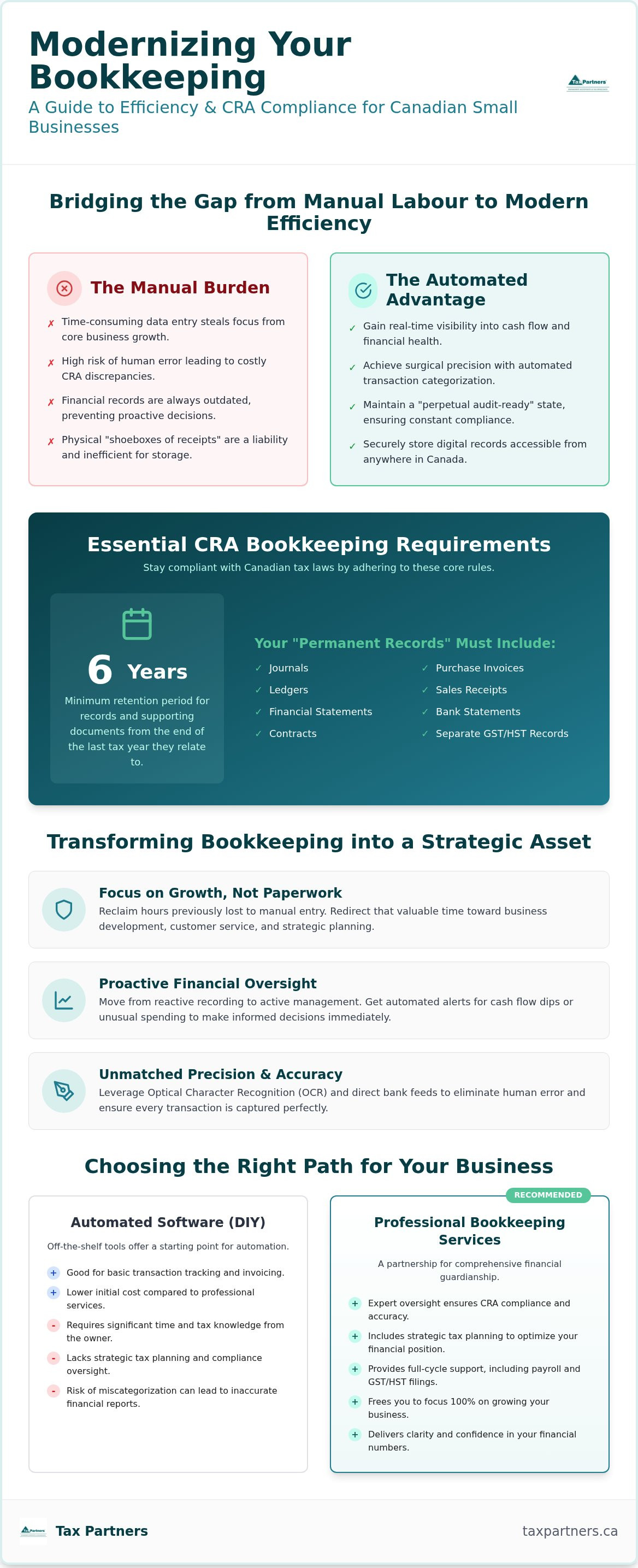
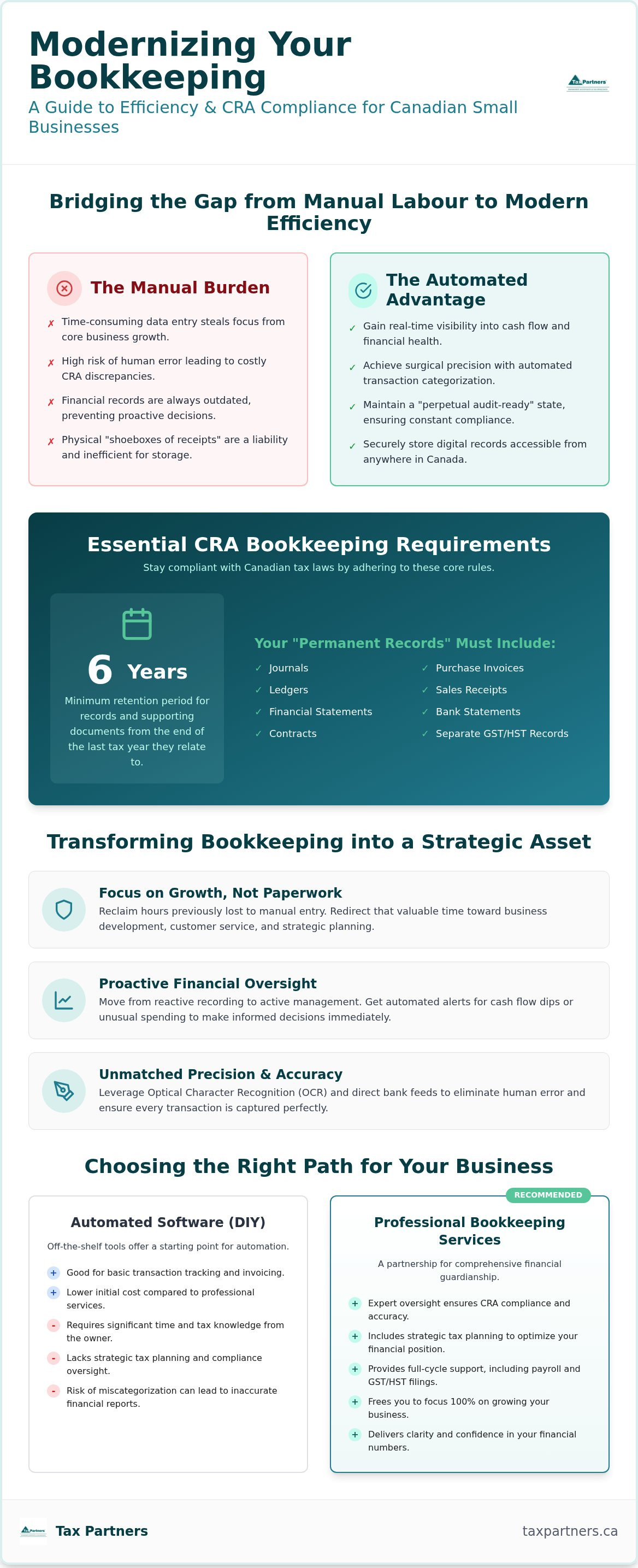
Automated bookkeeping is the intelligent application of software to capture, verify, and categorize financial transactions without the need for constant manual data entry. For many Canadian SMEs, this represents a fundamental departure from the traditional ledger, where every coffee receipt or invoice was once typed into a spreadsheet by hand. By leveraging cloud-based accounting platforms, businesses can now synchronize their bank feeds directly with their records. This ensures that every cent is accounted for as it moves, providing a level of precision that manual systems simply cannot replicate. It's about moving from a state of historical recording to one of active financial awareness.
The Shift from Manual Ledgers to Digital Systems
The era of the "shoebox full of receipts" is rapidly ending in the Canadian market. Business owners increasingly realize that physical paper is a liability, not just a clutter problem. Cloud-based systems offer accessibility that traditional desktop software cannot match. This allows owners to manage their finances from a job site in Calgary or a home office in Halifax with equal ease. A key driver of this shift is Optical Character Recognition (OCR) technology. This tool reads the text on scanned images of receipts and automatically extracts the date, vendor, and amount. It eliminates the human error inherent in manual typing. It also ensures that digital copies are stored securely, which is vital for meeting CRA standards for legible and accessible records.
Why Automation is Essential for SME Growth
Growth requires focus. When you utilize modern bookkeeping services for small business Canada, you reclaim hours previously lost to administrative toil. This time is better spent on business development or customer service. Beyond time savings, automation creates a "perpetual audit-ready" state. Because transactions are categorized in real-time, your books are always current. This transparency allows for proactive financial management. Instead of waiting until year-end to see a deficit, automated alerts can notify you of cash flow dips or unusual spending patterns immediately. It transforms bookkeeping from a reactive chore into a strategic asset. You gain the foresight needed to navigate market shifts while maintaining the ethical steadfastness your partners expect.
Essential CRA Bookkeeping Requirements for Small Business
Maintaining a robust financial history is a legal obligation under the Income Tax Act. The Canada Revenue Agency (CRA) expects businesses to keep "permanent records" that provide a clear picture of their financial health. These include journals, ledgers, and annual financial statements. However, the record is only as strong as its evidence. You must retain supporting documents like purchase invoices, sales receipts, contracts, and bank statements. When seeking bookkeeping services for small business Canada, ensuring your provider prioritizes this evidence trail is essential for long-term stability.
Precise tracking of GST/HST is another non-negotiable requirement. You must record these tax amounts separately from the base price of your goods or services. This level of detail allows you to claim Input Tax Credits (ITCs) accurately, which directly impacts your cash flow. The CRA also recognizes electronic signatures for many documents, provided they meet specific reliability standards. Using automated systems to capture these signatures can significantly speed up your administrative workflows while staying within the lines of regulatory compliance.
Standard Record-Keeping Periods Under CRA Rules
Generally, you must keep all records and supporting documents for a minimum of six years from the end of the last tax year they relate to. For example, records for a fiscal year ending in 2025 should be safely stored until at least the end of 2031. While this is the standard, certain situations like filing an objection or an appeal may require you to hold documents even longer. If you have questions about specific retention exceptions for your industry, you can consult with our team to clarify your obligations. Neglecting these timelines puts you at risk of reassessments and penalties, especially since the CRA currently charges compound daily interest on unpaid balances at some of the highest rates seen in a decade.
Digital Compliance and Data Integrity
The CRA has modernized its approach by allowing electronic record-keeping, but this flexibility comes with strict conditions. Digital files must remain readable and accessible throughout the entire six-year period. Simply saving a file isn't enough; it must be in a format that CRA software can process during an audit. This makes robust, redundant backup systems a critical part of your compliance strategy. Your automated systems must also produce a clear audit trail. Every digital entry should be traceable back to its original source document, ensuring that your data integrity remains beyond reproach during any professional review.
Automated Tools vs Professional Bookkeeping Services
Choosing between a software subscription and professional bookkeeping services for small business Canada isn't a binary decision. It's about understanding where technology ends and expertise begins. While off-the-shelf software is excellent for organizing receipts, it cannot replace the strategic foresight of a seasoned accountant. Software is a tool, much like a calculator; it only provides value if the person using it understands the underlying principles. For a growing SME, the difference between simple data entry and meaningful financial analysis is often the difference between stagnation and scale.
The Limitations of Software-Only Solutions
Software is inherently literal. It processes the data you provide without questioning the underlying tax logic. If you accidentally categorize a capital asset as a current expense, the software won't stop you; it will simply produce an incorrect balance sheet. This "garbage in, garbage out" risk is magnified during the busy tax season. Automated tools also struggle with complex CRA interpretations, such as determining the specific deductibility limits for meals and entertainment or navigating industry-specific tax credits. Without professional bank reconciliation, small discrepancies can snowball into significant errors. These mistakes often go unnoticed until they trigger a formal CRA inquiry, at which point the cost of correction far exceeds the cost of prevention.
Value-Added Benefits of Professional Oversight
A seasoned expert provides a proactive layer of protection that no algorithm can replicate. While software records what happened, a professional identifies what could happen. This includes spotting tax-saving opportunities that automation misses or suggesting structural changes to improve your bottom line. Beyond daily records, professional bookkeeping services are essential when you need a "Notice to Reader" or a formal financial review for lenders. This oversight transforms your books from a compliance chore into a strategic asset.
The hybrid model is the gold standard for Canadian SMEs. You use the software to handle high-volume, repetitive tasks, while your CPA focuses on high-value, strategic ones. This ensures your data is not only current but also accurate and strategically aligned with your long-term goals. It's the difference between merely staying afloat and actually steering the ship. You gain the peace of mind that comes from knowing a proactive guardian is watching over your financial integrity, allowing you to focus entirely on your core business growth.
How to Implement Automated Bookkeeping Under CRA Rules
Transitioning to an automated environment requires more than just a software subscription. It demands a structured roadmap to ensure your digital records align with Canadian regulatory standards. The first step involves a comprehensive needs assessment to identify which business processes, such as invoicing or expense tracking, are ripe for automation. While the allure of "plug and play" solutions is strong, the initial configuration determines the long-term success of your bookkeeping services for small business Canada. A professional setup ensures that your automated feeds flow into a system designed for accuracy rather than just speed.
Selecting and Setting Up Your Software
Your choice of platform must prioritize Canadian tax localization. It's essential to select software that handles GST/HST tracking and provincial tax variations with precision. During setup, your Chart of Accounts must be customized to reflect your specific industry. Generic templates often lead to miscategorized expenses that can complicate your year-end filings. Additionally, robust user permissions and data security protocols are vital. You should control who can view or edit financial data to maintain internal integrity and protect sensitive business information from unauthorized access.
Integrating Payroll and Expense Management
Timely source deduction remittances are a major focus for the CRA. Automated payroll modules calculate these amounts and schedule payments, which significantly reduces the risk of costly late-filing penalties. This integration extends to expense management through digital receipt capture. By scanning receipts immediately, you fulfill the requirement for accessible records while eliminating the risk of lost paperwork. It's equally important to link your business bank accounts and third-party payment processors directly to your ledger. This creates a seamless data flow, but you must remain disciplined about keeping personal funds entirely separate. This clear division is the bedrock of a defensible audit trail and simplifies the reconciliation process.
Building a modern financial system is a journey that benefits from a steady hand at the helm. If you're ready to modernize your operations with a system built for compliance and growth, contact us today to discuss a tailored implementation plan for your bookkeeping services for small business Canada.
Scaling Your Business with Tax Partners Professional Support
Automation provides the data, but scaling a company requires the wisdom to interpret it. Tax Partners stands as the ideal ally for entrepreneurs ready to move beyond basic record-keeping. With over 40 years of experience in the Canadian market, we've helped countless businesses navigate the transition from manual ledgers to high-efficiency automated systems. Our bookkeeping services for small business Canada do more than just balance your accounts; they create a seamless bridge to Canadian corporate tax compliance. This integration ensures that your daily transaction data flows directly into your year-end tax strategy, which minimizes friction and maximizes your financial efficiency.
Having a CPA-managed system provides a level of peace of mind that software alone cannot offer. We act as your proactive guardian, ensuring that every automated entry aligns with the ethical steadfastness and precision your business requires. This professional oversight means you aren't just filing returns; you're building a verifiable financial history that commands respect from lenders, partners, and the CRA alike. We combine decades of institutional wisdom with a forward-thinking approach to modern business needs.
Bespoke Solutions for Over 20 Industries
Every sector has unique financial rhythms. We provide specialized support for more than 20 industries, including the high-volume transaction needs of ecommerce, the complex billing cycles of healthcare, and the capital-heavy requirements of real estate. This niche expertise allows us to provide more than just data entry. We offer tailored insights that lead to significantly more accurate tax planning for SMEs. When your bookkeeping is handled with industry-specific foresight, you're better positioned to capture every available deduction and credit. If you're ready for a system that reflects the unique nuances of your trade, we invite you to Contact Tax Partners for a tailored consultation.
The Advantage of a Seasoned Mentor
We view our role as your seasoned mentor and proactive guardian. We don't just react to your financial data; we look ahead to identify potential hurdles before they impact your bottom line. Accurate bookkeeping is the indispensable foundation for your future wealth management and long-term financial planning. By securing your records today, you're building the stability required to scale tomorrow. It's time to trade the stress of manual entry for the clarity of a CPA-managed system. Let us provide the steady hand at the helm while you focus on the core growth of your business. Modernizing your operations is the first step toward a more secure and profitable future.
Secure Your Financial Future with Modern Bookkeeping
Transitioning to automated systems represents a pivotal shift for any entrepreneur. You've seen how digital tools eliminate the drudgery of manual entry while ensuring your records remain compliant with strict CRA standards. However, the true value lies in the hybrid approach; combining powerful software with the strategic oversight of a seasoned CPA. This synergy turns your financial data into a roadmap for growth rather than just a compliance requirement.
Tax Partners has been a steady hand at the helm for Canadian businesses since 1981. With over 1,390 five-star Google reviews, our reputation for reliability and ethical steadfastness is well-documented. We specialize in complex CRA matters and cross-border tax compliance, ensuring your bookkeeping services for small business Canada are handled with precision and foresight. Don't let your financial records remain a source of stress. Ready to automate your bookkeeping? Contact Tax Partners today for a professional consultation. We look forward to helping you realize your business's full potential with clarity and confidence.
Frequently Asked Questions
Is automated bookkeeping compliant with CRA regulations?
Yes, automated systems are fully compliant as long as they produce readable and accessible electronic records. The CRA allows digital storage provided the data integrity remains intact and you maintain a clear audit trail. This means every digital entry must be traceable back to its original source document. Relying on professional bookkeeping services for small business Canada ensures your automated system is configured to meet these specific regulatory standards from the start.
How long must I keep my digital bookkeeping records for the CRA?
You must retain your records for a minimum of six years from the end of the last tax year they relate to. For example, if you're filing for a fiscal year ending in December 2025, you need to keep those digital files and supporting documents until the end of 2031. This retention period applies to both paper and electronic records. It's a critical safety net in case the CRA decides to review your historical filings.
Can I use automated bookkeeping software without an accountant?
While you can use software independently, doing so often misses the strategic oversight needed for complex Canadian tax laws. Software is a recording tool, not a professional advisor. It doesn't understand the nuances of industry-specific deductions or changing CRA interpretations. A hybrid approach ensures your data is entered efficiently while a CPA reviews the records for accuracy and identifies potential tax-saving opportunities that automation alone would overlook.
What is the difference between bookkeeping and accounting for Canadian SMEs?
Bookkeeping involves the daily recording and categorization of financial transactions to keep your records current. Accounting takes that data to the next level by performing high-level analysis, financial reporting, and tax preparation. Think of bookkeeping as the foundation of your house and accounting as the architectural plan that ensures the structure is sound. Both are essential for a healthy Canadian SME, but they serve different roles in your financial management.
How much does professional bookkeeping service cost in Canada?
Professional service fees in Canada are typically determined by the volume of your transactions and the complexity of your business structure. A simple retail operation will have different requirements than a multi-provincial construction firm. Rather than looking for the lowest price, focus on the value of accuracy and the potential for tax savings. Investing in quality bookkeeping services for small business Canada often pays for itself by preventing costly CRA penalties and interest charges.
What supporting documents do I need to keep for automated expenses?
You need to keep original receipts, invoices, and contracts, even if they are stored digitally. A bank statement or credit card slip shows that a payment was made, but it doesn't provide enough detail for the CRA to verify the nature of the expense. Most automated systems allow you to attach digital copies of these supporting documents directly to the transaction. This creates a robust and organized audit trail that is easy to navigate.
Does automated bookkeeping help with GST/HST filing?
Yes, automation significantly simplifies GST/HST filing by tracking the tax paid on purchases and the tax collected on sales. By categorizing these amounts in real-time, the software can automatically calculate your net tax owing or your refund. This precision makes it much easier to claim Input Tax Credits (ITCs) accurately. It reduces the risk of manual calculation errors that could lead to an unwanted audit or reassessment of your filings.
Can automated systems handle payroll for Canadian employees?
Modern automated systems frequently include integrated payroll modules designed specifically for the Canadian market. These tools calculate federal and provincial source deductions, manage vacation pay, and even generate year-end T4 slips. By automating these repetitive tasks, you ensure that remittances are made on time, which is a major focus for CRA compliance. This integration ensures your payroll data flows seamlessly into your general ledger for accurate and reliable financial reporting.

Article by
Mahad Mohamed
Mahad Mohamed is an accountant and the CEO of Tax Partners, with over 26+ years of Canadian and international tax and accounting experience. His expertise includes corporate reorganization, cross-border tax structuring (Canada & US), tax disputes, CRA audits, and tax planning for small owner-managed private corporations. Most recently, Mahad is a pioneer in Canadian crypto taxation and founded Block3 Finance.
Previously, Mahad worked for the Canada Revenue Agency (CRA), Big4 accounting firms, and served as a Rulings Officer for the Federal Tax Authority of the UAE before acquiring Tax Partners in 2014.
Tax Partners has 44 full-time accountants and over 18,400+ clients.
Disclaimer
This article provides general information only and is current as of its publication date. It has not been updated and may be out of date. It does not constitute legal advice and should not be relied upon as such. Every tax situation is unique and may differ from the examples discussed in this article. If you have specific questions, you should seek the advice of our accountants for your unique circumstances. Book a FREE Initial Consultation Today!
Frequently Asked Questions
Is automated bookkeeping compliant with CRA regulations?
Yes, automated bookkeeping is fully compliant with CRA regulations as long as your records remain readable and accessible. The CRA accepts digital records provided they are complete and supported by original source documents like receipts. Using professional bookkeeping services for small business Canada ensures your digital trail meets these rigorous standards and remains audit-ready at all times.
How long must I keep my digital bookkeeping records for the CRA?
You must retain your records for a minimum of six years from the end of the last tax year to which they relate. This requirement applies to both paper and electronic documents under CRA rules. If you're involved in an ongoing appeal or objection, you might need to keep them longer. You should consult the CRA directly for specific extensions related to your industry.
Can I use automated bookkeeping software without an accountant?
While you can use software independently, doing so carries the risk of misinterpreting complex tax rules or miscategorizing transactions. Software is a tool for data entry, but it can't provide the strategic oversight or CRA-specific advice that a professional offers. An accountant acts as a proactive guardian, ensuring your automated data translates into accurate filings and effective tax planning.
What is the difference between bookkeeping and accounting for Canadian SMEs?
Bookkeeping focuses on the daily recording and categorization of financial transactions to maintain an accurate ledger. Accounting takes that data to perform high-level analysis, prepare financial statements, and develop tax strategies. Both are essential for growth; bookkeeping provides the raw data while accounting provides the insight needed to make informed business decisions.
How much does professional bookkeeping service cost in Canada?
Industry data for 2026 suggests that monthly retainers for small businesses typically range between C$300 and C$1,200, depending on the volume of transactions. Hourly rates for certified specialists can range from C$85 to C$125. These costs vary based on the complexity of your operations and whether you require specialized services like payroll management or cross-border tax support.
What supporting documents do I need to keep for automated expenses?
You must keep digital copies of original invoices, receipts, and bank statements for every expense recorded in your system. The CRA requires these source documents to verify the nature and amount of your business deductions. Most automated systems allow you to attach these digital files directly to the transaction, creating a seamless and permanent audit trail for review.
Does automated bookkeeping help with GST/HST filing?
Yes, automated systems are highly effective at isolating GST/HST amounts and tracking Input Tax Credits (ITCs) in real time. This precision reduces the risk of overpaying or under-reporting your tax obligations during your filing period. Utilizing professional bookkeeping services for small business Canada ensures your tax settings are correctly localized for your specific province and industry requirements.
Can automated systems handle payroll for Canadian employees?
Modern automated platforms are designed to manage payroll by calculating CPP, EI, and federal income tax deductions based on current CRA rates. They also help track taxable benefits and ensure source deductions are remitted on time. This integration reduces manual errors and ensures your payroll records are always synchronized with your general ledger for accurate year-end reporting.