The Essential Guide to Cross-Border E-commerce Accounting in 2026

The global cross-border e-commerce market is projected to reach C$1.74 trillion in 2026, yet this growth becomes a significant liability if your compliance remains an afterthought. You likely feel the persistent weight of reconciling fragmented platform data while worrying about the C$500,000 economic nexus thresholds in states like Texas or New York. It's why securing a specialized cross border ecommerce accountant is now a fundamental requirement for any serious Canadian seller.
We promise to help you master the complexities of CRA and IRS compliance so you can scale your online business without the constant stress of double taxation. Working with a dedicated cross border ecommerce accountant ensures your corporate structure is meticulously optimized for long-term growth rather than immediate tax leak. This clarity allows you to focus on market expansion while we act as your proactive guardian.
This guide provides a clear roadmap for US-Canada tax compliance and explains how to bridge the data gap between merchant platforms and your accounting software. We'll show you how a cross border ecommerce accountant turns your regulatory requirements into a decisive strategic advantage. You will move from a state of potential uncertainty toward a feeling of total control and understanding.
Key Takeaways
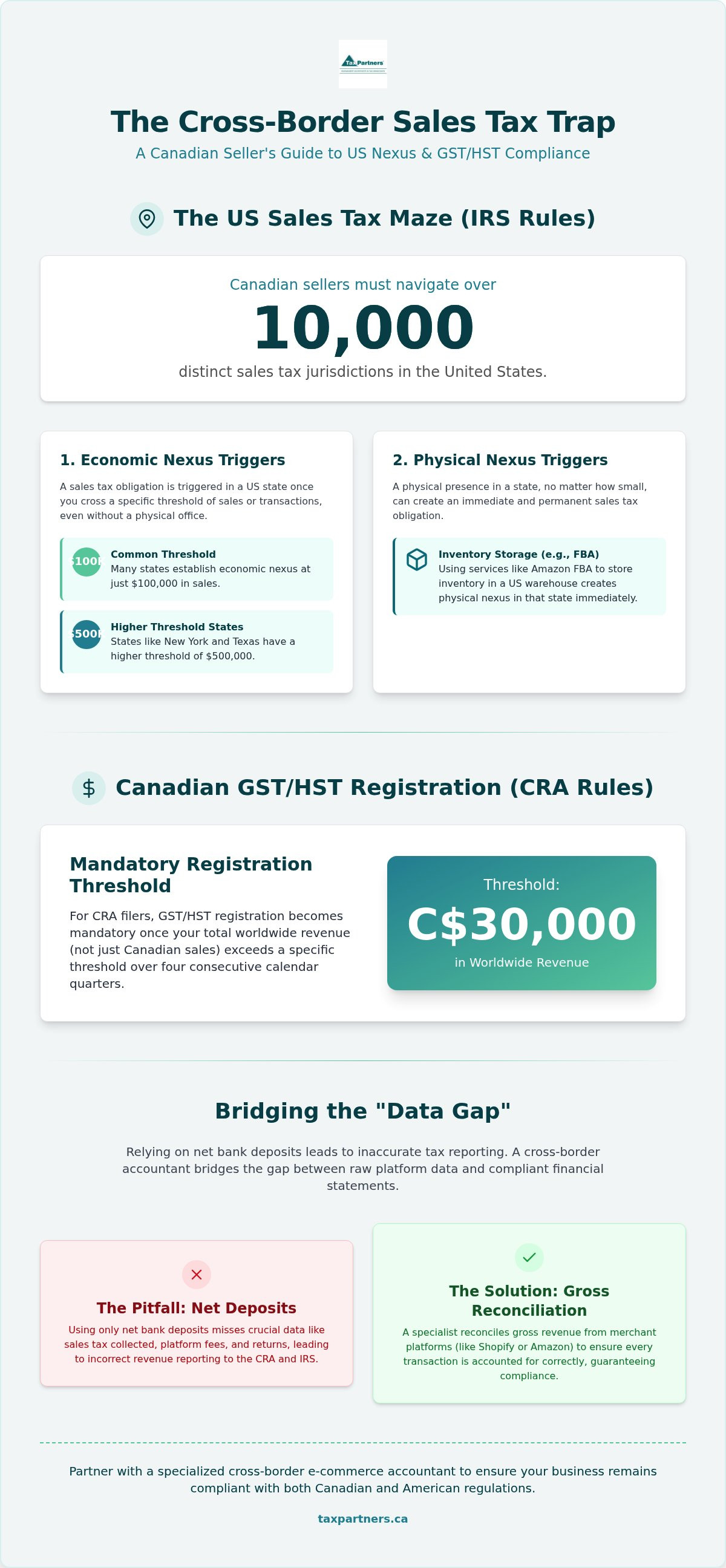
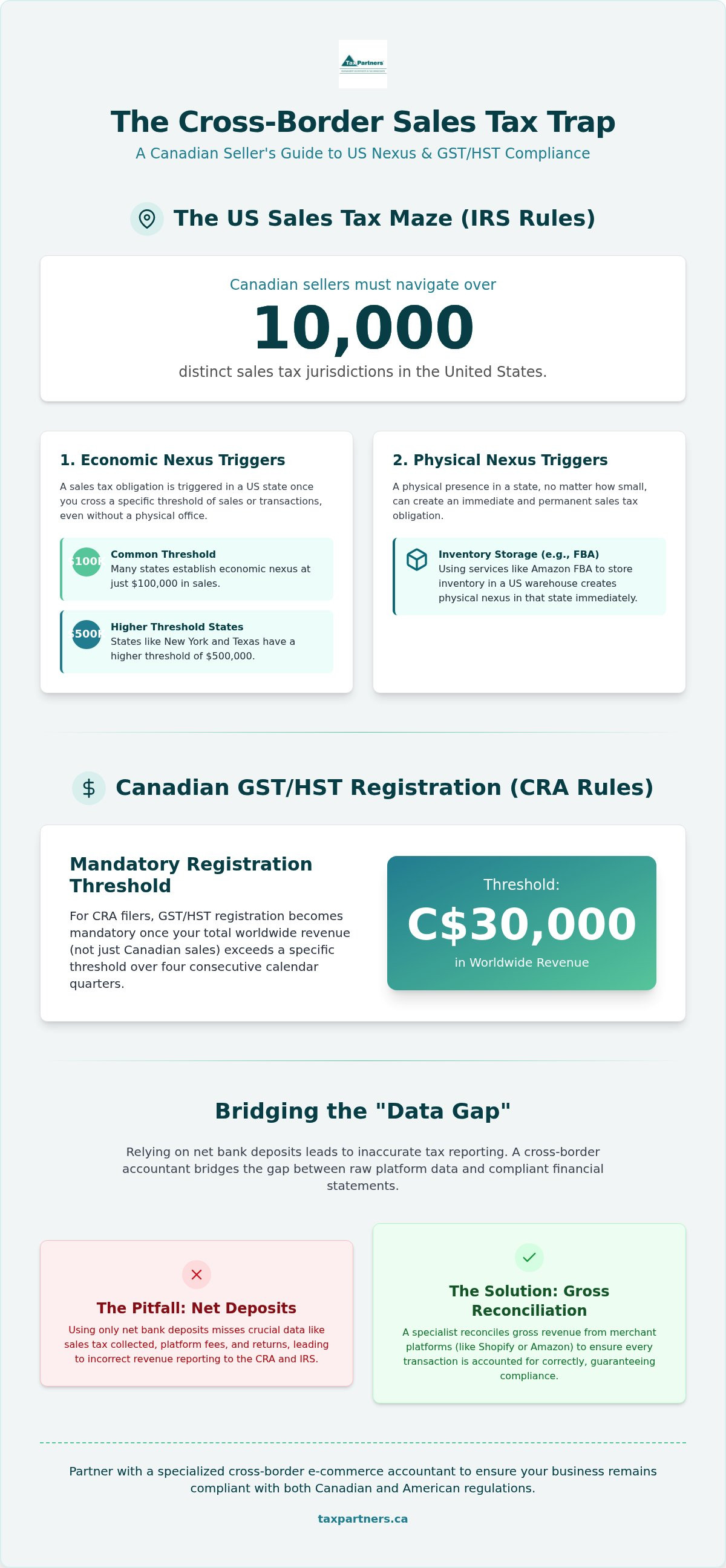
- Learn how to navigate more than 10,000 sales tax jurisdictions in the United States to avoid unexpected nexus liabilities under IRS rules.
- Determine if your worldwide revenue has crossed the C$30,000 threshold requiring mandatory GST/HST registration for CRA filers in Canada.
- Bridge the "Data Gap" by reconciling gross platform revenue rather than relying on net bank deposits that often lead to inaccurate tax reporting.
- Evaluate the tax efficiency of a Canadian corporation versus a US-based entity to minimize global tax leak and simplify your reporting requirements.
- Partner with a specialized cross border ecommerce accountant to ensure your business remains compliant with both Canadian and American regulations throughout 2026.
Navigating the Hidden Borders of E-commerce Taxation
The Canada-United States Tax Convention is your primary tool for preventing double taxation. It ensures that you aren't taxed twice on the same dollar earned. As your cross border ecommerce accountant, we act as a proactive guardian. We don't just react to past data; we look ahead to secure your financial future and optimize your global tax position.
Understanding Your Obligations Under CRA Rules
For CRA filers, the Canada Revenue Agency (CRA) considers you a "Canadian resident" if you have significant residential ties to the country. This status means you must report world-wide income on your Canadian tax return, no matter where your customers live. The CRA also uses "carrying on business" criteria to decide if a corporation owes tax in Canada. These factors include where you solicit orders, where your inventory is held, and where your primary business decisions are made. If you meet these criteria, you're generally required to file a T2 Corporation Income Tax Return annually.
Establishing Your Presence Under IRS Rules
Under IRS rules, non-resident sellers must navigate the concept of Effectively Connected Income (ECI). This is income derived from a trade or business within the United States. The Canada-US tax treaty often protects Canadian businesses through the "Permanent Establishment" (PE) concept. This rule generally prevents the IRS from taxing your profits unless you have a fixed place of business, like a warehouse or office, in the US.
However, you must still be diligent about understanding economic nexus. Crossing specific revenue thresholds in various states can trigger sales tax obligations even without a physical presence. Canadian corporations often need to file Form 1120-F to claim treaty benefits and stay in the good graces of the IRS. Failing to file this form, even if no tax is owed, can lead to significant penalties that drain your business capital.
The Sales Tax Trap: Nexus and GST/HST Compliance
Sales tax is often the most dangerous trap for expanding businesses. Unlike income tax, which is calculated annually on your net profit, sales tax is a consumption tax collected at the point of sale. Failing to collect it doesn't mean the obligation disappears; it simply means the government will eventually collect it directly from your bottom line. Understanding key e-commerce definitions is vital before you start shipping goods across state or provincial lines.
The complexity is staggering. There are over 10,000 distinct sales tax jurisdictions in the United States alone. Each has its own rules, rates, and filing deadlines. Relying solely on platform automation is a common mistake. While services like Shopify or Amazon collect tax, they don't always monitor your nexus triggers or handle the actual filings correctly. A specialized cross border ecommerce accountant provides the oversight needed to bridge these compliance gaps.
If you ignore these triggers, you face the risk of retroactive assessments. States can demand years of back taxes, plus interest and heavy penalties. This can easily wipe out the profit margins of a growing business. It's much safer to have a proactive guardian monitoring your sales volume in real time.
US Sales Tax and the Concept of Economic Nexus
For IRS filers, "Economic Nexus" is the standard following the Wayfair Supreme Court decision. This means you have a tax obligation in a state once you cross a specific threshold of sales or transactions, even without a physical office. For example, New York and Texas both have a $500,000 threshold, but many other states trigger at just $100,000. Physical presence also still matters. If you use Amazon FBA, storing inventory in a warehouse creates physical nexus in that state immediately. You should consult a professional to confirm which state thresholds currently apply to your specific sales volume.
If your sales volume is approaching these limits, particularly in the Lone Star State, you can discover TaxLawAdvisory for specialized legal support to ensure your business remains compliant with local and federal tax codes.
Managing GST, HST, and QST for CRA Filers
For CRA filers in Canada, the registration threshold for GST/HST is C$30,000 in taxable revenue from worldwide sales over four consecutive quarters. Once you cross this limit, registration is mandatory. You must also be aware of the Quebec Sales Tax (QST) if you sell to customers in Quebec. This province has its own registration requirements that operate alongside the federal system. The silver lining is the ability to claim Input Tax Credits (ITCs). These allow you to recover the GST/HST you've paid on business expenses like shipping, inventory, and digital tools. A cross border ecommerce accountant ensures you maximize these credits to protect your cash flow.
Structural Foundations: Choosing Between Entities
Choosing the right business structure is a pivotal decision that impacts your long-term profitability. It dictates your reporting requirements and determines your effective tax rate across two different countries. Without precision, you risk tax leakage, a situation where you pay taxes in one jurisdiction but cannot claim a corresponding credit in another. This often leads to trapped credits that provide no financial benefit. Designing a framework that prevents these inefficiencies is a core responsibility of a cross border ecommerce accountant.
The Canadian Corporation for International Sales
For many entrepreneurs, a Canadian-controlled private corporation (CCPC) serves as a robust foundation. This structure allows you to benefit from the Small Business Deduction, which reduces the corporate tax rate on the first portion of your active business income. When you sell into the American market, the Canada-US tax treaty generally protects your profits from being taxed by the IRS, provided you don't have a permanent establishment. Maintaining Canadian corporate tax compliance is essential to ensure your world-wide income is reported accurately without losing these domestic advantages. It's a balance of meeting CRA expectations while leveraging treaty protections to keep your global tax burden as low as possible.
The US LLC and the 'Hybrid Entity' Challenge
The US Limited Liability Company (LLC) is often marketed as a simple solution for Canadian sellers, but it carries significant risks. The primary issue is its status as a hybrid entity. Under IRS rules, an LLC is typically treated as a flow-through entity where the owners are taxed personally. Conversely, for CRA filers, the Canadian government often views a US LLC as a corporation. This discrepancy can lead to a scenario where you pay personal income tax in the US but cannot use those payments as a foreign tax credit against your Canadian corporate obligations.
Navigating the Limited Liability Company rules requires foresight to avoid double taxation. If your structure isn't organized correctly, you might find yourself paying the maximum rate in both countries without any relief. A seasoned cross border ecommerce accountant acts as your proactive guardian, looking ahead to ensure your entity choice supports your growth rather than creating a regulatory nightmare. They help you weigh the administrative burden of each option against the potential tax savings to find the most efficient path forward.
Operational Precision: Reconciling Merchant Data
Many sellers fall into the trap of recording bank deposits as their total revenue. This creates a dangerous "Data Gap" between what your platform reports and what actually hits your bank account. A net deposit from Shopify or Amazon isn't your gross sales. It's a final number after the platform has deducted fees, refunds, and shipping costs. Both the CRA and IRS require you to report gross revenue and then deduct expenses separately. If you only track net deposits, your books are technically incorrect from day one.
Closing this gap requires automated integrations between your sales channels and your accounting software. Manual entry is a recipe for disaster in a high-volume environment. Professional bookkeeping ensures your records are "audit-ready" at all times. A specialized cross border ecommerce accountant ensures every transaction is mapped correctly to your general ledger. This precision protects you during regulatory reviews and provides a clear view of your actual profit margins.
Reconciling Amazon, Shopify, and eBay Reports
Platform reports are notoriously dense. You must account for platform fees, customer returns, and shipping subsidies with total accuracy. For CRA filers, it's vital to separate sales by jurisdiction to ensure GST/HST and QST compliance. For IRS filers, this data is necessary to monitor state-specific nexus triggers. We recommend maintaining digital backups of all merchant statements for at least seven years. This exceeds the standard six-year requirement from the CRA and provides an extra layer of security for your business.
Protecting this sensitive financial data is paramount; to ensure your providers meet these standards, check out Apex Tech 4 Tax Pros for specialized cybersecurity solutions and Written Information Security Plans (WISP).
The Role of Cloud Accounting in Cross-Border Success
Cloud-based tools are no longer optional for international sellers. We recommend using multi-currency accounting software to track foreign exchange gains or losses accurately. This prevents "hidden" costs from eating into your margins when converting C$ to other currencies. By leveraging Ecommerce accounting services Canada, you gain access to real-time financial data. This transparency allows for proactive tax planning. You can make informed decisions throughout the year rather than reacting to a surprise bill at tax time. If you want to ensure your data is reconciled correctly, get in touch with our team today.
Finding the right platform is the first step in this process; you can consult the guide from Samios Partners to compare accounting software and find the perfect fit for your expanding business.
The Proactive Guardian: Why Expert Guidance Is Essential
E-commerce moves fast. You need a partner who anticipates the next regulatory shift before it impacts your bottom line. A cross border ecommerce accountant acts as more than just a service provider; they are a strategic ally invested in your long-term stability. While software can track numbers, it cannot provide the seasoned judgment required to navigate shifting international treaties.
Tax Partners has spent over 40 years helping entrepreneurs manage the friction of international trade. We've saved our clients more than C$87 million by identifying tax efficiencies that generalist firms often overlook. While the "Big Four" firms offer scale, they frequently lack the personalized foresight a boutique firm provides. We act as your proactive guardian, ensuring your global strategy remains robust as you enter new jurisdictions—much like how you can discover The Sphere Group for specialized guidance if you expand into the Australian market.
For entrepreneurs exploring growth beyond North America, firms such as Davis & Co LLP offer essential audit and specialized tax planning services to ensure your international operations remain seamless and compliant.
Beyond Filing: Strategic Wealth and Succession Planning
Your business profits shouldn't exist in a vacuum. Integrating these gains into a comprehensive Wealth Management & Financial Planning strategy is vital for your personal security. Estate planning becomes significantly more complex for business owners with assets or entities in multiple countries. You must ensure your hard work today translates into a lasting legacy for your family. Proper planning protects your heirs from the administrative hurdles of cross-border inheritance under both CRA and IRS rules.
Taking the Next Step for Your Online Business
Scaling further without a professional compliance review is a high-risk gamble. The landscape for CRA filers and the requirements under IRS rules are constantly shifting. You deserve a steady hand at the helm of your financial future. This allows you to focus on product innovation and market expansion while we handle the regulatory weight. Take control of your global tax strategy today to prevent future revenue leaks. Contact Tax Partners for a cross-border consultation and experience the confidence that comes with expert mentorship.
Secure Your Global Expansion Strategy
Mastering the friction between CRA and IRS rules is the difference between a thriving global brand and a business burdened by tax leak. You now understand that reconciling gross revenue rather than net deposits is essential for accurate reporting under both Canadian and American regulations. Choosing the right entity structure protects your world-wide income from double taxation while ensuring you remain compliant with the requirements for CRA filers.
A specialized cross border ecommerce accountant acts as a proactive guardian for your entrepreneurial vision. With over 40 years of institutional wisdom and more than C$87 million saved for our clients, we provide the steady hand needed to navigate the complex regulatory shifts of 2026. Our 1,390+ five-star reviews reflect a deep-seated reliability that helps alleviate the stress of international expansion. Your business doesn't have to face these complexities alone.
If your expansion strategy includes the Australian market, you can learn more about Business Wise to ensure your tax obligations are managed with similar precision and expertise.
For entrepreneurs seeking specialized international tax and estate guidance, Sheikh Najam TEP offers the legal expertise needed to secure your global interests and ensure long-term compliance.
Taking control of your tax strategy today prevents the administrative hurdles that often derail successful sellers. Your potential for international growth is limitless when your financial foundation is secure and ethically steadfast. Let us help you turn your accounting from a requirement into a competitive advantage.
Secure your e-commerce future with a professional cross-border consultation
Frequently Asked Questions
Do I need to file a US tax return if I only sell digital products to US customers?
Yes, you generally need to file a protective return under IRS rules to claim treaty benefits, even if you don't owe tax. While the Canada-US tax treaty often protects digital sellers without a physical presence, filing Form 1120-F ensures the IRS realizes you are claiming these exemptions. This proactive step prevents the IRS from assessing taxes and penalties based on your gross revenue without allowing for business deductions.
What is the difference between a physical Nexus and an economic Nexus for IRS filers?
Physical nexus is triggered by a tangible connection like storing inventory in an Amazon FBA warehouse, while economic nexus is based entirely on sales activity. Under IRS rules, economic nexus thresholds vary by state, with many states using a limit of $100,000 in annual sales. A cross border ecommerce accountant monitors both triggers to ensure you register for sales tax collection as soon as you meet these state-specific requirements.
Professional tax preparers often rely on robust software from Apex Tax Solutions LLC to manage these complex filings and ensure their clients stay compliant with varying state regulations.
Can I use my Canadian corporation to sell on Amazon.com without a US entity?
You can certainly use your Canadian corporation to sell on Amazon.com without forming a separate US entity. You will need to provide a completed W-8BEN-E form to Amazon to certify your foreign status and claim a reduction in tax withholding under the treaty. This allows you to keep your corporate structure simple while still accessing the massive American consumer market under IRS rules.
How do I avoid paying GST/HST on products I ship directly to US customers?
Products exported from Canada are considered "zero-rated" for CRA filers, which means you don't charge GST/HST to your US customers. To maintain this status, you must keep meticulous records of export, such as shipping manifests or postal receipts, for at least six years. These documents prove to the CRA that the goods actually left Canada and qualify for the 0% tax rate on international sales.
What is a 1040-NR and does it apply to Canadian e-commerce sellers?
Form 1040-NR is the US Nonresident Alien Income Tax Return used by individuals who aren't US residents but earn income from US sources. If you operate your e-commerce business as a sole proprietor rather than a corporation, you must use this form to report your earnings to the IRS. It allows you to calculate your US tax liability and claim relevant treaty benefits to avoid double taxation.
What happens if I forget to collect sales tax in a US state where I have Nexus?
You become personally liable for the uncollected tax, along with significant interest and penalties, if you miss a nexus deadline. States are increasingly aggressive about auditing out-of-state sellers who cross their economic thresholds. If you discover a past error, we can help you navigate a Voluntary Disclosure Agreement to settle the debt with the state while potentially reducing the associated penalties under IRS rules.
How does the CRA view income earned through a US-based Stripe or PayPal account?
The CRA views income in your US-based payment accounts as part of your world-wide income, which is taxable in Canada for all residents. You must convert these earnings into Canadian Dollars (C$) using the Bank of Canada's annual average exchange rate or the rate on the day of the transaction. Simply leaving the money in a US account does not defer your tax obligations for CRA filers.
Should I apply for an ITIN as a Canadian selling online in the US?
You should apply for an Individual Taxpayer Identification Number (ITIN) if you have US tax filing requirements but are not eligible for a Social Security Number. This number is essential for claiming treaty benefits on your US tax returns and prevents payment processors from withholding 30% of your gross revenue. An ITIN provides a formal identity for your business activities under IRS rules and simplifies your cross-border compliance.

Article by
Mahad Mohamed
Mahad Mohamed is an accountant and the CEO of Tax Partners, with over 26+ years of Canadian and international tax and accounting experience. His expertise includes corporate reorganization, cross-border tax structuring (Canada & US), tax disputes, CRA audits, and tax planning for small owner-managed private corporations. Most recently, Mahad is a pioneer in Canadian crypto taxation and founded Block3 Finance.
Previously, Mahad worked for the Canada Revenue Agency (CRA), Big4 accounting firms, and served as a Rulings Officer for the Federal Tax Authority of the UAE before acquiring Tax Partners in 2014.
Tax Partners has 44 full-time accountants and over 18,400+ clients.
Disclaimer
This article provides general information only and is current as of its publication date. It has not been updated and may be out of date. It does not constitute legal advice and should not be relied upon as such. Every tax situation is unique and may differ from the examples discussed in this article. If you have specific questions, you should seek the advice of our accountants for your unique circumstances. Book a FREE Initial Consultation Today!
Frequently Asked Questions
Do I need to file a US tax return if I only sell digital products to US customers?
Yes, you generally need to file a protective return under IRS rules to claim treaty benefits, even if you don't owe tax. While the Canada-US tax treaty often protects digital sellers without a physical presence, filing Form 1120-F ensures the IRS realizes you are claiming these exemptions. This proactive step prevents the IRS from assessing taxes and penalties based on your gross revenue without allowing for business deductions.
What is the difference between a physical Nexus and an economic Nexus for IRS filers?
Physical nexus is triggered by a tangible connection like storing inventory in an Amazon FBA warehouse, while economic nexus is based entirely on sales activity. Under IRS rules, economic nexus thresholds vary by state, with many states using a limit of $100,000 in annual sales. A cross border ecommerce accountant monitors both triggers to ensure you register for sales tax collection as soon as you meet these state-specific requirements.
Can I use my Canadian corporation to sell on Amazon.com without a US entity?
You can certainly use your Canadian corporation to sell on Amazon.com without forming a separate US entity. You will need to provide a completed W-8BEN-E form to Amazon to certify your foreign status and claim a reduction in tax withholding under the treaty. This allows you to keep your corporate structure simple while still accessing the massive American consumer market under IRS rules.
How do I avoid paying GST/HST on products I ship directly to US customers?
Products exported from Canada are considered "zero-rated" for CRA filers, which means you don't charge GST/HST to your US customers. To maintain this status, you must keep meticulous records of export, such as shipping manifests or postal receipts, for at least six years. These documents prove to the CRA that the goods actually left Canada and qualify for the 0% tax rate on international sales.
What is a 1040-NR and does it apply to Canadian e-commerce sellers?
Form 1040-NR is the US Nonresident Alien Income Tax Return used by individuals who aren't US residents but earn income from US sources. If you operate your e-commerce business as a sole proprietor rather than a corporation, you must use this form to report your earnings to the IRS. It allows you to calculate your US tax liability and claim relevant treaty benefits to avoid double taxation.
What happens if I forget to collect sales tax in a US state where I have Nexus?
You become personally liable for the uncollected tax, along with significant interest and penalties, if you miss a nexus deadline. States are increasingly aggressive about auditing out-of-state sellers who cross their economic thresholds. If you discover a past error, we can help you navigate a Voluntary Disclosure Agreement to settle the debt with the state while potentially reducing the associated penalties under IRS rules.
How does the CRA view income earned through a US-based Stripe or PayPal account?
The CRA views income in your US-based payment accounts as part of your world-wide income, which is taxable in Canada for all residents. You must convert these earnings into Canadian Dollars (C$) using the Bank of Canada's annual average exchange rate or the rate on the day of the transaction. Simply leaving the money in a US account does not defer your tax obligations for CRA filers.
Should I apply for an ITIN as a Canadian selling online in the US?
You should apply for an Individual Taxpayer Identification Number (ITIN) if you have US tax filing requirements but are not eligible for a Social Security Number. This number is essential for claiming treaty benefits on your US tax returns and prevents payment processors from withholding 30% of your gross revenue. An ITIN provides a formal identity for your business activities under IRS rules and simplifies your cross-border compliance.