401(k) in Canada Tax Treatment: A 2026 Guide for CRA Filers

What if the very treaty designed to protect your retirement savings actually becomes a source of financial risk because of a single missed filing? Moving across the border shouldn't mean losing sleep over your 401(k) or fearing that the CRA will take an unfair bite out of your hard-earned US savings. You've spent years building your nest egg under IRS rules; it's natural to feel overwhelmed by the transition to a new tax authority. Proper knowledge of the 401k in Canada tax treatment is essential for anyone looking to preserve their wealth while living north of the border.
We recognize that the shift from US terminology to Canadian compliance can feel like learning a second language. This guide simplifies that journey by explaining how the Canada-United States Tax Treaty acts as your primary safeguard. You'll learn how to maintain your account's tax-deferred status and avoid the trap of double taxation through proper foreign tax credits. We also provide a clear preview of the 2026 CRA reporting requirements, including the T1135 cost-amount thresholds and the vital elections needed for Roth 401(k) holders.
Key Takeaways
- Understand how the Canada-United States Tax Treaty protects your savings. Growth remains tax-deferred under CRA rules until you begin distributions.
- Discover the critical one-time election required for Roth 401(k) holders. This step is essential to maintain tax-free status in Canada and avoid liabilities on future growth.
- Learn about the specific CRA reporting requirements, such as Form T1135, that apply to the 401k in Canada tax treatment. This is mandatory when foreign assets exceed the $100,000 CAD cost-amount threshold.
- Identify how to utilize foreign tax credits on your Canadian income tax return. These credits help offset US withholding taxes and eliminate the risk of double taxation.
- Evaluate your management options, such as rolling your funds into a Traditional IRA. This can provide greater investment control while residing in Canada.
Understanding the 401(k) as a Canadian Tax Resident
A 401(k) is a retirement savings plan sponsored by an employer in the United States. It allows employees to save and invest a portion of their paycheck before taxes are taken out. For those who have moved north, the Canada Revenue Agency (CRA) generally recognizes these plans as "foreign retirement arrangements" under the Income Tax Act. This classification is vital for your annual tax filing because it dictates how the CRA views the money sitting in your account. Without this clear definition, your retirement savings could be misclassified, leading to unnecessary tax complications.
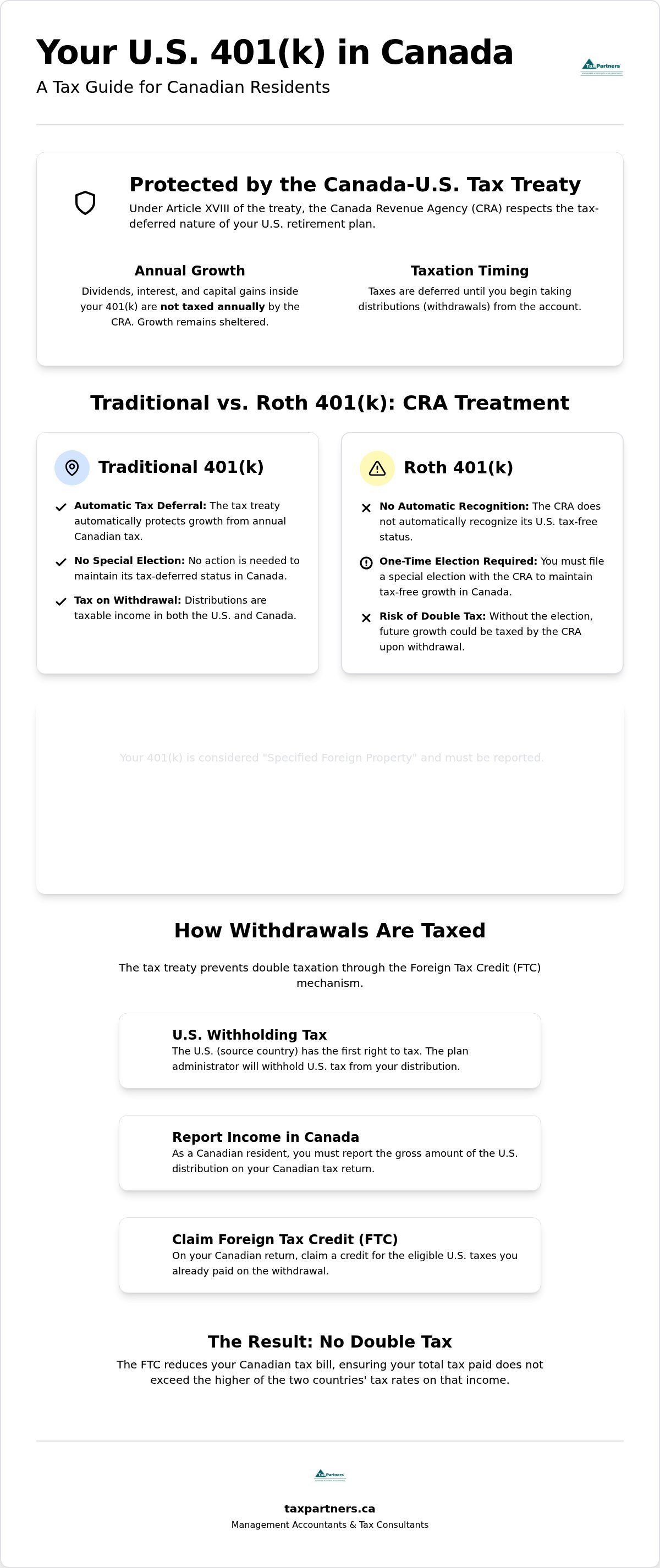
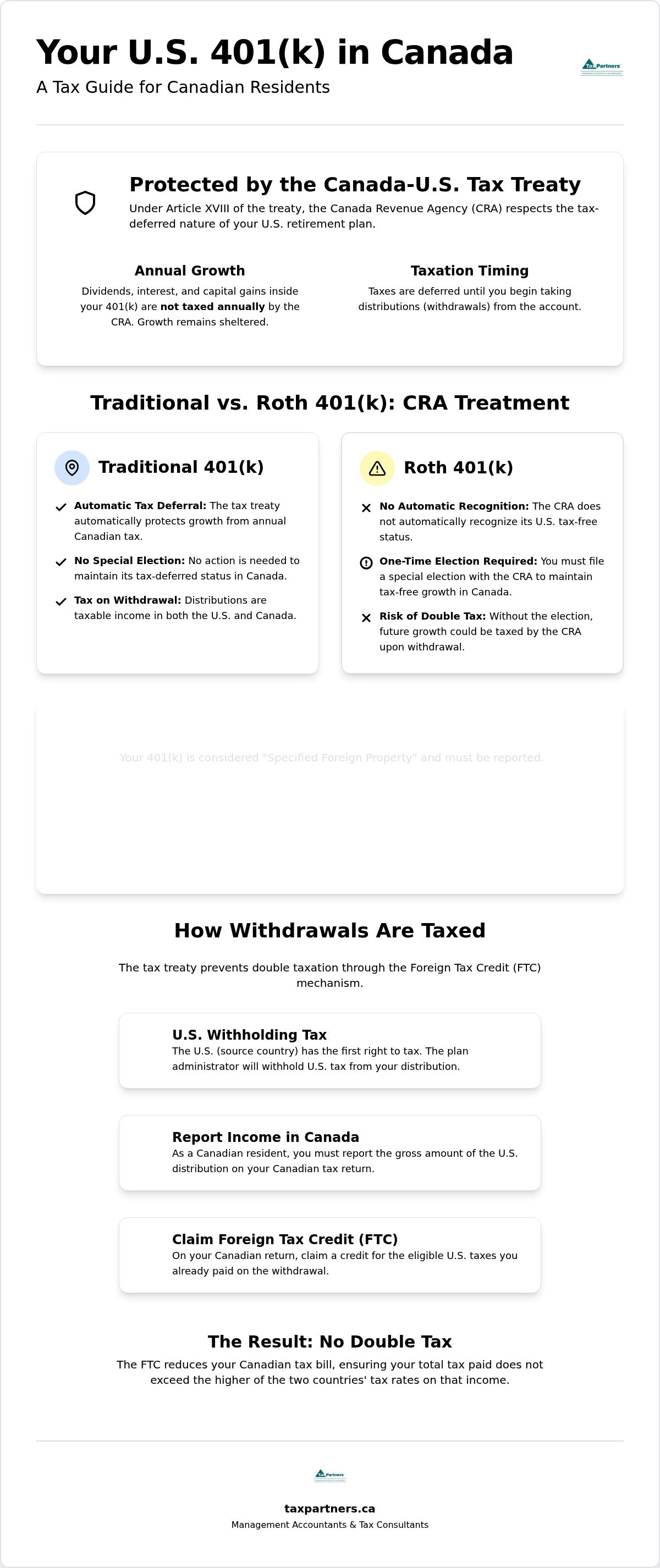
One of the most common concerns for new Canadian residents is whether the CRA will tax the annual growth inside their plan. You might see your balance increase through dividends, interest, or capital gains. Fortunately, the default 401k in Canada tax treatment for a traditional account mirrors the US approach. The CRA does not tax the growth annually while it stays within the plan. Instead, tax is deferred until the moment you take a distribution. This alignment between the IRS and CRA helps protect your long-term savings from immediate erosion while you are building your life in Canada.
Traditional vs. Roth 401(k) from a CRA Perspective
The distinction between account types is where many filers encounter confusion. A traditional 401(k) uses pre-tax contributions, whereas a Roth 401(k) is funded with after-tax dollars. Under IRS rules, the Roth version offers tax-free growth and withdrawals. However, the CRA views these differently. While the IRS sees a Roth account as a retirement vehicle, the CRA requires specific action to maintain its tax-free status. If you don't file a one-time election, the CRA could treat the earnings as taxable income. You shouldn't assume that US tax-free status automatically applies in Canada. The 401k in Canada tax treatment for Roth accounts is a specialized area that requires careful attention to detail.
The Resident vs. Non-Resident Distinction
Your tax obligations change significantly the day you become a resident of Canada for tax purposes. At that point, you are required to report your worldwide income to the CRA. This transition is complex for US citizens because they remain US tax persons regardless of where they live. Conversely, Canadian residents who are not US citizens are treated as non-resident aliens by the IRS. You must understand your residency status for tax in Canada to ensure you are filing correctly with both authorities. Failing to distinguish between these roles can lead to costly reporting errors and potential audits from either the CRA or the IRS.
The Canada-United States Tax Treaty: Protecting Your Retirement Savings
The cornerstone of cross-border retirement planning is the Canada-United States Tax Treaty, specifically Article XVIII. This agreement provides the legal framework that prevents your savings from being eroded by competing tax authorities. Under this treaty, the 401k in Canada tax treatment is governed by the principle of tax deferral. This means the CRA respects the original purpose of your US plan; it won't tax the internal growth of a traditional 401(k) while the funds remain in the account. You don't need to file a special election to secure this deferral for traditional plans, as the treaty provides this protection automatically for Canadian residents.
A vital concept to understand is the "First Right to Tax." When you eventually withdraw funds, the US, as the source country, has the primary right to tax that income. As a Canadian resident, you must also report this income to the CRA. To ensure you aren't paying twice, the treaty allows you to claim a Foreign Tax Credit (FTC) on your Canadian return. This mechanism effectively reduces your Canadian tax bill by the amount of eligible tax already paid to the IRS. If you feel uncertain about how these treaty benefits apply to your specific portfolio, you can consult with a specialist to ensure your filings are optimized.
Avoiding Double Taxation on Distributions
The goal of the Foreign Tax Credit is to ensure your total tax liability doesn't exceed the higher of the two countries' tax rates. When you receive a distribution, you report the gross amount on your Canadian return. You then apply the tax withheld by the IRS as a credit against your Canadian provincial and federal tax owing. This process requires precision to match the income to the correct tax year and currency exchange rates. For those managing significant assets, obtaining expert guidance on avoiding double taxation is a proactive way to safeguard your wealth.
IRS Withholding Rules for Canadian Residents
The IRS applies different withholding rates depending on how you take your money. For periodic pension payments, such as regular monthly distributions, the treaty typically reduces the US withholding rate to 15% for Canadian residents. However, if you opt for a non-periodic lump-sum withdrawal, the default US withholding rate is 30%. To qualify for these reduced treaty rates, you must provide your US plan custodian with a completed Form W-8BEN. You should also be aware that under IRS rules, a 10% early withdrawal penalty applies if you take distributions before age 59.5. It is important to remember that this 10% penalty is generally not creditable on a Canadian tax return, making it a pure cost of withdrawal. For more details on how these rules compare to domestic plans, you can review the CRA rules for registered retirement plans.
Traditional vs. Roth 401(k)s: Navigating CRA Election Requirements
The 401k in Canada tax treatment for Roth accounts represents one of the most technical areas of cross-border compliance. While the IRS allows these accounts to grow and distribute funds tax-free, the CRA treats them as taxable foreign trusts by default. This means that unless you take specific action, the CRA could tax the annual dividends, interest, and realized capital gains within your Roth account. To avoid this, you must invoke the protections of the Canada-United States Tax Treaty. It's a requirement for anyone wishing to maintain the tax-free benefits they earned while working in the United States under IRS rules for 401(k) plans.
To preserve the tax-deferred status of your Roth 401(k), you must file a one-time election with the CRA. This election informs the Canadian authorities that you wish to treat the account as a pension plan under the treaty. If you neglect this step, the CRA will not recognize the account's tax-exempt status. Consequently, you would owe Canadian tax on the internal earnings of the account every year, even if you don't take a distribution. This is a common pitfall that can lead to significant tax liabilities and complex catch-up filings if not addressed immediately upon establishing residency.
Filing the Roth Election with the CRA
You must file this election in writing to the CRA. It's a formal statement where you identify your Roth account and claim treaty benefits to defer taxation on its earnings. The deadline for this filing is typically April 30th of the year following the year you became a Canadian resident. It's a protective election that secures the future tax-free status of your withdrawals. Because this is a one-time requirement, you should verify the current submission procedures directly with the CRA or a cross-border specialist to ensure your savings remain protected.
Pro-Tax Tip: The "No Contribution" Rule
Establishing residency in Canada brings an immediate end to your ability to contribute to a Roth 401(k). If you make even a single contribution to the plan while you're a Canadian resident, you "taint" the account. Under the treaty, adding new funds after you've moved can cause the entire account to lose its tax-exempt status in Canada. This would make all future growth taxable by the CRA. To avoid this, you should stop all automated contributions before your move date. Instead, consider redirecting your retirement savings into Canadian vehicles like a Registered Retirement Savings Plan (RRSP) or a Tax-Free Savings Account (TFSA), which are designed for Canadian residents.
Mandatory Reporting for Cross-Border Accounts under CRA and IRS Rules
While the Canada-United States Tax Treaty provides essential protection against double taxation, it does not exempt you from the rigorous reporting requirements of either country. Many filers mistakenly believe that because their savings are tax-deferred, they don't need to disclose them to the CRA. In reality, the 401k in Canada tax treatment involves strict transparency. You must proactively report these holdings to ensure you remain in good standing with the tax authorities. Failure to do so can lead to significant administrative hurdles and financial penalties that far outweigh any potential tax savings.
The primary reporting tool for the CRA is Form T1135, the Foreign Income Verification Statement. If you are a Canadian resident and the total cost amount of your specified foreign property exceeds $100,000 CAD at any time during the year, you are legally required to file this form. Your 401(k) is considered specified foreign property. The penalties for neglecting this filing are severe; the CRA can apply a penalty of $25 per day, reaching a maximum of $2,500 per year plus interest. This penalty applies even if you owe no tax to the CRA, making it a critical compliance step for every expat. If you are unsure whether your current assets meet these requirements, you should speak with a cross-border accountant to review your portfolio.
CRA Form T1135: The $100,000 Threshold
Calculating whether you meet the $100,000 CAD threshold requires looking at the "cost amount" of your assets, not just their current market value. For most new residents, the cost amount is the fair market value of the 401(k) on the day you officially became a resident of Canada. If your total foreign assets are between $100,000 and $249,999 CAD, the CRA allows for a simplified reporting method. However, once your assets exceed $250,000 CAD, you must use the detailed reporting method. You can find more details on these forms in our FBAR and T1135 filing requirements checklist.
IRS Compliance for Dual Citizens and Green Card Holders
If you are a US citizen or Green Card holder living in Canada, your reporting obligations to the IRS remain unchanged. You must continue to file annual US tax returns and report your 401(k) on FinCEN Form 114, commonly known as the FBAR. This form is required if the aggregate value of all your foreign financial accounts exceeds $10,000 USD at any point during the calendar year. Additionally, you may need to file IRS Form 8938 under FATCA rules if your assets exceed certain thresholds. For those who are not US citizens but have US income, understanding 1040-NR Filing for Canadians: A Guide to IRS Compliance in 2026 is equally vital for maintaining total cross-border integrity.
Strategic Management of Your U.S. Retirement Assets from Canada
Deciding what to do with your 401(k) after moving to Canada is a choice that defines your financial future. You generally have three paths to consider, each with distinct implications for the 401k in Canada tax treatment. The first option is to leave the funds in the US plan. This is often the simplest route because the Canada-US Tax Treaty automatically protects the tax-deferred status of traditional accounts. However, you may face limited investment choices, and some US plan administrators will freeze accounts or force distributions once they realize you no longer reside in the United States. This can create an unexpected tax event at a time when you aren't prepared to manage it.
The second option involves rolling your 401(k) into a Traditional IRA. This move typically provides greater control over your investments and allows you to consolidate multiple old employer plans into a single account. While this maintains your tax deferral under CRA rules, you must ensure your US custodian is willing to work with Canadian residents. The third, and most complex, option is to collapse the plan entirely and move the proceeds to Canada. This strategy requires a bespoke approach that accounts for your age, your current tax bracket, and your long-term goals in Canada.
The RRSP Transfer: Moving Funds to Canada
Transferring US retirement funds into a Canadian Registered Retirement Savings Plan (RRSP) is possible through a specific mechanism under Section 60(j) of the Income Tax Act. This process allows you to take a lump-sum withdrawal from your US plan and contribute it to your RRSP. If executed correctly, the strategy aims to be tax-neutral in Canada; the RRSP deduction you claim should offset the income you report from the US withdrawal. However, the 401k in Canada tax treatment in this scenario is tricky because the IRS will likely withhold 30% of the lump sum immediately. You must have the cash on hand to "top up" the RRSP contribution to the full gross amount of the withdrawal to avoid a Canadian tax bill. This requires precise timing and a deep understanding of how to recover that 30% US withholding through foreign tax credits on your Canadian return.
Why a Cross-Border Specialist is Essential
Managing cross-border wealth involves more than just filling out forms; it requires a proactive guardian who can anticipate regulatory shifts before they impact your savings. Tax Partners provides a steady hand for these complex transitions, drawing on over 40 years of institutional wisdom to protect our clients' interests. We don't just react to requirements; we look ahead to secure the best possible outcomes for your retirement. Whether you are navigating the T1135 threshold or weighing the merits of a 60(j) transfer, professional oversight is your best defence against CRA audits and IRS penalties. You don't have to manage these complexities alone. Contact Tax Partners for a personalized cross-border tax consultation to ensure your retirement strategy is as robust as your ambitions.
Protect Your Retirement Legacy with Confidence
Successfully managing your US retirement assets while living in Canada requires a proactive approach to compliance. You have worked hard to build your nest egg; don't let administrative oversights like missing a Roth election or failing to file Form T1135 jeopardize your financial security. The Canada-United States Tax Treaty provides a robust framework for your protection, but it requires precise execution to remain effective under CRA scrutiny. Understanding the nuances of 401k in Canada tax treatment is the first step toward a stress-free transition and long-term stability.
With over 40 years of institutional wisdom and more than 1,390 five-star Google reviews, our specialized US-Canada tax experts are ready to act as your proactive guardian. We ensure every detail is handled with precision, from foreign tax credit optimization to complex jurisdictional reporting. Secure your cross-border retirement with Tax Partners today to gain total control over your global assets. You deserve a steady hand at the helm to guide you through every regulatory challenge with warmth and expertise.
Frequently Asked Questions
Is my US 401(k) taxable by the CRA if I move to Canada?
The growth within your traditional 401(k) is not taxable by the CRA on an annual basis while it remains in the account. Under Article XVIII of the Canada-United States Tax Treaty, the CRA respects the tax-deferred status of these plans for Canadian residents. You only face taxation in Canada when you take a distribution from the account, at which point the withdrawal is reported as pension income on your Canadian tax return.
Can I contribute to my 401(k) after becoming a Canadian resident?
You should generally stop all contributions to your 401(k) once you establish residency in Canada. For traditional plans, continuing to contribute while working for a US employer as a Canadian resident can create complex reporting issues. For Roth accounts, making even a single contribution after moving can "taint" the plan, causing the CRA to tax all future internal growth and potentially stripping the account of its treaty protections.
What is the CRA Roth election and when is the deadline?
The Roth election is a one-time written statement sent to the CRA to maintain the tax-free status of your Roth 401(k) earnings in Canada. Without this election, the CRA may treat the account's annual growth as taxable income. Under CRA rules, the deadline for filing this protective election is typically April 30th of the year following the calendar year in which you became a resident of Canada.
Do I need to report my 401(k) on CRA Form T1135?
You must report your 401(k) on Form T1135 if the total cost amount of your specified foreign property exceeds $100,000 CAD at any point during the year. This form is a mandatory information return required by the CRA for Canadian residents holding significant foreign assets. Failure to file this form can result in a penalty of $25 per day, up to a maximum of $2,500 per year plus interest.
How does the Canada-US Tax Treaty prevent double taxation on my 401(k)?
The treaty prevents double taxation through the Foreign Tax Credit (FTC) mechanism on your Canadian tax return. When you withdraw funds, the US has the first right to tax the income at the source. You then report that same income to the CRA and claim a credit for the eligible US taxes paid. This ensures the 401k in Canada tax treatment remains fair, with your total tax limited to the higher of the two countries' rates.
Can I transfer my 401(k) directly into a Canadian RRSP?
A direct, tax-free transfer from a US 401(k) to a Canadian RRSP is not possible under current tax laws. However, you can perform an indirect transfer by taking a lump-sum withdrawal from the US plan and contributing it to an RRSP under Section 60(j) of the Income Tax Act. This is a highly technical process that involves US withholding taxes and requires sufficient RRSP contribution room to achieve a tax-neutral outcome.
What happens to my 401(k) if I am a dual citizen living in Canada?
Dual citizens face a double reporting burden because they are viewed as tax persons by both the CRA and the IRS. You must report your 401(k) distributions on both your Canadian and US tax returns while utilizing treaty credits to avoid paying tax twice. Additionally, you must meet IRS reporting requirements, such as filing the FBAR (FinCEN Form 114) if your total foreign account balances exceed $10,000 USD.
Is there an early withdrawal penalty for taking money out of a 401(k) from Canada?
Yes, under IRS rules, a 10% early withdrawal penalty typically applies if you take money out of your 401(k) before age 59.5. It is important to realize that the CRA does not view this 10% penalty as a creditable tax. Therefore, you cannot use this US penalty to reduce your Canadian tax bill, making early withdrawals a particularly expensive option for Canadian residents.

Article by
Mahad Mohamed
Mahad Mohamed is an accountant and the CEO of Tax Partners, with over 26+ years of Canadian and international tax and accounting experience. His expertise includes corporate reorganization, cross-border tax structuring (Canada & US), tax disputes, CRA audits, and tax planning for small owner-managed private corporations. Most recently, Mahad is a pioneer in Canadian crypto taxation and founded Block3 Finance.
Previously, Mahad worked for the Canada Revenue Agency (CRA), Big4 accounting firms, and served as a Rulings Officer for the Federal Tax Authority of the UAE before acquiring Tax Partners in 2014.
Tax Partners has 44 full-time accountants and over 18,400+ clients.
Disclaimer
This article provides general information only and is current as of its publication date. It has not been updated and may be out of date. It does not constitute legal advice and should not be relied upon as such. Every tax situation is unique and may differ from the examples discussed in this article. If you have specific questions, you should seek the advice of our accountants for your unique circumstances. Book a FREE Initial Consultation Today!
Frequently Asked Questions
Is my US 401(k) taxable by the CRA if I move to Canada?
The growth within your traditional 401(k) is not taxable by the CRA on an annual basis while it remains in the account. Under Article XVIII of the Canada-United States Tax Treaty, the CRA respects the tax-deferred status of these plans for Canadian residents. You only face taxation in Canada when you take a distribution from the account, at which point the withdrawal is reported as pension income on your Canadian tax return.
Can I contribute to my 401(k) after becoming a Canadian resident?
You should generally stop all contributions to your 401(k) once you establish residency in Canada. For traditional plans, continuing to contribute while working for a US employer as a Canadian resident can create complex reporting issues. For Roth accounts, making even a single contribution after moving can "taint" the plan, causing the CRA to tax all future internal growth and potentially stripping the account of its treaty protections.
What is the CRA Roth election and when is the deadline?
The Roth election is a one-time written statement sent to the CRA to maintain the tax-free status of your Roth 401(k) earnings in Canada. Without this election, the CRA may treat the account's annual growth as taxable income. Under CRA rules, the deadline for filing this protective election is typically April 30th of the year following the calendar year in which you became a resident of Canada.
Do I need to report my 401(k) on CRA Form T1135?
You must report your 401(k) on Form T1135 if the total cost amount of your specified foreign property exceeds $100,000 CAD at any point during the year. This form is a mandatory information return required by the CRA for Canadian residents holding significant foreign assets. Failure to file this form can result in a penalty of $25 per day, up to a maximum of $2,500 per year plus interest.
How does the Canada-US Tax Treaty prevent double taxation on my 401(k)?
The treaty prevents double taxation through the Foreign Tax Credit (FTC) mechanism on your Canadian tax return. When you withdraw funds, the US has the first right to tax the income at the source. You then report that same income to the CRA and claim a credit for the eligible US taxes paid. This ensures the 401k in Canada tax treatment remains fair, with your total tax limited to the higher of the two countries' rates.
Can I transfer my 401(k) directly into a Canadian RRSP?
A direct, tax-free transfer from a US 401(k) to a Canadian RRSP is not possible under current tax laws. However, you can perform an indirect transfer by taking a lump-sum withdrawal from the US plan and contributing it to an RRSP under Section 60(j) of the Income Tax Act. This is a highly technical process that involves US withholding taxes and requires sufficient RRSP contribution room to achieve a tax-neutral outcome.
What happens to my 401(k) if I am a dual citizen living in Canada?
Dual citizens face a double reporting burden because they are viewed as tax persons by both the CRA and the IRS. You must report your 401(k) distributions on both your Canadian and US tax returns while utilizing treaty credits to avoid paying tax twice. Additionally, you must meet IRS reporting requirements, such as filing the FBAR (FinCEN Form 114) if your total foreign account balances exceed $10,000 USD.
Is there an early withdrawal penalty for taking money out of a 401(k) from Canada?
Yes, under IRS rules, a 10% early withdrawal penalty typically applies if you take money out of your 401(k) before age 59.5. It is important to realize that the CRA does not view this 10% penalty as a creditable tax. Therefore, you cannot use this US penalty to reduce your Canadian tax bill, making early withdrawals a particularly expensive option for Canadian residents.