2026 Tax Strategies for Canadian Real Estate Investors

Did you know that the widely feared increase to the capital gains inclusion rate was officially cancelled, leaving the 2026 rate at 50% under CRA rules? While this news brings relief, many Canadian investors still struggle to distinguish between current and capital expenses or fear the rising tide of audits. Successfully implementing tax strategies for real estate investors Canada requires more than just filing forms; it demands a proactive defensive framework.
You likely feel that the regulatory environment is becoming increasingly complex, especially with the CRA's heightened focus on short-term rental compliance. It's natural to want a steady hand to guide you through these shifting requirements and ensure every deduction is legitimate. This article will help you master the nuances of real estate taxation so you can protect your hard-earned wealth and maximize your investment returns.
We've designed this guide to provide a clear framework for property deductions and a deep dive into when a holding company makes sense for your portfolio. For CRA filers, gaining the confidence to meet reporting requirements like Form T776 is essential to avoiding unnecessary scrutiny. Let's look ahead together to secure a better outcome for your 2026 tax season.
Key Takeaways
- Learn how to implement effective tax strategies for real estate investors Canada to properly classify your rental income and avoid common pitfalls.
- Understand the fundamental distinction between current and capital expenses to maximize your annual property deductions under CRA rules.
- Gain clarity on capital gains reporting and the principal residence exemption to protect your profits during a property sale.
- Evaluate the benefits of personal ownership against corporate structures to find the most efficient path for your wealth growth.
- Identify the red flags that trigger a CRA audit and learn how to build a robust digital trail for total reporting confidence.
Understanding Real Estate Taxation for CRA Filers
Establishing effective tax strategies for real estate investors Canada begins with a clear understanding of your legal obligations. For CRA filers, property is categorized based on the intent and the level of service provided. Understanding the broader framework of Taxation in Canada is the first step toward securing your financial future.
You must demonstrate a "reasonable expectation of profit" to claim expenses against your income. If the CRA determines your rental activity is a personal endeavour rather than a commercial one, they may disallow your deductions. A proactive guardian at your side ensures your records reflect a legitimate investment strategy from the moment you acquire a property.
Professional guidance from a seasoned CPA firm helps you navigate these definitions with ease. It's not just about compliance; it's about building a stable foundation for decades to come. Having an expert who understands both the tax code and your long-term financial goals provides the reassurance needed to grow your portfolio confidently.
Rental Income vs. Business Income
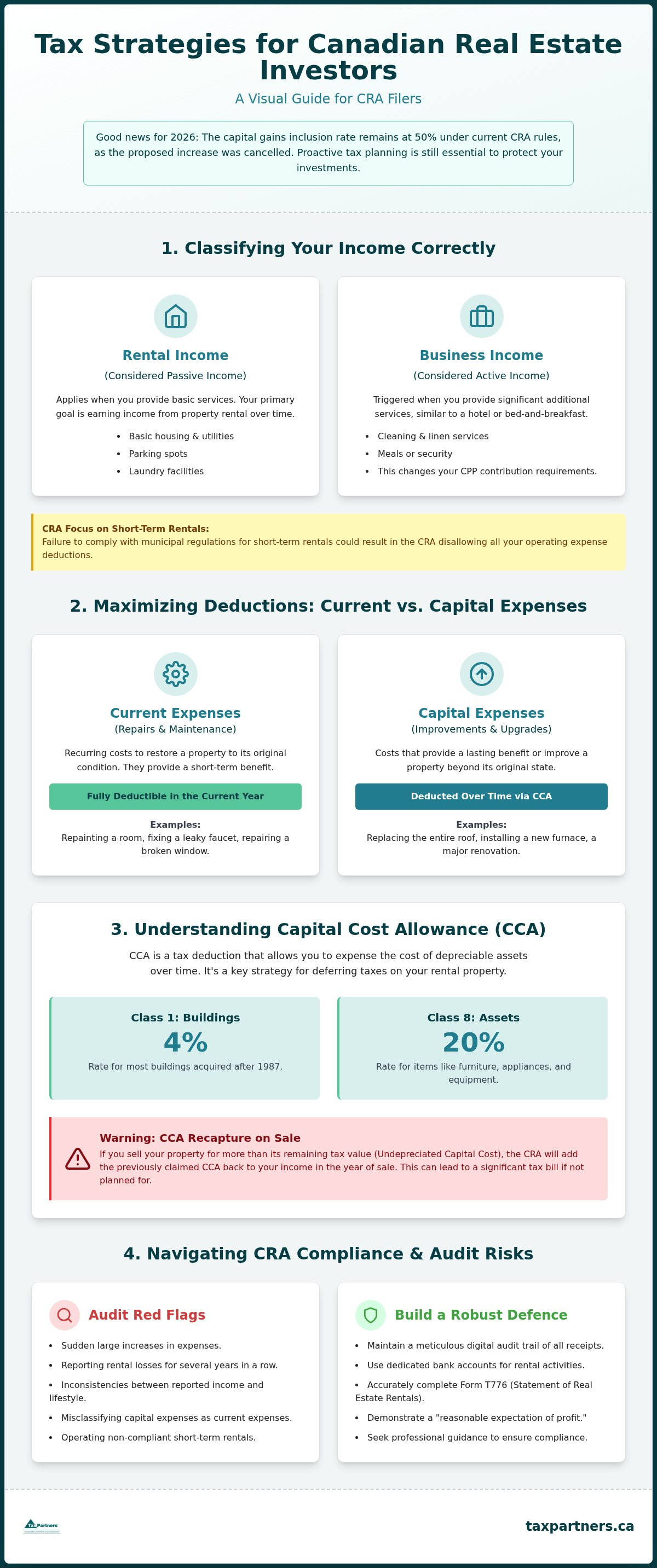
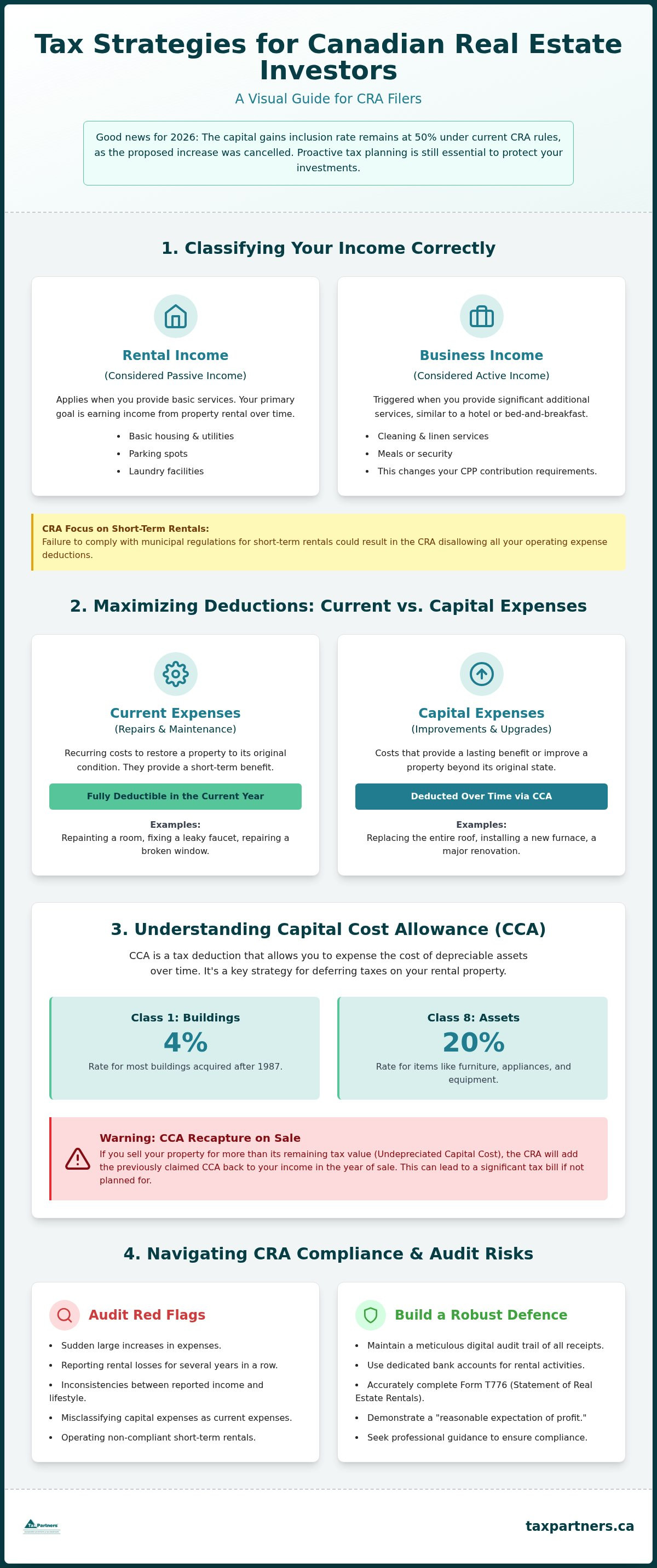
Most investors earn rental income, which the CRA considers passive. This typically includes providing basic utilities and parking. However, if you offer "extra" services like linen changes, cleaning, or meals, your earnings might be reclassified as business income.
This shift changes how you pay Canada Pension Plan (CPP) contributions and impacts your overall tax brackets. Short-term rentals are currently a high-priority area for the CRA. If your property doesn't follow municipal regulations, you risk losing the ability to deduct any operating expenses for the 2026 tax year.
The Role of the CRA in Real Estate Oversight
Reporting your activity correctly starts with Form T776, the Statement of Real Estate Rentals. This form is where you detail every dollar earned and spent. Precision here is vital because the CRA's automated tools are designed to catch inconsistencies between reported income and your lifestyle.
Implementing advanced tax strategies for real estate investors Canada helps you stay ahead of these checks. By maintaining an organized bookkeeping system, you transform a potential audit into a routine confirmation of your compliance. Professional oversight ensures you're not just reacting to requirements but actively looking ahead to protect your wealth.
Maximizing Deductions for Canadian Rental Properties
Reducing your taxable income is a fundamental pillar of effective tax strategies for real estate investors Canada. Every legitimate expense you claim acts as a shield for your investment returns. However, the CRA requires precise categorization of these costs to ensure your wealth remains protected.
The distinction between current and capital expenses is a frequent source of confusion for many property owners. Current expenses are recurring costs that restore a property to its original state, such as repainting a hallway or repairing a broken window. These are fully deductible in the year you incur them, providing immediate relief on your tax return.
Capital expenses are those that provide a lasting benefit or improve the property beyond its original condition. Replacing an entire roof or installing a new furnace are prime examples. For a deeper dive into these classifications, the CRA's T4036 Rental Income Guide provides exhaustive lists to guide your reporting and help you avoid common filing errors.
Capital Cost Allowance (CCA) is a strategic tool that allows you to deduct the cost of your building and equipment over time. Under CRA rules, most buildings acquired after 1987 fall into Class 1 with a 4% rate, while appliances and furniture are typically Class 8 at a 20% rate. It's a powerful way to defer taxes, but it requires a long-term view of your portfolio's growth.
You must be aware of recapture, which is the tax treatment that occurs when you sell a property for more than its remaining tax value. If the sale price exceeds the undepreciated capital cost, which is the remaining tax value of the property, the CRA will add previously claimed CCA back to your taxable income. This can result in a substantial tax bill if you haven't planned for this eventuality years in advance.
Mastering these tax strategies for real estate investors Canada involves more than just listing receipts; it requires a proactive approach to timing. Maintaining a meticulous digital audit trail is the best way to safeguard your claims against future scrutiny. If you find the complexity of these rules overwhelming, it may be time to consult with our team to ensure your strategy is both aggressive and compliant.
Capital Gains and the Principal Residence Exemption
For CRA filers, a capital gain occurs when you sell an investment property for more than its adjusted cost base plus any selling costs. The adjusted cost base, or ACB, represents the original purchase price of your property plus the costs associated with the acquisition, such as legal fees and land transfer taxes. Identifying the most effective tax strategies for real estate investors Canada often centres on timing these sales to minimize the impact on your marginal tax rate.
Managing the tax hit on property appreciation requires a long-term outlook and precise documentation of all capital improvements. Every major renovation you complete increases your ACB, which directly reduces the size of your taxable profit when you eventually exit the investment. This proactive approach ensures you're not paying more than your fair share by failing to track legitimate cost increases over time.
Navigating the Capital Gains Landscape
The portion of your profit that the CRA taxes is determined by the inclusion rate, which has historically been set at 50% for most individual filers. However, tax laws are subject to change, and you should always verify the current inclusion rate for the 2026 tax year with a qualified CPA. You can also find detailed reporting requirements in the CRA Guide to Rental Income (T4036) to ensure your filings remain compliant.
Strategic planning around these gains helps you preserve more of your equity for future reinvestment. For a broader look at how these rules integrate with your overall financial goals, explore our insights on Tax-Efficient Wealth Management. This level of foresight is what separates a casual landlord from a sophisticated investor who understands the nuances of the Canadian tax system.
Protecting the Principal Residence Exemption
The Principal Residence Exemption (PRE) is a powerful tool that can eliminate capital gains tax on the sale of a home you ordinarily inhabit. For CRA filers, only one property per family unit can be designated as a principal residence for any specific year. It's essential to understand that using this exemption requires you to meet strict residency and ownership criteria throughout the period you own the home.
CRA oversight has increased to prevent the misuse of the PRE, particularly in cases of property flipping. If you sell a property after holding it for less than 365 days, the CRA may classify the entire profit as business income rather than a capital gain. This reclassification can significantly increase your tax bill, as business income is 100% taxable at your personal rate.
When you transition a primary home into a rental property, you trigger a change in use rule under CRA regulations. This results in a deemed disposition, where you're treated as having sold the property at fair market value even if no cash changed hands. You may be able to file a subsection 45(2) election, which is a special filing that allows you to treat a property as your principal residence for up to four years even after it becomes a rental.
Accurate reporting is mandatory even if you expect the entire gain to be exempt from taxation. You must report the sale and the designation of your principal residence on the CRA Schedule 3 form. This information is then submitted as part of your annual CRA T1 Income Tax and Benefit Return to ensure you maintain your eligibility for the exemption.
Structural Decisions: Personal Ownership vs. Incorporation
Deciding whether to hold your properties personally or within a corporation is a fundamental pillar of long-term wealth management. For CRA filers, this choice influences everything from your annual tax bill to your eventual estate planning. Effective tax strategies for real estate investors Canada often hinge on this structural foundation.
Incorporating can offer significant tax deferral advantages, especially for high earners who don't need immediate access to rental profits. By retaining earnings within the company, you avoid paying the high personal marginal tax rates that apply to individual income. This allows for more capital to be reinvested into additional properties or other investment vehicles.
However, you must weigh these benefits against the increased complexity and costs of maintaining a corporation. Legal fees, annual minute book updates, and separate corporate tax filings add layers of administrative responsibility. It's a strategic move that requires a steady hand at the helm to ensure the long-term benefits outweigh the initial setup efforts.
The Benefits of a Real Estate Holding Company
A holding company acts as a proactive guardian for your personal wealth. It creates a legal barrier that protects your personal assets from liabilities associated with the property, such as tenant disputes or structural issues. Additionally, corporations offer flexibility through income splitting, allowing you to distribute dividends to family members who may be in lower tax brackets.
Setting up these structures requires precision to ensure they meet all regulatory requirements. You can explore our Canadian Corporate Tax Services to see how we help investors establish robust holding companies. Professional oversight ensures your corporate entity remains a tool for growth rather than a source of administrative stress.
When Personal Ownership Makes More Sense
Personal ownership is often the right path for those starting their investment journey or managing a small portfolio. It's significantly simpler and avoids the ongoing costs of corporate tax returns and legal maintenance. Financing is also generally more accessible for individuals, as many lenders offer more favourable rates for personal mortgages than commercial ones.
If your personal marginal tax rate is relatively low, the tax benefits of incorporation might not outweigh the annual expenses. You should also consider that personal ownership allows for the easier use of the Principal Residence Exemption, which we discussed previously. Balancing these factors requires a bespoke approach tailored to your specific financial situation.
Choosing the right structure is a complex decision that impacts your wealth for decades. To ensure you're making the most informed choice for your portfolio, contact us for a personalized consultation today.
Navigating CRA Compliance and Audit Risks
The CRA's oversight of the real estate sector has intensified, driven by sophisticated data analytics and automated tools. For CRA filers, maintaining compliance isn't just about honesty; it's about proving your claims with a robust digital audit trail. Implementing proactive tax strategies for real estate investors Canada ensures you're prepared for scrutiny before a letter ever arrives in your mailbox.
When you're facing a review, having a seasoned professional to represent you is invaluable. A CPA firm acts as your proactive guardian, managing communication with the CRA and ensuring your rights are protected throughout the process. This steady hand at the helm transforms a stressful situation into a manageable procedural step.
Common Audit Triggers for Real Estate
One of the most frequent red flags for the CRA is the consistent reporting of rental losses over several years. While initial losses are common in new ventures, the CRA expects a "reasonable expectation of profit" to remain a legitimate business activity. If your expenses outweigh your income indefinitely, your deductions may be at risk of being disallowed.
Large, one-time capital expense claims also attract significant attention. The CRA often scrutinizes these to ensure they aren't actually capital improvements that should be depreciated over time rather than deducted immediately. For a deeper look at managing these risks, explore our CRA Audit Help guide for 2026.
Best Practices for Record-Keeping
Meticulous record-keeping is your best defence against a reassessment. You should maintain a comprehensive log of all rental income, along with original receipts for every expense claimed, from property taxes to minor repairs. The CRA requires Canadian taxpayers to retain these records for a minimum of six years after the end of the tax year they relate to.
Digital organization is now the industry standard for successful investors. Utilizing professional bookkeeping services ensures your financial data is accurate and ready for inspection at any moment. This level of precision not only satisfies the CRA but also provides you with total control over your portfolio's performance.
Professional tax preparation is the final layer of security for your wealth. It ensures that every deduction is legitimate and that your reporting meets the highest standards of accuracy. By partnering with experts who understand the nuances of tax strategies for real estate investors Canada, you can focus on growing your investments with complete peace of mind.
Secure Your Real Estate Legacy
Implementing effective tax strategies for real estate investors Canada is a multi-year commitment to your financial health. By mastering the distinction between current and capital expenses and choosing the right ownership structure, you protect your portfolio. Maintaining a meticulous digital audit trail ensures that your wealth remains secure against increasing CRA scrutiny.
With over 40 years of Canadian tax experience, we understand the unique pressures facing multi-property investors. Our team provides the strategic guidance and comprehensive CRA audit support you need to navigate these complexities with total confidence. We act as your proactive guardian; we look ahead to ensure you achieve the best possible financial outcome.
Secure your real estate investment future with a professional tax strategy from Tax Partners. Your path to long-term stability starts with a single, informed decision. We look forward to partnering with you on your journey toward financial freedom.
Frequently Asked Questions
How does the CRA distinguish between a capital gain and business income?
The CRA looks at your primary intent at the time of purchase to distinguish between these categories. Capital gains generally result from holding a property for long-term rental income, where only 50% of the profit is taxable. Business income applies if the CRA determines you bought the property with the primary goal of selling it for a profit. This includes property flipping or development activities where 100% of the gain is taxable as income.
Can I deduct the interest on my mortgage for a Canadian rental property?
You can deduct the interest on money borrowed to purchase or improve a rental property under CRA rules. This deduction only applies to the interest portion of your mortgage payment, as the principal repayment is not deductible. It's a fundamental component of tax strategies for real estate investors Canada that helps lower your overall taxable income. Always ensure the loan is used specifically for the income-producing property to maintain eligibility.
What happens if I move into my rental property and make it my primary residence?
Moving into your rental triggers a deemed disposition under CRA regulations, meaning you're treated as having sold the property at fair market value. This can result in a taxable capital gain even though no actual sale occurred. You may be able to defer this tax by filing a subsection 45(3) election. This election allows you to postpone reporting the gain until you eventually sell the property to a third party.
Is it better to own a rental property personally or through a corporation in 2026?
The choice between personal and corporate ownership depends on your income level and the size of your portfolio. Corporations provide liability protection and allow for tax deferral if you're a high earner who doesn't need immediate access to rental profits. Personal ownership is usually more cost-effective for individuals with fewer properties due to lower administrative fees. A bespoke analysis of your marginal tax rate is essential to making the right choice.
What are the tax implications of selling a property to a family member?
Selling to a family member at a price below fair market value (FMV) can lead to significant tax complications with the CRA. You'll be taxed as if you sold the property at FMV, while the family member's cost base will be the actual price paid. This often results in double taxation when they eventually sell the property. It's vital to obtain a professional appraisal to ensure the transaction reflects current market conditions.
How long must I hold a property to avoid being classified as a "flipper" by the CRA?
Under the residential property flipping rule for CRA filers, you should hold a property for at least 365 consecutive days. If you sell within a year, the profit is automatically treated as business income rather than a capital gain. This rule applies unless you meet specific life event exemptions, such as death, disability, or a job relocation. Maintaining clear records of your residency and intent is crucial for avoiding this classification.
Can I claim travel expenses to visit my investment properties?
You can claim travel expenses if you travel to a different area to collect rents or manage your properties under CRA rules. However, if you only own one rental property, you generally cannot deduct travel expenses to visit that specific site. For investors with multiple properties, these costs must be reasonable and supported by a detailed logbook. This documentation should include the date, destination, and the specific business purpose of each trip.
What should I do if I receive a notice of audit from the CRA regarding my real estate?
You should immediately organize your records and consult with a professional CPA firm if you receive an audit notice. Providing a clear digital audit trail of your income and expenses is the best way to resolve the matter quickly. Our team acts as a proactive guardian during these reviews, managing communication with the CRA to protect your interests. Professional representation ensures that your tax strategies for real estate investors Canada are properly defended during a review.

Article by
Mahad Mohamed
Mahad Mohamed is an accountant and the CEO of Tax Partners, with over 26+ years of Canadian and international tax and accounting experience. His expertise includes corporate reorganization, cross-border tax structuring (Canada & US), tax disputes, CRA audits, and tax planning for small owner-managed private corporations. Most recently, Mahad is a pioneer in Canadian crypto taxation and founded Block3 Finance.
Previously, Mahad worked for the Canada Revenue Agency (CRA), Big4 accounting firms, and served as a Rulings Officer for the Federal Tax Authority of the UAE before acquiring Tax Partners in 2014.
Tax Partners has 44 full-time accountants and over 18,400+ clients.
Disclaimer
This article provides general information only and is current as of its publication date. It has not been updated and may be out of date. It does not constitute legal advice and should not be relied upon as such. Every tax situation is unique and may differ from the examples discussed in this article. If you have specific questions, you should seek the advice of our accountants for your unique circumstances. Book a FREE Initial Consultation Today!
Frequently Asked Questions
How does the CRA distinguish between a capital gain and business income?
The CRA looks at your primary intent at the time of purchase to distinguish between these categories. Capital gains generally result from holding a property for long-term rental income, where only 50% of the profit is taxable. Business income applies if the CRA determines you bought the property with the primary goal of selling it for a profit. This includes property flipping or development activities where 100% of the gain is taxable as income.
Can I deduct the interest on my mortgage for a Canadian rental property?
You can deduct the interest on money borrowed to purchase or improve a rental property under CRA rules. This deduction only applies to the interest portion of your mortgage payment, as the principal repayment is not deductible. It's a fundamental component of tax strategies for real estate investors Canada that helps lower your overall taxable income. Always ensure the loan is used specifically for the income-producing property to maintain eligibility.
What happens if I move into my rental property and make it my primary residence?
Moving into your rental triggers a deemed disposition under CRA regulations, meaning you're treated as having sold the property at fair market value. This can result in a taxable capital gain even though no actual sale occurred. You may be able to defer this tax by filing a subsection 45(3) election. This election allows you to postpone reporting the gain until you eventually sell the property to a third party.
Is it better to own a rental property personally or through a corporation in 2026?
The choice between personal and corporate ownership depends on your income level and the size of your portfolio. Corporations provide liability protection and allow for tax deferral if you're a high earner who doesn't need immediate access to rental profits. Personal ownership is usually more cost-effective for individuals with fewer properties due to lower administrative fees. A bespoke analysis of your marginal tax rate is essential to making the right choice.
What are the tax implications of selling a property to a family member?
Selling to a family member at a price below fair market value (FMV) can lead to significant tax complications with the CRA. You'll be taxed as if you sold the property at FMV, while the family member's cost base will be the actual price paid. This often results in double taxation when they eventually sell the property. It's vital to obtain a professional appraisal to ensure the transaction reflects current market conditions.
How long must I hold a property to avoid being classified as a "flipper" by the CRA?
Under the residential property flipping rule for CRA filers, you should hold a property for at least 365 consecutive days. If you sell within a year, the profit is automatically treated as business income rather than a capital gain. This rule applies unless you meet specific life event exemptions, such as death, disability, or a job relocation. Maintaining clear records of your residency and intent is crucial for avoiding this classification.
Can I claim travel expenses to visit my investment properties?
You can claim travel expenses if you travel to a different area to collect rents or manage your properties under CRA rules. However, if you only own one rental property, you generally cannot deduct travel expenses to visit that specific site. For investors with multiple properties, these costs must be reasonable and supported by a detailed logbook. This documentation should include the date, destination, and the specific business purpose of each trip.
What should I do if I receive a notice of audit from the CRA regarding my real estate?
You should immediately organize your records and consult with a professional CPA firm if you receive an audit notice. Providing a clear digital audit trail of your income and expenses is the best way to resolve the matter quickly. Our team acts as a proactive guardian during these reviews, managing communication with the CRA to protect your interests. Professional representation ensures that your tax strategies for real estate investors Canada are properly defended during a review.