Tax-Efficient Investment Strategies for CRA Filers (2026)

Most Canadians focus on which stocks to buy, but your real wealth is often determined by where you hold them. It's frustrating to watch a high marginal tax rate of up to 33% erode your hard-earned investment gains before you can even enjoy them. You've likely felt the confusion of balancing TFSA and RRSP limits or wondered why your dividends are taxed so differently from your interest income. Implementing tax-efficient investment strategies Canada requires more than just a diverse portfolio; it demands a precise understanding of asset location and current CRA regulations.
We'll show you how to organize your Canadian portfolio to minimize your annual tax bill and maximize after-tax returns. This guide provides a clear framework for long-term wealth preservation by navigating the 2026 tax landscape, including the 50% capital gains inclusion rate and the $7,000 TFSA contribution limit. You're about to discover a proactive approach that turns tax complexity into a structured path for financial growth and stability. We've helped thousands of clients save millions in taxes, and now we're sharing that expertise to help you secure a better outcome.
Key Takeaways
- Learn why prioritizing after-tax returns over gross performance is the most reliable way to accelerate your long-term wealth preservation.
- Understand the critical differences in how the CRA taxes interest, dividends, and capital gains to avoid paying more than your fair share.
- Discover the power of asset location by matching specific investments with the unique tax advantages of TFSAs, RRSPs, and non-registered accounts.
- Implement professional tax-efficient investment strategies Canada to maintain compliance while significantly reducing your annual tax liability.
- Recognize how bespoke wealth management provides a steady hand when integrating complex corporate structures with personal financial goals.
Defining Tax-Efficient Investing for CRA Filers
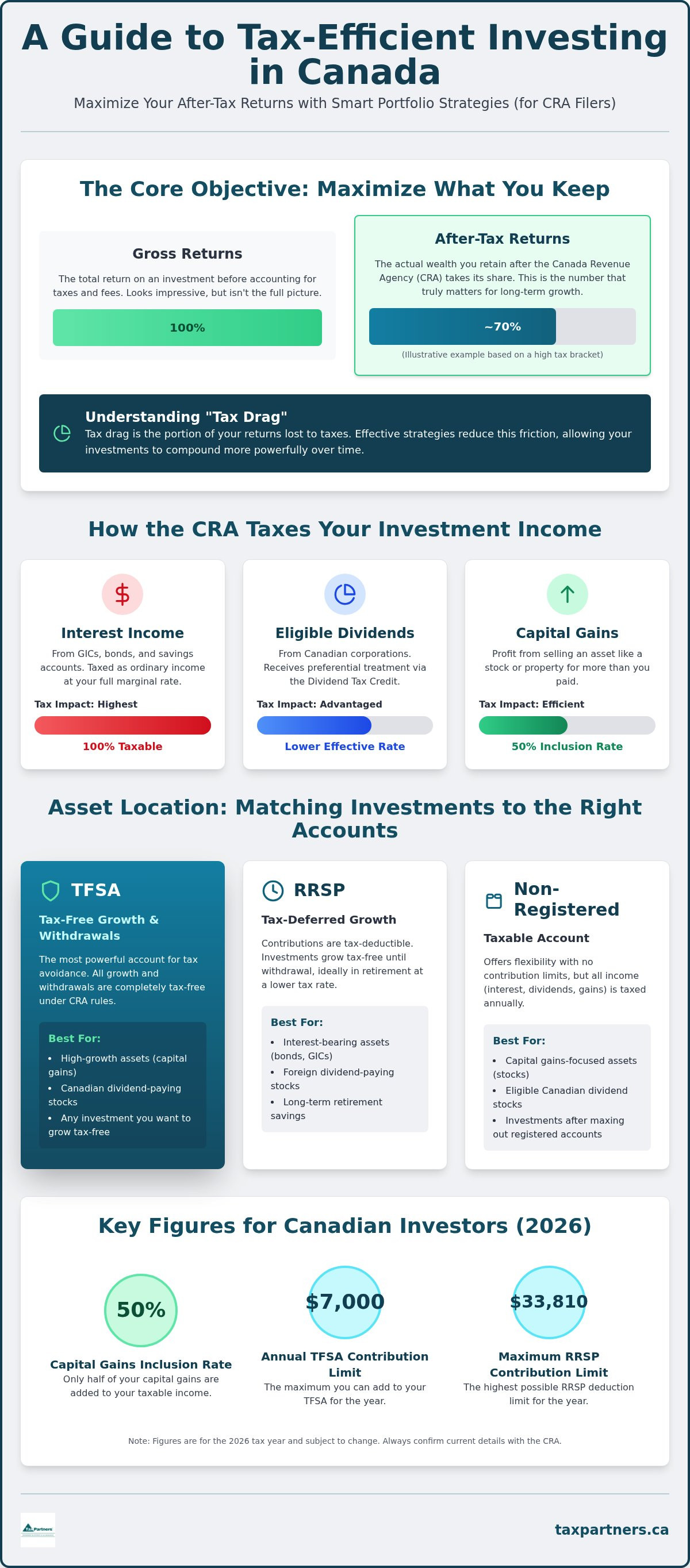
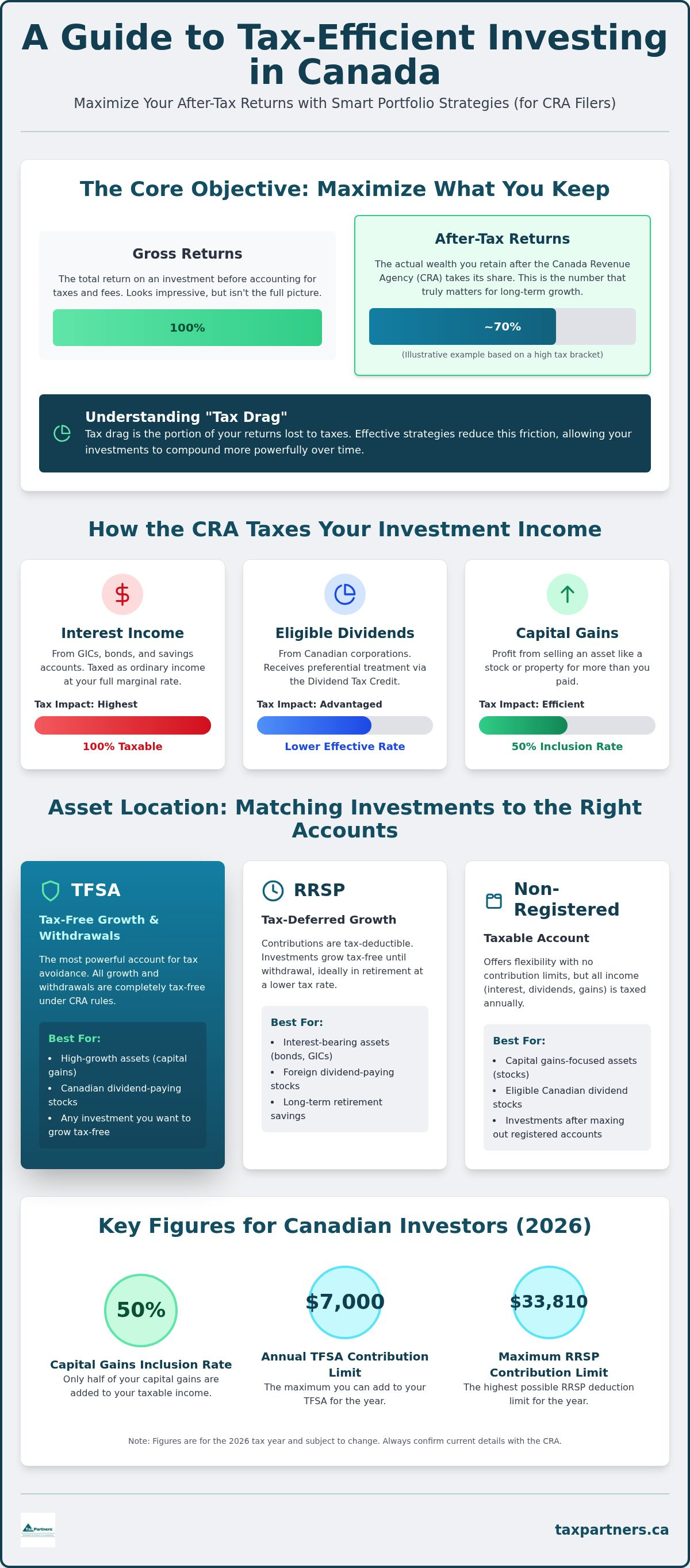
Success in the Canadian market often depends more on what you keep than what you earn. Tax-efficient investing is the strategic arrangement of your assets to ensure that tax liabilities don't unnecessarily hinder your portfolio's growth. For residents filing under Canada Revenue Agency (CRA) rules, the primary objective is to maximize after-tax returns. While gross returns look impressive on a monthly statement, they don't reflect the actual wealth available for your future goals. The concept of Tax efficiency focuses on minimizing the tax liability associated with an investment portfolio, ensuring your capital remains productive.
We often refer to the loss of potential growth as tax drag. This is the invisible friction representing the portion of your investment gains diverted to the CRA instead of remaining in your accounts to compound. By adopting tax-efficient investment strategies Canada, you're essentially reducing this friction to keep your financial momentum high. It's a shift from a reactive stance to a proactive one. Every investment decision you make should consider the eventual tax impact before the trade is even placed.
The Core Objectives of Tax Planning
Effective planning relies on three pillars: tax deferral, tax avoidance, and strategic income characterization. Tax deferral allows you to postpone payments to a future date, giving your capital more time to grow through the power of compounding. We achieve this primarily through registered accounts like the RRSP, where taxes are paid only upon withdrawal, ideally when you're in a lower tax bracket.
It's vital to distinguish between tax avoidance and tax evasion. Tax avoidance is the legal optimization of your financial affairs using frameworks the government intentionally provides, such as the TFSA or the First Home Savings Account (FHSA). Evasion is the illegal misrepresentation or concealment of income. Our role is to provide ethical steadfastness, using the law exactly as it's written to protect your assets and promote long-term stability.
Why 2026 is a Critical Year for Investors
The 2026 tax year brings specific thresholds that require your attention. With the TFSA annual contribution limit set at $7,000 and the RRSP limit reaching $33,810, the room for tax-sheltered growth is substantial. However, these limits are only useful if you utilize them with precision. The regulatory environment is never static, and 2026 is no exception.
Staying informed is a year-round commitment. Recent updates to capital gains inclusion rates, which remain at 50% for individuals in 2026, prove that tax law requires constant vigilance. Professional wealth management and financial planning ensures you aren't just reacting to these numbers in April. It takes a steady hand at the helm to navigate these shifting currents and secure your long-term prosperity. We look ahead to help you realize a more secure financial future.
Understanding How the CRA Taxes Investment Income
Not all income is created equal in the eyes of the Canada Revenue Agency. The CRA categorizes your earnings into three distinct buckets: interest, dividends, and capital gains. Each category carries a different tax weight, which directly impacts your bottom line. Understanding how investment income is taxed is the first step toward building a resilient financial plan. By recognizing these differences, you can implement tax-efficient investment strategies Canada that align with your long-term wealth goals. It's a matter of precision and foresight, ensuring you don't pay more than your fair share.
Interest Income and Ordinary Income
Interest income is the least tax-efficient way to earn money in a non-registered account. When you receive payments from GICs, bonds, or standard savings accounts, the CRA treats every dollar as ordinary income. This means it's taxed at your full marginal rate, just like the salary from your job. If you're in a high tax bracket, you could lose nearly half of your interest earnings to the government. Because of this, interest-bearing assets are often better suited for tax-sheltered accounts like the RRSP or TFSA.
Dividends and the Dividend Tax Credit
The CRA provides a unique advantage for those investing in Canadian corporations through the Dividend Tax Credit. This mechanism exists to prevent double taxation, as the corporation has already paid tax on its profits. When you receive "Eligible Dividends," the amount is first "grossed up" to a higher value on your tax return, and then a credit is applied to reduce the tax you actually owe. This often results in a much lower effective tax rate compared to interest. However, you must be careful with global holdings. Dividends from foreign stocks, such as those in the US, generally don't qualify for this credit and are taxed as ordinary income.
Capital Gains under Current CRA Rules
Capital gains remain one of the most attractive forms of income for Canadian investors. A capital gain is the profit you realize when you sell an asset for more than its original cost. In 2026, the inclusion rate for individuals remains at 50%. This means only half of your profit is subject to tax, while the other half is yours to keep entirely tax-free. One of the greatest strengths of this system is that you only trigger a tax event when you sell. This allows you to control the timing of your gains, potentially realizing them in years when your other income is lower.
Every individual's situation is unique, and your specific marginal tax rate will depend on your province of residence and total annual earnings. If you're looking for clarity on how these rules apply to your specific portfolio, reaching out to a specialist can provide the bespoke guidance you need to move forward with confidence. We act as a proactive guardian for your wealth, ensuring your choices today lead to a more secure tomorrow.
Selecting the Right Accounts for Your Assets in Canada
Sophisticated wealth management isn't just about what you buy; it's about where those assets live. This concept, known as asset location, is the cornerstone of tax-efficient investment strategies Canada. By matching the tax characteristics of an investment with the specific rules of a Canadian account, you can significantly reduce the amount of profit lost to the CRA. For a deeper dive into these advanced structures, our Tax-Efficient Wealth Management for CRA Filers guide provides a comprehensive 2026 strategic framework. It's a journey from simple saving to precise, proactive wealth preservation.
Every year, the CRA sets specific contribution limits that dictate your available tax-sheltered room. In 2026, the TFSA annual limit is $7,000, while the RRSP limit has reached $33,810. Utilizing these accounts effectively requires more than just filling them up. It involves a steady hand at the helm to ensure your interest, dividends, and capital gains are positioned to minimize tax drag. For a foundational overview of these mechanics, you can consult the Canadian Investment Regulatory Organization guide to taxes and investing. We focus on ensuring your portfolio remains compliant while maximizing your after-tax bottom line.
Tax-Free Savings Accounts (TFSA) vs RRSPs
The TFSA and RRSP serve very different roles in your financial life. TFSA contributions are made with after-tax dollars. This means you don't get an immediate tax break, but every cent of growth and all future withdrawals are entirely tax-free. If you've been eligible since 2009 and never contributed, your cumulative room in 2026 is a substantial $109,000. It's often the best home for high-growth equities or assets that generate significant taxable income.
The RRSP acts as a powerful tax-deferral tool. Your contributions reduce your current taxable income, which is especially valuable if you're in one of the higher tax brackets, such as the 33% federal bracket for income over $258,482. You only pay tax when you withdraw the funds, ideally during retirement when your income is lower. Choosing between the two depends on your current earnings versus your expected future tax rate. We help you realize the best path for your specific situation.
Non-Registered Accounts and Tax Efficiency
Non-registered accounts offer no immediate tax shelter, making them the most challenging to manage for CRA filers. However, they're essential for investors who have already maximized their TFSA and RRSP room. The key is to hold capital-gains-oriented assets here. Since only 50% of capital gains are included in your taxable income, these assets are much more efficient in a taxable account than interest-bearing bonds or GICs.
Interest income remains poorly suited for non-registered accounts because it's taxed at your full marginal rate. For SME owners and professionals, this becomes even more complex when integrating corporate accounts. A bespoke approach ensures that your corporate and personal holdings work together rather than in isolation. We act as your proactive guardian, looking ahead to secure the best possible after-tax outcome for your entire family.
Implementing Advanced Tax-Reduction Strategies
Sophisticated wealth management for high-net-worth filers goes beyond simply filling contribution buckets. It involves structural decisions that can save thousands in annual tax drag. To succeed, you must implement tax-efficient investment strategies Canada that align with your broader corporate and family goals. These strategies require precise execution. A single misstep in timing or documentation can trigger a CRA audit or disqualify a hard-won deduction. For business owners, staying current with Canadian corporate tax compliance is the first step toward integrated wealth preservation. Success at this level requires meticulous record-keeping. You should organize every transaction receipt and trust document to support your filings during the 2026 tax season.
Tax-Loss Harvesting in Taxable Accounts
Tax-loss harvesting is a powerful tool for your non-registered accounts. You sell investments that have declined in value to offset capital gains realized elsewhere in your portfolio. This reduces your immediate tax bill. However, you must navigate the CRA's superficial loss rule. If you or an affiliated person buys the same security within 30 days before or after the sale, the CRA disallows the loss. If your losses exceed your gains in 2026, you can carry them back three years or forward indefinitely to protect future profits. It's a strategic way to turn a market dip into a tax advantage.
Corporate Class Funds and Holding Companies
SME owners often find significant advantages in investing through a corporate income tax structure. Holding investments within a Canadian Controlled Private Corporation (CCPC) allows for significant tax deferral on active business income used for investment. You must remain mindful of the passive income rules. Once your corporation earns more than $50,000 in passive investment income, your small business deduction begins to decrease. Balancing these thresholds requires a steady hand and proactive planning to ensure your corporate structure remains a benefit rather than a burden.
Income Splitting and Family Trusts
Income splitting remains a viable path for family wealth transfer. By shifting income to family members in lower tax brackets, you reduce the overall household tax burden. The CRA's Tax on Split Income (TOSI) rules are strict. They generally apply the highest marginal rate to split income unless specific exceptions are met. One effective method is the use of a prescribed rate loan to a family trust. This allows the investment growth to be taxed in the hands of beneficiaries while maintaining full compliance with CRA standards. It's a bespoke approach that requires careful legal and tax coordination.
Managing these moving parts requires a partner who understands the intersection of corporate law and personal finance. If you're ready to optimize your structure and protect your capital, speak with a specialist at Tax Partners to develop a plan that secures your legacy.
Navigating Wealth Preservation with Professional Advice
Every financial journey reaches a point where generic advice is no longer sufficient. When your portfolio spans across corporate structures, family trusts, and emerging sectors, a bespoke approach becomes a necessity rather than a luxury. Implementing tax-efficient investment strategies Canada is a continuous process of refinement and foresight. It requires a partner who doesn't just react to the current year's numbers but actively looks ahead to secure a better outcome. This is where the value of a steady hand at the helm becomes clear, especially when dealing with the volatility and regulatory shifts in areas like cryptocurrency. We act as a proactive guardian, moving you from a state of potential uncertainty toward a feeling of total control over your financial legacy.
The CPA Advantage in Wealth Management
Traditional brokers often focus narrowly on market performance and gross returns. While these metrics matter, they ignore the tax drag that can silently erode your wealth over decades. The advantage of working with Tax Partners lies in our holistic perspective. We integrate wealth management and financial planning with rigorous tax compliance to ensure every investment decision is viewed through a lens of tax efficiency. Our firm brings over 40 years of experience and a track record of filing over 495,000 returns to every client relationship. This deep-seated reliability provides the foundation for a long-term partnership built on ethical steadfastness and proven results. We've saved our clients over $87M by looking at the entire picture, not just the individual trades.
Securing Your Future Today
The best time to start planning for tax efficiency was years ago; the second best time is today. Waiting until the end of the fiscal year to consider your asset location or income splitting often leads to missed opportunities. Personalized care is the hallmark of our boutique approach. We remain genuinely attentive to your individual concerns, ensuring that your plan is as unique as your goals. Whether you're managing a professional practice or scaling a small business, our expertise is curated to remain accessible while providing sophisticated solutions.
Take the next step toward optimizing your Canadian portfolio. By aligning your investments with the most current CRA regulations, you can preserve more of your capital for what truly matters. Our team is ready to lead you through a guided journey from complexity to clarity. We combine institutional wisdom with a modern, forward-thinking outlook to help you realize a future defined by stability and growth.
Take Command of Your After-Tax Returns
Mastering your financial future in 2026 requires a shift from reactive filing to proactive management. By prioritizing asset location and understanding how the CRA treats different income streams, you ensure your capital remains productive. Implementing tax-efficient investment strategies Canada isn't a one-time event; it's a commitment to long-term wealth preservation that adapts to shifting regulations. You now have the framework to distinguish between simple tax avoidance and sophisticated, compliant optimization using the legal tools at your disposal.
Tax Partners stands as your proactive guardian, offering 40+ years of institutional wisdom and specialized expertise across 20+ industries. With over 1,390 five-star Google reviews, our reputation for reliability and personalized care is well-earned. We help you move from uncertainty toward total control, ensuring your corporate and personal assets work in perfect harmony. Don't let tax drag hinder your financial momentum. Secure your wealth with a personalized tax strategy—Contact Tax Partners today. Your journey toward a more stable and prosperous future begins with a single, decisive step.
Frequently Asked Questions
What is the difference between tax-free and tax-efficient investing in Canada?
Tax-free investing means you pay zero tax on your investment growth, which is only possible within specific accounts like the TFSA. Tax-efficient investing is a broader approach that focuses on minimizing the "tax drag" on your entire portfolio. By using tax-efficient investment strategies Canada, you place assets with higher tax rates in registered accounts and keep lower-taxed assets, like those generating capital gains, in non-registered accounts.
How much of my capital gains will the CRA tax in 2026?
The CRA applies a 50% inclusion rate to capital gains for individual filers in 2026. This means if you realize a profit of C$10,000 from selling a stock, only C$5,000 is added to your taxable income. The remaining half is yours to keep entirely tax-free. This remains one of the most effective ways to build wealth outside of registered accounts.
Can I use investment losses from previous years to reduce my current taxes?
You can use net capital losses from previous years to offset capital gains in 2026. The CRA allows you to carry these losses back three years to recover taxes already paid or forward indefinitely to protect future gains. This is a vital tool for maintaining a steady hand during market volatility and preserving your long-term capital.
What happens if I hold US dividend stocks in my TFSA?
The IRS applies a 15% non-resident withholding tax on dividends from US stocks held within a TFSA. Unlike the RRSP, the TFSA is not recognized as a retirement account under the Canada-US tax treaty, so this tax cannot be recovered or credited. For many investors, it's more efficient to hold US dividend-paying equities in an RRSP to avoid this immediate loss of income.
Is it better to invest through a holding company or personally?
Investing through a holding company offers significant tax deferral for SME owners who have excess active business income. However, you must be mindful of the C$50,000 passive income threshold. If your corporation earns more than this amount in investment income, the CRA begins to reduce your small business deduction. We provide bespoke guidance to help you realize which structure offers the best protection for your specific assets.
How does the CRA define a superficial loss?
A superficial loss occurs when you sell an investment at a loss and repurchase the same security within 30 days before or after the sale. This rule also applies if your spouse or a corporation you control buys the security. In these instances, the CRA disallows the loss claim, and the loss is instead added to the adjusted cost base of the new shares.
What are the current RRSP and TFSA contribution limits for CRA filers?
For the 2026 tax year, the annual TFSA contribution limit is C$7,000. The RRSP contribution limit is the lesser of 18% of your earned income from the previous year or C$33,810. Utilizing these tax-efficient investment strategies Canada ensures you maximize your sheltered growth while avoiding the costly penalties associated with over-contribution.
Can professional tax planning fees be deducted from my investment income?
You can generally deduct fees paid for investment management or advice if the fees are for non-registered accounts. This includes professional fees for managing your taxable portfolio or developing a tax-efficient plan. It's important to note that fees related to the management of registered accounts, such as an RRSP or TFSA, are not deductible under current CRA regulations.

Article by
Mahad Mohamed
Mahad Mohamed is an accountant and the CEO of Tax Partners, with over 26+ years of Canadian and international tax and accounting experience. His expertise includes corporate reorganization, cross-border tax structuring (Canada & US), tax disputes, CRA audits, and tax planning for small owner-managed private corporations. Most recently, Mahad is a pioneer in Canadian crypto taxation and founded Block3 Finance.
Previously, Mahad worked for the Canada Revenue Agency (CRA), Big4 accounting firms, and served as a Rulings Officer for the Federal Tax Authority of the UAE before acquiring Tax Partners in 2014.
Tax Partners has 44 full-time accountants and over 18,400+ clients.
Disclaimer
This article provides general information only and is current as of its publication date. It has not been updated and may be out of date. It does not constitute legal advice and should not be relied upon as such. Every tax situation is unique and may differ from the examples discussed in this article. If you have specific questions, you should seek the advice of our accountants for your unique circumstances. Book a FREE Initial Consultation Today!
Frequently Asked Questions
What is the difference between tax-efficient and tax-free investing in Canada?
Tax-free investing means you pay no tax on growth or withdrawals, which is the primary benefit of a TFSA. Tax-efficient investing in Canada is a broader approach that uses various legal strategies to minimize the tax drag on your entire portfolio. It involves placing the right assets in the right accounts to ensure you keep more of your total returns after the CRA takes its share.
How much of my capital gains will the CRA tax in 2026?
The CRA taxes 50% of your realized capital gains in 2026 at your marginal tax rate. This inclusion rate applies to individuals and means that if you profit C$10,000 on a stock sale, only C$5,000 is added to your taxable income. This remains one of the most effective tax-efficient investment strategies Canada filers can use to build wealth in non-registered accounts.
Can I use investment losses from previous years to reduce my current taxes?
Yes, you can apply net capital losses from previous years against capital gains realized in the current year. The CRA allows you to carry these losses back up to three years or forward indefinitely until they're fully used. This flexibility helps you recover some of the tax cost when you experience a market downturn or a losing trade.
What happens if I hold US dividend stocks in my TFSA?
Holding US dividend stocks in a TFSA results in a 15% non-resident withholding tax on the dividends paid. The TFSA isn't recognized as a retirement account under the Canada-US tax treaty, so this tax cannot be recovered through a foreign tax credit. Many investors prefer holding these specific assets in an RRSP where the withholding tax is typically waived.
Is it better to invest through a holding company or personally?
Investing through a holding company is often superior for business owners who want to defer personal income taxes on corporate earnings. It allows you to keep more capital working within the corporate structure before it's eventually withdrawn as dividends. For most individual employees without a corporation, personal investing is simpler and avoids the added costs of corporate compliance and accounting.
How does the CRA define a superficial loss?
The CRA defines a superficial loss as a capital loss that's disallowed because you repurchased the same security too quickly. This rule triggers if you, your spouse, or a corporation you control buys the identical asset within 30 days before or after the sale. If the CRA identifies a superficial loss, you can't use that loss to offset your gains in the current year.
What are the current RRSP and TFSA contribution limits for CRA filers?
For 2026, the annual TFSA contribution limit is C$7,000, bringing the cumulative total for those eligible since 2009 to C$109,000. The RRSP contribution limit is the lesser of 18% of your 2025 earned income or C$33,810. You should always verify your specific available room through the CRA My Account portal to avoid over-contribution penalties.
Can professional tax planning fees be deducted from my investment income?
You can generally deduct fees paid for professional tax planning or investment advice if they're related to your non-registered accounts. The CRA does not allow deductions for fees associated with registered accounts like RRSPs, RRIFs, or TFSAs. This deduction provides a small but helpful way to reduce the net cost of receiving expert oversight for your taxable investments.