Sales Tax for Canadian Ecommerce Selling to the US: 2026 Guide

Your Canadian business ships a product to a customer in Texas, and months later, a notice arrives demanding back taxes, penalties, and interest from a state you've never set foot in. This scenario is playing out for Canadian ecommerce sellers at an accelerating pace, and the reason is a legal concept called economic nexus (a tax obligation triggered by sales volume alone, not physical presence).
You're right to feel uncertain. Navigating sales tax for Canadian ecommerce selling to US customers is genuinely complex, and the rules shifted dramatically after the landmark 2018 South Dakota v. Wayfair Supreme Court decision gave individual states the authority to require out-of-country sellers to register and remit sales tax. The concern is valid; the confusion is understandable.
This guide cuts through the complexity. You'll gain a clear understanding of how economic nexus thresholds work under state-level rules, which states are most likely to affect your business, and what a practical compliance roadmap actually looks like. We'll walk you through each piece methodically, so you move from uncertainty to a position of confident, informed control.
Key Takeaways
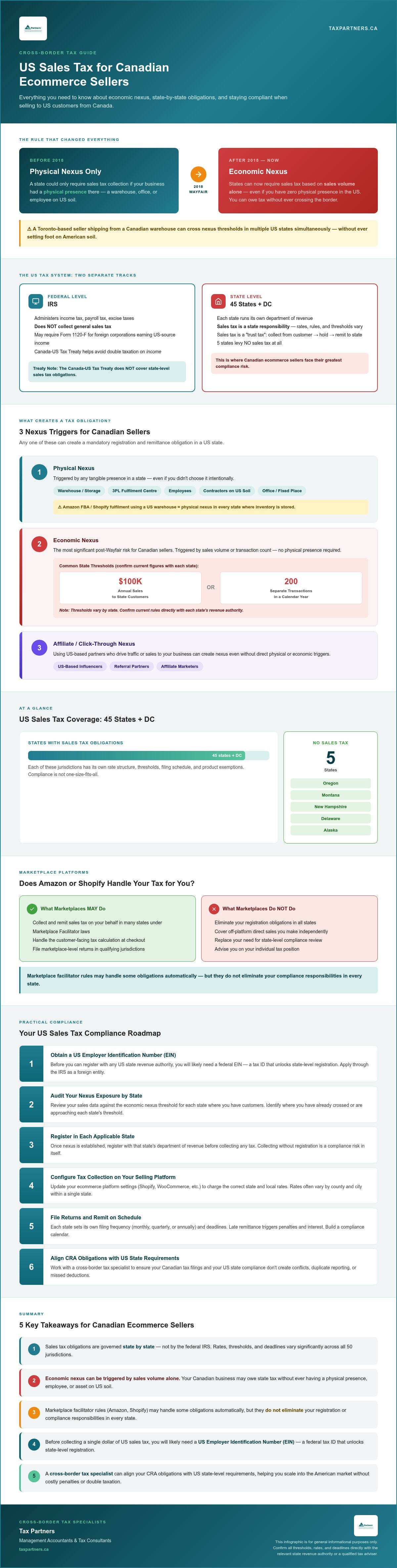
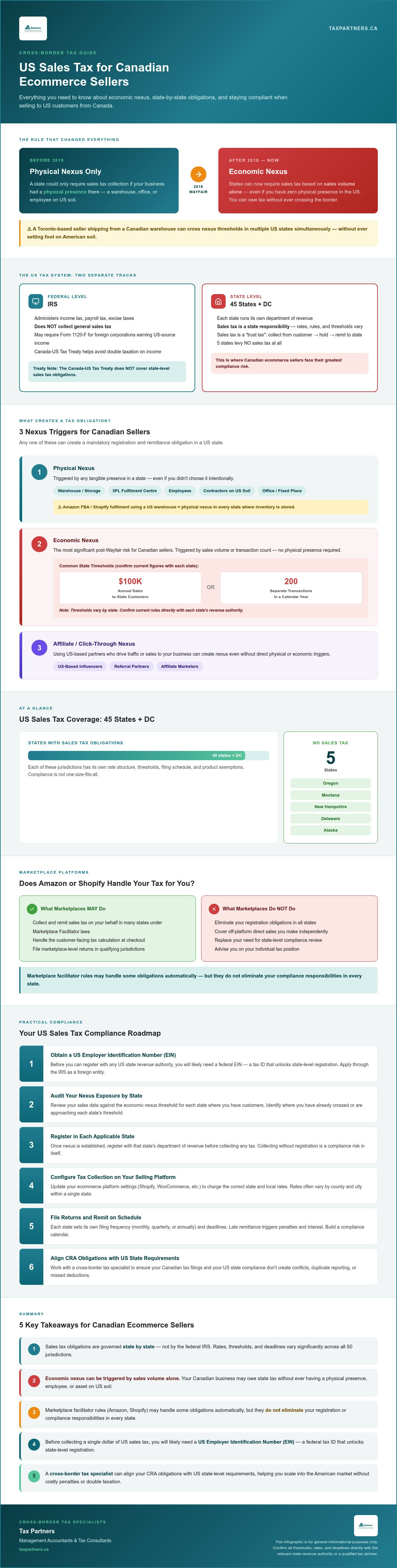
- Mastering sales tax for Canadian ecommerce selling to US customers starts with understanding that obligations are governed state by state — not by the federal IRS — and thresholds vary significantly across jurisdictions.
- Economic nexus can be triggered by sales volume alone, meaning your Canadian business may owe state tax without ever having a physical presence, an employee, or an asset on US soil.
- Marketplace facilitator rules on platforms like Amazon may handle some of your tax obligations automatically, but they do not eliminate your registration or compliance responsibilities in every state.
- Before you collect a single dollar of US sales tax, you will likely need a US Employer Identification Number (EIN) — a federal tax ID that unlocks your ability to register with individual state revenue authorities.
- A cross-border tax specialist can align your CRA obligations with US state-level requirements, helping you scale into the American market without exposing your business to costly penalties or double taxation.
Navigating the US Sales Tax Landscape for Canadian Sellers
The US tax system is not a single, unified structure. It operates on two distinct tracks that many Canadian sellers conflate — and that confusion can be costly. Understanding how these tracks divide is the essential first step in managing sales tax for Canadian ecommerce selling to US customers with any real confidence.
At the federal level, the Internal Revenue Service (IRS) administers income tax, payroll tax, and certain excise taxes. What the IRS does not collect is general sales tax. That responsibility falls entirely to individual states, each operating its own department of revenue with its own rates, rules, and thresholds. To get a sense of just how varied this landscape is, the US sales tax system spans 45 states plus the District of Columbia, with five states levying no sales tax at all.
Federal IRS Rules vs. State Tax Obligations
Sales tax is what tax professionals call a trust tax: you collect it from your customer on behalf of the state, hold it in trust, and remit it to the relevant state authority on a scheduled basis. The IRS plays no role in this process whatsoever.
That said, Canadian sellers should not dismiss federal obligations entirely. Depending on how your business is structured and how it earns US-source income, you may have a federal filing requirement under IRS rules, such as submitting Form 1120-F (the US income tax return for foreign corporations). Confirm your specific federal filing position with a qualified cross-border tax adviser, as the rules vary by business structure and treaty application.
One important clarification: the Canada-US Tax Treaty is a powerful instrument for avoiding double taxation on income, but it does not extend to state-level sales tax. State obligations exist entirely outside the treaty's scope.
The Shift from Physical to Economic Presence
Before 2018, a Canadian business had to maintain a physical presence in a US state, such as a warehouse, office, or employee, before that state could require it to collect sales tax. This was known as physical nexus.
The US Supreme Court's 2018 ruling in South Dakota v. Wayfair, Inc. fundamentally dismantled that framework. States can now establish economic nexus, meaning your obligation to collect and remit sales tax can be triggered solely by reaching a state's defined sales volume or transaction count threshold, regardless of where your business is physically located.
This is precisely why sales tax for Canadian ecommerce selling to US markets has become so complex so quickly. A seller operating entirely from Toronto, shipping directly from a Canadian warehouse, can cross an economic nexus threshold in multiple states simultaneously, without ever setting foot on American soil. The obligation arrives quietly, and the penalties for non-compliance do not.
Understanding Nexus: When Does Your Canadian Business Owe US Tax?
Nexus is the legal connection between your business and a US state that creates a tax obligation. Think of it as a tripwire: once crossed, registration and remittance become mandatory under that state's law, regardless of where your business is incorporated or operated. For Canadian sellers, three distinct triggers can set that tripwire off.
The primary nexus triggers are:
- Physical presence: Warehouses, inventory, employees, or contractors located in a state
- Economic activity: Reaching a state's defined sales volume or transaction count threshold
- Affiliate or click-through relationships: Using US-based influencers, referral partners, or affiliate marketers who drive sales on your behalf
Each trigger carries its own compliance requirements, and in some cases, a single business can establish nexus through more than one channel simultaneously. Understanding which applies to your situation is where managing sales tax for Canadian ecommerce selling to US customers gets genuinely precise.
Physical Nexus: Warehouses and Third-Party Logistics (3PL)
Storing inventory in a US-based third-party logistics facility creates immediate physical nexus in that state, even if you've never visited. The moment your products cross the border and sit in a fulfilment centre, the state where that facility operates can require you to register and collect sales tax. This catches many Canadian sellers off guard, particularly those using fulfilment networks that distribute inventory across multiple states automatically.
Attending a US trade show or sending a sales representative into a state, even briefly, can also establish physical nexus in certain jurisdictions. The rules vary, but the principle is consistent: a taxable connection to the state exists the moment a business asset or person is present there on your behalf.
Meticulous record-keeping is essential when inventory crosses the border. You'll want to document:
- Which states your 3PL stores inventory in, and the dates inventory entered each state
- The value and volume of goods held at each location
- Any agreements with your logistics provider that specify storage locations
These records don't just support compliance; they're your first line of defence if a state revenue authority questions when your obligation began.
Economic Nexus: The 2026 Standards
The most common economic nexus threshold across US states is USD $100,000 in annual sales or 200 separate transactions into that state, whichever is reached first. However, the landscape has shifted since Wayfair. Several states have eliminated the 200-transaction rule entirely, meaning only the dollar threshold applies. Confirm the current rules for each state you sell into, as thresholds and structures do change.
The most reliable way to stay ahead of registration requirements is to monitor your trailing twelve-month (TTM) sales totals on a state-by-state basis. TTM tracking means you're always looking at a rolling twelve-month window rather than a calendar year, which gives you early warning before you cross a threshold and need to register. Many sellers build this into their bookkeeping cadence, reviewing state-level totals monthly.
Marketplace Facilitator Rules: What Platforms Handle (and What They Don't)
If you sell through Amazon, Etsy, or a similar marketplace, the platform may collect and remit sales tax on your behalf under marketplace facilitator laws, which now exist in most US states. This is genuinely helpful, but it doesn't eliminate your compliance responsibilities entirely.
Direct sales through your own Shopify store, for instance, are not covered by marketplace facilitator rules. If you operate across multiple channels, you could have obligations handled automatically on one channel while remaining fully responsible on another. Assuming the platform covers everything is one of the most common and costly mistakes Canadian ecommerce sellers make.
Click-Through and Affiliate Nexus
Some states extend nexus to businesses that use US-based affiliates or influencers to generate sales. If a US resident earns a commission for referring customers to your store, certain states treat that relationship as establishing a taxable presence. This is particularly relevant as influencer marketing becomes a standard growth channel for Canadian brands targeting American consumers.
Once any form of nexus is established, registration isn't optional. It's a legal requirement under state law, and the clock on your obligation starts from the date nexus was created, not the date you discovered it. If you're uncertain whether your current US sales activity has already crossed a threshold, a conversation with a cross-border tax specialist is the most efficient way to assess your exposure before a state revenue notice does it for you.
State-by-State Variations and Economic Thresholds
Where your customer is located determines which state's rules apply. This is the core principle of destination-based sourcing, the method used in most US states for cross-border ecommerce transactions. Under this approach, sales tax is calculated based on the buyer's ship-to address, not the seller's location. For a Canadian business shipping from Mississauga or Vancouver, that means every state where a customer receives a package is a potential tax jurisdiction.
The contrast matters because a small number of states use origin-based sourcing, where tax is calculated based on where the sale originates. For remote Canadian sellers, however, destination-based rules govern the vast majority of transactions. Confirm the specific sourcing rule for each state you sell into, as applying the wrong method creates both underpayment and overpayment risks.
Two additional features of the US system catch Canadian sellers off guard: sales tax holidays and the Streamlined Sales Tax (SST) agreement. Sales tax holidays are temporary windows, typically lasting a weekend or a week, during which certain product categories are exempt from tax. Back-to-school supplies, emergency preparedness items, and energy-efficient appliances are common examples. If your products fall into an exempt category during one of these windows, you must adjust your collection accordingly. Tracking holiday schedules across multiple states adds a meaningful layer of operational complexity.
The Streamlined Sales Tax (SST) agreement is a cooperative framework among participating states designed to simplify registration and remittance for remote sellers. Member states standardize definitions, filing procedures, and exemption certificates to reduce the compliance burden. Participation varies, so verify which states belong to the SST agreement when building your compliance calendar, as member status can change.
Major State Thresholds for Canadian Exporters
The four states most likely to affect Canadian ecommerce volumes are California, Texas, Florida, and New York, given their population size and purchasing power. Each applies a USD $100,000 annual sales threshold for economic nexus under state-level rules, though the treatment of local taxes, product exemptions, and filing frequencies differs considerably. California's state rate is among the highest in the country, and local district taxes can push the combined rate significantly higher. Texas applies sales tax broadly but exempts certain categories of manufacturing inputs. Florida eliminated its 200-transaction threshold, leaving only the dollar threshold in place. New York maintains detailed product-level exemption rules that require careful classification.
These figures reflect current guidance, but thresholds and structures do change. Verify the current rules for each state with a qualified cross-border tax adviser before registering, and revisit them annually.
Home rule states add another layer entirely. In jurisdictions like Colorado and Alabama, local municipalities have the authority to administer their own sales tax rules independently of the state. That means separate registration, separate rates, and sometimes separate filing requirements at the city or county level. For managing sales tax for Canadian ecommerce selling to US customers in home rule states, automated tax software alone is rarely sufficient; professional oversight is essential.
Marketplace Facilitator Laws and Your Responsibility
Platforms like Amazon, eBay, and Etsy collect and remit sales tax on behalf of sellers in most US states under marketplace facilitator laws. That coverage is genuinely valuable, but it creates a compliance blind spot that many sellers miss: even when a marketplace handles remittance, some states still require the underlying seller to file a return, reporting zero tax owed. Skipping these zero-return filings can trigger penalties despite no actual tax liability.
Canadian B2B sellers face an additional consideration. If you sell wholesale to US-based resellers, your buyers may provide a resale certificate (sometimes called a wholesale certificate) to exempt the transaction from sales tax. Accepting and retaining these certificates correctly is a legal requirement; an improperly documented exemption leaves you liable for the uncollected tax. Processes for validating and storing resale certificates should be built into your order workflow before your first wholesale transaction clears.
For a detailed overview of your obligations under US tax rules, the US and cross-border tax services page outlines how integrated planning addresses both state-level compliance and federal filing requirements for Canadian sellers scaling into the American market.
Registration and Compliance Requirements Under IRS and State Rules
Knowing you have a nexus obligation is only half the battle. Acting on it correctly, in the right sequence, is where many Canadian sellers stumble. The compliance process for sales tax for Canadian ecommerce selling to US customers follows a defined order of operations, and skipping steps creates compounding problems that are far more expensive to resolve than the original obligation.
The four-stage process works as follows:
- Obtain a US Employer Identification Number (EIN) from the IRS as your federal business identifier
- Register for a sales tax permit with each state where you've established nexus
- Collect the correct tax at the point of sale, applying the destination-state rate
- File returns and remit on the schedule assigned by each state authority
Each stage is a prerequisite for the next. You can't register for a state permit without an EIN, and you can't legally collect tax without a valid permit in place.
Obtaining a US EIN as a Non-Resident
An EIN is a unique nine-digit number the IRS uses to identify your business for federal tax purposes. It's the foundational credential that unlocks your ability to register with state revenue authorities. Canadian corporations apply by submitting Form SS-4 directly to the IRS; because you don't hold a US Social Security Number, the application must be completed by fax or phone rather than online. Individual sellers operating as sole proprietors may need an Individual Taxpayer Identification Number (ITIN) instead. For guidance on that process, Tax Partners' ITIN application services outline the steps for non-resident individuals.
Sales Tax Permits and Filing Procedures
Each state issues its own Sales and Use Tax Permit, and you must hold one before collecting a single dollar of tax in that jurisdiction. Use tax is the counterpart to sales tax: it applies when a taxable transaction occurred but tax wasn't collected at the point of sale, placing the remittance obligation on the buyer or, in some cases, the seller. Understanding both is essential for full compliance.
Filing frequency is determined by your sales volume in each state. High-volume states typically assign monthly filing; moderate volumes may qualify for quarterly filing; lower-volume sellers are sometimes placed on an annual schedule. States assign these frequencies at registration, but they can change as your volume grows.
Penalties for non-compliance are real and cumulative. Late filing typically triggers interest charges and fixed penalties, while failure to collect tax from customers at all can result in the state holding you personally liable for the uncollected amount, plus penalties on top.
One critical warning: never simply begin filing returns for past periods without first addressing the gap in your compliance history. This approach, sometimes called a quiet disclosure, carries significant risk. States may interpret it as an admission of prior non-compliance without the protections that a formal voluntary disclosure agreement provides. A structured voluntary disclosure, negotiated with professional support, typically limits your back-tax exposure and waives certain penalties. Attempting to quietly correct years of unfiled returns without that framework can trigger a full audit instead of resolving the issue.
If your US sales activity has already crossed nexus thresholds in prior years, the most protective step you can take is to address it proactively rather than reactively. Speak with a cross-border tax specialist at Tax Partners to assess your exposure and structure a compliant path forward before a state revenue notice forces the conversation.
Strategic Cross-Border Tax Planning with Tax Partners
Compliance is the floor, not the ceiling. The Canadian ecommerce sellers who scale into the US market with confidence aren't just avoiding penalties; they're structuring their operations to grow profitably on both sides of the border. That requires something no software platform can provide: integrated, strategic advice that bridges CRA obligations with US state-level requirements simultaneously.
Tax Partners brings over 40 years of cross-border tax experience to exactly this challenge. The firm's ecommerce accounting services are built around the operational realities of Canadian brands selling into the US, from multi-channel revenue tracking and marketplace reconciliation to state-level registration management and foreign income reporting. The goal isn't just to file returns accurately; it's to build a tax position that supports your next stage of growth rather than constraining it.
Financial clarity underpins every good decision. Tax Partners' accounting services, including Notice to Reader (NTR) financial statement preparation, give growing ecommerce businesses the clean, credible financial records they need to make informed decisions, secure financing, and demonstrate compliance to both CRA and US state authorities. When your books are structured correctly from the outset, managing sales tax for Canadian ecommerce selling to US customers becomes a manageable process rather than a reactive scramble.
Avoiding Double Taxation for Ecommerce Profits
The Canada-US Tax Treaty exists to ensure that the same dollar of income isn't taxed twice, once by the CRA and again by the IRS. For Canadian ecommerce sellers with US-source income, the treaty's provisions on Foreign Tax Credits (FTCs) are particularly relevant. An FTC allows you to offset Canadian tax owing by the amount of qualifying US income tax already paid, reducing your overall tax burden rather than simply layering obligations on top of each other. The mechanics depend on your corporate structure and how US income is characterized, so confirm your specific position with a qualified adviser. For a detailed overview of how treaty provisions interact with corporate compliance, the Canadian corporate tax compliance guide provides a useful reference point.
Tailored Solutions for Growing Canadian Brands
Proactive planning is where the real advantage lies. Tax Partners works with Canadian SMEs through its US cross-border tax services to assess economic nexus exposure before thresholds are crossed, not after a state revenue notice arrives. That early-stage planning shapes registration sequencing, pricing strategy, and entity structure in ways that protect margin and simplify compliance as volume scales.
The risks of managing this landscape reactively are real. The opportunity in managing it strategically is equally real. If your business is approaching US economic nexus thresholds, or you're uncertain whether you've already crossed them, the right time to act is now. Contact Tax Partners for a comprehensive cross-border review and move forward with the steady hand of a team that knows both sides of the border with equal depth.
Your Next Step Toward Confident US Market Growth
Managing sales tax for Canadian ecommerce selling to US customers isn't a one-time task; it's an ongoing discipline that grows more complex as your sales volume scales. The core lessons are clear: economic nexus can be triggered without any physical presence in the US, compliance obligations vary state by state, and acting proactively is always less costly than responding to a state revenue notice.
The good news is that you don't have to navigate this alone. With over 495,000 returns filed since 1981 and more than 1,390 five-star Google reviews, Tax Partners brings the depth of experience and cross-border specialisation that Canadian ecommerce businesses need to grow into the American market with genuine confidence.
The right time to assess your exposure is before a compliance gap becomes a penalty. Secure your cross-border growth with a professional tax consultation today and move forward knowing your US obligations are firmly in hand.
Frequently Asked Questions About Sales Tax for Canadian Ecommerce Selling to the US
Do I need to collect US sales tax if I only sell through my own website?
Yes, selling exclusively through your own website doesn't exempt you from US state sales tax obligations. Unlike marketplace platforms such as Amazon or Etsy, which collect and remit tax on your behalf under marketplace facilitator laws, your own Shopify or WooCommerce store places the full collection and remittance responsibility on you. Once you cross a state's economic nexus threshold through that channel, registration and collection become mandatory under state law.
This is one of the most consequential distinctions in managing sales tax for Canadian ecommerce selling to US customers across multiple channels. Direct-to-consumer websites receive no automatic tax handling, which means your compliance process must be built deliberately into your store's checkout configuration before you cross a threshold, not after.
What is the 'Wayfair' threshold for Canadian sellers in 2026?
The most common economic nexus threshold established following the South Dakota v. Wayfair decision is USD $100,000 in annual sales into a given state. Many states originally paired this with a 200-transaction count, but a number of jurisdictions have since eliminated the transaction rule, leaving only the dollar threshold in place. The specific structure varies by state, and thresholds do change, so confirm the current rules for each state you sell into with a qualified cross-border tax adviser.
Importantly, "Wayfair threshold" isn't a single federal standard; it's shorthand for the economic nexus frameworks each state independently enacted following the ruling. California, Texas, Florida, and New York each apply their own version of these rules with different product exemptions, local tax layers, and filing frequencies on top of the base threshold.
Do I need a US bank account to pay state sales taxes?
A US bank account isn't universally required to remit state sales taxes, but it makes the process considerably more practical. Most state revenue authorities accept electronic payments via ACH transfer, which typically requires a US bank account. Some states also accept international wire transfers or credit card payments, though fees and processing times vary. Attempting to remit from a Canadian account can introduce currency conversion complications and payment rejection risks that create unnecessary compliance delays.
If you're registering in multiple states, opening a dedicated US business bank account early in the process is a practical step that simplifies remittance, reconciliation, and record-keeping across all your state obligations simultaneously.
Is there a federal US sales tax for Canadian ecommerce?
No, the United States does not have a federal sales tax. Sales tax is administered entirely at the state level, with each state operating its own department of revenue, setting its own rates, and defining its own thresholds and exemptions. The IRS collects federal income tax, payroll tax, and certain excise taxes, but plays no role in sales tax collection or enforcement whatsoever.
This decentralised structure is precisely what makes US sales tax compliance complex for Canadian sellers. Rather than filing with one central authority, you may have separate registration, collection, and remittance obligations across dozens of individual states, each with its own rules and filing calendar.
How do I get a US EIN for my Canadian corporation?
Canadian corporations apply for a US Employer Identification Number by submitting Form SS-4 to the IRS. Because your business doesn't hold a US Social Security Number, you can't complete the application online; the IRS requires you to apply by fax or phone for international applicants. The process typically involves providing your Canadian business registration details, your business structure, and the reason for the EIN application. Processing times can vary, so apply well before you need to register with any state revenue authority.
Individual Canadian sellers operating as sole proprietors may need an Individual Taxpayer Identification Number (ITIN) rather than an EIN, as the two serve different applicant types. Confirm which identifier applies to your specific business structure before beginning the application process.
Does the US-Canada tax treaty exempt me from state sales tax?
No, the Canada-US Tax Treaty doesn't provide any exemption from state sales tax. The treaty is designed to prevent double taxation on income and governs how income is characterised and taxed at the federal level by the IRS and CRA respectively. State-level sales tax obligations exist entirely outside the treaty's scope and are not affected by its provisions in any way.
This is a common and understandable misconception. Treaty protections for income tax, including Foreign Tax Credit provisions, are genuinely valuable for Canadian sellers with US-source income. But they offer no relief from the state-by-state registration and remittance requirements that apply once economic nexus is established.
What happens if I have nexus in a state but haven't registered yet?
Your obligation to collect and remit tax began from the date nexus was established, not the date you discovered it. States can assess back taxes, interest, and penalties covering the entire unregistered period. Simply beginning to file returns for past periods without a formal arrangement in place, sometimes called a quiet disclosure, carries significant risk and can trigger a full audit rather than resolving the gap.
The most protective path forward is a structured voluntary disclosure agreement, negotiated with professional support, which typically limits back-tax exposure and waives certain penalties. If you suspect your US sales activity has already crossed thresholds in prior periods, addressing it proactively through a cross-border tax specialist is far less costly than waiting for a state revenue notice to initiate the conversation.
Can I use my Canadian GST/HST number to collect tax in the US?
No, your Canadian GST/HST registration number has no legal standing in the United States. GST and HST are federal Canadian taxes administered by the CRA, and they're entirely separate instruments from US state sales tax. Each US state where you establish nexus requires its own Sales and Use Tax Permit, issued by that state's revenue authority, before you can legally collect tax from customers in that jurisdiction.
Attempting to apply your Canadian tax registration to US transactions would constitute non-compliance under state law. You'll need to complete the EIN application process first, then register individually with each state where your sales volume triggers an obligation, obtaining a separate permit for each jurisdiction.

Article by
Mahad Mohamed
Mahad Mohamed is an accountant and the CEO of Tax Partners, with over 26+ years of Canadian and international tax and accounting experience. His expertise includes corporate reorganization, cross-border tax structuring (Canada & US), tax disputes, CRA audits, and tax planning for small owner-managed private corporations. Most recently, Mahad is a pioneer in Canadian crypto taxation and founded Block3 Finance.
Previously, Mahad worked for the Canada Revenue Agency (CRA), Big4 accounting firms, and served as a Rulings Officer for the Federal Tax Authority of the UAE before acquiring Tax Partners in 2014.
Tax Partners has 44 full-time accountants and over 18,400+ clients.
Disclaimer
This article provides general information only and is current as of its publication date. It has not been updated and may be out of date. It does not constitute legal advice and should not be relied upon as such. Every tax situation is unique and may differ from the examples discussed in this article. If you have specific questions, you should seek the advice of our accountants for your unique circumstances. Book a FREE Initial Consultation Today!
Frequently Asked Questions
Do I need to collect US sales tax if I only sell through my own website?
Yes, selling exclusively through your own website doesn't exempt you from US state sales tax obligations. Unlike marketplace platforms such as Amazon or Etsy, which collect and remit tax on your behalf under marketplace facilitator laws, your own Shopify or WooCommerce store places the full collection and remittance responsibility on you. Once you cross a state's economic nexus threshold through that channel, registration and collection become mandatory under state law. This is one of the most consequential distinctions in managing sales tax for Canadian ecommerce selling to US customers across multiple channels. Direct-to-consumer websites receive no automatic tax handling, which means your compliance process must be built deliberately into your store's checkout configuration before you cross a threshold, not after.
What is the 'Wayfair' threshold for Canadian sellers in 2026?
The most common economic nexus threshold established following the South Dakota v. Wayfair decision is USD $100,000 in annual sales into a given state. Many states originally paired this with a 200-transaction count, but a number of jurisdictions have since eliminated the transaction rule, leaving only the dollar threshold in place. The specific structure varies by state, and thresholds do change, so confirm the current rules for each state you sell into with a qualified cross-border tax adviser. Importantly, "Wayfair threshold" isn't a single federal standard; it's shorthand for the economic nexus frameworks each state independently enacted following the ruling. California, Texas, Florida, and New York each apply their own version of these rules with different product exemptions, local tax layers, and filing frequencies on top of the base threshold.
Do I need a US bank account to pay state sales taxes?
A US bank account isn't universally required to remit state sales taxes, but it makes the process considerably more practical. Most state revenue authorities accept electronic payments via ACH transfer, which typically requires a US bank account. Some states also accept international wire transfers or credit card payments, though fees and processing times vary. Attempting to remit from a Canadian account can introduce currency conversion complications and payment rejection risks that create unnecessary compliance delays. If you're registering in multiple states, opening a dedicated US business bank account early in the process is a practical step that simplifies remittance, reconciliation, and record-keeping across all your state obligations simultaneously.
Is there a federal US sales tax for Canadian ecommerce?
No, the United States does not have a federal sales tax. Sales tax is administered entirely at the state level, with each state operating its own department of revenue, setting its own rates, and defining its own thresholds and exemptions. The IRS collects federal income tax, payroll tax, and certain excise taxes, but plays no role in sales tax collection or enforcement whatsoever. This decentralised structure is precisely what makes US sales tax compliance complex for Canadian sellers. Rather than filing with one central authority, you may have separate registration, collection, and remittance obligations across dozens of individual states, each with its own rules and filing calendar.
How do I get a US EIN for my Canadian corporation?
Canadian corporations apply for a US Employer Identification Number by submitting Form SS-4 to the IRS. Because your business doesn't hold a US Social Security Number, you can't complete the application online; the IRS requires you to apply by fax or phone for international applicants. The process typically involves providing your Canadian business registration details, your business structure, and the reason for the EIN application. Processing times can vary, so apply well before you need to register with any state revenue authority. Individual Canadian sellers operating as sole proprietors may need an Individual Taxpayer Identification Number (ITIN) rather than an EIN, as the two serve different applicant types. Confirm which identifier applies to your specific business structure before beginning the application process.
Does the US-Canada tax treaty exempt me from state sales tax?
No, the Canada-US Tax Treaty doesn't provide any exemption from state sales tax. The treaty is designed to prevent double taxation on income and governs how income is characterised and taxed at the federal level by the IRS and CRA respectively. State-level sales tax obligations exist entirely outside the treaty's scope and are not affected by its provisions in any way. This is a common and understandable misconception. Treaty protections for income tax, including Foreign Tax Credit provisions, are genuinely valuable for Canadian sellers with US-source income. But they offer no relief from the state-by-state registration and remittance requirements that apply once economic nexus is established.
What happens if I have nexus in a state but haven't registered yet?
Your obligation to collect and remit tax began from the date nexus was established, not the date you discovered it. States can assess back taxes, interest, and penalties covering the entire unregistered period. Simply beginning to file returns for past periods without a formal arrangement in place, sometimes called a quiet disclosure, carries significant risk and can trigger a full audit rather than resolving the gap. The most protective path forward is a structured voluntary disclosure agreement, negotiated with professional support, which typically limits back-tax exposure and waives certain penalties. If you suspect your US sales activity has already crossed thresholds in prior periods, addressing it proactively through a cross-border tax specialist is far less costly than waiting for a state revenue notice to initiate the conversation.
Can I use my Canadian GST/HST number to collect tax in the US?
No, your Canadian GST/HST registration number has no legal standing in the United States. GST and HST are federal Canadian taxes administered by the CRA, and they're entirely separate instruments from US state sales tax. Each US state where you establish nexus requires its own Sales and Use Tax Permit, issued by that state's revenue authority, before you can legally collect tax from customers in that jurisdiction. Attempting to apply your Canadian tax registration to US transactions would constitute non-compliance under state law. You'll need to complete the EIN application process first, then register individually with each state where your sales volume triggers an obligation, obtaining a separate permit for each jurisdiction.