How to Reduce Corporate Tax in Canada: Strategic Planning for CRA Filers

Did you know the Scientific Research and Experimental Development (SR&ED) program distributes approximately $4.5 billion annually to over 22,000 claimants? If you feel that high tax rates are consistently eating into the growth capital you need to scale, you aren't alone. Many Canadian business owners find the complexity of CRA compliance overwhelming and worry they're missing out on vital credits that could transform their financial outlook. Learning how to reduce corporate tax Canada isn't about finding aggressive loopholes; it's about the precise alignment of your business structure with available incentives.
You deserve a roadmap that provides total control over your fiscal future. We've helped clients save more than $87 million by applying proactive, ethical planning to their unique situations. In this article, you'll discover the most effective strategies to minimize your tax burden in 2026 while maximizing your business's bottom line. We'll walk through the specifics of the Small Business Deduction, explore the latest provincial rate reductions in Ontario and Quebec, and provide a clear path toward long-term tax efficiency. It is time to move from uncertainty to a position of strength and clarity.
Key Takeaways
- Understand the dual-level tax structure for CRA filers and the critical distinction between accounting profit and taxable income to identify hidden savings.
- Discover how to reduce corporate tax Canada by strategically timing your operational expenses and distinguishing between current and capital expenditures under federal guidelines.
- Learn how proper corporate structuring can utilize tax integration to defer personal taxes and keep more capital working within your business.
- Identify high-impact, refundable tax credits that provide a dollar-for-dollar reduction of your tax owing, which may result in a refund from the CRA even if no tax is due.
- Protect your bottom line by adopting a proactive compliance strategy that minimizes the risk of a CRA audit through precise, year-round record keeping.
Understanding the Canadian Corporate Tax Landscape for CRA Filers
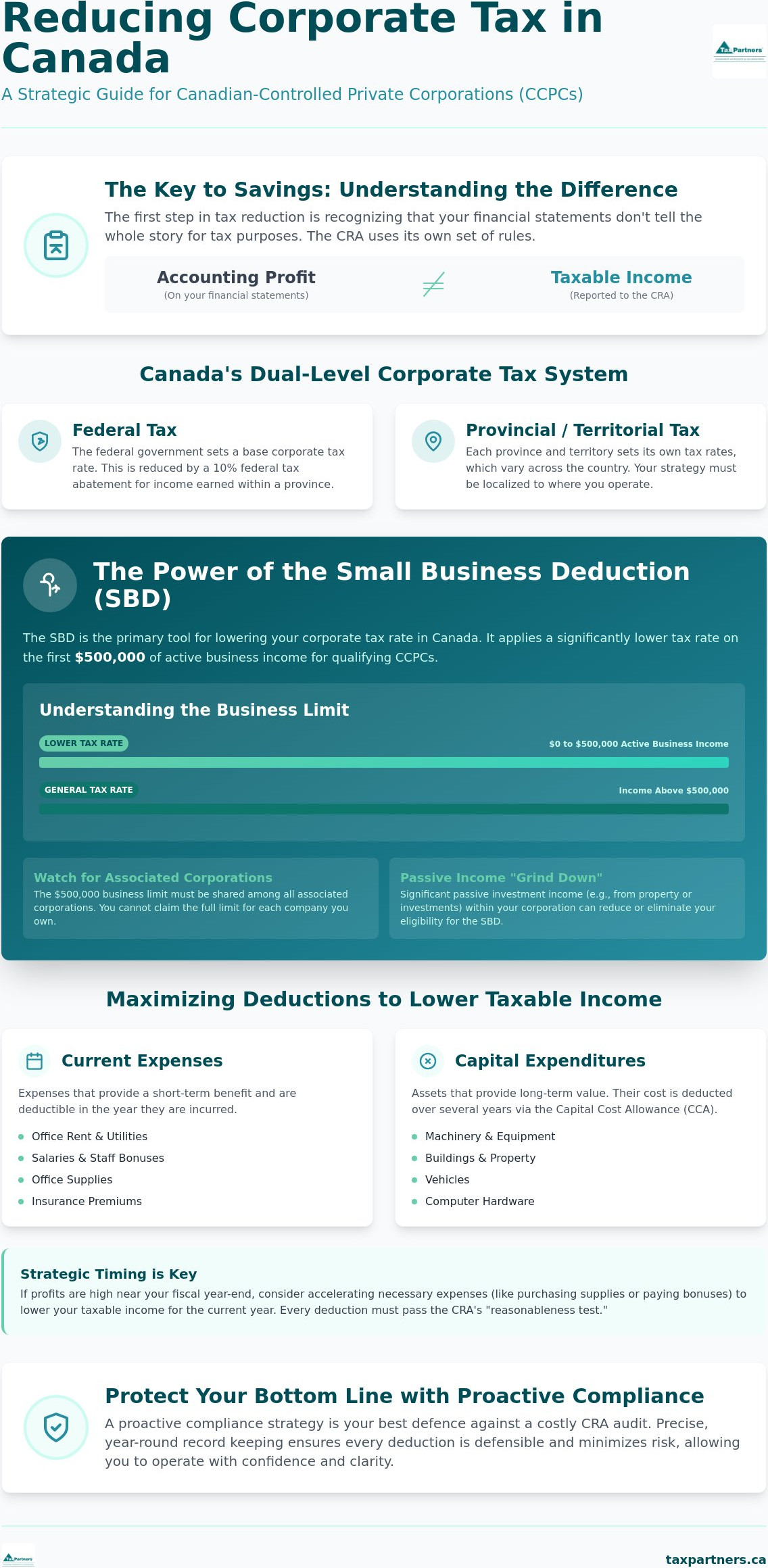
The Canadian corporate tax landscape is built on a dual-level system. Every corporation operating within our borders faces both federal and provincial or territorial taxes. For many business owners, the first step in learning how to reduce corporate tax Canada is recognizing that your "accounting profit" listed on your financial statements rarely matches your "taxable income" reported to the Canada Revenue Agency (CRA). This gap exists because the CRA applies specific tax laws and adjustments that differ from standard accounting principles. We focus on bridging this gap to ensure you aren't paying a cent more than required.
To unlock the most significant savings, your business must qualify as a Canadian-controlled private corporation (CCPC). This specific status is the gateway to the most generous incentives available under current rules. It acts as the foundation for the Small Business Deduction (SBD), which serves as the primary engine for lowering your effective tax rate. Without CCPC status, your business could face the general corporate tax rate, significantly impacting your ability to reinvest and grow.
Federal and Provincial Tax Rate Interplay
The federal government sets a basic corporate tax rate, but this is immediately reduced by a 10% federal tax abatement for income earned in a province. When you apply the SBD, the federal rate drops even further. However, the total amount you pay depends heavily on where you operate. Provincial rates vary across the country. For example, Ontario and Quebec are both implementing small business rate reductions in 2026. Because these figures can shift based on provincial budgets, we always recommend verifying current year-specific rates on the official CRA website or consulting with a corporate tax professional. This regional variation means your tax strategy must be as localized as your operations.
The Power of the Small Business Deduction (SBD)
The SBD allows CCPCs to pay a much lower tax rate on their first $500,000 of active business income. This is often referred to as the federal "business limit." While this provides a massive advantage, it comes with strict oversight from the CRA. They monitor "associated corporations" closely. If you own multiple companies, you can't claim the full $500,000 limit for each; you must share that limit among the group. Additionally, having significant passive investment income inside your corporation can "grind down" or reduce your eligibility for the SBD. This reduction starts when your adjusted aggregate investment income exceeds certain thresholds. Managing these limits requires foresight to prevent a sudden jump into a higher tax bracket.
Maximizing Operational Deductions to Lower Taxable Income
Reducing your taxable income requires more than just keeping receipts; it demands a clear understanding of how the Canada Revenue Agency (CRA) classifies your spending. When looking at how to reduce corporate tax Canada, you must distinguish between current expenses and capital expenditures. Current expenses, such as office rent or monthly utilities, provide a short-term benefit and are typically deductible in the year they occur. Organizations seeking to improve their margins can find out more about Cost reduction consulting and implementation to ensure their non-labor spending is efficient. In contrast, capital expenditures involve assets like machinery or property that offer long-term value. These aren't deducted all at once. Instead, they're recovered over several years through the Capital Cost Allowance (CCA).
Timing is everything. If your corporation is approaching its fiscal year-end with higher than expected profits, accelerating certain expenses can be a powerful move. Purchasing necessary office supplies, pre-paying insurance premiums, or declaring staff bonuses before your year-end can effectively lower your taxable income for the current cycle. However, every deduction must pass the CRA's "reasonableness" test. This means the expense must be incurred for the purpose of earning business income and the amount must be what a sensible person would pay in a similar situation. This is where professional bookkeeping becomes indispensable. It ensures that every cent is captured accurately and categorized correctly, leaving no room for missed opportunities or CRA disputes.
Capital Cost Allowance (CCA) Strategies
The CRA uses the CCA system to account for the wear and tear of business assets. Generally, the "half-year rule" applies, meaning you can only claim 50% of the normal CCA rate in the year you acquire an asset. For 2026, keep a close eye on immediate expensing rules. Eligible CCPCs may be able to deduct the full cost of certain technology or clean energy assets in the first year, bypassing the traditional multi-year grind. If you're planning a major tech upgrade, speaking with an advisor can help you time the purchase to maximize these specific CRA incentives.
Optimizing Business-Use-of-Home and Travel
For incorporated business owners, the CRA maintains strict criteria for home office deductions. Your home must either be your principal place of business or used exclusively for meeting clients or customers on a regular basis. Similarly, vehicle expenses are a frequent target for CRA audits. You must maintain a detailed logbook documenting every business-related kilometre to support your per-kilometre allowance claims. Beyond the obvious, don't overlook operational costs like professional development courses, business insurance, and the interest paid on business-related loans. These smaller entries often add up to significant tax relief over the long term.
Strategic Corporate Structuring and Income Splitting
While maximizing deductions helps on a month-to-month basis, the most profound impact on your long-term wealth comes from the structural architecture of your business. The CRA operates on the principle of tax integration. This concept suggests that whether you earn income through a corporation or personally, the total tax paid should be relatively equal. However, this neutrality doesn't account for the power of timing. By utilizing a corporation, you can defer the personal portion of your tax bill, often for decades. This is a sophisticated way of how to reduce corporate tax Canada by keeping more capital working within your business ecosystem rather than sending it to the government prematurely.
You must also be mindful of the Tax on Split Income (TOSI) rules. These CRA regulations were significantly expanded to prevent business owners from shifting income to family members in lower tax brackets. Unless a family member is actively engaged in the business or meets specific "excluded shares" criteria, paying them dividends could result in them being taxed at the highest marginal rate. Navigating these complexities requires a bespoke approach, which is why our corporate income tax services focus on creating structures that remain compliant while protecting your family's financial interests.
The Role of a Holding Company
A holding company acts as a proactive guardian for your accumulated wealth. It allows you to move excess profits from your operating company to a separate entity via tax-free inter-corporate dividends. This move serves two primary purposes. First, it secures your cash away from the operational risks and potential creditors of the active business. Second, it facilitates long-term succession planning. By centralizing assets in a holding company, you can eventually transition the operating company to new owners or the next generation with much greater tax efficiency. It is a steady hand at the helm of your corporate journey.
Salary vs. Dividends for Business Owners
Deciding how to pay yourself is a critical annual decision. A salary is a deductible expense for your corporation, which lowers its taxable income directly. It also builds RRSP contribution room and provides for Canada Pension Plan (CPP) benefits. On the other hand, dividends are paid from the corporation's after-tax profits. They don't require CPP contributions and are often simpler to administer. For business owners in certain income brackets, the dividend tax credit can result in a lower immediate tax bill. We look ahead to your personal and corporate goals to find the right balance between these two methods, ensuring your strategy is tailored for maximum efficiency.
Leveraging Specialized Tax Credits and Incentives
While the previous sections focused on lowering the income figure the CRA evaluates, tax credits offer a more direct route to efficiency. A tax deduction reduces the amount of income subject to tax, but a tax credit reduces the actual tax you owe dollar-for-dollar. This distinction is vital for anyone exploring how to reduce corporate tax Canada. Even more compelling is the concept of "refundable" credits. Under CRA rules, if a refundable credit exceeds the total tax your corporation owes, the government doesn't just zero out your bill; they send you a cheque for the difference. These incentives aren't loopholes. They are deliberate tools the Canadian government uses to encourage specific economic behaviours, such as innovation, hiring, and environmental stewardship.
Scientific Research and Experimental Development (SR&ED)
The Scientific Research and Experimental Development (SR&ED) program is Canada's largest R&D support mechanism, distributing approximately $4.5 billion annually to over 22,000 claimants. Many business owners mistakenly believe this program is reserved for "lab coats" and high-tech research facilities. In reality, the CRA provides these credits to a vast array of industries, including software development, process engineering, and food science. If your company has worked to overcome a technical challenge where the solution wasn't immediately obvious, you may qualify. The CRA evaluates claims based on three pillars: technical uncertainty, technical advancement, and a systematic investigation. Because the average SR&ED claim for a CCPC ranges from $180,000 to $198,000, the CRA's review process is understandably rigorous. Meticulous documentation of your technical journey is the only way to survive a review and secure your funding.
Regional and Industry-Specific Incentives
Beyond research, the CRA manages several credits designed to support specific sectors and labour needs. For instance, the apprenticeship job creation tax credit provides a non-refundable credit to businesses that hire eligible apprentices in Red Seal trades. This helps offset the costs of training the next generation of skilled workers. Similarly, if your corporation operates in creative fields, you may be eligible for significant digital media or film production credits that can cover a large portion of your labour expenditures. For businesses with interests that reach into international markets, our Global Information section provides further context on how cross-border incentives can be integrated into your broader strategy. These specialized credits require a proactive guardian to identify and claim correctly.
Identifying which of these high-value credits your business qualifies for is a cornerstone of professional tax optimization. To ensure you aren't leaving money on the table this fiscal year, we encourage you to reach out to our team for a detailed assessment of your eligibility under current CRA guidelines.
Proactive Compliance and the Value of Professional Advisory
The most significant "tax leak" for many Canadian small and medium sized enterprises is the habit of waiting until April to speak with a professional. By the time your fiscal year has ended, many of the most effective tools for how to reduce corporate tax Canada are no longer available. A truly efficient tax strategy isn't a retrospective exercise; it's a proactive framework that begins with the very first entry in your books. When your accounting is handled with foresight, you move from a state of reactive stress to a position of total control and understanding.
Professional CRA audit help isn't just about responding to a letter from the government; it's about ensuring your filings are so precise that they don't invite scrutiny in the first place. This often starts with a Compilation Engagement, previously known as a "Notice to Reader." These financial statements provide a clear, standardized summary of your data that carries far more credibility with the CRA and your bank than internally generated reports. At Tax Partners, we act as a steady hand at the helm, ensuring your corporate records reflect the high standards of ethical steadfastness the CRA expects.
Avoiding Common CRA Audit Triggers
The CRA utilizes sophisticated automated systems to flag returns that fall outside industry norms. Common red flags include consistently high shareholder loans, where money is taken from the corporation without being properly classified as salary or dividends, and unusual travel-to-income ratios. To remain compliant, you must keep all supporting documentation for the CRA-mandated six-year period. If the CRA does request more information, having professional representation is invaluable. We manage all communications on your behalf, ensuring that technical questions are answered with the precision and transparency required to resolve matters quickly.
Moving Beyond Compliance to Wealth Management
Once your compliance is secure, we look ahead to how your corporate structure supports your long-term wealth management. For high-earning business owners, an Individual Pension Plan (IPP) can be a superior alternative to a standard RRSP. An IPP is a defined-benefit pension plan sponsored by your corporation, allowing for significantly higher contribution limits that are fully deductible for the business. This strategy turns a required tax obligation into a powerful tool for personal wealth preservation. If you're ready to move beyond basic filing and discover a more sophisticated approach to how to reduce corporate tax Canada, contact Tax Partners today for a comprehensive corporate tax review.
Secure Your Business Legacy with Strategic Tax Planning
Achieving long-term fiscal stability requires moving beyond simple compliance toward a comprehensive strategy. You've seen how identifying the right corporate structure and maximizing refundable credits like SR&ED can fundamentally change your bottom line. By mastering how to reduce corporate tax Canada, you aren't just saving money this year; you're building a resilient foundation for future growth. Implementing these strategies under the guidance of a proactive guardian ensures that every entry in your books serves a dual purpose: lowering your current tax burden and protecting you against potential CRA scrutiny.
With over 40 years of Canadian tax expertise and more than 1,390 five-star Google reviews, we provide the steady hand needed to navigate these complexities. We offer tailored strategies for over 20 industries, ensuring your plan is as unique as your business. Book a Consultation with Our Corporate Tax Experts today to begin your journey toward total financial clarity and long-term wealth preservation. Your success is our mission, and we're ready to help you thrive in an ever-changing regulatory environment.
Frequently Asked Questions
What is the small business tax rate in Canada for 2026?
Under CRA rules, the federal small business tax rate for Canadian-controlled private corporations (CCPCs) is 9% on the first $500,000 of eligible business income. You must also account for provincial rates, which vary by region. For instance, Ontario's small business rate is scheduled to decrease to 2.2% effective July 1, 2026, while Quebec's rate will also drop to 2.2% for taxation years beginning after April 29, 2026. Combining these federal and provincial incentives is a fundamental step in how to reduce corporate tax Canada.
Can I deduct my personal car expenses through my corporation?
You can only deduct the specific portion of vehicle expenses that relate to earning business income. The CRA requires a detailed logbook that tracks the date, destination, purpose, and kilometres for every business trip to justify the claim. Many business owners find it more efficient to use the CRA's prescribed per-kilometre travel allowance, as it simplifies record-keeping while still capturing the cost of business-related travel accurately.
How does a holding company help reduce my corporate tax bill?
A holding company helps you manage tax by receiving profits from an operating company through tax-free inter-corporate dividends. This structure allows you to move excess cash out of an active business without triggering the personal income tax that would apply if you paid that money to yourself directly. It defers personal tax obligations and keeps more capital available for reinvestment or long-term wealth planning within your corporate group.
Is it better to pay myself a salary or dividends for tax purposes?
The choice between salary and dividends depends on your need for RRSP contribution room and CPP benefits. A salary is a deductible expense for your corporation, which lowers its taxable income, but it requires both employer and employee CPP contributions. Dividends are paid from after-tax profits and don't require CPP, which can be a simpler way how to reduce corporate tax Canada if you already have sufficient retirement savings elsewhere.
What are the most common CRA audit triggers for small businesses?
The CRA often flags corporations that report consistently high shareholder loans or travel and promotion expenses that appear excessive compared to industry averages. Other triggers include significant inconsistencies between your reported income and your personal lifestyle or failing to file GST/HST returns on time. Maintaining organized records for the CRA-mandated six-year period is the most effective way to address these inquiries if they arise.
How can I claim the SR&ED tax credit for my small business?
You claim the SR&ED credit by filing Form T661 along with your T2 corporate return no later than 18 months after your fiscal year-end. Your project must meet the CRA's criteria for technical uncertainty, technical advancement, and systematic investigation. For eligible CCPCs, this can result in a 35% refundable tax credit on the first $6 million of qualifying expenditures, providing a significant cash injection for your business.
Does my corporation have to pay tax if it didn't make a profit?
Generally, your corporation won't owe income tax if it didn't earn a profit, but you're still required to file a T2 return with the CRA. Filing allows you to formally record a non-capital loss, which can be carried back three years to recover previously paid taxes or carried forward up to 20 years to offset future earnings. You must still fulfill other obligations, such as payroll remittances and GST/HST filings, regardless of profit.
What is the deadline for filing a Canadian corporate tax return (T2)?
The deadline to file your T2 return is six months after the end of your corporation's fiscal year. However, it's vital to realize that the deadline to pay any tax owing to the CRA is usually earlier. Most corporations must pay their taxes within two months of their year-end, though certain CCPCs may have an extended payment deadline of three months if they meet specific taxable income and capital requirements.

Article by
Mahad Mohamed
Mahad Mohamed is an accountant and the CEO of Tax Partners, with over 26+ years of Canadian and international tax and accounting experience. His expertise includes corporate reorganization, cross-border tax structuring (Canada & US), tax disputes, CRA audits, and tax planning for small owner-managed private corporations. Most recently, Mahad is a pioneer in Canadian crypto taxation and founded Block3 Finance.
Previously, Mahad worked for the Canada Revenue Agency (CRA), Big4 accounting firms, and served as a Rulings Officer for the Federal Tax Authority of the UAE before acquiring Tax Partners in 2014.
Tax Partners has 44 full-time accountants and over 18,400+ clients.
Disclaimer
This article provides general information only and is current as of its publication date. It has not been updated and may be out of date. It does not constitute legal advice and should not be relied upon as such. Every tax situation is unique and may differ from the examples discussed in this article. If you have specific questions, you should seek the advice of our accountants for your unique circumstances. Book a FREE Initial Consultation Today!
Frequently Asked Questions
What is the small business tax rate in Canada for 2026?
Under CRA rules, the federal small business tax rate for Canadian-controlled private corporations (CCPCs) is 9% on the first $500,000 of eligible business income. You must also account for provincial rates, which vary by region. For instance, Ontario's small business rate is scheduled to decrease to 2.2% effective July 1, 2026, while Quebec's rate will also drop to 2.2% for taxation years beginning after April 29, 2026. Combining these federal and provincial incentives is a fundamental step in how to reduce corporate tax Canada.
Can I deduct my personal car expenses through my corporation?
You can only deduct the specific portion of vehicle expenses that relate to earning business income. The CRA requires a detailed logbook that tracks the date, destination, purpose, and kilometres for every business trip to justify the claim. Many business owners find it more efficient to use the CRA's prescribed per-kilometre travel allowance, as it simplifies record-keeping while still capturing the cost of business-related travel accurately.
How does a holding company help reduce my corporate tax bill?
A holding company helps you manage tax by receiving profits from an operating company through tax-free inter-corporate dividends. This structure allows you to move excess cash out of an active business without triggering the personal income tax that would apply if you paid that money to yourself directly. It defers personal tax obligations and keeps more capital available for reinvestment or long-term wealth planning within your corporate group.
Is it better to pay myself a salary or dividends for tax purposes?
The choice between salary and dividends depends on your need for RRSP contribution room and CPP benefits. A salary is a deductible expense for your corporation, which lowers its taxable income, but it requires both employer and employee CPP contributions. Dividends are paid from after-tax profits and don't require CPP, which can be a simpler way how to reduce corporate tax Canada if you already have sufficient retirement savings elsewhere.
What are the most common CRA audit triggers for small businesses?
The CRA often flags corporations that report consistently high shareholder loans or travel and promotion expenses that appear excessive compared to industry averages. Other triggers include significant inconsistencies between your reported income and your personal lifestyle or failing to file GST/HST returns on time. Maintaining organized records for the CRA-mandated six-year period is the most effective way to address these inquiries if they arise.
How can I claim the SR&ED tax credit for my small business?
You claim the SR&ED credit by filing Form T661 along with your T2 corporate return no later than 18 months after your fiscal year-end. Your project must meet the CRA's criteria for technical uncertainty, technical advancement, and systematic investigation. For eligible CCPCs, this can result in a 35% refundable tax credit on the first $6 million of qualifying expenditures, providing a significant cash injection for your business.
Does my corporation have to pay tax if it didn't make a profit?
Generally, your corporation won't owe income tax if it didn't earn a profit, but you're still required to file a T2 return with the CRA. Filing allows you to formally record a non-capital loss, which can be carried back three years to recover previously paid taxes or carried forward up to 20 years to offset future earnings. You must still fulfill other obligations, such as payroll remittances and GST/HST filings, regardless of profit.
What is the deadline for filing a Canadian corporate tax return (T2)?
The deadline to file your T2 return is six months after the end of your corporation's fiscal year. However, it's vital to realize that the deadline to pay any tax owing to the CRA is usually earlier. Most corporations must pay their taxes within two months of their year-end, though certain CCPCs may have an extended payment deadline of three months if they meet specific taxable income and capital requirements.