Filing Back Taxes in Ontario: A Strategic Guide for CRA Filers in 2026

What if the looming weight of unfiled returns isn't the dead end you fear, but a manageable hurdle that can be cleared with a single, strategic move? You've likely spent months worrying about the consequences of filing back taxes in Ontario, especially with the 7% daily compounded interest rate the CRA charges on overdue taxes for the third quarter of 2026. It's an exhausting position that feels like a constant shadow over your financial stability and peace of mind.
This guide provides a professional pathway for resolving your tax debt, showing you how to minimize penalties and regain your standing with the Canada Revenue Agency. You'll discover how to leverage the 2026 Voluntary Disclosures Program (VDP) rules to resolve unintentional errors and secure a future free from the fear of prosecution. We'll examine the specific forms required for previous years and the precise steps you can take to move from a state of uncertainty to total financial control.
Key Takeaways
- Identify the immediate legal and financial consequences of unfiled returns under the Canadian Income Tax Act to better assess your current risk level.
- Learn how to retrieve missing T4 and T5 slips directly from the CRA to build a complete and accurate tax history.
- Explore the specific eligibility criteria for the Voluntary Disclosure Program as a professional method for filing back taxes Ontario while reducing interest and penalty charges.
- Implement a practical diagnostic framework to organize your financial records and prepare for a comprehensive submission to the tax authorities.
- Understand the role of professional advocacy in negotiating with the CRA to secure your financial stability and long-term peace of mind.
Understanding the Implications of Unfiled Tax Returns for CRA Filers
Under the Canadian Income Tax Act, filing a tax return isn't merely a suggestion; it's a statutory obligation for anyone with tax payable. Many residents believe that if they don't owe money, they don't need to file. This is a risky assumption. The Canada Revenue Agency (CRA) uses these filings to determine your eligibility for essential social programs. If you've fallen behind, the financial friction begins almost immediately. It's a weight that grows heavier with every passing deadline.
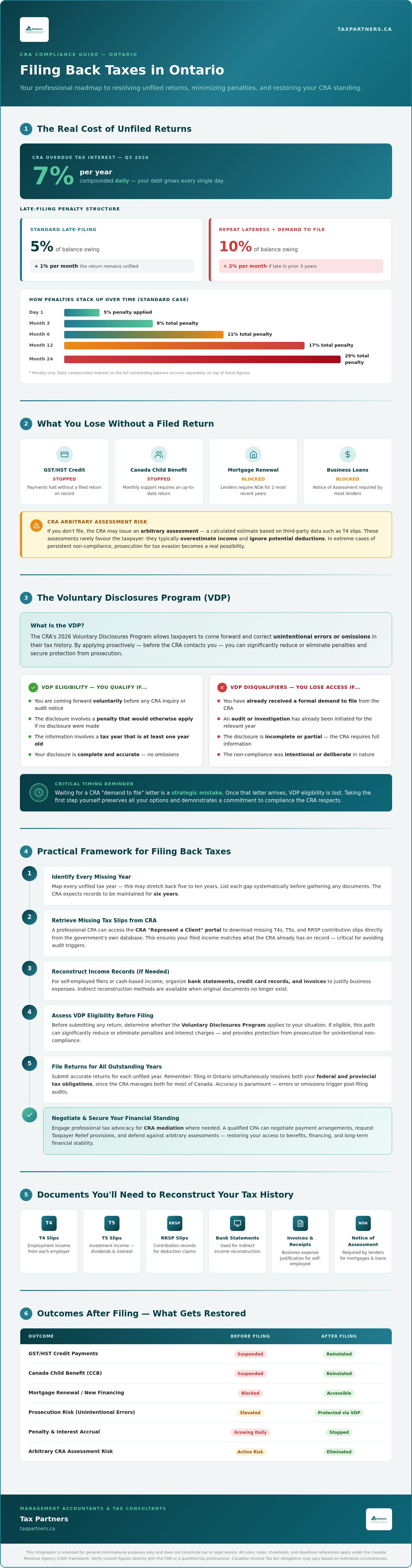
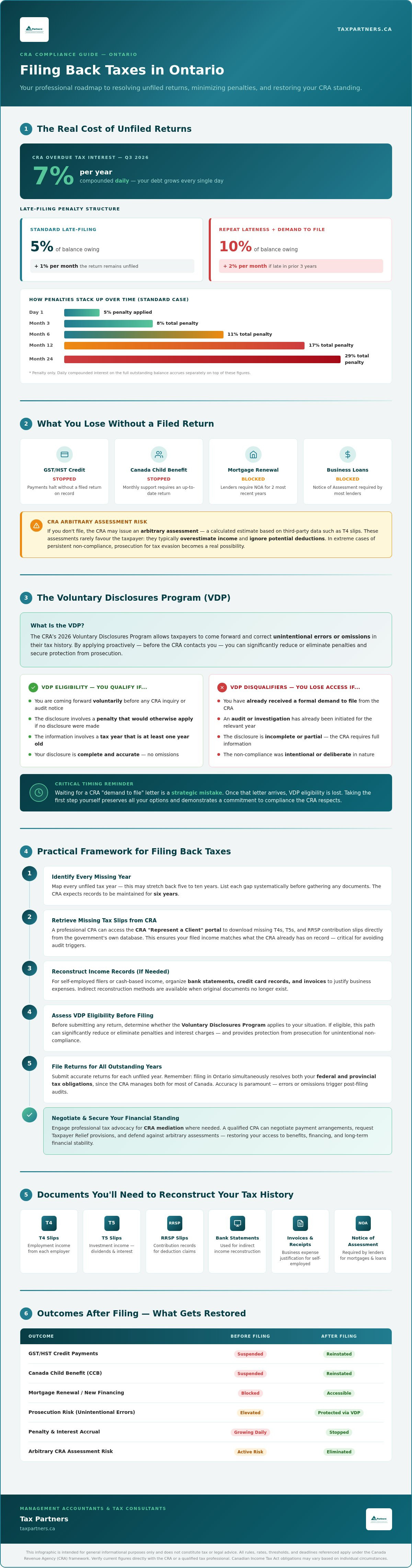
For the third quarter of 2026, the CRA has set the interest rate on overdue taxes at 7% per year, compounded daily. This means your debt grows every single day you delay. When you combine this with the late-filing penalty, which starts at 5% of your balance owing plus 1% for every month the return is late, the numbers become staggering. If you've been late in any of the three previous tax years and received a demand to file, those penalties can jump to 10% plus 2% per month. These costs are designed to be punitive, and they're highly effective at eroding your savings.
Beyond the immediate debt, unfiled returns freeze your access to vital cash flow. The GST/HST credit and the Canada Child Benefit (CCB) both rely on the data from your most recent tax year. Without a filed return, these payments stop. For families and individuals in Ontario, this loss of monthly support can create significant hardship. Additionally, if you're looking to renew a mortgage or secure a business loan, most Canadian lenders will require a Notice of Assessment (NOA) for the two most recent years. Completing the process of filing back taxes in Ontario is often the only way to unlock these essential financial tools.
The Statutory Limits and CRA Powers
The CRA possesses broad powers to ensure compliance. If you don't file, the agency may issue an "arbitrary assessment." This is essentially a calculated guess of your income based on third-party data like T4 slips or previous history. These assessments rarely favour the taxpayer; they often overestimate income and ignore potential deductions. In extreme cases of persistent non-compliance, the risk of prosecution for tax evasion becomes a reality. This is why proactive CRA mediation and professional filing are so critical to protecting your assets.
Impact on Ontario and National Taxpayers
While your focus might be on filing back taxes in Ontario, remember that the CRA manages both federal and provincial taxes for most of Canada. When you file your catch-up returns, you're resolving your standing with both levels of government simultaneously. Waiting for a formal "demand to file" from the CRA is a strategic mistake. Once that letter arrives, you generally lose your eligibility for the Voluntary Disclosures Program. Taking the first step yourself preserves your options and demonstrates a commitment to compliance that the agency respects.
The Methodology of Catching Up: Reconstructing Your Tax History
Reconstructing your financial past can feel like assembling a puzzle with half the pieces missing. However, the process of filing back taxes in Ontario requires a methodical approach to ensure the final picture is accurate enough to withstand CRA scrutiny. You can't simply guess at your figures. You need a paper trail that matches what the government already knows about you. Accuracy is your best defence; a return that contains errors or omissions is far more likely to trigger a post-filing audit, which can lead to further penalties and stress.
The first step involves identifying every single missing year. For many, this isn't just about the recent past but may stretch back five or ten years. By following practical steps for filing back taxes, you can begin to identify every gap in your history. For self-employed filers, this means organizing bank statements, credit card records, and invoices to justify business expenses. The CRA expects you to maintain these records for six years, but when you're catching up, you may need to dig even deeper to prove your claims.
Gathering Missing Information
If you've lost your original slips, don't panic. A professional CPA can use the CRA "Represent a Client" portal to download missing T4, T5, and RRSP contribution slips directly from the government's database. This ensures your filed income matches the records the CRA already possesses. For those with cash-based income or incomplete records, we use indirect methods to reconstruct your earnings. Furthermore, for those involved in digital assets, specialized cryptocurrency accounting is essential to ensure every trade and gain is correctly reported under Canadian rules.
Determining the Order of Filing
While it might be tempting to file for the most recent year first, filing chronologically is often the most strategic path. This is because many tax credits and deductions, such as unused RRSP room or capital losses, carry forward from one year to the next. For example, a significant business loss in 2021 could drastically reduce the tax you owe for 2023. By filing in sequence, you ensure that every available benefit is applied correctly to minimize your total debt. If the volume of missing data feels overwhelming, you can reach out to our team for guidance on how to systematically retrieve your records and begin the reconstruction process.
Strategic filing also involves looking at capital gains and losses across multiple years. If you realized a gain in 2024 but had losses in 2022 that were never reported, filing those back years allows you to offset that gain and keep more of your money. This level of foresight is what separates a basic filing from a professional tax strategy. It's about more than just compliance; it's about optimizing your financial outcome after years of uncertainty.
Navigating the Voluntary Disclosure Program and Relief Provisions
The Voluntary Disclosure Program (VDP) is perhaps the most powerful tool available to Canadians who have fallen behind on their obligations. Under CRA rules, the VDP offers a second chance to correct past omissions or file returns that are significantly overdue. When you're considering the process of filing back taxes in Ontario, the VDP can mean the difference between a fresh start and a financial catastrophe. If your application is accepted, the CRA may grant relief from prosecution and, in many cases, waive the heavy penalties that would otherwise apply.
To qualify for this program, your disclosure must meet four strict criteria. First, it must be voluntary; if the CRA has already contacted you about your unfiled returns or started an audit, you're generally ineligible. Second, the disclosure must be complete, meaning you cannot pick and choose which years or income sources to report. Third, the information must involve a penalty. Finally, you must include payment of the estimated tax owing. The CRA currently operates a two-track system: the General Program for unintentional errors and the Limited Program for taxpayers whose non-compliance involved a level of intent or sophisticated planning. While the Limited Program provides less interest relief, it still offers protection against criminal prosecution.
Strategic Use of the VDP
Timing is everything when utilizing this program. You must act before the CRA initiates any enforcement action. We often guide clients through a pre-disclosure discussion, formerly known as a "no-name" disclosure, which allows for a non-binding conversation with a CRA official about the facts of the case before your identity is revealed. This helps determine the likelihood of acceptance. For a deeper look at how this process works, see our detailed guide on The Voluntary Disclosure Program: Fixing Past Mistakes. Proactive disclosure is almost always more favourable than waiting for the agency to discover the omission on its own.
Taxpayer Relief Provisions
If you don't qualify for the VDP, or if your situation is defined by extraordinary circumstances, you may seek assistance through Taxpayer Relief Provisions. This process allows you to request the cancellation or waiver of penalties and interest when you couldn't meet your tax obligations due to factors beyond your control. Common grounds for these "fairness" requests include serious illness, a death in the immediate family, or financial hardship so severe that paying the interest would deprive you of basic necessities like food or shelter. To initiate this, you must file Form RC4288, "Taxpayer Relief Request," providing a clear narrative and supporting evidence. This is another area where filing back taxes in Ontario requires a precise, well-documented approach to ensure the CRA understands the human element behind the missing data.
A Practical Framework for Filing Back Taxes in Ontario and Canada
Resolving years of non-compliance requires more than just good intentions; it demands a structured, step-by-step framework to ensure nothing is missed. When you're ready to begin the process of filing back taxes in Ontario, your journey moves from reconstruction to execution. This phase is about precision. By following a logical sequence, you can transform a chaotic financial history into a compliant, professional submission that the CRA will accept without unnecessary friction.
The framework for a successful catch-up filing includes five essential stages:
- Step 1: Diagnostic. Conduct a full review of your current standing with the CRA to confirm exactly which years are outstanding and if any arbitrary assessments have already been issued.
- Step 2: Consolidation. Gather every piece of evidence. Use our checklist to ensure you have all historical income slips, expense receipts, and investment records ready for processing.
- Step 3: Preparation. Draft the returns using the specific tax rules and forms that were in effect for each individual tax year.
- Step 4: Strategic Evaluation. Decide whether a standard filing or a VDP application is the safer route based on your risk of penalties or prosecution.
- Step 5: Submission and Negotiation. File the returns and, if you cannot pay the full balance immediately, negotiate a formal payment arrangement with the CRA.
Preparing the Returns
Accuracy in this stage is paramount. You cannot use current-year tax software to file for years like 2020 or 2021; each year has unique tax brackets, credit amounts, and legislative rules. For example, the 2026 federal tax brackets have been adjusted for inflation, but those rates don't apply to your historical filings. It's also vital to ensure all provincial Ontario credits, such as the Ontario Trillium Benefit, are claimed correctly alongside federal ones. Missing these provincial incentives is a common mistake that leaves money on the table. If you're feeling overwhelmed by the technical requirements, book a consultation with our specialists to ensure your filings are both accurate and optimized.
Post-Submission Management
Your responsibility doesn't end the moment you hit "submit." After filing, the CRA will process your returns and issue a Notice of Assessment (NOA) for each year. This document confirms the CRA's calculation of your tax, interest, and penalties. You must review these carefully. In some cases, the agency may send follow-up questions or request additional documentation to verify your claims. If your back taxes are flagged for a deeper review, having a professional plan for a CRA audit is essential. We act as your proactive guardian during this period, managing all correspondence to ensure the process remains focused on resolution rather than escalation.
Securing Your Financial Future with Professional Tax Advocacy
While off-the-shelf software might help you fill out forms, it cannot replace the strategic advocacy of a seasoned CPA. The process of filing back taxes in Ontario is rarely a straightforward data entry task; it's a negotiation with a complex federal agency. With the CRA's planned spending reaching approximately $6.27 billion for the 2026-27 period, the agency's enforcement and audit capabilities are more robust than ever. Professional representation ensures that you aren't just another number in their system. We act as a steady hand at the helm, using our expertise to protect your assets and your reputation.
Our firm has filed over 495,000 returns since 1981, providing us with a deep well of institutional wisdom. This history allows us to anticipate CRA responses and proactively address potential red flags before they escalate. We don't just react to past requirements. We look ahead to secure a more stable outcome for every client we serve. By choosing professional advocacy, you're investing in a partnership that prioritizes your long-term financial health over simple clerical completion.
Why Experience Matters in Back-Tax Cases
Decades of experience mean we understand the unwritten expectations of CRA auditors and VDP officers. This level of insight is what we call "proactive guardianship." It involves identifying tax-saving opportunities that generic software often misses, such as specific provincial credits or carry-forward losses that can be applied across multiple years to reduce your debt. As our leadership emphasizes in the Managing Partner's message, our commitment to client success is rooted in ethical steadfastness and personalized care.
Moving Toward Financial Clarity
Resolving your arrears is the first step toward total financial control. Once your history is clean, the focus shifts to maintaining that compliance. For business owners, this often means moving away from disorganized records toward a sustainable payroll system or integrated bookkeeping solution. These systems ensure that you never face the stress of unfiled returns again. They provide the transparency needed to make informed decisions about your wealth and business growth.
You don't have to carry this burden alone. The path to resolution begins with a confidential conversation where we can assess your specific situation and develop a bespoke strategy for your catch-up filings. Take the final step toward peace of mind and Contact Tax Partners today to resolve your unfiled taxes. We're here to help you regain your standing and secure your financial future through every stage of the journey.
Take Control of Your Financial Future
The path to resolving unfiled returns doesn't have to be a journey you take alone. By understanding the implications of late filing and using a structured framework for reconstruction, you can navigate the complexities of the Canada Revenue Agency with confidence. Whether you're utilizing the Voluntary Disclosure Program or seeking relief from compounded daily interest, the key is to act before the CRA initiates contact. Completing the process of filing back taxes Ontario is the most effective way to restore your access to essential benefits and secure your long-term stability.
Since 1981, we've served as a proactive guardian for our clients, having filed over 495,000 returns and earned more than 1,390 five-star Google reviews. We combine decades of institutional wisdom with a modern approach to complex compliance. You deserve the peace of mind that comes from professional advocacy and a clear plan for resolution. It's time to move from a state of uncertainty to a position of total control. Book a Confidential Consultation with Our Senior Tax Partners to review your arrears and start your journey back to compliance today. Your fresh start is closer than you think.
Frequently Asked Questions
How many years back can I file my taxes in Canada?
You can technically file a tax return for any previous year, though the CRA typically limits your ability to claim refunds or certain credits to the 10 most recent calendar years. If you owe taxes, there's no statutory limit on how far back the agency can assess you. It's best to address all outstanding years simultaneously to ensure your total account is brought into good standing.
Will I go to jail for filing back taxes in Ontario?
Prosecution is extremely unlikely for those who voluntarily come forward to correct their records. The CRA focuses criminal investigations on cases of deliberate tax evasion or fraudulent activity. By taking the initiative to begin filing back taxes Ontario, you're demonstrating a commitment to compliance that the authorities generally respect, especially when you use the Voluntary Disclosure Program to resolve the issue.
What happens if I don't have my T4 slips from five years ago?
You don't need the physical slips to complete your filing. A professional accountant can access the CRA "Represent a Client" portal to retrieve historical T4, T5, and other tax slips recorded under your Social Insurance Number. This ensures that the income you report matches the data the CRA already possesses, which significantly reduces the risk of an immediate post-filing audit or clerical error.
Can the CRA waive the interest on my late tax payments?
The CRA has the authority to waive or cancel interest and penalties under the Taxpayer Relief Provisions. This relief is typically reserved for taxpayers who faced extraordinary circumstances, such as a serious illness, a natural disaster, or a death in the immediate family. You'll need to provide documented evidence of these circumstances when submitting your request for a formal fairness review.
Is there a deadline to apply for the Voluntary Disclosure Program?
There isn't a specific date on the calendar, but the window of opportunity closes the moment the CRA initiates an enforcement action against you. To be considered voluntary, your application must reach the CRA before they send a demand to file or start a related audit. Waiting even one day after receiving a CRA notice can disqualify you from the program's penalty relief benefits.
How much does a CPA charge to help with back taxes?
Professional fees for tax catch-up services depend on the number of years involved and the complexity of your financial records. A self-employed individual with missing receipts will require more intensive reconstruction work than a salaried employee with simple T4 slips. We recommend a confidential consultation to assess the scope of your arrears and provide a clear, professional pathway forward for your specific situation.
Can I file back taxes if I am currently being audited by the CRA?
You can still file your returns, but you won't be eligible for the Voluntary Disclosure Program for any tax year that is already under audit. It's still strategically beneficial to file as soon as possible to stop the accrual of further late-filing penalties. Professional advocacy is particularly important in these cases to manage communication with the auditor and protect your standing during the review.
What if I owe the CRA money but cannot afford to pay right now?
You should still file your returns immediately even if you can't pay the full balance. Filing on time stops the late-filing penalty from growing, though interest will still accrue on the unpaid amount at the current rate. Once the returns are processed, you can negotiate a payment arrangement with the CRA that fits your current financial capacity while keeping your account in good standing.

Article by
Mahad Mohamed
Mahad Mohamed is an accountant and the CEO of Tax Partners, with over 26+ years of Canadian and international tax and accounting experience. His expertise includes corporate reorganization, cross-border tax structuring (Canada & US), tax disputes, CRA audits, and tax planning for small owner-managed private corporations. Most recently, Mahad is a pioneer in Canadian crypto taxation and founded Block3 Finance.
Previously, Mahad worked for the Canada Revenue Agency (CRA), Big4 accounting firms, and served as a Rulings Officer for the Federal Tax Authority of the UAE before acquiring Tax Partners in 2014.
Tax Partners has 44 full-time accountants and over 18,400+ clients.
Disclaimer
This article provides general information only and is current as of its publication date. It has not been updated and may be out of date. It does not constitute legal advice and should not be relied upon as such. Every tax situation is unique and may differ from the examples discussed in this article. If you have specific questions, you should seek the advice of our accountants for your unique circumstances. Book a FREE Initial Consultation Today!
Frequently Asked Questions
How many years back can I file my taxes in Canada?
You can technically file a tax return for any previous year, though the CRA typically limits your ability to claim refunds or certain credits to the 10 most recent calendar years. If you owe taxes, there's no statutory limit on how far back the agency can assess you. It's best to address all outstanding years simultaneously to ensure your total account is brought into good standing.
Will I go to jail for filing back taxes in Ontario?
Prosecution is extremely unlikely for those who voluntarily come forward to correct their records. The CRA focuses criminal investigations on cases of deliberate tax evasion or fraudulent activity. By taking the initiative to begin filing back taxes Ontario, you're demonstrating a commitment to compliance that the authorities generally respect, especially when you use the Voluntary Disclosure Program to resolve the issue.
What happens if I don't have my T4 slips from five years ago?
You don't need the physical slips to complete your filing. A professional accountant can access the CRA "Represent a Client" portal to retrieve historical T4, T5, and other tax slips recorded under your Social Insurance Number. This ensures that the income you report matches the data the CRA already possesses, which significantly reduces the risk of an immediate post-filing audit or clerical error.
Can the CRA waive the interest on my late tax payments?
The CRA has the authority to waive or cancel interest and penalties under the Taxpayer Relief Provisions. This relief is typically reserved for taxpayers who faced extraordinary circumstances, such as a serious illness, a natural disaster, or a death in the immediate family. You'll need to provide documented evidence of these circumstances when submitting your request for a formal fairness review.
Is there a deadline to apply for the Voluntary Disclosure Program?
There isn't a specific date on the calendar, but the window of opportunity closes the moment the CRA initiates an enforcement action against you. To be considered voluntary, your application must reach the CRA before they send a demand to file or start a related audit. Waiting even one day after receiving a CRA notice can disqualify you from the program's penalty relief benefits.
How much does a CPA charge to help with back taxes?
Professional fees for tax catch-up services depend on the number of years involved and the complexity of your financial records. A self-employed individual with missing receipts will require more intensive reconstruction work than a salaried employee with simple T4 slips. We recommend a confidential consultation to assess the scope of your arrears and provide a clear, professional pathway forward for your specific situation.
Can I file back taxes if I am currently being audited by the CRA?
You can still file your returns, but you won't be eligible for the Voluntary Disclosure Program for any tax year that is already under audit. It's still strategically beneficial to file as soon as possible to stop the accrual of further late-filing penalties. Professional advocacy is particularly important in these cases to manage communication with the auditor and protect your standing during the review.
What if I owe the CRA money but cannot afford to pay right now?
You should still file your returns immediately even if you can't pay the full balance. Filing on time stops the late-filing penalty from growing, though interest will still accrue on the unpaid amount at the current rate. Once the returns are processed, you can negotiate a payment arrangement with the CRA that fits your current financial capacity while keeping your account in good standing.