FATCA Compliance in Canada: 2026 Cross-Border Tax Guide

Did you know that nearly one million people living in Canada are considered U.S. persons by the IRS, yet many remain unaware of their complex cross-border reporting obligations? This status often comes as a shock when a local Canadian bank suddenly requests your U.S. Taxpayer Identification Number. For those who have fallen behind, the IRS's Streamlined Foreign Offshore Procedures in Canada offer a reliable way to catch up without facing heavy penalties.
It's completely normal to feel a sense of dread when you realize your private financial information is being shared across borders. The distinction between an FBAR and IRS Form 8938 is often blurry, and the fear of heavy IRS penalties can cause significant anxiety for families trying to build a life in Canada.
You can handle these requirements with confidence and protect your global assets by understanding the specific rules for 2026. This guide provides a clear path to total compliance and peace of mind. We will explore how to resolve past non-compliance and ensure your disclosures meet current IRS standards.
Key Takeaways
- Learn how the 2014 Inter-Governmental Agreement (IGA) facilitates the automatic exchange of your financial information between the CRA and the IRS.
- Identify whether you qualify as a "U.S. person" under IRS regulations, including specific rules for Canadian residents born in the States or holding a Green Card.
- Understand why your bank's reporting to the CRA doesn't satisfy your personal obligation to file annual tax returns and disclosures with the IRS.
- Discover how the streamlined foreign offshore procedures Canada can help you resolve past non-compliance with the IRS without facing significant financial penalties.
- Gain a clear roadmap for managing your cross-border tax position to ensure total compliance with both CRA and IRS requirements for the 2026 tax year.
Understanding FATCA Compliance in Canada for 2026
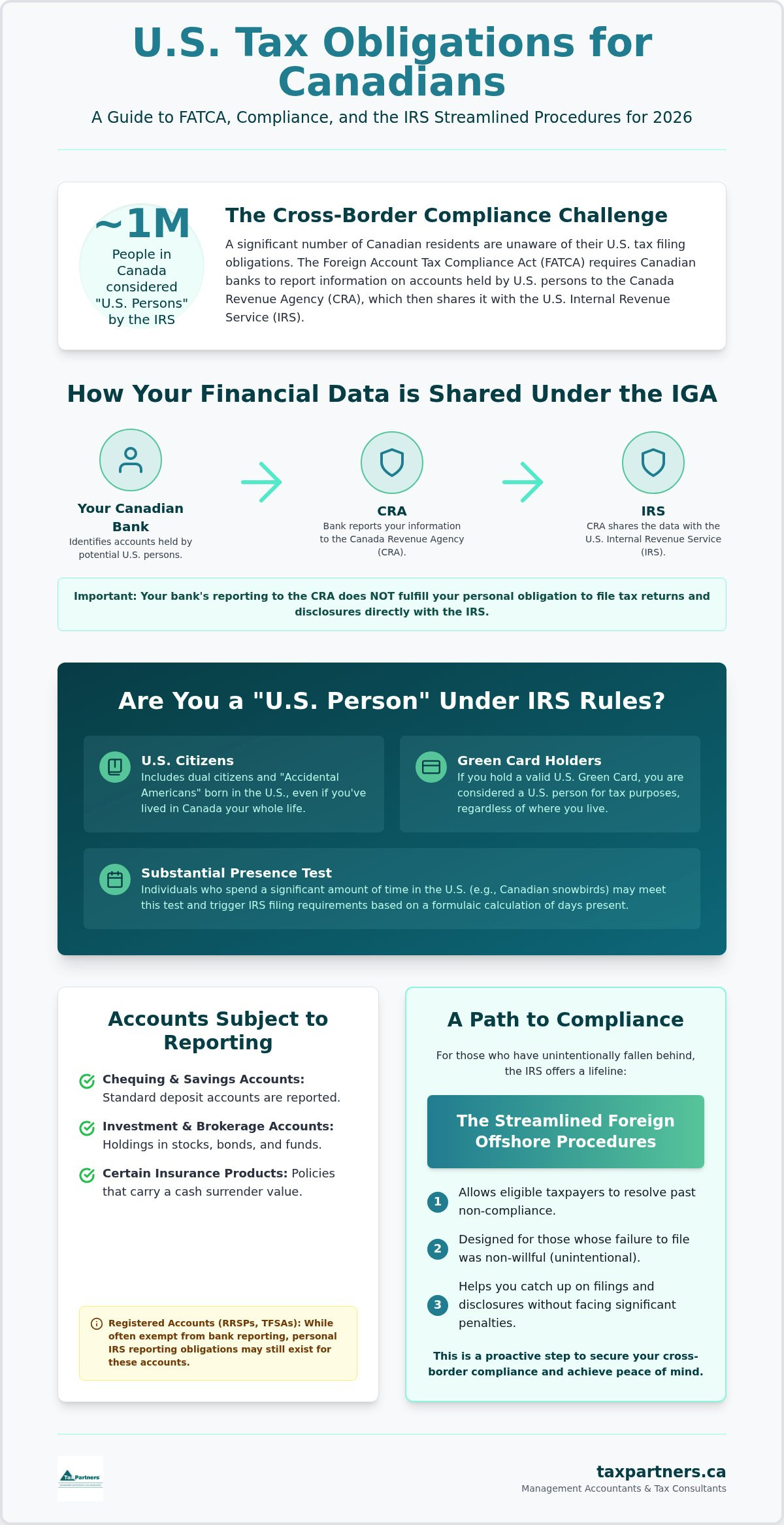
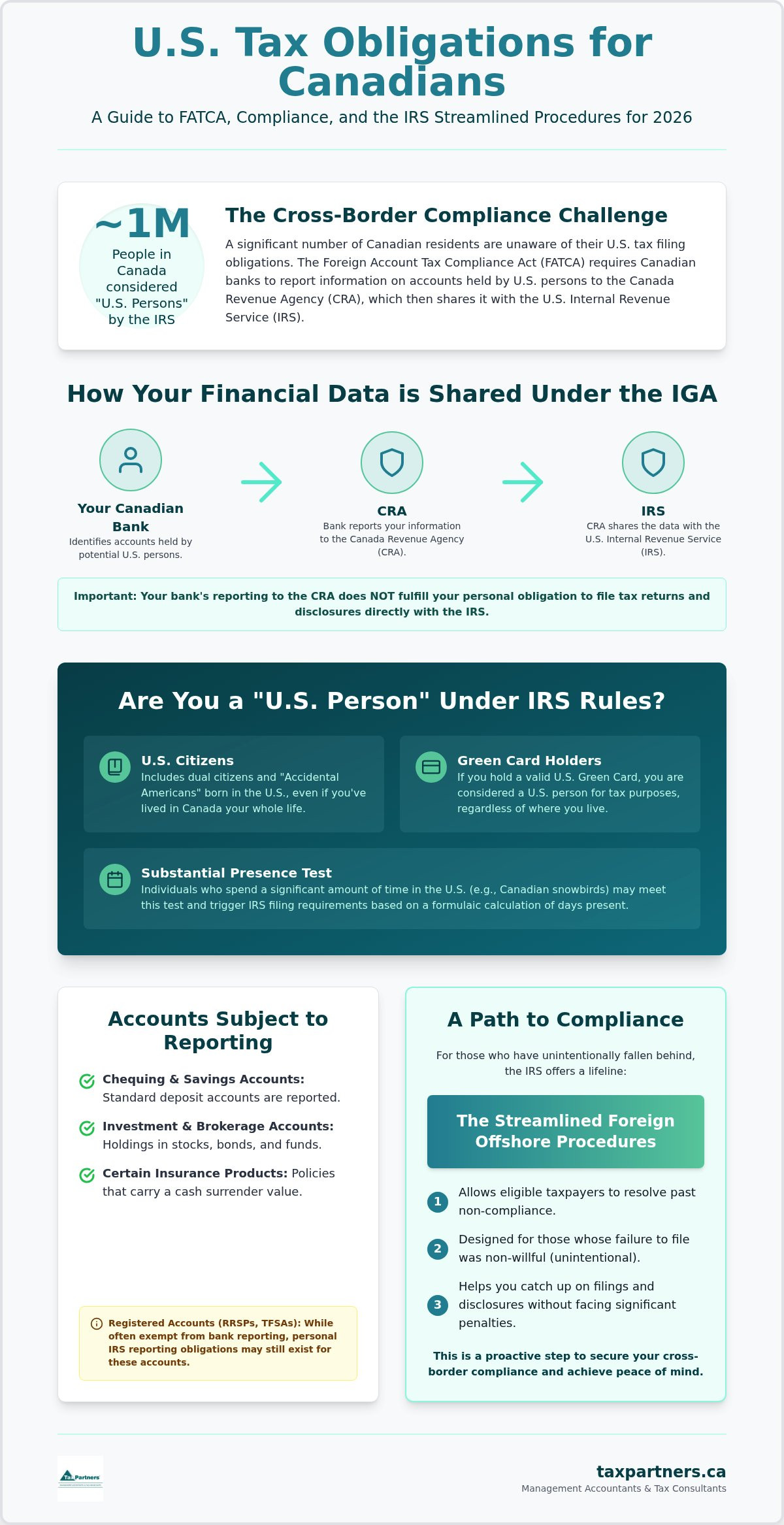
The Foreign Account Tax Compliance Act (FATCA) is a robust piece of legislation under IRS authority. It requires foreign financial institutions to identify and report accounts held by U.S. persons. In Canada, this process is governed by the 2014 Canada-U.S. Inter-Governmental Agreement (IGA).
You might assume your Canadian bank communicates with the IRS directly, but that isn't the case. Under the IGA, Canadian financial institutions report relevant account information to the CRA. The CRA then shares this data with the IRS under existing tax treaty frameworks. This system ensures compliance while respecting the legal boundaries of each jurisdiction.
The Purpose of FATCA for U.S. Taxpayers in Canada
The primary goal of the IRS is to identify U.S. persons who may be using offshore accounts to avoid their tax obligations. This law creates a high level of transparency for global financial holdings. It ensures that all U.S. tax residents, regardless of where they live, contribute their fair share.
It's vital to distinguish between intentional tax evasion and simple non-compliance errors. Many expats in Canada are simply unaware of these complex rules. If you find yourself in this position, the streamlined foreign offshore procedures Canada provides a structured way to correct past mistakes without the burden of heavy penalties.
This transparency makes it easier for the IRS to spot discrepancies. Utilizing the streamlined foreign offshore procedures Canada is a proactive step for those who need to catch up. It allows you to come forward voluntarily before the IRS identifies a reporting gap through the IGA data exchange.
How the IGA Affects Your Canadian Bank Accounts
Your local bank branch may have recently asked for your U.S. Social Security Number (SSN) or Individual Taxpayer Identification Number (ITIN). This request is a direct result of their obligations under the IGA. Banks must confirm the tax residency of their clients to satisfy reporting requirements under IRS rules.
Several types of accounts are subject to this automated reporting:
- Chequing and savings accounts
- Investment and brokerage accounts
- Certain insurance products with cash value
Registered accounts like RRSPs and TFSAs have specific nuances under the IGA. While they are often exempt from the bank's automatic reporting to the CRA, your personal reporting duties to the IRS may still apply. Understanding these distinctions is the first step toward securing your financial future in both countries.
Defining a 'U.S. Person' Under IRS Tax Regulations
Understanding your status is the foundation of cross-border compliance. Under IRS rules, a 'U.S. person' encompasses a broad range of individuals and entities. This definition includes all U.S. citizens, even if they have lived in Canada for decades, and U.S. Green Card holders regardless of where they currently reside. Additionally, U.S. entities such as corporations, estates, and trusts fall under these IRS reporting requirements.
The reach of the IRS also extends to those who spend significant time in the United States. Frequent travel can trigger tax obligations through the Substantial Presence Test. If you find yourself caught in this web of regulations, the IRS Streamlined Filing Compliance Procedures offer a path toward resolution. This program is specifically designed to help those who were unaware of their status catch up on delinquent filings.
The Challenge for Dual Citizens and Accidental Americans
The IRS maintains a unique system of citizenship-based taxation. Unlike the CRA, which primarily taxes based on residency, the IRS requires all citizens to report their global income. This creates a significant burden for dual citizens living in Canada who may not realize they have a dual filing duty.
Many individuals are 'Accidental Americans,' a term describing people born in the U.S. to non-resident parents or those who left the country as infants. These individuals often have no social or economic ties to the U.S., yet they remain subject to full IRS disclosure rules. For these taxpayers, the streamlined foreign offshore procedures Canada provides an essential safety net to fix past non-compliance without facing life-altering penalties.
The Substantial Presence Test for Canadian Snowbirds
Canadian snowbirds often face unexpected IRS scrutiny due to the Substantial Presence Test. This is a formulaic calculation that looks at the number of days you spent in the U.S. over a three-year period. If the weighted total reaches 183 days, the IRS considers you a U.S. resident for tax purposes.
To avoid being taxed on your worldwide income by the IRS, you may need to file Form 8840. This form, known as the Closer Connection Exception, allows you to maintain your status as a non-resident for IRS purposes. The 'Closer Connection' rule essentially proves that your primary social and economic life is centred within the CRA's jurisdiction rather than the United States.
Determining your exact status can be a complex process that requires foresight and precision. Our team helps clients navigate the streamlined foreign offshore procedures Canada to ensure every asset is correctly disclosed. If you are unsure whether your travel history has triggered these requirements, you can speak with our cross-border specialists for a personalized assessment.
Navigating the IGA: Bank Reporting vs. Personal IRS Filings
A common misconception among U.S. expats in Canada is that bank-level reporting satisfies their personal tax obligations. While the Canada-U.S. Inter-Governmental Agreement (IGA) requires your bank to share data with the CRA, this is a separate mechanism from your individual filing duties. Relying on your bank's compliance can lead to a false sense of security and unexpected scrutiny from the IRS.
Under IRS rules, you must personally disclose your foreign assets if they meet specific dollar amounts. This is done through IRS Form 8938, also known as the Statement of Specified Foreign Financial Assets. If you've missed these filings, the IRS Streamlined Filing Procedures provide a proactive way to come into full compliance and protect your financial standing.
IRS Form 8938: Thresholds for Canadian Residents
The reporting requirements for Form 8938 are distinct for those living outside the United States. For U.S. persons residing in Canada, the IRS allows for significantly higher thresholds than for those living stateside. This adjustment acknowledges the reality of holding local accounts while living abroad as a primary resident.
Under IRS rules, single filers or those married filing separately residing in Canada must file if total specified foreign assets exceed $200,000 USD on the last day of the year or $300,000 USD at any point during the year. Married couples filing jointly face higher limits of $400,000 USD on the last day of the year and $600,000 USD at any point during the year. Because these figures can change based on annual adjustments, it's wise to confirm current thresholds with a cross-border expert before submitting your return.
FATCA vs. FBAR: Key Differences for Taxpayers
It's easy to confuse FATCA with the FBAR, but they're governed by different agencies and sets of rules. The FBAR (FinCEN Form 114) is a requirement of the Financial Crimes Enforcement Network, while Form 8938 is an IRS tax form. You may find that your financial situation requires you to file both forms in the same tax year to remain fully compliant.
The FBAR has a much lower, flat threshold that applies to many more taxpayers. You must file if the aggregate value of all your foreign financial accounts exceeds $10,000 USD at any time during the calendar year. Understanding the FBAR filing requirements is just as critical as managing your FATCA disclosures. If you've overlooked these forms in the past, the streamlined foreign offshore procedures Canada can help you rectify multiple years of non-compliance simultaneously.
Navigating these overlapping requirements requires precision and foresight. Our team ensures that your streamlined foreign offshore procedures Canada submission is comprehensive, covering both IRS and FinCEN obligations. This methodical approach transforms a state of uncertainty into a feeling of total control over your cross-border affairs.
Resolving Non-Compliance: The IRS Streamlined Filing Procedures
For many U.S. expats living in Canada, the realization that they are behind on their tax filings is a source of immense stress. Fortunately, the IRS offers a specific program to help you return to good standing without the threat of life-altering fines. The streamlined foreign offshore procedures Canada provides a clear, legal pathway for taxpayers whose failure to report was non-willful.
Non-willful conduct, under IRS rules, is defined as conduct that is due to negligence, inadvertence, or a simple mistake. It also includes conduct that results from a good faith misunderstanding of the requirements of the law. To participate, you must submit a signed certification on IRS Form 14653 explaining the specific reasons for your past non-compliance.
The most significant benefit for eligible taxpayers residing in Canada is the 0% penalty on unreported foreign financial assets. This means you can disclose your Canadian bank accounts and investments without the IRS imposing the standard miscellaneous offshore penalties. It's a powerful tool designed to encourage voluntary disclosure rather than waiting for an enforcement action.
By coming forward proactively, you protect your assets from the much harsher penalties associated with an IRS audit. This program allows you to wipe the slate clean and ensures your future filings are based on a solid, compliant foundation. It transforms a complex regulatory hurdle into a manageable process with a certain outcome.
How to Qualify for the Streamlined Procedure
To be eligible for this program, you must meet specific residency requirements under IRS rules. You must have lived outside the United States for at least one of the last three most recent tax years. Additionally, you cannot be under a current IRS investigation or audit, as the program is only available for voluntary catch-up filings.
The process requires you to file the three most recent years of delinquent U.S. income tax returns. You must also submit the six most recent years of FBARs to FinCEN to satisfy all reporting layers. For a more detailed look at the steps involved, you can review The IRS Streamlined Procedure for US Expats to understand the full scope of the requirements.
The Risks of Ignoring FATCA Obligations
Choosing to ignore your reporting duties under IRS rules can lead to severe financial consequences. The IRS has the authority to impose significant monetary penalties for each year an FBAR or Form 8938 was not filed. These fines can often exceed the actual balance of the accounts if the non-compliance is deemed willful by the authorities.
The IRS now has access to more data than ever before through the information shared by the CRA. This automatic exchange of information means it's no longer a matter of if the IRS will find out about your Canadian accounts, but when. Taking a proactive step now ensures you remain in control of the narrative and your assets.
Voluntary disclosure provides a sense of security that's impossible to achieve while hiding from regulatory requirements. It allows you to move forward with your financial planning in Canada without the constant fear of a surprise IRS notice. If you're ready to start this journey, our team can help you prepare your streamlined submission with precision and care.
Securing Your Cross-Border Compliance with Tax Partners
Tax Partners acts as a steady hand at the helm for those managing the complexities of cross-border obligations. Our firm brings over 40 years of institutional wisdom to every client engagement. We've filed over 495,000 returns, positioning us as a proactive guardian for your global financial interests.
We provide a bespoke approach that analyzes your unique position under both IRS and CRA regulations. This methodical process ensures that no detail is overlooked and every asset is protected. If you've missed previous filings, we'll guide you through the streamlined foreign offshore procedures Canada to restore your standing with precision.
Our role is that of an authoritative mentor, moving you from uncertainty to a state of total control. We don't just react to current requirements; we look ahead to secure a better long-term outcome for your family. You can realize your compliance goals through a partnership built on ethical steadfastness and deep-seated reliability.
Expert Guidance for Dual Citizens and Expats
Managing annual IRS tax duties requires more than just filling out forms. We assist dual citizens with the intricate details of Form 1040 and the specific disclosure requirements of Form 8938 under IRS rules. Our team ensures that your foreign income and assets are reported accurately to avoid the risk of heavy penalties.
Successful compliance is often tied to your broader financial health. We emphasize the importance of wealth management and financial planning for families living between two jurisdictions. This integrated strategy helps you protect your capital while satisfying all regulatory demands on both sides of the border.
Your Partner in IRS and CRA Audit Support
Facing a compliance review or an audit can be an incredibly stressful experience. Our seasoned CPAs provide robust representation for clients during interactions with tax authorities. We manage the dialogue with the IRS or CRA to ensure your rights are protected and the process remains transparent.
Having an expert manage your international tax advisory Canada needs provides invaluable peace of mind. We use our decades of experience to resolve complex disputes and secure favourable outcomes. Our team remains deeply invested in your success, providing a level of personalized care that distant institutions simply cannot match.
The path to total compliance begins with a single proactive step. We invite you to schedule a consultation to discuss how the streamlined foreign offshore procedures Canada can benefit your specific situation. Let us help you navigate these regulatory waters with the foresight and expertise your assets deserve.
Secure Your Financial Future Across the Border
Managing your global assets requires a blend of precision and foresight. By identifying your status as a U.S. person and distinguishing bank reporting from your personal filing duties, you take the first step toward true financial clarity. If you've missed previous disclosures, the streamlined foreign offshore procedures Canada offers a reliable path to resolve non-compliance without the weight of heavy penalties.
Tax Partners stands ready to act as your proactive guardian in this complex regulatory landscape. With over 40 years of cross-border tax expertise and 1,390+ five-star Google reviews, we've helped thousands of clients move from uncertainty to total control. Our team specializes in IRS Streamlined Procedures, ensuring your submission meets the highest standards of accuracy and integrity.
Don't let the fear of disclosure hold you back from achieving peace of mind. Schedule a consultation with our cross-border tax experts today to protect your wealth and secure your standing in both countries. We're here to provide the steady hand you need to navigate these requirements with confidence.
Frequently Asked Questions
What is the difference between FATCA and FBAR for Canadians?
FATCA is part of your annual IRS tax return via Form 8938, while the FBAR is filed with the Financial Crimes Enforcement Network. Both forms track foreign financial assets but have different reporting thresholds and filing platforms. For example, the FBAR threshold is an aggregate of $10,000 USD at any time during the year. You must ensure you satisfy both requirements under IRS rules to avoid significant compliance risks.
Do I need to report my TFSA or RRSP under FATCA rules?
Registered accounts like RRSPs and TFSAs have specific nuances under the Canada-U.S. Inter-Governmental Agreement. While these accounts are generally exempt from the bank's automatic reporting to the CRA, your personal reporting duty to the IRS may still exist. Under IRS rules, you must evaluate these accounts as specified foreign financial assets. It's best to confirm current disclosure rules with a cross-border expert to ensure total compliance.
What happens if I received a letter from my Canadian bank about FATCA?
A letter from your Canadian bank indicates they have identified you as a potential U.S. person under the IGA. They are legally required to confirm your status and obtain your U.S. Taxpayer Identification Number. If you don't respond, the bank will report your account information to the CRA, which eventually reaches the IRS. This notification often serves as a helpful prompt to review your status under IRS rules.
Can the IRS penalize me if I live in Canada and have no U.S. income?
Yes, the IRS can impose penalties even if you don't owe any U.S. tax. Reporting requirements like Form 8938 and the FBAR are information-based rather than tax-based. Under IRS rules, failing to disclose foreign accounts can result in fines that start at $10,000 USD per violation. These penalties apply to all U.S. persons living in Canada, regardless of where their income is earned or where they reside.
Is there a way to catch up on missed FATCA filings without massive penalties?
The streamlined foreign offshore procedures Canada provides a dedicated pathway for non-willful taxpayers to catch up on missed filings. This program allows you to file three years of back taxes and six years of FBARs without facing the standard miscellaneous penalties. It's a proactive way to restore your good standing with the IRS. By coming forward voluntarily, you eliminate the stress of potential audits and future enforcement actions.
Who is considered a U.S. person for tax purposes in Canada?
Under IRS rules, a U.S. person includes citizens born in the United States, dual citizens, and Green Card holders. It also encompasses individuals who meet the Substantial Presence Test by spending a weighted total of 183 days in the U.S. over a three-year period. U.S. entities like estates and trusts are also included. Identifying your status is the critical first step in determining your reporting duties to the IRS.
How much does it cost to become FATCA compliant?
The cost to become compliant depends entirely on the complexity of your financial history and the number of years you need to catch up. Every situation is unique, especially when dealing with both CRA and IRS jurisdictions. We recommend consulting with a cross-border tax specialist to receive a bespoke analysis of your requirements. This approach ensures you get an accurate estimate tailored to your specific assets and filing needs.
What is the deadline for filing Form 8938 with the IRS?
Form 8938 must be submitted to the IRS as an attachment to your annual U.S. income tax return. For U.S. persons living in Canada, the typical filing deadline is June 15, though you can request an extension to October 15. It's important to remember that while the tax return has an automatic extension, any tax owed to the IRS is generally due by April 15 to avoid interest charges.

Article by
Mahad Mohamed
Mahad Mohamed is an accountant and the CEO of Tax Partners, with over 26+ years of Canadian and international tax and accounting experience. His expertise includes corporate reorganization, cross-border tax structuring (Canada & US), tax disputes, CRA audits, and tax planning for small owner-managed private corporations. Most recently, Mahad is a pioneer in Canadian crypto taxation and founded Block3 Finance.
Previously, Mahad worked for the Canada Revenue Agency (CRA), Big4 accounting firms, and served as a Rulings Officer for the Federal Tax Authority of the UAE before acquiring Tax Partners in 2014.
Tax Partners has 44 full-time accountants and over 18,400+ clients.
Disclaimer
This article provides general information only and is current as of its publication date. It has not been updated and may be out of date. It does not constitute legal advice and should not be relied upon as such. Every tax situation is unique and may differ from the examples discussed in this article. If you have specific questions, you should seek the advice of our accountants for your unique circumstances. Book a FREE Initial Consultation Today!
Frequently Asked Questions
What is the difference between FATCA and FBAR for Canadians?
FATCA is part of your annual IRS tax return via Form 8938, while the FBAR is filed with the Financial Crimes Enforcement Network. Both forms track foreign financial assets but have different reporting thresholds and filing platforms. For example, the FBAR threshold is an aggregate of $10,000 USD at any time during the year. You must ensure you satisfy both requirements under IRS rules to avoid significant compliance risks.
Do I need to report my TFSA or RRSP under FATCA rules?
Registered accounts like RRSPs and TFSAs have specific nuances under the Canada-U.S. Inter-Governmental Agreement. While these accounts are generally exempt from the bank's automatic reporting to the CRA, your personal reporting duty to the IRS may still exist. Under IRS rules, you must evaluate these accounts as specified foreign financial assets. It's best to confirm current disclosure rules with a cross-border expert to ensure total compliance.
What happens if I received a letter from my Canadian bank about FATCA?
A letter from your Canadian bank indicates they have identified you as a potential U.S. person under the IGA. They are legally required to confirm your status and obtain your U.S. Taxpayer Identification Number. If you don't respond, the bank will report your account information to the CRA, which eventually reaches the IRS. This notification often serves as a helpful prompt to review your status under IRS rules.
Can the IRS penalize me if I live in Canada and have no U.S. income?
Yes, the IRS can impose penalties even if you don't owe any U.S. tax. Reporting requirements like Form 8938 and the FBAR are information-based rather than tax-based. Under IRS rules, failing to disclose foreign accounts can result in fines that start at $10,000 USD per violation. These penalties apply to all U.S. persons living in Canada, regardless of where their income is earned or where they reside.
Is there a way to catch up on missed FATCA filings without massive penalties?
The streamlined foreign offshore procedures Canada provides a dedicated pathway for non-willful taxpayers to catch up on missed filings. This program allows you to file three years of back taxes and six years of FBARs without facing the standard miscellaneous penalties. It's a proactive way to restore your good standing with the IRS. By coming forward voluntarily, you eliminate the stress of potential audits and future enforcement actions.
Who is considered a U.S. person for tax purposes in Canada?
Under IRS rules, a U.S. person includes citizens born in the United States, dual citizens, and Green Card holders. It also encompasses individuals who meet the Substantial Presence Test by spending a weighted total of 183 days in the U.S. over a three-year period. U.S. entities like estates and trusts are also included. Identifying your status is the critical first step in determining your reporting duties to the IRS.
How much does it cost to become FATCA compliant?
The cost to become compliant depends entirely on the complexity of your financial history and the number of years you need to catch up. Every situation is unique, especially when dealing with both CRA and IRS jurisdictions. We recommend consulting with a cross-border tax specialist to receive a bespoke analysis of your requirements. This approach ensures you get an accurate estimate tailored to your specific assets and filing needs.
What is the deadline for filing Form 8938 with the IRS?
Form 8938 must be submitted to the IRS as an attachment to your annual U.S. income tax return. For U.S. persons living in Canada, the typical filing deadline is June 15, though you can request an extension to October 15. It's important to remember that while the tax return has an automatic extension, any tax owed to the IRS is generally due by April 15 to avoid interest charges.