CRA Audit Risks: A Guide to Real Estate Non-Compliance in Canada (2026)

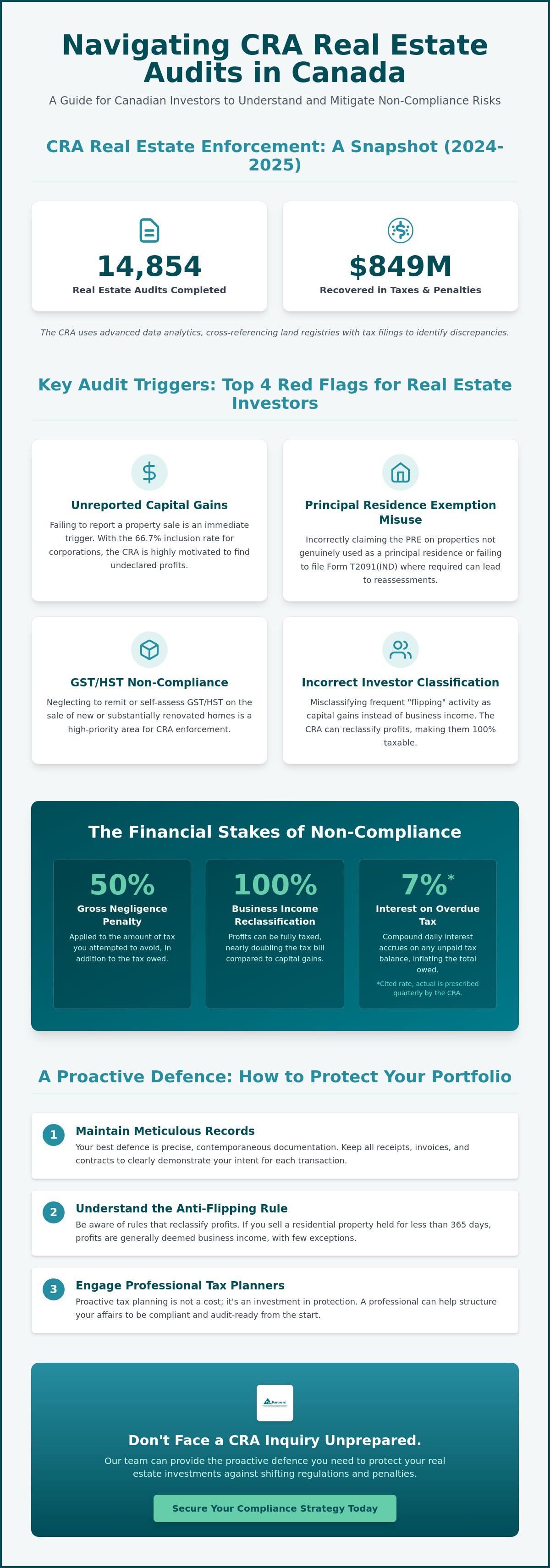
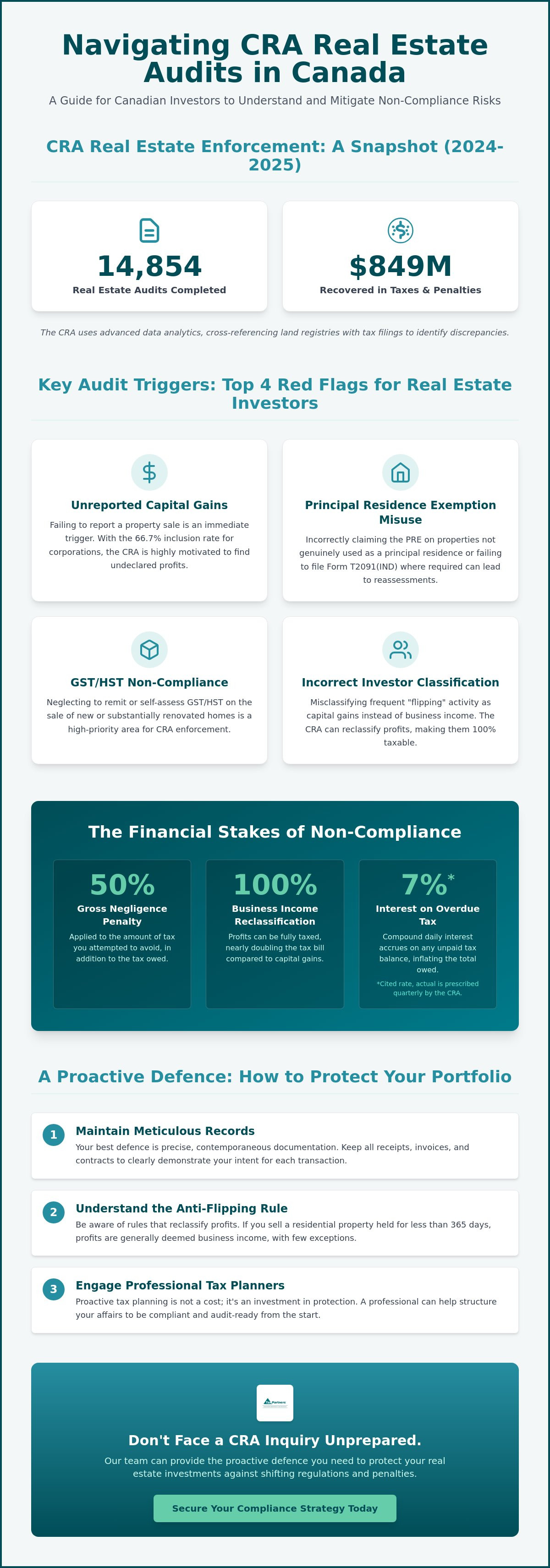
Did you know that between April 2024 and March 2025, the Canada Revenue Agency (CRA) completed 14,854 real estate audits, recovering $849 million in taxes and penalties? This surge in activity highlights why understanding cra audit non-compliance real estate risks is essential for every Canadian investor in 2026. It's natural to feel a sense of unease when facing new regulations like the 365-day anti-flipping rule or the 66.7% capital gains inclusion rate for corporations. You've worked hard to build your portfolio; the last thing you want is a surprise Notice of Non-Compliance or a 7% interest charge on overdue tax.
We're here to help you navigate these complexities with clarity and confidence. We believe that real estate compliance is no longer just about filing your returns; it's about proving your intent through precise, contemporaneous documentation. This guide will show you how to identify audit red flags and maintain the rigorous records needed to protect your investments. We'll explore the primary triggers for a CRA review, clarify GST/HST rebate eligibility, and provide a methodical strategy to ensure you're always prepared for a potential inquiry.
Key Takeaways
- Understand how the CRA utilizes sophisticated data analytics and land registry records to detect discrepancies in property reporting.
- Identify critical audit red flags, including the misapplication of the Principal Residence Exemption and unreported capital gains on property sales.
- Navigate the complexities of the Residential Property Anti-Flipping Rule to ensure your profits are not unexpectedly reclassified as business income.
- Discover how to protect your portfolio from a cra audit non-compliance real estate inquiry by maintaining precise, contemporaneous records.
- Recognize the value of professional tax planning in providing a proactive defence against shifting regulatory requirements and interest penalties.
What is CRA Real Estate Non-Compliance?
Non-compliance in real estate isn't just about making a mistake on a form; it's a fundamental gap between what actually occurred in a property transaction and what was reported to the government. For Canadian taxpayers, this gap can lead to significant financial and legal hurdles. The Canada Revenue Agency (CRA) defines non-compliance as any instance where a person fails to accurately report property-related income or transactions according to the Income Tax Act. Whether it's an oversight or a deliberate omission, the consequences remain a serious concern for your investment portfolio.
The tax landscape of 2026 is vastly different than in previous decades. The CRA doesn't just wait for your paper trail anymore. They now use advanced data analytics to cross-reference land registry records with social media posts and banking data. If you're celebrating a "quick flip" on Instagram but haven't declared the profit as business income, you've created a red flag. This technological shift means that cra audit non-compliance real estate risks are higher than ever before. Auditors are looking for consistency, and they have the tools to find discrepancies that used to stay hidden.
Auditors distinguish between a simple mistake and intentional non-compliance. A calculation error might result in a reassessment and interest. However, if the CRA determines you've shown "gross negligence", which is a reckless disregard for the law, they can apply a penalty equal to 50% of the tax you tried to avoid. This is a heavy price for what some might call a shortcut. Addressing cra audit non-compliance real estate issues requires a proactive approach to record-keeping to ensure your intent matches your filings.
The Role of the CRA Compliance Toolbox
The CRA often starts with an "outreach-first" strategy. This includes the Liaison Officer service, which offers free tax help to small businesses and self-employed individuals to help them get things right from the start. It's an educational step designed to build a cooperative relationship. However, this period of grace is short-lived for high-risk sectors. When the CRA sees patterns of unreported income, they quickly move from education to enforcement, initiating full-scale audits that scrutinize every receipt and bank statement in your history.
Why Real Estate is a High-Priority Sector
Real estate remains a top target because of its massive impact on the Canadian tax base. Practices like "shadow flipping", where a contract is reassigned multiple times before a final sale, often result in unreported gains that the CRA is eager to capture. To combat this, federal authorities now coordinate directly with provincial land registries to flag every transfer of title and identify potential non-filers. Real estate non-compliance is the failure to align transactional data with reported income tax returns.
The 10 Red Flags: Key Areas of CRA Audit Risk
Identifying red flags before an auditor does is the most effective way to protect your financial standing. In 2026, the Canada Revenue Agency (CRA) has sharpened its focus on specific areas where taxpayers often fall short of their obligations. One of the primary triggers for a cra audit non-compliance real estate review is the misreporting of capital gains. With the inclusion rate now at two-thirds (66.7%) for individual gains over $250,000 and for all corporate gains, the incentive for the CRA to investigate unreported sales has never been higher.
- Unreported Gains and Withholdings: Failing to report a sale or neglecting non-resident withholding requirements is an immediate red flag.
- PRE Misuse: Incorrectly claiming the Principal Residence Exemption on multiple properties or failing to file Form T2091(IND) can lead to significant penalties.
- GST/HST Errors: Neglecting to pay or self-assess GST/HST on new builds or substantial renovations remains a high-priority enforcement area.
- Investor Status: Misclassifying yourself as an "Investor" when your frequent trading activity suggests you are a "Land Developer" can result in your profits being taxed as 100% business income.
The distinction between a developer and an investor is a frequent point of contention during audits. If you're buying, improving, and selling properties with high frequency, the CRA may view your profits as fully taxable business income rather than capital gains. This reclassification can nearly double your tax bill if you haven't planned for it. If you're concerned about how your current activity might be viewed by an auditor, you can speak with a specialist to review your reporting strategy.
Lifestyle Audits and Third-Party Data
A lifestyle audit occurs when the CRA notices a glaring mismatch between your reported income and your standard of living. If you've purchased a multi-million dollar property but report a modest salary, auditors will use Indirect Verification of Income (IVI) techniques to find the source of your funds. They cross-reference banking records, luxury asset registries, and municipal property tax rolls to uncover "unreported worldwide income." In the current era of cra audit non-compliance real estate enforcement, your financial footprint is constantly being analyzed for inconsistencies.
GST/HST Rebate Misuse
The New Housing Rebate is designed for those who intend to use a new property as their primary residence or for long-term rental. However, many filers claim this rebate while intending to flip the property for a profit. The CRA now uses land title data to verify how long you actually occupied the home. If you sell shortly after closing, they'll likely demand the rebate back with interest, which is currently 7% on overdue taxes. Realtors also face scrutiny here, as their own commissions and personal property sales are often used as a starting point for broader brokerage reviews.
The Anti-Flipping Rule and Intent-Based Taxation
For decades, the distinction between a capital gain and business income was often a matter of interpretation. That changed on January 1, 2023, with the introduction of the Residential Property Anti-Flipping Rule. Under these CRA rules, any profit made from selling a residential property held for less than 365 consecutive days is deemed to be 100% taxable business income. You cannot use the Principal Residence Exemption to offset these profits, regardless of whether you moved into the home or not. This "bright-line" test removes the ambiguity that previously surrounded short-term transactions and has become a primary focus for cra audit non-compliance real estate enforcement.
The burden of proof rests squarely on your shoulders. If you sell a property after 13 or 14 months, you aren't automatically safe from an audit. The CRA still looks at your "intent" at the time of purchase. If they determine your primary motive was to sell for a profit rather than to hold the property as a long-term investment, they can still reclassify your capital gain as business income. This means instead of paying tax on a portion of the gain, you'll be taxed on the full amount. Living in a house for six months is a common "trap" investors fall into; the CRA sees right through this if your history shows a pattern of frequent moves and quick sales.
Valid Exceptions to the 12-Month Rule
There are specific "life event" exceptions that can protect you from the anti-flipping rule. If you must sell your home within a year due to a death in the family, a serious illness or disability, or a job relocation that moves you at least 40 km closer to a new workplace, the rule may not apply. Other valid reasons include divorce, insolvency, or involuntary job termination. To satisfy a CRA inquiry, you must maintain rigorous documentation, such as medical records or employment contracts, to prove the sale was forced by circumstances. Auditors also evaluate the "badges of trade," which include the nature of the property and your frequency of similar transactions, to decide if you're acting as a professional trader.
Shadow Flipping and Assignment Sales
Assignment sales, often called "shadow flipping," involve selling your right to purchase a pre-construction property before the building is even finished. The CRA views the profit from these assignments as 100% taxable business income. Because you never actually took title to the property, it's almost impossible to argue that the gain should be treated as a capital gain. For "middle investors" in the pre-construction market, reporting requirements are strict. Failing to declare these profits is a major trigger for cra audit non-compliance real estate penalties, as the CRA regularly obtains buyer lists from developers to ensure every assignment is accounted for on tax returns.
Proactive Defence: Organizing for a Real Estate Audit
An audit doesn't have to be a source of panic if you've positioned yourself as a proactive guardian of your own financial records. For CRA filers, the key to surviving a review is contemporaneous record-keeping. This means documenting your transactions as they happen rather than trying to reconstruct your history years later. When it comes to cra audit non-compliance real estate issues, the CRA looks for clear evidence of your original intent. If you claimed a property was a long-term rental but took out a short-term "fix-and-flip" loan or a specific type of insurance policy that contradicts that claim, an auditor will spot the discrepancy immediately.
Proper accounting for real estate investors involves more than just saving receipts; it's about building a narrative that supports your tax filings. For example, if you sell your home, you must report the sale on Form T2091 (IND) to designate it as your principal residence. Even if the sale is tax-exempt, failing to file this form is a reporting error that can lead to penalties and a potential loss of the exemption. By organizing your files today, you ensure that your reporting strategy remains defensible under the scrutiny of a 2026 audit.
The Essential Document Checklist
To maintain a rigorous defence, you should have the following documents digitized and readily accessible for every property in your portfolio:
- Signed purchase and sale agreements along with final closing statements and legal fee invoices.
- Receipts for all capital improvements and renovations. These costs are vital because they adjust your Adjusted Cost Base (ACB), which directly reduces your taxable gain when you sell. For high-end upgrades, companies like BCR Basements provide detailed records that are essential for substantiating these claims during an audit.
- Bank statements and mortgage documents that clearly show the source of your down payment and the history of your mortgage payments.
- Property tax assessments and utility bills that prove you or your tenants actually occupied the premises.
Correcting Past Mistakes
If you realize that previous filings contain omissions, you don't have to wait for the CRA to find them. The Voluntary Disclosure Program (VDP) allows taxpayers to come forward and correct their returns before an audit begins. As of 2026, unprompted applicants who come forward voluntarily can receive up to 75% interest relief and 100% penalty relief. However, if you've already received a "query letter" from the CRA, you may only qualify for the prompted relief tier, which offers a lower 25% interest relief. You should always consult a CPA before responding to any formal or informal CRA inquiry. By taking the lead on your disclosure, you can avoid the threat of criminal prosecution and the heavy gross negligence penalties that often follow a discovery by the CRA.
If you've received a letter from the CRA or simply want to ensure your records are audit-ready, you can schedule a consultation with our compliance team to secure your portfolio.
Professional Oversight: How Tax Partners Manages Compliance
In the current environment of heightened scrutiny, having a seasoned professional by your side isn't just a luxury; it's a strategic necessity. Tax Partners serves as a proactive guardian for your portfolio, identifying potential issues before they escalate into formal inquiries. We understand that the complexities of cra audit non-compliance real estate rules require more than just standard bookkeeping. It demands a sophisticated understanding of how the CRA views intent, frequency, and documentation. By aligning your property transactions with the latest regulatory standards, we help you build a defensible and transparent financial history.
Precision in reporting is the cornerstone of long-term wealth preservation. Whether you're navigating the 66.7% capital gains inclusion rate for corporations or ensuring your GST/HST New Housing Rebate claims are airtight, our team provides the technical expertise required for total compliance. Every real estate portfolio is unique, and we believe your tax strategy should reflect that. We don't offer generic solutions. Instead, we provide a customized approach that considers your specific holdings, your future acquisition goals, and your overall risk tolerance. This level of foresight is what separates a simple tax filer from a true financial partner.
Audit Representation and Support
Receiving a letter from the CRA can be an incredibly stressful experience, but you don't have to face it alone. Professional representation significantly reduces the burden of direct interaction with auditors. We act as your primary point of contact, ensuring that every response provided to the government is accurate, complete, and legally sound. With over 40 years of institutional wisdom, we've developed a deep understanding of how CRA auditors operate and what they need to see to close a file. Our goal is to resolve queries quickly and efficiently, protecting your interests while maintaining a professional relationship with tax authorities.
Long-Term Partnership for Real Estate Success
True financial security comes from moving beyond reactive filing toward proactive tax optimization. We look ahead to identify upcoming legislative changes that could impact your bottom line, allowing you to adjust your strategy in advance. By integrating your real estate holdings into a broader wealth management and financial planning framework, we help you realize the full potential of your investments. Success in the Canadian property market requires a steady hand and a forward-thinking outlook. If you're ready to secure your portfolio and ensure you're meeting all your obligations under CRA rules, book a consultation with our team today. We're here to provide the end-to-end support you need to grow your wealth with confidence.
Secure Your Real Estate Legacy
Real estate investment in 2026 requires more than market intuition; it demands a rigorous commitment to tax integrity. We've explored how the 365-day anti-flipping rule and the new capital gains inclusion rates have fundamentally changed the landscape for Canadian investors. Success now depends on your ability to prove intent through meticulous, contemporaneous record-keeping. By addressing potential cra audit non-compliance real estate risks today, you transform a source of uncertainty into a foundation for long-term stability.
At Tax Partners, we act as your proactive guardian in an increasingly complex regulatory environment. Our team brings over 40 years of Canadian tax expertise to your portfolio, having filed more than 495,000 returns. We've saved our clients over $87 million through precise, strategic planning, ensuring every reporting strategy is both ethically steadfast and financially optimized. You don't have to navigate these challenges alone. Contact Tax Partners today for expert CRA audit support and real estate tax planning. Your path to a secure, compliant, and prosperous investment future starts with a single, confident conversation.
Frequently Asked Questions
What is the Residential Property Anti-Flipping Rule in Canada?
The Residential Property Anti-Flipping Rule is a "bright-line" test where any profit from a property sold within 365 consecutive days is deemed fully taxable business income. Under these CRA rules, the Principal Residence Exemption cannot be used to offset this income. This rule applies to all Canadian residential properties sold after January 1, 2023. Unless you qualify for a specific life event exception, like a death or job relocation, you must report 100% of the profit.
Can I still claim the Principal Residence Exemption if I sell my home after only 10 months?
You cannot claim the Principal Residence Exemption for a sale under 12 months unless you meet a specific "life event" exception. The CRA automatically classifies these short-term sales as business income rather than capital gains. Valid exceptions include circumstances like divorce, disability, or a job move of at least 40 km. Without a verified exception, you'll be taxed on the full profit, and the exemption will be denied by auditors.
How does the CRA find out about unreported real estate sales?
The CRA identifies unreported sales by cross-referencing provincial land registry data with municipal tax rolls and individual income tax returns. They also utilize advanced data analytics to monitor social media activity and banking records for signs of "lifestyle" mismatches. This proactive approach helps them detect cra audit non-compliance real estate risks that might otherwise go unnoticed. Approximately 25% of material reassessments in this sector are also triggered by informant tips to the CRA.
What happens if I forget to file Form T2091 when I sell my home?
Failing to file Form T2091(IND) can result in a late-filing penalty of up to $8,000 and the potential loss of your tax-exempt status for that sale. You are legally required to report the disposition of a principal residence to the CRA to officially designate it as such. If you omit this form, the CRA may assume the property was an investment and reassess the entire gain as taxable income plus interest.
Is profit from an assignment sale considered a capital gain or business income?
Profits from assignment sales are considered 100% taxable business income under current CRA guidelines. Because the investor sells the right to a property before taking legal title, the transaction is viewed as a business venture rather than the sale of a capital asset. You must also account for GST/HST implications on the profit. Misreporting an assignment sale as a capital gain is a frequent trigger for a detailed real estate audit.
What are the penalties for real estate tax non-compliance under CRA rules?
Penalties for non-compliance include a gross negligence penalty of 50% of the understated tax and daily interest on overdue balances. As of June 2026, the CRA's prescribed interest rate for overdue taxes is 7%. Additionally, if you fail to provide requested information during an audit, you may receive a Notice of Non-Compliance penalty of $50 per day, which can reach a maximum of $25,000.
How far back can the CRA audit my real estate transactions?
The CRA typically audits real estate transactions within a three-year window, but this period is indefinite if they suspect fraud or "gross negligence." For most Canadian filers, the normal reassessment period begins on the date of your original Notice of Assessment. However, the CRA has the power to reopen any tax year if they find evidence that you misstated your income or intentionally omitted a property sale from your return.
Do I need to report the sale of a property if I didn’t make any profit?
You are required to report the sale of any property on your Canadian tax return, regardless of whether you made a profit or a loss. Reporting ensures the CRA can track your property history and verify that you are applying the Principal Residence Exemption correctly. Omitting a sale, even at a loss, can lead to a cra audit non-compliance real estate inquiry as auditors seek to confirm the details of the transaction and your intent.

Article by
Mahad Mohamed
Mahad Mohamed is an accountant and the CEO of Tax Partners, with over 26+ years of Canadian and international tax and accounting experience. His expertise includes corporate reorganization, cross-border tax structuring (Canada & US), tax disputes, CRA audits, and tax planning for small owner-managed private corporations. Most recently, Mahad is a pioneer in Canadian crypto taxation and founded Block3 Finance.
Previously, Mahad worked for the Canada Revenue Agency (CRA), Big4 accounting firms, and served as a Rulings Officer for the Federal Tax Authority of the UAE before acquiring Tax Partners in 2014.
Tax Partners has 44 full-time accountants and over 18,400+ clients.
Disclaimer
This article provides general information only and is current as of its publication date. It has not been updated and may be out of date. It does not constitute legal advice and should not be relied upon as such. Every tax situation is unique and may differ from the examples discussed in this article. If you have specific questions, you should seek the advice of our accountants for your unique circumstances. Book a FREE Initial Consultation Today!
Frequently Asked Questions
The Role of the CRA Compliance Toolbox
The CRA often starts with an "outreach-first" strategy. This includes the Liaison Officer service, which offers free tax help to small businesses and self-employed individuals to help them get things right from the start. It's an educational step designed to build a cooperative relationship. However, this period of grace is short-lived for high-risk sectors. When the CRA sees patterns of unreported income, they quickly move from education to enforcement, initiating full-scale audits that scrutinize every receipt and bank statement in your history.
Why Real Estate is a High-Priority Sector
Real estate remains a top target because of its massive impact on the Canadian tax base. Practices like "shadow flipping", where a contract is reassigned multiple times before a final sale, often result in unreported gains that the CRA is eager to capture. To combat this, federal authorities now coordinate directly with provincial land registries to flag every transfer of title and identify potential non-filers. Real estate non-compliance is the failure to align transactional data with reported income tax returns. Identifying red flags before an auditor does is the most effective way to protect your financial standing. In 2026, the Canada Revenue Agency (CRA) has sharpened its focus on specific areas where taxpayers often fall short of their obligations. One of the primary triggers for a cra audit non-compliance real estate review is the misreporting of capital gains. With the inclusion rate now at two-thirds (66.7%) for individual gains over $250,000 and for all corporate gains, the incentive for the CRA to investigate unreported sales has never been higher. The distinction between a developer and an investor is a frequent point of contention during audits. If you're buying, improving, and selling properties with high frequency, the CRA may view your profits as fully taxable business income rather than capital gains. This reclassification can nearly double your tax bill if you haven't planned for it. If you're concerned about how your current activity might be viewed by an auditor, you can speak with a specialist to review your reporting strategy.
Lifestyle Audits and Third-Party Data
A lifestyle audit occurs when the CRA notices a glaring mismatch between your reported income and your standard of living. If you've purchased a multi-million dollar property but report a modest salary, auditors will use Indirect Verification of Income (IVI) techniques to find the source of your funds. They cross-reference banking records, luxury asset registries, and municipal property tax rolls to uncover "unreported worldwide income." In the current era of cra audit non-compliance real estate enforcement, your financial footprint is constantly being analyzed for inconsistencies.
GST/HST Rebate Misuse
The New Housing Rebate is designed for those who intend to use a new property as their primary residence or for long-term rental. However, many filers claim this rebate while intending to flip the property for a profit. The CRA now uses land title data to verify how long you actually occupied the home. If you sell shortly after closing, they'll likely demand the rebate back with interest, which is currently 7% on overdue taxes. Realtors also face scrutiny here, as their own commissions and personal property sales are often used as a starting point for broader brokerage reviews. For decades, the distinction between a capital gain and business income was often a matter of interpretation. That changed on January 1, 2023, with the introduction of the Residential Property Anti-Flipping Rule. Under these CRA rules, any profit made from selling a residential property held for less than 365 consecutive days is deemed to be 100% taxable business income. You cannot use the Principal Residence Exemption to offset these profits, regardless of whether you moved into the home or not. This "bright-line" test removes the ambiguity that previously surrounded short-term transactions and has become a primary focus for cra audit non-compliance real estate enforcement. The burden of proof rests squarely on your shoulders. If you sell a property after 13 or 14 months, you aren't automatically safe from an audit. The CRA still looks at your "intent" at the time of purchase. If they determine your primary motive was to sell for a profit rather than to hold the property as a long-term investment, they can still reclassify your capital gain as business income. This means instead of paying tax on a portion of the gain, you'll be taxed on the full amount. Living in a house for six months is a common "trap" investors fall into; the CRA sees right through this if your history shows a pattern of frequent moves and quick sales.
Valid Exceptions to the 12-Month Rule
There are specific "life event" exceptions that can protect you from the anti-flipping rule. If you must sell your home within a year due to a death in the family, a serious illness or disability, or a job relocation that moves you at least 40 km closer to a new workplace, the rule may not apply. Other valid reasons include divorce, insolvency, or involuntary job termination. To satisfy a CRA inquiry, you must maintain rigorous documentation, such as medical records or employment contracts, to prove the sale was forced by circumstances. Auditors also evaluate the "badges of trade," which include the nature of the property and your frequency of similar transactions, to decide if you're acting as a professional trader.
Shadow Flipping and Assignment Sales
Assignment sales, often called "shadow flipping," involve selling your right to purchase a pre-construction property before the building is even finished. The CRA views the profit from these assignments as 100% taxable business income. Because you never actually took title to the property, it's almost impossible to argue that the gain should be treated as a capital gain. For "middle investors" in the pre-construction market, reporting requirements are strict. Failing to declare these profits is a major trigger for cra audit non-compliance real estate penalties, as the CRA regularly obtains buyer lists from developers to ensure every assignment is accounted for on tax returns. An audit doesn't have to be a source of panic if you've positioned yourself as a proactive guardian of your own financial records. For CRA filers, the key to surviving a review is contemporaneous record-keeping. This means documenting your transactions as they happen rather than trying to reconstruct your history years later. When it comes to cra audit non-compliance real estate issues, the CRA looks for clear evidence of your original intent. If you claimed a property was a long-term rental but took out a short-term "fix-and-flip" loan or a specific type of insurance policy that contradicts that claim, an auditor will spot the discrepancy immediately. Proper accounting for real estate investors involves more than just saving receipts; it's about building a narrative that supports your tax filings. For example, if you sell your home, you must report the sale on Form T2091 (IND) to designate it as your principal residence. Even if the sale is tax-exempt, failing to file this form is a reporting error that can lead to penalties and a potential loss of the exemption. By organizing your files today, you ensure that your reporting strategy remains defensible under the scrutiny of a 2026 audit.
The Essential Document Checklist
To maintain a rigorous defence, you should have the following documents digitized and readily accessible for every property in your portfolio:
Correcting Past Mistakes
If you realize that previous filings contain omissions, you don't have to wait for the CRA to find them. The Voluntary Disclosure Program (VDP) allows taxpayers to come forward and correct their returns before an audit begins. As of 2026, unprompted applicants who come forward voluntarily can receive up to 75% interest relief and 100% penalty relief. However, if you've already received a "query letter" from the CRA, you may only qualify for the prompted relief tier, which offers a lower 25% interest relief. You should always consult a CPA before responding to any formal or informal CRA inquiry. By taking the lead on your disclosure, you can avoid the threat of criminal prosecution and the heavy gross negligence penalties that often follow a discovery by the CRA. If you've received a letter from the CRA or simply want to ensure your records are audit-ready, you can schedule a consultation with our compliance team to secure your portfolio. In the current environment of heightened scrutiny, having a seasoned professional by your side isn't just a luxury; it's a strategic necessity. Tax Partners serves as a proactive guardian for your portfolio, identifying potential issues before they escalate into formal inquiries. We understand that the complexities of cra audit non-compliance real estate rules require more than just standard bookkeeping. It demands a sophisticated understanding of how the CRA views intent, frequency, and documentation. By aligning your property transactions with the latest regulatory standards, we help you build a defensible and transparent financial history. Precision in reporting is the cornerstone of long-term wealth preservation. Whether you're navigating the 66.7% capital gains inclusion rate for corporations or ensuring your GST/HST New Housing Rebate claims are airtight, our team provides the technical expertise required for total compliance. Every real estate portfolio is unique, and we believe your tax strategy should reflect that. We don't offer generic solutions. Instead, we provide a customized approach that considers your specific holdings, your future acquisition goals, and your overall risk tolerance. This level of foresight is what separates a simple tax filer from a true financial partner.
Audit Representation and Support
Receiving a letter from the CRA can be an incredibly stressful experience, but you don't have to face it alone. Professional representation significantly reduces the burden of direct interaction with auditors. We act as your primary point of contact, ensuring that every response provided to the government is accurate, complete, and legally sound. With over 40 years of institutional wisdom, we've developed a deep understanding of how CRA auditors operate and what they need to see to close a file. Our goal is to resolve queries quickly and efficiently, protecting your interests while maintaining a professional relationship with tax authorities.
Long-Term Partnership for Real Estate Success
True financial security comes from moving beyond reactive filing toward proactive tax optimization. We look ahead to identify upcoming legislative changes that could impact your bottom line, allowing you to adjust your strategy in advance. By integrating your real estate holdings into a broader wealth management and financial planning framework, we help you realize the full potential of your investments. Success in the Canadian property market requires a steady hand and a forward-thinking outlook. If you're ready to secure your portfolio and ensure you're meeting all your obligations under CRA rules, book a consultation with our team today. We're here to provide the end-to-end support you need to grow your wealth with confidence. Real estate investment in 2026 requires more than market intuition; it demands a rigorous commitment to tax integrity. We've explored how the 365-day anti-flipping rule and the new capital gains inclusion rates have fundamentally changed the landscape for Canadian investors. Success now depends on your ability to prove intent through meticulous, contemporaneous record-keeping. By addressing potential cra audit non-compliance real estate risks today, you transform a source of uncertainty into a foundation for long-term stability. At Tax Partners, we act as your proactive guardian in an increasingly complex regulatory environment. Our team brings over 40 years of Canadian tax expertise to your portfolio, having filed more than 495,000 returns. We've saved our clients over $87 million through precise, strategic planning, ensuring every reporting strategy is both ethically steadfast and financially optimized. You don't have to navigate these challenges alone. Contact Tax Partners today for expert CRA audit support and real estate tax planning. Your path to a secure, compliant, and prosperous investment future starts with a single, confident conversation.
What is the Residential Property Anti-Flipping Rule in Canada?
The Residential Property Anti-Flipping Rule is a "bright-line" test where any profit from a property sold within 365 consecutive days is deemed fully taxable business income. Under these CRA rules, the Principal Residence Exemption cannot be used to offset this income. This rule applies to all Canadian residential properties sold after January 1, 2023. Unless you qualify for a specific life event exception, like a death or job relocation, you must report 100% of the profit.
Can I still claim the Principal Residence Exemption if I sell my home after only 10 months?
You cannot claim the Principal Residence Exemption for a sale under 12 months unless you meet a specific "life event" exception. The CRA automatically classifies these short-term sales as business income rather than capital gains. Valid exceptions include circumstances like divorce, disability, or a job move of at least 40 km. Without a verified exception, you'll be taxed on the full profit, and the exemption will be denied by auditors.
How does the CRA find out about unreported real estate sales?
The CRA identifies unreported sales by cross-referencing provincial land registry data with municipal tax rolls and individual income tax returns. They also utilize advanced data analytics to monitor social media activity and banking records for signs of "lifestyle" mismatches. This proactive approach helps them detect cra audit non-compliance real estate risks that might otherwise go unnoticed. Approximately 25% of material reassessments in this sector are also triggered by informant tips to the CRA.
What happens if I forget to file Form T2091 when I sell my home?
Failing to file Form T2091(IND) can result in a late-filing penalty of up to $8,000 and the potential loss of your tax-exempt status for that sale. You are legally required to report the disposition of a principal residence to the CRA to officially designate it as such. If you omit this form, the CRA may assume the property was an investment and reassess the entire gain as taxable income plus interest.
Is profit from an assignment sale considered a capital gain or business income?
Profits from assignment sales are considered 100% taxable business income under current CRA guidelines. Because the investor sells the right to a property before taking legal title, the transaction is viewed as a business venture rather than the sale of a capital asset. You must also account for GST/HST implications on the profit. Misreporting an assignment sale as a capital gain is a frequent trigger for a detailed real estate audit.
What are the penalties for real estate tax non-compliance under CRA rules?
Penalties for non-compliance include a gross negligence penalty of 50% of the understated tax and daily interest on overdue balances. As of June 2026, the CRA's prescribed interest rate for overdue taxes is 7%. Additionally, if you fail to provide requested information during an audit, you may receive a Notice of Non-Compliance penalty of $50 per day, which can reach a maximum of $25,000.
How far back can the CRA audit my real estate transactions?
The CRA typically audits real estate transactions within a three-year window, but this period is indefinite if they suspect fraud or "gross negligence." For most Canadian filers, the normal reassessment period begins on the date of your original Notice of Assessment. However, the CRA has the power to reopen any tax year if they find evidence that you misstated your income or intentionally omitted a property sale from your return.
Do I need to report the sale of a property if I didn’t make any profit?
You are required to report the sale of any property on your Canadian tax return, regardless of whether you made a profit or a loss. Reporting ensures the CRA can track your property history and verify that you are applying the Principal Residence Exemption correctly. Omitting a sale, even at a loss, can lead to a cra audit non-compliance real estate inquiry as auditors seek to confirm the details of the transaction and your intent.