Self-Employed Tax Deductions for Ontario Filers Under CRA Rules

Could your fear of a CRA audit be costing you thousands of dollars in unclaimed business expenses every year? Many entrepreneurs struggle to identify all eligible self-employed tax deductions Ontario allows, often leaving significant money on the table because they worry about triggering a review. It's natural to feel overwhelmed by the distinction between current and capital expenses, especially when record-keeping feels like a secondary task to running your business.
You deserve to feel confident in your filing and certain that you aren't overpaying the government. We'll help you master these complexities to maximize your business expenses while staying fully compliant with the latest CRA regulations. This guide provides a clear roadmap to organized records and reduced tax liability for the 2026 filing season.
We will explore everything from vehicle mileage to the Capital Cost Allowance (CCA), which is the tax version of depreciation that lets you deduct the cost of long-term assets over several years. We also define exactly when an expense is "incurred," or the moment you become legally responsible for a business cost regardless of when you pay the bill. By the end, you'll have the tools to transform tax season from a source of stress into a strategic advantage for your long-term growth.
Key Takeaways
- Learn how to qualify for self-employed tax deductions Ontario residents use by meeting the CRA requirement for a reasonable expectation of profit.
- Identify if your home workspace qualifies for deductions based on whether it is your principal place of business or used regularly to meet clients.
- Discover the specific vehicle costs you can claim, such as fuel and insurance, provided you maintain a rigorous mileage logbook for CRA compliance.
- Understand the distinction between immediately deductible operating costs and capital expenses that provide long-term value to your business.
- Protect your business from scrutiny by maintaining all supporting documents for the mandatory six-year period, providing your best defence during a CRA review.
Understanding Business Expense Eligibility for CRA Filers
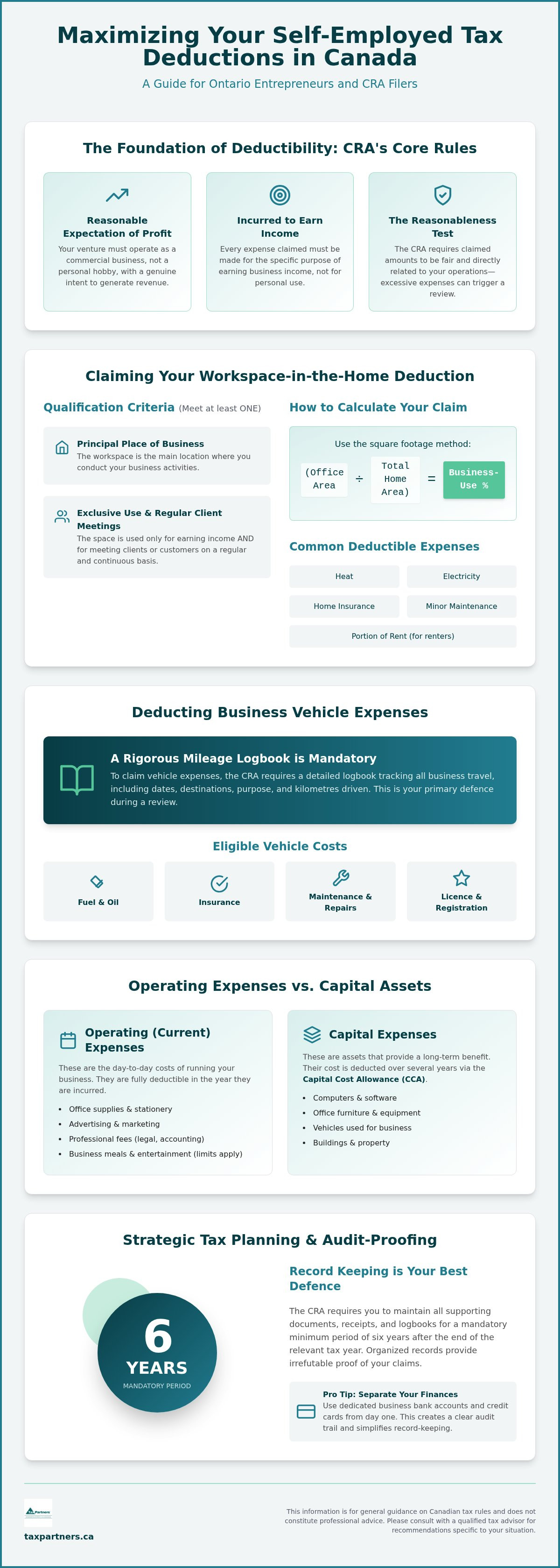
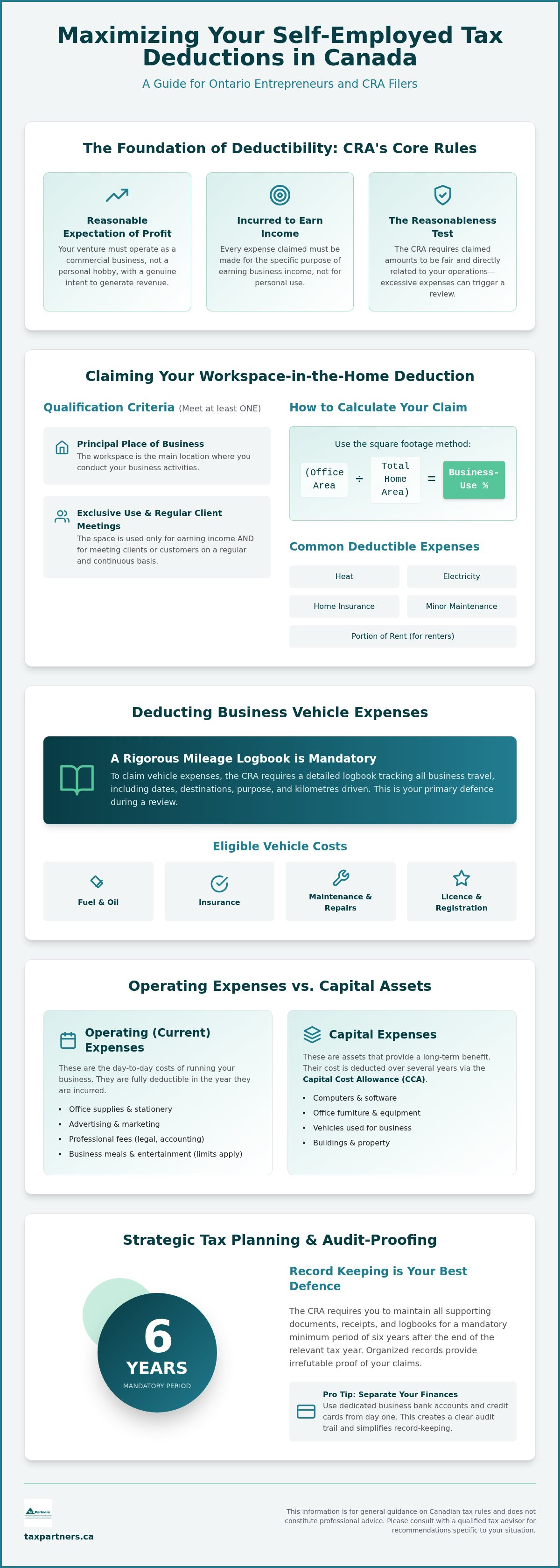
Understanding the eligibility of self-employed tax deductions Ontario filers can claim begins with defining your business activity. The CRA classifies self-employment income as money earned from a business you operate yourself or as a partner. To qualify for deductions, your venture must demonstrate a "reasonable expectation of profit." This means your activity should have a clear commercial character rather than being a personal hobby or a side project with no genuine intent to generate revenue.
A fundamental concept in Canadian tax law is the timing of your claims. You can deduct any "incurred" expense, which refers to a cost you have already paid or are legally obligated to pay to earn business income. Even if you haven't physically sent the funds yet, the expense is valid for the tax year it was billed or provided. Every deduction must also pass the test of "reasonableness." The CRA expects that any amount you claim is fair and directly related to your business operations; excessive or lavish expenses often trigger unwanted scrutiny.
The Intent to Earn Income Rule
The CRA requires you to show that every expense was made specifically to earn income. If you buy a new laptop, you must be able to prove it serves your professional needs rather than just your personal entertainment. Distinguishing between a hobby and a business is vital because the CRA doesn't allow you to use hobby losses to offset other income sources. We recommend separating your personal and professional finances from your very first day of operation. Using dedicated bank accounts and credit cards makes it easier to organize your records and provides a clear audit trail. You can find more advice on setting up these structures through our business solutions.
Federal vs. Provincial Tax Context
While the CRA manages the Canadian income tax system at the federal level, your business expenses also directly impact your provincial obligations. Most self-employed tax deductions Ontario residents claim reduce their total taxable income, which in turn lowers the amount of provincial tax owed to the Ontario government. Most tax rules remain consistent across the country; however, specific provincial credits can vary depending on your location and industry. Our team provides proactive guidance to ensure you benefit from every available incentive while maintaining total compliance with both federal and provincial regulations. This dual focus helps you preserve wealth and maintain a steady course toward your financial goals.
Calculating Home Office Deductions for Canadian Taxpayers
Claiming a workspace-in-the-home deduction is a powerful way to manage the self-employed tax deductions Ontario residents have available. To qualify under CRA rules, the space must be your principal place of business. Alternatively, you must use the area exclusively to earn income and meet clients, customers, or patients on a regular and continuous basis.
When you meet these criteria, you can prorate a variety of household expenses to reduce your taxable income. This includes costs for heat, electricity, and home insurance. While renters can deduct a portion of their monthly rent, homeowners generally focus on utilities and minor maintenance rather than mortgage principal. You will report these figures on CRA Form T2125 to ensure your business activities are properly documented.
The Square Footage Calculation Method
To calculate your deduction accurately, measure the total finished area of your home and the specific area dedicated to your office. Divide the office square footage by the total home square footage to find your business-use percentage. If you use a room for both personal and business activities, you must further adjust this percentage based on the number of hours the space is used for work. Documentation is your best defence during a review, so maintain a floor plan or clear measurements of your workspace. If you're unsure how to apply these percentages to your unique living situation, you can reach out to our team for personalized guidance.
Maintenance and Minor Repair Costs
Distinguishing between current and capital expenses is crucial for maintenance claims. Minor repairs, such as fixing a leak in the office or purchasing cleaning supplies, are usually fully deductible in the year they occur. However, major renovations that provide a lasting benefit, such as replacing a roof or installing new windows, are often considered capital expenses that must be depreciated over time.
Repairs that benefit the entire house must be prorated using your business-use percentage. In contrast, a repair made specifically to your office space can often be claimed at its full value. Always keep every receipt, as even small costs for light bulbs or paint contribute to your overall tax efficiency. Organized records allow you to claim these costs with confidence while staying fully compliant with CRA standards.
Vehicle and Travel Expenses: Meeting CRA Record-Keeping Standards
Claiming vehicle costs is a primary way to optimize the self-employed tax deductions Ontario residents use to lower their liability. Under CRA rules, you must calculate the business portion of your total driving to determine your eligible claim. This percentage is based on the total kilometres driven for business versus personal use throughout the tax year.
Deductible vehicle costs include fuel, oil, repairs, insurance, and registration fees. You can also claim interest on a vehicle loan or monthly lease payments, subject to specific caps for the 2026 tax year. For new leases entered into during 2026, the maximum deductible lease payment is $1,100 per month before tax. If you financed your vehicle, the maximum allowable interest deduction is $350 per month for new loans.
The 2026 mileage rates are 73 cents per kilometre for the first 5,000 kilometres and 67 cents per kilometre thereafter. These rates provide a simplified way to account for wear and tear on your vehicle while following CRA rules on business expenses. Understanding these thresholds ensures you remain compliant while maximizing your legitimate savings.
The Importance of a Valid Mileage Log
Maintaining a detailed logbook is your best defence against a CRA audit of your vehicle claims. The CRA is historically strict regarding documentation and rarely accepts "estimates" or rounded figures. Your logbook must record the date, destination, purpose of the trip, and the specific kilometres driven for every business journey. Digital tools or mobile apps can simplify this process for the 2026 tax year by automatically tracking your movements via GPS. Without this evidence, the CRA may deny your vehicle expenses entirely during a review.
Meals, Entertainment, and Client Meetings
Under CRA regulations, you can generally only claim 50% of the cost of food, beverages, and entertainment incurred for business purposes. This rule applies whether you are taking a client to lunch or attending a professional networking event. The CRA defines "travel" specifically as a business trip that requires you to be away from your home community for at least 12 hours. While the 50% limit is standard, there are rare exceptions where costs are 100% deductible, such as staff parties where all employees are invited. You should keep every receipt and clearly note the business purpose of the meeting to satisfy potential inquiries.
Operating Expenses vs. Capital Cost Allowance (CCA)
Distinguishing between immediate costs and long-term investments is vital for maximizing the self-employed tax deductions Ontario business owners claim. Current expenses provide a short-term benefit and are typically recurring costs, such as office supplies or monthly subscriptions. You can deduct the full amount of these expenses in the year you incur them to reduce your net income.
Capital expenses refer to the purchase of property or equipment that provides a lasting benefit over several years. This includes items like office furniture, computers, or a new vehicle. Because these assets lose value over time, the CRA requires you to claim their cost through the Capital Cost Allowance (CCA), which is the tax version of depreciation.
Common Operating Costs for Ontario Professionals
Operating costs are the everyday expenses that keep your business running smoothly. You can claim professional fees paid to accountants or consultants, business insurance premiums, and even bank charges for your business accounts. Advertising and marketing costs are also fully deductible, including website hosting fees and software subscriptions used for your trade.
If you find yourself unable to collect payment from a client after making a legitimate effort, you may be able to deduct that amount as a bad debt. This ensures you aren't paying taxes on income you never actually received. Keeping meticulous receipts for every minor purchase, from printer ink to postage, helps build a robust tax return.
Navigating CCA Classes and Rates
Under CRA rules, you cannot deduct the total cost of a major asset like a laptop in a single year. Instead, you must group assets into specific "classes" that each have a predetermined annual depreciation rate. For example, Class 8 covers general furniture and fixtures at a 20% rate, while Class 50 covers computer equipment and systems software at a 55% rate.
For the 2026 tax year, the Reaccelerated Investment Incentive (RIIP) is a significant benefit for business owners. This incentive suspends the standard "half-year rule" for most eligible assets, allowing you to claim a full year of CCA in the year you acquire the property. This can result in a much larger deduction in the first year of ownership, providing immediate tax relief.
Correctly classifying your assets is essential to avoid CRA adjustments that could lead to unexpected tax bills. If you're unsure which class applies to your recent business purchases, contact our tax professionals today to ensure your filing is accurate and optimized.
Strategic Tax Planning and Audit-Proofing Your Business
The most effective way to secure the self-employed tax deductions Ontario residents claim is through meticulous, year-round organization. While many entrepreneurs wait until the June 15 filing deadline to sort their finances, a proactive approach ensures you never miss a legitimate expense. Organized record-keeping serves as your strongest shield, transforming tax season from a period of high stress into a routine administrative task.
The CRA requires you to keep all business records and supporting documents for at least six years from the end of the last tax year they relate to. This rule applies to both paper and digital formats, ensuring the government can verify your claims if they select your return for a review. Maintaining these files with precision allows you to demonstrate the commercial intent behind every dollar spent on your operations.
Building a Robust Audit Trail
A complete audit trail consists of original receipts, invoices, and bank statements that clearly show the date, amount, and nature of each transaction. You should be aware that credit card statements alone are often insufficient for a CRA review. Statements show where you spent money, but they do not provide the itemized details found on a receipt, which are necessary to prove the expense was for business use.
We encourage the use of digital storage solutions to protect your records from physical damage, such as fire or fading ink. Scanning your receipts as soon as you receive them ensures they remain legible and easy to retrieve. This digital-first mindset creates a seamless flow of information that simplifies the preparation of your annual return while providing total peace of mind.
The Role of Professional CPA Oversight
Partnering with a seasoned professional provides a layer of security that software alone cannot match. Tax Partners uses over 40 years of experience to identify missed opportunities for optimization and to ensure your records meet the highest standards of compliance. Our role as a proactive guardian means we don't just react to your current needs; we look ahead to secure your long-term financial health.
If the CRA requests a compliance review or a formal audit, having professional representation is invaluable. We manage the communication with tax authorities on your behalf, providing the technical expertise needed to defend your claims. Our commitment to your success is reflected in the Tax Partners mission and vision, where we prioritize ethical steadfastness and personalized care for every client we serve. This partnership allows you to focus on growing your business while we handle the complexities of the Canadian tax system.
Secure Your Professional Legacy
Mastering the nuances of self-employed tax deductions Ontario residents rely on requires a blend of daily discipline and strategic foresight. By accurately distinguishing between immediate operating costs and long-term capital assets, you transform your tax return into a powerful tool for business growth. Remember that maintaining a robust audit trail for at least six years remains your most reliable defence against CRA inquiries.
You don't have to manage these complexities alone. With over 40 years of Canadian tax expertise, Tax Partners serves as a proactive guardian for entrepreneurs across the country. As an A+ rated GTA accounting firm providing national service, we're dedicated to simplifying CRA compliance while helping you preserve more of your hard-earned wealth.
Maximize your self-employed deductions with Tax Partners today. Your journey toward total financial control starts with a single, well-informed step.
Frequently Asked Questions
What are the most common tax deductions for self-employed individuals in Ontario?
Common self-employed tax deductions Ontario residents claim include home office expenses, vehicle operating costs, and professional fees like accounting or legal services. You can also deduct business insurance premiums, office supplies, and advertising costs. These expenses must be incurred specifically to earn business income and must be reasonable in amount. Ensuring you identify every eligible cost is the first step toward reducing your total tax liability for the year.
Can I deduct my cell phone and internet bills for business use?
You can deduct your cell phone and internet bills, but only the portion that relates directly to your business activities. If you use one device for both personal and professional calls, you must prorate the monthly service fees based on the percentage of business usage. For example, if you use your phone for work 40% of the time, you can claim 40% of the bill. It's helpful to keep itemized bills to support your claim during a review.
How do I calculate the business portion of my home expenses?
To calculate the business portion of your home expenses, divide the area of your workspace by the total finished area of your home. If your office is 150 square feet and your home is 1,500 square feet, your business-use percentage is 10%. You then apply this percentage to eligible costs like heat, electricity, and home insurance. If the space is also used for personal activities, you must further adjust the claim based on the hours worked.
What is the 50% rule for meals and entertainment under CRA rules?
The 50% rule under CRA regulations limits the deduction for most food, beverages, and entertainment costs to half of the amount you actually paid. This rule applies to client lunches, coffee meetings, and tickets for events where business is discussed. There are specific exceptions where you can claim 100%, such as a staff holiday party where everyone is invited. Always note the business purpose and the names of the people attending on every receipt.
How long do I need to keep my business receipts for the CRA?
You must keep all business receipts, invoices, and supporting documents for at least six years following the end of the tax year they relate to. This requirement ensures you have an audit trail if the CRA selects your return for a compliance review. Digital copies are acceptable and often safer than paper, as ink can fade over time. Maintaining organized records for this duration is your best defence against adjustments or potential penalties during an audit.
What is the difference between a current expense and a capital expense?
A current expense is a recurring cost that provides a short-term benefit, while a capital expense provides a lasting benefit over several years. For instance, buying printer paper is a current expense that you deduct entirely in the year you buy it. Purchasing a new desk is a capital expense because it remains useful for a long time. Capital expenses cannot be deducted all at once; instead, they are depreciated through the Capital Cost Allowance system.
Can I claim vehicle expenses if I do not have a mileage log?
Claiming vehicle expenses without a valid mileage log is highly risky, as the CRA often denies these claims during an audit. The CRA requires a detailed record of every business trip, including the date, destination, and kilometres driven. While you can claim a percentage of your total vehicle costs, you need the logbook to prove that percentage is accurate. Using digital tracking apps for the 2026 tax year can help you maintain the required level of precision.
How does Capital Cost Allowance (CCA) work for my business equipment?
Capital Cost Allowance (CCA) is the method used to claim depreciation on business equipment by grouping assets into specific classes. Each class has a set percentage, such as 20% for general equipment or 55% for computer hardware, that you can deduct annually. For the 2026 tax year, the Reaccelerated Investment Incentive (RIIP) allows many business owners to claim a full year of CCA in the year an asset is purchased, suspending the usual half-year rule.

Article by
Mahad Mohamed
Mahad Mohamed is an accountant and the CEO of Tax Partners, with over 26+ years of Canadian and international tax and accounting experience. His expertise includes corporate reorganization, cross-border tax structuring (Canada & US), tax disputes, CRA audits, and tax planning for small owner-managed private corporations. Most recently, Mahad is a pioneer in Canadian crypto taxation and founded Block3 Finance.
Previously, Mahad worked for the Canada Revenue Agency (CRA), Big4 accounting firms, and served as a Rulings Officer for the Federal Tax Authority of the UAE before acquiring Tax Partners in 2014.
Tax Partners has 44 full-time accountants and over 18,400+ clients.
Disclaimer
This article provides general information only and is current as of its publication date. It has not been updated and may be out of date. It does not constitute legal advice and should not be relied upon as such. Every tax situation is unique and may differ from the examples discussed in this article. If you have specific questions, you should seek the advice of our accountants for your unique circumstances. Book a FREE Initial Consultation Today!
Frequently Asked Questions
What are the most common tax deductions for self-employed individuals in Ontario?
Common self-employed tax deductions Ontario residents claim include home office expenses, vehicle operating costs, and professional fees like accounting or legal services. You can also deduct business insurance premiums, office supplies, and advertising costs. These expenses must be incurred specifically to earn business income and must be reasonable in amount. Ensuring you identify every eligible cost is the first step toward reducing your total tax liability for the year.
Can I deduct my cell phone and internet bills for business use?
You can deduct your cell phone and internet bills, but only the portion that relates directly to your business activities. If you use one device for both personal and professional calls, you must prorate the monthly service fees based on the percentage of business usage. For example, if you use your phone for work 40% of the time, you can claim 40% of the bill. It's helpful to keep itemized bills to support your claim during a review.
How do I calculate the business portion of my home expenses?
To calculate the business portion of your home expenses, divide the area of your workspace by the total finished area of your home. If your office is 150 square feet and your home is 1,500 square feet, your business-use percentage is 10%. You then apply this percentage to eligible costs like heat, electricity, and home insurance. If the space is also used for personal activities, you must further adjust the claim based on the hours worked.
What is the 50% rule for meals and entertainment under CRA rules?
The 50% rule under CRA regulations limits the deduction for most food, beverages, and entertainment costs to half of the amount you actually paid. This rule applies to client lunches, coffee meetings, and tickets for events where business is discussed. There are specific exceptions where you can claim 100%, such as a staff holiday party where everyone is invited. Always note the business purpose and the names of the people attending on every receipt.
How long do I need to keep my business receipts for the CRA?
You must keep all business receipts, invoices, and supporting documents for at least six years following the end of the tax year they relate to. This requirement ensures you have an audit trail if the CRA selects your return for a compliance review. Digital copies are acceptable and often safer than paper, as ink can fade over time. Maintaining organized records for this duration is your best defence against adjustments or potential penalties during an audit.
What is the difference between a current expense and a capital expense?
A current expense is a recurring cost that provides a short-term benefit, while a capital expense provides a lasting benefit over several years. For instance, buying printer paper is a current expense that you deduct entirely in the year you buy it. Purchasing a new desk is a capital expense because it remains useful for a long time. Capital expenses cannot be deducted all at once; instead, they are depreciated through the Capital Cost Allowance system.
Can I claim vehicle expenses if I do not have a mileage log?
Claiming vehicle expenses without a valid mileage log is highly risky, as the CRA often denies these claims during an audit. The CRA requires a detailed record of every business trip, including the date, destination, and kilometres driven. While you can claim a percentage of your total vehicle costs, you need the logbook to prove that percentage is accurate. Using digital tracking apps for the 2026 tax year can help you maintain the required level of precision.
How does Capital Cost Allowance (CCA) work for my business equipment?
Capital Cost Allowance (CCA) is the method used to claim depreciation on business equipment by grouping assets into specific classes. Each class has a set percentage, such as 20% for general equipment or 55% for computer hardware, that you can deduct annually. For the 2026 tax year, the Reaccelerated Investment Incentive (RIIP) allows many business owners to claim a full year of CCA in the year an asset is purchased, suspending the usual half-year rule.