Financial reporting for small business: understand profit and cash flow

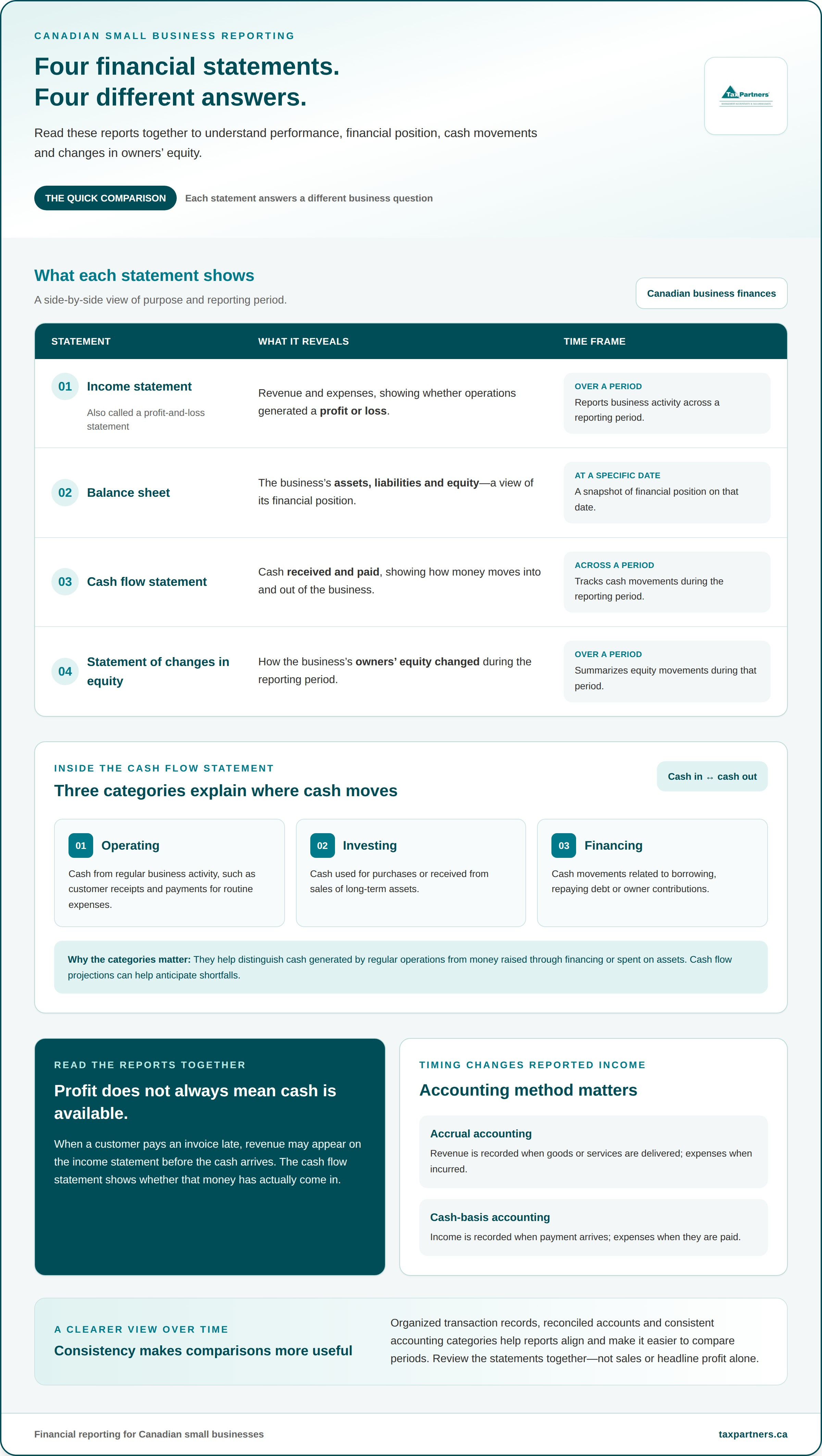
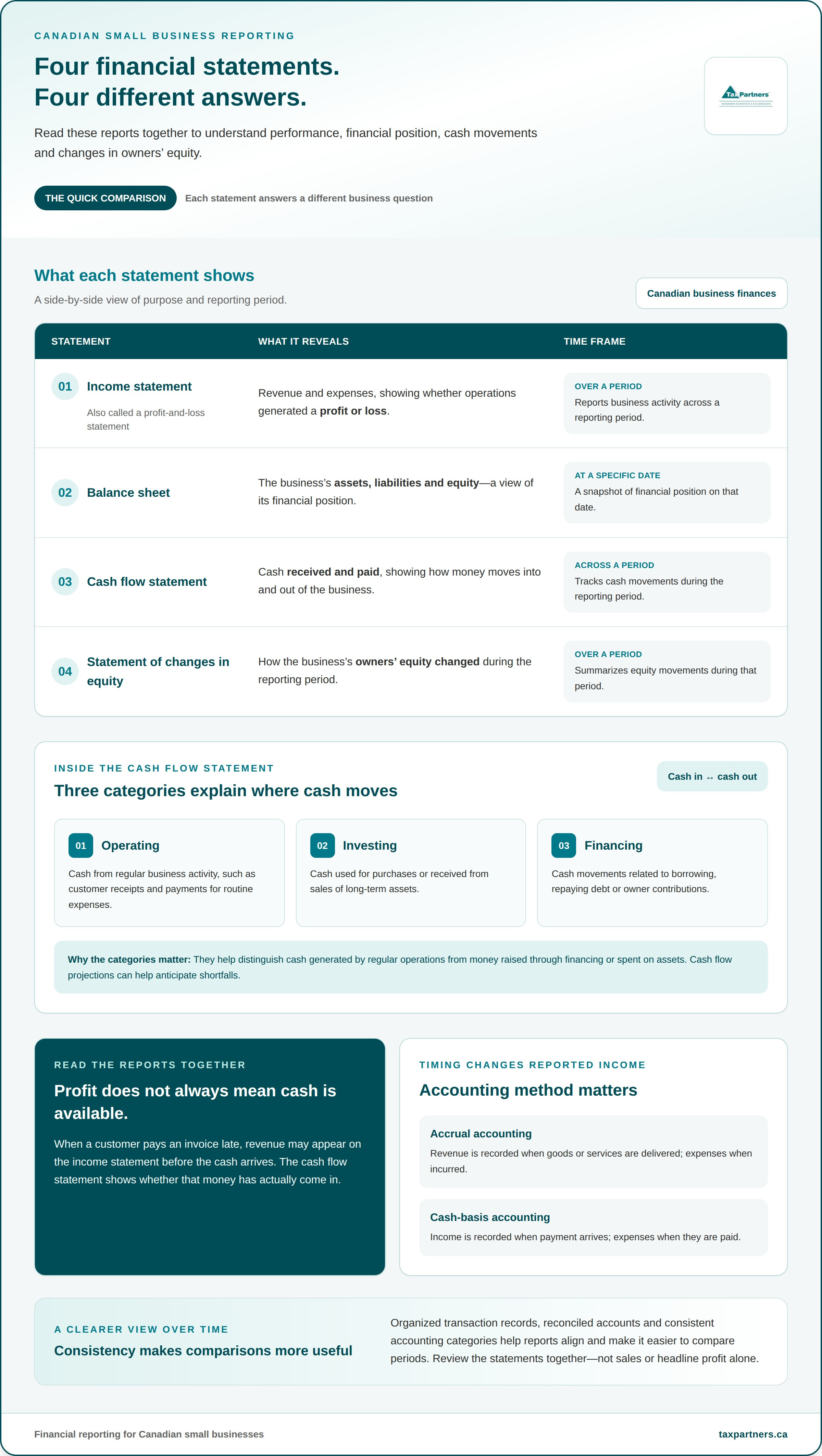
Financial reporting for small business brings together four core statements: the income statement, balance sheet, cash flow statement and statement of changes in equity. They show profit or loss over a period, the business’s financial position on a specific date, cash moving in and out, and changes in owners’ equity. Each answers a different question, so no single statement gives the full picture.
A profitable business can still face a cash shortfall. When customers pay invoices late, for example, revenue may appear in the income statement before the cash arrives. Reading profit and cash flow together helps you distinguish income earned from money available to cover expenses.
This guide explains what each statement shows, how the reports differ and how they can inform decisions about spending, growth and cash needs. It also covers how consistent reporting helps you compare results over time and spot issues that a headline profit figure might hide.
Key Takeaways
- Use cash flow projections to anticipate shortfalls and plan for upcoming expenses.
- Read income statements with care: the accounting method affects when revenue and expenses appear.
- Consistent categories and reconciled accounts make financial reports more useful for comparison.
- Turn financial results into decisions by comparing actual performance with budgets and forecasts.
- Management reports can reveal which business lines, products or customer groups are driving results.
What are the four basic financial statements?
Canadian small businesses use four core statements to understand performance, financial position, cash movements and changes in owners’ equity. Together, they help owners assess operations, plan budgets and explain results to banks or investors.
The purpose of financial statements
Financial statements organize a business’s accounting records into a consistent view of its finances. They help Canadian owners assess whether operations are profitable, what the business owes and whether cash can cover upcoming payments.
Each statement answers a different question, so reviewing them together gives a fuller picture than looking at sales alone. An income statement may show a profit, for example, while the cash flow statement reveals that customer payments have not arrived.
Cash flow activity categories
A cash flow statement tracks cash entering and leaving the business through operating, investing and financing activities. Operating activities include cash received from customers and payments for routine expenses. Investing activities cover purchases or sales of long-term assets.
Financing activities show cash movements related to borrowing, repaying debt or owner contributions. These categories help owners distinguish cash generated by regular operations from money raised through financing or spent on assets. Projections can then help anticipate shortfalls.
Having core financial statements prepared for a small business
To prepare an income statement, balance sheet and cash flow statement, a professional organizes transaction records, reconciles accounts and applies consistent accounting categories. The statements are then reviewed together to ensure reported profit, assets, liabilities and cash movements align.
For this work, a professional may use accounting support to organize records and produce reports suited to the business’s needs. The fourth statement, changes in equity, summarizes movements in owners’ equity over the reporting period.
- Income statement: summarizes revenue and expenses to show profit or loss over a period.
- Balance sheet: presents assets, liabilities and equity at a specific date.
- Cash flow statement: reports cash received and paid across the three activity categories.
- Statement of changes in equity: explains how owners’ equity changed during the period.
Banks use financial statements to assess whether a business’s operations generate enough profit to service debt. Investors can examine profitability and growth to judge how effectively the business uses invested capital.
Canadian small businesses can track gross margin, which compares gross profit with revenue, and liquidity measures, which indicate their capacity to meet near-term obligations. Useful KPIs also include revenue growth, available cash, expense trends and actual results compared with the budget.
Preparing statements consistently helps owners compare periods, identify changes and make informed decisions. For example, rising revenue alongside slower profit growth may prompt a closer review of expenses before setting the next budget.
Income statements and business profit or loss
An income statement, also called a profit-and-loss statement, summarizes business income and expenses over a reporting period. Canadian owners use it to understand whether operations generated a profit or a loss.
Income and business expenses
An income statement groups revenue and expenses to show how business activity affected results during a period. Under accrual accounting, revenue is recorded when goods or services are delivered, and expenses when incurred. Under cash-basis accounting, income is recorded when payment arrives and expenses when they’re paid.
That timing matters. A service business might complete work and issue an invoice in one period, then collect payment later. The accounting method determines when the income appears, helping owners interpret results alongside outstanding payments and expenses.
Profit-and-loss reporting
A profit-and-loss statement calculates whether income exceeded expenses during its reporting period. Gross profit is revenue minus the cost of goods sold, the direct costs tied to the goods sold. The statement then accounts for other expenses to show whether the business earned a net profit or incurred a loss.
A retailer, for example, may generate strong sales but see lower profit if inventory costs or operating expenses rise. Comparing categories across periods can help explain what changed, rather than treating a single profit figure as the whole story.
For Canadian income tax reporting, organized records help support reported business income and expenses. A professional can classify transactions, distinguish business expenses from personal spending, and prepare reports using consistent categories. Receipts and invoices provide support for recorded transactions and may help substantiate tax deductions.
The accounting method also shapes how owners interpret performance. With accrual accounting, an invoice can increase reported income before the customer pays. With cash-basis accounting, income appears when payment is received. This helps explain why reported profit and cash available for payments may not move together.
The CRA requires Canadian businesses to retain books and records supporting their financial statements for a minimum of 6 years from the end of the last tax year to which they relate. Those records include the documents behind reported income and expenses, such as invoices and receipts.
Consistent categories make statements easier to compare across periods. A professional can review income, cost of goods sold and operating expenses together, then help owners understand whether changing sales or spending patterns are affecting profit. This context supports budgeting and planning decisions.
For help organizing business records and preparing reports, discuss professional bookkeeping support.
What is financial reporting?
Financial reporting organizes a business’s records into statements and reports that explain revenue, expenses, assets and debts. In Canada, these reports support owners’ decisions and provide lenders and other readers with a structured view of financial health.
Bookkeeping and accounting
Bookkeeping records and organizes transactions, while accounting analyzes that information to explain results and support planning. The distinction matters because reliable reports depend on complete, correctly categorized entries before anyone interprets trends.
A professional can use accounting software to record transactions, organize accounts and match entries against bank and credit card statements. During reconciliation, they compare the business’s records with statement activity, investigate differences and correct errors so reports reflect the recorded transactions.
Accounting standards in Canada
Accounting standards provide the framework for preparing external financial statements. In Canada, publicly accountable enterprises, such as public companies, report under International Financial Reporting Standards (IFRS). Most private companies, including many small businesses, use Accounting Standards for Private Enterprises (ASPE), although they can choose IFRS.
The applicable framework shapes how transactions appear in statements, which matters when reports go to a lender, investor or other external reader. For companies managing cross-border operations or overseas entities that require formal verification, services like auditfirm.sg help small and medium enterprises complete their local audit requirements. A professional considers the business’s structure and reporting purpose when preparing statements, rather than treating accounting frameworks as interchangeable.
Reconciliation also helps identify duplicate entries, missing transactions or amounts recorded in the wrong account. If a bank statement shows a payment missing from the accounting records, for example, the professional investigates and updates the books before finalizing reports. Unresolved discrepancies can distort revenue, expenses and cash balances.
Separating business and personal finances makes transactions easier to identify. A dedicated business bank account can clarify which deposits relate to business revenue and which payments are business expenses. Professionals can then reconcile business accounts against bank and credit card statements.
In Canada, the CRA uses distinct program account identifiers: RT for GST/HST, RP for payroll deductions, RC for corporation income tax and RZ for information returns. A business number connects to the relevant program accounts, helping organize records and interactions for different tax activities.
Common reporting risks include unreconciled accounts, mixed personal and business spending, missing invoices and inconsistent transaction categories. Guidance from small business advisors at POP Business highlights how easily routine expenses—such as staff amenities versus entertainment—can be misclassified. These errors can make statements less reliable and complicate tax reporting if recorded income and expenses don’t match the underlying documents.
Bookkeeping software costs and professional bookkeeping costs in Canada depend on the case and are given after a quote request. The relevant factors include transaction volume, the number of accounts, reporting needs and the scope of work.
What is the difference between a balance sheet and an income statement?
A balance sheet shows a business’s financial position on a specific date. An income statement reports revenue and expenses across a period, so the two statements answer different questions.
Assets on the balance sheet
Assets are resources a business owns or controls, such as cash, customer receivables, inventory or equipment. The balance sheet lists these alongside liabilities and equity to show the business’s position on its reporting date.
That date matters. A balance sheet dated December 31, 2025, is a snapshot of the business then, not a summary of the entire year. For example, it can show receivables still owed by customers, even if those amounts haven’t been collected.
Owners can use the asset list to see what resources support operations and where value is held. Cash, inventory and equipment serve different purposes, so the total alone doesn’t show how readily each asset can meet upcoming needs.
Liabilities and equity
Liabilities are amounts the business owes, while equity represents the owners’ remaining interest after liabilities are deducted from assets. The balance sheet follows this relationship: equity equals assets minus liabilities.
A business may hold equipment and cash while also owing suppliers or a lender, for example. Reviewing obligations alongside assets helps owners understand what the business owns and what claims must be met.
Closing equity equals opening equity plus net profit minus owner withdrawals. This connects the balance sheet to the income statement: profit can increase equity, while withdrawals can reduce it. A change in equity therefore helps explain how results and owner transactions affected the business.
An income statement covers activity over a period, such as a month, quarter or fiscal year. It totals revenue and expenses to show whether operations produced a profit or loss during that span. The balance sheet, by contrast, captures the resulting position on a single date.
Reading the statements together provides context. An income statement may show a profit for a period, while the balance sheet shows customer receivables that remain unpaid on the reporting date. This helps explain why reported earnings don’t necessarily mean the same amount is available as cash.
For owners, the distinction supports clearer decisions. The income statement helps assess operating performance across periods; the balance sheet helps assess resources, obligations and equity at a point in time. Reviewing both can reveal whether business results are changing the company’s financial position.
How financial reports support business decisions
Financial reports become useful when owners connect results to a decision. A monthly review can show whether earnings support planned spending, whether operating costs are rising and where keeping cash available matters most.
Start by comparing actual monthly results with the budget. If advertising expenses exceed the planned amount while sales remain flat, owners can reassess that spending before committing more funds. If revenue is ahead of plan, they can examine whether the increase is also improving profit.
Historical results also help shape forecasts. A business can use past sales, costs and profit patterns to estimate the revenue needed to break even and plan expected earnings. The forecast then informs an operating budget, resource needs and spending choices for the period ahead.
Compare actual performance with the forecast as new reports become available. If sales fall short, owners can consider reducing costs or increasing sales activity. If supplier expenses rise, reviewing operating costs can reveal whether the pressure comes from one category or affects the broader business.
Cash flow reports help owners plan when to make payments, not just how much to spend. A forecast showing customer receipts arriving after supplier bills are due, for example, can signal a timing gap. Owners can use that insight to adjust payment timing, collection priorities or planned purchases.
Management reports add detail that broad financial statements may not show. They can break down sales and expenses by business line, product, geographic region or customer. If one product generates revenue but contributes little profit, owners can examine its costs before changing pricing, promotion or inventory plans.
Ratios and key performance indicators help track patterns across reporting periods. Owners might monitor margins, expense trends, cash availability and sales growth. Comparing revenue growth with profit growth can show whether expenses are rising faster than sales, prompting a review of cost control.
Financial reports can also support discussions with lenders and investors. Lenders assess whether operations generate enough profit to service debt, while investors examine profitability and growth. Clear comparisons between actual results, budgets and forecasts help explain the reasoning behind a business decision.
Financial reporting for small business owners works best when each report informs a decision, tracks a result and sets a review point. The value of financial reporting for small business becomes clear as reports ground planning in current performance. For help connecting financial results with planning, discuss your business’s financial planning needs.
Tax Partners: Wealth Management & Financial Planning
Tax Partners can help connect financial reporting with longer-term business and personal planning. When financial statements point to changing earnings, cash needs or growth plans, Wealth Management & Financial Planning can help you consider how those decisions fit your broader financial goals.
For support with the records behind your reports, Tax Partners also offers Canadian Accounting & Tax Services and Bookkeeping and Payroll Services. For Canadian businesses, the right support depends on whether you need clearer records, tax assistance or planning for future decisions.
Contact Tax Partners to discuss the support that fits your business.
Make your next decision with greater clarity
Let your reports guide a practical decision, not simply document what has already happened. For financial reporting for a small business, decide which information you need to act on, who will review it and how regularly it should inform planning.
Tax Partners offers Canadian Accounting & Tax Services, Bookkeeping and Payroll Services. This support can help bring reporting and related financial work into focus as your business needs evolve.
Share the decisions you’re facing and the reporting support you need. Contact Tax Partners to discuss your reporting needs and take a considered next step with confidence.
Frequently Asked Questions
What is small business accounting?
Small business accounting turns transaction records into information owners can use to monitor operations and meet reporting needs. A professional can classify a customer invoice, record a supplier bill and review how those entries affect the business’s accounts.
Bookkeeping maintains the underlying records; accounting interprets them to help owners assess performance, plan cash needs and understand the financial implications of business activity.
Which accounting method should a professional recommend for a small business?
The appropriate approach depends on the business’s structure, reporting needs and how it records transactions. The choice between cash-basis and accrual accounting affects when income and expenses are recorded. A professional can consider how the method affects reported earnings, unpaid invoices and business decisions, then prepare reports consistently using the appropriate approach.
Why is understanding cash flow important?
Understanding cash flow helps owners plan the timing of receipts and payments, not just whether the business has earned a profit. A company may need to pay suppliers before customers settle invoices, creating pressure even when sales are steady. Reviewing expected inflows and outflows helps owners decide whether to defer a purchase, follow up on receivables or adjust the timing of planned expenses.
What financial statements should a small business in Canada prepare?
A small business commonly prepares an income statement, balance sheet, cash flow statement and statement of changes in equity. Together, these help owners assess operations, financial position and changes in the owners’ stake. The reports’ level of detail may depend on their purpose: internal planning can call for different information than a package prepared for a lender or investor.
How often should Canadian small businesses prepare financial reports?
Set a reporting schedule that supports decisions throughout the year, then prepare a complete set for year-end needs. Businesses commonly prepare some reports monthly, others quarterly, and a full set annually for tax and lenders. Monthly income reporting, for instance, can help owners notice a rising expense category sooner, while a quarterly review can provide context for broader budget adjustments.
How do GST/HST, payroll deductions, and income tax appear in small business financial reports?
Reports should distinguish sales revenue from GST/HST collected, since tax collected is not the same as earned income. Payroll records show gross wages, related expenses and deductions withheld from employees, while income tax is recorded separately as appropriate to the business’s structure and accounting records. Organized supporting transactions help a professional classify these amounts and prepare clearer financial information.
What is the difference between cash-basis and accrual accounting for a small business in Canada?
Cash-basis accounting records revenue when payment arrives and expenses when they’re paid. Accrual accounting records revenue when goods or services are delivered and expenses when incurred. For example, a business that completes work in one month but receives payment later records the revenue in different periods under these methods. Incorporated businesses in Canada are required to use accrual-basis accounting.
How can a professional help choose financial reporting software for a Canadian small business?
A professional can assess what the business needs its reports to show, how transactions are currently recorded and whether bookkeeping or payroll workflows need to be considered. They can help compare those needs with software’s reporting functions and the business’s record-keeping process. A business tracking sales by product, for example, may need reports that separate those categories clearly for management decisions.

Article by
Mahad Mohamed
Mahad Mohamed is an accountant and the CEO of Tax Partners, with over 26+ years of Canadian and international tax and accounting experience. His expertise includes corporate reorganization, cross-border tax structuring (Canada & US), tax disputes, CRA audits, and tax planning for small owner-managed private corporations. Most recently, Mahad is a pioneer in Canadian crypto taxation and founded Block3 Finance.
Previously, Mahad worked for the Canada Revenue Agency (CRA), Big4 accounting firms, and served as a Rulings Officer for the Federal Tax Authority of the UAE before acquiring Tax Partners in 2014.
Tax Partners has 44 full-time accountants and over 18,400+ clients.
Disclaimer
This article provides general information only and is current as of its publication date. It has not been updated and may be out of date. It does not constitute legal advice and should not be relied upon as such. Every tax situation is unique and may differ from the examples discussed in this article. If you have specific questions, you should seek the advice of our accountants for your unique circumstances. Book a FREE Initial Consultation Today!
Frequently Asked Questions
What is small business accounting?
Small business accounting turns transaction records into information owners can use to monitor operations and meet reporting needs. A professional can classify a customer invoice, record a supplier bill and review how those entries affect the business’s accounts. Bookkeeping maintains the underlying records; accounting interprets them to help owners assess performance, plan cash needs and understand the financial implications of business activity.
Which accounting method should a professional recommend for a small business?
The appropriate approach depends on the business’s structure, reporting needs and how it records transactions. The choice between cash-basis and accrual accounting affects when income and expenses are recorded. A professional can consider how the method affects reported earnings, unpaid invoices and business decisions, then prepare reports consistently using the appropriate approach.
Why is understanding cash flow important?
Understanding cash flow helps owners plan the timing of receipts and payments, not just whether the business has earned a profit. A company may need to pay suppliers before customers settle invoices, creating pressure even when sales are steady. Reviewing expected inflows and outflows helps owners decide whether to defer a purchase, follow up on receivables or adjust the timing of planned expenses.
What financial statements should a small business in Canada prepare?
A small business commonly prepares an income statement, balance sheet, cash flow statement and statement of changes in equity. Together, these help owners assess operations, financial position and changes in the owners’ stake. The reports’ level of detail may depend on their purpose: internal planning can call for different information than a package prepared for a lender or investor.
How often should Canadian small businesses prepare financial reports?
Set a reporting schedule that supports decisions throughout the year, then prepare a complete set for year-end needs. Businesses commonly prepare some reports monthly, others quarterly, and a full set annually for tax and lenders. Monthly income reporting, for instance, can help owners notice a rising expense category sooner, while a quarterly review can provide context for broader budget adjustments.
How do GST/HST, payroll deductions, and income tax appear in small business financial reports?
Reports should distinguish sales revenue from GST/HST collected, since tax collected is not the same as earned income. Payroll records show gross wages, related expenses and deductions withheld from employees, while income tax is recorded separately as appropriate to the business’s structure and accounting records. Organized supporting transactions help a professional classify these amounts and prepare clearer financial information.
What is the difference between cash-basis and accrual accounting for a small business in Canada?
Cash-basis accounting records revenue when payment arrives and expenses when they’re paid. Accrual accounting records revenue when goods or services are delivered and expenses when incurred. For example, a business that completes work in one month but receives payment later records the revenue in different periods under these methods. Incorporated businesses in Canada are required to use accrual-basis accounting.
How can a professional help choose financial reporting software for a Canadian small business?
A professional can assess what the business needs its reports to show, how transactions are currently recorded and whether bookkeeping or payroll workflows need to be considered. They can help compare those needs with software’s reporting functions and the business’s record-keeping process. A business tracking sales by product, for example, may need reports that separate those categories clearly for management decisions.