CRA audit triggers for small businesses: the key red flags

The main CRA audit triggers for small businesses in Canada are often inconsistencies in reported figures, unusual patterns or information that doesn’t match third-party records. When selecting businesses for audit, the CRA compares current reporting with previous-year filings, industry benchmarks, regional averages and information from other sources. A discrepancy doesn’t automatically mean an audit, but it can draw attention to a return.
It is reasonable to want a clear explanation of what might put your business on the CRA’s radar, especially when you are managing taxes alongside daily operations. Understanding patterns that may invite scrutiny, and keeping records that support your reporting, can help you prepare.
This article explains how differences between income tax, goods and services tax/harmonized sales tax (GST/HST), the taxes on many goods and services, and payroll information can matter, why accurate books and supporting documents are important, and how the CRA selects businesses for review. You will learn which patterns may attract attention and how organized records can help you respond if the CRA asks questions.
Key Takeaways
- Look for inconsistencies between income tax returns, goods and services tax/harmonized sales tax (GST/HST) filings for sales taxes, payroll records and third-party information that could attract CRA scrutiny.
- Keep organized source documents to support reported income and expenses, including business-use claims.
- Understand how the CRA may assess risk by comparing reported information with past filings and industry patterns.
- Review recurring business losses in context and be prepared to show how the business is working toward profitability.
- Recognize that an audit can result from targeted risk selection or random compliance checks, not only an obvious reporting error.
1. What triggers a CRA audit for small businesses?
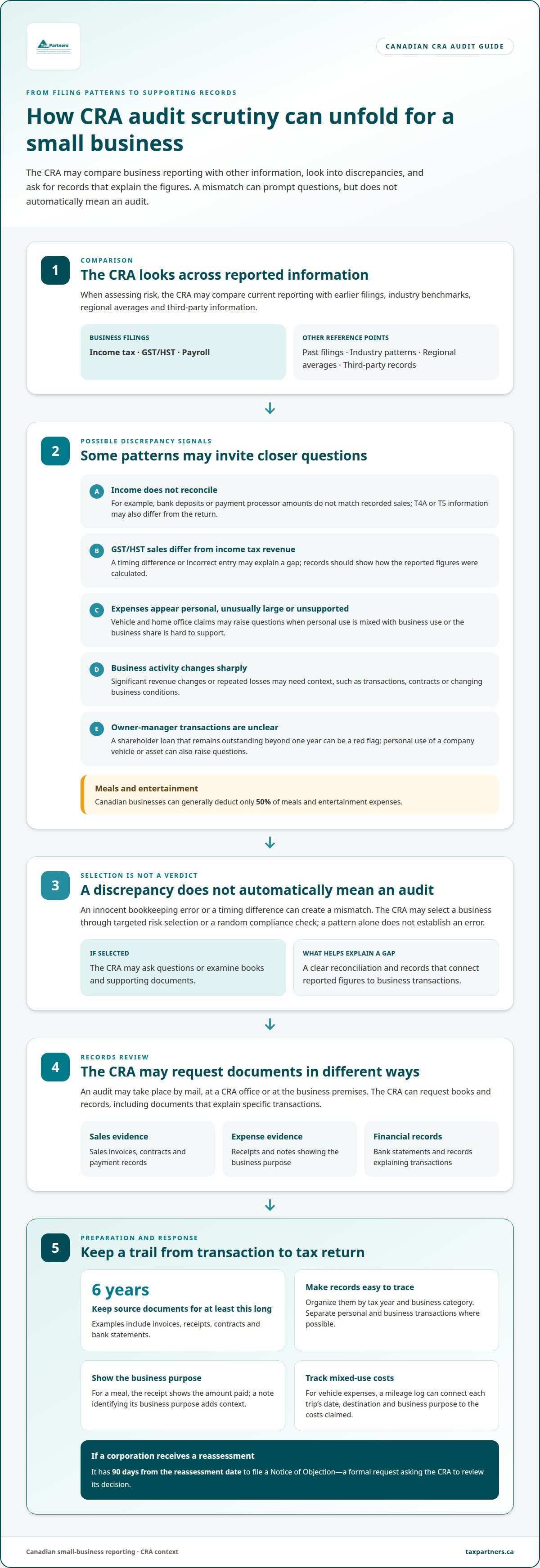
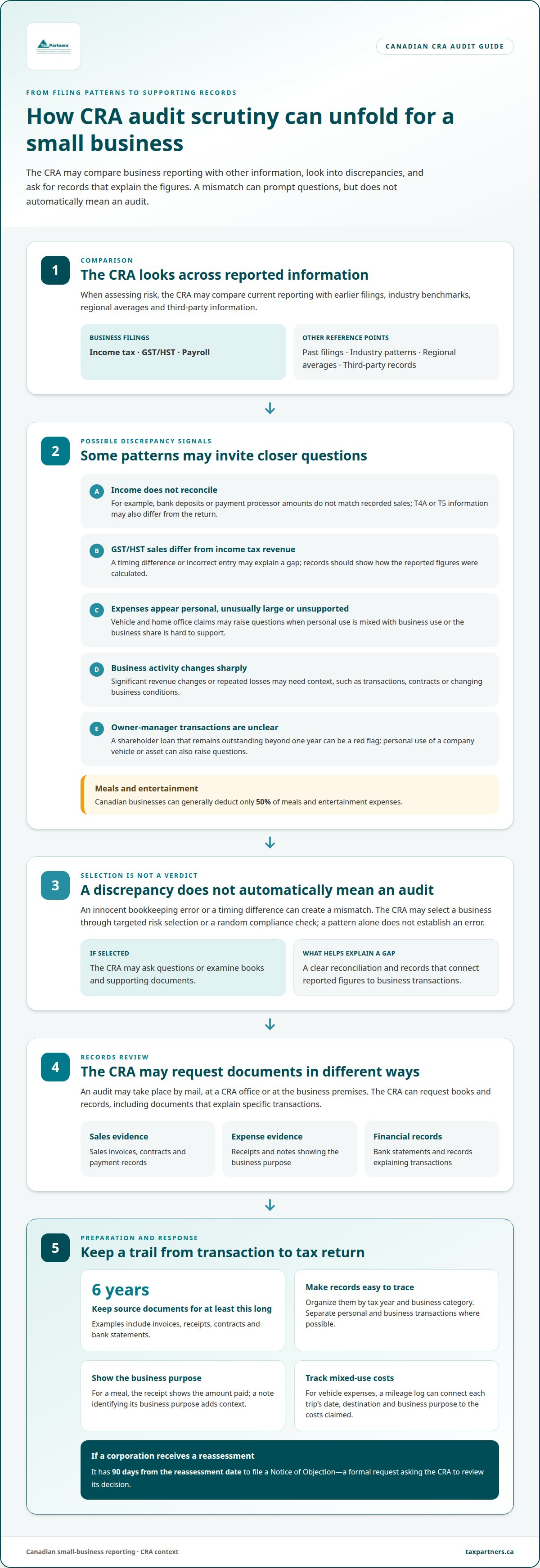
A CRA audit can begin when reported income, expenses or business activity do not align with other information. The agency may compare a return with previous filings, industry patterns and third-party records. Even an innocent bookkeeping error can create a mismatch that prompts questions.
Bank information can help the CRA verify reported income. Under section 231.2 of Canada’s Income Tax Act, the CRA can require financial information directly from financial institutions. If deposits don’t reconcile with recorded sales, the business may need to explain transactions and provide supporting records.
The CRA may also match a business’s reported income against bank and payment processor information, T4A slips reporting certain other income payments, T5 slips reporting investment income, and other online reporting sources. Before filing, reconcile amounts on T4A and T5 slips with the return. For example, income recorded by a payment processor but missing from the books may create a discrepancy for the agency to examine.
Differences between goods and services tax/harmonized sales tax (GST/HST) returns and corporate income tax returns can also attract scrutiny. GST/HST is the federal goods and services tax and, in participating provinces, the harmonized sales tax. The CRA compares sales reported on GST/HST returns with revenue reported on the corresponding income tax return. A timing difference or incorrect entry may explain a gap, but your records should show how you calculated the figures.
Expenses can face review when amounts appear personal, unusually large or unsupported. According to the Canada Revenue Agency, Canadian businesses can generally deduct only 50 percent of meals and entertainment expenses. Vehicle costs and home office claims may also draw questions, particularly when personal use is mixed with business use or the claimed business share is difficult to support.
Owner-manager transactions need careful attention. A shareholder loan is money a corporation lends to a shareholder or that a shareholder owes to the corporation. A shareholder loan that remains outstanding beyond one year can be a red flag, and an improperly managed balance may be included in the shareholder’s personal income, even if no cash changed hands. Personal use of a company vehicle or other business asset can also raise questions about how related expenses were recorded.
Sharp changes in income and repeated losses may invite closer review, particularly when a business reports losses over several consecutive years. A significant revenue change between filings may also need an explanation based on transactions, contracts or business conditions. The pattern alone does not establish an error, but unexplained changes can make reported figures harder to assess.
After a CRA audit reassessment, the business may owe additional tax, interest and penalties. A gross negligence penalty is a penalty for knowingly, or in circumstances amounting to gross negligence, making a false statement or omission; it may be as high as 50% of the understated tax and/or overstated credits related to the false statement or omission. A corporation has 90 days from the reassessment date to file a Notice of Objection, a formal request asking the CRA to review its decision.
Consistent Canadian income tax reporting can help bring return figures and business records into alignment before filing. Clear reconciliations also make it easier to explain differences if the CRA asks how income, revenue or expenses were reported.
2. Record keeping for self-employed businesses
For a self-employed business, reliable records connect each reported amount to a real transaction. Keep source documents for at least 6 years, including invoices, receipts, contracts and bank statements.
Organize records by tax year and business category, such as sales, supplies, travel and vehicle expenses. A consistent system makes it easier to trace income from customer payment to bookkeeping entry and tax return.
The CRA can inspect, audit or examine books and records under section 231.1(1) of Canada’s Income Tax Act. That authority makes complete documentation important, whether records are paper-based or stored electronically. Securing electronic financial records through robust managed IT and cybersecurity services—such as those provided by spacecentersystems.com—can also ensure critical accounting files remain safe, accessible, and intact when an auditor requests them.
During an audit, the CRA may review records by mail, at a CRA office or at your business premises. An auditor can request books and supporting documents, including sales invoices, expense receipts, bank statements and records explaining specific transactions.
Keep evidence of an expense’s business purpose, not just proof of payment. For example, a meal receipt shows the amount paid, while a note identifying the business purpose provides useful context.
For vehicle expenses, keep records that distinguish business travel from personal use. A mileage log can connect each trip’s date, destination and business purpose to the vehicle costs claimed.
Good records also help explain changes in your business. If sales fall while expenses rise, invoices, contracts and payment records can show whether delayed customer payments, a major purchase or reduced activity contributed to the change.
Separate business and personal transactions where possible. If one bank account includes both, identify business entries clearly and keep documents showing how each transaction relates to the business.
Record quality matters as much as volume. Missing receipts, vague descriptions or inconsistent totals can weaken support for reported income and expenses, even when the underlying transaction was legitimate.
Use a regular process to capture records as transactions occur. Match receipts to bookkeeping entries, save invoices with payment evidence, and reconcile account statements with recorded activity.
If the CRA sends a notice requesting documents, identify the period and transactions it specifies. Gather the relevant records, organize them by the same categories, and keep copies of everything you provide.
Well-organized files help you answer specific questions without searching through unrelated paperwork. They also make it easier to explain how totals were calculated and how adjustments were recorded.
If you need support organizing business books and tax documentation, contact Tax Partners about your records.
3. CRA audit selection and risk scoring
The CRA uses risk scoring to identify tax returns that may need closer review. It can compare reported information with T-slips, GST/HST returns, property records and industry benchmarks. A risk score helps guide audit selection; an unusual figure does not mean a return contains an error.
Industry benchmarks help the CRA assess whether a business’s results differ from patterns among comparable businesses. Profit margins well above or below an industry norm can attract attention, particularly when other reported details also conflict. A different margin may have a business reason, such as changing costs or a shift in sales, so your bookkeeping should make the calculation traceable.
Risk factors can overlap. For example, a cash-based business with sharply varying sales may face more scrutiny if reported revenue also differs from GST/HST information. Small corporations, self-employed people and businesses claiming expenses well above industry norms face materially higher audit risk than employees reporting only slip income.
Some industries receive targeted attention. The CRA runs reviews of sectors including construction, restaurants and real estate, while identified focus sectors for 2025-2026 include e-commerce and cryptocurrency. Operating in one of these sectors doesn’t establish a reporting problem, but accurate records and consistent filings matter when transactions are complex.
Other potential red flags include claiming more than 50% of home expenses as a home office deduction, or claiming 100 percent business use for mixed-use expenses without supporting evidence. For example, a family vehicle used for both work and personal travel needs a defensible division between those uses.
Sound bookkeeping can prevent avoidable inconsistencies. Record transactions in the correct period, reconcile account balances and classify expenses consistently before preparing your tax return. For corporations, compare bookkeeping totals with filed returns and GST/HST figures, and investigate differences rather than carrying them into another filing.
Input tax credit (ITC) claims may also attract attention if a business’s GST filings conflict with information reported by other businesses. An ITC lets a GST/HST-registered business recover GST/HST paid on eligible business purchases. Keep purchase records linked to the relevant transactions, and review unusual changes in claim amounts before filing. This helps catch errors early and provides a clear basis for reported figures.
The CRA does not publish an audit rate for individual taxpayers, so a business cannot calculate its likelihood of selection from a public rate. Focus instead on the information the CRA compares: T-slips, GST/HST returns, property records, industry patterns and consistency across filings. Clear explanations for unusual margins or changes provide context for the figures.
4. Repeated business losses and reasonable expectation of profit
A business loss can result from ordinary costs, changing demand or early investment. The CRA may look more closely when a business reports losses over several consecutive years, particularly when it is closely held. That pattern raises a practical question: do the business’s activities and decisions show a credible effort to earn income?
For self-employed people, losses in 3+ consecutive years are identified as a strong audit signal. That pattern doesn’t prove the deductions are incorrect, but it can prompt closer review of how the activity operates and how expenses relate to income. Consistent reporting matters: each loss should reflect the business’s actual transactions for that tax year.
A single year of losses is generally not a major CRA audit red flag on its own. For example, a temporary drop in customer demand could reduce revenue while rent and other operating costs continue. Your figures should explain the result rather than relying on a general claim that conditions were difficult.
To show a reasonable expectation of profit, consider the business’s actions over time. Pricing, efforts to find customers, changes made after weak results and plans to control costs can help explain how the activity aims to earn income. A business that adjusts after repeated losses presents a different pattern from one that continues unchanged.
Compare each year’s results with actual business decisions. If sales fell after you lost a major customer, identify the effect on revenue and the steps you took next. If expenses rose because the business expanded, connect those costs to the activity they supported instead of treating every deduction as self-explanatory.
Rental property losses can also attract attention when they continue across consecutive years. A vacant period, repairs or other costs may help explain a particular year’s result, but your reporting should distinguish those circumstances from ongoing rental activity. For example, a repair expense and a period without tenants affect the figures in different ways.
Benchmarks provide context, but a business may differ from its sector for specific reasons. A new operation may have start-up costs, while a rental property may have expenses that do not arise every year. Explain unusual results with the relevant facts, and keep reported income separate from any unreported amount identified during reconciliation.
A useful review starts with a year-by-year comparison of revenue, expenses and deductions. Note the largest changes, connect them to business events, and correct inaccurate reporting before filing. If losses continue, document the business decisions made in response. This gives the CRA a clearer account of why the figures changed and how the operation is pursuing profit.
5. How the CRA selects businesses for audit
The CRA selects files through risk assessment, targeted reviews and random compliance checks. Before deciding which returns merit scrutiny, it compares reported information with records from several sources.
Risk scoring looks for inconsistencies, not simply a business’s size. The CRA can compare tax returns with T-slips, GST/HST filings, property records and industry benchmarks.
A mismatch may matter more when several sources point in the same direction. For example, sales reported on a tax return that differ from GST/HST filings may warrant closer review.
Industry comparisons provide context for reported results. A profit margin far above or below a business’s sector pattern may stand out, particularly alongside unusual claims or conflicting figures.
An unusual margin does not explain itself. Higher material costs, a new contract or a change in customer demand may give a business a valid reason for results outside its industry benchmark.
Targeted audit programs also focus on selected sectors. The CRA runs reviews involving construction, restaurants and real estate, while its identified 2025-2026 focus sectors include e-commerce and cryptocurrency.
Activity in a particular sector does not establish an error. The CRA may consider business type alongside reporting patterns, third-party information and differences between current filings and past returns.
The CRA may also select returns randomly as part of compliance monitoring. The 1-3% annual random audit rate previously cited for Canadian small businesses should not be relied on; check the CRA’s current information directly.
That distinction matters: a business cannot use a public, individualized probability to predict selection. Risk factors help explain why a file may receive attention, but random selection can also lead to an audit.
Self-employed people, small corporations and cash-based businesses face materially higher audit risk than employees with only slip income. Claims well above an industry norm can add another reason for review.
When records are unreliable, the CRA may use Indirect Verification of Income techniques described in Chapter 13.3.1 of its Audit Manual. These techniques estimate income using indirect evidence, such as bank deposits, rather than relying only on business records.
A net-worth assessment estimates income by comparing changes in a taxpayer’s net worth with reported income. In Bousfield v. The King, 2022 TCC 169, a Canadian court upheld the CRA’s use of net-worth assessments and bank-deposit analysis when records were unreliable. Lifestyle patterns may therefore be considered against reported income.
Strong accounting practices can reduce avoidable discrepancies, although they cannot prevent random selection. Reconcile filings, review unusual claims and document the business reason for differences between reported amounts and source records.
If a CRA review raises questions about selection or reporting, discuss your audit concerns with a tax professional who can assess the records and the issues under review.
Tax Partners
Tax Partners helps small businesses address CRA audit concerns and strengthen the accounting behind their Canadian filings. Its Canadian Accounting & Tax Services supports business tax reporting, while Bookkeeping and Payroll Services help maintain organized financial records.
Consider this support if a CRA notice raises questions about reported amounts or your business needs help preparing its accounting information. Tax Partners can help assess the records and reporting issues relevant to your situation.
For a practical next step, contact Tax Partners to discuss your CRA audit concerns.
Make audit readiness part of your routine
Tax compliance is easier to manage when it is part of regular business decisions, rather than left until filing time. A practical next step is to decide who reviews accounting records, how unusual transactions are documented, and when reporting questions should be addressed.
Understanding the CRA audit triggers for small businesses in Canada can help you decide when to review your process more closely. Tax Partners provides Canadian Accounting & Tax Services and Bookkeeping and Payroll Services to help businesses manage their Canadian reporting.
If you have received a CRA notice or want to review your business’s reporting process before the next filing, consider getting tailored support. A conversation can help clarify the issue and identify a practical way forward.
Contact Tax Partners for support with your Canadian business tax or bookkeeping questions. A clear next step can help you approach upcoming tax decisions with greater confidence.
Frequently Asked Questions
What triggers a CRA audit for small businesses?
A CRA audit may follow reporting that conflicts with information the agency receives from other sources. For example, business payment records may show deposits that do not match recorded sales, or reported income may differ from information slips. Trace figures on the filed return back to the underlying transactions and identify any timing differences or missing entries.
What happens if CRA conducts a net worth audit?
In a net-worth review, the CRA can use a taxpayer’s assets, liabilities and bank deposits to assess whether reported income appears consistent with their financial picture. This approach may be used when business records are unreliable. In Bousfield v. The King, 2022 TCC 169, a Canadian court upheld the CRA’s authority to use net-worth assessments and bank-deposit analysis in that situation.
Does CRA target specific industries for audits?
Yes. The CRA conducts targeted reviews of sectors that include construction, restaurants and real estate. Its identified focus sectors for 2025-2026 also include e-commerce and cryptocurrency. A business in one of these industries isn’t automatically selected; its reported information and other risk factors still matter. Keep sector-specific transactions, such as project costs or online sales, identifiable in the business’s accounting records.
What triggers a CRA audit of a small business in Canada?
Common CRA audit triggers for small businesses in Canada include mismatches between reported figures and outside information, unusual expense claims, and results that differ from industry patterns. To assess a potential discrepancy, trace an amount from its original record through bookkeeping and into the filed return. This can reveal whether the issue involves a missing transaction, a timing difference or an incorrect classification.
Do cash transactions or frequent losses increase CRA audit risk for Canadian small businesses?
Cash-based businesses face materially higher CRA audit risk than employees reporting only slip income, and repeated losses can attract review. For self-employed people, losses in 3+ consecutive years are identified as a strong audit signal. That pattern doesn’t establish that a return is wrong. Keep a clear record of sales, costs and business decisions so the financial results can be explained in context.
Can late tax filings, unpaid balances, or inconsistent GST/HST returns trigger a CRA audit?
Inconsistent GST/HST sales and income reported on the corresponding tax return can attract scrutiny because the CRA compares those figures. The CRA also advises Canadian businesses to file on time even if they cannot immediately pay the amount owing. Keep filing, payment and audit issues distinct: a balance owing does not itself explain a discrepancy between reported sales and revenue.
How does the CRA use third-party information and data matching to select small businesses for audit?
The CRA can compare a business’s return with information from banks, payment processors, T4A slips, T5 income reports and other online reporting sources. It also compares filings with T-slips, GST/HST returns, property records and industry benchmarks. The CRA receives Common Reporting Standard (an international framework for sharing financial account information between tax authorities) data from financial institutions in 40+ countries, which can help identify income or assets that don’t align with a return.
What records must a Canadian small business keep, and for how long, to prepare for a CRA audit?
Canadian small businesses should keep source documents for at least 6 years. Useful records include invoices, receipts, contracts, bank statements and documents that support reported income and expenses. A practical system links each document to its bookkeeping entry and tax-year category. For example, save a supplier invoice with its payment record so the transaction can be traced without relying on memory.

Article by
Mahad Mohamed
Mahad Mohamed is an accountant and the CEO of Tax Partners, with over 26+ years of Canadian and international tax and accounting experience. His expertise includes corporate reorganization, cross-border tax structuring (Canada & US), tax disputes, CRA audits, and tax planning for small owner-managed private corporations. Most recently, Mahad is a pioneer in Canadian crypto taxation and founded Block3 Finance.
Previously, Mahad worked for the Canada Revenue Agency (CRA), Big4 accounting firms, and served as a Rulings Officer for the Federal Tax Authority of the UAE before acquiring Tax Partners in 2014.
Tax Partners has 44 full-time accountants and over 18,400+ clients.
Disclaimer
This article provides general information only and is current as of its publication date. It has not been updated and may be out of date. It does not constitute legal advice and should not be relied upon as such. Every tax situation is unique and may differ from the examples discussed in this article. If you have specific questions, you should seek the advice of our accountants for your unique circumstances. Book a FREE Initial Consultation Today!
Frequently Asked Questions
What triggers a CRA audit for small businesses?
A CRA audit may follow reporting that conflicts with information the agency receives from other sources. For example, business payment records may show deposits that do not match recorded sales, or reported income may differ from information slips. Trace figures on the filed return back to the underlying transactions and identify any timing differences or missing entries.
What happens if CRA conducts a net worth audit?
In a net-worth review, the CRA can use a taxpayer’s assets, liabilities and bank deposits to assess whether reported income appears consistent with their financial picture. This approach may be used when business records are unreliable. In Bousfield v. The King, 2022 TCC 169, a Canadian court upheld the CRA’s authority to use net-worth assessments and bank-deposit analysis in that situation.
Does CRA target specific industries for audits?
Yes. The CRA conducts targeted reviews of sectors that include construction, restaurants and real estate. Its identified focus sectors for 2025–2026 also include e-commerce and cryptocurrency. A business in one of these industries isn’t automatically selected; its reported information and other risk factors still matter. Keep sector-specific transactions, such as project costs or online sales, identifiable in the business’s accounting records.
What triggers a CRA audit of a small business in Canada?
Common CRA audit triggers for small businesses in Canada include mismatches between reported figures and outside information, unusual expense claims, and results that differ from industry patterns. To assess a potential discrepancy, trace an amount from its original record through bookkeeping and into the filed return. This can reveal whether the issue involves a missing transaction, a timing difference or an incorrect classification.
Do cash transactions or frequent losses increase CRA audit risk for Canadian small businesses?
Cash-based businesses face materially higher CRA audit risk than employees reporting only slip income, and repeated losses can attract review. For self-employed people, losses in 3+ consecutive years are identified as a strong audit signal. That pattern doesn’t establish that a return is wrong. Keep a clear record of sales, costs and business decisions so the financial results can be explained in context.
Can late tax filings, unpaid balances, or inconsistent GST/HST returns trigger a CRA audit?
Inconsistent GST/HST sales and income reported on the corresponding tax return can attract scrutiny because the CRA compares those figures. The CRA also advises Canadian businesses to file on time even if they cannot immediately pay the amount owing. Keep filing, payment and audit issues distinct: a balance owing does not itself explain a discrepancy between reported sales and revenue.
How does the CRA use third-party information and data matching to select small businesses for audit?
The CRA can compare a business’s return with information from banks, payment processors, T4A slips, T5 income reports and other online reporting sources. It also compares filings with T-slips, GST/HST returns, property records and industry benchmarks. The CRA receives Common Reporting Standard (an international framework for sharing financial account information between tax authorities) data from financial institutions in 40+ countries, which can help identify income or assets that don’t align with a return.
What records must a Canadian small business keep, and for how long, to prepare for a CRA audit?
Canadian small businesses should keep source documents for at least 6 years. Useful records include invoices, receipts, contracts, bank statements and documents that support reported income and expenses. A practical system links each document to its bookkeeping entry and tax-year category. For example, save a supplier invoice with its payment record so the transaction can be traced without relying on memory.