DIY Bookkeeping vs Outsourced Services: Which Costs Less

For Canadian businesses, DIY bookkeeping may seem less expensive, but it isn’t always the lower-cost option. In the DIY bookkeeping vs outsourced services decision, look beyond fees: transaction complexity, compliance needs, access to expertise and the accuracy of financial reports all matter. Outsourcing may make sense when bookkeeping takes time away from running the business or requires specialist attention.
It’s reasonable to want control over your records and a clear view of costs. But bookkeeping also needs to support reliable reporting and tax preparation, so include the time and expertise required in your comparison.
This article explains how to weigh the costs and trade-offs for a Canadian business, including when a hybrid approach may work. You’ll learn what can affect accuracy and compliance, and how to decide whether professional bookkeeping support fits your business.
Key Takeaways
- Compare the full demands of each bookkeeping option, including the time, expertise, oversight and continuity involved, not just the apparent cost.
- Consider professional support when records fall behind, errors build up or bookkeeping distracts from running your business.
- Match bookkeeping expertise to your transaction complexity and Canadian compliance needs, especially as your business grows.
- Professional use of accounting software can help keep financial records organized and accessible for ongoing reporting.
- Assess whether more consistent, accurate reports or a hybrid approach would better support your business decisions.
Is outsourcing better than DIY bookkeeping?
Outsourcing may be the better choice when transaction volume, complexity or limited staff expertise makes it harder to maintain accurate, timely records in-house. DIY bookkeeping may cost less in direct fees, but a full comparison also includes owner time, software, hiring, training and the effort needed to correct errors.
Outsourced Costs and Payroll Savings
Outsourced bookkeeping fees vary with transaction volume, financial complexity and the work included. The cost of professional bookkeeping depends on these factors and the service scope, and is provided after a quote request.
Using an external bookkeeper can avoid hiring an employee solely for bookkeeping, along with related payroll, benefits, training and supervision costs. It doesn’t eliminate bookkeeping costs: the service fee replaces some internal labour, while the business still needs to supply records and maintain clear processes. Ask what the fee covers, such as reconciliations, payroll entries or reporting, and what may be billed separately.
Bookkeeping Time and Opportunity Costs
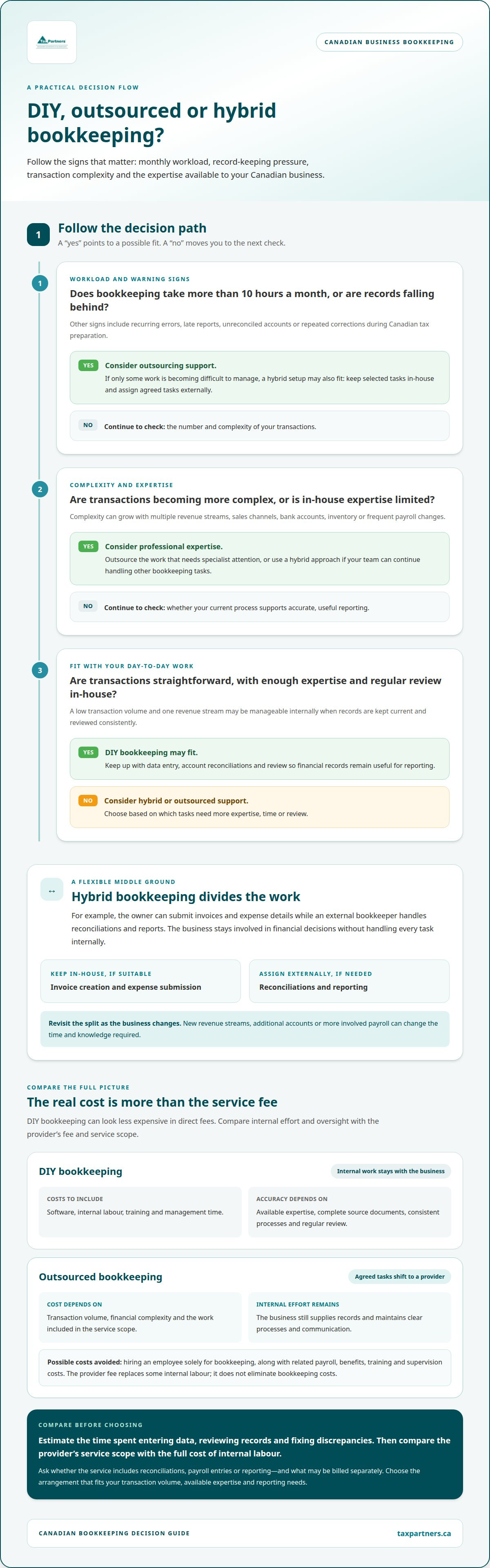
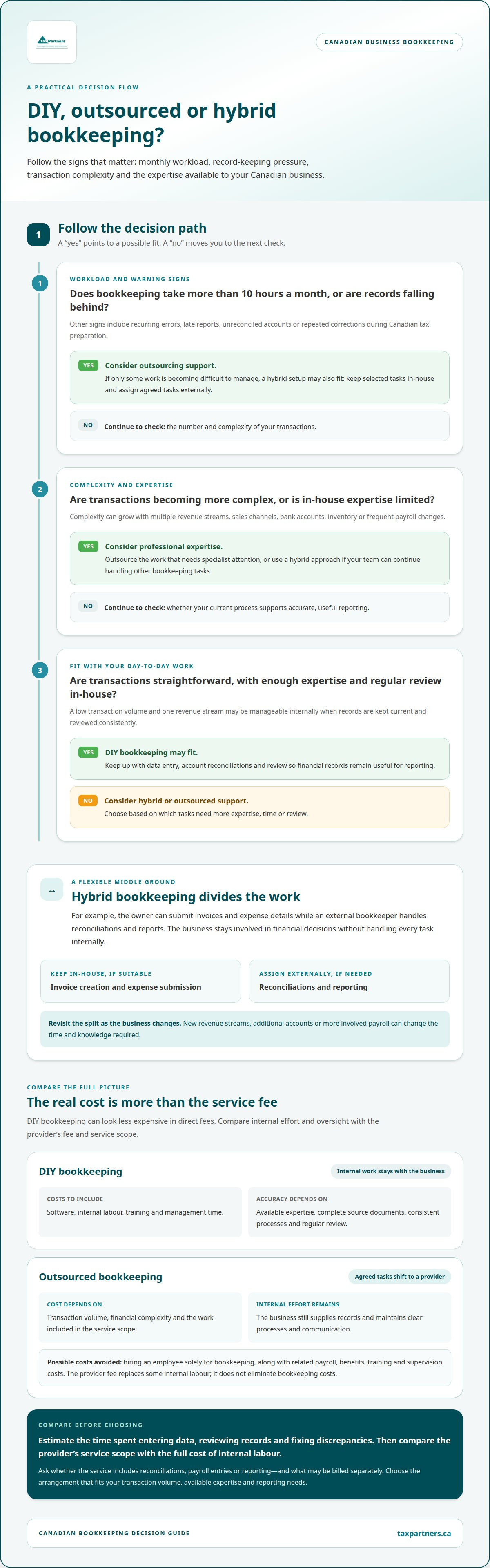
DIY bookkeeping uses time that an owner could spend on sales, customer service or operations. If bookkeeping takes more than 10 hours per month, a business may want to consider outsourcing. That time includes more than entering transactions: invoices, payables, account reconciliations and payroll records all need attention.
Outsourcing assigns agreed tasks to an external professional, but still requires organized records and communication. For example, an owner might submit invoices and expense details while a bookkeeper handles reconciliations and reports. This division can help the owner focus on operations while staying involved in financial decisions.
Hidden Costs of DIY Bookkeeping
A DIY system may involve software fees, staff training and management time, even without a dedicated bookkeeping hire. Errors add to the workload: correcting an expense coded to the wrong account or a missed transaction takes time and can delay reliable reports.
These costs depend on the business’s processes and internal expertise. A small operation with straightforward transactions may need little oversight, while multiple revenue streams or frequent payroll changes can require more. Estimate the hours spent entering data, reviewing records and fixing discrepancies to understand the workload behind an apparently low-cost approach.
Cost, Time, and Accuracy Comparison
DIY bookkeeping keeps daily processes close to the business, while outsourced support brings external expertise and a service fee. Neither option guarantees accurate records: results depend on complete source documents, consistent processes and timely review. Outsourced fees are often predictable monthly, though providers may structure fees around fixed or usage-based work.
| Option | Direct cost | Time and control | Accuracy considerations |
|---|---|---|---|
| DIY | Software and internal labour | Direct access; owner or staff time required | Depends on expertise and regular review |
| Outsourced | Provider fee based on scope and complexity | Less day-to-day control; agreed tasks shift externally | Professional processes can help reduce errors |
Compare the provider’s service scope with the full cost of internal labour, then choose the arrangement that fits your transaction volume, available expertise and reporting needs.
When should a small business stop doing DIY bookkeeping?
Consider outsourcing when records, reporting or available expertise no longer keep pace with the business. Transaction volume matters, but so do delays, errors and the time owners spend maintaining the books.
Signs You’re Ready to Outsource
Spending more than 10 hours a month on bookkeeping is a point to consider outsourcing. Other warning signs include records that fall behind, recurring errors, reports arriving late and tax preparation requiring repeated corrections.
These signals point to different pressures. A growing backlog suggests the current process cannot keep up; repeated corrections may indicate a need for additional expertise. If reconciliation takes more than a few hours per month, review whether the workload still fits the business’s needs.
- Transactions remain unrecorded or accounts unreconciled.
- Reports are incomplete or unavailable when decisions are due.
- Bookkeeping takes time away from customers, sales or operations.
The choice between DIY bookkeeping vs outsourced services depends on which problems need attention first and what expertise the business can access.
Bookkeeping as the Business Grows
A business with low transaction volume and one revenue stream may manage routine records internally. As sales channels, bank accounts, inventory or payroll become more complex, each transaction can require more classification, review and coordination.
Support can scale with the workload. A business may outsource reconciliations or reporting while keeping invoice creation and expense submission in-house. This hybrid approach can preserve daily visibility without building a full internal team. The right division depends on which tasks are growing fastest and where staff expertise is strongest.
Scalability also means revisiting the arrangement as operations change. A new revenue stream, additional account or more involved payroll process can alter the time and knowledge needed to keep records current.
Choosing and Transitioning to a Bookkeeping Service
In Canada, assess a bookkeeper’s relevant experience, references, service scope and familiarity with your transaction complexity. Ask what routine work includes, what may cost extra, how questions are handled and what security controls protect financial data.
The Office of the Privacy Commissioner of Canada says a business remains accountable for protecting customers’ personal information when it outsources data processing to a cloud provider. Clear access controls and agreed processes matter alongside bookkeeping expertise.
To transition, organize existing records, identify unreconciled accounts and agree which tasks will stay internal. Then define how invoices, receipts and payroll information will be shared, and set expectations for reports and communication. For a growing business, the DIY bookkeeping vs outsourced services decision can also guide which responsibilities move first.
If growth or delayed records are prompting a change, discuss a bookkeeping transition and the support your business needs.
Compliance needs and internal expertise
Bookkeeping records financial activity; tax preparation uses those records to support tax compliance. For a Canadian business, the choice depends on whether internal staff can maintain complete, consistent records and understand how transactions affect reporting.
CRA filings rely on accurate business information, so bookkeeping errors can affect tax calculations. For example, recording a business expense in the wrong category can distort reported profit and require corrections during tax preparation. A bookkeeper organizes the underlying transactions; tax professionals interpret them for tax reporting.
Useful records connect each transaction to supporting documentation. A business should be able to trace a payment, invoice or payroll entry to its source, then explain how it was recorded. Missing receipts or inconsistent descriptions make this harder, especially when several people handle purchasing, approvals and data entry.
A monthly review can help catch discrepancies before they accumulate. Compare bank and credit card statements with recorded transactions, check unpaid invoices and payables, and confirm payroll entries are reflected correctly. If a statement shows a payment missing from the books, staff can investigate while the transaction is still familiar.
Internal expertise matters most when transactions require judgment. A straightforward sale may be easy to record, while inventory purchases, several revenue streams or complex payroll can require more careful classification and review. Staff who understand the business may recognize unusual activity, but still need time and training to apply consistent processes.
External bookkeeping support can bring experience with reconciliations, reporting and tax-ready records. It doesn’t transfer responsibility for the business’s information or decisions. The owner still needs clear processes for approving payments, sharing source documents and reviewing reports; advisory support can help interpret the financial picture, not just record it.
- Errors: Identify whether corrections recur in payroll, expenses or reconciliations.
- Records: Check whether transactions have clear supporting documents and descriptions.
- Profit: Review whether reports reflect sales and expenses consistently.
- Expertise: Match the work’s complexity to the knowledge available internally.
For Canadian businesses, the practical test is whether records remain complete, explainable and useful for tax preparation. If internal staff can maintain reliable records and resolve exceptions promptly, in-house bookkeeping may fit. If gaps persist or transaction complexity exceeds the team’s experience, professional bookkeeping and tax expertise can help establish a more dependable process.
If the business is scaling, a hybrid model can pair in-house invoice creation and expense submission with outsourced reconciliations, reporting and compliance oversight.
How professional bookkeepers use accounting software for Canadian small businesses
Canadian small businesses can use cloud accounting software to organize transactions and share records remotely. A bookkeeper helps match the system and workflow to the business, then manages recurring tasks such as recording invoices, reconciling accounts and preparing reports.
There isn’t one software choice for every business. A bookkeeper considers transaction volume, revenue sources, payroll needs and the reports owners rely on. For example, a business with several revenue streams needs records that distinguish each stream clearly.
Software supports bookkeeping, but it doesn’t replace review. A bookkeeper can check that an invoice is recorded in the right period, confirm a payment appears in the records and follow up on transactions that don’t match supporting documents.
Cloud accounting stores data on remote, offsite servers rather than only on a local hard drive. This lets a bookkeeper access online records throughout the year, supporting timely reporting and tax-planning discussions instead of waiting until year-end.
Automation can reduce repeated data entry when the software supports it. For example, imported bank transactions can be reviewed and matched to recorded payments, while recurring invoices can follow a consistent process. A bookkeeper still needs to review exceptions, such as a bank charge with no clear business purpose.
Define access and responsibilities before remote work begins. The business can provide the bookkeeper with appropriate system access while retaining internal approval steps for payments and expenses. Clear roles help prevent an invoice entry from being mistaken for payment approval.
Bookkeepers can also work with software already in use. They can review the existing chart of accounts, transaction categories and reporting setup, then identify where current processes create duplicate entries or incomplete records. This avoids changing systems simply for the sake of change.
To manage the software effectively, the bookkeeper can establish a practical workflow: collect invoices and receipts, record transactions, reconcile accounts, review exceptions and prepare reports. For instance, an unpaid supplier invoice should remain visible as a payable rather than being treated as a completed payment.
Canadian businesses should also consider how staff will supply information and who can view financial records. The business remains accountable for protecting customer information when processing is outsourced to a cloud provider, according to the Office of the Privacy Commissioner of Canada. Access controls and defined processes belong in the software plan.
A bookkeeper’s role is to make accounting software useful, not simply to enter data. When selecting or managing a system, align its capabilities with the business’s transactions, reporting needs and existing processes, then use professional review to keep records coherent.
Accuracy and usefulness of financial reporting
Accurate books matter when reports help owners make timely decisions. A professional bookkeeper applies consistent processes to organize transactions, investigate discrepancies and prepare reports that reflect business activity. For the DIY bookkeeping vs outsourced services decision, compare how each approach supports the quality and timing of those reports.
Accuracy starts with complete source records. For example, a supplier payment should match an invoice and appear in the relevant account statement. Reconciliation brings those records together, helping identify duplicate entries, missing transactions or amounts that need review.
Transaction volume affects the review required. A business processing sales through several channels may need each deposit matched to its source, including fees or refunds. Without a clear process, deposits can be recorded as revenue without showing what was deducted or which sales they represent.
Classification matters too. If a purchase is assigned to the wrong expense category, reports may misstate costs and profit. A bookkeeper can use consistent coding, review unusual entries and correct mistakes before they distort a monthly report or year-end summary.
Reliable reporting also depends on timing. If invoices and expenses are entered late, a cash-flow report may not reflect recent obligations. Regular updates help owners see unpaid customer invoices, upcoming supplier payments and current account balances together, rather than relying on disconnected records.
Professional processes can reduce errors and costly discrepancies, but reports still depend on the information the business provides. Clear descriptions and supporting documents help a bookkeeper understand whether a transaction is a sale, refund, loan repayment or business expense.
- Reconciliation: Compare recorded activity with bank and credit card statements.
- Classification: Apply consistent categories to sales, expenses and payroll entries.
- Exception review: Investigate duplicate, missing or unusual transactions.
- Reporting: Prepare current summaries that show revenue, expenses and cash position.
Useful reports answer practical questions. A profit-and-loss report can show whether expenses are rising alongside revenue; an accounts receivable summary can reveal which customer invoices remain unpaid. Owners can then focus on specific patterns rather than relying on a single account balance.
DIY bookkeeping vs outsourced services is not simply a choice between less effort and more expertise. In-house records can be accurate with consistent processes and review; outsourcing can bring professional experience and an independent review process. The best fit depends on transaction volume, staff knowledge and the reports owners need to make decisions confidently.
For businesses connecting financial reporting with longer-term planning, discuss your reporting and financial planning needs.
Tax Partners: Bookkeeping and Payroll Services
Tax Partners provides Bookkeeping and Payroll Services for businesses that need consistent records, payroll support or help keeping financial tasks on schedule. This support may suit owners whose transaction volume is growing, whose records need regular attention or who want professional bookkeeping alongside their business responsibilities.
Where bookkeeping connects to Canadian tax preparation, Canadian Accounting & Tax Services can help align financial records with your business’s Canadian tax needs. The appropriate support depends on the work your business needs handled.
Share your bookkeeping priorities and the processes already in place to start a practical conversation. Contact Tax Partners to discuss support for your business.
Choose the support that fits your next stage
The decision between DIY bookkeeping and outsourced services is also a decision about the financial capacity you want to build inside your business. Treat it as an operating choice, not a permanent label: responsibilities can shift as your priorities, team and reporting needs change.
Tax Partners offers Bookkeeping and Payroll Services and Canadian Accounting & Tax Services. This support can connect routine bookkeeping with Canadian tax work, aligning financial records with your business’s needs.
Before choosing your next step, consider which tasks need consistent ownership and what information would help you make decisions. A clear scope can help align bookkeeping support with your workflow and future plans. Contact Tax Partners to discuss an approach for your business. With the right support in place, you can move forward with greater focus and confidence.
Frequently Asked Questions
Which Option Is Right for Your Business?
Choose the approach that fits your transaction complexity, internal expertise and need for timely reports. For example, a business with straightforward sales and staff who can maintain consistent records may keep bookkeeping in-house. If several people handle transactions or management needs clearer financial updates, outsourced or hybrid support may fit better. Consider whether you need help with the full bookkeeping process or specific tasks, such as payroll entries or reconciliations.
What tasks are included in outsourced bookkeeping for a Canadian small business?
Outsourced bookkeeping can cover transaction recording, account reconciliations, invoice and payable tracking, expense monitoring, payroll entries and financial reporting. The precise scope depends on the business and its agreement with the provider. For example, one arrangement may cover reconciliations and reports while staff continue creating customer invoices. Clarifying responsibilities helps prevent gaps, such as assuming a supplier invoice has been paid when it has only been recorded.
How much does outsourced bookkeeping cost in Canada in 2026?
There is no single cost for outsourced bookkeeping in Canada; fees depend on transaction volume, complexity and the agreed service scope. A business with multiple revenue streams or involved payroll may need different support from a business with simpler records. For bookkeeping services, pricing depends on the case and is provided after a quote request. The work included and records requiring attention shape the cost.
When should a Canadian small business hire an outsourced bookkeeper?
Consider hiring an outsourced bookkeeper when financial records no longer support decisions or routine reporting. For example, if an owner cannot determine which customer invoices remain unpaid before planning a supplier payment, the current process may need support. A bookkeeper can take on defined tasks while the owner retains approval authority. This can be especially useful when internal staff handle bookkeeping alongside unrelated operational duties.
What are the risks of inaccurate bookkeeping for a Canadian small business?
Inaccurate records can give owners a misleading view of revenue, expenses and available cash. For example, recording a customer payment twice may overstate income, while omitting an unpaid supplier bill may understate upcoming obligations. Those errors can affect budgeting, pricing and the information used for tax preparation. Clear supporting documents, consistent transaction descriptions and review of unusual entries help make reports more dependable.

Article by
Mahad Mohamed
Mahad Mohamed is an accountant and the CEO of Tax Partners, with over 26+ years of Canadian and international tax and accounting experience. His expertise includes corporate reorganization, cross-border tax structuring (Canada & US), tax disputes, CRA audits, and tax planning for small owner-managed private corporations. Most recently, Mahad is a pioneer in Canadian crypto taxation and founded Block3 Finance.
Previously, Mahad worked for the Canada Revenue Agency (CRA), Big4 accounting firms, and served as a Rulings Officer for the Federal Tax Authority of the UAE before acquiring Tax Partners in 2014.
Tax Partners has 44 full-time accountants and over 18,400+ clients.
Disclaimer
This article provides general information only and is current as of its publication date. It has not been updated and may be out of date. It does not constitute legal advice and should not be relied upon as such. Every tax situation is unique and may differ from the examples discussed in this article. If you have specific questions, you should seek the advice of our accountants for your unique circumstances. Book a FREE Initial Consultation Today!
Frequently Asked Questions
Which Option Is Right for Your Business?
Choose the approach that fits your transaction complexity, internal expertise and need for timely reports. For example, a business with straightforward sales and staff who can maintain consistent records may keep bookkeeping in-house. If several people handle transactions or management needs clearer financial updates, outsourced or hybrid support may fit better. Consider whether you need help with the full bookkeeping process or specific tasks, such as payroll entries or reconciliations.
What tasks are included in outsourced bookkeeping for a Canadian small business?
Outsourced bookkeeping can cover transaction recording, account reconciliations, invoice and payable tracking, expense monitoring, payroll entries and financial reporting. The precise scope depends on the business and its agreement with the provider. For example, one arrangement may cover reconciliations and reports while staff continue creating customer invoices. Clarifying responsibilities helps prevent gaps, such as assuming a supplier invoice has been paid when it has only been recorded.
How much does outsourced bookkeeping cost in Canada in 2026?
There is no single cost for outsourced bookkeeping in Canada; fees depend on transaction volume, complexity and the agreed service scope. A business with multiple revenue streams or involved payroll may need different support from a business with simpler records. For bookkeeping services, pricing depends on the case and is provided after a quote request. The work included and records requiring attention shape the cost.
When should a Canadian small business hire an outsourced bookkeeper?
Consider hiring an outsourced bookkeeper when financial records no longer support decisions or routine reporting. For example, if an owner cannot determine which customer invoices remain unpaid before planning a supplier payment, the current process may need support. A bookkeeper can take on defined tasks while the owner retains approval authority. This can be especially useful when internal staff handle bookkeeping alongside unrelated operational duties.
What are the risks of inaccurate bookkeeping for a Canadian small business?
Inaccurate records can give owners a misleading view of revenue, expenses and available cash. For example, recording a customer payment twice may overstate income, while omitting an unpaid supplier bill may understate upcoming obligations. Those errors can affect budgeting, pricing and the information used for tax preparation. Clear supporting documents, consistent transaction descriptions and review of unusual entries help make reports more dependable.