Bookkeeper vs Accountant: Compare Their Roles and Responsibilities

Hiring a bookkeeper and an accountant doesn’t have to be an either-or decision. To understand the difference between a bookkeeper and an accountant in Canada, start with what each does: bookkeepers organize and record transactions, while accountants interpret those records for tax filings, financial reporting and business decisions.
The roles can seem interchangeable when a business needs accurate records and financial guidance, but their responsibilities and professional authority differ. In Canada, provincial law protects the CPA designation; bookkeeping does not require a professional designation.
This comparison explains what each professional typically does, where their work overlaps and when a business may benefit from both. It also shows how accounting expertise can turn reliable bookkeeping records into useful advice, helping you choose support for your day-to-day needs and longer-term plans.
Key Takeaways
- Use bookkeeping to keep transactions organized and current, and accounting to interpret the records for reporting, tax and business decisions.
- Match support to your needs: routine transaction tracking may call for a bookkeeper, while complex reporting or forward-looking advice may call for an accountant.
- Understand how a Chartered Professional Accountant (CPA) designation and scope differ from a bookkeeper’s role in Canada.
- Accurate, organized records give an accountant a stronger foundation for useful analysis and guidance.
- Consider using both roles when your business needs consistent recordkeeping as well as deeper financial insight.
Bookkeeper vs Accountant: Which One Does Your Business Need?
Choose support based on your immediate need: reliable transaction records, financial interpretation or both. The scope of work matters more than a generic price comparison, since fees depend on factors such as transaction volume, record complexity, service frequency and the level of analysis required.
Daily Transaction Recording
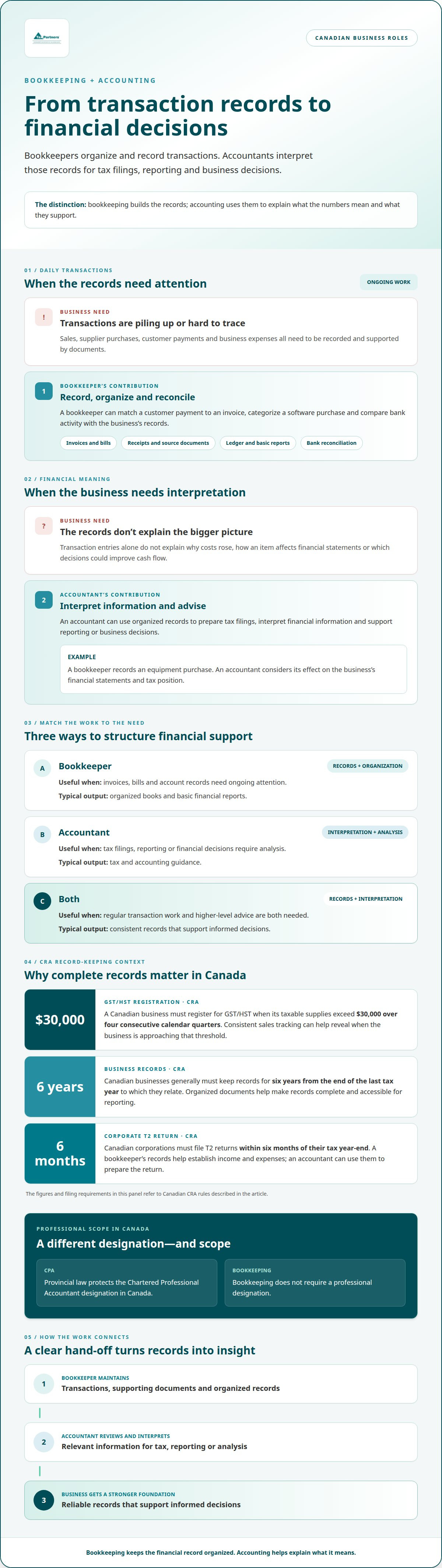
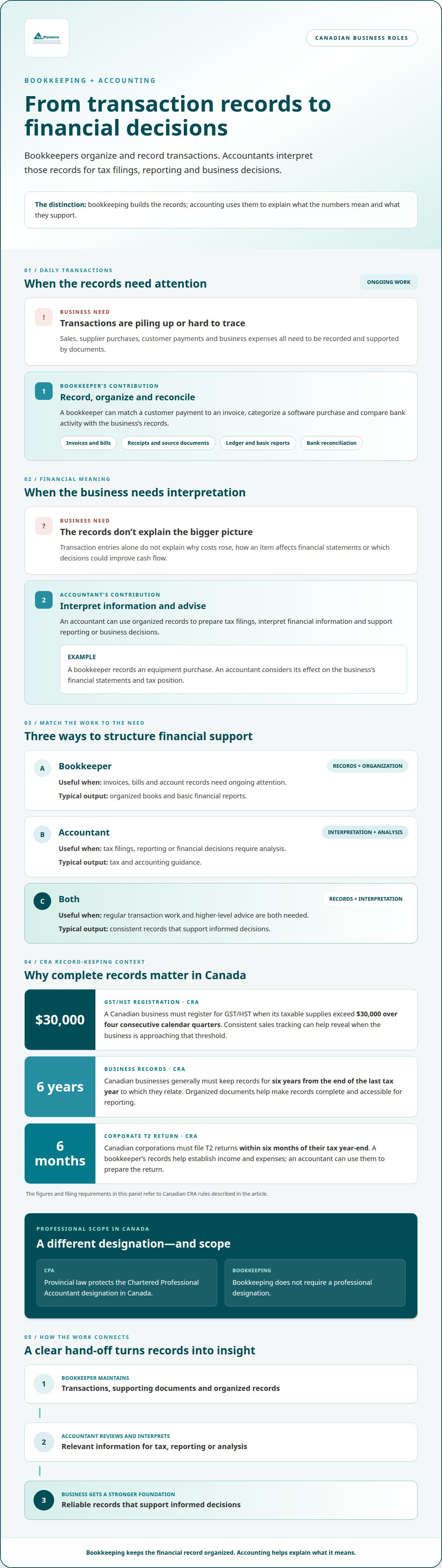
A bookkeeper records financial transactions, including sales, supplier purchases, customer payments and business expenses. For example, they can match a customer payment to an invoice, categorize a software purchase and reconcile the bank account with recorded activity, that is, check that the bank’s records match the business’s records. These ongoing tasks keep the books organized, but don’t explain on their own why costs rose or which decisions could improve cash flow.
Organized records also give a business a clearer view of what it owes and what customers owe. A bookkeeper may maintain the general ledger, issue invoices, track bill payments and prepare basic financial reports. The work is practical and transaction-focused: each entry should have supporting documentation and be assigned to the appropriate account.
Bookkeeping and Accounting Differences in Canada
Bookkeeping captures and organizes transactions; accounting uses those records to prepare or interpret financial information for reporting, tax and business decisions. A bookkeeper might record an equipment purchase, while an accountant considers its effect on the business’s financial statements and tax position. This distinction is central to understanding the difference between a bookkeeper and an accountant in Canada.
Transaction records can also help identify when a business has tax responsibilities. According to the Canada Revenue Agency, a Canadian business must register for GST/HST (the goods and services tax and harmonized sales tax) when its taxable supplies exceed $30,000 over four consecutive calendar quarters. Tracking sales consistently helps reveal when the business is approaching that threshold.
Good records support future reporting, too. According to the Canada Revenue Agency, Canadian businesses generally must keep records for six years from the end of the last tax year to which they relate. An accountant can use organized records to prepare tax filings, while the bookkeeper’s ongoing work helps make those records complete and accessible.
| Option | Primary focus | Useful when | Typical output |
|---|---|---|---|
| Bookkeeper | Recording and organizing transactions | Invoices, bills and account records need ongoing attention | Organized books and basic financial reports |
| Accountant | Interpreting financial information | Tax filings, reporting or financial decisions require analysis | Tax and accounting guidance |
| Both | Records plus interpretation | Regular transaction work and higher-level advice are both needed | Consistent records supporting informed decisions |
Choose a bookkeeper for consistent transaction records, an accountant for interpretation, or both when you need ongoing recordkeeping and informed analysis.
For Canadian tax and accounting work, the Canadian tax and accounting services page outlines support relevant to businesses managing records and reporting obligations.
Bookkeeping and accounting responsibilities
The responsibilities often connect, but each role contributes different work to a business’s financial process. A bookkeeper maintains the underlying records; an accountant uses them for reporting, tax filings and analysis.
For example, a bookkeeper records a customer invoice as income, tracks whether it has been paid and files the supporting receipt. They may also enter supplier bills, record payroll information and categorize expenses such as rent or office supplies. Consistent recordkeeping helps keep the ledger accurate and makes later reporting more dependable.
At month-end, reconciling bank activity means comparing transactions in the books with the bank statement and resolving differences. A bookkeeper may flag a duplicate payment or an unrecorded bank charge. They can also organize receipts and other source documents so an accountant can trace reported amounts back to the records.
- Bookkeeper: enters transactions, organizes supporting documents, and prepares basic financial reports.
- Accountant: interprets financial information, prepares tax filings, and advises on reporting or business decisions.
- Shared workflow: the bookkeeper maintains records, then the accountant reviews relevant details for a filing or analysis.
A tax return may rely on documents gathered by a bookkeeper, such as sales summaries, expense records and payroll details. A bookkeeper can organize documents and prepare information for tax returns, while an accountant can use the assembled records to determine how items should be reported. Clear records reduce time spent resolving missing or inconsistent entries.
For a corporation, the accountant may prepare its T2 return using the business’s financial records. According to the Canada Revenue Agency, Canadian corporations must file T2 returns within six months of their tax year end. The bookkeeper’s records help establish the income and expenses that feed into that filing, while the accountant handles the return preparation.
Responsibilities can shift with a business’s needs. A small operation with straightforward sales may mainly need consistent transaction entry; a corporation with payroll, multiple revenue streams or complex reporting may need additional accounting analysis. In either case, define who records transactions, who reviews reports and who prepares each filing to prevent gaps or duplicated work.
When both roles are involved, a practical handoff includes an organized ledger, supporting invoices and receipts, bank statements, payroll summaries and notes about unusual transactions. An accountant can then focus on interpretation rather than reconstructing routine activity. To discuss coordinated bookkeeping and accounting support, contact Tax Partners.
Differences in professional scope and authority
In Canada, professional authority depends on the work and, for some services, the province. A bookkeeper can manage records without a regulated designation, while a Chartered Professional Accountant (CPA) holds a protected professional designation.
Can bookkeepers in Canada file taxes or provide tax advice? No professional designation is required to prepare an income tax return in Canada, and bookkeepers can prepare tax documents. To electronically file a client’s return through EFILE (the Canada Revenue Agency’s electronic filing service), a tax preparer must meet Canada Revenue Agency requirements and pass its suitability screening.
Preparing a return and providing tax planning are different responsibilities. A bookkeeper can organize slips, expense records and transaction summaries; tax planning assesses how financial choices affect tax obligations. A CPA’s training and professional judgment can support that analysis, especially when a business faces complex reporting questions.
Protected designation and regulated work
In Canada, provincial law protects the Chartered Professional Accountant designation. Bookkeepers aren’t legally required to hold certification through a regulatory body, so their experience and services can vary. A bookkeeper may competently record sales and reconcile a credit card statement, but that work alone doesn’t confer CPA authority.
Only CPAs are authorized to issue certain audit, review and compilation engagement reports in Canada, although provincial restrictions can differ. In Ontario, public accounting work, including assurance engagements and certain compilation work, requires a public accounting licence. These rules matter when a lender, investor or other user needs a formal report rather than internal financial information.
A CPA’s professional obligations go beyond transaction entry. CPAs follow professional standards, ethical rules and continuing education requirements set by provincial bodies, such as CPABC. A typical bookkeeper’s role centres on maintaining records; professional accounting work can include preparing or reviewing financial statements and applying accounting standards.
For assurance work, independence is essential. In Canada, a CPA performing an audit or review engagement must be independent of the accounting records and cannot have prepared them. For example, a business may need separate recordkeeping and assurance roles when its financial statements require an independent review.
Match professional authority to the outcome you need: routine records may suit a bookkeeper, while a formal engagement, tax planning or professional financial judgment calls for a CPA. A CPA can also perform bookkeeping, but bookkeeping alone doesn’t establish the authority to issue regulated reports.
A CPA is a regulated, licensed and insured professional with advanced training in accounting, tax and financial reporting. Professional requirements can vary depending on the services an accountant provides. This distinction can help a business decide whether its needs call for formal accountability and broader expertise, rather than recordkeeping alone.
CPAs can handle bookkeeping as well as compliance, tax filing and long-term planning. Their scope can cover routine financial records and more complex needs as they arise. When selecting support, consider the work and the outcome you need: bookkeeping may suit ongoing recordkeeping, while compliance, tax filing or long-term planning may call for a CPA’s broader professional scope. Matching the provider to the task clarifies responsibility for each part of the work.
Accountant duties and strategic advice
An accountant turns recorded figures into explanations business owners can use. For example, comparing monthly sales with expenses can show whether revenue growth is improving profitability or simply increasing workload.
Financial statements bring together key information, including income, expenses, assets and liabilities. An accountant can prepare or review these statements, then explain what changed and why. If costs rose while sales stayed steady, the analysis can help identify which expense categories need attention.
Tax work is another typical accounting responsibility. Accountants can prepare corporate and personal tax filings, examine relevant records and discuss tax planning. For a corporation considering a major purchase, an accountant can assess the reporting and tax considerations before the business commits.
Useful advice starts with a specific decision, not a generic forecast. An accountant may compare a proposed hire with current payroll costs, review the effect of a new product line or assess whether the business has enough cash for planned expenses. These discussions connect financial information with operational choices.
- Explain performance: compare sales, expenses and margins across reporting periods.
- Support planning: assess a proposed purchase or expansion against available financial information.
- Prepare reporting: organize statements and filings using the business’s records.
- Identify questions: flag unusual changes, such as rising supplier costs or overdue customer accounts.
A forecast can help business owners see how different assumptions affect cash flow. For instance, an accountant might model slower collections alongside planned equipment spending. This clarifies when cash may be needed, rather than treating projected income as cash already available.
Accountants can also help interpret financial reports for people outside the business. A lender may want clear statements, while an owner may need a concise explanation of operating results. The accountant connects the underlying figures with the intended audience and decision.
Strategic advice depends on relevant, organized information. If records show a recurring seasonal dip in sales, an accountant can help assess its effect on budgets and planned spending. If transaction details are incomplete, they may need clarification before the analysis can guide a decision.
Business owners can get more from an accounting discussion by bringing a defined question, such as whether a planned expansion fits current cash flow. The accountant can examine the supporting statements, identify assumptions and explain the financial trade-offs. This makes accounting a decision-making resource, not simply a year-end task.
These discussions are more useful when records are organized and transaction details are available. Accountants can analyze financial information prepared by a bookkeeper and provide financial insights, advice and tax guidance.
Accurate bookkeeping helps a CPA analyze the business, support compliance and offer strategic guidance. A CPA’s typical work includes corporate and personal tax filings, tax planning, preparing or reviewing financial statements, audits and financial advisory services. Bring questions about results, reporting or upcoming choices so the accountant can explain relevant trade-offs and identify any information needed before you decide.
What is the difference between bookkeeping and accounting in Canada?
Bookkeeping captures a business’s financial activity; accounting explains what that activity means. In Canada, bookkeeping focuses on accurate, organized records, while accounting applies analysis, reporting knowledge and professional judgment to those records.
Consider a business changing how it earns revenue. A bookkeeper records the related transactions and supporting documents; an accountant can assess the change’s effects on financial statements, reporting and tax considerations. The first task builds the evidence; the second interprets it to inform decisions.
The roles also differ in training and expertise. Accountants typically need a university degree, followed by a few years of training and practice. Bookkeepers can develop practical expertise in recording transactions without obtaining a professional designation, although their experience and scope of work can vary.
Canada’s accounting profession consolidated three regulatory bodies under the CPA designation, with Ontario and the territories excepted. Provincial law protects the Chartered Professional Accountant designation. For work requiring formal financial reporting or professional judgment, that distinction can matter more than job titles alone.
- Bookkeeping: capture transactions, organize documents and maintain clear records.
- Accounting: interpret records, prepare financial statements and support tax or business decisions.
- Combined support: coordinate recordkeeping and analysis when a business needs both operational accuracy and informed interpretation.
Identify the outcome you need next. If staff need organized records for internal tracking, bookkeeping may address the immediate task. If owners need to understand results, prepare financial statements or consider the financial effects of a decision, accounting adds interpretation.
These functions often work best as connected stages, not competing alternatives. Clear records help an accountant trace financial results and explain them in a useful way. A defined handoff also clarifies who maintains source documents and who prepares or reviews the analysis.
Choose based on the work required, the complexity of the records and whether professional judgment is needed. For tailored support with bookkeeping, accounting or tax questions, discuss your business’s needs.
Tax Partners
Tax Partners can align your ongoing bookkeeping with your accounting and tax needs as your business grows. Its bookkeeping and payroll services support day-to-day financial administration; Canadian accounting and tax services address Canadian tax filings, financial statements and broader guidance.
This support can be useful when your business structure changes or financial responsibilities become more complex. Start with the work you need done, whether that means maintaining records, preparing Canadian filings or considering how financial choices affect your plans.
Contact Tax Partners to discuss the accounting support that fits your business.
Choose a Financial Support Plan That Can Grow
Your next step is to match financial support to the decisions ahead, not just the work waiting on your desk. As your business changes, revisit who maintains records, who interprets them and when you need professional input. That makes the difference between a bookkeeper and an accountant in Canada a practical planning choice, rather than a fixed either-or decision.
Tax Partners offers Canadian Accounting & Tax Services and Bookkeeping and Payroll Services. These services can bring recordkeeping, tax responsibilities and accounting guidance into a clearer working plan as your needs evolve.
Consider the questions you want answered, the records involved and the decisions coming into view. Discuss your accounting needs with Tax Partners and take a considered next step with confidence.
Frequently Asked Questions
What does a bookkeeper do in Canada?
A bookkeeper maintains the transaction records a Canadian business relies on to understand its activity. Along with entering sales and expenses, they can check for duplicate entries, identify transactions without supporting documents and flag items needing clarification. For example, a payment recorded without a matching invoice can be flagged for follow-up, making the books easier to review later.
What does an accountant do in Canada?
An accountant prepares and interprets financial information for reporting, tax filings and business decisions. If reported profit differs from available cash, for example, an accountant can examine receivables, upcoming payments and other relevant records to help explain the gap. Accountants may also prepare financial statements and tax returns using available information to address the business’s reporting needs.
What qualifications or designations do accountants need in Canada, such as CPA?
Provincial law protects the CPA designation in Canada, and accountants typically need a university degree followed by a few years of training and practice. Requirements depend on the work and province. Public accounting and assurance engagements, for example, may have specific licensing or independence requirements. A business seeking formal reporting should distinguish a CPA’s regulated designation from general accounting experience.
When should a Canadian small business hire a bookkeeper versus an accountant?
Hire a bookkeeper when routine recordkeeping, such as tracking bills and customer payments, takes time away from running the business. Bring in an accountant when you need tax filings, financial statements or analysis for a decision, such as assessing a proposed expansion. If both needs are ongoing, using both roles can connect current records with higher-level accounting work.
What financial records and tasks should a Canadian business give to a bookkeeper or accountant?
Give a bookkeeper routine transaction documents, including sales invoices, expense receipts, bank statements and payroll summaries. For accounting or tax work, provide relevant year-end statements, prior tax returns, loan documents and records of major asset purchases or owner transactions. These materials help the professional trace figures to their source and understand unusual activity without relying on incomplete summaries.

Article by
Mahad Mohamed
Mahad Mohamed is an accountant and the CEO of Tax Partners, with over 26+ years of Canadian and international tax and accounting experience. His expertise includes corporate reorganization, cross-border tax structuring (Canada & US), tax disputes, CRA audits, and tax planning for small owner-managed private corporations. Most recently, Mahad is a pioneer in Canadian crypto taxation and founded Block3 Finance.
Previously, Mahad worked for the Canada Revenue Agency (CRA), Big4 accounting firms, and served as a Rulings Officer for the Federal Tax Authority of the UAE before acquiring Tax Partners in 2014.
Tax Partners has 44 full-time accountants and over 18,400+ clients.
Disclaimer
This article provides general information only and is current as of its publication date. It has not been updated and may be out of date. It does not constitute legal advice and should not be relied upon as such. Every tax situation is unique and may differ from the examples discussed in this article. If you have specific questions, you should seek the advice of our accountants for your unique circumstances. Book a FREE Initial Consultation Today!
Frequently Asked Questions
What does a bookkeeper do in Canada?
A bookkeeper maintains the transaction records a Canadian business relies on to understand its activity. Along with entering sales and expenses, they can check for duplicate entries, identify transactions without supporting documents and flag items needing clarification. For example, a payment recorded without a matching invoice can be flagged for follow-up, making the books easier to review later.
What does an accountant do in Canada?
An accountant prepares and interprets financial information for reporting, tax filings and business decisions. If reported profit differs from available cash, for example, an accountant can examine receivables, upcoming payments and other relevant records to help explain the gap. Accountants may also prepare financial statements and tax returns using available information to address the business’s reporting needs.
What qualifications or designations do accountants need in Canada, such as CPA?
Provincial law protects the CPA designation in Canada, and accountants typically need a university degree followed by a few years of training and practice. Requirements depend on the work and province. Public accounting and assurance engagements, for example, may have specific licensing or independence requirements. A business seeking formal reporting should distinguish a CPA’s regulated designation from general accounting experience.
When should a Canadian small business hire a bookkeeper versus an accountant?
Hire a bookkeeper when routine recordkeeping, such as tracking bills and customer payments, takes time away from running the business. Bring in an accountant when you need tax filings, financial statements or analysis for a decision, such as assessing a proposed expansion. If both needs are ongoing, using both roles can connect current records with higher-level accounting work.
What financial records and tasks should a Canadian business give to a bookkeeper or accountant?
Give a bookkeeper routine transaction documents, including sales invoices, expense receipts, bank statements and payroll summaries. For accounting or tax work, provide relevant year-end statements, prior tax returns, loan documents and records of major asset purchases or owner transactions. These materials help the professional trace figures to their source and understand unusual activity without relying on incomplete summaries.