Sole proprietorship vs incorporation: compare costs and taxes

The simpler structure isn’t always the less costly choice over time. When deciding between sole proprietorship and incorporation in Canada, start with how you’ll use business profits and how much personal exposure you can accept. A sole proprietorship keeps the business and owner legally connected, while a corporation is a separate legal entity.
It’s natural to focus on setup costs and tax rates, but they’re only part of the decision. A sole proprietor reports business income on a personal tax return and is personally responsible for business debts. A corporation files separate tax returns and has additional administrative requirements, but can retain income for future business use.
This comparison explains how the two structures differ in costs, taxes, control, assets, liability, and ongoing administration. You’ll also find the trade-offs behind sole proprietorship advantages and disadvantages, along with a practical guide to assessing which structure fits your business plans, income needs, and risk exposure.
Key Takeaways
- A sole proprietorship is simpler to administer, but the owner and business are not legally separate.
- Incorporation creates a separate legal entity, with more formal recordkeeping and tax-filing responsibilities.
- Compare how you’ll use business profits: personal taxation and corporate tax deferral work differently.
- Consider personal liability, decision-making control and plans for growth alongside setup and ongoing costs.
- The right structure depends on your income needs, risk exposure and business plans, not tax rates alone.
What is a sole proprietorship?
A sole proprietorship is an unincorporated business owned by one individual. The owner receives its profits, reports business income personally, and is liable for business debts and obligations.
This structure can suit someone testing an idea or working independently. When deciding between sole proprietorship and incorporation, consider expected income, business risks, growth plans, and whether anyone else will own the venture.
In Canada, business-name registration, goods and services tax (GST), harmonized sales tax (HST), and permits are separate considerations. GST and HST are collected on taxable sales. A sole proprietor using a name other than their own must register that business name, while permit requirements depend on the activity and location.
Most Canadian businesses have to register for a GST/HST account after exceeding C$30,000 in sales within a certain period, according to Canada Revenue Agency. Most Canadian businesses have to register for a GST/HST account after exceeding $30,000 in sales within a certain period.
In Ontario, a sole proprietorship must register its business name if it carries on business under a name other than the individual proprietor’s own name. Some provinces may not require registration when the proprietor uses their personal name, so check the applicable provincial or territorial rules.
Registering a business name does not create a separate legal entity or protect the name itself. Registration requirements can also differ for a general partnership, which in Ontario is owned by two or more people.
Partners share responsibility for business decisions and, in Ontario, are responsible for partnership debts and losses. Registration requirements depend on the province or territory where the partnership operates.
| Option | Ownership | Income and responsibility | Administration |
|---|---|---|---|
| Sole proprietorship | One individual | Owner reports profits personally and is liable for business obligations | Business-name registration may apply |
| General partnership | Two or more people | Partners share responsibility for debts and losses in Ontario | Requirements depend on the province or territory |
| Corporation | One or more shareholders | Separate legal entity from its owners | Corporate records and filings apply |
Tax deductions also affect the comparison. A sole proprietor can generally deduct business expenses and losses from personal income. Keep records that connect each expense to business activity. Personal spending does not become a business expense simply because the owner is self-employed.
For larger purchases, such as business equipment, capital cost allowance (CCA) is the tax deduction used to claim eligible capital-asset costs over time, rather than treating the full purchase as an ordinary expense. The asset’s business use and applicable tax treatment affect the deduction.
Careful records help distinguish operating costs from capital purchases when preparing a Canadian tax return. Deciding between sole proprietorship and incorporation means weighing ownership, personal responsibility, registration duties, and how business costs will be claimed.
Corporate income retained for reinvestment or tax deferral
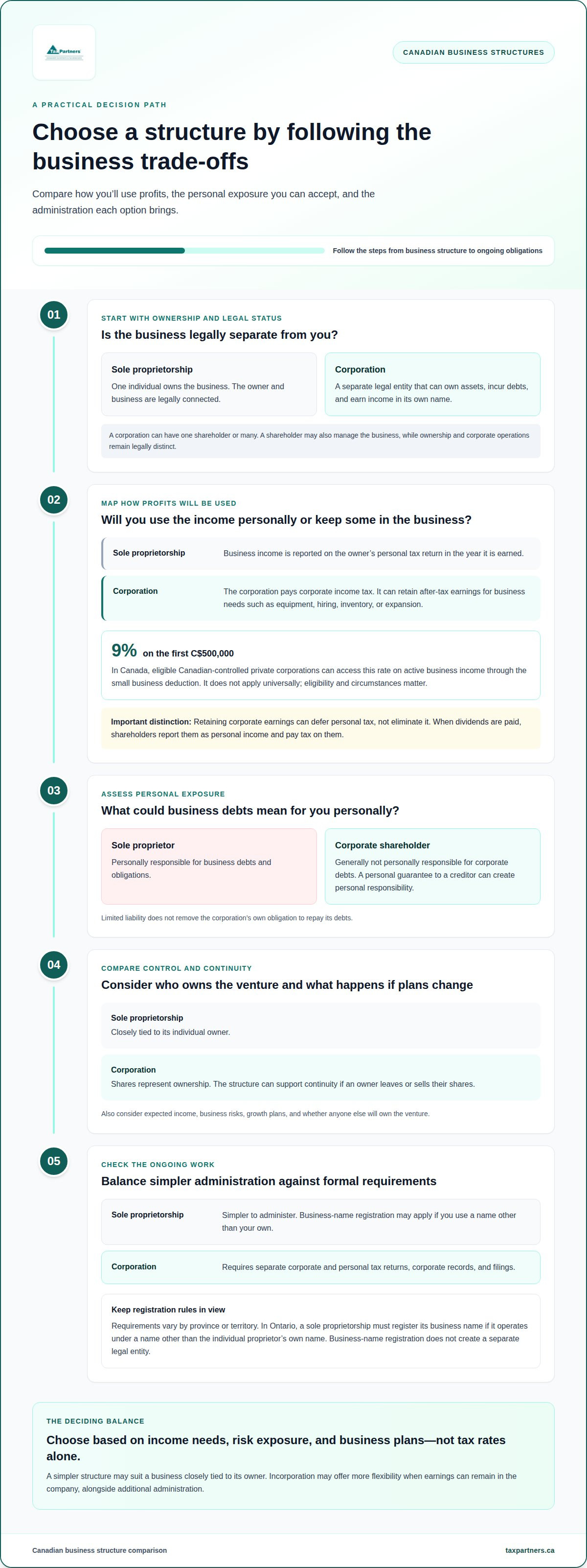
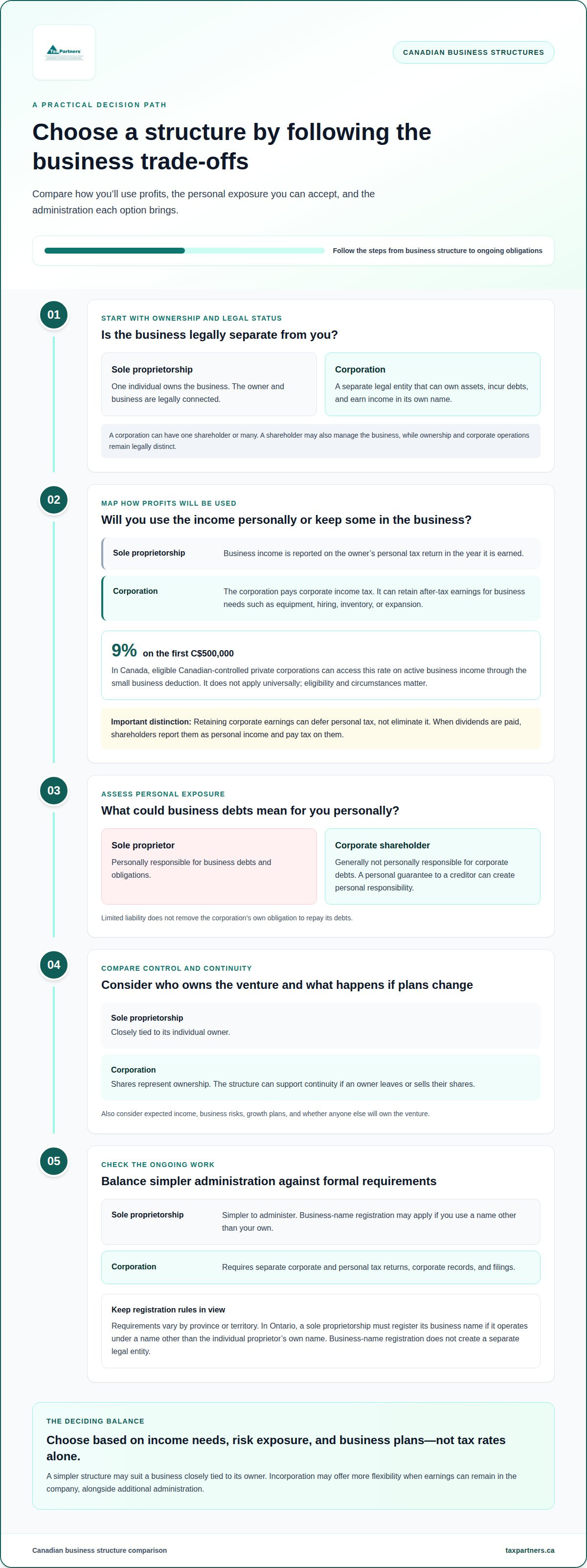
In Canada, a sole proprietorship and a corporation differ in ownership, legal status, and tax treatment. A sole proprietorship is not separate from its owner, while a corporation is a separate legal entity that can own assets, incur debts, and earn income in its own name.
A corporation can have one shareholder or many, each holding shares that represent ownership. A shareholder may also manage the business, but ownership and corporate operations remain legally distinct. This structure can support continuity if an owner leaves or sells their shares, while a sole proprietorship is closely tied to its individual owner.
Tax treatment changes how profits can be used. A sole proprietor reports business income on a personal tax return in the year it is earned. A Canadian corporation pays corporate income tax on its income, and eligible Canadian-controlled private corporations can access a 9% rate on their first C$500,000 of active business income through the small business deduction.
The small business rate does not apply universally to every corporation or type of income. Eligibility and the corporation’s circumstances determine whether the deduction applies. Corporate tax planning should account for the applicable rules and the province or territory where the business operates.
Retained earnings are profits kept inside the corporation after expenses and taxes. If the corporation needs funds for equipment, hiring, inventory, or expansion, retaining some earnings can make them available for business use without immediately paying them to shareholders as dividends.
This can defer personal tax, not eliminate it. When the corporation later pays dividends, shareholders report those amounts as personal income and pay tax on them. The timing and amount of a dividend matter: withdrawing all profits promptly leaves less income in the corporation to reinvest or defer.
Personal liability also differs. A sole proprietor is personally responsible for business debts and obligations. Corporate shareholders are generally not personally responsible for corporate debts, although a personal guarantee to a creditor can create personal responsibility. Limited liability does not remove the corporation’s own obligation to repay its debts.
Consider how much profit you need for personal expenses and how much can remain invested in the business. A corporation may offer more flexibility when earnings can stay in the company, but separate corporate and personal tax returns, records, and responsibilities add administration. A sole proprietorship may be more direct when you need profits personally, though its income is taxed at your personal rate.
A review of Canadian corporate tax treatment can help clarify how retained income, dividends, and eligibility for the small business deduction apply to your situation.
Sole proprietorship legal status, control, taxes, assets and liability
In Canada, the structure affects who owns business assets, reports income, and bears responsibility for obligations. It also shapes how you take money from the business and manage payroll.
Sole proprietor liability and incorporation protection
A sole proprietorship is not legally separate from its owner, so business debts and obligations are the proprietor’s personal responsibility. Incorporation creates a separate legal entity, unlike a sole proprietorship, and creditors may pursue the proprietor personally for business debts.
A corporation is a separate legal entity, and its shareholders are generally not personally responsible for corporate debts. That protection has limits: a shareholder who signs a personal guarantee to a creditor can become personally responsible for the guaranteed debt. Incorporation changes the legal relationship but does not erase every personal obligation.
Personal liability for lawsuits
If a customer brings a claim against a sole proprietorship, the owner and business are not separate legal parties. The proprietor’s personal assets may therefore be exposed to business-related legal actions as well as debts. For example, a claim tied to the owner’s services can affect the owner personally.
A corporation can help separate the shareholder’s personal assets from most claims against the business. The corporation remains responsible for its own obligations, and a personal guarantee can still expose the shareholder. This distinction matters when assessing risks related to the business’s work, contracts, and customer relationships.
Taxes, CPP and paying yourself
A sole proprietor reports business income on a personal tax return, and business profit is taxed as personal income in the year it is earned. An incorporated owner may receive salary or dividends instead, affecting personal income tax and the corporation’s records differently.
For a sole proprietor, Canada Pension Plan (CPP) contributions relate to self-employment income. The CPP is Canada’s public pension plan. An incorporated owner’s CPP and payroll treatment depends on how the owner is paid. Salary requires payroll administration, while dividends are payments to shareholders. Bookkeeping and payroll records help distinguish these transactions and support accurate returns.
A sole proprietor in Canada can incorporate later. Transferring equipment, contracts, or other business assets into a corporation can have tax consequences, so consider the assets, their values, and the timing before changing the structure.
Control and business assets
A sole proprietor makes business decisions directly and receives the profits, without dividing control among shareholders. The proprietor, rather than a separate corporation, holds the business assets. This can keep day-to-day decisions straightforward, but personal and business finances still need clear records.
With incorporation, the corporation owns assets in its name, while shareholders own shares and may appoint or act as directors. The structure can support shared ownership or investment, but decisions must follow corporate governance and recordkeeping arrangements. Employees can work in either structure; hiring them does not itself transfer ownership or control.
Compare the risks of your work, the assets at stake, how you plan to pay yourself, and whether you need shared ownership or outside capital. These practical factors help determine which structure better fits your business.
Incorporation costs and administrative requirements
In Canada, a sole proprietorship usually involves fewer formation and recordkeeping steps than a corporation. Compare initial registration expenses with the recurring work of corporate filings, records, and income tax returns.
Sole proprietorship and incorporation setup costs
A sole proprietorship can be a relatively simple way to start a business, though owners may still need to handle applicable registration and recordkeeping requirements. These are business-name setup expenses, not incorporation fees.
Incorporation adds a filing step and creates a separate corporate structure. In Ontario, an owner can choose federal or provincial incorporation, and the jurisdiction affects the setup process and costs.
Initial filing fees are only part of the comparison. A corporation may also require professional help to prepare incorporation documents, organize records, or plan how the business will operate. The ownership structure’s complexity and the support required influence startup expenses.
For a sole proprietor, the key decision is often whether to register a business name and meet local requirements. Incorporation involves establishing a legal entity before operating through it. Either structure needs sound records to support income tax reporting and separate business spending from personal expenses.
Compliance and professional costs
After incorporation, compliance becomes an ongoing responsibility. An Ontario corporation must provide annual filings and maintain corporate records, while corporations generally file a separate T2 income tax return. In Canada, that return is due within six months after the end of the corporation’s fiscal year.
The report is distinct from the corporate tax return, so completing one does not replace the other. Recordkeeping also supports accurate returns and documents corporate decisions.
A sole proprietor generally reports business income on a personal tax return, while an incorporated business files its own corporate return. The difference affects the administration required, but tax rates alone do not determine the overall cost. Consider the time and professional support needed to maintain records and meet filing obligations.
Professional startup costs may relate to incorporation documents, accounting setup, or advice about the business structure. Ongoing accounting costs depend on the company’s transactions, records, and reporting needs. They are separate from government filing fees and should be considered alongside the time required for annual compliance.
Compare the initial filings, recurring records, tax returns, and support needed for your situation. A sole proprietorship can mean lighter administration, while incorporation brings additional compliance duties and a distinct corporate tax process.
Sole proprietorship advantages and disadvantages
A sole proprietorship can suit an owner who values direct control and simpler administration. Its advantages come with trade-offs in liability, access to capital, and continuity.
Sole proprietorship advantages
The owner makes decisions directly, keeps the business profits, and avoids dividing authority with shareholders. For solo practitioners—such as therapists and counsellors who might seek business coaching from Martin Hogg Private Practice Success when setting up their clinics—this structure simplifies managing client work, pricing, and spending without corporate governance procedures.
Tax reporting also follows a direct path: the proprietor reports business income on a personal return. In Canada, business losses may be deducted from personal income, which can matter when a new venture has expenses before earning steady revenue.
This simplicity can help an owner assess an idea before taking on a more formal structure. A proprietor can incorporate later as the business grows, rather than establishing a corporation at the outset. The trade-off is that transferring assets during a later change can have tax consequences.
Sole proprietorship disadvantages
Personal liability is the central disadvantage. Because the owner and business are not separate legal entities, the proprietor is responsible for business debts and obligations. A business creditor may therefore pursue the owner personally, unlike most corporate debts owed by a separate corporation.
Raising capital can also be harder. Lenders and investors may prefer incorporated businesses, so a sole proprietor seeking funds for equipment or expansion could have fewer financing options. Bringing in partners also changes the ownership arrangement and may call for a different business structure.
Income is taxed personally in the year the proprietor earns it. This can limit tax-planning options when the owner wants to leave profits in the business rather than use them personally. Corporate tax treatment can allow eligible income to remain in a corporation, though incorporation brings separate filings and records.
Continuity is another consideration. A sole proprietorship dissolves upon the proprietor’s death, so the business does not automatically continue as the same entity. This can complicate plans for transferring operations, client relationships, or assets to another person.
Canada’s self-employment landscape includes both structures: 46.2% of self-employed people run unincorporated businesses. That figure shows the sole proprietorship is a common choice, but it does not make it suitable for every owner or risk profile.
Use a practical test: choose a sole proprietorship if direct control, personally reported income, and simpler administration fit your plans. Give more weight to incorporation if personal liability, investment, retained profits, or business continuity are central concerns. Neither structure is automatically better. The deciding factors are how the business earns, spends, and manages risk.
For a tailored assessment of these trade-offs, discuss your business structure.
Tax Partners
Tax Partners helps Canadian business owners assess how their structure affects tax reporting, bookkeeping, payroll, and financial planning. Its Canadian Accounting & Tax Services can support decisions about income reporting and corporate tax obligations, while Bookkeeping and Payroll Services help organize transaction records and owner compensation.
Consider professional guidance when you expect to retain profits in a corporation, plan to change structures, or face more involved payroll responsibilities. Reviewing your income needs, liability concerns, and administrative capacity together can clarify the trade-offs. Wealth Management & Financial Planning can also connect business decisions with your broader financial plans.
For guidance on your business structure and its tax implications, contact Tax Partners.
Make the decision part of your business plan
Treat the choice as a planning decision, not a permanent label. As you map your next stage, write down what the business needs from its structure: how you expect to use earnings, whether ownership may change, and what responsibilities you’re prepared to manage. This gives you a practical basis for reviewing the decision as your plans develop.
For owners deciding between sole proprietorship and incorporation, the most useful next step is to connect the structure choice to the business’s financial records and future direction. Tax Partners can help you consider the Canadian tax and accounting implications alongside your circumstances, including how cross-border activity or payroll may affect the picture. For international ventures or companies expanding into the UAE, firms like Account Dubai provide comparable bookkeeping, audit, and tax compliance support.
Contact Tax Partners to discuss your business structure and the considerations behind it. A clear plan can help you move forward with greater confidence.
Frequently Asked Questions
What is an incorporated business?
An incorporated business operates through a corporation created under federal or provincial law in Canada. The corporation exists separately from its owners, so it can hold business assets and enter into obligations in its own name. For example, a corporation can own equipment used by the business, while its shareholder owns shares in the corporation. Incorporation also brings corporate filing and recordkeeping responsibilities.
What is a corporation?
A corporation is a legal entity distinct from the people who own its shares. In Canada, it can have one shareholder or many, and it can continue to exist if an owner leaves or sells their shares. A shareholder may also help manage the business, but ownership and the corporation’s legal identity remain separate. This distinction affects how the business holds assets and handles obligations.
Can you claim a business loss on personal taxes?
In Canada, a sole proprietor may deduct business losses from personal income, subject to applicable tax rules. A corporation’s loss belongs to the corporation and cannot be deducted directly against its shareholder’s personal income. For example, if a business has a loss while buying equipment and building its customer base, the result depends on whether it operates personally or through a corporation.
What are the Advantages of Incorporation?
Incorporation can make ownership easier to divide through shares, which may help when a business seeks investors or plans a change in ownership. A corporation can also continue operating if a shareholder leaves or dies. These features can support continuity and access to capital over the long term. They matter most when growth plans require more than one owner or outside investment.
What are the Disadvantages of Incorporating?
Incorporation brings separate corporate records and tax filings in Canada, alongside the owner’s personal tax responsibilities. That can add administrative work, especially for an owner who handles all bookkeeping alone. A corporation’s business loss also does not reduce the shareholder’s personal income. Consider whether the business’s expected ownership, operations, and reporting needs justify maintaining a separate legal and tax structure.
What are the advantages and disadvantages of each?
A sole proprietorship can suit an owner who wants direct decision-making and straightforward income reporting, but the owner remains personally responsible for business obligations. Incorporation can support shared ownership and business continuity, but requires corporate administration and separate tax reporting. To compare the options, write down who will own the business, how profits will be used, and what risks or growth plans the structure must accommodate.
What are the costs to incorporate federally or provincially in Canada, and what are the ongoing annual fees?
Costs depend on the incorporation jurisdiction and ongoing filing requirements. These are examples, not a single Canada-wide fee schedule; additional professional costs depend on the work required.
How do I register a sole proprietorship or incorporate a business in my Canadian province or territory?
Start by identifying where the business will operate and whether it will use the owner’s personal name or another business name. Then follow the applicable provincial or territorial registration process, or choose federal or provincial incorporation and file the required documents. Registration, permits, and tax accounts are separate considerations, with requirements that depend on the business’s name, activities, and locations in Canada.

Article by
Mahad Mohamed
Mahad Mohamed is an accountant and the CEO of Tax Partners, with over 26+ years of Canadian and international tax and accounting experience. His expertise includes corporate reorganization, cross-border tax structuring (Canada & US), tax disputes, CRA audits, and tax planning for small owner-managed private corporations. Most recently, Mahad is a pioneer in Canadian crypto taxation and founded Block3 Finance.
Previously, Mahad worked for the Canada Revenue Agency (CRA), Big4 accounting firms, and served as a Rulings Officer for the Federal Tax Authority of the UAE before acquiring Tax Partners in 2014.
Tax Partners has 44 full-time accountants and over 18,400+ clients.
Disclaimer
This article provides general information only and is current as of its publication date. It has not been updated and may be out of date. It does not constitute legal advice and should not be relied upon as such. Every tax situation is unique and may differ from the examples discussed in this article. If you have specific questions, you should seek the advice of our accountants for your unique circumstances. Book a FREE Initial Consultation Today!
Frequently Asked Questions
What is an incorporated business?
An incorporated business operates through a corporation created under federal or provincial law in Canada. The corporation exists separately from its owners, so it can hold business assets and enter into obligations in its own name. For example, a corporation can own equipment used by the business, while its shareholder owns shares in the corporation. Incorporation also brings corporate filing and recordkeeping responsibilities.
What is a corporation?
A corporation is a legal entity distinct from the people who own its shares. In Canada, it can have one shareholder or many, and it can continue to exist if an owner leaves or sells their shares. A shareholder may also help manage the business, but ownership and the corporation’s legal identity remain separate. This distinction affects how the business holds assets and handles obligations.
Can you claim a business loss on personal taxes?
In Canada, a sole proprietor may deduct business losses from personal income, subject to applicable tax rules. A corporation’s loss belongs to the corporation and cannot be deducted directly against its shareholder’s personal income. For example, if a business has a loss while buying equipment and building its customer base, the result depends on whether it operates personally or through a corporation.
What are the Advantages of Incorporation?
Incorporation can make ownership easier to divide through shares, which may help when a business seeks investors or plans a change in ownership. A corporation can also continue operating if a shareholder leaves or dies. These features can support continuity and access to capital over the long term. They matter most when growth plans require more than one owner or outside investment.
What are the Disadvantages of Incorporating?
Incorporation brings separate corporate records and tax filings in Canada, alongside the owner’s personal tax responsibilities. That can add administrative work, especially for an owner who handles all bookkeeping alone. A corporation’s business loss also does not reduce the shareholder’s personal income. Consider whether the business’s expected ownership, operations, and reporting needs justify maintaining a separate legal and tax structure.
What are the advantages and disadvantages of each?
A sole proprietorship can suit an owner who wants direct decision-making and straightforward income reporting, but the owner remains personally responsible for business obligations. Incorporation can support shared ownership and business continuity, but requires corporate administration and separate tax reporting. To compare the options, write down who will own the business, how profits will be used, and what risks or growth plans the structure must accommodate.
What are the costs to incorporate federally or provincially in Canada, and what are the ongoing annual fees?
Costs depend on the incorporation jurisdiction and ongoing filing requirements. These are examples, not a single Canada-wide fee schedule; additional professional costs depend on the work required.
How do I register a sole proprietorship or incorporate a business in my Canadian province or territory?
Start by identifying where the business will operate and whether it will use the owner’s personal name or another business name. Then follow the applicable provincial or territorial registration process, or choose federal or provincial incorporation and file the required documents. Registration, permits, and tax accounts are separate considerations, with requirements that depend on the business’s name, activities, and locations in Canada.