CRA requirements for business records and how long to keep them
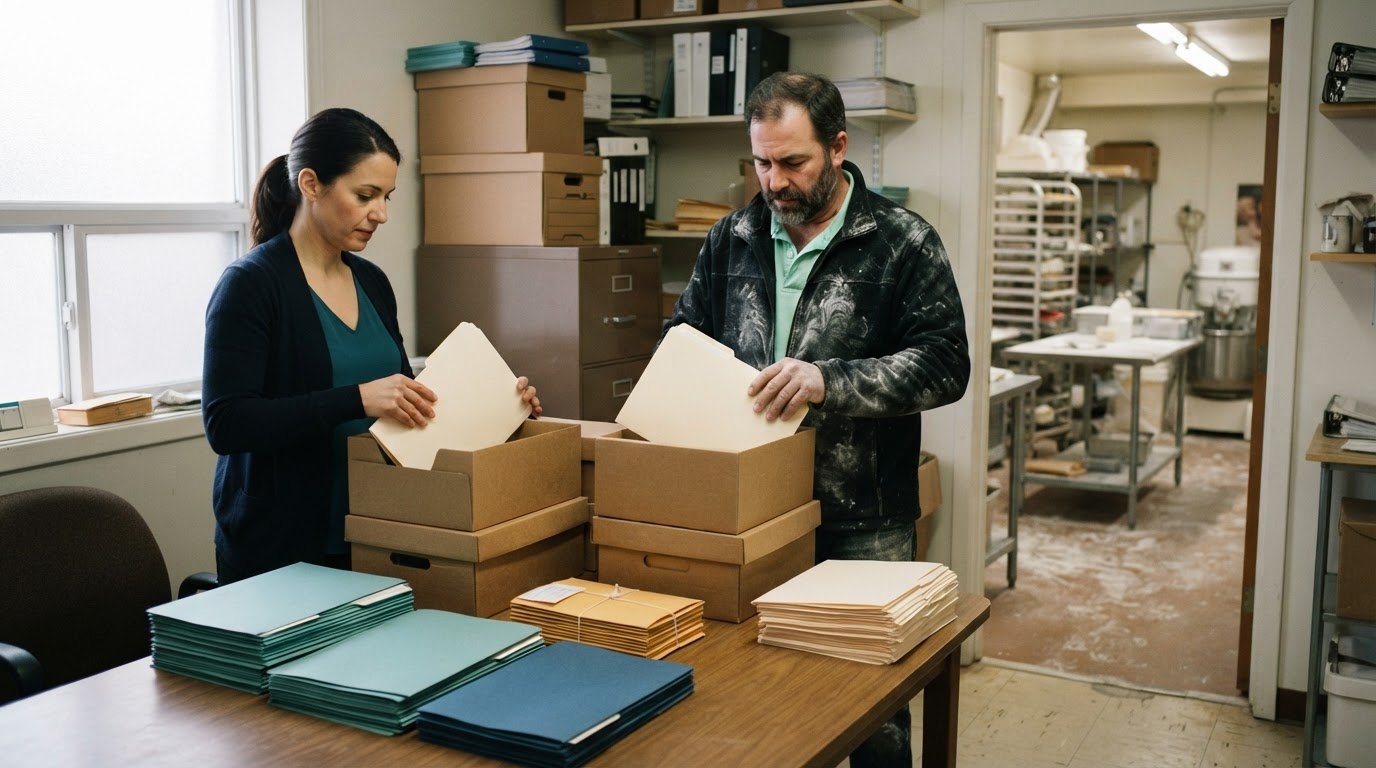
Six years is the standard starting point for business tax records in Canada. The CRA requirements for business records generally mean keeping important documents for six years from the end of the last taxation year, the annual period used to calculate tax, to which they relate, according to the Canada Revenue Agency. Some records may need to be kept longer if an audit, appeal or asset-related matter is still ongoing.
It’s understandable to want a clear date for clearing out old files. But the retention period is only part of the picture: records also need to support reported amounts and remain accessible if the CRA asks to review them.
This article explains how the six-year period works, which records to retain, and how to organize paper and digital files. It also covers what businesses may need to provide the CRA and what can happen when supporting documents are missing, including the risk that an expense claim may be rejected during an audit. A clear system makes recordkeeping easier to manage.
Key Takeaways
- Build a clear filing system for invoices, receipts, payroll documents and tax records so supporting evidence is easy to retrieve.
- Digital records can work when they remain accurate, accessible and securely backed up. Keep exported files readable when changing accounting systems.
- Check whether asset-related or corporate records need to be kept beyond routine tax documents before disposing of old files.
- Be prepared to provide records that support the amounts reported on a Canadian tax return if the CRA requests them.
- The CRA’s Information Circular IC78-10R5 describes a fine of not less than C$1,000 on summary conviction (a court decision finding someone guilty) for failing to keep adequate records or provide them, according to the Canada Revenue Agency.
Tax Records Retention Periods in Canada - How Long Should You Keep Them?
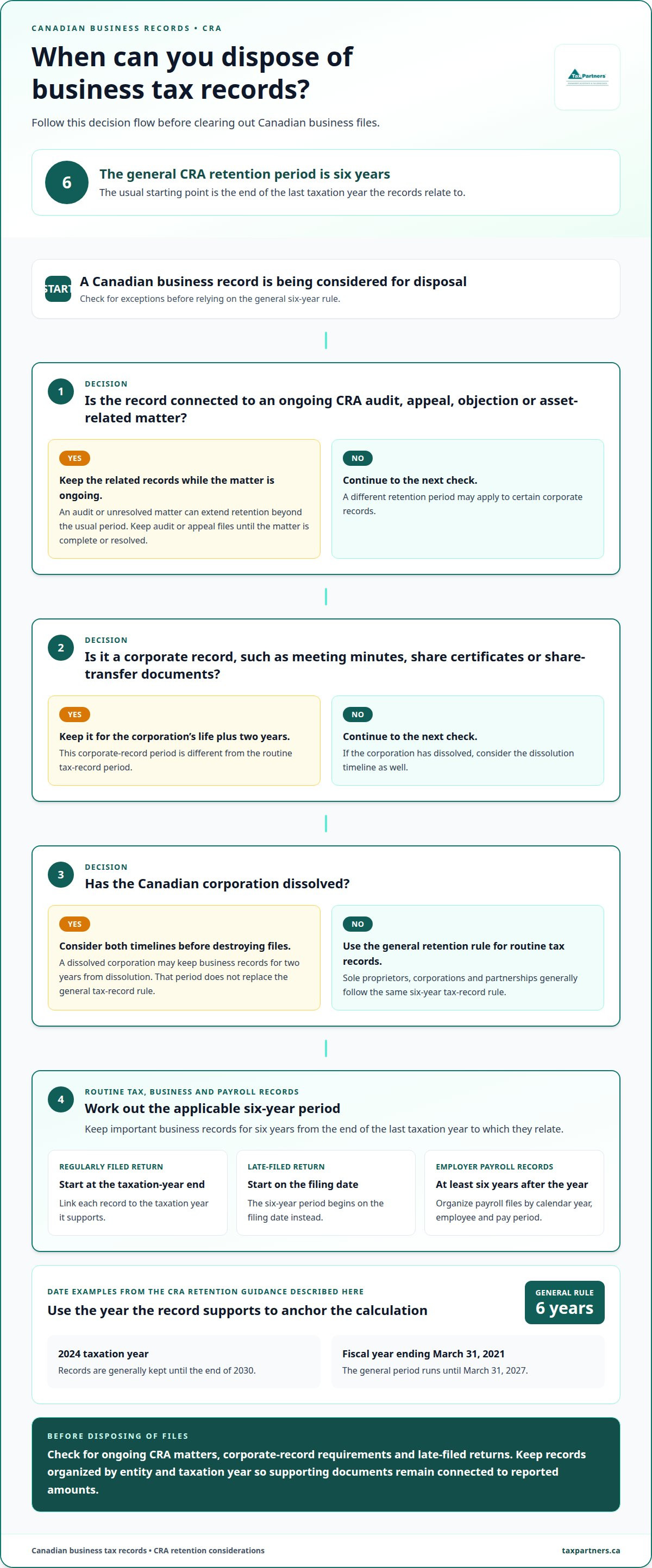
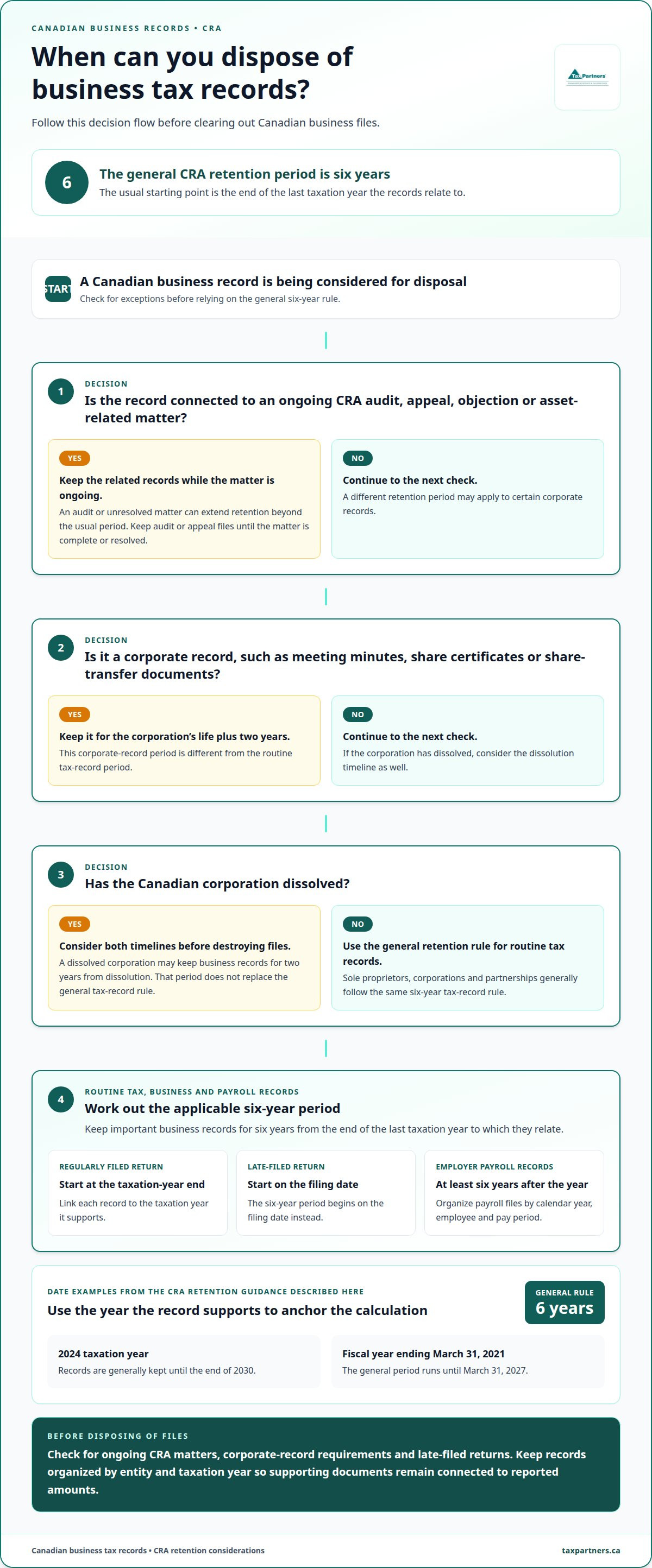
In Canada, the general retention period for important business records is six years. The starting point usually depends on the taxation year the records support.
The General Six-Year Retention Rule
The Canada Revenue Agency generally requires businesses to retain important records for six years from the end of the last taxation year to which they relate. These include tax documents such as invoices, receipts, financial statements, and payroll records.
For example, records related to a 2024 taxation year are generally kept until the end of 2030. If a Canadian tax return is filed late, the six-year period begins on the filing date instead. That distinction can change the disposal date, so connect each record to its tax year and return.
A CRA audit or unresolved objection can affect when you may dispose of records. Keep related files until the audit or matter is complete, even if the usual retention period has passed.
Keeping Records After Dissolution
A dissolved Canadian corporation may keep its business records for two years from its dissolution date. This post-dissolution period does not replace the general retention rule for tax records.
For example, if a corporation dissolves while its records are still within the usual six-year period, consider both timelines before destroying files. Keep records connected to an audit or appeal until the matter is resolved.
Corporate records can have a different retention period. Minutes of director and shareholder meetings, share certificates, and share-transfer documents must be kept for the corporation’s life plus two years.
Retention by Business Type
Sole proprietors, corporations, and partnerships generally follow the same six-year tax-record retention rule in Canada. The difference is in the records each structure creates and needs to preserve to support reported income and expenses.
A sole proprietor should link business records to the relevant tax year. A corporation should also retain records tied to its fiscal year, while a partnership needs records supporting the business figures reported by its partners.
For a corporation with a fiscal year ending March 31, 2021, the general period runs until March 31, 2027. Keep records organized by entity and taxation year, rather than mixing files across businesses or owners.
Payroll Records for Employers
Canadian employers must keep paper and electronic payroll records for at least six years after the year to which they relate. This includes payroll files connected to employer reporting and payments.
Organize payroll records by calendar year, employee, and pay period. This makes it easier to connect payroll figures to the relevant year and retrieve supporting documents if the CRA requests them.
Digital storage is permitted when records remain accurate, accessible, and securely backed up. Store payroll files so CRA officials can inspect, audit, and copy them on request. The key is practical access, not a particular storage location.
Organizing and documenting business records
A consistent filing system links each business transaction to its supporting documents. Clear organization also helps keep income and expenses traceable when preparing tax information or responding to a CRA request. Applying the CRA requirements for business records starts with making those links easy to follow.
Organizing Business Tax Documents
Organize business tax documents by taxation year, record type, and business activity. This makes it easier to match an invoice or receipt to the amount in your books and find the evidence behind a reported figure.
For example, separate folders for sales, operating expenses, payroll, GST/HST records, financial statements, and contracts can make files easier to retrieve. Use consistent labels that identify the year and transaction, and keep records for different businesses or entities separate.
Digital records are acceptable when they remain accurate, accessible, and securely backed up. If your business changes accounting software or service providers, export old records in a readable format so the required tax information remains available.
Records may be kept in English, French, or both. Back up electronic files, and arrange folders so the original document and related bookkeeping entry are easy to locate together. This practical approach brings the CRA requirements for business records into daily practice.
Income and Expense Supporting Documents
Income records should show the amount received, the date, and the source. Contracts, receipts, bank deposit slips, and sales invoices can support business income by showing how a transaction arose and how much the business received.
Expense documents should describe what the business bought and identify the purchase date, GST/HST paid, and the seller or supplier’s name and address. For a Canadian business purchase of C$100 or more before tax, the receipt should also include the seller’s business number if the seller is a GST/HST registrant.
Keep each supporting document with its accounting entry. For instance, a sales invoice and payment record can help explain a deposit, while a supplier receipt can substantiate an expense. Missing documents may leave a business unable to support an expense claim during a CRA audit.
Make retrieval part of your document-management process. Record the transaction date and category, preserve the original file, and use a consistent file name that identifies the document without relying on memory.
- Store sales invoices with related contracts or payment evidence.
- File purchase receipts with the expense category and bookkeeping entry.
- Keep payroll, GST/HST, and financial statement records in distinct folders.
- Back up digital files and retain readable exports when systems change.
When records also inform broader financial decisions, discuss your financial planning needs with Tax Partners.
How Long should Records be Kept?
Destroying tax records before the applicable retention period ends requires written permission. In Canada, a business must obtain that permission from the director of the relevant tax services office before destroying records early. The CRA may also require records to be kept beyond the usual six-year period, so an approaching disposal date does not settle every case.
Start by identifying the taxation year each document relates to and calculating its retention period. The general period is six years from the end of the last taxation year to which the records relate.
For a late-filed return, the period begins on the filing date. The disposal date can therefore depend on both the tax year and when the return was filed.
Early destruction is different from disposal after the retention period. If a fire, storage constraint, or system change creates pressure to destroy records sooner, keep the affected files intact while seeking written permission from the appropriate director. An informal conversation or planned application is not approval: obtain permission before destroying the records.
Several situations can extend the practical retention period. Keep records connected to a CRA audit until it is complete, even if more than six years have passed. Keep records tied to an objection or appeal until the matter is resolved and the time for a further appeal has passed.
Asset records also follow a different timeline. Keep documents for capital property, business assets such as buildings or investments, while the business owns the asset, then retain them for six years after the sale. Keep purchase records for an investment property until it is sold, as they help calculate the capital gain or loss, the profit or loss when the property is sold, on disposition.
Before disposing of a file, separate routine tax documents from records involving property, audits, objections, or appeals. For example, an ordinary expense receipt may follow its tax-year period, while purchase documents for a long-held building remain relevant through its sale and the following retention period.
- Identify the taxation year and filing date tied to each record.
- Keep audit and appeal files until their proceedings and appeal periods end.
- Retain capital-property documents while the asset is owned and for six years after its sale.
- Obtain written permission before destroying records early.
A disposal schedule can record the document category, related year, filing date, and earliest eligible destruction date. Flag audit, appeal, and asset files separately, then review those flags before approving disposal. This simple control helps prevent a routine clean-out from removing records the CRA may still require.
Providing records to support tax returns
The CRA may request records supporting figures reported on a Canadian business tax return. The CRA requirements for business records include making requested documents available to officials for inspection, audit, and copying. Respond by the deadline in the CRA’s request; the applicable timing depends on that communication.
Use the return as a guide when assembling evidence. Match each reported amount to source documents such as sales invoices, receipts, bank statements, payroll records, GST/HST records, and financial statements. For example, a corporation should be able to link reported sales to invoices and related deposits.
Keep records that explain how amounts were calculated, not just summary totals. An expense ledger entry is easier to support when its receipt identifies the purchase and supplier. Clear links help CRA officials follow a transaction from the source document to the reported figure.
A request may cover particular transactions, periods, or record types. Read its scope carefully, then gather documents that address each item.
Keep originals and related files together, and retain an organized copy of what you provide. This creates a clear response record without changing or replacing source documents.
Late-filed returns affect record retention. For a Canadian return filed late, the six-year period begins on the day it is filed. Keep supporting documents for that return throughout the resulting period, rather than calculating disposal from the taxation year-end alone.
An objection or appeal also affects when related records can be disposed of. Keep the files until the matter is resolved and the time for a further appeal has passed, and never for less than the six-year period. For example, preserve the return, calculations, invoices, and correspondence supporting the disputed amounts together as one case file. A corporation should also identify related business records by fiscal year.
These CRA requirements for business records make a consistent response process valuable when a request arrives:
- Record the request date and its stated response deadline.
- List each document or record category requested.
- Match requested items to the tax return and supporting files.
- Provide records in a readable format and retain a copy of the response.
For disputes involving a tax assessment, organized evidence can help explain the business’s position. Records related to an objection or appeal should remain accessible throughout the process; tax appeal and notice-of-objection support can help address that next step.
Consequences of inadequate records
Missing or incomplete records can make it difficult to support amounts on a Canadian tax return. During an audit, the CRA may reject a business expense claim if its supporting documents are missing. For example, a bookkeeping entry may not adequately support an expense without a receipt identifying the purchase.
The consequences can go beyond a single expense. If invoices, receipts, or bank records do not explain reported income, the business may struggle to show how it arrived at its figures. Organizing documents by the year they relate to helps link each amount to its evidence and makes gaps easier to spot.
Failure to maintain adequate records or provide them can also carry a penalty. The Canada Revenue Agency’s Information Circular IC78-10R5 describes a fine of not less than C$1,000 on summary conviction for failing to keep adequate records or provide them.
Recordkeeping duties apply to businesses and other persons required to pay or collect taxes or other amounts. A government request may require documents to be made available for inspection, audit, or copying. If a business cannot retrieve readable files, missing or inaccessible documents can leave reported amounts unsupported.
Digital systems need safeguards, too. A damaged device, lost account access, or software change can leave a business without records needed to explain a transaction. Secure backups and readable exports help preserve documents as systems change, while consistent file names make retrieval more reliable.
Review records regularly to identify gaps before filing or responding to a CRA request. A practical review can flag issues such as:
- An expense entry without a receipt or clear description.
- A sales figure without invoices or related deposit records.
- A payroll amount that cannot be connected to its supporting files.
- A tax document filed under the wrong business or year.
When a gap appears, identify the affected transaction and look for its original evidence or related records. For example, a sales invoice and corresponding bank deposit may together clarify a recorded amount. Keep recovered documents with the relevant entry instead of relying on an unsupported total.
Timely attention matters because records can support both a tax return and a later CRA review. A clear register, accurate entries, and accessible source documents help explain how the business reported income and expenses. Discuss support for your business records if gaps are making compliance difficult.
Tax Partners
Tax Partners helps Canadian businesses bring tax reporting and recordkeeping into a clear, consistent process. Its Canadian Accounting & Tax Services and Bookkeeping and Payroll Services support businesses that need help organizing records, maintaining books, or preparing tax information.
Consider support if records are difficult to reconcile, payroll files need better organization, or a CRA request raises questions about which documents support reported amounts. A well-managed records system makes it easier to trace figures back to invoices, receipts, and other supporting documents.
Contact Tax Partners to discuss support for your business records and accounting needs.
Make recordkeeping part of your next business decision
A dependable records process should keep pace as your business changes. New revenue streams, staffing changes, or shifts in financial management can affect which documents your team needs to organize and retrieve. Treating recordkeeping as part of regular financial planning helps keep the process aligned with how your business operates.
The CRA requirements for business records are easier to manage when responsibilities and filing practices are clear. If your current system is difficult to maintain or your business is changing, a tailored review can help identify a practical way forward. Tax Partners can help you address recordkeeping alongside your broader accounting and tax work.
Take the next step toward a more workable process. Contact Tax Partners to discuss your business records and how to support your ongoing accounting needs.
Frequently Asked Questions
Can You Keep Receipts and Records Digitally?
Yes, the CRA allows Canadian businesses to store tax records digitally. Include digital copies in the same filing system as the related bookkeeping entries, rather than keeping them in a separate archive. This helps connect a receipt to its transaction and makes it easier to understand what the file supports when reviewing business accounts.
Can my bookkeeper or accountant keep my records for me?
A bookkeeper or accountant can help manage records, but the business remains responsible for maintaining them. Set clear arrangements for access and file handover if the bookkeeping relationship changes. For example, identify who retains accounting data and supporting documents, and ensure the business can retrieve them without depending on a former service provider’s account or software.
Does an inactive or holding company still have to keep records?
An inactive or holding company should not treat inactivity as permission to discard records. A business required to pay or collect taxes or other amounts must keep books and records, and documents may still support its assets, filings, or transactions. For a dissolved corporation, the post-dissolution period is separate from the retention period for tax records.
How long do you need to retain records for CRA?
For Canadian tax records, the general period is six years from the end of the last taxation year to which they relate. For a late-filed return, the period starts on the filing date. Before disposing of records, consider whether an audit, objection, appeal, or capital asset means the relevant files should be kept longer.
What Counts as a Business Record?
A business record helps explain a business’s transactions, tax reporting, or corporate decisions. The right records depend on the activity: a service contract may explain why revenue was earned, while a board resolution may document a corporate decision. Keep records in a form that preserves their meaning and connection to the activity they document.
What Does the CRA Require?
The CRA requires businesses subject to Canadian tax recordkeeping duties to keep books and records supporting their tax-related activities. Protect records from loss or damage and make them available when requested. The practical test is whether you can explain how an entry arose and link it to the underlying transaction without relying on memory or unsupported summaries.
What Happens If You Do Not Keep Records Long Enough?
If a business cannot document an expense claim, the CRA may reject it during an audit. Missing records can also make it harder to explain how reported amounts were calculated. For example, if a transaction’s source document is missing, the business may struggle to show why the entry belongs in its accounts.
What business records must Canadian businesses keep for the CRA?
Keep records that explain the business’s income, expenses, tax filings, and relevant corporate activity. The specific documents depend on the transactions and business structure. To assess a file, ask whether it helps explain what happened, who was involved, and how the transaction was recorded in the business accounts.

Article by
Mahad Mohamed
Mahad Mohamed is an accountant and the CEO of Tax Partners, with over 26+ years of Canadian and international tax and accounting experience. His expertise includes corporate reorganization, cross-border tax structuring (Canada & US), tax disputes, CRA audits, and tax planning for small owner-managed private corporations. Most recently, Mahad is a pioneer in Canadian crypto taxation and founded Block3 Finance.
Previously, Mahad worked for the Canada Revenue Agency (CRA), Big4 accounting firms, and served as a Rulings Officer for the Federal Tax Authority of the UAE before acquiring Tax Partners in 2014.
Tax Partners has 44 full-time accountants and over 18,400+ clients.
Disclaimer
This article provides general information only and is current as of its publication date. It has not been updated and may be out of date. It does not constitute legal advice and should not be relied upon as such. Every tax situation is unique and may differ from the examples discussed in this article. If you have specific questions, you should seek the advice of our accountants for your unique circumstances. Book a FREE Initial Consultation Today!
Frequently Asked Questions
Can You Keep Receipts and Records Digitally?
Yes, the CRA allows Canadian businesses to store tax records digitally. Include digital copies in the same filing system as the related bookkeeping entries, rather than keeping them in a separate archive. This helps connect a receipt to its transaction and makes it easier to understand what the file supports when reviewing business accounts.
Can my bookkeeper or accountant keep my records for me?
A bookkeeper or accountant can help manage records, but the business remains responsible for maintaining them. Set clear arrangements for access and file handover if the bookkeeping relationship changes. For example, identify who retains accounting data and supporting documents, and ensure the business can retrieve them without depending on a former service provider’s account or software.
Does an inactive or holding company still have to keep records?
An inactive or holding company should not treat inactivity as permission to discard records. A business required to pay or collect taxes or other amounts must keep books and records, and documents may still support its assets, filings, or transactions. For a dissolved corporation, the post-dissolution period is separate from the retention period for tax records.
How long do you need to retain records for CRA?
For Canadian tax records, the general period is six years from the end of the last taxation year to which they relate. For a late-filed return, the period starts on the filing date. Before disposing of records, consider whether an audit, objection, appeal, or capital asset means the relevant files should be kept longer.
What Counts as a Business Record?
A business record helps explain a business’s transactions, tax reporting, or corporate decisions. The right records depend on the activity: a service contract may explain why revenue was earned, while a board resolution may document a corporate decision. Keep records in a form that preserves their meaning and connection to the activity they document.
What Does the CRA Require?
The CRA requires businesses subject to Canadian tax recordkeeping duties to keep books and records supporting their tax-related activities. Protect records from loss or damage and make them available when requested. The practical test is whether you can explain how an entry arose and link it to the underlying transaction without relying on memory or unsupported summaries.
What Happens If You Do Not Keep Records Long Enough?
If a business cannot document an expense claim, the CRA may reject it during an audit. Missing records can also make it harder to explain how reported amounts were calculated. For example, if a transaction’s source document is missing, the business may struggle to show why the entry belongs in its accounts.
What business records must Canadian businesses keep for the CRA?
Keep records that explain the business’s income, expenses, tax filings, and relevant corporate activity. The specific documents depend on the transactions and business structure. To assess a file, ask whether it helps explain what happened, who was involved, and how the transaction was recorded in the business accounts.