Cost of Hiring a Bookkeeper in Canada: Pricing Factors

A bookkeeping rate alone won’t tell you the full cost of hiring a bookkeeper in Canada. The total depends on the work required, transaction volume, business complexity, and whether you hire an employee or use an external bookkeeper.
It’s understandable to want a clear figure before making a decision. But comparing hourly rates alone can be misleading: the scope of work and hiring arrangement affect both your budget and your responsibilities.
This article explains the main factors that shape bookkeeping costs across Canadian provinces and cities, including the services your business needs and the level of support required. It also outlines how hiring arrangements connect to labour and tax considerations in Canada, so you can assess the options with a clearer view of what each involves.
Key Takeaways
- Compare bookkeeping quotes by the work covered, not just the billing method or headline rate.
- Consider how location, business complexity and the level of support you need can shape the scope of the work.
- Map your transaction volume and required services before choosing a freelance, outsourced or in-house arrangement.
- Clarify which routine tasks are included in a package and which may be handled separately.
- Account for payroll, goods and services tax/harmonized sales tax (GST/HST) support and year-end preparation when planning your bookkeeping needs.
Bookkeeping prices by province and city in Canada
Regional pricing means differences in bookkeeping quotes across locations. There isn’t one rate that applies throughout Canada. A quote reflects the work, delivery method, and business needs. A business in a major urban centre and one in a rural community may receive different quotes, especially when in-person support is required. Location alone, however, doesn’t determine the fee.
A local labour market is the pool of professionals available in an area. In-person work may involve travel, meetings, or handling documents, all of which can affect a quote’s scope. With remote support, proximity may matter less, particularly when you share records digitally and communicate online.
Provincial context can affect a business’s administrative and recordkeeping needs. Different sales tax processes may influence which records a bookkeeper organizes and what reporting support is needed. The province itself doesn’t set the fee. Focus on the records, reconciliations, and tax-related bookkeeping tasks your business requires.
City-level differences may also reflect how a service is delivered. Regular on-site meetings can require a different arrangement from a remote workflow. When comparing quotes, describe the same meeting expectations and document-sharing process to distinguish location-related costs from differences in the work included.
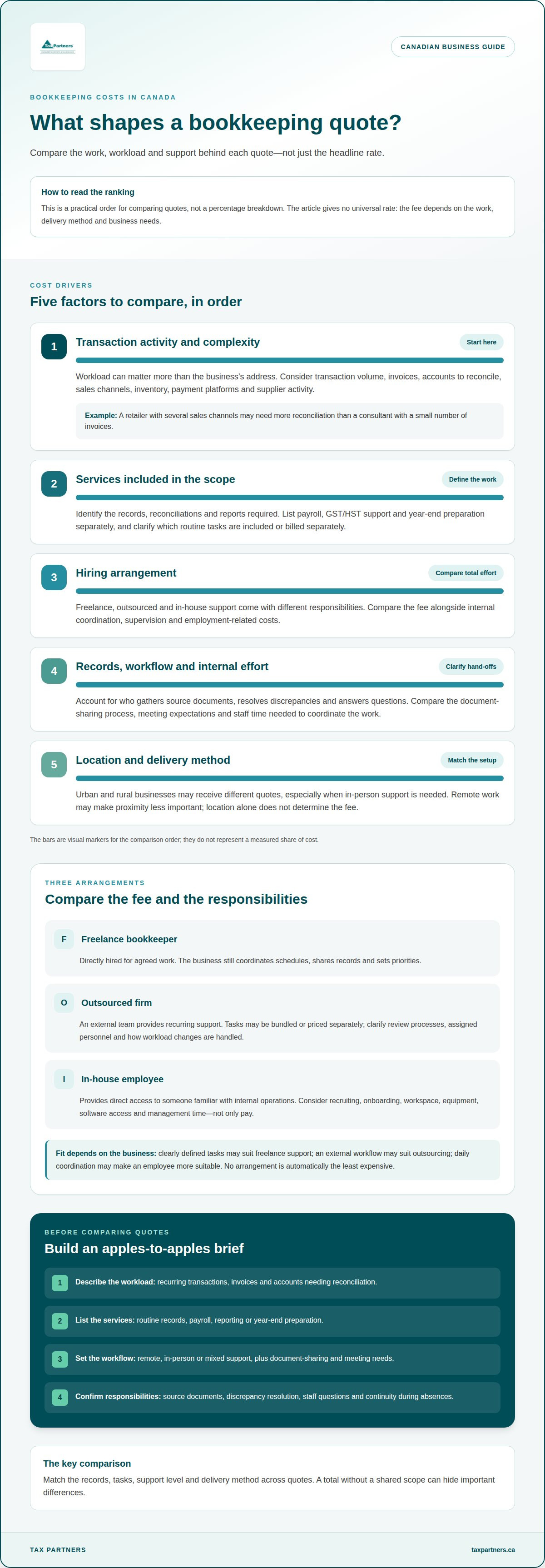
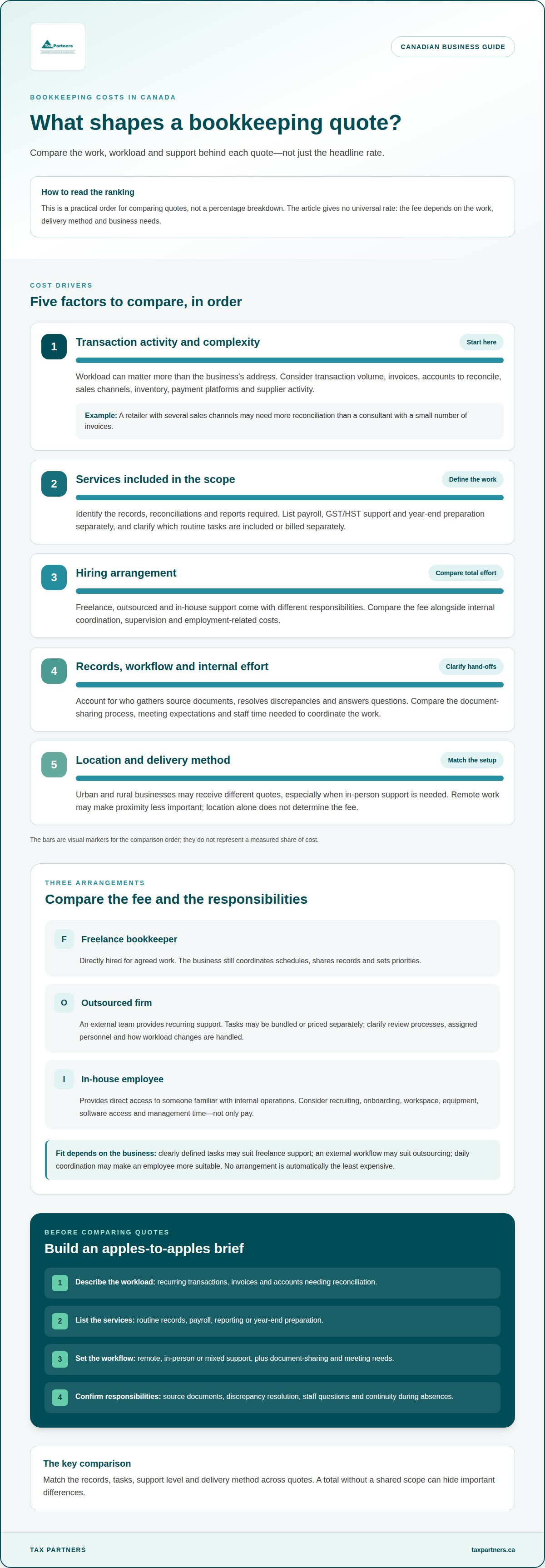
Business activity can matter more than its address. A retailer with several sales channels, for example, may need more reconciliation than a consultant with a small number of invoices. Inventory records, payment platforms, and supplier activity also shape the workload. These details make for a more useful comparison than location alone.
Use this location-based comparison process:
- Set the service area. Note where the business operates and whether it has multiple locations.
- Describe the workflow. Specify remote, in-person, or mixed support needs.
- List required tasks. Separate routine records from payroll or tax-related bookkeeping.
- Match the scope. Compare quotes covering the same records, reports, and meeting needs.
Matching the scope is essential. Two businesses in the same area may receive different quotes because their records and support needs differ. Comparing totals without matching tasks can hide those differences. Define the work before deciding whether location has materially affected a quote.
Businesses operating across provincial boundaries may need consistent records from multiple locations. Coordinating transactions and documents can affect the bookkeeping scope. Understanding Canadian tax considerations can also help clarify which records need attention.
Ultimately, a quote depends on location, in-person requirements, transaction activity, record quality, and service scope. Describe these factors clearly when requesting a quote. That gives the estimate a practical basis and makes comparisons more meaningful than broad assumptions about urban or rural pricing.
Freelance, outsourced, and in-house costs in Canada
A freelance bookkeeper is hired directly to do agreed work. A small business might engage one to organize monthly transactions. The arrangement covers the agreed services, not an employee’s ongoing presence.
Costs depend on workload, task complexity, and supervision. Direct communication can make adjustments straightforward, but the business still coordinates schedules, shares records, and sets priorities, all of which take staff time.
Outsourced bookkeeping assigns recordkeeping to an external firm. The business works with an outside team for recurring support, with tasks bundled or priced separately according to the firm’s scope.
A quote may reflect review processes, software workflows, and assigned personnel. Clarify how routine questions and workload changes are handled. A clear handoff can reduce internal coordination, while unclear responsibilities may add staff work.
An in-house bookkeeper is an employee who works within the business. This option gives staff direct access to someone familiar with internal operations, but the total employment cost includes more than pay.
Consider recruiting, onboarding, workspace, equipment, software access, and management time. Workload matters too. Seasonal activity may leave capacity unused during quieter periods, while daily recordkeeping needs may make an ongoing internal role more suitable.
Compare each arrangement by listing costs and responsibilities together. A consultancy with steady invoices, for example, may need a different setup from a retailer handling sales and supplier records.
Include who prepares source documents, resolves discrepancies, and communicates with staff. Consider continuity during absences and changes in workload. These practical details reveal differences that a fee alone can’t show.
Use this checklist to structure an apples-to-apples comparison:
- Work volume: Estimate recurring transactions, invoices, and accounts requiring reconciliation.
- Service scope: Identify whether payroll, reporting, or year-end preparation is needed.
- Availability: Decide whether support must be daily or periodic.
- Internal effort: Include staff time spent gathering documents and answering questions.
- Continuity: Clarify how work proceeds during absences or workload changes.
These factors help distinguish a low fee from a suitable arrangement. Freelance support may fit clearly defined tasks, while outsourcing may suit businesses seeking an external workflow.
An employee may be a better fit when daily coordination is central. No arrangement is automatically least expensive. The cost of hiring a bookkeeper in Canada depends on the service scope and your internal resources.
For a tailored discussion of your bookkeeping needs, contact the team with your workflow and required tasks.
What factors affect bookkeeping fees, such as transaction volume and services required?
Transaction volume is the number of financial entries handled during a period. A shop with frequent card sales creates more entries than a consultant sending occasional invoices. Each sale, supplier bill, refund, or deposit may need to be recorded and reviewed. More activity can mean more time matching records and resolving differences. The number of entries matters, but so does their complexity.
Reconciliation means matching account records against statements. This can include comparing a business’s bank activity with its recorded transactions. Several payment platforms or business accounts create separate records to review. Missing receipts and unclear descriptions may also require follow-up. Complete, organized documents make the work more straightforward than scattered files.
Service scope means the specific bookkeeping tasks included in an engagement. Basic transaction recording differs from a broader arrangement that includes account reconciliation, financial reports, payroll records, or year-end preparation. For example, a Calgary business that wants regular reports needs a different scope from one seeking transaction entry alone. A clear task list helps show what the fee covers.
Business complexity describes the workflows that affect its records. A retailer may have inventory, online sales, refunds, and supplier bills, while a professional service firm may mainly track invoices and expenses. Multiple locations, currencies, or payment systems can add review and coordination. The underlying activity, rather than the business label, shapes the bookkeeping effort.
Record quality refers to how complete and understandable the source documents are. Labelled invoices and receipts give a bookkeeper clearer information. Unmatched deposits or missing documents may require extra communication. Catch-up work means organizing records for earlier periods. When records fall behind, reviewing and correcting them can add work beyond routine bookkeeping.
Quotes may reflect different drivers, including:
- Transaction volume: Sales, expenses, refunds, and transfers create entries to review.
- Accounts involved: Multiple bank or payment accounts need separate reconciliation.
- Service scope: Reporting or payroll records expand the agreed tasks.
- Document readiness: Incomplete receipts may require follow-up and clarification.
- Business workflows: Inventory or several sales channels can complicate records.
- Timing needs: Frequent reporting may require a different work schedule.
Compare quotes using these factors, not a single fee alone. Two businesses with similar sales, for instance, may have different numbers of accounts, receipts, and reporting needs. Ask for the tasks, reporting frequency, and treatment of catch-up work to be clearly described. That gives you a practical basis for understanding the proposed scope.
The cost of hiring a bookkeeper in Canada reflects both record volume and the work required around it. A concise description of your accounts, documents, and desired outputs helps define that work. It also makes it easier to identify routine tasks and those needing separate attention.
What bookkeeping services are included in common Canadian pricing packages
A bookkeeping package is a defined set of recurring recordkeeping tasks. In Canada, package contents vary by provider and business needs. A Toronto consultant may need straightforward transaction records. An Ottawa retailer may need extra support for sales, supplier bills, and inventory records. Compare included tasks, not package names alone.
Transaction recording means entering business income and expenses into accounting records. A bookkeeper may organize sales, purchases, deposits, and receipts for a Calgary business. The work can include assigning transactions to appropriate categories. Clarify whether the package covers all accounts or only selected bank and card accounts.
Account reconciliation means matching recorded activity against statements. For a Vancouver business, this may involve comparing its bookkeeping records with bank and credit card statements. The process helps identify missing entries, duplicate transactions, or unexplained differences. Ask whether the package includes reconciliation for each account and how often it occurs.
Accounts payable tracking means organizing bills the business must pay. Accounts receivable tracking means monitoring amounts customers owe. A Winnipeg wholesaler may need both to follow supplier invoices and customer payments. Some packages record these items, while others may also prepare payment lists or follow overdue balances. Confirm the exact tasks covered.
Financial reporting means preparing summaries that help explain business activity. Common examples include income and expense reports, plus a balance sheet showing assets and obligations. A small business owner in Halifax might use these records to review cash flow and operating results. Ask which reports are included and how often they’re prepared.
Document organization means arranging receipts, invoices, and statements for bookkeeping. A package may include digital filing or document collection, but processes vary. One workflow may use uploaded receipts, while another relies on records supplied in organized batches. Clarify who gathers documents and how missing information is handled.
Packages may also specify a reporting schedule, such as recurring updates or periodic summaries. That schedule affects how quickly you see your records and how often questions arise. A retailer with frequent sales may value regular reconciliation, while a consultant with fewer transactions may prioritize clear summaries and organized year-end records.
Before comparing packages, use this scope checklist:
- Records: Identify which bank, card, and payment accounts are covered.
- Tasks: Separate transaction entry, reconciliation, and bill tracking.
- Reports: Name the summaries required and their delivery schedule.
- Documents: Clarify how receipts and invoices reach the bookkeeper.
- Boundaries: Note which work falls outside routine bookkeeping.
Some businesses also need coordinated accounting support alongside organized bookkeeping records. A package description should distinguish ongoing recordkeeping from additional accounting tasks. The cost of hiring a bookkeeper in Canada depends partly on that scope. The price depends on the case and is provided after a quote request, with service requirements and record volume shaping the quote.
Separately, the Canadian House of Commons has 343 members elected in electoral districts. This illustrates a defined structure, while bookkeeping packages likewise should be assessed by the specific tasks they include, rather than by a label alone. Confirming scope helps clarify what recurring records and reports a business can expect.
What extra fees do Canadian bookkeepers charge for payroll, GST/HST, and year-end work
Payroll processing means recording employee pay and related transactions. A Canadian bookkeeper may handle payroll records separately from routine business entries. The scope can include organizing employee information, recording pay details, and maintaining related records. A business with changing hours or commissions may need more review than one with steady pay.
Payroll remittances are payments of amounts withheld from employee pay. The bookkeeping work may include preparing records that support these payments. Clarify whether the arrangement includes calculations, payment preparation, submission, or recordkeeping only. Those are distinct tasks. An employer in Ontario, for example, should know who handles each step.
GST/HST bookkeeping means organizing records for the goods and services tax or harmonized sales tax. The work may include tracking tax amounts shown on sales and purchase records. Businesses in different provinces may have different sales tax records to organize. Clearly define the bookkeeper’s role and the reporting support included.
GST/HST reconciliation means comparing tax-related records with the business’s recorded transactions. This may involve reviewing invoices, receipts, and sales records for consistency. Missing documents or unclear tax coding can require extra follow-up. Ask whether the quoted scope covers record organization only or also preparation support for GST/HST reporting.
Year-end bookkeeping means organizing records for the close of a financial year. It can include completing reconciliations, reviewing account balances, and preparing organized records for an accountant. Unresolved transactions may require extra cleanup before year-end files are ready. Tax return preparation is separate work, so distinguish it from bookkeeping support.
Extra charges may arise when tasks fall outside the agreed recurring scope. Examples include processing payroll records, organizing GST/HST documentation, or correcting earlier entries. Compare the stated inclusions with your actual needs. A café with employees, for instance, may need payroll support, while a solo consultant may prioritize year-end record organization.
Use these questions to define the extra work:
- Payroll: Does the scope cover records, calculations, remittances, or submissions?
- GST/HST: Is the work limited to tracking, or does it include reporting support?
- Year-end: Are reconciliations and organized handoff records included?
- Cleanup: How are corrections for earlier periods handled?
- Changes: What happens when employee counts or transaction activity shift?
For a specific engagement, the fee depends on the scope and is provided after a quote request. The key factors are payroll complexity, tax-record volume, document quality, and year-end readiness. Discuss your payroll and bookkeeping needs to define which tasks belong in the engagement.
Tax Partners
Tax Partners helps Canadian businesses assess bookkeeping needs alongside related financial records. When payroll, reporting, and year-end preparation overlap, a coordinated view can clarify which tasks belong in the bookkeeping scope and which need separate attention.
Tax Partners’ Bookkeeping and Payroll Services support businesses with these records. The firm also provides Canadian Accounting & Tax Services when bookkeeping needs connect with broader Canadian accounting or tax work. Start with a clear picture of your transactions, existing records, and required support.
For help discussing your bookkeeping requirements, contact Tax Partners.
Make your next step clear
A useful bookkeeping arrangement should support how your business operates, not simply produce a monthly record. As your needs evolve, a clear workflow can keep financial information useful for planning and daily decisions. The cost of hiring a bookkeeper in Canada is one consideration; the arrangement should also fit your business over time.
Tax Partners offers Bookkeeping and Payroll Services alongside Canadian Accounting & Tax Services. If you’re weighing the cost of hiring a bookkeeper in Canada, consider how your bookkeeping needs connect with payroll or broader Canadian accounting work. Sharing the tasks you need covered is a practical way to start a focused discussion.
Discuss your bookkeeping needs with Tax Partners, and take the next step with a clearer view of the support your business requires.
Frequently Asked Questions
What is the average hourly rate for a bookkeeper in Canada?
There isn’t one hourly rate that applies to every Canadian business. The cost of hiring a bookkeeper in Canada depends on the work, experience required, and arrangement. A quote for transaction entry alone may differ from one covering reconciliations and payroll records. For a useful comparison, describe the same tasks and expected workload to each bookkeeper, then compare what each quoted rate includes.
How much does a full-time bookkeeper cost in Canada per year?
A full-time bookkeeper’s annual cost depends on compensation and associated employment expenses. Consider more than salary: recruiting, onboarding, equipment, software access, supervision, and any benefits or employer payroll costs can affect the overall budget. To estimate the cost of an in-house role, list these expenses alongside the expected bookkeeping duties, then compare the total with external support.
What are typical monthly bookkeeping fees for Canadian small businesses?
Monthly fees depend on the recurring work agreed for the business, so one monthly amount won’t suit every Canadian small business. A company with stable activity may need a different arrangement from one with seasonal sales or occasional catch-up work. Separate regular bookkeeping from one-time cleanup, then consider whether the monthly scope still fits during busier periods. This gives you a more useful budget than relying on a generic monthly figure.
How can a Canadian small business estimate its bookkeeping budget and compare quotes?
Start by preparing a brief scope for each quote: list your accounts, records, reporting needs, and any payroll or year-end tasks. Use representative recent records so providers can assess comparable work. Then compare recurring services, excluded tasks, and how extra work is billed. Describe busy periods if your business is seasonal. These details help distinguish a lower initial quote from a better fit across the year.

Article by
Mahad Mohamed
Mahad Mohamed is an accountant and the CEO of Tax Partners, with over 26+ years of Canadian and international tax and accounting experience. His expertise includes corporate reorganization, cross-border tax structuring (Canada & US), tax disputes, CRA audits, and tax planning for small owner-managed private corporations. Most recently, Mahad is a pioneer in Canadian crypto taxation and founded Block3 Finance.
Previously, Mahad worked for the Canada Revenue Agency (CRA), Big4 accounting firms, and served as a Rulings Officer for the Federal Tax Authority of the UAE before acquiring Tax Partners in 2014.
Tax Partners has 44 full-time accountants and over 18,400+ clients.
Disclaimer
This article provides general information only and is current as of its publication date. It has not been updated and may be out of date. It does not constitute legal advice and should not be relied upon as such. Every tax situation is unique and may differ from the examples discussed in this article. If you have specific questions, you should seek the advice of our accountants for your unique circumstances. Book a FREE Initial Consultation Today!
Frequently Asked Questions
What is the average hourly rate for a bookkeeper in Canada?
There isn’t one hourly rate that applies to every Canadian business. The cost of hiring a bookkeeper in Canada depends on the work, experience required, and arrangement. A quote for transaction entry alone may differ from one covering reconciliations and payroll records. For a useful comparison, describe the same tasks and expected workload to each bookkeeper, then compare what each quoted rate includes.
How much does a full-time bookkeeper cost in Canada per year?
A full-time bookkeeper’s annual cost depends on compensation and associated employment expenses. Consider more than salary: recruiting, onboarding, equipment, software access, supervision, and any benefits or employer payroll costs can affect the overall budget. To estimate the cost of an in-house role, list these expenses alongside the expected bookkeeping duties, then compare the total with external support.
What are typical monthly bookkeeping fees for Canadian small businesses?
Monthly fees depend on the recurring work agreed for the business, so one monthly amount won’t suit every Canadian small business. A company with stable activity may need a different arrangement from one with seasonal sales or occasional catch-up work. Separate regular bookkeeping from one-time cleanup, then consider whether the monthly scope still fits during busier periods. This gives you a more useful budget than relying on a generic monthly figure.
How can a Canadian small business estimate its bookkeeping budget and compare quotes?
Start by preparing a brief scope for each quote: list your accounts, records, reporting needs, and any payroll or year-end tasks. Use representative recent records so providers can assess comparable work. Then compare recurring services, excluded tasks, and how extra work is billed. Describe busy periods if your business is seasonal. These details help distinguish a lower initial quote from a better fit across the year.