Corporate tax planning for family business transfers

A family-business transfer can qualify for capital-gains treatment only when it meets Canada’s intergenerational transfer rules. Corporate tax planning for a family business should account for the immediate transfer test, with its three-year timing requirement, or the gradual transfer test, which spans five to ten years. The rules began with Bill C-208 in 2021, and new measures were enacted in June 2024.
It’s natural to focus first on who will take over and when. But the tax treatment of a transfer can also depend on the business’s eligibility, the successor’s involvement and the ownership structure. A sound plan brings these factors together.
This guide explains how Canadian transfer rules work, when the lifetime capital gains exemption may apply, and how estate freezes and family, alter-ego and joint-spousal trusts can fit into succession and estate planning. Timing matters: planning early can preserve options, while a transfer without a clear structure can lead to avoidable tax consequences.
Key Takeaways
- Compare the immediate and gradual intergenerational transfer pathways, since each has its own timing and successor-involvement requirements.
- Assess whether the business and proposed transfer structure meet the Canadian rules before relying on capital-gains treatment.
- For qualifying small business corporation shares, the Canada Revenue Agency requires the owner or a related person to have owned the shares for at least 24 months before sale.
- Consider how an estate freeze or trust could direct future business growth, while accounting for the tax rules that apply to each structure.
- Start succession planning early enough to align tax decisions with successor readiness, family roles and the business’s long-term plans.
How do the intergenerational business transfer rules work?
Canada’s intergenerational business transfer rules can allow qualifying family transfers to receive capital-gains treatment. Corporate tax planning for family business owners brings together eligibility, timing, successor involvement and transaction structure.
Estate freezes and wealth transfer
An estate freeze fixes the current owner’s share value and directs future growth to the next generation. For example, a parent may exchange common shares for fixed-value preferred shares, then issue growth shares to successors. This can help manage the value included in the parent’s estate while preserving a role in the business. The plan also needs to account for control, share rights and retirement goals.
Reorganizations and butterfly transactions
A divisive reorganization separates business assets or operations among shareholders. A butterfly transaction is one structure used for this purpose. A family may consider it when successors will take different parts of a business rather than continue under one ownership structure. The division must reflect the assets, shareholders and intended ownership. In Ontario, land transfer tax can also be relevant when a butterfly reorganization separates a family business.
Family and arm’s-length transfers
An intra-family transfer passes ownership between related people; an arm’s-length transfer involves parties acting independently. A family sale below fair market value can still be treated as occurring at fair market value for tax purposes, affecting the seller’s proceeds and the successor’s future tax position. Qualifying intergenerational transfers may receive capital-gains treatment, but must meet specific conditions. A sale to an unrelated buyer has a different commercial context and does not use the family-transfer tests.
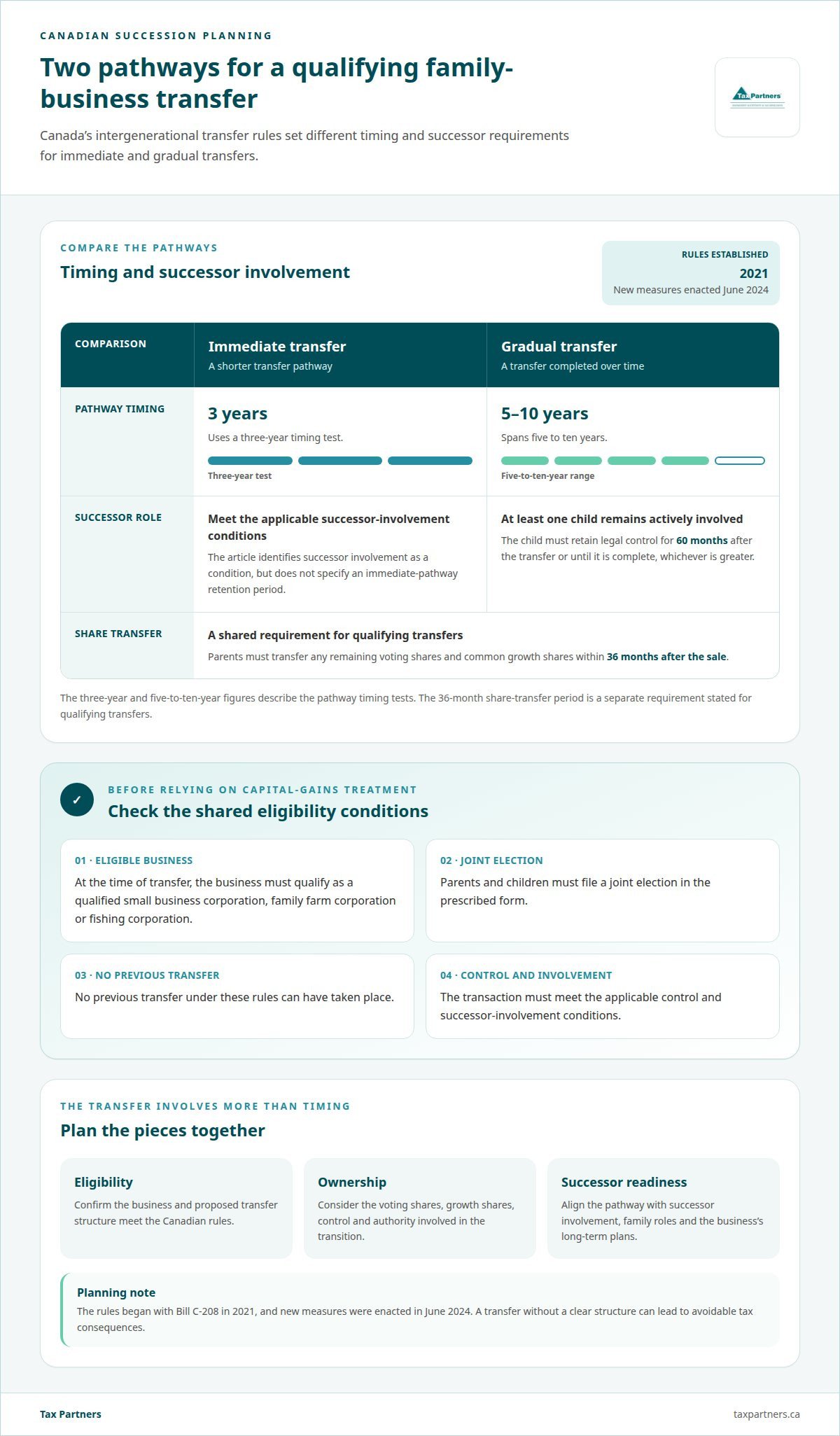
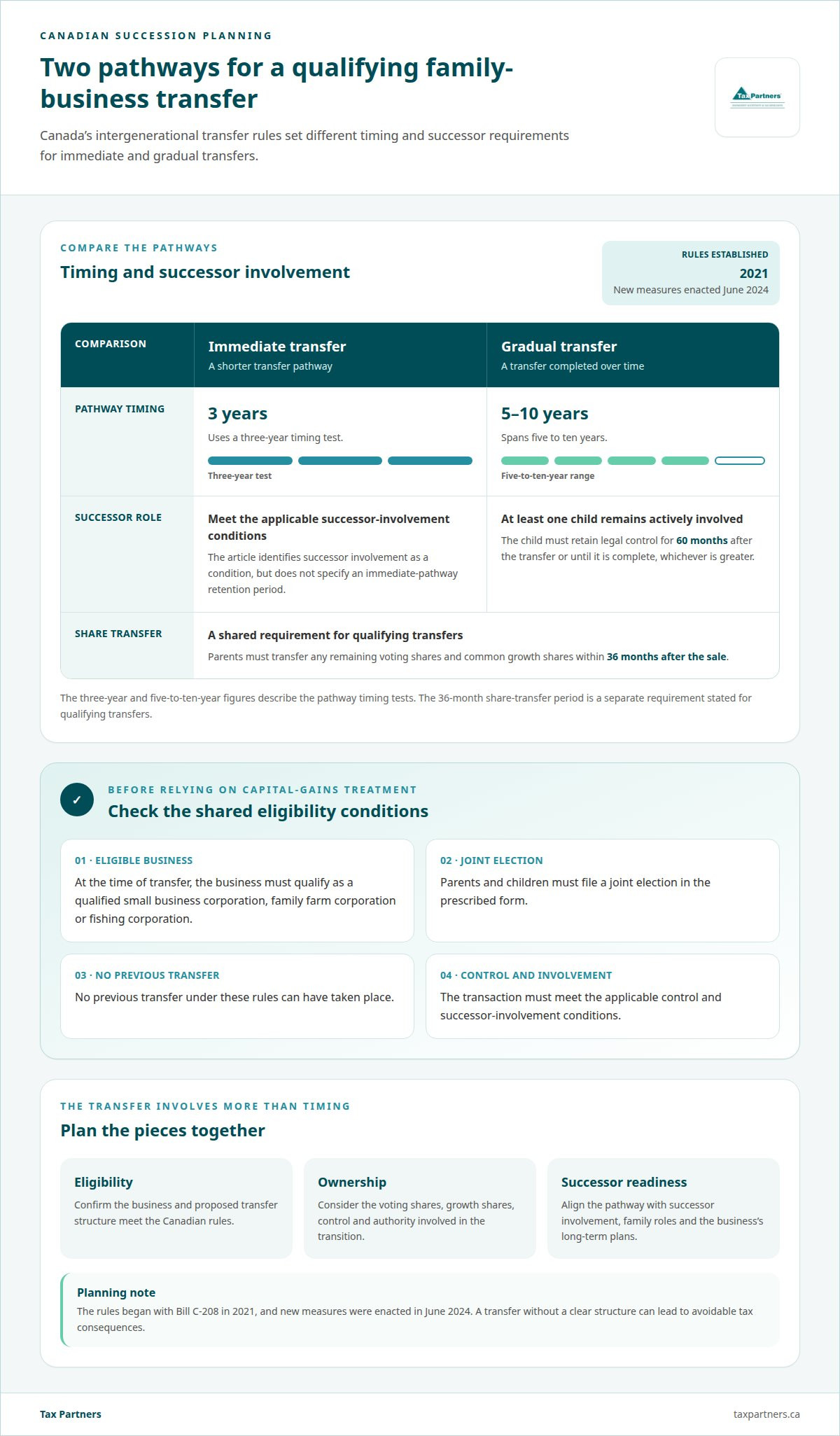
Bill C-208 established Canada’s intergenerational business transfer rules in 2021, with new measures enacted in June 2024. The rules provide immediate and gradual transfer paths with distinct timing and successor requirements. The immediate transfer test uses a three-year timing test; the gradual test spans five-to-ten years.
Eligibility is central. At the time of transfer, the business must qualify as a qualified small business corporation, family farm or fishing corporation. The parents and children must file a joint election in the prescribed form, and no previous transfer under these rules can have taken place. The transaction must also meet applicable control and successor-involvement conditions.
For qualifying transfers, parents must transfer any remaining voting shares and common growth shares within 36 months after the sale. Under the gradual pathway, at least one child must retain legal control for 60 months after the transfer or until it is complete, whichever is greater, and remain actively involved. These requirements shape ownership and authority.
Paying relatives also needs careful treatment. Canadian wages and salaries paid to family members are assessed under the CRA’s reasonableness test, comparing compensation with what a hypothetical third party would earn for similar work. Dividends to minors aged 17 and under, and certain other family-business income, may be subject to tax on split income at the top tax rate.
A Canadian-controlled private corporation can generally claim the federal Small Business Deduction on its first $500,000 of active business income, according to the Canada Revenue Agency. The deduction reduces federal tax on eligible income, not every type of corporate income.
Canadian corporate filing and instalment obligations depend on the corporation’s tax year, tax payable and eligibility for instalment exceptions. Filing a corporate return and paying tax are separate responsibilities, so include both in transfer planning.
Governance makes the transition workable. Families can define decision-making authority for directors, family council members and advisors, then assign responsibilities to the outgoing owner and successors. Corporate tax planning for family business transitions can bring these governance choices into the wider ownership plan. Wealth management and financial planning can connect succession decisions with family financial objectives.
Lifetime capital gains exemption
Canada’s lifetime capital gains exemption may shelter eligible gains when an owner sells qualifying small business corporation shares. Eligibility depends on the shares, the corporation’s assets and the sale structure.
Qualifying shares and the exemption
The exemption can reduce taxable capital gains from selling qualified small business corporation shares, up to the owner’s available lifetime limit. For qualifying shares, the Canada Revenue Agency requires the owner or a related person to have owned them for at least 24 months before sale. This holding-period test works alongside asset-use tests, so share ownership alone doesn’t establish eligibility.
At the time of sale, at least 90% of the corporation’s fair market value of assets must be used principally in an active business carried on primarily in Canada. Throughout the 24 months before sale, more than 50% of asset value must meet the active-business test. A holding company holding mainly passive investments generally won’t qualify as a small business corporation.
Capital gains on family business sales
A capital gain generally reflects the difference between the shares’ original cost and their value at sale. For qualifying shares, the exemption may shelter eligible gains within the seller’s remaining lifetime limit. Canadian intergenerational transfer rules can also allow qualifying family business sales to be treated as capital gains rather than full taxable dividends. The transaction’s legal form and eligibility conditions matter.
For a family business sale, the lifetime capital gains exemption applies only when the shares and corporation meet the relevant requirements. Owners of unincorporated businesses do not qualify for this exemption, and a gift or sale within a family can still trigger a deemed disposition at fair market value.
Vendor financing lets a buyer pay the seller over time, rather than paying the entire price at closing. For qualifying Canadian intergenerational transfers, a capital gains reserve may spread recognition of the gain over a maximum of 10 years, compared with five years under the regular period described. Payment terms and transfer eligibility shape how the reserve applies.
Purification strategies address excess passive assets that could prevent a corporation from meeting the active-business asset tests. The analysis compares asset use at sale and throughout the 24-month ownership period. Removing investments without considering their tax treatment or timing can create new consequences, so purification belongs within the broader sale plan.
There’s no separate Canadian corporate tax rate simply because a business is family-owned. The applicable rate depends on the corporation’s province and income type, including whether active business income qualifies for the small business rate; the federal and provincial components both matter. For 2026, a single national federal-and-provincial rate doesn’t describe every corporation.
Canadian capital gains continue to use the currently enacted 50% inclusion rate. The inclusion rate determines the portion of a gain included in taxable income; it is separate from the corporation’s tax rate and the seller’s exemption eligibility.
Before setting a sale price or payment schedule, connect share eligibility, asset composition and the buyer’s financing plan. A coordinated review of these factors can help clarify the tax treatment and available planning options. Discuss a business sale tax review as part of that planning.
Business succession and estate planning for owner-managers
A succession plan connects ownership, management and estate decisions. For Canadian owner-managers, the structure should reflect family roles, business assets and retirement plans.
Estate planning and wealth preservation
Estate planning sets out how an owner’s shares and other assets will pass to beneficiaries. It matters because, in Canada, a shareholder is generally deemed to dispose of private corporation shares at death, potentially creating a capital gain.
A further tax layer may arise if corporate assets are later distributed as dividends to estate beneficiaries. A succession plan can coordinate share ownership, the estate and the timing of distributions instead of treating each decision separately. The company’s value, family priorities and intended successor all shape the approach.
Estate freezes and tax-deferred rollovers
An estate freeze fixes the current owner’s interest at the business’s fair market value on the freeze date and directs future growth to the next generation. This can help manage the value included in the owner’s estate and clarify which successors share in later growth.
A common approach exchanges an owner’s common shares for fixed-value preferred shares of equal fair market value on a tax-deferred basis. Canada’s Income Tax Act also generally allows property transfers to a spouse to roll over on a tax-deferred basis, unless the parties opt out and agree to be taxed at transfer. These are distinct tools with different purposes.
Preferred and common share structures
Preferred shares can preserve the owner’s existing value, while new common shares can participate in future growth. For example, an owner may retain preferred shares after a freeze and have a successor hold growth shares, directly or through a trust.
This structure can shift future growth to the next generation without immediately giving up every ownership interest. It also makes share rights, voting control and distribution decisions central to the plan. The freeze date matters because it sets the value attached to the owner’s retained preferred shares.
Separating business operations from real estate
A reorganization may separate an operating company from the real estate it uses, such as a family-owned warehouse. This can distinguish operational ownership from property ownership when successors will take different responsibilities or assets.
The transfer requires careful sequencing because moving property between related corporations can have tax consequences. In Ontario, land transfer tax is also a consideration when a butterfly reorganization separates a family business. Let the family’s intended ownership after the division guide the structure, rather than simply seeking to isolate property.
Canadian income-splitting rules limit how families shift business income. Dividends and capital gains may be subject to attribution rules, while the tax on split income can tax affected income at the highest marginal rate. Wages and salaries are not subject to attribution in the same way, but the Canada Revenue Agency’s reasonableness test compares family compensation with pay for similar work by a hypothetical third party.
Governance gives the tax structure a practical foundation. Families can define decision-making authority for directors, family council members and advisors, then assign responsibilities to the owner and successor. Reviewing these roles as circumstances change helps align day-to-day operations with the succession plan and the owner’s retirement intentions.
Early succession planning for Canadian owner-managers
Early succession planning gives Canadian owner-managers more choices before a share transfer becomes urgent. It connects successor readiness, business value and tax structure.
Succession timelines and role assignments
A succession timeline sets out when leadership, ownership and decision-making responsibilities will shift. It matters because a successor’s readiness and the owner’s retirement plans may not automatically align.
For example, a parent can identify which children want operational roles, then assign responsibilities based on experience and merit. A realistic timeline should reflect successor readiness, the current leader’s retirement intentions and the steps needed to transfer authority. Clear roles for directors, family council members and advisors can prevent uncertainty during the transition.
Keep stakeholders informed as the plan develops. Family members, employees and business partners may need different information, but consistent communication helps them understand changes in authority. Record key decisions, including who leads operations, who approves major commitments and when the outgoing owner will step back.
Use performance measures to assess the transition, not family assumptions alone. A business can set key performance indicators for the successor’s responsibilities, such as operational targets already used to manage the company. Review results regularly and revise the plan as circumstances change. The successor’s progress, family needs or business conditions may call for a different pace or division of duties.
Tax-efficient family business succession
Tax-efficient succession aligns the transfer structure with the intended ownership and the business’s fair market value. Early planning matters because implementing an effective tax structure can take several years.
Before choosing a sale, gift or share reorganization, review whether the proposed transfer meets the applicable intergenerational conditions. A transfer below fair market value can still be treated as occurring at fair market value for tax purposes, affecting both the outgoing owner and successor. If a successor lives outside Canada, the transition may also involve withholding tax and reporting obligations.
Compare the tax consequences of transferring shares now with those of waiting until a later event. The choice affects when a gain may arise, who reports income and how the successor funds the purchase. Coordinating tax planning with retirement income and estate objectives keeps the business transition connected to the owner’s wider financial plan.
Holding companies in tax planning
A holding company can own shares or investments separately from the operating company. This distinction may help organize ownership and succession, but it does not automatically reduce tax.
Asset mix matters. A holding company is generally not a small business corporation when its assets are mainly passive, which can affect access to the lifetime capital gains exemption on its shares. Associated corporations also share the small business deduction limit, and investment income can affect that deduction. Review the structure alongside the operating company’s assets, planned transfers and successor ownership.
Canadian owner-managers can make the plan more durable by recording decision rights, successor measures and review points together. Revisit these decisions as leadership ability, family circumstances and business performance evolve, rather than treating succession as a single signing date.
Family, alter-ego and joint-spousal trusts
Trusts can hold shares or other assets as part of a Canadian family business succession plan. Their tax effects depend on who contributes assets, who benefits and how income or gains arise.
Use a family trust thoughtfully
A family trust can hold shares for family members, including successors in a business transition. For example, a trust may hold growth shares issued as part of an estate freeze while the founder retains fixed-value preferred shares.
This structure can help direct future growth among beneficiaries, but it does not make income-splitting automatic. Canada’s attribution rules may attribute income back to the person who transferred or lent property, while tax on split income can apply to certain amounts received by family members. The trust deed, share rights and source of funds all matter.
Understand alter-ego and joint-spousal trusts
Alter-ego and joint-spousal trusts are structures used in estate and wealth planning, with terms shaped around the settlor and, where relevant, a spouse or partner. For a business owner, the practical question is whether trust ownership supports the intended control, succession and estate outcomes.
Consider how the trust would hold business shares, who would make decisions and who could benefit. A trust suited to one family’s succession plan may not suit another family’s governance or retirement needs. Coordinate these decisions with the company’s share structure and the owner’s wider estate plan.
Account for attribution and split-income rules
Trust income does not automatically become taxed at a beneficiary’s lower rate. Canada’s tax on split income rules can apply the highest marginal tax rate to affected income, while attribution rules can assign income back to the transferor.
For example, moving shares into a trust for children does not by itself mean dividends will be taxed in their hands. The source of the property, the beneficiaries’ involvement and the applicable rules affect the result. Wages for genuine work are treated differently from dividends, but compensation to family members remains subject to the CRA’s reasonableness test.
Plan for the 21-year rule
The 21-year rule is a key consideration when using a trust for Canadian family business succession. A trust’s assets and future growth need to be reviewed before the rule affects the plan, rather than after a transfer deadline becomes urgent.
A practical review can map the trust’s assets, beneficiaries, share rights and expected liquidity needs. For instance, a trust holding private-company shares may need a plan for tax arising on a deemed disposition, even if it has not sold those shares. Accounting records should track the original transfers and later changes.
Trust planning brings legal documents, tax reporting and business ownership together. Consult an advisor about how family, alter-ego or joint-spousal trusts fit your succession objectives, then discuss trust and tax planning for your circumstances.
Tax Partners: Wealth Management & Financial Planning
Tax Partners helps family business owners connect succession decisions with tax and long-term financial planning. Its Wealth Management & Financial Planning and Canadian Accounting & Tax Services can support owners assessing how a transfer, estate plan and corporate structure fit together.
Consider bringing these decisions together before signing a share sale, reorganizing ownership or establishing a trust. Tax Partners also supports related bookkeeping and payroll needs. US & Cross-Border Accounting & Tax Services can be relevant when a successor or family member has cross-border tax considerations.
For guidance tailored to your business transition and family objectives, contact Tax Partners for a free initial consultation.
Set the next generation up to lead
A family business transfer is also a change in leadership, expectations and shared responsibility. Treat the tax plan as part of an ongoing conversation, and revisit it as the successor’s role, family circumstances and business priorities evolve.
Thoughtful corporate tax planning for a family business can connect ownership decisions with the next generation’s ability to lead. Tax Partners offers Canadian Accounting & Tax Services, US & Cross-Border Accounting & Tax Services, and Bookkeeping and Payroll Services to support related tax and financial administration.
As your plans take shape, bring forward the decisions that still feel unresolved, such as timing, ownership responsibilities or how family members will participate. Contact Tax Partners to discuss tax planning for your family business and take a considered next step toward its future.
Frequently Asked Questions
Should you transfer your personal investment portfolio to a Holdco?
Not automatically. Moving investments into a Canadian holding company can create tax consequences, particularly if they have increased in value or the corporation mainly holds passive assets. That asset mix can also affect whether a corporation qualifies for small-business tax treatment. Compare the potential tax on transferring assets with your reasons for changing ownership, such as coordinating investments with business succession or estate objectives.
What is a Holdco?
A Holdco, or holding company, is a corporation used to own assets such as shares or investments rather than directly carry on the family’s main operating activity. For example, a family might have one corporation running a business and another holding shares or investments. The distinction affects which assets sit in each company, but a Holdco’s name or structure alone does not determine its tax treatment.
How can a family business plan for succession and minimize tax on ownership transfer?
Start by linking the ownership change to the successor’s role, the seller’s income needs and the business’s share structure. For example, a parent financing a child’s purchase over time may need to plan payment terms alongside the transfer’s tax treatment. A qualifying family transfer may access capital-gains treatment, while other transactions can receive different treatment. Aligning transfer, funding and governance decisions helps avoid treating them as separate problems.
What are the tax benefits and risks of an estate freeze for a family-owned corporation?
An estate freeze can cap the current owner’s share value at the freeze date and direct later growth to successors, while the owner retains preferred shares. That may support estate planning and preserve a measure of control. The risks include freezing at an unsuitable value, allocating future growth before successors are ready, and overlooking trust considerations such as Canada’s 21-year rule. Share rights and beneficiaries need careful planning.
What tax risks and CRA rules should family businesses consider when transferring assets or shares?
For Canadian related-party transfers, a sale or gift may be treated as occurring at fair market value, even if the stated price is lower. Section 84.1 can affect a parent’s capital-gains treatment when selling shares to a corporation controlled by a child. Families should also consider income-splitting rules and whether payments for work are reasonable. Keep clear records of the asset valuation, transaction terms and services family members provide.
What are the 2026 federal and provincial corporate tax rates in Canada?
There is no single federal-and-provincial corporate tax rate for 2026; the applicable rate depends on the province and income type, including whether active business income qualifies for the small business rate.

Article by
Mahad Mohamed
Mahad Mohamed is an accountant and the CEO of Tax Partners, with over 26+ years of Canadian and international tax and accounting experience. His expertise includes corporate reorganization, cross-border tax structuring (Canada & US), tax disputes, CRA audits, and tax planning for small owner-managed private corporations. Most recently, Mahad is a pioneer in Canadian crypto taxation and founded Block3 Finance.
Previously, Mahad worked for the Canada Revenue Agency (CRA), Big4 accounting firms, and served as a Rulings Officer for the Federal Tax Authority of the UAE before acquiring Tax Partners in 2014.
Tax Partners has 44 full-time accountants and over 18,400+ clients.
Disclaimer
This article provides general information only and is current as of its publication date. It has not been updated and may be out of date. It does not constitute legal advice and should not be relied upon as such. Every tax situation is unique and may differ from the examples discussed in this article. If you have specific questions, you should seek the advice of our accountants for your unique circumstances. Book a FREE Initial Consultation Today!
Frequently Asked Questions
Should you transfer your personal investment portfolio to a Holdco?
Not automatically. Moving investments into a Canadian holding company can create tax consequences, particularly if they have increased in value or the corporation mainly holds passive assets. That asset mix can also affect whether a corporation qualifies for small-business tax treatment. Compare the potential tax on transferring assets with your reasons for changing ownership, such as coordinating investments with business succession or estate objectives.
What is a Holdco?
A Holdco, or holding company, is a corporation used to own assets such as shares or investments rather than directly carry on the family’s main operating activity. For example, a family might have one corporation running a business and another holding shares or investments. The distinction affects which assets sit in each company, but a Holdco’s name or structure alone does not determine its tax treatment.
How can a family business plan for succession and minimize tax on ownership transfer?
Start by linking the ownership change to the successor’s role, the seller’s income needs and the business’s share structure. For example, a parent financing a child’s purchase over time may need to plan payment terms alongside the transfer’s tax treatment. A qualifying family transfer may access capital-gains treatment, while other transactions can receive different treatment. Aligning transfer, funding and governance decisions helps avoid treating them as separate problems.
What are the tax benefits and risks of an estate freeze for a family-owned corporation?
An estate freeze can cap the current owner’s share value at the freeze date and direct later growth to successors, while the owner retains preferred shares. That may support estate planning and preserve a measure of control. The risks include freezing at an unsuitable value, allocating future growth before successors are ready, and overlooking trust considerations such as Canada’s 21-year rule. Share rights and beneficiaries need careful planning.
What tax risks and CRA rules should family businesses consider when transferring assets or shares?
For Canadian related-party transfers, a sale or gift may be treated as occurring at fair market value, even if the stated price is lower. Section 84.1 can affect a parent’s capital-gains treatment when selling shares to a corporation controlled by a child. Families should also consider income-splitting rules and whether payments for work are reasonable. Keep clear records of the asset valuation, transaction terms and services family members provide.
What are the 2026 federal and provincial corporate tax rates in Canada?
There is no single federal-and-provincial corporate tax rate for 2026; the applicable rate depends on the province and income type, including whether active business income qualifies for the small business rate.