CPA vs accountant for small business: Which should you choose

The right choice for your small business may not be the person with the most letters after their name. Choosing a CPA vs accountant for a small business in Canada comes down to the work you need: an accountant without the CPA designation may support routine bookkeeping, payroll and straightforward tax tasks, while a CPA may be a better fit for complex tax matters, assurance work or strategic financial advice.
It’s understandable to focus on credentials when you’re responsible for your business’s records and tax obligations. Credentials matter, but so does the scope of support: an accountant may or may not hold a professional designation, while a CPA has completed a formal qualification path and maintains professional development.
This article explains how the roles differ in qualifications, services and oversight, and what that can mean for Canadian small-business accounting and tax support. You’ll also find a practical guide to matching the right level of expertise to your business’s needs.
Key Takeaways
- Match your accounting support to the complexity of your finances, tax needs and plans for growth.
- Bookkeeping and routine financial tasks may suit a non-CPA accountant; assurance work and complex tax matters can call for a CPA.
- Understand how CPA education, practical experience and ongoing professional development differ from an accountant’s experience and credentials.
- Consider whether a lender, investor or other requirement calls for audited or reviewed financial statements before choosing support.
- Look at the full scope of help you need, from bookkeeping and payroll to tax filings and strategic financial advice.
Accountant or CPA: which should you choose?
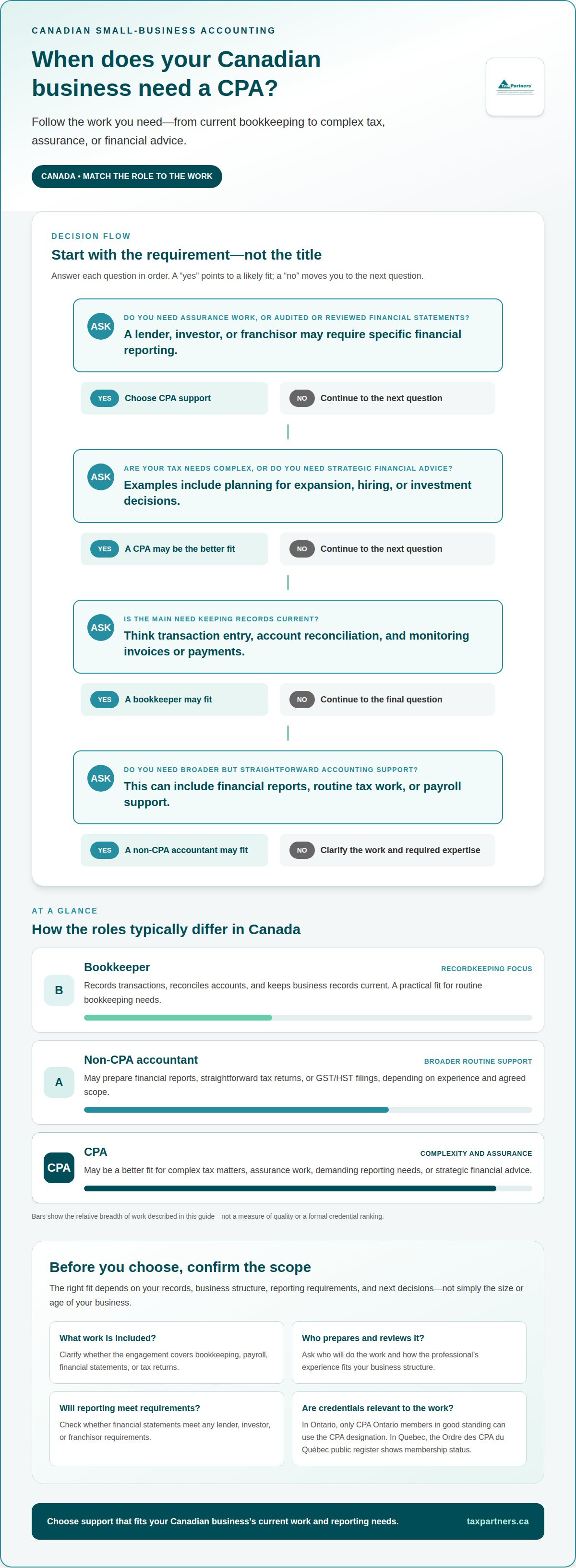
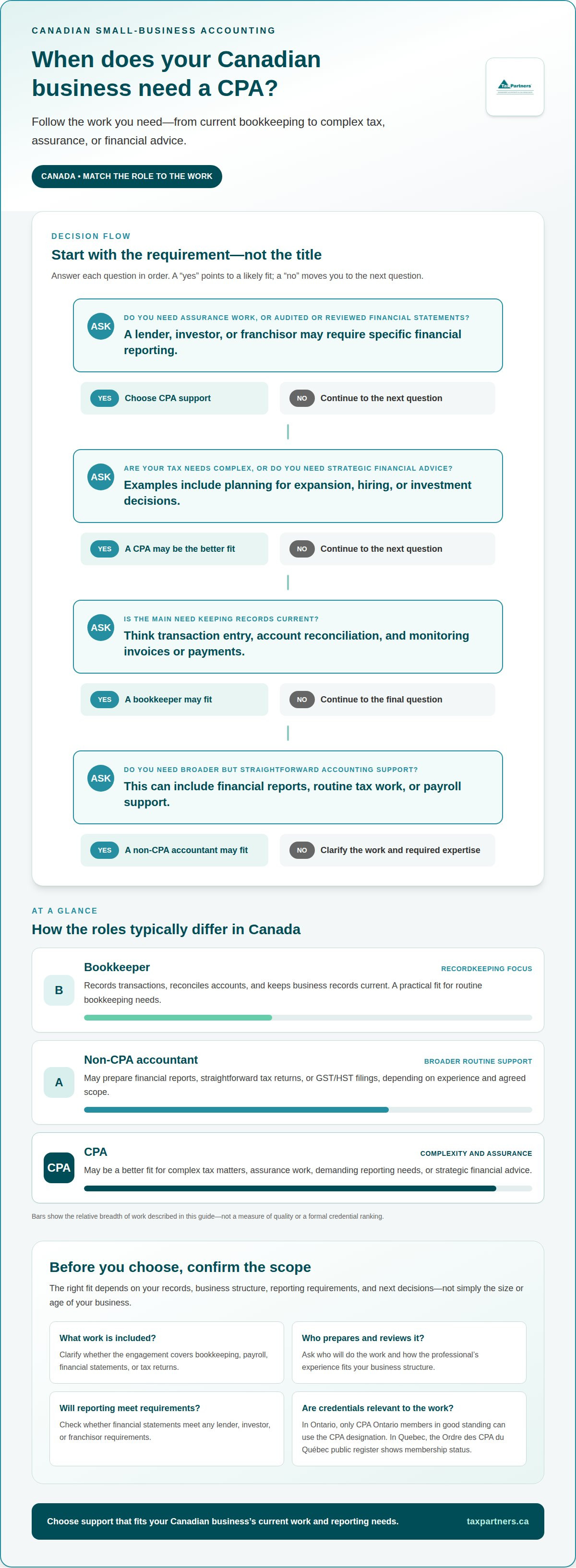
A Canadian small business should consider a CPA when it faces complex tax matters, needs assurance work, or must provide audited or reviewed financial statements. For routine bookkeeping and straightforward records, a bookkeeper or accountant may be a practical fit.
Comparing a CPA with an accountant for a small business starts with the work required now and the decisions ahead. Consider how your business earns revenue, manages records and plans to grow before choosing the level of support.
CPA Support for Complex or Growing Businesses
A CPA may suit a business with several revenue sources, employees, complex tax needs, or financial statement requirements from a lender, investor or franchisor. A CPA can also advise partners weighing expansion, hiring or investment decisions. These needs go beyond day-to-day recordkeeping, especially when outside parties rely on the business’s financial reporting.
As your business grows, compare CPA and accounting support again if new reporting requirements or tax questions arise. The right fit depends on the work involved, not simply the business’s size or age.
Accountant Support for Small-Business Needs
A non-CPA accountant can be suitable when the main tasks involve organizing transactions, preparing financial reports, or supporting routine tax and payroll work. A bookkeeper’s typical focus is narrower: recording transactions, reconciling accounts, and keeping records current. These roles can help a sole proprietor or small team maintain usable records without broader advisory support.
For example, a business owner who needs regular expense tracking and invoice monitoring may prioritize bookkeeping. If the business adds revenue streams or faces complex tax-planning needs, broader accounting expertise may be more suitable.
Questions for Comparing Accountants and CPAs
Compare professionals by matching their experience and services to your requirements. Ask which tasks they handle, whether they prepare financial statements that meet lender or investor requirements, and how they support tax matters or growth decisions. These questions clarify the service scope and who will do the work.
Also ask how records and deadlines will be managed, and whether the professional has experience with businesses like yours. Clear answers help distinguish day-to-day bookkeeping from planning or assurance services.
| Option | Typical focus | Best fit | Consider as needs change |
|---|---|---|---|
| Bookkeeper | Transaction records and reconciliations | Routine, current bookkeeping | More reporting or tax complexity |
| Non-CPA accountant | Accounting tasks and financial reporting | Straightforward small-business needs | Assurance or complex tax requirements |
| CPA | Complex tax, assurance, and strategic advice | Growth, funding, or demanding reporting needs | Changing business structure or operations |
Choose a professional whose services match your current records, reporting requirements and next business decisions.
What About Accountants Who Aren’t CPAs?
In Canada, an accountant may or may not hold a professional designation. A bookkeeper generally focuses on recording transactions, reconciling accounts and keeping business records current; an accountant may also prepare financial reports or support tax filings.
For a Canadian business, the relevant question is whether the professional’s training and experience fit the Canadian accounting or tax work required.
A sole proprietor, partnership and corporation can each have different accounting needs. For example, a corporation may need corporate tax filing support, while a partnership may need records that clearly track income and expenses among partners. Workload and complexity affect the expertise required.
Fees for Canadian bookkeeping, tax filing, and advice depend on transaction volume, record quality, business structure, and service scope. The cost is provided after a quote request, based on those factors.
Match the work to the role
Bookkeeping covers the financial activity a business needs to track throughout the year. A bookkeeper can enter transactions, reconcile accounts and monitor invoices and payments, giving the owner organized records for reporting and tax preparation.
An accountant without a CPA designation may handle broader tasks, such as preparing financial statements, straightforward tax returns or GST/HST filings. A CPA may be a better fit when the work involves complex tax or assurance needs rather than routine transaction processing alone.
Small businesses can outsource bookkeeping when they need consistent records but don’t need an employee dedicated to the task. For example, an owner can have transactions recorded and accounts reconciled, then use those records for tax preparation and business decisions.
Check credentials and scope
Ask what work the professional will prepare, who will review it, and whether their experience covers your business structure. In Ontario, only CPA Ontario members in good standing can use the CPA designation; in Quebec, the Ordre des CPA du Québec’s public register shows membership status.
Also clarify whether the engagement covers bookkeeping, payroll, financial statements or tax returns. A clear scope helps prevent gaps, such as assuming transaction entry also includes tax filing or financial advice.
For Canadian bookkeeping and tax support, discuss your business’s accounting needs and the level of help that fits its records and structure.
Differences between CPAs and unlicensed accountants
In Canada, the CPA designation signals regulated professional qualifications and oversight. An accountant without that designation may still have relevant training and experience, but the title alone doesn’t establish either.
CPA Services and Unlicensed Accountant Risks
Canadian CPAs can provide audit, review, assurance, complex tax and strategic financial consulting services. Assurance work provides an independent assessment of financial information; in Ontario, financial statement assurance requires a licensed public accountant.
Public-practice and in-house roles differ. An external audit is performed independently of the business, while an in-house accountant may review the organization’s own records. External audits and audits of public companies are handled by CPAs; in-house audits may be completed by accountants.
For example, a business seeking assurance on its financial statements needs a professional qualified for that work. An inexperienced accountant handling complex tax or reporting may overlook important details or leave records less prepared for a CRA audit. The risk depends on the work’s complexity and the professional’s relevant experience.
A CPA’s work can also extend to examining financial and non-financial information. A bookkeeper’s transaction records may support that work, but bookkeeping alone is different from an audit or assurance engagement.
Accountant Titles and Provincial Regulation
Whether someone may use the title “accountant” depends on provincial rules. In Quebec, the title is not protected by law, so people can use it regardless of their training or skills; the CPA designation is reserved for members of the Ordre des CPA du Québec.
In Ontario, only CPA Ontario members in good standing may use the CPA designation after their names. These examples show why business owners should distinguish a general job title from a professional designation, rather than assume the same title rules apply across Canada.
To assess a professional’s fit, ask about their education and supervised experience, the services they provide, and whether their provincial CPA membership is in good standing. Someone without the designation may still suit bookkeeping or routine accounting, but that doesn’t establish qualification for assurance work.
For a small business, the practical risk of hiring someone without suitable experience is a mismatch between the task and the person’s capabilities. Transaction entry may be routine, for example, while investigating financial discrepancies or preparing assurance work requires different expertise.
Match the professional’s credentials and relevant experience to the specific accounting work your business needs.
Accountant versus CPA services and oversight
For a Canadian business, the distinction matters most when work moves beyond routine recordkeeping. Compare the service required, the professional’s authority to perform it, and the oversight attached to their credentials.
A bookkeeper can record sales revenue, categorize expenses, reconcile accounts and keep transaction records current. An accountant may use those records to prepare financial reports, support tax filing or explain how hiring affects cash flow. These tasks help owners understand day-to-day performance, but they differ from independent assurance.
A CPA may provide audit, review, assurance, complex tax and strategic financial consulting services. Assurance involves an independent examination of financial information, rather than simply preparing it. If investors or a lender require audited or reviewed financial statements, the business needs an appropriately qualified professional for that engagement.
Canadian businesses can also turn to a CPA for representation before the Canada Revenue Agency, including during an audit or a request for information. A CPA can help explain records and address questions about reported income, expenses or filings. The exact support depends on the matter and the agreed scope of work.
Oversight is another difference. Provincial and territorial CPA bodies grant and oversee the CPA designation and set professional requirements for members. An accountant without the designation may have valuable education and experience, but the job title alone doesn’t show that the person is subject to CPA membership requirements.
For example, a bookkeeper might reconcile monthly sales and supplier expenses, while a CPA prepares an assurance report for external use. When comparing providers, identify who will use each report. Internal planning, a CRA filing and an investor’s assurance requirement have different purposes.
- Routine records: transaction entry, account reconciliation, and organized supporting documents.
- Tax support: preparation of filings and help addressing complex Canadian tax matters.
- Assurance: independent work on financial statements for a lender, investor, or other intended user.
- Strategic advice: analysis of revenue, expenses, hiring plans, and financing decisions.
Clarify the scope in writing before work begins: which records will be handled, which filings will be prepared, and whether the engagement includes advice, assurance or CRA representation. This helps prevent a mismatch, such as expecting transaction processing to include an audit opinion.
For ongoing Canadian accounting support, the appropriate service depends on the records, filings, and reporting your business needs.
Small-business accounting and tax support
For a Canadian small business, accounting support can connect daily records with tax filings and business decisions. An accountant may help organize bookkeeping, prepare financial statements, support payroll and plan for tax obligations as the business grows.
Build reliable records first
Current records help owners see whether revenue covers expenses and customers have paid. A bookkeeper or accountant can record transactions, reconcile accounts, monitor invoices and organize documents needed for Canadian tax preparation.
For example, a growing business that hires employees must track payroll alongside supplier costs and sales. Bringing those records together gives the owner a clearer view of cash flow and supports payroll remittances and financial reporting.
- Record sales, expenses, invoices, and payments consistently.
- Reconcile bank and business account activity against the books.
- Keep supporting documents organized for tax filing and CRA questions.
- Review reports to spot cash-flow pressures before making hiring decisions.
Connect bookkeeping to Canadian tax obligations
Canadian businesses may need to manage GST/HST filings, payroll remittances and corporate tax returns with the Canada Revenue Agency. An accountant can help prepare these filings and connect reported amounts to the business’s records.
A corporation in Canada must file its T2 return within six months of its year-end. That filing deadline is separate from the date a corporate tax balance is due, so businesses should plan for both obligations.
Tax planning also depends on accurate records throughout the year. An accountant can review income and expenses, discuss eligible deductions and help the owner understand how decisions may affect the business’s Canadian tax position.
Scale support as the business changes
A sole proprietor with straightforward transactions may mainly need bookkeeping and help preparing a tax return. A growing corporation with employees, several revenue sources or investor reporting needs may require broader accounting and tax support.
External support can give owners access to bookkeeping, payroll and tax expertise without assigning every task to an employee. The right scope depends on record volume, business structure, filing needs and whether the owner also needs strategic advice.
As operations expand, an accountant can analyze financial reports to inform decisions about hiring, equipment or new locations. A CPA may be appropriate when the business needs complex tax advice, assurance work or financial statements for a lender or investors.
To discuss Canadian bookkeeping, payroll, and tax needs, connect with an accounting professional.
Tax Partners
Tax Partners helps small businesses match accounting support to their records, tax obligations and growth plans. Its Canadian Accounting & Tax Services support businesses managing Canadian filings, while Bookkeeping and Payroll Services cover ongoing financial records and employee payroll.
As your needs develop, Wealth Management & Financial Planning can help connect business and financial decisions.
Whether you need help organizing routine records or handling more involved tax matters, the next step is to discuss the work involved. Contact Tax Partners to discuss your business’s accounting needs.
Make your next accounting decision with purpose
Choosing a CPA versus an accountant for a small business isn’t a permanent label for your business. Treat it as a working relationship that can evolve: agree on the decisions and records you need help with now, then revisit the arrangement as your operations change.
A useful next step is to identify the business question you most need help answering. It might involve planning a new direction, improving how financial information informs decisions, or coordinating accounting support with broader priorities. A focused discussion can turn a comparison of credentials into a practical plan for the work ahead.
Tax Partners can help you consider the accounting and tax support that fits your situation. Contact Tax Partners to discuss your next step, and move forward with greater clarity.
Frequently Asked Questions
So, does your business need a CPA?
Not always. If your main need is keeping transactions organized or preparing straightforward records, bookkeeping or accounting support without the CPA designation may fit. A CPA becomes more relevant when your Canadian business faces complex tax matters, needs assurance work, or must provide reviewed or audited financial statements. For example, an investor’s reporting requirements can change the level of expertise your business needs.
CPA vs Accountant: What’s the Core Difference?
A CPA holds a professional designation earned through a defined education, examination and experience pathway; “accountant” describes a broader role and may not indicate a credential. In practice, compare the person’s qualifications with the work you’re assigning. Someone may be well suited to organize transaction records, while a business seeking assurance needs a professional qualified for that engagement.
Can a CPA represent a company before the tax authorities?
In Canada, a CPA can represent a company before the Canada Revenue Agency, including during an audit or when the agency requests information. That support can include helping explain the company’s records and responding to questions about a filing. For example, a business facing questions about reported expenses can benefit from organized accounting information and a clearly explained position.
Should you hire a CPA or something else?
Choose according to the task, not the title alone. A bookkeeper can maintain transaction records; an accountant may prepare reports or support routine tax work; a CPA may be appropriate for assurance or complex tax advice. A small retailer with orderly sales records may need bookkeeping, while a company preparing financial information for investors may need CPA-level support.
What is the difference between a CPA and an accountant in Canada?
In Canada, CPA is a professional designation overseen by provincial and territorial CPA bodies, while accountant can describe someone’s work without confirming a credential. Rules for professional titles vary across provinces. Before assigning specialized work, clarify the professional’s training, relevant experience and standing with the applicable CPA body if they use the designation.
What services does a small business typically need from an accountant or CPA?
Common needs include bookkeeping, payroll support, financial reporting, Canadian tax preparation and help with GST/HST filings. The right combination depends on the business’s structure and activity. For example, a business hiring employees may need payroll support alongside accurate records, while an owner planning expansion may value financial analysis to inform hiring, equipment or cash-flow decisions.
Does a small business need a CPA to prepare or file a Canadian corporate tax return (T2)?
A small business does not necessarily need a CPA for a Canadian T2 return; a non-CPA accountant may handle a straightforward year-end return. A corporation in Canada must file its T2 within six months of its year-end. If its tax situation is complex or its financial statements require assurance, CPA expertise may be appropriate beyond routine return preparation.
How much do Canadian CPAs and small-business accountants charge for bookkeeping, tax filing, and advice?
Costs depend on transaction volume, record quality, business structure and the scope of services.

Article by
Mahad Mohamed
Mahad Mohamed is an accountant and the CEO of Tax Partners, with over 26+ years of Canadian and international tax and accounting experience. His expertise includes corporate reorganization, cross-border tax structuring (Canada & US), tax disputes, CRA audits, and tax planning for small owner-managed private corporations. Most recently, Mahad is a pioneer in Canadian crypto taxation and founded Block3 Finance.
Previously, Mahad worked for the Canada Revenue Agency (CRA), Big4 accounting firms, and served as a Rulings Officer for the Federal Tax Authority of the UAE before acquiring Tax Partners in 2014.
Tax Partners has 44 full-time accountants and over 18,400+ clients.
Disclaimer
This article provides general information only and is current as of its publication date. It has not been updated and may be out of date. It does not constitute legal advice and should not be relied upon as such. Every tax situation is unique and may differ from the examples discussed in this article. If you have specific questions, you should seek the advice of our accountants for your unique circumstances. Book a FREE Initial Consultation Today!
Frequently Asked Questions
So, does your business need a CPA?
Not always. If your main need is keeping transactions organized or preparing straightforward records, bookkeeping or accounting support without the CPA designation may fit. A CPA becomes more relevant when your Canadian business faces complex tax matters, needs assurance work, or must provide reviewed or audited financial statements. For example, an investor’s reporting requirements can change the level of expertise your business needs.
CPA vs Accountant: What’s the Core Difference?
A CPA holds a professional designation earned through a defined education, examination and experience pathway; “accountant” describes a broader role and may not indicate a credential. In practice, compare the person’s qualifications with the work you’re assigning. Someone may be well suited to organize transaction records, while a business seeking assurance needs a professional qualified for that engagement.
Can a CPA represent a company before the tax authorities?
In Canada, a CPA can represent a company before the Canada Revenue Agency, including during an audit or when the agency requests information. That support can include helping explain the company’s records and responding to questions about a filing. For example, a business facing questions about reported expenses can benefit from organized accounting information and a clearly explained position.
Should you hire a CPA or something else?
Choose according to the task, not the title alone. A bookkeeper can maintain transaction records; an accountant may prepare reports or support routine tax work; a CPA may be appropriate for assurance or complex tax advice. A small retailer with orderly sales records may need bookkeeping, while a company preparing financial information for investors may need CPA-level support.
What is the difference between a CPA and an accountant in Canada?
In Canada, CPA is a professional designation overseen by provincial and territorial CPA bodies, while accountant can describe someone’s work without confirming a credential. Rules for professional titles vary across provinces. Before assigning specialized work, clarify the professional’s training, relevant experience and standing with the applicable CPA body if they use the designation.
What services does a small business typically need from an accountant or CPA?
Common needs include bookkeeping, payroll support, financial reporting, Canadian tax preparation and help with GST/HST filings. The right combination depends on the business’s structure and activity. For example, a business hiring employees may need payroll support alongside accurate records, while an owner planning expansion may value financial analysis to inform hiring, equipment or cash-flow decisions.
Does a small business need a CPA to prepare or file a Canadian corporate tax return (T2)?
A small business does not necessarily need a CPA for a Canadian T2 return; a non-CPA accountant may handle a straightforward year-end return. A corporation in Canada must file its T2 within six months of its year-end. If its tax situation is complex or its financial statements require assurance, CPA expertise may be appropriate beyond routine return preparation.
How much do Canadian CPAs and small-business accountants charge for bookkeeping, tax filing, and advice?
Costs depend on transaction volume, record quality, business structure and the scope of services.