Business Use of Home Expenses in Canada: How Much Can You Claim

A home office doesn’t make every household bill deductible. When deducting business use of home expenses in Canada, a self-employed person may qualify if the workspace is their principal place of business, the main place where they conduct their business, or if it is used only to earn business income and clients are regularly and continuously seen there. The deductible amount is the business-use share of eligible expenses, and it can’t create or increase a business loss.
That share may apply to costs such as rent, utilities, home insurance, property tax, maintenance and mortgage interest. For a room that also serves personal purposes, both its share of the home’s area and the time it’s used for business can affect the calculation.
This guide explains who may claim these expenses, how to calculate the allocation and which household and office costs may qualify. It also explains how the rules distinguish shared spaces from dedicated work areas, and why the difference between a repair and a renovation can matter when reporting business expenses.
Key Takeaways
- A self-employed person may qualify when the home is their principal place of business, or when the workspace is used only to earn business income and clients are regularly and continuously seen there.
- For a shared workspace, the deductible share can depend on both the area used for business and the time it serves that purpose.
- Mortgage interest may be included in eligible home expenses, but mortgage principal payments aren’t deductible as a business-use-of-home expense.
- Separate office supplies and items used exclusively for business may be treated differently from shared household costs.
- Repairs that restore a property to its prior state may qualify as maintenance, while renovations aren’t deductible as business-use-of-home expenses.
Who Can Claim Business-Use-Of-Home Expenses?
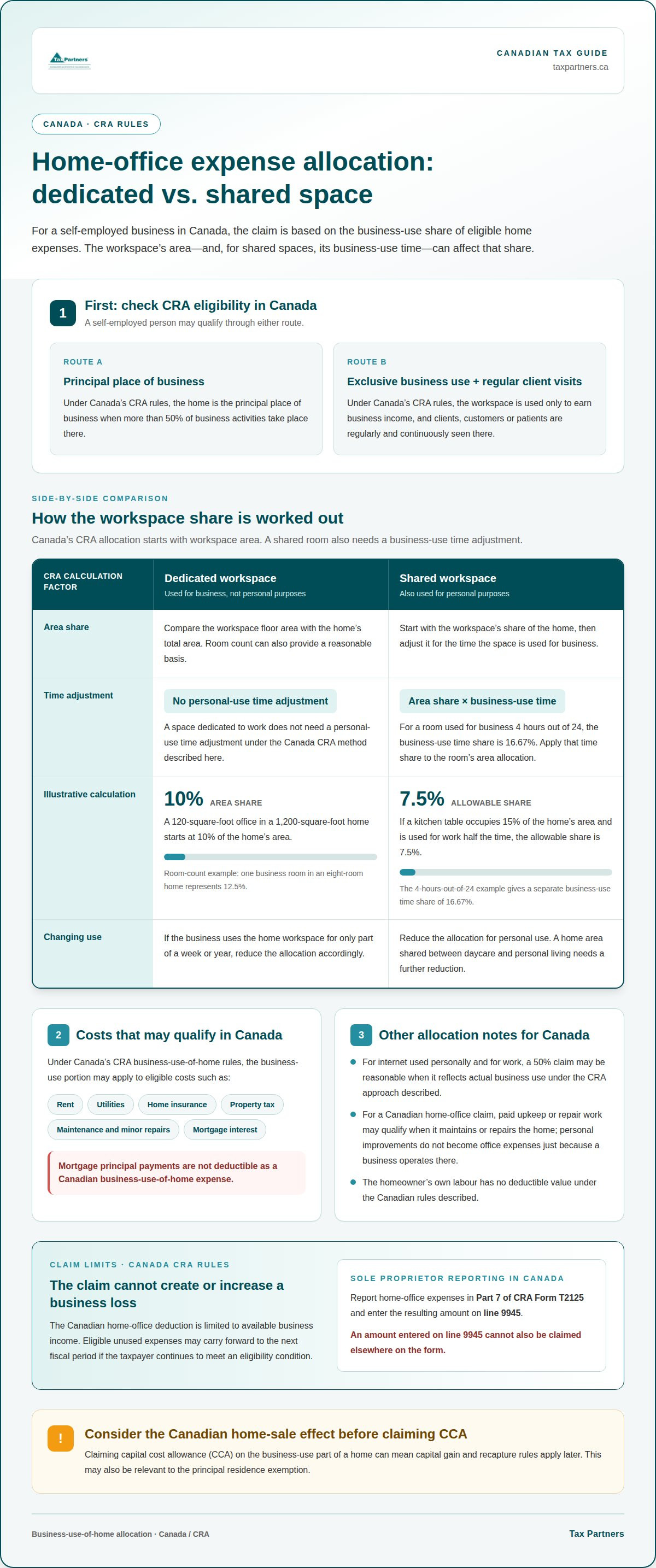
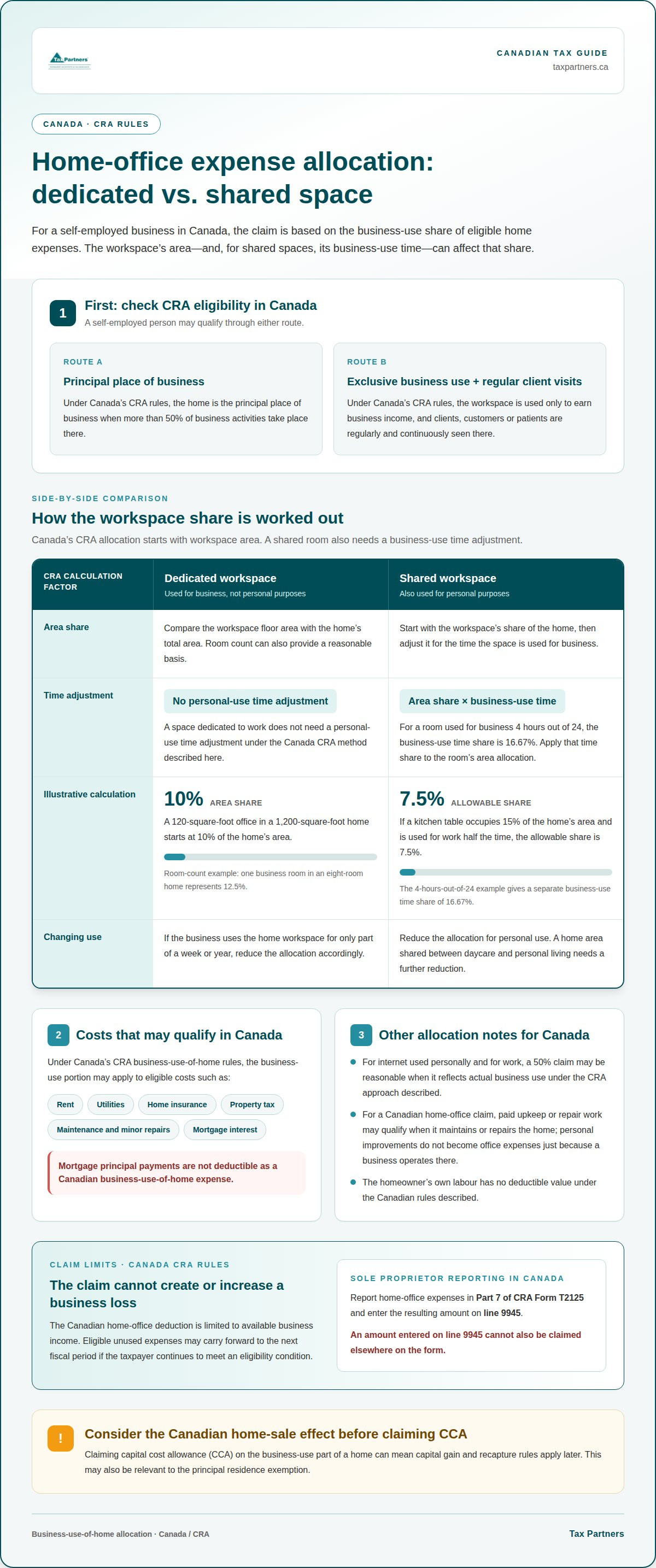
In Canada, a self-employed person may qualify if their home is their principal place of business, or if they use a workspace only to earn business income and regularly and continuously meet clients, customers or patients there. A home is the principal place of business when more than 50% of business activities take place there. A professional first assesses the work arrangement, then calculates the business portion of eligible household costs.
For the area-based method, the professional compares workspace floor area with the home's total area. A 120-square-foot office in a 1,200-square-foot home represents 10% of the home, so 10% is the starting allocation for eligible expenses. Room count can also provide a reasonable basis: one business room in a home with eight rooms represents 12.5%.
Shared rooms need another adjustment. A professional separates the workspace's area share from the time it serves business purposes, then applies both portions to eligible expenses. For example, a room used for business for 4 hours out of 24 is used for business 16.67% of the time. That time-based share reduces the room's area allocation.
Personal use matters even when work happens in a defined spot. If a kitchen table occupies 15% of the home's area but serves work half the time, the allowable share is 7.5%. By contrast, a space dedicated to work doesn't need a personal-use time adjustment. A professional also distinguishes household costs from other business claims, such as vehicle expenses, which use their own business-use allocation.
Work schedules can change the result. If the business uses the home workspace for only part of a week or year, the professional reduces the allocation accordingly. A home area shared between daycare and personal living needs a further reduction. For an internet connection used personally as well as for work, claiming 50% may be reasonable when that reflects actual business use.
Eligible expenses that exceed the amount claimable for the current fiscal period may carry forward to the next fiscal period if the taxpayer continues to meet an eligibility condition. The deduction can't create or increase a business loss, so it can be applied only against available business income. This limit affects how much of an otherwise eligible allocation can be claimed now.
For a sole proprietor, a professional reports home-office expenses in Part 7 of CRA Form T2125 and enters the resulting amount on line 9945. Expenses entered on line 9945 can't also be claimed elsewhere on the form. The allocation should align with the business-income reporting within professional Tax Partners services.
Eligibility for the self-employed home office deduction
In Canada, self-employed people may claim home office expenses when the workspace is their principal place of business. They may also qualify if they use the workspace only to earn business income and regularly and continuously meet clients, customers or patients there. These are separate eligibility routes, so assess the work arrangement before considering household costs.
People employed by someone else shouldn’t assume these self-employed rules apply to them. The claim discussed here concerns expenses connected with a self-employed business, not everyone who works remotely. The nature of the work, where business activities take place and whether clients attend the home all inform the eligibility assessment.
Eligible costs can include a business-use portion of rent, utilities, home insurance, property taxes, mortgage interest, maintenance and minor repairs. Distinguish expenses related to the home workspace from personal household costs. For example, a repair to a workspace may qualify as maintenance, while the homeowner’s own labour has no deductible value.
Maintenance claims need a clear connection to upkeep. The cost of paid work or materials may be considered when it maintains or repairs the home, but personal improvements don’t become office expenses simply because a business operates there. A professional reviews the nature of the work and allocates shared costs consistently with the workspace’s business use.
Home office expenses can’t create or increase a business loss in Canada. If allowable expenses exceed business income before the home-office claim, the current deduction is limited. Eligible unused amounts may carry forward if the taxpayer continues to meet an eligibility condition. This limit changes the timing of a deduction, not whether a cost was originally related to the business.
A different consideration arises when the home is sold. Claiming capital cost allowance, or CCA, on the business-use part of a home can mean capital gain and recapture rules apply later. Consider this potential home-sale effect when deciding whether to claim CCA, including its possible relevance to the principal residence exemption.
For example, a self-employed consultant who conducts business from a dedicated home office and regularly meets clients there may meet an eligibility condition. A consultant who works at home occasionally, without using it as a principal business location or meeting clients there, shouldn’t treat remote work alone as sufficient. The business facts determine whether a claim is available.
Calculating workspace area and deductible expenses
A professional starts with the workspace’s share of the home, then adjusts for personal use and eligible expenses. For a Canadian sole proprietor, the resulting amount is reported through Part 7 of Form T2125.
Measuring the Workspace for a Professional Claim
To measure the workspace, compare the area used for business with the home’s total floor area. Use a consistent area-based method, such as square footage, to establish the starting portion of shared household expenses. Accurate measurements matter because the percentage applies across eligible costs, not just one utility bill.
For example, a 300-square-foot office in a 1,500-square-foot home represents 20% of the home’s area. A professional uses that ratio to calculate the workspace share of allowable costs, while excluding expenses that don’t qualify. Room count can also be a reasonable method when room sizes are comparable, but floor area better reflects a home with differently sized rooms.
Calculating Business-Use Space for a Professional Claim
The area percentage is only the starting point when a workspace also serves personal purposes. Adjust the allocation for the time the space is used for business, so household expenses reflect actual business use rather than full-time occupation.
For instance, if a shared room is used for business for 8 hours a day, its area-based share is reduced to reflect those business hours. A dedicated work-only space doesn’t need the same personal-use time adjustment. If the business operates from home for only part of a week or year, the professional also reduces the claim for that period.
This approach matters for business owners using a kitchen table, guest room or other shared area. Combine the workspace’s share of the home’s area with its business-use time, then apply the result to eligible costs. The business portion must reflect the space’s actual use for business purposes.
Illustrative Expense Calculation by a Professional
A professional applies the calculated business-use percentage to each eligible expense, rather than treating all household spending as deductible. For example, a 200-square-foot office in a 1,000-square-foot home represents 20% of the area.
The final claim is also limited by business income before home expenses, because the deduction can’t create or increase a business loss. Eligible unused amounts may carry forward if eligibility continues.
For a Canadian sole proprietor, the professional records the allowable amount in Part 7 of Form T2125. Expenses claimed on line 9945 can’t also be claimed elsewhere on that form. This keeps the home-office calculation distinct from other business costs, including capital cost allowance, which can affect tax treatment when the home is sold.
Office furniture, supplies and renovations
Furniture, supplies and building work are treated differently from shared household expenses. Separate items used for business from costs related to the home itself, then consider the business-use percentage when there is personal use.
Items used exclusively in a dedicated home office are typically 100% business expenses. Paper, paper clips, printer cartridges and pens are examples of office supplies that could be fully deducted in the 2020 Canadian tax year. For other Canadian tax years, the treatment depends on the applicable rules and the item’s business use.
Renovations aren’t deductible as Canadian business-use-of-home expenses. Repairs that restore property to its prior state may be treated as maintenance, so consider what the work actually did rather than relying only on the invoice description. Business owners also can’t deduct the value of their own labour on repairs or maintenance.
Employees have a separate home-office expense process from self-employed business owners. A T2200 relates to employee expenses, while the business-use allocation discussed here applies to eligible self-employed claims; the two situations shouldn’t be combined.
Useful records include receipts for household costs, office supplies, repairs and maintenance, along with information showing how the workspace is used. Canadian businesses should keep business expense receipts for at least six years in case of an audit. Clear records connect claimed costs to business activity and support the percentage assigned to shared spaces.
Distinguish home-office costs from other business expenses. For example, vehicle expenses use a separate business-use calculation and shouldn’t be included in the home-workspace percentage. Likewise, supplies used personally as well as for work require a reasonable allocation, not an automatic full claim.
For Canadian self-employed individuals, the filing deadline is June 15. Interest on unpaid Canadian tax balances starts accruing on May 1, so the return filing date and the start of interest are different considerations.
Common claim weaknesses include unsupported receipts, inconsistent workspace percentages and treating personal or renovation costs as business expenses. These aren’t automatic findings of an audit, but each can make a claim harder to substantiate. A professional review can organize the records and separate eligible costs from personal spending; discuss a home-office claim.
Common deductible home expenses
For self-employed people in Canada, deducting business use of home expenses in Canada means identifying eligible costs and claiming only the business-related share. Each expense must relate to business use of the home; household spending doesn’t qualify automatically.
Rent, Utilities and Internet
For a Canadian business-use-of-home claim, a renter may allocate the portion of rent related to the workspace. Eligible household costs may also include a business-use share of heating, electricity, water and cleaning materials. The calculation should reflect whether each bill covers the whole home or a specific work area.
Under Canadian tax rules, only the business-related portion of home internet expenses may be claimed. If the connection serves both work and personal purposes, allocate the cost according to its business use rather than treating the entire bill as a business expense.
Property Taxes and Mortgage Interest
For Canadian business-use-of-home purposes, property taxes and mortgage interest may be included in eligible home expenses, allocated according to business use. The principal portion of a mortgage payment isn’t deductible as a home-business expense; only the interest portion may be included.
Canadian claims may also include eligible home insurance, maintenance and minor repairs. The nature of the work matters: repairs that restore property to its prior state may count as maintenance, while renovations aren’t deductible as business-use-of-home expenses.
Under Canadian tax rules, an increase in home insurance premiums caused by operating a home-based business is generally a business expense. Personal costs don’t qualify simply because the owner works from home; the expense must relate to business use.
Keep other Canadian business-expense categories separate. Vehicle expenses relate to business driving, while meals and entertainment follow their own deduction rules, not the home-workspace allocation. For Canadian business owners, deducting business use of home expenses in Canada means classifying each cost before applying the appropriate business-use share.
The practical takeaway for Canadian claims is to distinguish rent, utilities, internet, property taxes, mortgage interest, insurance and maintenance before calculating the allowable amount. Get help assessing eligible home expenses for a clear, supportable calculation.
Tax Partners
Tax Partners helps Canadian business owners assess home-office eligibility, allocate eligible expenses and report claims alongside business income. Its Canadian Accounting & Tax Services can support shared workspaces, part-year business use and questions about how a home-office claim fits into broader tax reporting.
When household and business costs overlap, professional support can help align the calculation with your bookkeeping. Tax Partners also offers Bookkeeping and Payroll Services to help keep business records organized.
Contact Tax Partners to discuss your Canadian home-office expense claim.
Make the claim part of your business plan
Your home workspace may change as your business evolves. A room could become dedicated to work, or your business activity could shift during the year. Keep your tax planning aligned with those changes so the claim reflects how you actually use your home.
Deducting business use of home expenses in Canada is one part of managing your business finances. A considered approach can help you plan for changing work arrangements and keep your records aligned with your tax reporting.
Contact Tax Partners for help with your next step, and move forward with confidence.
Frequently Asked Questions
How much can a professional determine you may claim?
The claim depends on eligible expenses, business use and available business income. For example, if net business income before the home-expense deduction is C$5,000, the claim is limited to C$5,000; the excess may carry forward if eligibility continues. A professional can calculate the allowable amount from the expense records and workspace details, but the result isn’t a flat percentage of every household bill.
What expenses can you deduct?
Eligible costs can include the business-use portion of rent, utilities, home insurance, property taxes, mortgage interest, maintenance and minor repairs. Treatment depends on the expense: a repair that restores a workspace differs from a renovation, and mortgage principal isn’t deductible as home-office interest.
Direct business supplies and household costs also require different treatment. The expense must relate to earning business income, not simply occur in the home.
What can a professional claim as a business expense on your behalf?
A tax professional can determine which expenses relate to the business, calculate the allowable share and report the claim with the business income information. This may include a supported portion of household costs and eligible office expenses. The professional applies the rules to the facts and records, rather than treating personal costs as business deductions. The claim must also respect the limit imposed by available business income.
What makes an expense “defensible”?
An expense is easier to support when its business purpose, amount and allocation can be traced to consistent records. For example, a receipt for a workspace repair, paired with an explanation of the work performed, supports the nature of the cost better than a bank entry alone. A reasonable allocation should also match how the space was actually used. Unsupported estimates or inconsistent percentages weaken the connection between an expense and business income.
Who can claim business-use-of-home expenses in Canada?
In Canada, a self-employed person may qualify if the home is their principal place of business, or if a workspace is used only to earn business income and clients, customers or patients are regularly and continuously seen there. These are alternative eligibility conditions. Working from home occasionally does not, by itself, establish eligibility under these tests; the person’s business activities and use of the space matter.
How does a professional calculate the business-use percentage of your home expenses?
A professional can use workspace area as a share of total home area, then account for personal use where the space is shared. For example, one business room in a four-room home represents a 25% area share before any shared-use adjustment. The professional applies the resulting allocation to eligible costs, rather than using it for unrelated expenses such as vehicle costs.
Can employees deduct work-from-home expenses in Canada, and what rules apply?
Employees should distinguish their work-from-home expenses from the self-employed business-use-of-home claim described here. The CRA introduced a simplified home office expense tax deduction for employees to claim for the 2020 tax year. That historical measure does not make the self-employed eligibility tests interchangeable with employee rules. An employee’s situation depends on the rules applicable to the tax year and the circumstances of their employment.
What records and receipts should you provide for a professional home office claim?
Provide receipts or bills for the household costs being considered, along with records showing the workspace’s size and business use. A floor plan or measurements can support the area calculation; a calendar or work schedule can help explain when a shared room serves business purposes. Include repair invoices describing the work completed. Keep business expense receipts for at least six years in case of an audit.

Article by
Mahad Mohamed
Mahad Mohamed is an accountant and the CEO of Tax Partners, with over 26+ years of Canadian and international tax and accounting experience. His expertise includes corporate reorganization, cross-border tax structuring (Canada & US), tax disputes, CRA audits, and tax planning for small owner-managed private corporations. Most recently, Mahad is a pioneer in Canadian crypto taxation and founded Block3 Finance.
Previously, Mahad worked for the Canada Revenue Agency (CRA), Big4 accounting firms, and served as a Rulings Officer for the Federal Tax Authority of the UAE before acquiring Tax Partners in 2014.
Tax Partners has 44 full-time accountants and over 18,400+ clients.
Disclaimer
This article provides general information only and is current as of its publication date. It has not been updated and may be out of date. It does not constitute legal advice and should not be relied upon as such. Every tax situation is unique and may differ from the examples discussed in this article. If you have specific questions, you should seek the advice of our accountants for your unique circumstances. Book a FREE Initial Consultation Today!
Frequently Asked Questions
How much can a professional determine you may claim?
The claim depends on eligible expenses, business use and available business income. For example, if net business income before the home-expense deduction is C$5,000, the claim is limited to C$5,000; the excess may carry forward if eligibility continues. A professional can calculate the allowable amount from the expense records and workspace details, but the result isn’t a flat percentage of every household bill.
What expenses can you deduct?
Eligible costs can include the business-use portion of rent, utilities, home insurance, property taxes, mortgage interest, maintenance and minor repairs. Treatment depends on the expense: a repair that restores a workspace differs from a renovation, and mortgage principal isn’t deductible as home-office interest. Direct business supplies and household costs also require different treatment. The expense must relate to earning business income, not simply occur in the home.
What can a professional claim as a business expense on your behalf?
A tax professional can determine which expenses relate to the business, calculate the allowable share and report the claim with the business income information. This may include a supported portion of household costs and eligible office expenses. The professional applies the rules to the facts and records, rather than treating personal costs as business deductions. The claim must also respect the limit imposed by available business income.
What makes an expense “defensible”?
An expense is easier to support when its business purpose, amount and allocation can be traced to consistent records. For example, a receipt for a workspace repair, paired with an explanation of the work performed, supports the nature of the cost better than a bank entry alone. A reasonable allocation should also match how the space was actually used. Unsupported estimates or inconsistent percentages weaken the connection between an expense and business income.
Who can claim business-use-of-home expenses in Canada?
In Canada, a self-employed person may qualify if the home is their principal place of business, or if a workspace is used only to earn business income and clients, customers or patients are regularly and continuously seen there. These are alternative eligibility conditions. Working from home occasionally does not, by itself, establish eligibility under these tests; the person’s business activities and use of the space matter.
How does a professional calculate the business-use percentage of your home expenses?
A professional can use workspace area as a share of total home area, then account for personal use where the space is shared. For example, one business room in a four-room home represents a 25% area share before any shared-use adjustment. The professional applies the resulting allocation to eligible costs, rather than using it for unrelated expenses such as vehicle costs.
Can employees deduct work-from-home expenses in Canada, and what rules apply?
Employees should distinguish their work-from-home expenses from the self-employed business-use-of-home claim described here. The CRA introduced a simplified home office expense tax deduction for employees to claim for the 2020 tax year. That historical measure does not make the self-employed eligibility tests interchangeable with employee rules. An employee’s situation depends on the rules applicable to the tax year and the circumstances of their employment.
What records and receipts should you provide for a professional home office claim?
Provide receipts or bills for the household costs being considered, along with records showing the workspace’s size and business use. A floor plan or measurements can support the area calculation; a calendar or work schedule can help explain when a shared room serves business purposes. Include repair invoices describing the work completed. Keep business expense receipts for at least six years in case of an audit.