Tax avoidance vs tax evasion in Canada: How to tell them apart

A tax arrangement can follow the wording of a rule and still have its tax benefit denied. The difference between tax avoidance and tax evasion in Canada turns on what the taxpayer actually did: avoidance may involve arrangements that conflict with the purpose of tax rules, while evasion involves deliberately hiding or misrepresenting tax obligations.
It’s understandable to think these terms describe the same problem, but they do not. Tax evasion is a crime. Tax avoidance can lead to a dispute over whether a tax benefit fits the purpose of the law, including under Canada’s General Anti-Avoidance Rule (GAAR), which lets the CRA deny a tax benefit from an avoidance transaction that misuses or abuses tax rules.
This article explains what can constitute tax evasion in Canada, how it differs from tax avoidance, and how courts assess whether a transaction is genuine or a sham. The key distinction is not simply whether an arrangement reduced tax, but whether the parties intended and carried out the legal relationships described in their documents.
Key Takeaways
- Distinguish lawful tax planning from arrangements that conflict with the purpose of Canadian tax rules, and from deliberate evasion.
- Recognize how intentionally hiding income, overstating expenses, or making false statements can lead to criminal consequences.
- Understand how Canada’s General Anti-Avoidance Rule can challenge a tax benefit even when a transaction follows the literal wording of a provision.
- See why courts consider whether parties genuinely intended and carried out the legal relationships their documents describe when assessing a possible sham.
- Learn how the legal test and the evidence differ between a civil tax dispute and a criminal evasion charge.
Explainer: What's the difference between tax avoidance and tax evasion?
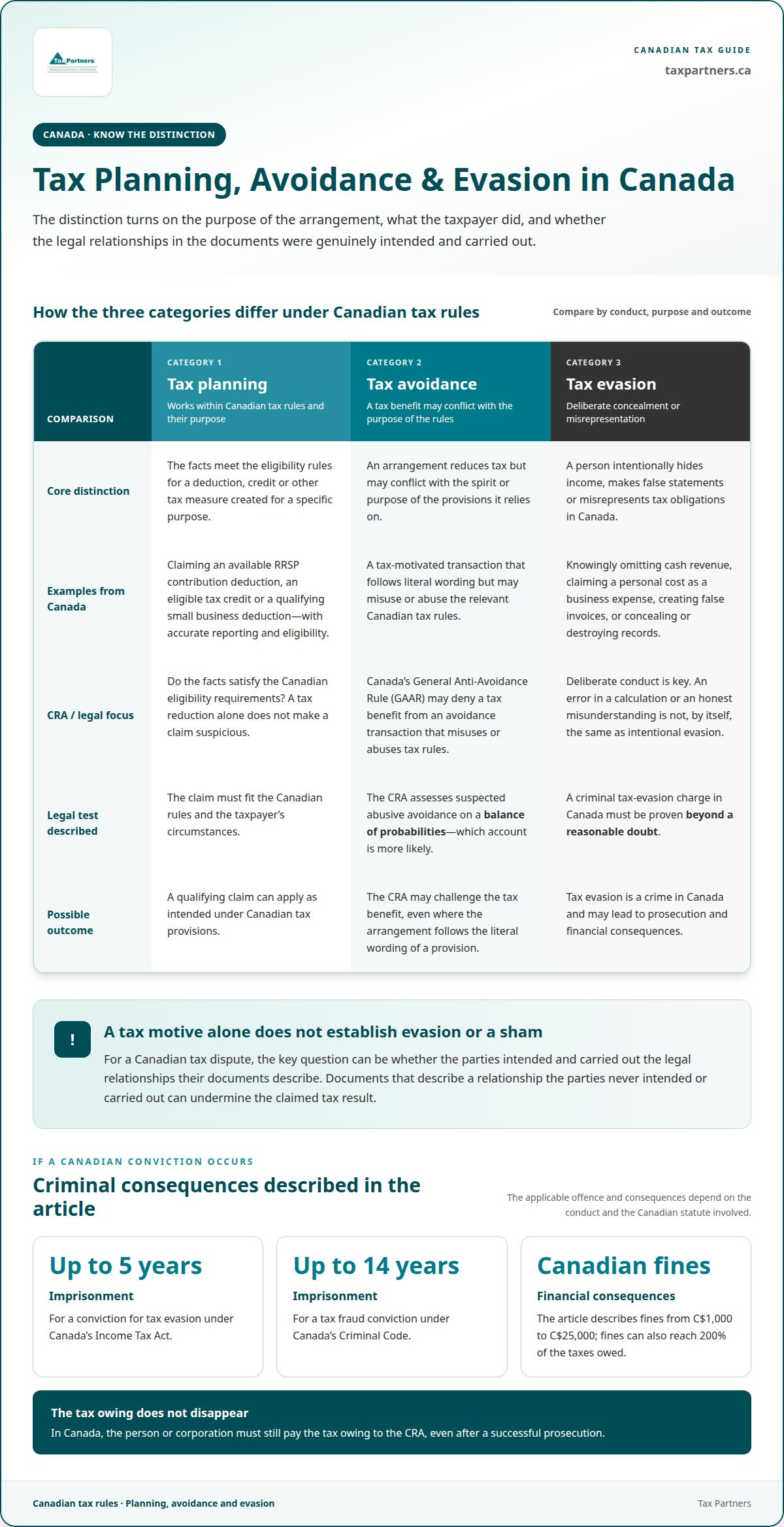
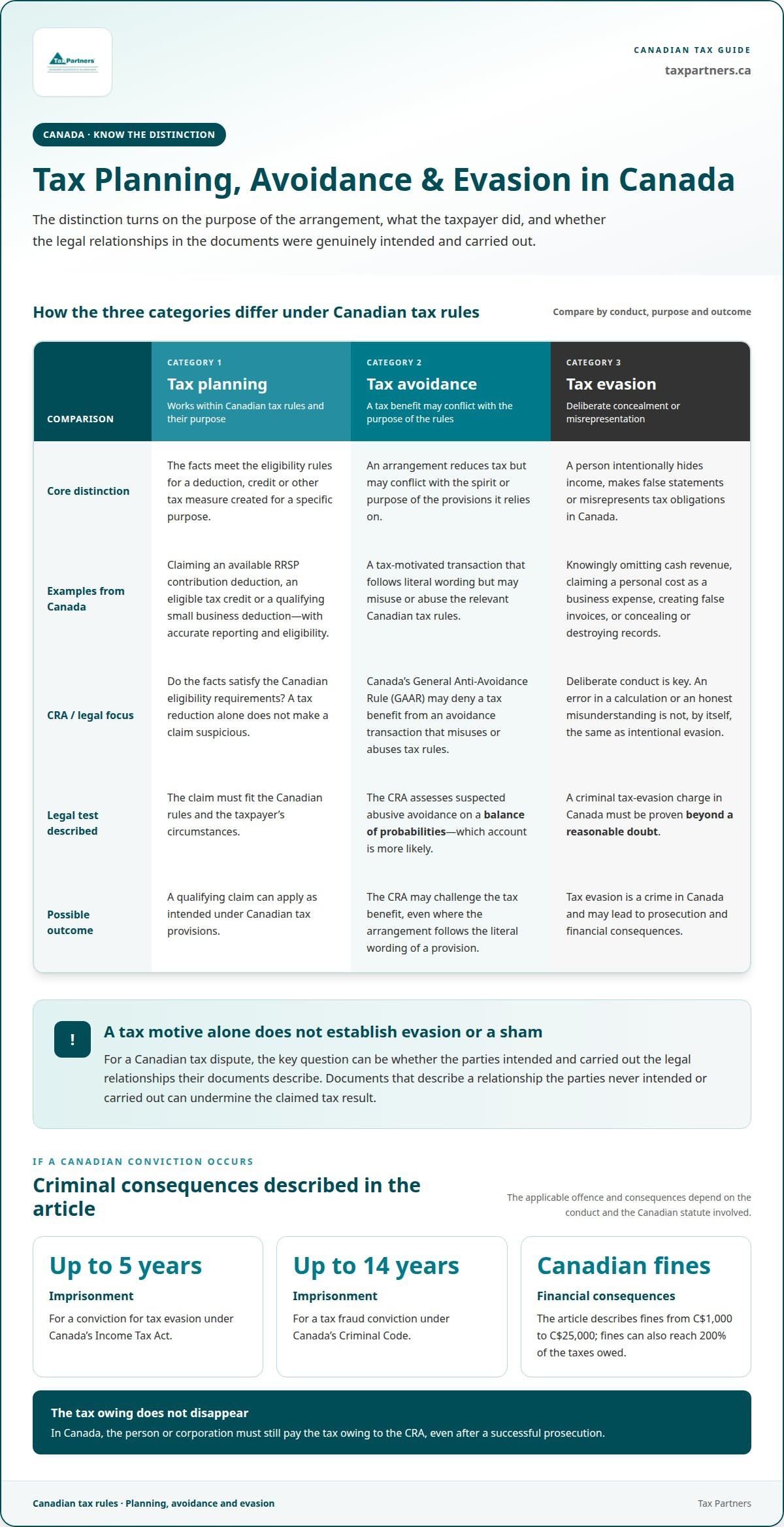
In Canada, tax planning works within tax rules and their purpose. Tax avoidance describes arrangements that reduce tax but may conflict with the spirit of those rules. Tax evasion is illegal and involves intentionally hiding income, making false statements, or misrepresenting tax obligations. The distinction is not simply whether a transaction lowers tax; it also depends on how the transaction works and what the taxpayer intended.
A deduction, credit, or exemption is not automatically suspicious because it reduces tax. For example, a Canadian taxpayer may claim an available deduction for contributions to a Registered Retirement Savings Plan (RRSP), a plan for retirement savings, use an eligible tax credit, or claim a qualifying small business deduction. These measures follow provisions Parliament created for specific purposes. Accurate reporting and eligibility matter: knowingly claiming an expense that is not deductible can make a claim problematic.
Tax-motivated transactions require careful consideration of their legal form and real-world operation. A taxpayer may arrange investments or business affairs to reduce tax, and a tax motive alone does not establish evasion or a sham. But documents describing a relationship the parties never intended or carried out can undermine the claimed tax result. Canada’s General Anti-Avoidance Rule (GAAR) may deny a tax benefit when an arrangement conflicts with the object, spirit, or purpose of the relevant provisions.
- Effective planning: Claim a deduction or credit only when the facts meet its Canadian eligibility rules.
- Avoidance concern: Consider whether a transaction’s tax benefit fits the purpose of the provisions it relies on.
- Evasion risk: Do not conceal income or knowingly submit false information to the Canada Revenue Agency (CRA).
The CRA assesses suspected abusive tax avoidance on a balance of probabilities, weighing which account is more likely. A criminal tax-evasion charge requires proof beyond a reasonable doubt. These different legal tests reflect the distinction between disputing a tax benefit and proving criminal conduct.
How does the CRA detect and investigate suspected tax evasion? The CRA uses audits and investigations to examine suspicious financial activity and discrepancies, such as reported income that does not align with available information. Where financial misconduct extends across borders, enforcement often connects with international intelligence networks and whistleblower programs examined by firms such as Piacentile & Associates LLP. An audit can lead to questions or a reassessment, but a discrepancy alone does not establish criminal evasion.
How can taxpayers challenge a CRA reassessment for suspected tax avoidance or evasion? A taxpayer can dispute a reassessment through the CRA’s formal objection process, explaining the disputed findings and providing supporting reasons and records. Issues may include whether income or expenses were reported correctly, whether a claimed benefit fits the law, and whether the transaction’s legal form reflects what occurred.
For Canadian tax planning, the relevant rules depend on the taxpayer’s income, transactions, and supporting records. Canadian tax guidance can help put deductions, credits, and investment decisions in the context of the rules that apply.
What constitutes tax evasion in Canada?
For Canadian income tax, evasion involves intentionally misrepresenting tax obligations to reduce tax payable. Under section 239 of Canada’s Income Tax Act, making, participating in, assenting to, or acquiescing in false or deceptive statements in a required return or other filing is an offence. The key element is deliberate conduct, not simply an error in a calculation or an honest misunderstanding.
Examples include omitting cash revenue, claiming a personal cost as a corporate expense, or creating false invoices to support deductions. Intentionally hiding, altering, or destroying books and records can also constitute evasion. A record that does not support a claimed expense can prompt scrutiny, but the conduct and evidence determine whether a tax offence occurred.
The law can apply to more than income tax. Canada’s Excise Tax Act addresses tax evasion under section 327, and the Criminal Code addresses fraud under section 380. Tax fraud can include under-reporting income or omitting a source of income. These provisions concern different offences, so the applicable charge and possible consequences depend on the conduct and statute involved.
Can tax evasion lead to criminal charges or imprisonment in Canada? Yes. A conviction for tax evasion under Canada’s Income Tax Act can result in imprisonment for up to five years, and tax evasion can be prosecuted in criminal court. A tax fraud conviction under Canada’s Criminal Code can carry imprisonment for up to 14 years.
Financial consequences can accompany a conviction. In Canada, penalties for tax evasion may include fines from C$1,000 to C$25,000, while fines can reach 200% of the taxes owed. The person or corporation must still pay the tax owing to the Canada Revenue Agency (CRA), even after a successful prosecution; a fine or sentence does not erase the underlying tax debt.
- Income omitted: A business knowingly leaves cash receipts out of its reported revenue.
- Expense overstated: A taxpayer claims a fictitious meal expense or inflates a business cost.
- Records concealed: Someone intentionally alters or destroys accounting books to hide taxable activity.
Accurate bookkeeping helps connect reported income, expenses, and supporting documents, including for a corporate return. If a CRA inquiry concerns questionable records or reporting, discuss your tax reporting concerns with a Canadian tax professional who can help clarify the accounting and compliance issues.
What are examples of tax avoidance methods in Canada?
Canada’s General Anti-Avoidance Rule (GAAR) is set out in section 245 of the Income Tax Act. It gives the Canada Revenue Agency (CRA) a way to challenge a tax benefit when a transaction or series of transactions conflicts with the object, spirit, or purpose of the relevant rules. A taxpayer may follow the legislation’s literal wording and still face a GAAR challenge.
GAAR focuses on an arrangement’s tax effect and the provisions it relies on. A transaction undertaken mainly to obtain a tax benefit, without a genuine business purpose, may attract scrutiny. That does not make every tax-motivated decision criminal: GAAR addresses abusive avoidance, while evasion involves deliberate misrepresentation or concealment.
Ordinary tax planning uses options Parliament built into Canadian law. For example, a taxpayer may contribute to a Tax-Free Savings Account (TFSA) within available contribution room. Canada’s annual TFSA contribution limit for the 2025 tax year is C$7,000. Eligible pension income may also be split by transferring up to 50% to a spouse or common-law partner.
- TFSA contributions: Use available room under the Canadian rules for the relevant tax year.
- Pension income splitting: Apply the Canadian eligibility rules before allocating eligible income to a spouse or common-law partner.
- Business transactions: Examine whether the commercial steps and documents reflect a genuine business arrangement.
These examples do not automatically amount to avoidance. The facts matter: a transaction’s legal form, purpose, and actual operation help show whether it uses a provision as intended. By contrast, a series of steps structured mainly to secure a benefit contrary to the spirit of the law may be challenged under GAAR, even if each step appears technically permissible.
Canada also has a general anti-avoidance rule in section 274 of the Excise Tax Act. The relevant statute depends on the tax benefit at issue, so federal income tax and excise tax arrangements may engage different provisions. In either case, a GAAR assessment can deny the benefit and result in additional tax, but it is not itself a criminal conviction.
For a complex investment or business restructuring, consult a Canadian tax professional before treating projected savings as settled. A careful review should connect the transaction’s legal documents, commercial purpose, and expected tax result to the provisions being relied on. This analysis can help distinguish effective planning from an arrangement that risks a serious GAAR dispute.
Canadian court recognition of taxpayers’ right to arrange their affairs
Canadian courts recognize that taxpayers may arrange their affairs to reduce tax. In Shell Canada Ltd. v. Canada, [1999] 3 SCR 622, the Supreme Court of Canada said legal relationships generally must be respected for tax purposes, unless a sham or a specific statutory rule applies. A tax motive alone does not make an arrangement unacceptable.
That principle does not protect every aggressive scheme. In Canada Trustco Mortgage Co. v. Canada, 2005 SCC 54, the Supreme Court set out a three-part test for applying Canada’s General Anti-Avoidance Rule. The analysis considers whether there is a tax benefit, whether an avoidance transaction occurred, and whether it misuses or abuses the relevant provisions.
The facts behind a transaction can also shape a court’s view of intent. In Canada v. Pomeroy Acquireco Ltd., 2021 FCA 187, the Federal Court of Appeal held that the Canada Revenue Agency must specifically plead sham before relying on it at trial. That procedural requirement helps define the issue the taxpayer must answer.
Courts have found sham arrangements where documents did not reflect the parties’ actual intentions. In Antle v. The Queen, 2010 FCA 280, the Federal Court of Appeal upheld a finding that a trust arrangement was a sham. By contrast, the Tax Court of Canada held in 2018 TCC 230 that a transaction entered into solely to save tax was not, by itself, proof of sham when the parties genuinely intended and carried out the documented relationships.
Criminal consequences provide a separate illustration of how courts treat deliberate evasion. From April 1, 2021, to March 31, 2026, Canadian courts convicted and sentenced 80 taxpayers for evading more than C$32 million in federal tax. Those cases resulted in more than 83 years in jail and C$21.8 million in court fines.
In 2025-2026, Canadian courts recorded 10 tax-crime convictions with sentencing and imposed C$2.4 million in fines. These figures show outcomes in tax-crime cases; they do not determine whether a particular tax arrangement is abusive or whether a taxpayer committed an offence.
Can taxpayers correct undeclared income through the CRA Voluntary Disclosures Program, and what relief is available? Taxpayers can use the Canada Revenue Agency’s Voluntary Disclosures Program to disclose previously unreported income or correct inaccurate filings. The program may provide relief from penalties or prosecution when its conditions are met, but tax owing remains payable.
A taxpayer can challenge a reassessment through the CRA’s objection process, where the legal analysis and supporting facts matter. Tax assessment appeal support can help organize the issues and records for that review.
Difference between a sham and legitimate tax avoidance
A tax-saving motive does not, by itself, make a Canadian transaction a sham. The central question is whether the parties genuinely intended and carried out the legal relationships their documents describe, or used paperwork to create a false appearance. This is different from asking whether the arrangement’s tax benefit conflicts with the purpose of a tax provision.
In Antle v. The Queen, 2010 FCA 280, the Federal Court of Appeal upheld a finding that a trust arrangement was a sham. The case shows why signed documents alone may not settle the issue: courts can examine whether the arrangement described on paper reflects what participants actually intended and did.
By contrast, in 2018 TCC 230, the Tax Court of Canada confirmed that entering a transaction solely to save tax does not itself prove a sham. The parties genuinely intended and carried out the documented legal relationships. A tax motive can therefore coexist with a real transaction, although the General Anti-Avoidance Rule may separately apply to abusive tax avoidance.
Consider a proposed transfer of property to a trust. If the parties genuinely transfer it and follow the documented arrangement, the transaction is not a sham merely because it reduces tax. If they retain the property and control while presenting records that claim otherwise, the gap between the documents and their conduct becomes central to a sham allegation.
Evidence may include contracts, accounting records, payment flows, and the parties’ actions after signing. For example, a court may compare who received income with the person or entity named in the documents. No single document or tax-saving purpose answers the question; the evidence must be considered in context.
- Genuine arrangement: The parties intend the stated legal relationship and act consistently with it.
- Possible sham: Documents describe rights or obligations that the parties never intended or followed.
- Possible GAAR issue: A real transaction may still produce a benefit inconsistent with a Canadian tax provision’s purpose.
These distinctions also separate civil tax disputes from criminal allegations. A sham finding can affect the tax result, but it does not automatically establish that someone committed an offence or faces prison. Criminal evasion concerns deliberate false reporting or concealment, while a sham analysis asks whether the stated legal arrangement matches reality.
For a Canadian transaction with complex documents or an unusual flow of funds, organize the agreements and records around what actually happened. Discuss a complex tax arrangement to clarify how its legal form, real-world conduct, and intended tax treatment fit together.
Tax Partners
Tax Partners helps individuals and businesses understand Canadian tax obligations, reporting, and planning. If you’re weighing a tax-driven transaction, reviewing income or expenses, or concerned that records may not reflect what occurred, clear accounting support can help you assess the tax issues and keep filings grounded in the facts.
Canadian Accounting & Tax Services supports tax compliance and planning, while bookkeeping services help maintain organized income and expense records. Tax Partners provides accounting and tax support, not legal representation in tax litigation.
Contact Tax Partners to discuss your Canadian tax reporting or planning needs.
Make your next tax decision with clarity
Understanding the difference between tax avoidance and tax evasion in Canada can shape how you approach a transaction before it becomes a reporting issue. A useful next step is to bring together the legal documents, accounting records, and business purpose so your tax position reflects what actually happened.
Tax Partners supports this work through Canadian Accounting & Tax Services, Bookkeeping and Payroll Services, and other Canadian tax services. These services help individuals and businesses assess their reporting and planning with the relevant facts in view.
Contact Tax Partners to discuss your tax situation. A clear, well-supported understanding of your obligations can help you move forward with greater confidence.
Frequently Asked Questions
What is Tax Avoidance?
Tax avoidance describes arrangements that may reduce a taxpayer’s liability while conflicting with the purpose of Canadian tax provisions. It can arise in a real transaction, so the issue may be how the law treats the resulting benefit. Tax deferral is a different planning outcome: for example, an RRSP deduction can shift taxation until funds are withdrawn.
What’s the difference?
The difference between tax avoidance and tax evasion in Canada often becomes clear from the issue the CRA is examining. An avoidance dispute may focus on whether a benefit fits the purpose of a tax provision; an evasion allegation concerns deliberate non-compliance. The distinction matters because a reassessment disputing a benefit is not, by itself, a criminal charge.
How does the CRA define tax avoidance versus tax evasion in Canada?
The CRA describes tax avoidance as planning that reduces tax inconsistently with the overall spirit of the law. Tax evasion involves deliberately misrepresenting or concealing tax obligations. In a disputed avoidance case, the question is whether the arrangement’s benefit is abusive under the relevant rules. If it is unclear whether abusive avoidance occurred, taxpayers are treated as innocent.
What is the difference between tax avoidance, tax planning, and tax evasion under Canadian law?
Tax planning organizes financial decisions within Canadian tax rules, while avoidance describes planning that may conflict with a provision’s purpose. For instance, choosing when to make an investment transaction can affect when income is recognized, but reporting must still reflect the actual transaction. Evasion involves deliberate misrepresentation, not simply choosing a tax-effective option.
When does the CRA consider a transaction abusive tax avoidance under the general anti-avoidance rule (GAAR)?
The CRA may consider GAAR when an arrangement secures a tax benefit that defeats the purpose of the relevant Canadian tax provisions. The analysis looks beyond a provision’s literal wording to its object, spirit, or purpose. The CRA must establish abusive avoidance on a balance of probabilities, and uncertainty about whether an arrangement is abusive is treated in the taxpayer’s favour.
What penalties and interest apply to tax evasion in Canada?
Tax evasion can leave a taxpayer owing the underlying tax and interest on unpaid amounts, with fines or imprisonment possible after conviction. Interest relates to the outstanding balance, while criminal penalties follow a court process. The outcome depends on the offence and evidence, so a tax balance alone does not establish criminal liability.
What penalties apply to failing to report income or making a false tax statement in Canada?
Section 239(1)(a) of Canada’s Income Tax Act covers making, participating in, assenting to, or acquiescing in a false or deceptive statement in a required filing. The provision therefore addresses more than the person who personally submits a return. Whether an omission or statement results in an offence depends on the conduct and evidence, including whether the misrepresentation was deliberate.
What are examples of legal tax avoidance and illegal tax evasion in Canada?
A taxpayer who accurately reports investment income and claims only deductions supported by eligible expenses is using the tax rules as intended. A transaction may raise an avoidance issue if its benefit conflicts with the purpose of the provisions it relies on. Knowingly leaving a customer payment out of reported income, by contrast, can constitute evasion. The facts and intent distinguish these situations.

Article by
Mahad Mohamed
Mahad Mohamed is an accountant and the CEO of Tax Partners, with over 26+ years of Canadian and international tax and accounting experience. His expertise includes corporate reorganization, cross-border tax structuring (Canada & US), tax disputes, CRA audits, and tax planning for small owner-managed private corporations. Most recently, Mahad is a pioneer in Canadian crypto taxation and founded Block3 Finance.
Previously, Mahad worked for the Canada Revenue Agency (CRA), Big4 accounting firms, and served as a Rulings Officer for the Federal Tax Authority of the UAE before acquiring Tax Partners in 2014.
Tax Partners has 44 full-time accountants and over 18,400+ clients.
Disclaimer
This article provides general information only and is current as of its publication date. It has not been updated and may be out of date. It does not constitute legal advice and should not be relied upon as such. Every tax situation is unique and may differ from the examples discussed in this article. If you have specific questions, you should seek the advice of our accountants for your unique circumstances. Book a FREE Initial Consultation Today!
Frequently Asked Questions
What is Tax Avoidance?
Tax avoidance describes arrangements that may reduce a taxpayer’s liability while conflicting with the purpose of Canadian tax provisions. It can arise in a real transaction, so the issue may be how the law treats the resulting benefit. Tax deferral is a different planning outcome: for example, an RRSP deduction can shift taxation until funds are withdrawn.
What’s the difference?
The difference between tax avoidance and tax evasion in Canada often becomes clear from the issue the CRA is examining. An avoidance dispute may focus on whether a benefit fits the purpose of a tax provision; an evasion allegation concerns deliberate non-compliance. The distinction matters because a reassessment disputing a benefit is not, by itself, a criminal charge.
How does the CRA define tax avoidance versus tax evasion in Canada?
The CRA describes tax avoidance as planning that reduces tax inconsistently with the overall spirit of the law. Tax evasion involves deliberately misrepresenting or concealing tax obligations. In a disputed avoidance case, the question is whether the arrangement’s benefit is abusive under the relevant rules. If it is unclear whether abusive avoidance occurred, taxpayers are treated as innocent.
What is the difference between tax avoidance, tax planning, and tax evasion under Canadian law?
Tax planning organizes financial decisions within Canadian tax rules, while avoidance describes planning that may conflict with a provision’s purpose. For instance, choosing when to make an investment transaction can affect when income is recognized, but reporting must still reflect the actual transaction. Evasion involves deliberate misrepresentation, not simply choosing a tax-effective option.
When does the CRA consider a transaction abusive tax avoidance under the general anti-avoidance rule (GAAR)?
The CRA may consider GAAR when an arrangement secures a tax benefit that defeats the purpose of the relevant Canadian tax provisions. The analysis looks beyond a provision’s literal wording to its object, spirit, or purpose. The CRA must establish abusive avoidance on a balance of probabilities, and uncertainty about whether an arrangement is abusive is treated in the taxpayer’s favour.
What penalties and interest apply to tax evasion in Canada?
Tax evasion can leave a taxpayer owing the underlying tax and interest on unpaid amounts, with fines or imprisonment possible after conviction. Interest relates to the outstanding balance, while criminal penalties follow a court process. The outcome depends on the offence and evidence, so a tax balance alone does not establish criminal liability.
What penalties apply to failing to report income or making a false tax statement in Canada?
Section 239(1)(a) of Canada’s Income Tax Act covers making, participating in, assenting to, or acquiescing in a false or deceptive statement in a required filing. The provision therefore addresses more than the person who personally submits a return. Whether an omission or statement results in an offence depends on the conduct and evidence, including whether the misrepresentation was deliberate.
What are examples of legal tax avoidance and illegal tax evasion in Canada?
A taxpayer who accurately reports investment income and claims only deductions supported by eligible expenses is using the tax rules as intended. A transaction may raise an avoidance issue if its benefit conflicts with the purpose of the provisions it relies on. Knowingly leaving a customer payment out of reported income, by contrast, can constitute evasion. The facts and intent distinguish these situations.