Dividend vs salary for Canadian business owners: compare tax and retirement effects

The choice that leaves more cash in your hands today may provide less retirement support later. For dividends versus salary for Canadian business owners in 2026, neither option is automatically better: salary is deductible to the corporation, while dividends come from after-tax profits. Canadian tax integration is designed to make the overall tax on corporate income paid as dividends roughly comparable to salary, but the two affect Canada Pension Plan (CPP) contributions and Registered Retirement Savings Plan (RRSP) contribution room differently.
It’s understandable to focus first on personal tax when deciding between salary and dividends, especially when the choice also affects your company’s cash flow. A useful comparison includes retirement income and the administration involved in payroll and dividend reporting, not just how much cash you take home now.
This guide explains how these factors interact for Ontario Canadian-controlled private corporations (CCPCs), including when salary, dividends or a combination may suit your priorities. It also covers the administrative requirements of each option, helping you make a more informed decision for your business and longer-term plans.
Key Takeaways
- Compare salary and dividends on their combined corporate and personal tax effects, not just the cash you receive today.
- Consider how your compensation choice shapes future CPP benefits and RRSP contribution room.
- For an Ontario CCPC, weigh the value of salary’s retirement-related benefits against the flexibility dividends may offer.
- Plan for personal tax instalments when dividends don’t have payroll tax withheld at source.
- Include payroll remittances, dividend records and year-end slips in your decision about which approach is practical to administer.
Corporate and personal tax integration
In Canada, salary is generally deductible to the corporation, while dividends are paid from profits the corporation has already taxed. The combined corporate and personal tax result varies by province, income type and the owner’s personal tax position.
Corporate tax rates vary across Canada, and the applicable rate depends on whether income qualifies for the small business deduction. Personal tax then affects the total: integration is intended to make dividends and salary broadly comparable, and owner-managers’ combined rates are typically within 1% to 2%.
Salary and Dividend Tax Integration
Salary is employment income: the corporation deducts it as an expense, and the owner reports it personally. Dividends aren’t deductible. The corporation pays them from after-tax profits, and the owner reports the income and receives a dividend tax credit intended to recognize corporate tax already paid.
For Ontario, the combined small-business corporate rate is 11.2% effective 1 July 2026, following the provincial rate reduction; it was 12.2% before 1 July 2026. The combined general corporate rate is 26.5% in 2026. Small-business and general-rate income can produce different dividend classifications and personal tax outcomes.
Canadian dividends are classified as eligible or non-eligible, each with separate gross-up and tax-credit treatment. The gross-up increases the dividend amount used to calculate personal tax, reflecting corporate tax already paid. Small-business profits most often produce non-eligible dividends. These mechanisms support integration, but the final comparison depends on the province, corporate income and the owner’s other income.
Corporate Cash and Retained Earnings
Retained earnings are profits left in the corporation after expenses and taxes. They aren’t automatically personal funds. Before paying compensation or dividends, the corporation needs to account for operating costs, tax instalments and base payroll.
Dividends require after-tax profits and sufficient retained earnings. A distribution that ignores unpaid corporate tax debts can expose shareholders to CRA collection action. Keep business and personal transactions separate, and record each withdrawal according to its actual nature rather than treating the corporate account as a personal account.
For Canadian tax information relevant to business owners, Canadian tax services address the rules that shape corporate and personal reporting.
Dividend Requirements and Records
A corporation’s board of directors must declare each dividend, even if one person is its only director. Record the decision, amount, payment date and recipient in the corporate records, then ensure the accounting entries match the distribution.
For Canadian tax purposes, paying a shareholder-manager through dividends doesn’t make every payment acceptable or remove reporting obligations. Dividends paid to family shareholders may be subject to tax on split income, or TOSI. The Department of Justice Canada identifies section 120.4 and related provisions of Canada’s Income Tax Act as the TOSI provisions.
Salary and dividends also require different records: salary is employment income, while dividends require corporate declaration and shareholder reporting. Use this comparison to focus on the right criteria:
| Compensation option | Corporate treatment | Personal tax treatment | Key record or condition |
|---|---|---|---|
| Salary | Deductible compensation | Employment income | Payroll records and source deductions |
| Non-eligible dividend | Paid from after-tax profits | Gross-up and dividend tax credit | Board declaration and sufficient retained earnings |
| Eligible dividend | Paid from qualifying corporate income | Different gross-up and credit treatment | Corporate records supporting its classification |
Choose based on the corporation’s income and cash needs, your personal tax position, and the retirement and administrative effects discussed in the following sections.
How will it affect my retirement if I rely primarily on dividends for income?
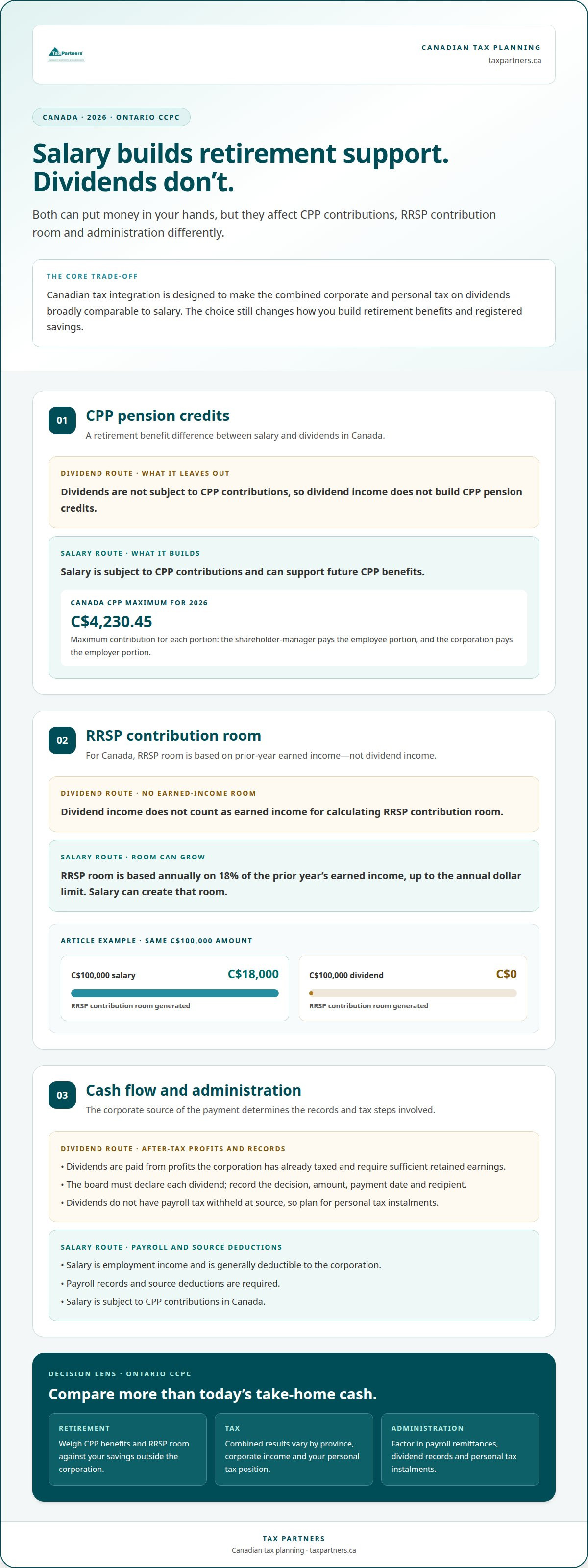
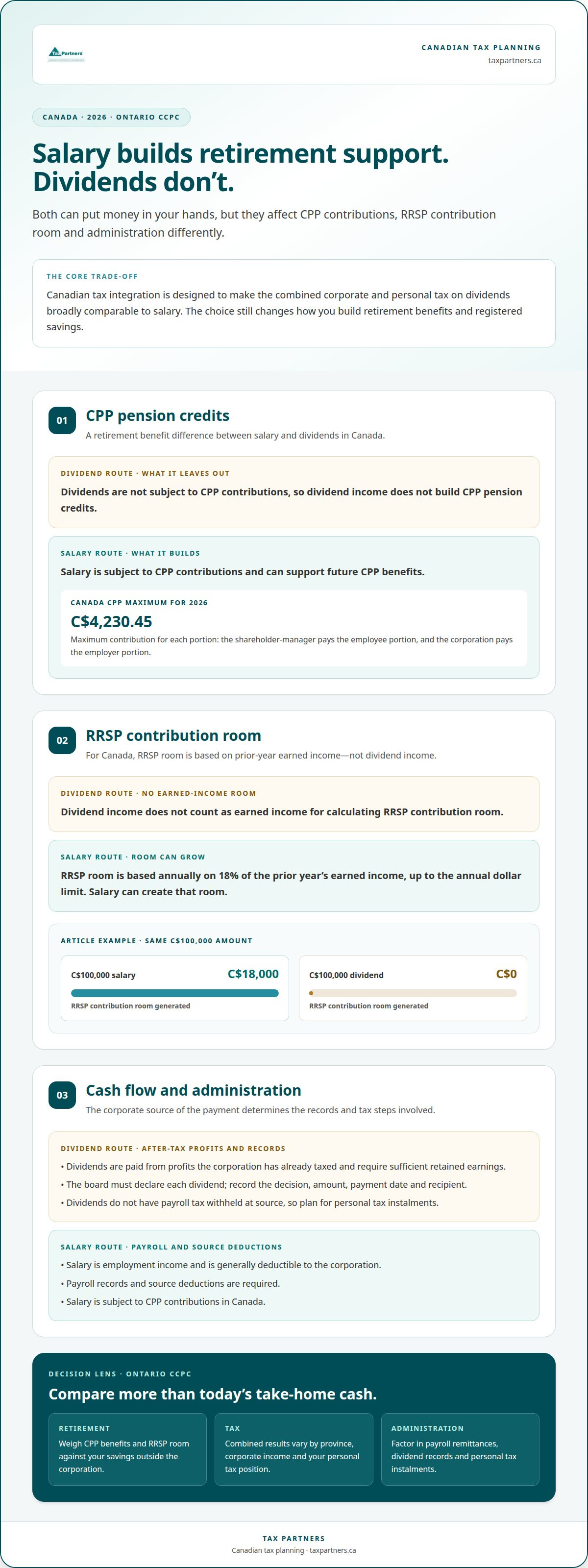
Dividends can provide cash for retirement, but they don’t build Canada Pension Plan (CPP) pension credits or Registered Retirement Savings Plan (RRSP) contribution room. Salary creates CPP contributions and earned income, which can support future retirement benefits and registered savings. In Canada, this difference matters even when both options provide similar spending money today.
For CPP in 2026, salary is subject to contributions, while dividends aren’t subject to CPP contributions. According to the Canada Revenue Agency, the 2026 maximum CPP contribution is C$4,230.45 for each employee and employer portion. A shareholder-manager receiving salary bears the employee portion, while the corporation pays the employer portion.
RRSP room is another retirement trade-off. According to the Canada Revenue Agency, RRSP contribution room is based annually on 18% of the prior year’s earned income, up to the annual dollar limit. Salary can create that room; dividend income doesn’t count as earned income for this purpose. For example, a C$100,000 salary generates C$18,000 of RRSP contribution room, while a C$100,000 dividend generates none.
This difference affects how you build savings outside the corporation. If you rely mainly on dividends, consider whether you’re setting aside enough for retirement through other savings and investments. Salary may support CPP and RRSP participation, while dividends can leave more funds available for current personal or corporate priorities.
Payroll also creates ongoing reporting duties. A salary requires payroll source deductions, including income tax and CPP, and the corporation reports employment income on a T4 slip. Those deductions affect take-home pay during the year, but they also require accurate payroll records and remittances; directors can be held personally liable for unremitted payroll source deductions.
The federal small business deduction limit for Canadian-controlled private corporations is C$500,000 in Canada and in most provinces and territories. This limit affects how qualifying corporate income is taxed, not whether an owner earns RRSP room. Keep the distinction clear: corporate profit may fund compensation, but only earned income supports RRSP room.
Eligible child care expenses add another planning consideration for Canadian business owners. The deduction generally requires earned income, so salary can support eligibility where dividends alone may not. The amount and treatment depend on the applicable rules and circumstances, but income type is an important part of the comparison.
To align payroll deductions and T4 reporting with your compensation plan, get support with payroll administration.
Should I pay myself salary or dividends from my Ontario CCPC?
For an Ontario CCPC, the choice involves more than personal tax. Compare current cash flow, pension-building, RRSP room, corporate earnings and the records required for each payment.
Salary and Dividend Compensation Examples
A salary is earned income; dividends are distributions from corporate profits. In Canada, the Canada Revenue Agency sets the 2026 employer and employee CPP contribution rate at 5.95% each. Salary therefore directs a portion of compensation toward CPP, while dividends avoid CPP contributions but don’t build CPP pension credits.
Ontario’s top personal marginal tax rate exceeds 53%. The tax result also depends on whether dividends are eligible or non-eligible, since each has different tax-credit treatment. A comparison should account for both corporate tax and the shareholder’s personal income, rather than judging only by the amount deposited.
For 2026, Ontario’s combined small-business corporate tax rate is 11.2% effective 1 July, and its combined general corporate rate is 26.5%. The applicable rate depends on the corporation’s income and eligibility for the small business deduction. These corporate rates affect the after-tax earnings available for dividends, while salary is treated as a corporate expense.
Dividends can provide more immediate cash because they avoid CPP contributions. Salary can support retirement planning through CPP and earned income. An Ontario owner-manager should weigh these outcomes alongside personal tax, business cash needs and income timing.
Blended Owner Compensation
A blended approach pays part of compensation as salary and the rest as dividends. Unlike an all-salary or all-dividend approach, it balances payroll-based earned income with distributions from corporate profits.
For example, a 40% salary and 60% dividend split is one possible first-year transition when managing accumulated dividend-tax obligations. It isn’t a standard formula. The appropriate portions depend on the owner’s income, retirement priorities, and the corporation’s available earnings.
Salary paid to a spouse must reflect work actually performed and reasonable compensation. Under section 67, an unreasonable amount may not qualify as a deductible business expense. Tie the amount to the spouse’s duties and contributions, and maintain records that explain the compensation decision.
Plan the mix around specific objectives rather than choosing a fixed split out of habit. Consider whether you need earned income for retirement savings, how much profit the corporation must retain, and whether regular payroll deductions suit its cash flow. Dividends also require available after-tax corporate profits and proper records.
Review the mix as income, family circumstances and retirement goals change. For business owners considering how their compensation structure fits into broader succession and exit planning, educational guides from significantbusinessresults.com offer practical insights on leadership and corporate value. A forecast comparing personal tax, corporate tax, CPP and retained earnings can show the trade-offs before compensation is paid. The aim is a deliberate plan, not simply the option with the lowest immediate deductions.
Salary or Dividends: What’s the Best Way for Business Owners to Pay Themselves?
In Canada, eligible and non-eligible dividends have different gross-up and dividend tax credit treatment. Eligible dividends generally come from income taxed at the general corporate rate, while small-business profits most often produce non-eligible dividends.
Dividends can give a shareholder flexibility over when to draw corporate funds, but personal tax still applies. The practical difference is that salary usually has income tax withheld through payroll, while dividend payments don’t have payroll withholding.
Dividend Tax Treatment
When you receive a dividend, Canada’s tax system grosses up the amount and provides a dividend tax credit intended to recognize corporate tax already paid. The eligible or non-eligible classification determines which gross-up and credit apply, so the dividend type matters alongside your other personal income.
For Ontario, the federal dividend tax credit is 15.02% of the grossed-up amount for eligible dividends and 9.03% for non-eligible dividends. These credits don’t make dividends tax-free; they form part of the calculation on your personal return.
Use the dividend classification shown in the corporation’s records and tax reporting. Don’t treat every distribution as eligible: small-business income most often supports non-eligible dividends, which receive a smaller dividend tax credit.
Dividend Flexibility and Personal Tax Planning
Unlike salary paid through payroll, dividends don’t have regular income tax withheld at source. That can leave more cash available when they’re paid, but the shareholder needs to plan for the personal tax bill instead of treating the full deposit as spendable income.
For Canadian individuals, tax instalments generally apply when personal tax owing exceeds C$3,000 at tax time in either of the previous two years. The first personal tax instalment is due March 15. Personal tax on dividends is due April 30, so setting aside cash as dividends arrive can help prepare for the bill.
Build a practical routine: record each dividend, keep its classification with the supporting corporate documents, and set aside funds for personal income tax. Compare expected dividend income with salary and other income before deciding how much cash to draw. This helps prevent a large tax balance from disrupting household savings or pension contributions.
Salary may suit an owner who values payroll withholding and wants earned income for contribution room. Dividends may suit a shareholder seeking flexible distributions from corporate profits, provided personal tax and instalment obligations are included in the plan. Review the mix as income and retirement priorities change rather than relying on the same approach every year.
Dividend filing and payroll administration
Salary and dividends create different administrative work for a Canadian corporation. Payroll involves recurring calculations and source deductions; dividends require corporate approval, accurate shareholder records and tax-slip reporting.
For salary, set up each pay period with gross employment income, federal and provincial income tax deductions, and CPP contributions. Record the employee and employer amounts separately, then reconcile payroll records with the corporation’s remittances. Accurate T4 reporting also supports the salary history used to calculate earned income and future RRSP room.
- Payroll: Calculate salary and required deductions for each pay period, then record and remit the amounts.
- CPP: Track employee and employer contributions separately in the corporation’s payroll records.
- Year-end: Reconcile payroll totals with the employee’s T4 slip and the corporation’s accounts.
Dividends don’t run through payroll, so they don’t require payroll source deductions or CPP contributions. Instead, document the corporate decision, the shareholder receiving the payment, its amount and its eligible or non-eligible classification. Matching the accounting entry to the corporate records helps ensure the shareholder’s tax reporting reflects the payment.
For Canadian reporting, a T4 slip for a spouse employee must be issued by the last day of February annually. Dividend payments have a separate reporting process: the T5 filing deadline is February 28. Treat each deadline as a year-end close task, and reconcile recipient details and payment amounts before preparing slips.
Payroll errors can create more than a year-end correction. In Canada, directors can be held personally liable for unremitted payroll source deductions, and late salary-withholding remittances can incur a penalty of 10% of the remitted amount. A missed or inaccurate remittance can therefore affect both corporate compliance and directors personally.
Dividends require disciplined record-keeping, even without payroll deductions. Before payment, record the directors’ declaration and confirm the corporation’s accounts reflect the distribution. Then match each shareholder payment to its tax-slip information. This helps distinguish compensation from other corporate transactions and supports a reliable calculation of total tax.
Choose an administrative routine that fits the compensation method: payroll needs regular deductions and remittances, while dividends need documented declarations and recipient reporting. Get help organizing payroll and dividend records so reporting follows the payments made.
Tax Partners
Tax Partners can help you assess salary and dividends alongside corporate tax, personal income, retirement priorities and record-keeping. Its Canadian Accounting & Tax Services and Bookkeeping and Payroll Services support compensation planning and related reporting. Wealth Management & Financial Planning connects business decisions with longer-term goals.
Consider working with Tax Partners when reviewing your compensation approach or planning how it fits your financial goals. A coordinated discussion can bring business and personal considerations together.
If you’d like support with your compensation planning, contact Tax Partners.
Make your next compensation decision deliberately
Your compensation plan can evolve as your business, household priorities and retirement goals change. Revisit the salary-and-dividend mix when your circumstances shift rather than treating it as a permanent choice made once and left untouched.
For Canadian business owners weighing dividends against salary in 2026, a useful next step is to map out the upcoming year before setting compensation. Consider expected business cash needs, personal spending, savings goals, and the records each payment method requires. A clear forecast can help you see how one decision affects the others, and give you a practical basis for discussing adjustments.
Tax Partners can help you work through the relevant tax and bookkeeping considerations for your situation. Discuss your compensation plan with Tax Partners and take your next step with greater clarity.
Frequently Asked Questions
What are dividends and how are they taxed?
Dividends are distributions a corporation pays to shareholders from corporate profits. In Canada, shareholders report dividends as personal income, and the eligible or non-eligible classification affects the applicable gross-up and dividend tax credit. For example, a shareholder receiving dividends from a small business should use the classification reported by the corporation rather than assume the payment qualifies as eligible.
What is a salary and how is it taxed?
Salary is compensation a corporation pays for work, reported as employment income on the recipient’s Canadian personal tax return. The corporation withholds income tax and makes required payroll deductions, then reports the amounts on a T4 slip. Unlike a dividend, salary can create earned income for RRSP purposes. The recipient’s final personal tax depends on total income and applicable federal and provincial rates.
How do tax rules vary by province?
Canadian owner-managers face federal tax rules alongside provincial or territorial personal and corporate tax rules. As a result, the same salary or dividend can produce different combined outcomes depending on where the business earns income and where the owner pays personal tax. For example, Ontario’s 2026 combined corporate rate differs from the broader range across provinces and territories, so a national comparison may not fit an Ontario CCPC.
Salary vs Dividends in Canada (2026): How Should You Pay Yourself?
Choose by weighing current cash flow against retirement savings and administration. An owner who wants earned income for RRSP room and CPP pension credits may favour some salary; someone prioritizing flexible withdrawals may consider dividends. A combination can balance those goals. Before deciding, compare expected corporate profit, personal income, cash reserves and the records required for each payment method.
What are the benefits of a salary?
Salary can create RRSP contribution room and CPP pension credits, while regular payroll withholding can help spread personal tax payments through the year. It also gives the corporation a documented compensation expense when the payment relates to work performed. For a shareholder-manager planning for retirement, these features may matter as much as immediate take-home pay, particularly if dividend income alone wouldn’t support registered savings goals.
How are salary and dividends taxed for Canadian business owners in 2026?
In Canada, salary is generally deductible to the corporation and taxed personally as employment income. Dividends are paid from corporate profits after corporate tax, then reported personally with a dividend tax credit. The combined result depends on the corporation’s income type, province and the owner’s other income. Compare both corporate and personal tax rather than looking only at the personal return or cash received.
What are the 2026 federal and provincial personal income tax rates in Canada?
Canada’s personal income tax combines federal rates with provincial or territorial rates, and the applicable marginal rate depends on taxable income and location. A complete rate comparison must also distinguish ordinary income from eligible and non-eligible dividends, which receive different tax-credit treatment. For a business owner, calculate tax using the compensation type and total personal income rather than applying one headline rate to all income.
How does paying salary versus dividends affect corporate tax and the small business deduction?
In Canada, salary generally reduces corporate profit as a deductible expense; dividends don’t reduce profit because the corporation pays them from after-tax earnings. The federal small business deduction limit is C$500,000 for Canadian-controlled private corporations in most provinces and territories, subject to applicable reduction rules. Compensation choices can therefore affect taxable corporate income, while qualification for the deduction depends on the corporation’s circumstances.

Article by
Mahad Mohamed
Mahad Mohamed is an accountant and the CEO of Tax Partners, with over 26+ years of Canadian and international tax and accounting experience. His expertise includes corporate reorganization, cross-border tax structuring (Canada & US), tax disputes, CRA audits, and tax planning for small owner-managed private corporations. Most recently, Mahad is a pioneer in Canadian crypto taxation and founded Block3 Finance.
Previously, Mahad worked for the Canada Revenue Agency (CRA), Big4 accounting firms, and served as a Rulings Officer for the Federal Tax Authority of the UAE before acquiring Tax Partners in 2014.
Tax Partners has 44 full-time accountants and over 18,400+ clients.
Disclaimer
This article provides general information only and is current as of its publication date. It has not been updated and may be out of date. It does not constitute legal advice and should not be relied upon as such. Every tax situation is unique and may differ from the examples discussed in this article. If you have specific questions, you should seek the advice of our accountants for your unique circumstances. Book a FREE Initial Consultation Today!
Frequently Asked Questions
What are dividends and how are they taxed?
Dividends are distributions a corporation pays to shareholders from corporate profits. In Canada, shareholders report dividends as personal income, and the eligible or non-eligible classification affects the applicable gross-up and dividend tax credit. For example, a shareholder receiving dividends from a small business should use the classification reported by the corporation rather than assume the payment qualifies as eligible.
What is a salary and how is it taxed?
Salary is compensation a corporation pays for work, reported as employment income on the recipient’s Canadian personal tax return. The corporation withholds income tax and makes required payroll deductions, then reports the amounts on a T4 slip. Unlike a dividend, salary can create earned income for RRSP purposes. The recipient’s final personal tax depends on total income and applicable federal and provincial rates.
How do tax rules vary by province?
Canadian owner-managers face federal tax rules alongside provincial or territorial personal and corporate tax rules. As a result, the same salary or dividend can produce different combined outcomes depending on where the business earns income and where the owner pays personal tax. For example, Ontario’s 2026 combined corporate rate differs from the broader range across provinces and territories, so a national comparison may not fit an Ontario CCPC.
Salary vs Dividends in Canada (2026): How Should You Pay Yourself?
Choose by weighing current cash flow against retirement savings and administration. An owner who wants earned income for RRSP room and CPP pension credits may favour some salary; someone prioritizing flexible withdrawals may consider dividends. A combination can balance those goals. Before deciding, compare expected corporate profit, personal income, cash reserves and the records required for each payment method.
What are the benefits of a salary?
Salary can create RRSP contribution room and CPP pension credits, while regular payroll withholding can help spread personal tax payments through the year. It also gives the corporation a documented compensation expense when the payment relates to work performed. For a shareholder-manager planning for retirement, these features may matter as much as immediate take-home pay, particularly if dividend income alone wouldn’t support registered savings goals.
How are salary and dividends taxed for Canadian business owners in 2026?
In Canada, salary is generally deductible to the corporation and taxed personally as employment income. Dividends are paid from corporate profits after corporate tax, then reported personally with a dividend tax credit. The combined result depends on the corporation’s income type, province and the owner’s other income. Compare both corporate and personal tax rather than looking only at the personal return or cash received.
What are the 2026 federal and provincial personal income tax rates in Canada?
Canada’s personal income tax combines federal rates with provincial or territorial rates, and the applicable marginal rate depends on taxable income and location. A complete rate comparison must also distinguish ordinary income from eligible and non-eligible dividends, which receive different tax-credit treatment. For a business owner, calculate tax using the compensation type and total personal income rather than applying one headline rate to all income.
How does paying salary versus dividends affect corporate tax and the small business deduction?
In Canada, salary generally reduces corporate profit as a deductible expense; dividends don’t reduce profit because the corporation pays them from after-tax earnings. The federal small business deduction limit is C$500,000 for Canadian-controlled private corporations in most provinces and territories, subject to applicable reduction rules. Compensation choices can therefore affect taxable corporate income, while qualification for the deduction depends on the corporation’s circumstances.