Early Retirement Financial Planning in Canada: Estimate Your Savings Needs

Early retirement isn’t defined by a single birthday. In Canada, it generally means leaving paid work before the average retirement age of 65, so early retirement financial planning in Canada starts with estimating how long your savings must support you and what income sources will be available along the way.
Wanting more freedom before traditional retirement age is understandable, but the savings target depends on more than your current expenses. A common planning rule of thumb is to save 25 to 30 times your annual expenses; your pension, investments, retirement timeline and expected government benefits all affect how that estimate applies to you.
This guide explains what early retirement can mean, how to estimate the savings you may need, and how the Canada Pension Plan (CPP), a public pension program, workplace pensions and the FIRE (financial independence, retire early) approach fit into a Canadian plan. You’ll learn why the timing of income sources matters, what decisions to consider and how financial planning can bring the pieces together.
Key Takeaways
- CPP can start before age 65 or be delayed, changing the amount you receive. Consider timing alongside your other retirement income.
- RRSP (registered retirement savings plan) contributions and withdrawals affect how retirement savings are used and taxed in Canada; spousal RRSPs may also factor into household income planning.
- Workplace pension terms can shape the cost of retiring early, including possible payment reductions and bridge benefits before age 65.
- A financial planner can bring expenses, income sources, taxes and retirement timing together to estimate the savings your plan needs.
- FIRE offers a framework for pursuing financial independence, but its fit depends on your goals, spending and income plan.
Canada Pension Plan (CPP): Taking It Early or Late?
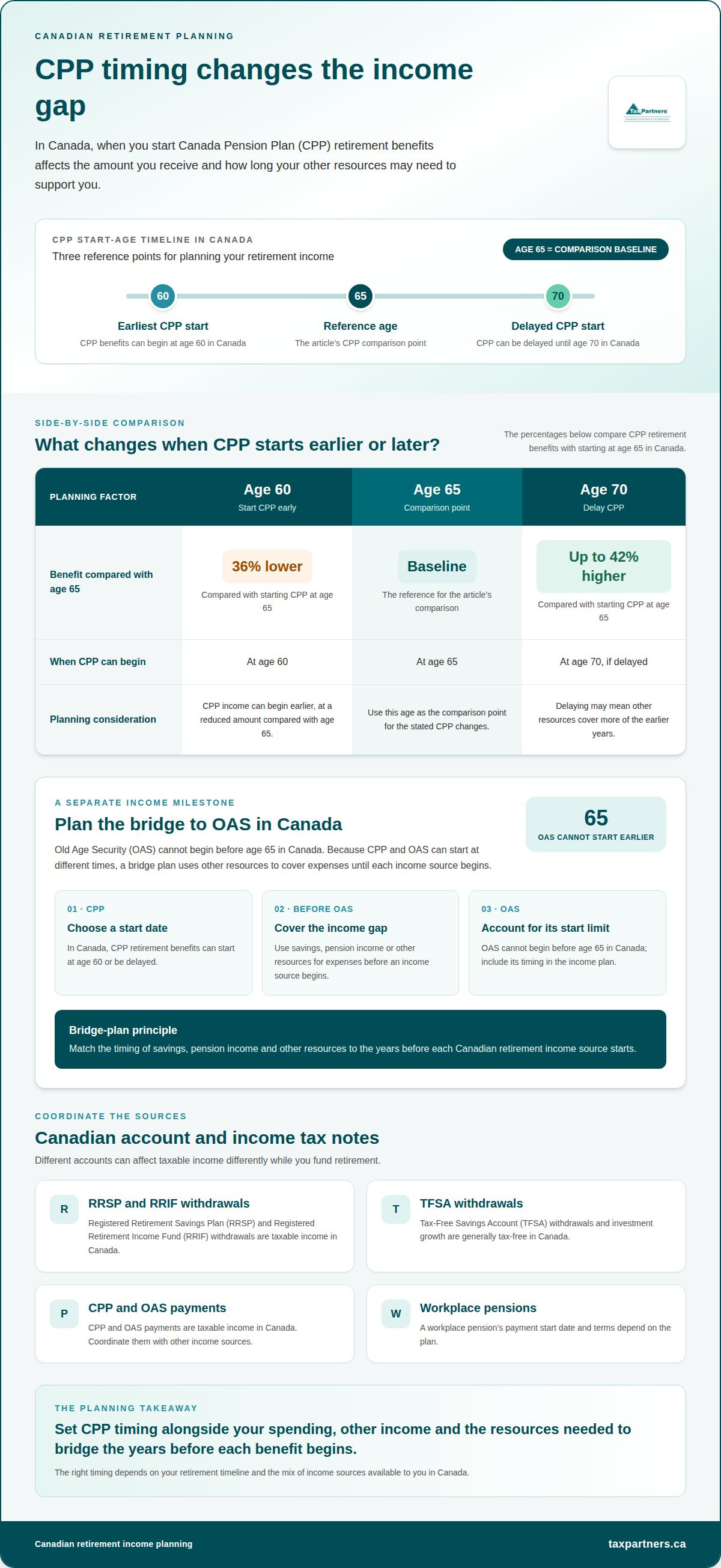
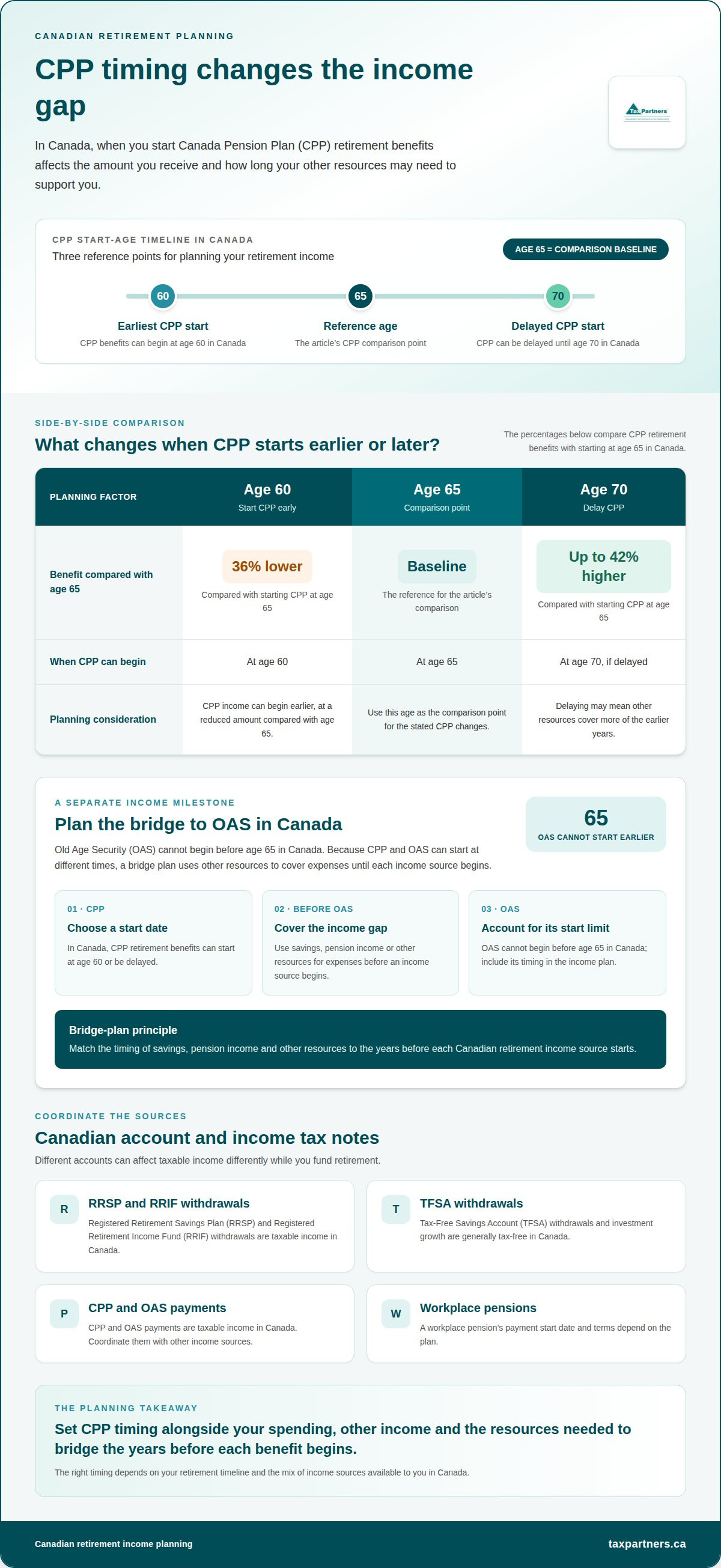
In Canada, CPP retirement benefits can start at age 60, with a 36% reduction compared with starting at age 65. Delaying CPP until age 70 can provide up to 42% more than starting at age 65, so the choice affects how much personal savings must cover earlier years.
Canada’s CPP and Old Age Security (OAS) provide retirement income, but they may not cover the full period before benefits begin. CPP can start at age 60, while OAS cannot begin before age 65. A bridge plan uses savings, pension income or other resources to cover expenses until each income source starts.
Registered Retirement Savings Plans (RRSPs), registered retirement income funds (RRIFs), tax-free savings accounts (TFSAs) and workplace pensions have different access and tax rules in Canada. RRSP withdrawals are taxable income; RRSPs must be converted to a RRIF by December 31 of the year the account holder turns 71. A workplace pension’s payment start date and terms depend on the plan.
For Canadian tax planning, RRSP and RRIF withdrawals, CPP and OAS payments are taxable income. TFSA withdrawals and income from non-registered or corporate accounts affect the tax picture differently. Coordinate how you use these accounts with the timing of pension income.
Coordinate registered and other accounts
RRSP contributions may reduce taxable income in the contribution year, while withdrawals add taxable income when taken. In Canada, the annual RRSP contribution limit is the lesser of 18% of the previous year’s income or the government’s fixed contribution limit for that year; unused room can carry forward. The 2025 limit is C$32,490.
Canada’s TFSA contribution limit is C$7,000 for 2025. A withdrawal can provide a source of funds between retirement and pension start dates. Coordinate TFSA and RRSP withdrawals with non-registered investments and corporate accounts, considering each account’s tax treatment and its role in maintaining long-term growth. Canadian tax planning can account for how these sources work together.
Plan contributions and withdrawals
Review workplace pension matching before directing additional savings elsewhere. If your employer matches RRSP contributions, contributing enough to receive the available match can be part of your plan. Then coordinate RRSP and TFSA contributions with your available contribution room, expected income and retirement timeline.
In Canada, RRIF withdrawals must meet the applicable minimum. One illustrative example uses a 5.4% first-year RRIF withdrawal: a C$1 million balance would produce a C$54,000 withdrawal. This amount is taxable, so the withdrawal schedule should fit alongside CPP, OAS and pension income.
What Does "Early Retirement" Actually Mean?
Early retirement means leaving paid work before your chosen retirement age, not necessarily stopping all income. In Canada, the average retirement age is 65, but your own definition might involve part-time work, a career change or financial independence. Set the goal around the life you want, then identify the annual income needed to support it.
Start with your spending, not a portfolio target. Separate essential costs, such as housing and food, from flexible expenses, such as travel or hobbies. Include irregular costs and income you expect from work, a workplace pension, CPP, investments or property. This gives you a practical estimate of the income your savings need to provide.
Income sources can work in different ways. A Canadian investment portfolio of C$1 million yielding 4% generates C$40,000 annually in dividend income in one example. A rental property generating C$3,500 per month provides C$42,000 per year before expenses. An annuity example pays C$2,500 monthly for life after a C$500,000 purchase. Each source has different risks, flexibility and tax treatment.
Spousal RRSPs can also shape a household’s retirement income. For example, a higher-earning spouse making C$300,000 could contribute to a spousal RRSP for a spouse earning C$70,000. Spousal RRSP contributions and withdrawals can have tax implications for both spouses, so consider the household’s circumstances when planning them. For RRIF income, eligible couples may split pension income for tax purposes once the account holder is 65 and the RRSP has been converted to a RRIF.
A TFSA offers flexible access to savings, and its investment growth and withdrawals are generally tax-free in Canada. It can be useful for income needs before registered retirement income begins. The right mix of accounts depends on withdrawal timing, taxable income and future pension payments.
Inflation, investment returns and longevity all influence a planner’s projection. The plan tests how rising costs and varying growth affect future income, and considers that Canadians’ life expectancy is about 82 years. Retiring early can extend the period savings must support you.
A market downturn near retirement can reduce your portfolio’s value just as withdrawals begin. Selling investments after a decline may leave fewer assets to participate in a recovery. A plan can help coordinate flexible spending and income sources through different market conditions.
A financial planner brings your goals, accounts, pension estimates and tax considerations into one retirement income plan. If you want professional help translating those details into a coordinated strategy, discuss your retirement plan.
Estimating early-retirement savings needs
A financial planner estimates the gap between your expected spending and dependable retirement income, then assesses how savings could fill it. Early retirement financial planning in Canada brings together your retirement date, account types, workplace pensions and the start dates for CPP and Old Age Security.
Compound Growth and Early Saving
Compound growth occurs when investment returns stay invested and can generate further returns over time. Starting earlier gives savings more time to grow. Delaying contributions may mean making larger regular deposits to pursue the same target.
One example assumes an average annual return of 5%, compounded monthly. Under that assumption, investing C$300 monthly for 40 years accumulates to C$457,806; C$500 monthly reaches C$763,010, and C$750 monthly reaches C$1,144,515. These projections illustrate how contribution size and time influence retirement savings, not a guaranteed result.
Using Retirement Savings Calculators
A retirement savings calculator estimates future savings using inputs such as current balances, regular contributions, expected returns and retirement timing. A planner can use it to compare scenarios and show how a later start or changed contribution could affect projected assets.
A calculator is only as useful as its assumptions. A planner considers inflation, investment growth, spending needs and longevity, then tests how different outcomes affect the income gap. Canada’s life expectancy is about 82 years, so projections should account for the possibility that savings support a long retirement.
Estimate the Income Gap
A planner begins with expected annual expenses, then separates essential costs from discretionary spending. A common rule of thumb is to save 25 to 30 times annual expenses.
That range is a starting point, not a complete plan. A planner subtracts expected income from a workplace pension, CPP, OAS and other sources from projected spending. The remaining gap indicates how much your retirement savings may need to provide, and for how long.
The analysis also considers when each income source can begin. If you retire before CPP or OAS eligibility, savings may need to cover more of the early years. Pension terms, investment accounts and taxable income all help shape the withdrawal strategy.
Protect and Grow Retirement Savings
A planner assesses how investment choices, withdrawals and timing work together to support your savings through changing markets. A downturn near retirement can affect portfolio value just as withdrawals begin, so the plan can test lower-return periods and flexible spending assumptions.
The strategy also coordinates registered, TFSA, non-registered and corporate accounts according to their tax treatment and intended use. Workplace pension income can reduce the amount your savings need to provide, while future CPP and Old Age Security can change your withdrawal pattern. A planner brings these details together so early retirement financial planning in Canada reflects your household’s goals and available income sources.
Employer pension provisions for early retirement
A workplace pension can provide income before government benefits begin, but its start date and payment terms shape your retirement plan. Review them alongside the timing of CPP and Old Age Security.
Workplace Pension Timing and Benefits
A workplace pension’s timing and benefits are determined by the terms of its pension plan. Some Canadian plans offer a bridge benefit between early retirement and age 65, when it may end.
For a defined benefit pension, early retirement can reduce monthly payments. One plan example applies a 0.5% reduction for each month retirement precedes the plan’s normal retirement age. The reduction’s effect depends on the plan’s terms and chosen start date, so an advisor can include both in the financial plan.
Compare the pension income you could receive at different start dates with household expenses and other retirement income. A bridge benefit may provide temporary income, but account for what happens when it ends. This helps show whether savings will need to cover a larger share of spending later.
Early Retirement Effects on Pensions and CPP Contributions
Leaving work early can change when workplace pension income begins and how long employment-based CPP contributions continue. In Canada, CPP retirement benefits can begin at age 60; OAS benefits cannot begin before age 65. A retirement plan must account for the income gap between leaving work and starting each benefit.
CPP contributions are linked to employment earnings, so leaving paid work changes your future contribution activity. The effect on your eventual CPP pension depends on your contribution history. An advisor can include expected CPP income in projections rather than treating it as an immediate replacement for employment income.
Your plan should also account for the workplace pension’s normal retirement age, early payment adjustments and any bridge benefit. These terms can change your expected cash flow at different stages. Reviewing projections annually helps an advisor update the plan when your retirement timing, work income or pension estimates change.
Healthcare needs matter in the years between leaving work and receiving later retirement income. Include prescription medicines, dental and vision care, and the end date of any employer coverage in your cash-flow plan. Coverage and out-of-pocket needs vary, so make your budget reflect your circumstances.
Private health insurance is another potential expense. One estimate puts comprehensive coverage for a healthy couple at C$300-C$500 per month. This is a planning example, not a universal amount; age, coverage choices and household needs affect the expense. An advisor can include it with pension income and savings needs to assess whether the retirement plan can achieve its intended spending goals.
Early retirement and the FIRE approach in Canada
FIRE means financial independence, retire early: building assets and income that can support your chosen lifestyle without relying on full-time employment. In Canada, it is a planning approach, not a fixed retirement age or government program. The central question is whether savings and other income can cover expenses before and after CPP and Old Age Security begin.
Your target depends on the life you plan to fund. A household planning modest spending may need a different level of assets than one budgeting for travel, a mortgage or family support. Estimate regular and irregular expenses, then consider how part-time earnings, a workplace pension, investments or rental income could change what your savings need to provide.
FIRE can also describe different work choices. Some people leave paid work entirely; others reduce hours or change careers after reaching partial financial independence. One example describes a lawyer working 15 hours weekly by age 42, with passive income exceeding their needs by age 47. That path combines investment income and ongoing work rather than an immediate, complete exit.
Canadian account rules affect how a FIRE plan is funded. A TFSA can help cover planned expenses before age 65, the earliest age for OAS, while RRSP withdrawals add taxable income. One example uses TFSA funds to cover expenses from age 52 to 65. Coordinating account withdrawals with later pension income can help manage taxable income across different retirement stages.
Income targets should distinguish portfolio value from spendable cash flow. Account for taxes, investment withdrawals and costs that may rise over time. Government benefits can contribute to income later, but you still need a plan for the years before eligibility and for expenses those benefits do not cover.
Review FIRE projections regularly. Investment growth can vary, and a long retirement may require savings to last for decades. A plan can test changes in expenses, work income and market conditions, then help you adjust your retirement date or spending assumptions. Flexibility matters: room to earn income or reduce discretionary spending gives you more options when circumstances change.
Confidence and expectations are worth weighing alongside a numerical target. In 2024, 31% of non-retirees in Canada felt confident about their expected retirement income, compared with 55% in 2019. Also, 41% of Canadian retirees said their current financial standard of living was lower than expected before retirement. These figures underline why a FIRE decision should connect projected income with the lifestyle you intend to maintain.
A clear takeaway: treat FIRE as a personalized financial plan, not a universal savings formula. If you’re considering an early-retirement timeline, discuss your financial plan with a professional.
Tax Partners: Wealth Management & Financial Planning
Tax Partners brings retirement goals, savings, pension income and tax considerations together through Wealth Management & Financial Planning. This can help when you’re weighing an early retirement date, coordinating withdrawals across accounts or aligning investment decisions with expected income.
Canadian Accounting & Tax Services can support the tax side of retirement planning. Start the planning conversation with your retirement goals, income sources and the decisions you’re considering.
Contact Tax Partners to discuss your retirement planning needs.
Make your next move with confidence
Your retirement plan should evolve as your priorities, income and circumstances change. Bring those moving parts into one forward-looking plan so decisions about work, savings and future income support the life you want.
Tax Partners offers Wealth Management & Financial Planning, Canadian Accounting & Tax Services, and Bookkeeping and Payroll Services. These services can connect financial planning with the tax and income considerations that shape an early retirement plan in Canada.
Contact Tax Partners to discuss your plans. A thoughtful conversation can help you identify a clear direction for the next stage.
Frequently Asked Questions
How can a financial planner estimate how much you should save for your retirement plan?
A financial planner estimates a savings target by comparing projected spending with expected income and existing assets. They can model different retirement dates, include workplace pension estimates and account for savings in registered and non-registered accounts. For example, a plan can show how your target changes if you work part-time for a period or postpone withdrawals from an investment account.
What happens if I over-contribute to my RRSP or TFSA?
In Canada, an RRSP holder can exceed their contribution limit by C$2,000 without penalty; beyond that, a 1% monthly penalty applies to the excess amount. A TFSA over-contribution is subject to a 1% monthly penalty on the excess. Track contributions and available room across accounts, since excess amounts can remain subject to the monthly charge until corrected.
When should I start planning for retirement?
Start planning when retirement becomes a financial goal, then revisit your plan as circumstances change. A new job, changing family responsibilities, a business transition or a shift in your desired retirement date can affect savings and expected income. Starting earlier gives you more time to adjust contributions and goals; even with a later start, a clear view of expenses and available resources is useful.
How can a financial planner estimate how much money you need to retire early in Canada?
A planner estimates the amount you may need by projecting the years before CPP and OAS income begins, then assessing later retirement income separately. The plan accounts for expected spending, pensions, savings and other income across both periods. For early retirement financial planning in Canada, this distinction matters: the assets needed to bridge the first years may differ from the amount needed once government benefits begin.
How does a financial planner calculate retirement expenses and savings needs in Canada?
A planner groups spending into recurring costs, flexible expenses and irregular items, then considers how those needs may change after you stop working. They compare the resulting cash-flow estimate with pension income, investment income and available savings. For example, commuting costs may fall after retirement, while travel or health-related spending could take a larger share of your household budget.
How do CPP and OAS benefits change if I retire before age 65?
In Canada, CPP can begin at age 60, but starting then means a 36% reduction compared with starting at age 65. OAS cannot begin before age 65, so retiring earlier may leave a period without either benefit. Delaying CPP until age 70 can provide up to 42% more than starting at age 65, changing how much other income must cover.
How can a financial planner structure RRSP and TFSA withdrawals for early retirement in Canada?
A planner can coordinate withdrawals by considering how each account affects taxable income and future flexibility. RRSP withdrawals are taxable, while TFSA withdrawals offer a different source of funds. The plan can compare which account to draw from at each retirement phase, while factoring in pension income and expected CPP or OAS. This helps align cash flow with both current needs and later years.

Article by
Mahad Mohamed
Mahad Mohamed is an accountant and the CEO of Tax Partners, with over 26+ years of Canadian and international tax and accounting experience. His expertise includes corporate reorganization, cross-border tax structuring (Canada & US), tax disputes, CRA audits, and tax planning for small owner-managed private corporations. Most recently, Mahad is a pioneer in Canadian crypto taxation and founded Block3 Finance.
Previously, Mahad worked for the Canada Revenue Agency (CRA), Big4 accounting firms, and served as a Rulings Officer for the Federal Tax Authority of the UAE before acquiring Tax Partners in 2014.
Tax Partners has 44 full-time accountants and over 18,400+ clients.
Disclaimer
This article provides general information only and is current as of its publication date. It has not been updated and may be out of date. It does not constitute legal advice and should not be relied upon as such. Every tax situation is unique and may differ from the examples discussed in this article. If you have specific questions, you should seek the advice of our accountants for your unique circumstances. Book a FREE Initial Consultation Today!
Frequently Asked Questions
How can a financial planner estimate how much you should save for your retirement plan?
A financial planner estimates a savings target by comparing projected spending with expected income and existing assets. They can model different retirement dates, include workplace pension estimates and account for savings in registered and non-registered accounts. For example, a plan can show how your target changes if you work part-time for a period or postpone withdrawals from an investment account.
What happens if I over-contribute to my RRSP or TFSA?
In Canada, an RRSP holder can exceed their contribution limit by C$2,000 without penalty; beyond that, a 1% monthly penalty applies to the excess amount. A TFSA over-contribution is subject to a 1% monthly penalty on the excess. Track contributions and available room across accounts, since excess amounts can remain subject to the monthly charge until corrected.
When should I start planning for retirement?
Start planning when retirement becomes a financial goal, then revisit your plan as circumstances change. A new job, changing family responsibilities, a business transition or a shift in your desired retirement date can affect savings and expected income. Starting earlier gives you more time to adjust contributions and goals; even with a later start, a clear view of expenses and available resources is useful.
How can a financial planner estimate how much money you need to retire early in Canada?
A planner estimates the amount you may need by projecting the years before CPP and OAS income begins, then assessing later retirement income separately. The plan accounts for expected spending, pensions, savings and other income across both periods. For early retirement financial planning in Canada, this distinction matters: the assets needed to bridge the first years may differ from the amount needed once government benefits begin.
How does a financial planner calculate retirement expenses and savings needs in Canada?
A planner groups spending into recurring costs, flexible expenses and irregular items, then considers how those needs may change after you stop working. They compare the resulting cash-flow estimate with pension income, investment income and available savings. For example, commuting costs may fall after retirement, while travel or health-related spending could take a larger share of your household budget.
How do CPP and OAS benefits change if I retire before age 65?
In Canada, CPP can begin at age 60, but starting then means a 36% reduction compared with starting at age 65. OAS cannot begin before age 65, so retiring earlier may leave a period without either benefit. Delaying CPP until age 70 can provide up to 42% more than starting at age 65, changing how much other income must cover.
How can a financial planner structure RRSP and TFSA withdrawals for early retirement in Canada?
A planner can coordinate withdrawals by considering how each account affects taxable income and future flexibility. RRSP withdrawals are taxable, while TFSA withdrawals offer a different source of funds. The plan can compare which account to draw from at each retirement phase, while factoring in pension income and expected CPP or OAS. This helps align cash flow with both current needs and later years.