Employee or independent contractor in Canada? Understand your tax status

The label on a contract doesn’t settle the employee vs independent contractor Canada tax question. Classification depends on the true nature of the working relationship: how much control the payer has, who carries financial risk, whether the worker can earn a profit, and how the parties operate in practice. A third possibility, dependent contractor, can also matter when a worker relies financially on one main client.
It’s understandable to look for a clear dividing line, especially when status affects tax treatment and access to employment-related benefits. This article explains how control, tools, subcontracting, financial risk and profit potential fit into the Canadian assessment, and why no single factor decides the result. You’ll also learn how personal service business rules may affect an incorporated contractor, and what distinguishes employees, independent contractors and dependent contractors. The aim is a clearer view of the relationship, not just the title attached to it.
Key Takeaways
- Assess the actual working relationship, not just the title in a contract; several factors are considered together.
- Look at who directs the work, supplies tools, can subcontract and carries operating costs to understand the level of independence.
- Consider whether the worker can increase profit through business decisions or faces a real risk of loss.
- Incorporation alone doesn’t settle tax treatment; personal service business rules may affect how the corporation is taxed and which expenses it can deduct.
- Distinguish dependent contractors from employees and independent contractors, since financial reliance on one main client can affect the relationship.
Employees or independent contractors, what’s the difference?
In Canada, classification depends on the real working relationship, not just the contract’s title. Outside Quebec, the CRA weighs several factors together to decide whether a worker is an employee or self-employed.
Worker classification factors
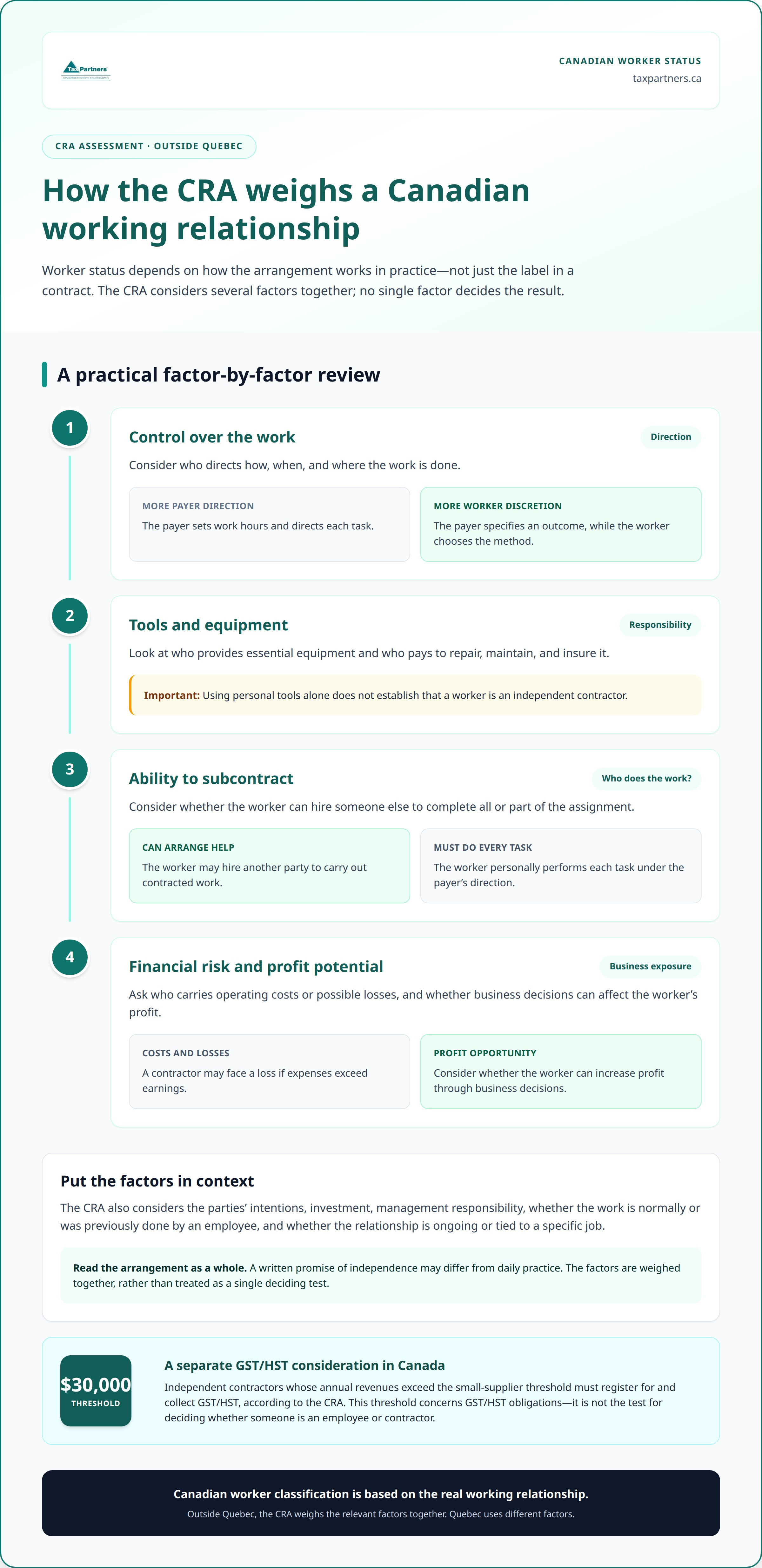
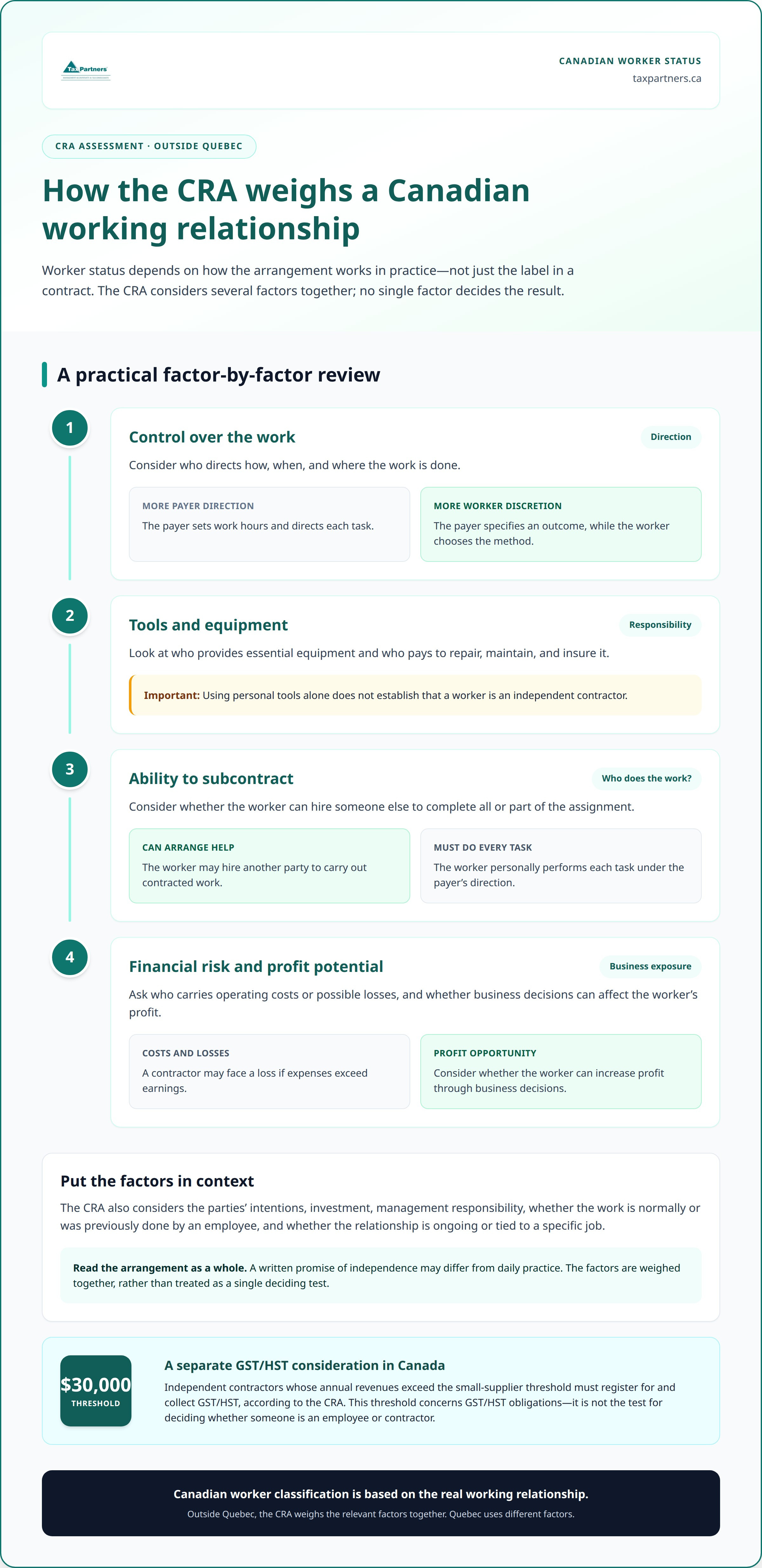
The assessment considers the parties’ intentions and how their arrangement works in practice. Outside Quebec, relevant factors include control, tools and equipment, subcontracting, financial risk, investment, management responsibility, and opportunity for profit.
No single factor determines status. For example, using personal tools doesn’t automatically make a worker an independent contractor. The CRA also considers whether the work is normally or was previously performed by an employee, and whether the relationship is ongoing or tied to a specific job. Quebec uses different factors.
Worker and payer relationships
A self-employed worker carries on a business and provides services under a contract for services. An employee generally works under the payer’s direction and control under a contract of service. Calling someone a contractor doesn’t override how the relationship actually operates.
In Canada, independent contractors whose annual revenues exceed the $30,000 small-supplier threshold must register for and collect GST/HST, according to the Canada Revenue Agency. This threshold concerns GST/HST obligations, not the test for deciding whether someone is an employee or contractor.
Court decisions on classification
Canadian court decisions show how classification depends on the facts of each working relationship. The CRA guide cites Wiebe Door Services Ltd. v Canada (M.N.R.), [1986] 3 F.C. 553, and 1392644 Ontario Inc. (Connor Homes) v Canada (National Revenue), 2013 FCA 85.
In IBI Behavioural Services Inc. v. M.N.R., 2023 TCC 159, the Tax Court of Canada found the worker was an employee. In Beach Place Ventures Ltd. v. The Queen, 2019 TCC 24, it found the taxi drivers were independent contractors under the Income Tax Act. Different outcomes reflect the particular facts considered.
Tax and contribution responsibilities
For an employee in Canada, the employer deducts income tax, CPP contributions, and EI premiums from pay. A self-employed worker manages their own income tax and pays both portions of CPP contributions. For 2026 Canadian CPP rates and maximums, consult the CRA’s current figures; they aren’t provided here.
If worker status is uncertain, either the worker or payer can request a CRA CPP/EI ruling. The request deadline is June 29 of the year following the year in question. If the CRA reclassifies a contractor as an employee, the employer may owe unpaid taxes, past CPP and EI remittances, and applicable penalties. Canadian tax rules also inform these responsibilities.
Control, tools, subcontracting, and financial risk
In Canada, control and financial exposure help show whether a worker runs an independent business. The parties’ intentions matter, but the working arrangement must reflect them.
Control and financial risk
Control concerns who directs how, when, and where work gets done. Financial risk concerns who bears operating costs or possible losses. These factors help distinguish an employee working under a client’s direction from a contractor responsible for delivering a service.
For example, a payer that sets work hours and directs each task exercises more control than one that specifies an outcome and leaves the method to the worker. A contractor may also face a loss if expenses exceed earnings. Both examples contribute to the classification assessment, but neither decides it alone.
Look at the practical arrangement, not just a written promise of independence. If a contract gives a worker freedom but the client directs daily tasks, the parties’ stated intentions and actual conduct may point in different directions. That difference is relevant when assessing the relationship.
Tools, equipment, and subcontracting
Ownership of tools and equipment, responsibility for their costs, and the ability to subcontract can indicate how independently a worker operates. A contractor who supplies equipment and pays for its repair, maintenance, and insurance has responsibilities that may differ from those of an employee using the payer’s equipment.
Consider a worker who brings specialized equipment, maintains it, and can hire someone to complete part of an assignment. Those facts may support a business relationship, particularly when the worker also manages costs. By contrast, supplying a personal tool alone doesn’t establish independent status.
Subcontracting means more than having help nearby: an independent contractor may hire another party to complete all or part of the contracted work. If the worker must personally perform every task under the payer’s direction, that presents a different picture. The assessment weighs these details alongside control and financial risk.
For a practical comparison, consider who:
- sets the work method, schedule, and location;
- provides and maintains essential equipment;
- pays operating costs and absorbs losses; and
- can arrange for another person to complete the work.
Together, these questions clarify the parties’ responsibilities. A worker’s independent choices about equipment or subcontracting carry more weight when the day-to-day relationship supports those choices.
If control, costs, or subcontracting arrangements are difficult to assess, discuss the tax implications of your working arrangement.
Independent contractors usually own the tools and equipment needed for their work and are responsible for repair, maintenance, and insurance costs.
Alberta’s Workers’ Compensation Board considers whether workers are hired, whether an unincorporated business is independent and established, and whether it involves substantial investment when assessing an employer’s account application. These considerations look beyond who supplies equipment to the circumstances of the business and work arrangement. Tool ownership and responsibility for upkeep can help describe a worker’s role, while the board’s listed considerations address whether the business is established and involves substantial investment. Looking at both sets of details keeps the assessment focused on practical responsibilities.
Opportunity for profit or loss
The possibility of earning more or losing money can help distinguish a business relationship from employment in Canada. An employee normally doesn’t face either outcome under their employment terms, while an independent contractor may. This profit-or-loss factor is one part of assessing the Canadian tax distinction between employees and independent contractors.
The key issue is whether the worker’s decisions can affect the financial result. A contractor may be able to organize a project in a way that increases the amount left after costs. The same arrangement may expose the contractor to a loss if costs rise or the work takes longer than planned.
Consider a contractor who agrees to complete a project for a set fee. If the contractor manages the work efficiently and keeps costs below the fee, the remaining amount may increase their profit. If expenses exceed the fee or unexpected work takes more time, the contractor may earn less or incur a loss.
Compare that arrangement with an employee paid to complete assigned duties. The employee generally doesn’t keep extra profit by finishing sooner and doesn’t bear the employer’s loss if a project costs more than expected. The contrast helps show who carries the financial consequences of the work.
Payment structure provides useful context, but a fixed fee alone doesn’t establish contractor status. The assessment considers whether the worker can influence the financial outcome and carries business obligations linked to the work. Payment that varies by result may matter differently from wages tied to assigned duties.
Financial records can help show how the arrangement works in practice. For example, project invoices, cost records, and agreements may show whether the worker manages the project’s financial outcome or simply receives set pay. Independent contractors and small businesses often rely on firms like InterUSA Tax & Accounting to maintain organized financial records and track project expenses. Consider those records alongside the actual responsibilities and the parties’ conduct.
Assess the arrangement as a whole. Factors that may indicate profit potential or exposure to loss include:
- whether the worker can make decisions that increase the amount retained from a project;
- whether the worker bears costs that exceed the agreed payment;
- whether payment is tied to completing a result or carrying out assigned duties; and
- whether the worker’s obligations include managing the project’s financial outcome.
These indicators work together, rather than as a checklist with one decisive answer. A worker may have project costs without meaningful control over the financial result. The nature of the arrangement, not one isolated expense, informs the employee-versus-contractor tax assessment in Canada.
If the financial terms make a working relationship difficult to assess, discuss your Canadian tax situation.
Personal Service Business rules for incorporated contractors
Incorporation doesn’t automatically make a worker’s income eligible for the small business deduction. In Canada, Personal Service Business rules can apply when a corporation provides services through an incorporated worker whose working relationship resembles employment.
How the rules can apply
The Canada Revenue Agency considers multiple factors when deciding whether an incorporated individual operates a Personal Service Business. A contract alone is typically insufficient; the actual working relationship and the parties’ conduct also matter.
For example, incorporation may not settle the issue if the worker is integrated into a payer’s business and performs services much like an employee. The assessment also considers financial risk, investment, management responsibility, control, and whether the worker uses their own tools. No single factor determines the result.
Share ownership can also be relevant. Under the Personal Service Business rules described here, a specified shareholder generally owns 10% or more of any class of shares. A corporation with five or more full-time employees throughout the year is exempt from Personal Service Business status under this rule.
Tax treatment and deductions
The classification matters because a Personal Service Business corporation loses access to the small business deduction. In Ontario, the general corporate tax rate for Personal Service Business income is 26.5%.
For comparison, the Ontario small-business tax rate described for active business income is 13.3% on the first C$500,000. That rate doesn’t apply to Personal Service Business income through the small business deduction, because those corporations lose access to that deduction.
Personal Service Business corporations may deduct the salary paid to the incorporated employee and certain expenses specifically incurred to earn income from the contract. This is narrower than assuming every corporate operating cost can reduce that income. The nature and purpose of each expense matter.
Assess the business relationship
Business presence involves more than having a corporation, business name, or tools. A worker may have those features yet remain closely integrated into one payer’s operations, so the CRA considers how the work is actually performed.
Assess the arrangement as a whole: who directs the work, who bears financial risk, whether the corporation invests in delivering services, and whether it has full-time employees. These details help distinguish a genuine business operation from an incorporated role that resembles employment.
A ruling can address employment status for CPP and EI purposes, but it doesn’t replace the broader Personal Service Business analysis. Ontario corporations should also consider how these rules affect their corporate income tax treatment.
Differences between employees, independent contractors and dependent contractors
Canadian working relationships generally fall into employee or independent contractor categories, but dependent contractor status can also matter. The distinction affects tax and contribution treatment, while employment protections may depend on the province and the relationship’s actual terms.
An employee typically works as part of the payer’s business, under its direction, and may receive benefits through that employer. An independent contractor runs a business, may serve several clients, and generally controls how the work is completed. The agreement’s label doesn’t settle status if the working arrangement points elsewhere.
A dependent contractor occupies a middle ground: the worker operates under a contract but relies financially on primarily one client. Courts in a few Canadian provinces recognize this category. If the relationship resembles employment more than independent contracting, a dependent contractor may have certain rights employees also have, including potential severance.
The difference can affect benefits and workplace rights. Employees may be entitled to benefit plans, such as registered pension plans or group health and dental coverage; independent contractors generally aren’t entitled to employee benefit plans. Vacation pay, overtime, and termination protections depend on the applicable employment rules and the worker’s true status. If a contractor is reclassified, the payer may owe vacation pay and other benefits for past services.
Employment Insurance can also depend on classification. An employee may have access to EI benefits, while an independent contractor doesn’t receive employee protections on that basis. A dependent contractor’s financial reliance on one client may shape the relationship but doesn’t, by itself, settle EI treatment.
Canadian legislation also reflects the importance of status: paragraph 6(1)(a) of the Canada Pension Plan is a legislative reference relevant to employment status, according to Department of Justice Canada. The Employment Insurance Act is also relevant to determining employment status and EI entitlement in Canada.
Consider a courier who signs an independent contractor agreement but works mainly for one payer. If the payer controls the work and the courier depends financially on that relationship, the contractor label may not capture the full picture. By contrast, a courier who serves several clients and manages the work independently may have a stronger business relationship.
For workers, the practical takeaway is to distinguish the contract’s wording from the rights and responsibilities that follow the real relationship. For payers, a change in duties or dependence on one client can make a past classification less reliable. Discuss a worker classification concern when the arrangement affects benefits, contributions, or termination obligations.
Employees are generally reimbursed for work expenses and aren’t usually responsible for operating expenses or financially liable for failing to meet their contractual obligations. In Canada, employees typically work for one business, while independent contractors usually have several clients and control their working conditions. An employee isn’t considered to operate their own business but is treated as an integral part of the payer’s business.
Dependent contractors are financially dependent on primarily one client and may have certain rights that employees also have. In 2014 BCSC 1429, the Supreme Court of British Columbia awarded damages in lieu of notice to a courier driver who was a dependent contractor. Paragraph 5(1)(a) of the Employment Insurance Act is a legislative reference relevant to employment status.
Tax Partners
Tax Partners helps workers and businesses understand the Canadian tax and payroll implications of a working arrangement. If employee or contractor status affects income reporting, CPP contributions, or payroll deductions, Canadian accounting and tax support can help clarify the obligations arising from the relationship.
For businesses managing employee and contractor payments, bookkeeping and payroll services can support accurate records and payroll administration. This can be useful when a role changes, a contractor arrangement becomes ongoing, or the parties review how payments have been recorded. For incorporated contractors, support can also help organize business income reporting and company records.
For help with the tax and payroll questions raised by your working relationship, contact Tax Partners.
Make classification part of your next decision
The employee-versus-independent-contractor tax question in Canada is worth revisiting when duties, client dependence, or the way work is managed changes. A written agreement can describe the parties’ intentions, but reviewing how the arrangement operates in practice can help align tax reporting and payroll decisions.
Tax Partners supports this work through Canadian Accounting & Tax Services and Bookkeeping and Payroll Services.
If a current or changing work arrangement raises questions about classification, contact Tax Partners to discuss your tax situation. A considered next step can help you move forward with greater clarity.
Frequently Asked Questions
How does the CRA determine whether a worker is an employee or independent contractor in Canada?
The CRA assesses the full working relationship, including the parties’ intentions and how the arrangement operates in practice. Outside Quebec, it considers factors such as control, tools, financial risk, investment, management responsibility, and opportunity for profit. In Quebec, the assessment considers how the work is carried out, remuneration, and subordination. For example, a contractor label in a contract may carry less weight if daily practices show close direction by the payer.
How do employee and contractor tax rules vary by province or territory in Canada?
Tax classification is assessed under Canadian rules, but employment standards and related workplace obligations vary by province and territory. Quebec also uses different factors to assess worker status. For a business operating across jurisdictions, the same role may raise separate questions about tax treatment and provincial employment protections. The worker’s location, the payer’s operations, and whether the work falls in a federally regulated industry can all affect which employment standards apply.
How can a worker request a CRA ruling on employee versus self-employed status in Canada?
Either the worker or the payer can request a CRA CPP/EI ruling to determine the worker’s status. The request must be made by June 29 of the year after the year in question.

Article by
Mahad Mohamed
Mahad Mohamed is an accountant and the CEO of Tax Partners, with over 26+ years of Canadian and international tax and accounting experience. His expertise includes corporate reorganization, cross-border tax structuring (Canada & US), tax disputes, CRA audits, and tax planning for small owner-managed private corporations. Most recently, Mahad is a pioneer in Canadian crypto taxation and founded Block3 Finance.
Previously, Mahad worked for the Canada Revenue Agency (CRA), Big4 accounting firms, and served as a Rulings Officer for the Federal Tax Authority of the UAE before acquiring Tax Partners in 2014.
Tax Partners has 44 full-time accountants and over 18,400+ clients.
Disclaimer
This article provides general information only and is current as of its publication date. It has not been updated and may be out of date. It does not constitute legal advice and should not be relied upon as such. Every tax situation is unique and may differ from the examples discussed in this article. If you have specific questions, you should seek the advice of our accountants for your unique circumstances. Book a FREE Initial Consultation Today!
Frequently Asked Questions
How does the CRA determine whether a worker is an employee or independent contractor in Canada?
The CRA assesses the full working relationship, including the parties’ intentions and how the arrangement operates in practice. Outside Quebec, it considers factors such as control, tools, financial risk, investment, management responsibility, and opportunity for profit. In Quebec, the assessment considers how the work is carried out, remuneration, and subordination. For example, a contractor label in a contract may carry less weight if daily practices show close direction by the payer.
How do employee and contractor tax rules vary by province or territory in Canada?
Tax classification is assessed under Canadian rules, but employment standards and related workplace obligations vary by province and territory. Quebec also uses different factors to assess worker status. For a business operating across jurisdictions, the same role may raise separate questions about tax treatment and provincial employment protections. The worker’s location, the payer’s operations, and whether the work falls in a federally regulated industry can all affect which employment standards apply.
How can a worker request a CRA ruling on employee versus self-employed status in Canada?
Either the worker or the payer can request a CRA CPP/EI ruling to determine the worker’s status. The request must be made by June 29 of the year after the year in question.