Estate Planning Accountant Ontario: Guide for CRA Filers

Your family legacy shouldn't be treated as a final tax windfall for the government. Many Ontarians are surprised to learn that the Canada Revenue Agency (CRA) applies a "deemed disposition" rule at death, which means the law treats your assets as if you sold them at fair market value right before you passed. Partnering with a specialized estate planning accountant Ontario ensures you aren't leaving your heirs with an unexpected tax bill.
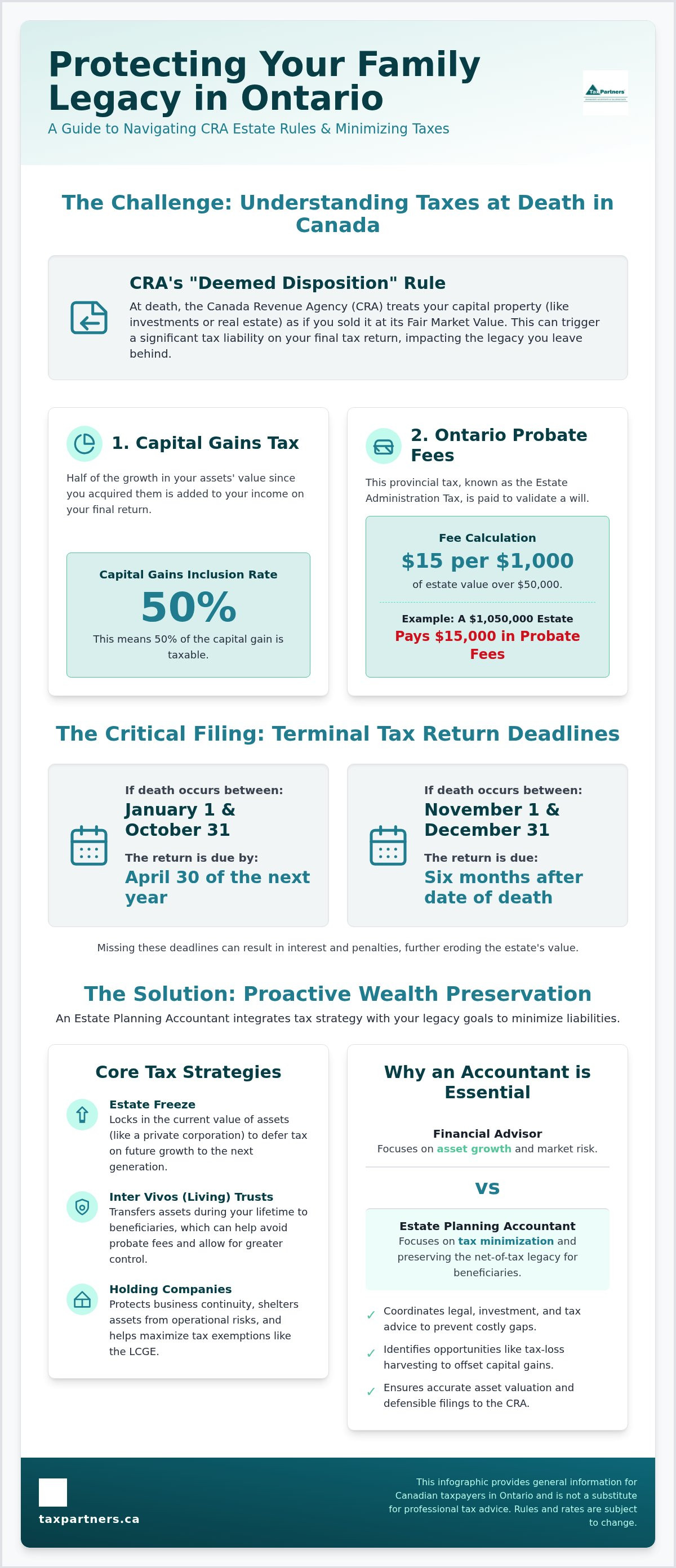
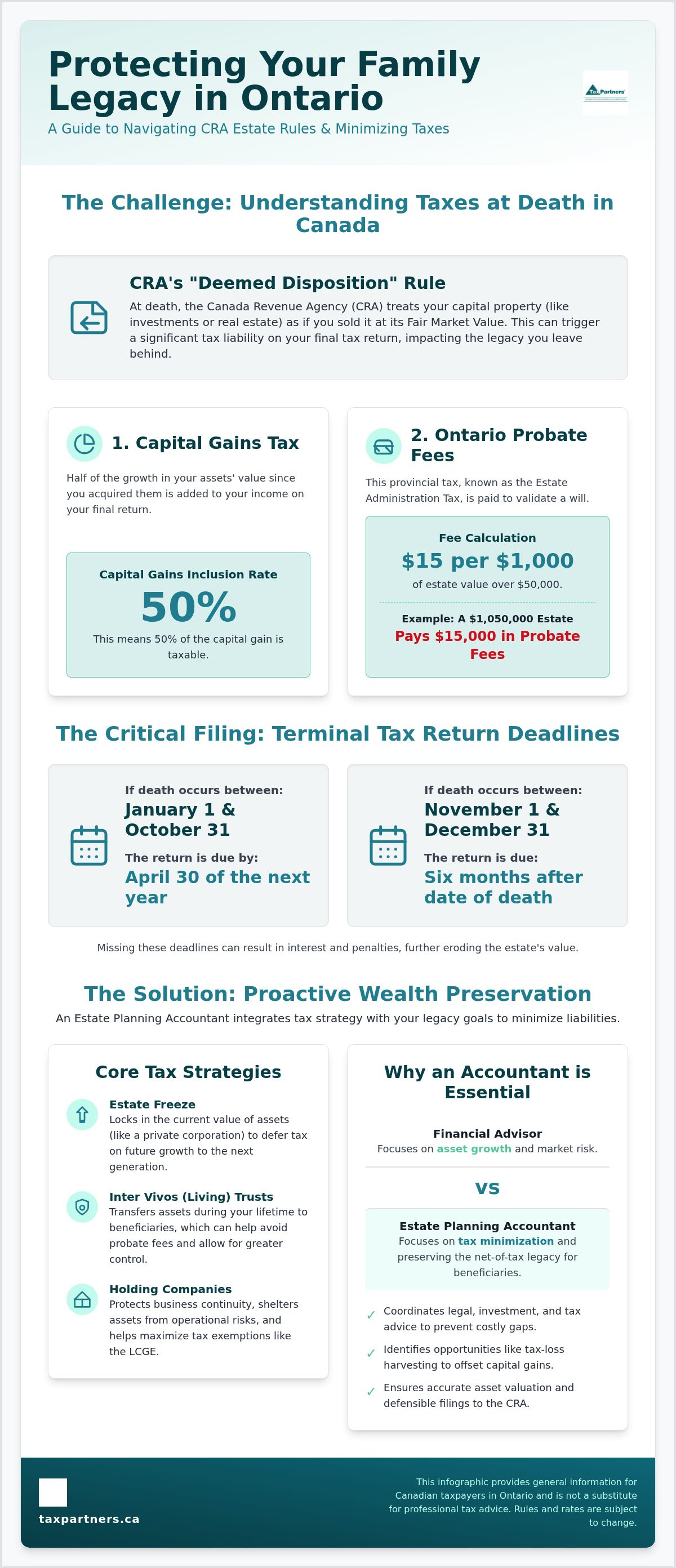
It's natural to feel anxious about the CRA taking a significant portion of what you've spent a lifetime building. You might also worry about "probate," which is the Ontario provincial tax paid to validate a will, currently costing $15 for every $1,000 of estate value over $50,000. These costs can quickly erode the wealth intended for your children or the continuity of your business.
This guide will show you how to protect your assets and minimize these liabilities through proactive strategies. We'll explore a clear roadmap for asset transfer, including ways to reduce capital gains taxes and secure your family's future. You'll gain the peace of mind that comes from having a steady hand at the helm of your financial legacy.
Key Takeaways
- Understand how the CRA's "deemed disposition" rule triggers capital gains tax on your assets at death and how to prepare for this mandatory tax filing.
- Learn why partnering with an estate planning accountant Ontario is essential for managing the intricate tax consequences that standard financial planning often misses.
- Discover how strategic tools like an "Estate Freeze" or Inter Vivos trusts can lock in asset values to limit the future tax burden on your beneficiaries.
- Explore how holding companies and formal succession planning protect your business continuity while maximizing available CRA tax exemptions.
- Identify proactive steps to minimize Ontario probate fees and ensure your family legacy remains intact through seasoned professional oversight.
Understanding Deemed Disposition and CRA Estate Rules
Canada's tax system handles death with a specific mechanism known as "deemed disposition." Unlike some other countries, we don't have a standalone federal inheritance tax. Instead, the CRA treats you as if you sold all your capital property at its fair market value (FMV) immediately before you passed away. This transition from traditional estate taxes is detailed in the History of Canadian Estate and Gift Taxes, which explains how our current system focuses on taxing accrued gains rather than the transfer of wealth itself.
For Ontario residents holding investment properties or diverse portfolios, this rule often triggers a substantial capital gains tax bill. Under current 2026 CRA rules, the capital gains inclusion rate is 50%. This means half of the increase in your assets' value is added to your income on your final return. Without the guidance of an estate planning accountant Ontario, your heirs could face a sudden liquidity crisis. They might be forced to sell off family assets just to settle the debt with the CRA.
The Concept of Fair Market Value for CRA Filers
Fair market value is defined as the highest price a willing buyer would pay a willing seller in an open market. While this is straightforward for public stocks, it's far more complex for non-liquid assets like real estate or private company shares. The CRA scrutinizes these valuations closely. If you underestimate the value of a property or a business, the estate risks a costly audit and potential penalties. We recommend obtaining professional appraisals to ensure your figures are defensible and accurate. You can find more detail on how we support these filings on our estate income tax services page.
Terminal Tax Return Deadlines and Requirements
The final tax filing for a deceased individual is called a terminal return. It's quite different from the annual filings you're used to because it captures all income earned from January 1 up to the date of passing, including those deemed gains. Deadlines for the terminal return are strict and depend on when the death occurred:
- January 1 to October 31: The return is due by April 30 of the following year.
- November 1 to December 31: The return is due six months after the date of death.
Missing these windows can lead to interest charges that erode the value of the legacy you've worked so hard to build. Proactive planning ensures your executor has the information they need to meet these obligations without delay. It's about providing a clear path forward during a difficult time.
The Role of an Estate Planning Accountant for CRA Filers
Building wealth is only half of the journey. Protecting it from excessive taxation requires a different set of tools and a specialized perspective. While many people rely on financial advisors for asset allocation, an estate planning accountant Ontario focuses on the intricate tax consequences that follow a lifetime of growth. They ensure that your final transition of wealth is as seamless and cost-effective as possible.
One of the greatest risks to a family legacy is "siloed advice." This happens when your investment strategy, legal will, and tax planning aren't coordinated. A CPA acts as a proactive guardian, identifying opportunities like tax-loss harvesting to offset the capital gains triggered by CRA rules. By selling underperforming assets at a loss, you can reduce the taxable income on your terminal return and keep more wealth within the family.
Professional oversight from provincial CPA bodies also provides an essential layer of public protection. When you work with a designated accountant, you're benefiting from a professional held to high ethical standards and rigorous continuing education. This expertise is vital when navigating the complexities of CRA compliance reviews and ensuring your filings are beyond reproach.
CPA vs. Financial Advisor: Choosing the Right Professional
Financial advisors are excellent at growing your portfolio and managing market risk. However, they don't always specialize in the technical nuances of tax minimization or the preservation of a net-of-tax legacy. Accountants bridge this gap by focusing on the "bottom line" of what your beneficiaries actually receive after the CRA takes its portion. This tax-centric approach is the only way to maximize the true value of an estate.
Credentials matter when dealing with the CRA. A seasoned accountant understands the specific thresholds and rules that apply to 2026 filings, such as the Lifetime Capital Gains Exemption or the specific reporting requirements for digital assets. This precision prevents costly errors that could delay the distribution of assets for months or even years.
Integrated Financial Guardianship
We believe in a "mentor" approach to financial health, where we guide families through complex transitions over decades. This involves coordinating closely with your legal professionals to ensure your will is structured to minimize the Ontario Estate Administration Tax. In 2026, this tax costs $15 for every $1,000 of value over $50,000, making probate planning a high priority for many Ontario families.
Our firm is deeply committed to our mission to provide ethical steadfastness in every client interaction. We don't just react to tax forms; we look ahead to secure the best possible outcome for the next generation. If you want to ensure your family is fully provided for, you can reach out to our team to start building your comprehensive strategy.
Core Tax Strategies for Wealth Preservation in Ontario
Proactive wealth preservation moves beyond simple compliance. It focuses on reducing the taxable value of your estate while you're still here to manage the process. By working with an estate planning accountant Ontario, you can deploy sophisticated tools that mitigate the tax impact of a deemed disposition before it ever occurs.
Life insurance serves as a vital liquidity tool in this process. It provides the immediate cash your executor needs to settle with the CRA, ensuring your heirs don't have to liquidate family real estate or business shares under pressure. Similarly, charitable giving through your will creates tax credits that can offset up to 100% of the income reported on your terminal return.
The Estate Freeze Strategy for Growing Assets
An estate freeze "locks in" the current value of your assets, such as shares in a family business. You exchange your appreciating common shares for fixed-value preferred shares. This allows all future growth to accrue to the next generation through new common shares, effectively capping your future capital gains tax liability.
Timing is critical for Ontario business owners considering this move. You should implement a freeze when your business has achieved significant value but still possesses substantial growth potential. Waiting too long increases the tax bill you'll eventually face upon the deemed disposition of those preferred shares.
The CRA maintains strict technical requirements for these reorganizations under the Income Tax Act. If the exchange isn't executed with precision, it could trigger an immediate tax hit or be ignored during a later audit. Professional oversight ensures the freeze is recognized and your tax deferral remains secure.
Utilizing Trusts for Wealth Transfer
Trusts are versatile vehicles that dictate how and when your wealth is distributed to beneficiaries. An Inter Vivos trust is established during your lifetime, while a Testamentary trust is created through your will upon death. Each has distinct tax treatments under CRA rules that must be carefully managed to avoid double taxation.
These structures are excellent for protecting the financial welfare of a surviving spouse or ensuring minor children receive support over many years. They allow for controlled distributions rather than a single lump sum, which can protect assets from creditors or matrimonial claims. Trusts also help assets bypass the probate process, saving on provincial fees.
For a deeper look at how these structures integrate with your long-term goals, explore our Wealth Management & Financial Planning services. We help you balance immediate tax savings with the long-term security of your heirs.
Succession Planning for Canadian Business Owners
For many Ontario entrepreneurs, their business represents the majority of their net worth. Without a formal succession plan, the transition of ownership can lead to operational chaos and a massive tax bill from the CRA. An estate planning accountant Ontario helps you balance the need for business continuity with the necessity of tax efficiency.
Succession planning ensures that your business remains a viable legacy rather than a liability for your heirs. It involves more than just picking a successor; it requires a structural overhaul that protects your assets from creditors and the taxman. This proactive approach allows you to step away with confidence, knowing the enterprise you built will thrive under new leadership.
Holding Company Tax Planning and Risks
Holding companies are powerful tools for managing surplus cash and corporate investments. By moving excess profits from an operating company to a holding company, you can protect those funds from business risks while deferring personal taxes. You can explore how these structures fit into your broader strategy on our Corporate Income Tax services page.
However, you must be careful with CRA rules regarding passive income. Passive income is money earned from investments, like interest or dividends, rather than active business operations. If your corporation earns more than $50,000 in passive income, the CRA begins to reduce your access to the small business tax rate. Managing these thresholds is a core part of our "proactive guardian" approach to your wealth.
Five Steps to a Seamless Business Transition
A successful transition requires a methodical approach that starts years before you plan to retire. These steps help minimize friction and maximize the value you retain from the sale or transfer of your shares:
- Identify the Successor: Choose a family member or partner early and establish a clear timeline for their training and eventual takeover.
- Conduct a Valuation: Obtain a professional valuation based on fair market value principles to satisfy CRA requirements and avoid future disputes.
- Optimize Share Structure: Use your Lifetime Capital Gains Exemption (LCGE), which is indexed to approximately $1,275,000 for 2026, to shield a significant portion of your gains.
- Draft a Buy-Sell Agreement: Create a legal contract that dictates how shares are handled if a partner passes away or leaves the business.
- Fund the Transition: Ensure the business has the liquidity, often through life insurance, to buy out shares without crippling the company's cash flow.
Maintaining operational stability during this period is essential for preserving the company's market value. If you're ready to secure your business's future, contact our specialist team to design a bespoke succession strategy.
Securing Your Family Legacy with Tax Partners
Estate planning shouldn't be a reactive exercise performed during a crisis. A proactive, tax-centric approach ensures you stay ahead of CRA requirements rather than scrambling to meet them. By partnering with an estate planning accountant Ontario, you transform a complex legal obligation into a structured generational legacy.
Tax Partners brings over 40 years of institutional wisdom to every client relationship. We've helped Ontario families keep more of what they earn by saving our clients over $87M in potential tax liabilities. This depth of experience allows us to anticipate regulatory shifts and protect your assets with unmatched precision.
It's time to move from uncertainty to total control over your financial future. Knowing that your family is provided for and your business is secure allows you to focus on what matters most. We act as your seasoned mentor, leading you from a state of potential stress toward a feeling of complete understanding.
The Tax Partners Difference
We believe every estate plan requires a bespoke blend of precision, transparency, and foresight. Our team doesn't just fill out forms; we look ahead to secure a better outcome for your heirs. This commitment to ethical steadfastness is why we maintain 1,390+ five-star reviews from clients across Ontario.
We position ourselves as a proactive guardian for your wealth. This means we are constantly looking for ways to reduce your probate fees and capital gains taxes under CRA rules. Our reputation for reliability is built on decades of successful wealth preservation and integrated succession strategies.
Taking the First Step Toward Peace of Mind
Our methodical process begins with a thorough review of your current assets and long-term goals. We then build a personalized roadmap that addresses everything from holding company structures to terminal tax return deadlines. Choosing a dedicated estate planning accountant Ontario ensures that every detail of your strategy aligns with current CRA regulations.
The ultimate goal is a seamless, tax-efficient transfer of everything you've built. We're here to provide the steady hand at the helm that you need to navigate these complex financial waters. You can contact us today to begin your journey toward lasting peace of mind.
Empower Your Future and Protect Your Heirs
Effective estate planning transforms potential tax liabilities into a structured path for generational wealth. By mastering CRA concepts like deemed disposition and utilizing tools like Inter Vivos trusts, you ensure your assets remain within your family rather than being lost to preventable fees. Proactive planning is the only way to safeguard what you've spent a lifetime building.
A dedicated estate planning accountant Ontario provides the foresight needed to navigate these complex regulations with confidence. Tax Partners offers over 40 years of tax planning expertise and has saved clients more than $87M in taxes through proven, CRA-focused strategies for Ontario families. We act as a proactive guardian for your wealth, ensuring every detail is managed with technical precision.
Don't leave your legacy to chance or administrative delays. Secure your legacy today with a specialized estate planning accountant from Tax Partners. We look forward to helping you build a roadmap that brings lasting stability and peace of mind to those you love most.
Frequently Asked Questions
What is the 'deemed disposition' rule in Canadian estate law?
The deemed disposition rule means the CRA considers you to have sold all your capital property at fair market value right before you die. This triggers capital gains tax on the difference between the original cost and the current value. While this creates a tax bill on your final return, an automatic rollover is often available if you're leaving assets to a surviving spouse or common-law partner under CRA regulations.
How much tax will my estate owe to the CRA when I pass away?
Total tax liability is highly individual and depends on your specific asset mix and total capital gains. Your estate will face income tax on half of all capital gains and the full value of non-spousal RRSP transfers. In Ontario, you must also account for the Estate Administration Tax, which is 1.5% on estate values exceeding $50,000. Consulting an estate planning accountant Ontario is the best way to estimate these costs.
Is there an inheritance tax in Ontario for beneficiaries?
Ontario doesn't have a direct inheritance tax for those receiving a legacy. Instead, the deceased's estate is responsible for paying all taxes owing to the CRA before any assets are distributed. Once the executor receives a Tax Clearance Certificate from the CRA, beneficiaries can usually receive their portion of the estate without further tax obligations. This ensures the government collects its share from the estate directly rather than from your heirs.
When is the terminal tax return due for a CRA filer?
The deadline for a terminal tax return depends on the date of death during the calendar year. If a person passes away between January 1 and October 31, the return is due by April 30 of the following year. However, if the death occurs between November 1 and December 31, the CRA allows a six-month window from the date of death. Meeting these timelines is critical to avoid interest charges that can erode your legacy.
Can a trust help reduce the probate fees my estate must pay?
Trusts are effective tools for bypassing the probate process in Ontario. Because assets in a trust are legally owned by the trust rather than the individual, they aren't included in the calculation for the Estate Administration Tax. This can save your heirs $15 for every $1,000 of asset value that is successfully moved outside of the primary estate. It's a proactive way to maintain more of your family's wealth through technical precision.
What is an estate freeze and who should consider one?
An estate freeze is a strategy where you lock in the value of your shares in a private corporation. You exchange your current shares for fixed-value preferred shares, allowing future growth to go to your heirs through new common shares. This is a powerful move for Ontario business owners who expect their company's value to grow significantly and want to cap their future capital gains tax liability under current CRA rules.
How does a holding company fit into an estate planning strategy?
Holding companies act as a protective layer for corporate investments and surplus cash. They allow you to move profits out of an active operating company to shield them from business risks and creditors. In an estate context, a holding company can help you organize assets for the next generation while ensuring the operating company remains eligible for the Lifetime Capital Gains Exemption under CRA rules. It provides a centralized vehicle for long-term wealth.
Why should I hire a CPA instead of just using a will kit?
Will kits focus on the legal transfer of property but often ignore the massive tax liabilities triggered by death. A CPA helps you manage the "deemed disposition" and probate costs that a simple document can't address. Hiring an estate planning accountant Ontario ensures your legacy isn't drained by the CRA because of poor tax structure. It's about combining your legal intent with professional financial oversight to protect your family's future.

Article by
Mahad Mohamed
Mahad Mohamed is an accountant and the CEO of Tax Partners, with over 26+ years of Canadian and international tax and accounting experience. His expertise includes corporate reorganization, cross-border tax structuring (Canada & US), tax disputes, CRA audits, and tax planning for small owner-managed private corporations. Most recently, Mahad is a pioneer in Canadian crypto taxation and founded Block3 Finance.
Previously, Mahad worked for the Canada Revenue Agency (CRA), Big4 accounting firms, and served as a Rulings Officer for the Federal Tax Authority of the UAE before acquiring Tax Partners in 2014.
Tax Partners has 44 full-time accountants and over 18,400+ clients.
Disclaimer
This article provides general information only and is current as of its publication date. It has not been updated and may be out of date. It does not constitute legal advice and should not be relied upon as such. Every tax situation is unique and may differ from the examples discussed in this article. If you have specific questions, you should seek the advice of our accountants for your unique circumstances. Book a FREE Initial Consultation Today!
Frequently Asked Questions
What is the 'deemed disposition' rule in Canadian estate law?
The deemed disposition rule means the CRA considers you to have sold all your capital property at fair market value right before you die. This triggers capital gains tax on the difference between the original cost and the current value. While this creates a tax bill on your final return, an automatic rollover is often available if you're leaving assets to a surviving spouse or common-law partner under CRA regulations.
How much tax will my estate owe to the CRA when I pass away?
Total tax liability is highly individual and depends on your specific asset mix and total capital gains. Your estate will face income tax on half of all capital gains and the full value of non-spousal RRSP transfers. In Ontario, you must also account for the Estate Administration Tax, which is 1.5% on estate values exceeding $50,000. Consulting an estate planning accountant Ontario is the best way to estimate these costs.
Is there an inheritance tax in Ontario for beneficiaries?
Ontario doesn't have a direct inheritance tax for those receiving a legacy. Instead, the deceased's estate is responsible for paying all taxes owing to the CRA before any assets are distributed. Once the executor receives a Tax Clearance Certificate from the CRA, beneficiaries can usually receive their portion of the estate without further tax obligations. This ensures the government collects its share from the estate directly rather than from your heirs.
When is the terminal tax return due for a CRA filer?
The deadline for a terminal tax return depends on the date of death during the calendar year. If a person passes away between January 1 and October 31, the return is due by April 30 of the following year. However, if the death occurs between November 1 and December 31, the CRA allows a six-month window from the date of death. Meeting these timelines is critical to avoid interest charges that can erode your legacy.
Can a trust help reduce the probate fees my estate must pay?
Trusts are effective tools for bypassing the probate process in Ontario. Because assets in a trust are legally owned by the trust rather than the individual, they aren't included in the calculation for the Estate Administration Tax. This can save your heirs $15 for every $1,000 of asset value that is successfully moved outside of the primary estate. It's a proactive way to maintain more of your family's wealth through technical precision.
What is an estate freeze and who should consider one?
An estate freeze is a strategy where you lock in the value of your shares in a private corporation. You exchange your current shares for fixed-value preferred shares, allowing future growth to go to your heirs through new common shares. This is a powerful move for Ontario business owners who expect their company's value to grow significantly and want to cap their future capital gains tax liability under current CRA rules.
How does a holding company fit into an estate planning strategy?
Holding companies act as a protective layer for corporate investments and surplus cash. They allow you to move profits out of an active operating company to shield them from business risks and creditors. In an estate context, a holding company can help you organize assets for the next generation while ensuring the operating company remains eligible for the Lifetime Capital Gains Exemption under CRA rules. It provides a centralized vehicle for long-term wealth.
Why should I hire a CPA instead of just using a will kit?
Will kits focus on the legal transfer of property but often ignore the massive tax liabilities triggered by death. A CPA helps you manage the "deemed disposition" and probate costs that a simple document can't address. Hiring an estate planning accountant Ontario ensures your legacy isn't drained by the CRA because of poor tax structure. It's about combining your legal intent with professional financial oversight to protect your family's future.