E-commerce Tax Accountant Canada: 2026 Seller Guide

What if your international expansion is actually eroding your bottom line through hidden tax leakage? Engaging a specialized ecommerce tax accountant Canada ensures your financial foundation is as robust as your sales strategy. It's natural to feel overwhelmed by the complexities of multi-province GST/HST (Goods and Services Tax and Harmonized Sales Tax) registration and the constant shifts in cross-border trade regulations.
You likely started your business to build a brand, not to spend your nights untangling multi-currency reconciliation or fearing a CRA (Canada Revenue Agency) audit. We understand the unique pressures of managing global revenue while staying compliant with federal and provincial authorities. This 2026 guide will help you master Canadian compliance, protect your margins, and implement accounting strategies tailored for both domestic and cross-border filers.
You'll gain a clear understanding of the $30,000 worldwide revenue threshold for GST/HST registration and how to handle the latest U.S. tariff changes. We'll also preview how to integrate your sales platforms for seamless reporting, ensuring you keep more of your hard-earned profit. Let's move from a state of regulatory uncertainty toward a feeling of total control over your business finances.
Key Takeaways
- Understand how CRA rules apply to your digital storefront, ensuring all worldwide business income is properly reported for Canadian tax purposes.
- Consult an ecommerce tax accountant Canada to monitor your "Small Supplier" status and manage the transition to mandatory GST/HST registration as your revenue grows.
- Simplify your bookkeeping by learning to reconcile platform payouts against gross sales, accounting for hidden costs like merchant fees and shipping labels.
- Determine your US sales tax obligations under IRS rules by identifying "Nexus" thresholds that require you to collect and remit tax to individual states.
- Evaluate the strategic benefits of incorporating as a Canadian-Controlled Private Corporation (CCPC) to protect your margins and access lower corporate tax rates.
Understanding Ecommerce Tax Obligations Under CRA Rules
Ecommerce tax accounting is the specialized practice of managing high-volume digital transactions for accurate tax reporting. Unlike traditional retail, online selling involves a constant stream of micro-data from various payment processors and marketplaces. For CRA filers, your business income is taxable in Canada regardless of where your digital storefront is hosted or where your servers are located. Your tax liability is determined by your residency and the nature of your operations rather than the physical location of a checkout button.
If you are "carrying on business in Canada," you must adhere to specific reporting standards. This legal concept applies if you have a place of business in Canada or if you actively solicit orders from Canadian customers. You must report all income in Canadian dollars. This necessitates accurate currency conversion using the Bank of Canada's annual average exchange rate or the daily rate on the date of the transaction. Precision here is vital to avoid overpaying or triggering red flags during a review.
The Role of an Ecommerce CPA
Traditional bookkeeping often fails to capture the nuance of digital commerce. Standard systems might only record the net payout from a platform, which masks the true gross sales and underlying fees. A dedicated ecommerce tax accountant Canada ensures that every platform-specific fee, refund, and shipping charge is correctly categorized. This level of detail is essential for maintaining a clear audit trail and understanding your true profitability.
This specialized oversight helps you identify tax-deductible expenses unique to the digital space. These often include:
- Digital advertising costs and social media marketing spend.
- Software subscriptions for inventory management and email marketing.
- Home office expenses and specialized hardware for order fulfillment.
Having a professional at your side provides a steady hand during a CRA audit. High transaction volumes make manual reconciliation impossible, so having robust, CPA-verified systems is your best defense against regulatory scrutiny.
Income Tax vs. Sales Tax for Online Sellers
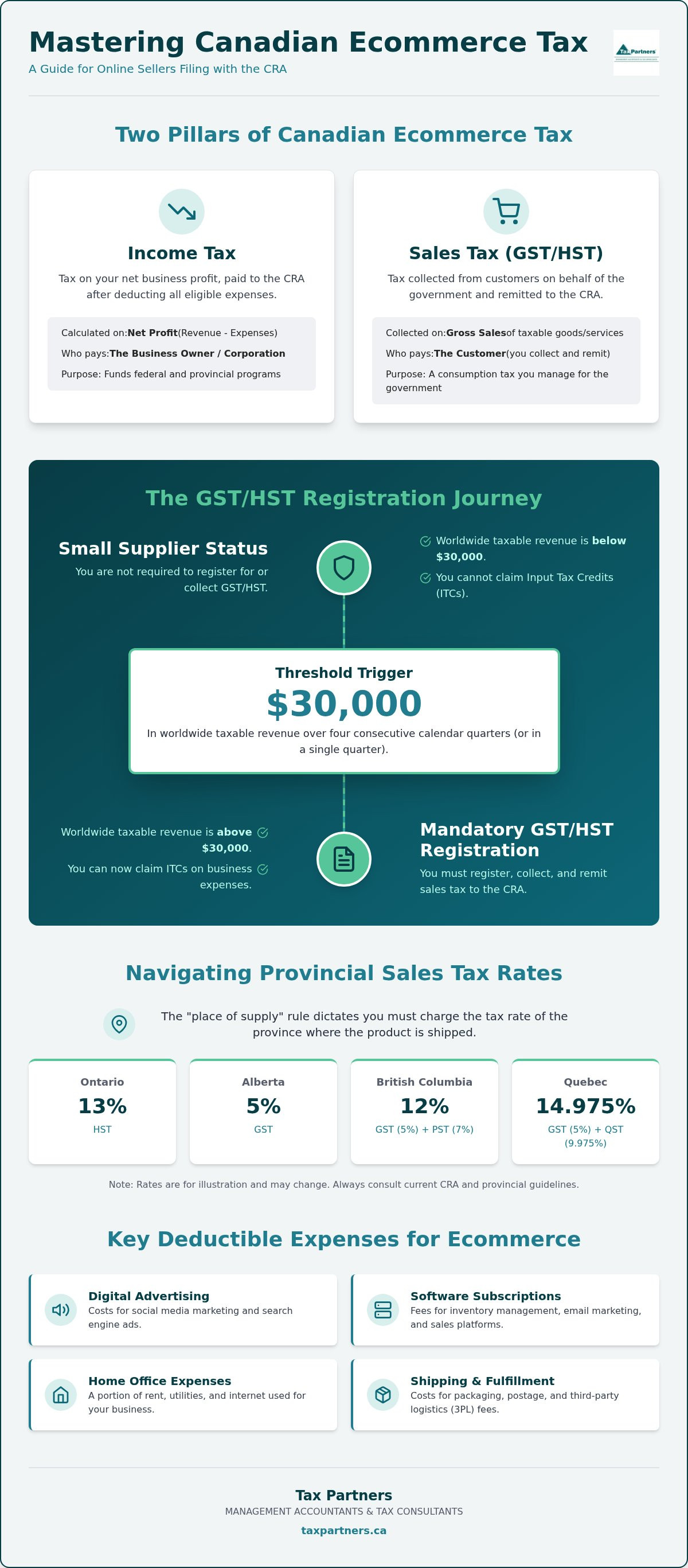
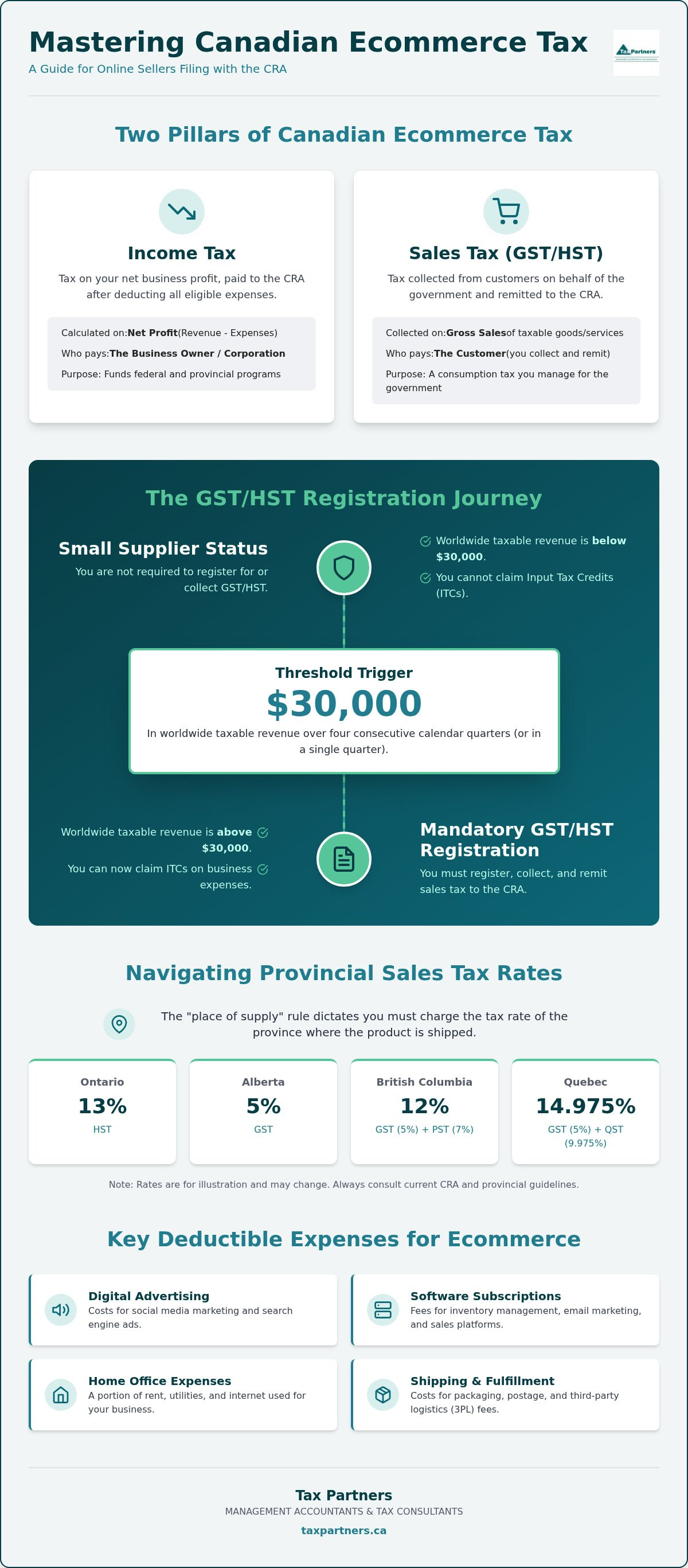
Understanding the distinction between these two obligations is critical for protecting your margins. Income tax is the tax you pay on your net business profits under CRA regulations. It's calculated after all your allowable expenses are deducted from your total revenue. This is a personal or corporate liability depending on how you've structured your business.
In contrast, Sales taxes in Canada, such as the GST (Goods and Services Tax) and HST (Harmonized Sales Tax), are collected from your customers on behalf of the government. You act as a temporary trustee for these funds before remitting them to the CRA. Tracking these separately ensures you don't accidentally spend your sales tax reserves on inventory, which could lead to significant cash flow strain when your filing deadline arrives.
Managing GST/HST and Sales Tax Compliance in Canada
Mastering sales tax is a pivotal step in scaling your online business beyond a hobby. Under CRA rules on GST/HST registration, you must register for an account once your worldwide taxable revenue exceeds $30,000 in a single calendar quarter or over four consecutive quarters. This threshold includes all sales before expenses, so it's vital to monitor your gross revenue closely.
Until you cross this $30,000 mark, the CRA considers you a "Small Supplier." While you aren't required to collect GST/HST as a small supplier, you also cannot claim back the tax you pay on business expenses. Transitioning out of this status requires proactive monitoring from an ecommerce tax accountant Canada to ensure you don't miss the registration window once the threshold is met.
Shipping across Canada introduces the complexity of "place of supply" rules. This means the tax rate you charge depends on the province where your customer receives the goods. For example, a customer in Ontario pays 13% HST, while someone in Alberta only pays 5% GST. You must also navigate Provincial Sales Tax (PST) in British Columbia, Saskatchewan, and Manitoba, along with Quebec Sales Tax (QST), each having its own unique registration requirements.
Maximizing Input Tax Credits (ITCs)
Input Tax Credits (ITCs) are the GST/HST amounts you pay on business-related purchases that you can recover directly from the CRA. Effectively, these credits offset the sales tax you collect from customers, reducing your net remittance. For online sellers, common ITCs include digital advertising spend on social media, monthly platform subscriptions, and physical shipping materials.
Maintaining impeccable records is the only way to safeguard these claims during a CRA review. You must keep digital copies of all receipts and invoices that clearly show the supplier's GST/HST number. If you're feeling overwhelmed by the paperwork, you can connect with our team to streamline your digital record-keeping.
Filing Frequencies and Deadlines
The CRA assigns your filing frequency based on your annual taxable supplies. Most growing businesses file annually or quarterly, though high-volume sellers may be required to file monthly. It's essential to confirm your specific deadlines directly with the CRA, as missing a date can lead to costly interest and penalties.
Professional GST/HST Filing Services ensure your returns are accurate and submitted on time. We help you reconcile your platform data with your bank statements to ensure every dollar is accounted for. This precision protects your margins and provides peace of mind as you focus on growing your brand.
Optimizing Bookkeeping for Shopify and Amazon Platforms
Managing a high-volume storefront requires shifting your focus from bank balances to gross revenue. Many sellers make the mistake of recording only the net payout deposited into their accounts. This approach is flawed because it hides the true cost of doing business. An ecommerce tax accountant Canada helps you unpack these numbers to reveal your actual profitability. You must account for gross sales before Amazon FBA (Fulfillment by Amazon) fees, referral fees, and Shopify subscription charges are deducted.
If you sell a product for $100 but only receive $85 after merchant processor charges and shipping labels, the CRA requires you to report the full $100 as revenue. The $15 in fees is then recorded as a business expense. Cloud-based accounting software that integrates directly with your storefront is the most reliable way to automate this. It ensures that every transaction is synchronized, reducing the risk of manual data entry errors. Transitioning to a system that tracks these details accurately often requires the foresight of a specialized ecommerce tax accountant Canada who understands the digital landscape.
Multi-Currency Reconciliation
Selling globally often means collecting payments in USD, EUR, or GBP. Using the exchange rate provided by your bank can be risky because banks often include a hidden spread that doesn't reflect the official market rate. For CRA filers, you must realize foreign exchange gains or losses based on the difference between the transaction date rate and the settlement date rate. This refers to the profit or loss made when converting one currency to another. Utilizing Professional Bookkeeping Services can help you automate these calculations and maintain compliance with federal reporting standards.
Inventory Management and Tax Precision
Under CRA rules, inventory is treated as an asset until it's sold. This means you cannot simply deduct the cost of your stock the moment you buy it. Instead, it sits on your balance sheet and only moves to your income statement as Cost of Goods Sold (COGS) when a customer makes a purchase. Accurate year-end inventory counts are essential because they directly impact your taxable income for the year.
If your ending inventory is overvalued, your COGS will be lower, which artificially inflates your profit and increases your tax bill. Conversely, identifying "dead stock", which are items that are damaged or unsellable, allows you to perform a write-down. This reduces your inventory asset value and increases your expenses. Proactively managing these write-offs is a simple yet effective way to reduce your tax liability while keeping your financial records clean.
Addressing Cross-Border Sales and IRS Obligations
Selling to customers south of the border brings your business under the jurisdiction of the Internal Revenue Service (IRS). Working with an ecommerce tax accountant Canada is essential to distinguish between your domestic duties and these international requirements. While the Canada-US Tax Treaty provides some relief, it primarily applies to federal taxes and doesn't exempt you from individual state-level obligations.
You must monitor your activity in each state to identify when you've established "Nexus." This term refers to the level of connection required for a state to demand that you collect and remit sales tax. US state-level taxes operate independently of federal agreements, meaning the treaty won't protect you from state-specific filing mandates.
US Federal Tax and the Protective Return
The Canada-US Tax Treaty often protects Canadian corporations from paying US federal income tax if they don't have a "permanent establishment," such as an office or warehouse, in the US. However, the IRS still requires you to disclose your activities to claim this exemption. For CRA filers operating as corporations, this is done through a "Protective Return" using Form 1120-F.
This filing essentially informs the IRS that you're claiming treaty benefits. It acts as an insurance policy, protecting you from being taxed on your gross US income if the IRS later determines you had a filing obligation. Failing to submit this form can result in the loss of legitimate deductions and the application of significant penalties. You can access specialized US & Cross-Border Tax Services to ensure these complex international forms are handled correctly.
Managing US Sales Tax (Situs)
"Situs," or location, is a legal concept that determines which US state has the right to tax a specific transaction. In the ecommerce world, situs is usually based on where the customer receives the product. You can trigger a tax obligation through "Physical Nexus," such as storing inventory in a US-based warehouse, or "Economic Nexus," which is based on reaching a specific dollar or transaction threshold in a state.
Because these thresholds vary widely across all 50 states, relying on a seasoned ecommerce tax accountant Canada is the most reliable way to stay compliant. Some states may require registration after only $100,000 in sales, while others have much lower transaction count triggers. Keeping a close eye on your state-by-state data prevents unexpected back-tax liabilities that can quickly erode your margins.
If you're unsure whether your current US sales volume requires state registration, book a consultation with our cross-border experts today to review your nexus profile.
Strategic Tax Planning and Wealth Management for Founders
As your storefront scales, your tax strategy must evolve from simple compliance to active wealth preservation. For many founders, the shift from a sole proprietorship to a corporation marks a significant milestone in tax optimization. Under CRA rules, incorporating as a Canadian-Controlled Private Corporation (CCPC) allows you to benefit from significantly lower corporate tax rates on active business income.
This structure enables you to leave excess profit within the company to reinvest in inventory or marketing rather than paying high personal income tax rates. It's vital to maintain a strict separation between your personal and business finances to protect the corporate veil, which is the legal distinction that limits your personal liability. Our team at Tax Partners integrates these tax advantages into your broader Wealth Management and Financial Planning to ensure your business success translates into long-term security.
Succession and Exit Strategies
When you're ready to exit, the quality of your bookkeeping directly dictates your business valuation. Potential buyers look for clean, CPA-verified records that prove consistent margins and low regulatory risk. For CRA filers, a primary advantage of selling a qualified small business corporation is the Lifetime Capital Gains Exemption (LCGE).
In 2026, the LCGE has increased to $1.25 million, potentially allowing you to sell your business and keep a significant portion of the proceeds tax-free. You should explore Estate Planning for Business Owners early to ensure your corporate structure is optimized for this eventual transition. This foresight ensures that the value you've built over years of hard work remains within your family.
Why Specialized Boutique CPA Support Matters
Partnering with a specialized ecommerce tax accountant Canada offers a level of personalized care that large, impersonal firms simply cannot match. At Tax Partners, we act as your proactive guardian, utilizing over 40 years of experience to navigate the complexities of CRA audits and shifting global regulations. We don't just react to your requirements; we actively look ahead to secure the best possible outcome.
Our firm has filed over 495,000 returns, saving our clients more than $87M through precise tax optimization. This deep-seated reliability is why we have earned over 1,390 five-star Google reviews from business owners just like you. We invite you to book a consultation today to build a bespoke tax strategy that protects your margins and grows your legacy.
Secure Your Global Digital Legacy
Building a sustainable online brand requires more than just high sales volumes. It demands a precise understanding of the $30,000 worldwide revenue threshold for CRA registration and a proactive approach to IRS state-level nexus. Partnering with a specialized ecommerce tax accountant Canada provides the clarity needed to reconcile complex platform data while protecting your profit margins from unexpected tax leakage. This foresight ensures you remain compliant without sacrificing the growth of your digital storefront.
Our team brings over 40 years of Canadian and cross-border tax expertise to your corner. We've earned 1,390+ five-star Google reviews by delivering specialized ecommerce industry solutions that address the unique challenges of modern sellers. We focus on long-term stability and wealth preservation, moving you from a state of uncertainty toward a feeling of total financial control and understanding.
You don't have to manage these evolving regulatory hurdles alone. We're here to provide the steady hand and institutional wisdom your business deserves to thrive in 2026 and beyond. Secure your ecommerce margins with Tax Partners; contact our Canadian CPA experts today.
Frequently Asked Questions
Do I need a specialized ecommerce tax accountant in Canada?
Yes, because digital commerce involves high-volume data and platform-specific fees that traditional firms often miss. Engaging a specialized ecommerce tax accountant Canada ensures that every Shopify payout and Amazon FBA fee is correctly reconciled. This expertise protects your margins from hidden tax leakage and ensures your bookkeeping remains audit-ready for the CRA.
What are the GST/HST registration requirements for online sellers under CRA rules?
For CRA filers, registration is mandatory once your worldwide taxable revenue exceeds $30,000 within a single calendar quarter or over four consecutive quarters. This threshold includes all sales before any expenses are deducted. Once you register, you must collect and remit tax based on the customer's province, navigating the different rates across the country.
How does the CRA treat dropshipping income for Canadian residents?
The CRA treats dropshipping revenue as business income, which is taxable in Canada for all residents. Even if your products never physically enter Canada, you must report your net profit on your Canadian tax return. Sales tax rules for dropshipping are complex and depend on the specific location of your supplier and your end customer.
Do I have to pay US taxes if I sell products to American customers?
You may trigger obligations under IRS rules if your sales activities establish nexus in a US state. While the Canada-US Tax Treaty often protects you from federal income tax, it doesn't apply to state-level sales tax. You must monitor your sales volume in each state to determine when you're required to register and collect tax.
What ecommerce expenses can I deduct from my business income for CRA purposes?
You can deduct any reasonable expense incurred to earn income, including digital advertising, platform subscriptions, and shipping costs. Home office expenses and merchant processor fees are also deductible for CRA filers. An ecommerce tax accountant Canada can help you identify specialized deductions, such as software for inventory management or specialized hardware for fulfillment.
How do I manage multi-currency sales for my Canadian tax return?
You must report all income and expenses in Canadian dollars using the Bank of Canada's exchange rates. You can use the daily rate or an annual average rate for your conversion. Proper reconciliation ensures you accurately track foreign exchange gains or losses, which refers to the profit or loss made when converting one currency to another.
What is the difference between physical and economic nexus in the US?
Physical nexus occurs if you have a tangible connection to a state, such as inventory in a warehouse or an employee. Economic nexus is triggered when your sales exceed a specific dollar amount or transaction count in that state under individual state laws. Both types of nexus require you to collect and remit sales tax to that specific state.
Can an ecommerce business claim the Scientific Research and Experimental Development (SR&ED) tax credit?
Yes, if your business develops new technologies or improves existing digital processes through experimental development. For example, creating a proprietary inventory algorithm might qualify for this CRA incentive. This credit can significantly reduce your tax liability or even provide a refundable cash payment. You should consult a professional to see if your project meets the technical criteria.

Article by
Mahad Mohamed
Mahad Mohamed is an accountant and the CEO of Tax Partners, with over 26+ years of Canadian and international tax and accounting experience. His expertise includes corporate reorganization, cross-border tax structuring (Canada & US), tax disputes, CRA audits, and tax planning for small owner-managed private corporations. Most recently, Mahad is a pioneer in Canadian crypto taxation and founded Block3 Finance.
Previously, Mahad worked for the Canada Revenue Agency (CRA), Big4 accounting firms, and served as a Rulings Officer for the Federal Tax Authority of the UAE before acquiring Tax Partners in 2014.
Tax Partners has 44 full-time accountants and over 18,400+ clients.
Disclaimer
This article provides general information only and is current as of its publication date. It has not been updated and may be out of date. It does not constitute legal advice and should not be relied upon as such. Every tax situation is unique and may differ from the examples discussed in this article. If you have specific questions, you should seek the advice of our accountants for your unique circumstances. Book a FREE Initial Consultation Today!
Frequently Asked Questions
Do I need a specialized ecommerce tax accountant in Canada?
Yes, because digital commerce involves high-volume data and platform-specific fees that traditional firms often miss. Engaging a specialized ecommerce tax accountant Canada ensures that every Shopify payout and Amazon FBA fee is correctly reconciled. This expertise protects your margins from hidden tax leakage and ensures your bookkeeping remains audit-ready for the CRA.
What are the GST/HST registration requirements for online sellers under CRA rules?
For CRA filers, registration is mandatory once your worldwide taxable revenue exceeds $30,000 within a single calendar quarter or over four consecutive quarters. This threshold includes all sales before any expenses are deducted. Once you register, you must collect and remit tax based on the customer's province, navigating the different rates across the country.
How does the CRA treat dropshipping income for Canadian residents?
The CRA treats dropshipping revenue as business income, which is taxable in Canada for all residents. Even if your products never physically enter Canada, you must report your net profit on your Canadian tax return. Sales tax rules for dropshipping are complex and depend on the specific location of your supplier and your end customer.
Do I have to pay US taxes if I sell products to American customers?
You may trigger obligations under IRS rules if your sales activities establish nexus in a US state. While the Canada-US Tax Treaty often protects you from federal income tax, it doesn't apply to state-level sales tax. You must monitor your sales volume in each state to determine when you're required to register and collect tax.
What ecommerce expenses can I deduct from my business income for CRA purposes?
You can deduct any reasonable expense incurred to earn income, including digital advertising, platform subscriptions, and shipping costs. Home office expenses and merchant processor fees are also deductible for CRA filers. An ecommerce tax accountant Canada can help you identify specialized deductions, such as software for inventory management or specialized hardware for fulfillment.
How do I manage multi-currency sales for my Canadian tax return?
You must report all income and expenses in Canadian dollars using the Bank of Canada's exchange rates. You can use the daily rate or an annual average rate for your conversion. Proper reconciliation ensures you accurately track foreign exchange gains or losses, which refers to the profit or loss made when converting one currency to another.
What is the difference between physical and economic nexus in the US?
Physical nexus occurs if you have a tangible connection to a state, such as inventory in a warehouse or an employee. Economic nexus is triggered when your sales exceed a specific dollar amount or transaction count in that state under individual state laws. Both types of nexus require you to collect and remit sales tax to that specific state.
Can an ecommerce business claim the Scientific Research and Experimental Development (SR&ED) tax credit?
Yes, if your business develops new technologies or improves existing digital processes through experimental development. For example, creating a proprietary inventory algorithm might qualify for this CRA incentive. This credit can significantly reduce your tax liability or even provide a refundable cash payment. You should consult a professional to see if your project meets the technical criteria.