Common tax filing mistakes for freelancers, starting with expenses

The most common tax filing mistakes for freelancers often start with expenses: claiming personal costs or failing to keep records for legitimate business expenses. In Canada, claim only reasonable expenses related to earning business income, and keep supporting records. For a home office, you may claim an appropriate share of costs such as rent and utilities when the workspace meets the applicable business-use conditions.
It’s easy to see why expense claims can feel uncertain, especially when work and personal spending overlap. A clear record of your income and expenses can help you report accurately and claim eligible costs without treating every purchase as a write-off.
This article explains which expenses may qualify and how to avoid other common tax filing mistakes for freelancers, including overlooking CPP contributions, mixing personal and business finances, missing tax instalments, or delaying GST/HST registration. Use this practical framework to organize your records and understand decisions that can affect your Canadian tax return.
Key Takeaways
- Claim only reasonable expenses tied to earning business income, and keep records that support each claim.
- Account for both portions of CPP contributions on self-employment income, and learn which portion may be deductible.
- Keep business and personal transactions separate to make income tracking and expense claims clearer.
- According to the Canada Revenue Agency (CRA), you may have to pay instalments for 2026 if your net tax owing is more than C$3,000 (C$1,800 for Quebec) for 2026 and in either 2025 or 2024.
- Understand when GST/HST registration is required and how registration affects what you charge and claim.
1. CPP contributions for self-employed workers
Self-employed Canadians pay both the employee and employer portions of Canada Pension Plan (CPP) contributions on net business income. Your tax balance may be higher than expected if you budget only for income tax. Include CPP in your tax planning instead of treating it as an afterthought when preparing your return.
For 2026, the self-employed CPP contribution rate is 11.9% on pensionable earnings between the C$3,500 basic exemption and the first earnings ceiling of C$74,600. CPP2 adds an 8% contribution on earnings between C$74,600 and C$85,000. If net earnings reach C$85,000 or more, the maximum combined contribution is C$9,292.90.
Those maximums consist of a first additional CPP contribution of up to C$8,460.90 and CPP2 contributions of up to C$832 for 2026. The amount owed depends on pensionable earnings, not simply the total revenue your business received. Keep the calculation in view as income changes during the year, and set aside funds regularly to reduce the chance of a shortfall.
CPP contributes to retirement planning for self-employed people, but it isn’t the only consideration. Keep required CPP contributions separate from any voluntary retirement savings you choose to make. If you also have employment income, review how it affects your overall CPP contributions before estimating what to set aside from freelance earnings.
For Canadian tax reporting, freelancers report business income and eligible expenses on Form T2125, Statement of Business or Professional Activities, as part of their T1 income tax return. Include all professional income, even when a client doesn’t provide an information slip; payments through different accounts or platforms still count. The resulting net business income is used to calculate taxable income and self-employed CPP contributions.
Newcomers to Canada may have questions about how their arrival, work history, and income sources fit into a Canadian return. Organize business records by source and date, and distinguish freelance receipts from employment income. If your return includes both, accurate categorization helps keep income reporting and CPP calculations aligned.
Common tax filing mistakes for freelancers include overlooking CPP, leaving out a payment, or assuming a client’s slip captures all income. The self-employed portion of CPP is deductible on the return, so keep the contribution calculation and supporting records with your tax documents. Report all income, then apply the deduction correctly.
2. Business Expenses for Freelancers: What Can You Claim?
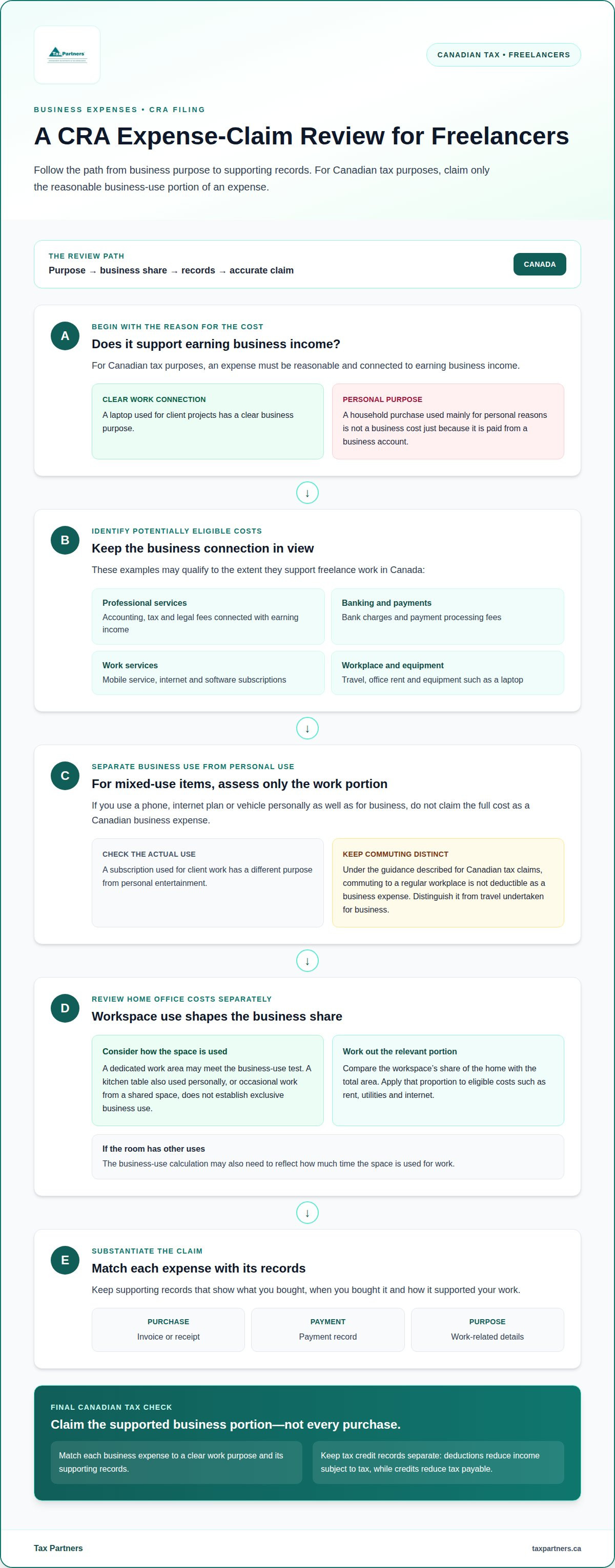
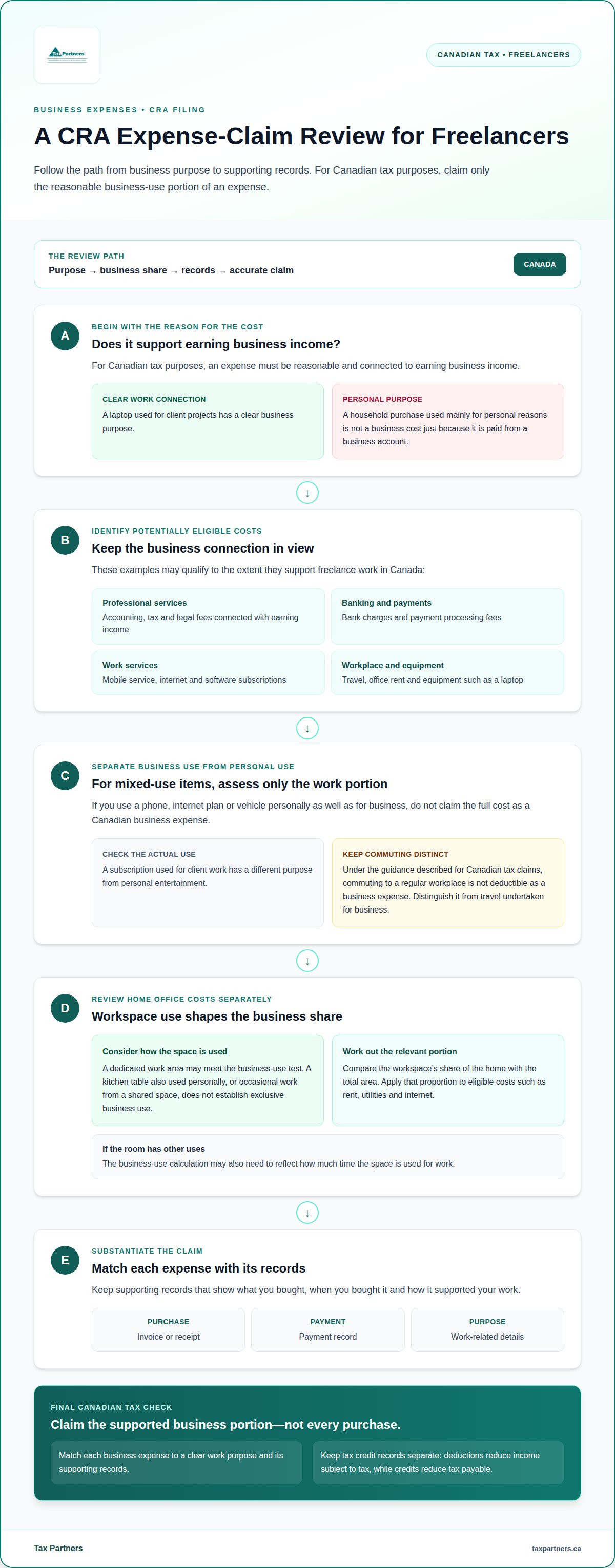
For Canadian tax purposes, a business expense must be reasonable and connected to earning income. Claim only the business-use portion, and keep records showing what you bought, when you bought it, and how it supported your work. A laptop used for client projects, for example, has a clearer business purpose than a household purchase used mainly for personal reasons.
Start with operating expenses directly related to your freelance work. Eligible examples include accounting, tax, and legal fees connected with earning income, as well as bank charges and payment processing fees. Mobile service, internet, travel, software subscriptions, office rent, and equipment such as a laptop may also qualify to the extent they support business activities.
Home office expense claims depend on how the workspace is used for work. A desk in a dedicated work area may meet that test; a kitchen table also used for personal activities may not. Occasional work from a shared space doesn’t establish exclusive business use.
Calculate the home office portion by comparing the workspace’s share of the home with the total area. Apply that proportion to eligible costs such as rent, utilities, and internet. If the room serves other purposes, the business-use calculation may also need to reflect how much time it is used for work.
Freelance designers can assess software subscriptions, internet, mobile bills, and computer equipment using the same business-use principle. Design software used for client deliverables has a direct work connection; a personal streaming subscription doesn’t become a business expense just because it’s paid from a business account. Keep invoices and payment records with the expense details.
Personal spending is a common source of inaccurate claims. Don’t deduct the full cost of a mixed-use phone, internet plan, or vehicle if you also use it personally. Under the guidance described here, commuting to a regular workplace isn’t deductible as a business expense. Distinguish it from travel undertaken for business.
Tax deductions reduce the income subject to tax, while tax credits reduce tax payable. Eligibility depends on the specific credit and your circumstances, so keep credit records separate from business expense receipts. Before filing, match each claim to its supporting document and remove costs without a clear business purpose.
If a home office, mixed-use equipment, or designer expenses make your Canadian tax return difficult to classify, discuss your expense questions with a tax professional. A careful review can help distinguish eligible business costs from personal spending before the return is filed.
3. Separating business and personal finances
A dedicated business account creates a clear trail for freelance income and expenses. Deposit client payments there and pay business bills from it instead of mixing transactions with groceries or household costs. If you use one account for both, record each transaction’s business purpose and keep its receipt with the relevant entry.
Separate records also make it easier to review your business activity. For example, matching a client deposit to its invoice can help identify payments recorded twice or not linked to the right project. Consistent accounting can also reveal personal purchases mistakenly entered as business costs.
For Canadian tax purposes, a sole proprietor reports net business income on their personal return. That income is added to other income and taxed at personal marginal rates. An incorporated business is a separate entity with its own accounting and tax filing responsibilities; money received by the corporation isn’t automatically the owner’s personal income.
An eligible Canadian-controlled private corporation may qualify for a 9% federal small business tax rate on active business income up to C$500,000. That corporate rate isn’t the same as an individual’s income tax rate, and incorporation doesn’t make personal expenses deductible. The corporation’s eligibility and the treatment of money paid to its owner depend on the applicable rules and how the business operates.
For Canadian freelancers, the US Qualified Business Income deduction doesn’t apply to a Canadian tax return. Focus your records on the Canadian business structure you use, and distinguish a sole proprietorship from an incorporated business when organizing income and expenses.
For newcomers to Canada, incorporating can involve considerations beyond bookkeeping, including specific incorporation rules for taxpayers who are neither Canadian citizens nor permanent residents. Before choosing a structure, consider expected income, administrative responsibilities, how you’ll use business funds, and whether the corporation’s tax treatment fits your circumstances.
A practical monthly close keeps records useful: reconcile business account activity, categorize each transaction, attach receipts, and record owner withdrawals separately from operating costs. Accounting software can help organize entries, but categories still need to reflect each purchase’s actual purpose. Keep a clear record when a payment combines personal and business use.
Clear separation helps you see how much cash belongs to business operations and how much you’ve taken out personally. It also gives you a consistent record of account activity for reviewing your books or preparing financial statements. For sole proprietors and incorporated newcomers alike, a regular accounting process can reduce confusion when organizing business records.
4. Estimated quarterly tax payments and safe-harbour amounts
Unlike an employed worker whose employer withholds income tax, a freelancer may need to pay tax instalments during the year. According to Canada Revenue Agency (CRA), you may have to pay tax instalments for next year's taxes if your net tax owing is more than C$3,000 (C$1,800 for Quebec) for 2026 and in either 2025 or 2024.
CRA instalments are payments toward the income tax you expect to owe, rather than a separate tax. If your freelance income changes, keep updated records of income, expenses, and contributions so your tax planning reflects the business’s current position. The C$3,000 threshold applies outside Quebec; the C$1,800 threshold applies in Quebec.
For Canadian freelancers who must make quarterly instalments, the dates are March 15, June 15, September 15, and December 15. Mark each date in your bookkeeping calendar and leave time for payment processing. Missing an instalment can contribute to interest charges, so keep proof of each payment with your tax records.
Self-employed Canadians must file their annual tax return by June 15, while any balance owing is due by April 30. These are separate deadlines: filing by June 15 doesn’t extend the April 30 payment date. Plan for both, even if your final income totals are still being organized when the balance is due.
Freelancers are advised to set aside 25–30% of income for taxes in a dedicated savings account. Treat this as a budgeting guideline, not a calculation of your exact tax bill; income, eligible expenses, and other tax circumstances affect the amount owing. Regular transfers after client payments can help prevent tax funds from being spent on operating costs.
Reliable bookkeeping starts with recording each invoice and matching it to the payment received. Keep receipts for business expenses, note payment dates, and reconcile account activity regularly. If an invoice remains unpaid at month-end, for example, mark it separately from collected income so your cash planning reflects what has actually arrived.
Use a simple monthly routine: update invoices, match deposits, categorize expenses, and record instalment payments. Save receipts and payment confirmations alongside the related bookkeeping entry. This creates a consistent record for preparing your Canadian return and helps identify missing client payments before filing season.
At year-end, compare total income and instalments already paid with your bookkeeping records. If instalments exceed the final tax owing, the difference is handled through the tax return process; if payments fall short, you may need to pay the remaining balance. Tracking each quarter helps you plan for either outcome without confusing instalments with the annual filing deadline.
5. GST/HST registration threshold
In Canada, freelancers generally must register for the Goods and Services Tax/Harmonized Sales Tax (GST/HST) when income exceeds C$30,000 in a single calendar quarter or across four consecutive calendar quarters. This is the small-supplier threshold for registration. Track your revenue regularly, because checking only at tax season can mean noticing the threshold after your business has crossed it.
Keep a running total by calendar quarter, then review the total across each consecutive four-quarter period. For example, a freelancer whose revenue is below C$30,000 in each separate quarter could still exceed the threshold when four consecutive quarters are considered together. An accurate record of invoices and income helps you identify which test applies.
Once registered in Canada, you must charge the applicable GST/HST on invoices and can claim credits for GST/HST paid on business-related expenses. These credits can reduce the net amount of tax you remit. Keep purchase receipts and record the tax charged so your sales and expense figures are organized for GST/HST filings.
The rate depends on the province or territory relevant to the supply. Ontario’s HST rate is 13%; New Brunswick, Newfoundland and Labrador, and Prince Edward Island have a 15% HST rate. Nova Scotia’s HST rate is 14% as of April 1, 2025. Alberta, Yukon, the Northwest Territories, and Nunavut have a 5% GST rate.
Location matters for accuracy. If you work with clients in different provinces, keep invoice details that identify each transaction and the tax charged. Don’t apply one province’s rate to every invoice by habit; organize records so each charge can be reviewed against the relevant place of supply.
For example, a designer approaching C$30,000 in revenue should monitor both the current calendar quarter and the rolling four-quarter total. Keep dated invoices, payment records, and expense receipts together. That record can help show when the threshold was reached and support the GST/HST amounts reported.
GST/HST collected from clients is not the same as income set aside for income tax or retirement savings. Track it separately in your bookkeeping so collected tax doesn’t appear to be spendable business income. A separate account or ledger entry can help distinguish tax collected from operating funds.
Registration affects invoicing, recordkeeping, and expense claims, so plan for these obligations before the threshold becomes a tax-season surprise. If you need help applying Canada’s GST/HST registration rules to your freelance records, speak with a tax professional about GST/HST.
Tax Partners
Tax Partners supports freelancers with Canadian Accounting & Tax Services and Bookkeeping and Payroll Services. These services can help as your freelance activity grows, your records become harder to manage, or you need support preparing Canadian tax filings.
For longer-term decisions, Wealth Management & Financial Planning can connect tax considerations with broader financial goals. The right support depends on what you need, from day-to-day bookkeeping to planning ahead.
For guidance with your Canadian freelance tax or accounting needs, contact Tax Partners to discuss your situation.
Build a steadier tax routine
Freelance work changes, and your tax process should keep pace. A new client, a shift in workload, or a move from solo work to a more formal business structure can change what your records need to capture. Set a recurring time to review your bookkeeping and tax procedures instead of waiting until filing season to discover gaps.
That habit can help prevent common tax filing mistakes for freelancers as your business evolves. It also gives you a clearer foundation for decisions about cash flow, future plans, and the records needed to support your return. If your circumstances have become more complex, professional guidance can help you understand the Canadian tax considerations relevant to you.
Contact Tax Partners to discuss your tax needs and decide on a practical next step. With a consistent process and the right support, you can focus more confidently on building your freelance business.
Frequently Asked Questions
Business Expenses for Freelancers: What Can You Claim?
Canadian freelancers can generally deduct reasonable costs incurred to earn business income. Examples include professional fees, bank charges, payment processing fees, and the business-use portion of software or mobile service. For each claim, connect the expense to a work activity and keep the invoice or receipt with its payment record. This makes it easier to explain why a cost belongs in your business accounts rather than as personal spending.
Can I take the home office deduction if I rent?
Yes, renting doesn’t automatically prevent a Canadian freelancer from claiming eligible home office costs. The workspace must be used regularly and exclusively for business, and the claim should reflect its share of the home. Keep your rental records and a note showing how you calculated the business-use portion. A shared dining table used for personal activities may not meet the exclusive-use condition.
What are some common consequences of improperly filing taxes?
In Canada, an inaccurate or late return can lead to tax owing, interest, or a late-filing penalty. For a late return with an outstanding balance, the penalty described is 5% of the amount owing, plus 1% for each month late. If you filed late within the previous three years, the described penalty rises to 10%, plus 2% for each month late. Correcting records promptly can help address reporting errors.
What are the most common tax mistakes for freelance designers?
Freelance designers can make mistakes by omitting client payments, claiming personal purchases, or recording an entire mixed-use expense as business-related. For example, software used for both personal projects and paid design work should be recorded according to its actual business use. Keep project invoices, payment records, and software receipts together to distinguish client expenses from personal purchases when preparing your return.
What tax responsibilities do freelancers have?
Canadian freelancers must report business income, track eligible expenses, and file the appropriate personal tax return. Depending on their income and circumstances, they may also need to account for self-employed CPP contributions, tax instalments, and GST/HST registration. Reconcile invoices and payments regularly, then review income and tax obligations before filing season. A client information slip doesn’t replace reporting freelance income.
What are the most common tax filing mistakes Canadian freelancers make?
Common tax filing mistakes for freelancers in Canada include leaving out payments without information slips, misclassifying personal spending, overlooking CPP, and missing an applicable instalment or GST/HST obligation. These errors often start with incomplete records rather than complicated calculations. Before filing, compare your client invoices, deposits, expense entries, and tax payments. Resolve any differences instead of assuming one source captures everything.
Which business expenses can Canadian freelancers deduct, and what documentation is required?
Eligible costs can include professional fees, bank charges, payment processing fees, and business-related portions of internet, travel, software, or equipment expenses. Keep invoices, receipts, payment evidence, and client agreements that help explain each business purpose. For a mixed-use item, record how you determined the work-related share. For example, allocate a mobile bill used for both client calls and personal use on a supportable basis.
How should freelancers calculate and claim the business-use portion of home office expenses in Canada?
For a qualifying Canadian home office, calculate the workspace’s share of the home and apply that proportion to eligible costs such as rent, utilities, and internet. Keep measurements or another basis for the calculation with the related bills. The workspace must be used regularly and exclusively for business. Don’t claim the full household cost when only part of the home supports your freelance work.

Article by
Mahad Mohamed
Mahad Mohamed is an accountant and the CEO of Tax Partners, with over 26+ years of Canadian and international tax and accounting experience. His expertise includes corporate reorganization, cross-border tax structuring (Canada & US), tax disputes, CRA audits, and tax planning for small owner-managed private corporations. Most recently, Mahad is a pioneer in Canadian crypto taxation and founded Block3 Finance.
Previously, Mahad worked for the Canada Revenue Agency (CRA), Big4 accounting firms, and served as a Rulings Officer for the Federal Tax Authority of the UAE before acquiring Tax Partners in 2014.
Tax Partners has 44 full-time accountants and over 18,400+ clients.
Disclaimer
This article provides general information only and is current as of its publication date. It has not been updated and may be out of date. It does not constitute legal advice and should not be relied upon as such. Every tax situation is unique and may differ from the examples discussed in this article. If you have specific questions, you should seek the advice of our accountants for your unique circumstances. Book a FREE Initial Consultation Today!
Frequently Asked Questions
Business Expenses for Freelancers: What Can You Claim?
Canadian freelancers can generally deduct reasonable costs incurred to earn business income. Examples include professional fees, bank charges, payment processing fees, and the business-use portion of software or mobile service. For each claim, connect the expense to a work activity and keep the invoice or receipt with its payment record. This makes it easier to explain why a cost belongs in your business accounts rather than as personal spending.
Can I take the home office deduction if I rent?
Yes, renting doesn’t automatically prevent a Canadian freelancer from claiming eligible home office costs. The workspace must be used regularly and exclusively for business, and the claim should reflect its share of the home. Keep your rental records and a note showing how you calculated the business-use portion. A shared dining table used for personal activities may not meet the exclusive-use condition.
What are some common consequences of improperly filing taxes?
In Canada, an inaccurate or late return can lead to tax owing, interest, or a late-filing penalty. For a late return with an outstanding balance, the penalty described is 5% of the amount owing, plus 1% for each month late. If you filed late within the previous three years, the described penalty rises to 10%, plus 2% for each month late. Correcting records promptly can help address reporting errors.
What are the most common tax mistakes for freelance designers?
Freelance designers can make mistakes by omitting client payments, claiming personal purchases, or recording an entire mixed-use expense as business-related. For example, software used for both personal projects and paid design work should be recorded according to its actual business use. Keep project invoices, payment records, and software receipts together to distinguish client expenses from personal purchases when preparing your return.
What tax responsibilities do freelancers have?
Canadian freelancers must report business income, track eligible expenses, and file the appropriate personal tax return. Depending on their income and circumstances, they may also need to account for self-employed CPP contributions, tax instalments, and GST/HST registration. Reconcile invoices and payments regularly, then review income and tax obligations before filing season. A client information slip doesn’t replace reporting freelance income.
What are the most common tax filing mistakes Canadian freelancers make?
Common tax filing mistakes for freelancers in Canada include leaving out payments without information slips, misclassifying personal spending, overlooking CPP, and missing an applicable instalment or GST/HST obligation. These errors often start with incomplete records rather than complicated calculations. Before filing, compare your client invoices, deposits, expense entries, and tax payments. Resolve any differences instead of assuming one source captures everything.
Which business expenses can Canadian freelancers deduct, and what documentation is required?
Eligible costs can include professional fees, bank charges, payment processing fees, and business-related portions of internet, travel, software, or equipment expenses. Keep invoices, receipts, payment evidence, and client agreements that help explain each business purpose. For a mixed-use item, record how you determined the work-related share. For example, allocate a mobile bill used for both client calls and personal use on a supportable basis.
How should freelancers calculate and claim the business-use portion of home office expenses in Canada?
For a qualifying Canadian home office, calculate the workspace’s share of the home and apply that proportion to eligible costs such as rent, utilities, and internet. Keep measurements or another basis for the calculation with the related bills. The workspace must be used regularly and exclusively for business. Don’t claim the full household cost when only part of the home supports your freelance work.