US Citizen Selling Canadian Property Tax Guide 2026

Could you afford to lose 25% of your home's gross sale price to the government the moment the deal closes? For many, the reality of the US citizen selling Canadian property tax process is a sudden, significant withholding by the Canada Revenue Agency (CRA) that can disrupt even the best financial plans.
We realize that managing dual-country compliance feels like an overwhelming burden of paperwork and potential penalties. It's natural to feel protective of your hard-earned equity when faced with complex regulations from both the IRS and the CRA.
This guide will empower you to manage these requirements with precision and foresight. You'll learn how to minimize withholding at the source under CRA rules and how to successfully claim Foreign Tax Credits on your IRS return to prevent double taxation.
Key Takeaways
- Discover how to harmonize your reporting obligations under IRS rules and CRA regulations to ensure total compliance.
- Learn the process for obtaining a Section 116 Certificate of Compliance to minimize the standard 25% withholding tax for CRA filers.
- Understand the specific documentation required for a US citizen selling Canadian property tax filing to avoid costly IRS penalties.
- Leverage the Canada-US Tax Treaty and its tie-breaker rules to protect your equity from being taxed twice by different jurisdictions.
- Gain professional foresight into the disposition process to realize a more favourable financial outcome for your cross-border assets.
Understanding the Tax Impact of Selling Canadian Real Estate
Cross-border tax planning is the essential harmonization of two distinct legal systems that often operate with conflicting priorities. For a US citizen selling Canadian property tax obligations are not merely a matter of local filing. This process requires a sophisticated alignment of Internal Revenue Service (IRS) requirements with Canada Revenue Agency (CRA) regulations to protect your financial interests.
Tax residency serves as the legal status that determines which country holds the primary right to tax your income. It is a nuanced designation based on your physical presence and your economic ties to a specific jurisdiction. Understanding this status is the first step in managing the sale of your assets effectively.
When you dispose of real estate, you realize a capital gain, which is the profit calculated from the difference between your purchase price and the sale price. In 2026, both the US and Canada will seek to tax this profit, though they apply different rates and inclusion rules. Tax Partners acts as a proactive guardian during these transactions, ensuring that your equity remains protected from avoidable administrative losses.
The Role of Tax Residency for US Persons
The CRA determines residency for tax purposes using the Significant Closest Connection test. This evaluation examines your primary residential ties, such as where your home, spouse, or dependants are located. It also considers secondary ties like Canadian bank accounts, driver's licences, and health insurance.
Under IRS rules, the Substantial Presence Test is often used to determine residency for those living in the United States. However, US citizens face a unique challenge because they are taxed on their worldwide income regardless of where they reside globally. This reporting requirement is supported by the FATCA Agreement Explained, which ensures the IRS receives information about Canadian financial assets held by US persons.
Why Standard Domestic Planning Fails
Common Canadian tax strategies often fail when applied to US persons because the IRS may not recognize specific Canadian exemptions. For instance, a strategy designed to reduce tax for CRA filers could inadvertently trigger a higher tax bracket or a penalty under IRS rules. Relying on local advice that ignores the cross-border element is a significant risk to your wealth.
The timing of your sale also plays a vital role in your overall tax liability. A gain realized late in the year might interact differently with your other income sources in each country. You need a coordinated, bespoke approach to ensure you realize maximum savings while remaining ethically steadfast in your dual-country filings.
Obligations Under IRS Rules for US Persons
Your citizenship creates a lifelong bond with the Internal Revenue Service (IRS), regardless of where your assets are located. For any US citizen selling Canadian property tax compliance starts with a clear understanding of IRS Form 1040. This obligation is entirely separate from any filings you make with the Canada Revenue Agency (CRA) and applies specifically to your status as a US person.
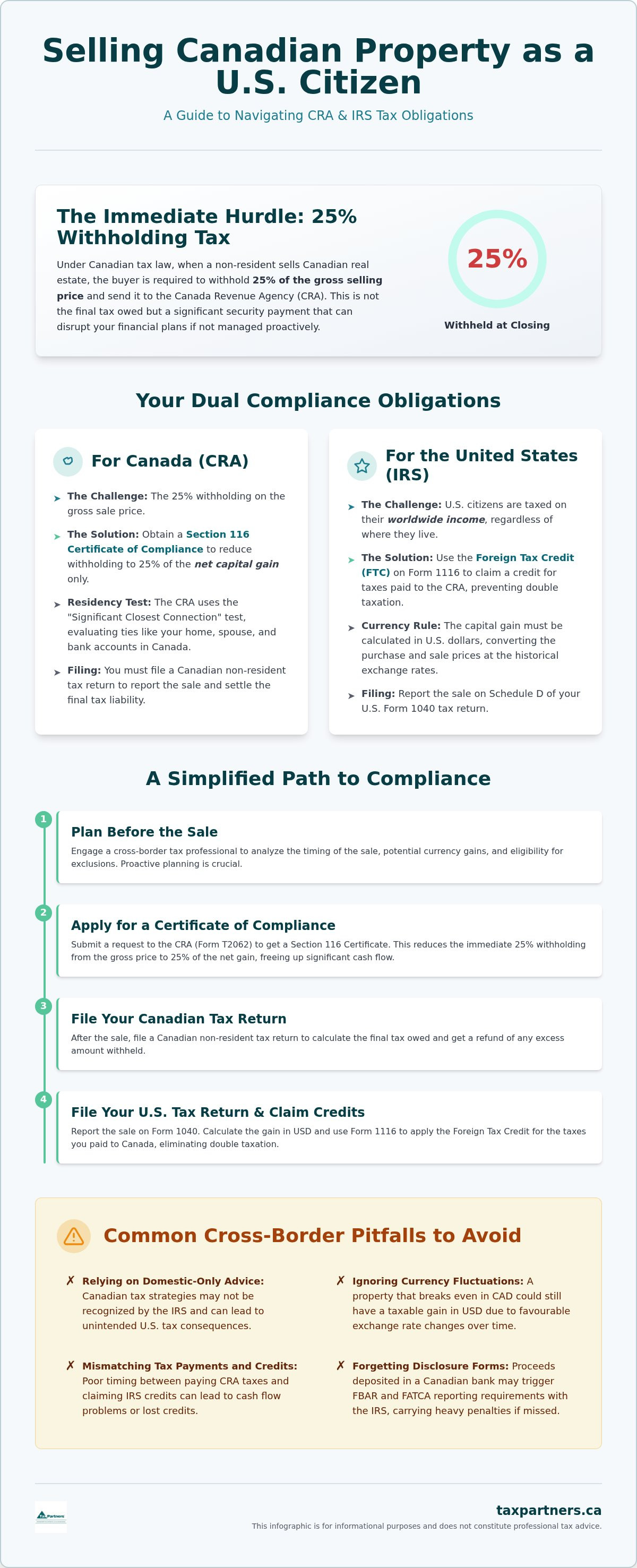
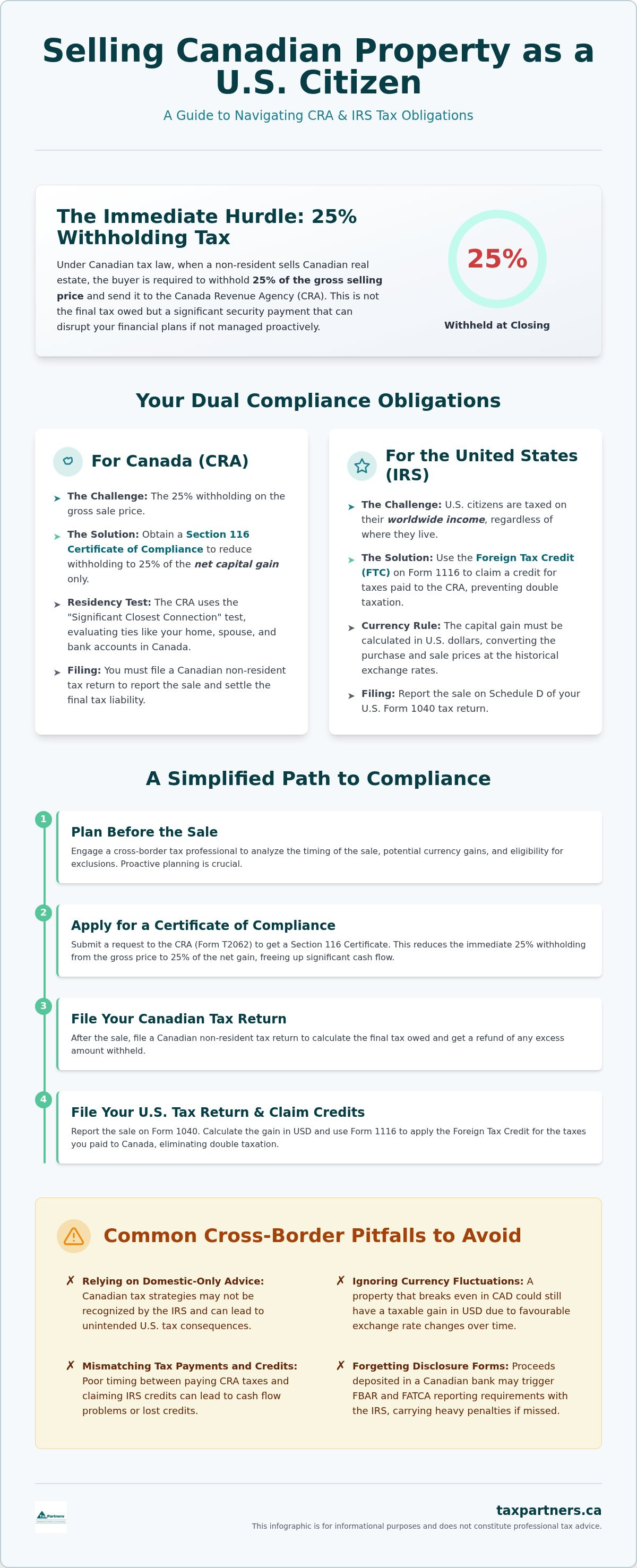
One critical factor often overlooked is currency translation. The IRS requires you to calculate your capital gain in US dollars. This means you must convert the original purchase price using the exchange rate from the date of acquisition and the sale price using the rate from the date of disposition. Because exchange rates fluctuate, you might realize a taxable gain for IRS purposes even if the property value remained stagnant in Canadian dollars. We recommend that you visit the official IRS website to confirm the current dollar thresholds for reporting, as these figures can change annually.
Filing Form 1040 and Capital Gains Reporting
You report the disposition of your Canadian real estate on Schedule D of Form 1040. This filing allows the IRS to assess the applicable tax rate based on your total worldwide income. It's helpful to review the IRS Rules on Selling a Home to determine if you qualify for any primary residence exclusions. These exclusions can apply to foreign properties under specific conditions, potentially shielding a portion of your gain from US taxation. Our team specializes in US tax compliance and can help you navigate these complex forms.
To prevent double taxation, you can utilize the Foreign Tax Credit (FTC). This mechanism allows you to claim a credit on your US return for the taxes you've already paid to the CRA. Managing this credit requires precision to ensure the timing of your payments aligns with IRS filing deadlines. A mismatch in timing can lead to temporary cash flow issues or lost credits.
FBAR and FATCA Disclosure Requirements
If the proceeds from your property sale are deposited into a Canadian bank account, you may trigger additional reporting requirements. The Foreign Bank Account Report (FBAR) is mandatory if the total value of your foreign accounts exceeds US $10,000 at any point during the year. This is a disclosure of account details rather than a direct tax, but the penalties for non-disclosure are severe.
Similarly, the Foreign Account Tax Compliance Act (FATCA) requires you to report specific foreign financial assets if they exceed certain thresholds. These rules ensure transparency between international financial institutions and the US government. If you've fallen behind on these disclosures, the IRS streamlined procedure for US expats offers a path to catch up without facing heavy penalties. We can help you navigate these requirements to ensure your financial transition is smooth and secure. Connect with our cross-border experts to review your specific situation.
Requirements for CRA Filers Selling Canadian Assets
Navigating the Canadian side of your transaction requires a deep understanding of the rules enforced by the Canada Revenue Agency (CRA). When a non-resident disposes of real estate, the CRA mandates a specific withholding process under Section 116 of the Income Tax Act. This rule serves as a safeguard to ensure taxes are paid before proceeds leave the country. Typically, the purchaser's lawyer must withhold 25% of the gross sale price and remit it directly to the CRA. For depreciable property, such as a rental unit where you've previously claimed capital cost allowance, this withholding can increase to 50%.
A Certificate of Compliance is the primary tool used to manage your cash flow during the sale. By applying for this certificate, you provide the CRA with proof of the property's adjusted cost base, which represents the original purchase price plus any eligible capital improvements. Once the CRA reviews your application and receives the necessary tax payment on the actual gain, they issue the certificate. This allows the lawyer to release the remaining funds to you. You can find comprehensive details on these procedures in the CRA Guide for Non-Residents.
Obtaining the certificate is a vital step, but it doesn't end your obligations for CRA filers. You're still required to file a final Canadian income tax return by April 30 of the year following the sale. This return allows you to report the final gain or loss and claim a refund if the amount withheld at the source exceeded your actual tax liability. For any US citizen selling Canadian property tax management must be viewed as a multi-stage process that extends well beyond the closing date.
The Underused Housing Tax (UHT) for Non-Residents
The Underused Housing Tax is a 1% federal tax on the value of residential property in Canada considered vacant or underused. While many owners may qualify for an exemption, the CRA still requires non-residents to file an annual UHT return for each property they own. Failing to file these disclosures by the annual deadline can result in significant penalties, even if you owe no tax. We act as a proactive guardian to ensure these secondary filings don't jeopardize your financial outcome.
Canadian Residency and Deemed Disposition
If you were once a resident of Canada, you must consider the rule of deemed disposition. This regulation treats you as having sold your property at fair market value the moment you cease to be a Canadian resident. This can trigger a "Departure Tax" even if you haven't actually sold the asset yet. Managing these transitions requires a coordinated approach to Tax in Canada to ensure you aren't hit with unexpected bills when you eventually decide to sell. Our team provides the ethical steadfastness needed to navigate these complex residency shifts.
Utilizing the Canada-US Tax Treaty to Protect Wealth
The Canada-United States Tax Convention acts as a vital shield for your wealth. It's a bilateral agreement designed to ensure that the same income isn't taxed by both jurisdictions. For any US citizen selling Canadian property tax relief is found within these treaty provisions. However, you must realize that treaty benefits aren't granted automatically. You must explicitly claim them through specific disclosures and forms when filing your returns with the IRS and the CRA.
Tie-breaker rules within the treaty provide a methodical way to resolve residency disputes. If both countries claim you as a tax resident, these rules prioritize factors like the location of your permanent home or your centre of vital interests. This clarity prevents you from being caught in a jurisdictional tug-of-war. Our global tax advisory services ensure these rules are applied to your benefit, maintaining the integrity of your cross-border strategy.
Mechanisms for Avoiding Double Taxation
The Foreign Tax Credit (FTC) is the most powerful tool for preventing double taxation on real estate gains. It functions as a dollar-for-dollar reduction of your US tax liability for the taxes you've already paid to the CRA. To claim the credit, you must provide the IRS with proof of your Canadian tax assessment and payment. This requires careful coordination of your filing timelines in both countries.
| Income Type | Primary Taxing Jurisdiction | Treaty Treatment |
|---|---|---|
| Real Estate Gains | Canada (Source) | Taxed by CRA; FTC claimed on IRS return |
| Rental Income | Canada (Source) | Withholding for CRA filers; credit in US |
| Interest Income | US (Residency) | Reduced withholding under treaty rules |
Strategic Asset Structuring
Principal residence exemptions are treated differently under IRS rules and CRA regulations. While Canada may offer a full exemption for a qualifying home, the IRS limits the exclusion to specific dollar thresholds based on your filing status. This gap can create a surprising US tax bill even if the sale is tax-free in Canada. We provide the foresight needed to manage these discrepancies before they impact your net proceeds.
Holding Canadian real estate through a US Limited Liability Company (LLC) can lead to complex and punitive tax consequences. The CRA often views an LLC as a corporation, which can result in the loss of personal tax credits and trigger higher corporate tax rates. Harmonized estate planning is essential to ensure your assets are protected for future generations without creating a tax trap. Speak with our cross-border specialists to review your current asset structure.
Navigating the Disposition Process with Strategic Foresight
Proactive management of your real estate transaction is the only way to ensure your equity remains intact. For a US citizen selling Canadian property tax planning shouldn't begin at the closing table. It starts months earlier with a comprehensive assessment of your cross-border liabilities. Tax Partners provides the bespoke advisory needed to help you keep more of your earnings through meticulous preparation and foresight.
Gathering documentation early is the most effective way to avoid the long wait times often associated with government processing. In 2026, the CRA continues to experience high volumes, making it essential to have your original purchase documents, capital improvement receipts, and residency proof ready. This preparation allows us to act as your proactive guardian, shielding you from the stress of frozen funds and administrative delays.
A Roadmap for a Successful Property Sale
- Step 1: Pre-sale tax exposure analysis. We estimate your potential liabilities under both IRS rules and CRA regulations before you even list the property. This ensures you aren't surprised by the cash flow impact of withholding taxes.
- Step 2: Apply for the CRA Certificate of Compliance. You should submit this application immediately after a sale agreement is signed. Under CRA rules, you have 10 days from the disposition to notify the agency, but filing early is the key to faster fund release.
- Step 3: File final income tax returns. In the year following the sale, you must file a 1040 with the IRS and a T1 return for CRA filers. This final step reconciles all withheld funds and allows you to claim any eligible refunds or credits.
How Professional Advisory Secures Your Future
A cross-border CPA firm provides more than just tax preparation; they offer a steady hand at the helm during a complex international transaction. We ensure that every deadline for the IRS and the CRA is met with precision, preventing costly penalties for non-disclosure. Relying on an expert mentor allows you to focus on your next chapter while we handle the regulatory heavy lifting.
Choosing a long-term partnership with an advisor who understands the nuances of both systems is an investment in your financial security. We've helped thousands of clients navigate these waters, saving millions in avoidable taxes. Professional guidance turns what could be a chaotic event into a controlled, predictable process that secures your financial legacy. Realize your goals with the confidence that your cross-border assets are in expert hands.
Secure Your Cross-Border Success
Successfully managing US citizen selling Canadian property tax requirements demands precision and early preparation. By aligning your reporting for CRA filers with your obligations under IRS rules, you protect the equity you've built over years of ownership.
Leveraging the Canada-US Tax Treaty is the most effective way to ensure your income isn't taxed twice. With over 40 years of cross-border tax expertise, we provide the A+ rated professional advisory you need to navigate these dual-country complexities.
Our team offers comprehensive IRS and CRA compliance support to ensure every deadline is met with ethical steadfastness. Secure your cross-border financial future with Tax Partners; contact our specialists today.
You've worked hard for your investment, and we're here to help you protect it every step of the way.
Frequently Asked Questions
Do I have to file taxes in both Canada and the US if I sell my property?
Yes, you're required to file tax returns in both countries. For CRA filers, a Canadian return is necessary to report the disposition of taxable Canadian property. Under IRS rules, US citizens must report their worldwide income, which includes the gain from a Canadian real estate sale, on their US federal return.
What is the CRA withholding tax rate for non-resident property sellers in 2026?
The standard withholding rate for non-residents is 25% of the gross sale price. This rate increases to 50% for depreciable property, such as a rental unit, under CRA rules. These funds are typically held in escrow by the purchaser's lawyer until the CRA issues a Certificate of Compliance.
How do I avoid paying capital gains tax twice on the same property sale?
You prevent double taxation by claiming the Foreign Tax Credit on your US federal income tax return. This credit allows you to reduce your IRS liability by the amount of tax already paid to the CRA. Precise documentation is required to ensure the US citizen selling Canadian property tax credit aligns with the correct reporting year.
What is a Certificate of Compliance and why do I need one from the CRA?
A Certificate of Compliance is an official document from the CRA confirming that the appropriate tax on a property gain has been secured. You need this certificate to reduce the 25% withholding tax at the source. Without it, the purchaser is legally required to remit the full withholding amount directly to the Canadian government.
Does the IRS recognize the Canadian Principal Residence Exemption?
No, the IRS does not recognize the unlimited Canadian exemption; it applies its own specific thresholds. Under IRS rules, you can exclude up to $250,000 of gain for single filers or $500,000 for married couples filing jointly. You must meet the ownership and use tests, which generally require living in the home for two of the last five years.
What are the penalties for not reporting a Canadian property sale to the IRS?
Failing to report the sale can result in substantial penalties, interest, and the loss of the Foreign Tax Credit. If the sale proceeds are held in a Canadian account, you may also face penalties for failing to file an FBAR or FATCA disclosure. The IRS enforces these rules strictly to ensure transparency of foreign financial assets.
How long does it take for the CRA to process a Section 116 application?
Processing times for a Section 116 application can be lengthy, often stretching over several months. Some industry professionals report wait times of six months or more in 2026. We recommend submitting your application immediately after the sale agreement is signed to minimize the time your funds are held by the CRA.
Do I need to file an Underused Housing Tax (UHT) return when I sell my property?
Yes, most non-resident owners are required to file an annual UHT return even if they qualify for an exemption from the 1% tax. The CRA requires this filing to confirm the property was not vacant or underused during the year. For a US citizen selling Canadian property tax compliance includes ensuring all UHT obligations are met up to the date of disposition.

Article by
Mahad Mohamed
Mahad Mohamed is an accountant and the CEO of Tax Partners, with over 26+ years of Canadian and international tax and accounting experience. His expertise includes corporate reorganization, cross-border tax structuring (Canada & US), tax disputes, CRA audits, and tax planning for small owner-managed private corporations. Most recently, Mahad is a pioneer in Canadian crypto taxation and founded Block3 Finance.
Previously, Mahad worked for the Canada Revenue Agency (CRA), Big4 accounting firms, and served as a Rulings Officer for the Federal Tax Authority of the UAE before acquiring Tax Partners in 2014.
Tax Partners has 44 full-time accountants and over 18,400+ clients.
Disclaimer
This article provides general information only and is current as of its publication date. It has not been updated and may be out of date. It does not constitute legal advice and should not be relied upon as such. Every tax situation is unique and may differ from the examples discussed in this article. If you have specific questions, you should seek the advice of our accountants for your unique circumstances. Book a FREE Initial Consultation Today!
Frequently Asked Questions
Do I have to file taxes in both Canada and the US if I sell my property?
Yes, you're required to file tax returns in both countries. For CRA filers, a Canadian return is necessary to report the disposition of taxable Canadian property. Under IRS rules, US citizens must report their worldwide income, which includes the gain from a Canadian real estate sale, on their US federal return.
What is the CRA withholding tax rate for non-resident property sellers in 2026?
The standard withholding rate for non-residents is 25% of the gross sale price. This rate increases to 50% for depreciable property, such as a rental unit, under CRA rules. These funds are typically held in escrow by the purchaser's lawyer until the CRA issues a Certificate of Compliance.
How do I avoid paying capital gains tax twice on the same property sale?
You prevent double taxation by claiming the Foreign Tax Credit on your US federal income tax return. This credit allows you to reduce your IRS liability by the amount of tax already paid to the CRA. Precise documentation is required to ensure the US citizen selling Canadian property tax credit aligns with the correct reporting year.
What is a Certificate of Compliance and why do I need one from the CRA?
A Certificate of Compliance is an official document from the CRA confirming that the appropriate tax on a property gain has been secured. You need this certificate to reduce the 25% withholding tax at the source. Without it, the purchaser is legally required to remit the full withholding amount directly to the Canadian government.
Does the IRS recognize the Canadian Principal Residence Exemption?
No, the IRS does not recognize the unlimited Canadian exemption; it applies its own specific thresholds. Under IRS rules, you can exclude up to $250,000 of gain for single filers or $500,000 for married couples filing jointly. You must meet the ownership and use tests, which generally require living in the home for two of the last five years.
What are the penalties for not reporting a Canadian property sale to the IRS?
Failing to report the sale can result in substantial penalties, interest, and the loss of the Foreign Tax Credit. If the sale proceeds are held in a Canadian account, you may also face penalties for failing to file an FBAR or FATCA disclosure. The IRS enforces these rules strictly to ensure transparency of foreign financial assets.
How long does it take for the CRA to process a Section 116 application?
Processing times for a Section 116 application can be lengthy, often stretching over several months. Some industry professionals report wait times of six months or more in 2026. We recommend submitting your application immediately after the sale agreement is signed to minimize the time your funds are held by the CRA.
Do I need to file an Underused Housing Tax (UHT) return when I sell my property?
Yes, most non-resident owners are required to file an annual UHT return even if they qualify for an exemption from the 1% tax. The CRA requires this filing to confirm the property was not vacant or underused during the year. For a US citizen selling Canadian property tax compliance includes ensuring all UHT obligations are met up to the date of disposition.